mRNA Vaccine Platform
mRNA Vaccine Platform — an illustrated inventions story, set in Global. 10 illustrated pages, free to read on Wonder Inventions.
Page 1

Before the advent of mRNA technology, humanity faced a perennial challenge in confronting emerging pathogens: time. Traditional vaccine development, often spanning years, proved agonizingly slow against rapidly spreading diseases. This inherent delay left populations vulnerable, transforming local outbreaks into global pandemics. Dr. Katalin Karikó and Dr. Drew Weissman, through decades of relentless research, laid the groundwork for a radical new approach to vaccine development, one that would redefine medical preparedness and response.
Page 2

The limitations of conventional vaccinology were stark. Developing vaccines historically involved growing vast quantities of a virus, inactivating or attenuating it, and then purifying the components for injection. This process was not only time-consuming but also rigid, making rapid adaptation to new viral strains exceedingly difficult. Each new threat demanded a fresh, lengthy development cycle, leaving a critical window open for widespread infection and devastating societal impact.
Page 3

At the University of Pennsylvania in the early 1990s, Dr. Katalin Karikó, a biochemist with dark, pulled-back hair and a focused expression, championed a seemingly radical idea: using messenger RNA (mRNA) itself as a therapeutic tool. However, cellular machinery, evolved to defend against viral RNA, treated synthetic mRNA as an invader, triggering a potent, counterproductive inflammatory response and rapid degradation. This fundamental biological hurdle meant Karikó faced profound skepticism and persistent funding challenges, yet her conviction in mRNA's potential remained unshakeable.
Page 4

The path forward required overcoming two formidable obstacles: mRNA's inherent instability and its immunogenicity. In 1997, Dr. Karikó joined forces with Dr. Drew Weissman, an immunologist at Penn. Together, they embarked on a series of painstaking experiments, repeatedly injecting synthetic mRNA into cells and observing the undesired inflammatory reactions and the rapid disappearance of the fragile genetic material. Their work was a testament to scientific persistence, battling against the very mechanisms cells used to protect themselves from foreign RNA.
"Dr. Weissman, a man with short grey hair and a thoughtful expression, adjusted his glasses, examining the data. 'The cellular defense mechanisms are incredibly potent, Katalin. Every time, the inflammation is overwhelming, and the mRNA barely lasts hours.' Dr. Karikó, her brow furrowed in concentration, replied, 'But the potential is too vast to abandon, Drew. There must be a way to make it 'invisible' to the immune system, to trick the cells into accepting it as their own.'"
Page 5

After years of frustration, the pivotal breakthrough arrived in 2005. Karikó and Weissman discovered that by modifying one of mRNA's four basic nucleoside building blocks, uridine, into pseudouridine, they could trick the immune system. This subtle chemical alteration prevented the unwanted inflammatory response, allowing the modified mRNA to persist longer within cells and produce significantly more protein. It was a discovery that fundamentally changed the trajectory of mRNA research, rendering the fragile molecule effective and tolerable for therapeutic use. As Dr. Karikó once observed, paraphrasing Thomas Edison's famous spirit of perseverance, 'We hadn't failed; we had simply found thousands of ways that wouldn't work, which only brought us closer to the one that would.'
Page 6

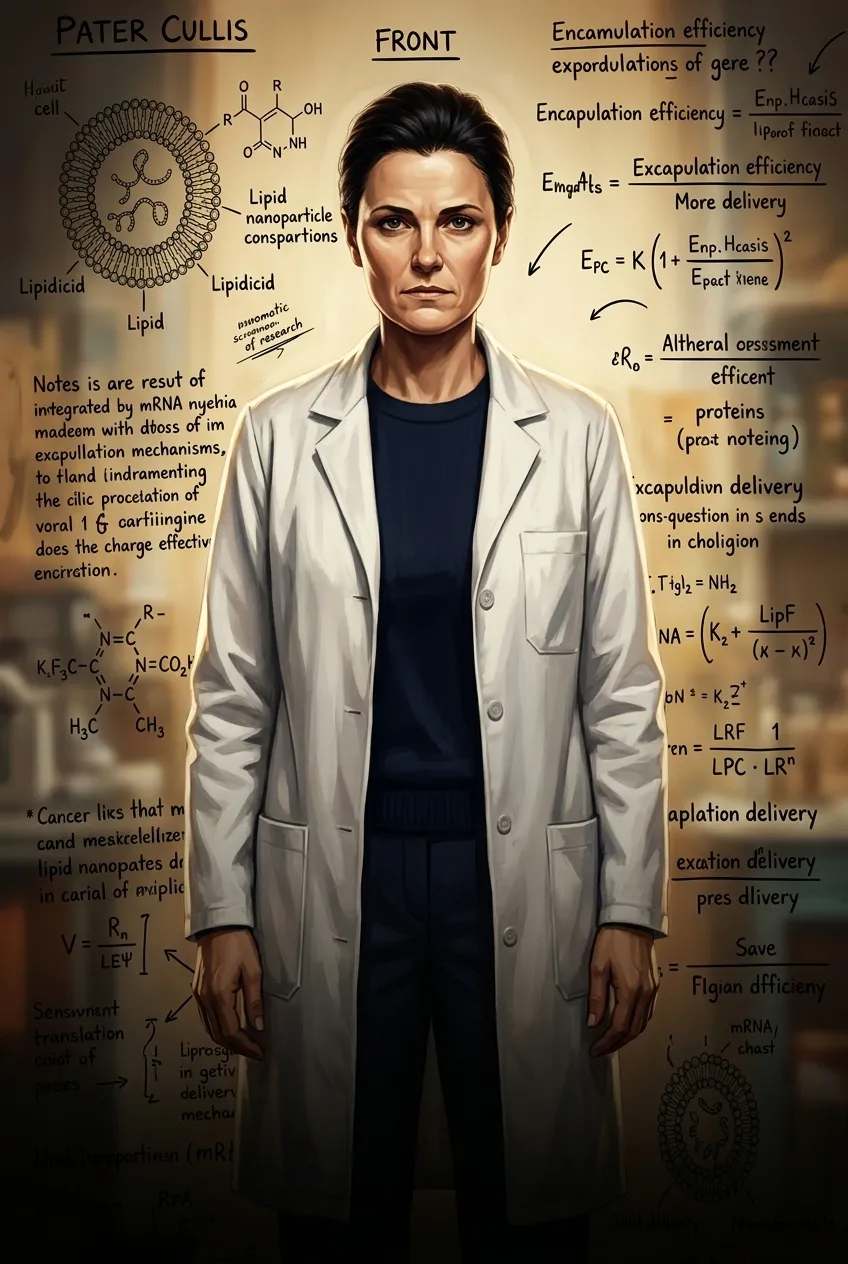
Even with the modified nucleosides, efficient and safe delivery of mRNA into target cells remained a formidable challenge. Naked mRNA is inherently unstable and vulnerable to degradation by ubiquitous enzymes in the body. The solution emerged from decades of work by researchers like Dr. Pieter Cullis and Dr. Thomas Madden on Lipid Nanoparticles (LNPs). These microscopic fatty bubbles provided the perfect protective casing, shielding the delicate mRNA from degradation and facilitating its entry into cells. This technological advancement was the second critical pillar of the mRNA platform.
"Dr. Cullis, a man with a focused expression and neatly combed gray hair, wearing a white lab coat, carefully adjusted a microfluidic device. 'The key is precision engineering,' he explained to his team, his voice calm and authoritative. 'These nanoparticles must be stable enough to protect the mRNA, yet dynamic enough to release their payload efficiently inside the cell. It's a delicate balance of lipid chemistry and physical forces.'"
Page 7
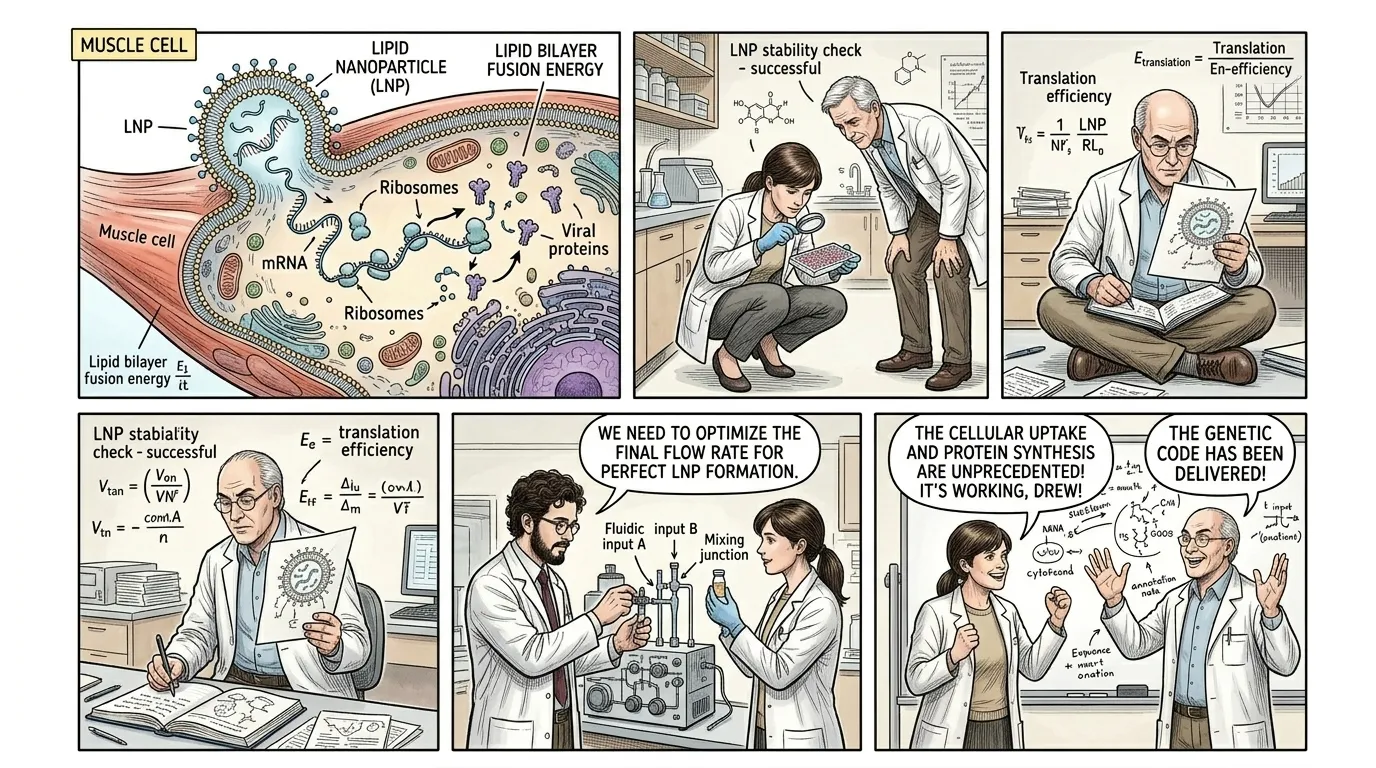
With lipid nanoparticle delivery perfected, the mRNA vaccine platform's elegant mechanism could fully unfold. Once injected into muscle, the LNPs fuse with the membranes of nearby cells, releasing their precious mRNA cargo into the cytoplasm. The cell's own ribosomes, the protein-making factories, then 'read' the mRNA instructions. These instructions direct the ribosomes to synthesize a specific, harmless viral protein—for instance, the spike protein of SARS-CoV-2. This protein, though not part of an actual virus, is recognized as foreign by the immune system.
Page 8

Once produced, these harmless viral proteins are either displayed on the cell's surface or released, acting as flags for the immune system. This triggers a powerful and targeted immune response, generating specific antibodies that can neutralize the real virus, and activating T-cells to destroy infected cells. Crucially, the mRNA itself is ephemeral; it performs its task and is naturally degraded by the body's enzymes within a few days, leaving no permanent genetic footprint. It never enters the cell nucleus, ensuring it cannot alter host DNA.
Page 9

For decades, the mRNA platform remained largely theoretical or confined to specialized research, a 'sleeping giant' of biomedical potential. Its true capability was unleashed by the urgent, unprecedented demands of the COVID-19 pandemic in 2020. The platform's inherent adaptability allowed scientists to rapidly design and produce vaccines based on the novel coronavirus's genetic sequence within days, not years. This agility led to the fastest vaccine development and deployment in human history, fundamentally altering the trajectory of the pandemic and saving countless lives worldwide.
Page 10

The mRNA Vaccine Platform represents more than just a triumph over a single pandemic; it signifies a profound paradigm shift in medicine. Its modularity, speed, and precision have opened vast new frontiers, promising to revolutionize not only infectious disease prevention but also personalized cancer therapies, treatments for autoimmune conditions, and even gene editing. The ingenuity of Karikó, Weissman, Cullis, Madden, and their collaborators has provided humanity with an agile, powerful tool to confront future biological challenges, reshaping the landscape of global health and therapeutics for generations to come.
About this story
- Location: Global
- Audience: general readers
Questions and answers
Read Wonder Inventions on your phone
Wonder Inventions is available on Android. Get Wonder Inventions on Google Play.