News Wire Service
News Wire Service — an illustrated inventions story, set in Global. 10 illustrated pages, free to read on Wonder Inventions.
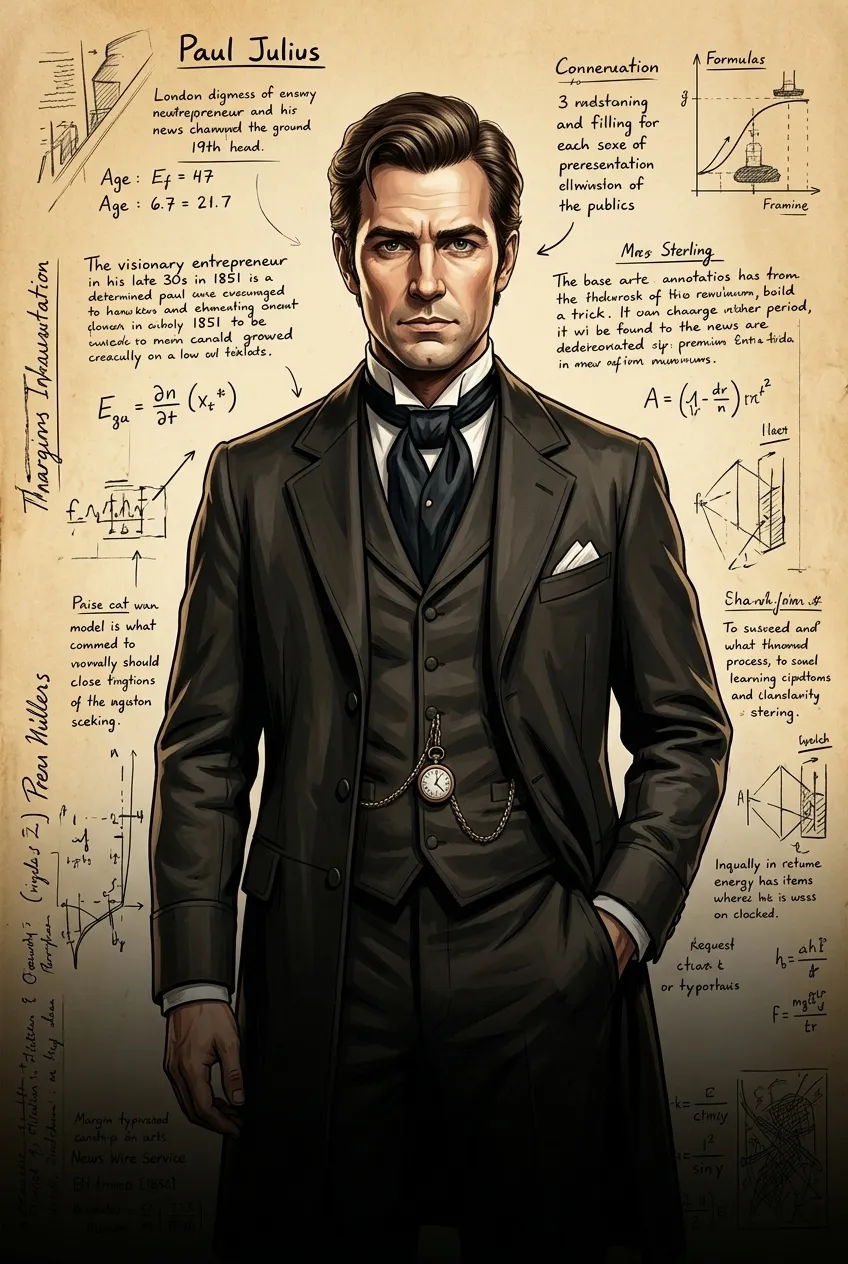
Page 1
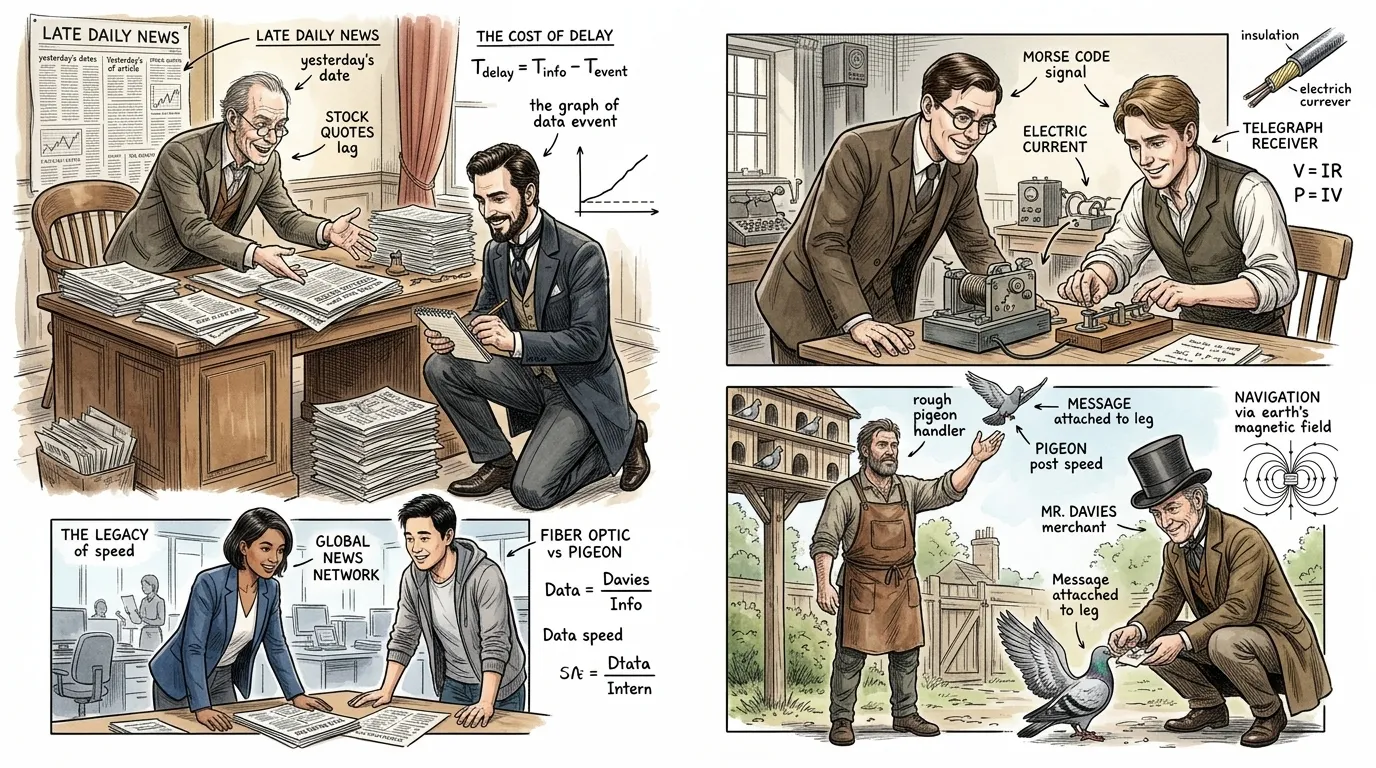
The mid-19th century buzzed with the promise of invention, yet the world remained fragmented. News traveled at the pace of trains or ships, leaving communities isolated from critical global events. In London, 1851, the need for real-time information was a tangible pressure, felt keenly by entrepreneurs like Paul Julius Reuter.
""Mr. Reuter, another day, another dispatch delayed!" exclaimed a newspaper editor, gesturing to a stack of yesterday's papers. "Our readers demand immediacy, yet we are beholden to the whims of sea and rail. How can we truly inform them?" Paul Julius Reuter, ever focused, nodded gravely. "Indeed, Mr. Sterling. The gap between event and report is a chasm we must bridge. As Francis Bacon once observed, 'Knowledge itself is power.' To truly empower our society, we must deliver that knowledge with unprecedented speed and accuracy.""
Page 2
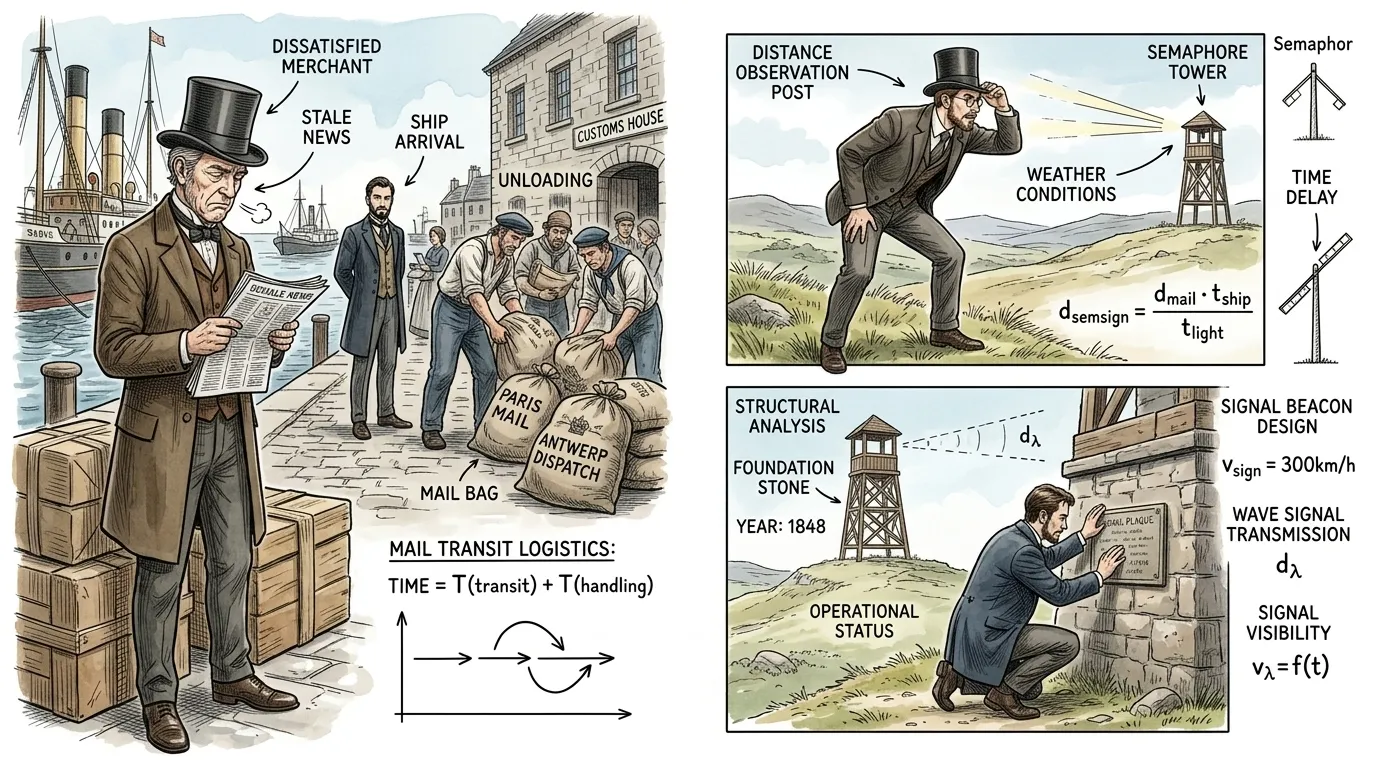
Before telegraph lines spanned continents, the relay of news was a painstaking affair, prone to delays and inconsistencies. Dispatches from distant lands could take weeks to reach European capitals, rendering critical developments obsolete upon arrival. This fundamental lag impacted commerce, diplomacy, and public understanding of global affairs.
""Just imagine, Mr. Reuter," a merchant, Mr. Davies, sighed, tapping a folded newspaper with frustration, "news of cotton prices in New Orleans is days, sometimes weeks, old by the time it reaches us. My investments hinge on real-time data, not stale reports! How can one make informed decisions in such a slow world?" Reuter, observing a group of weary sailors unloading mailbags from a newly arrived ship, replied, "Precisely, Mr. Davies. This reliance on physical transport, be it ship or courier, creates an unacceptable vulnerability. We need to overcome this tyranny of distance." He then gestured towards a distant signal tower, "Even optical telegraphs are limited to line-of-sight and clear weather.""
Page 3
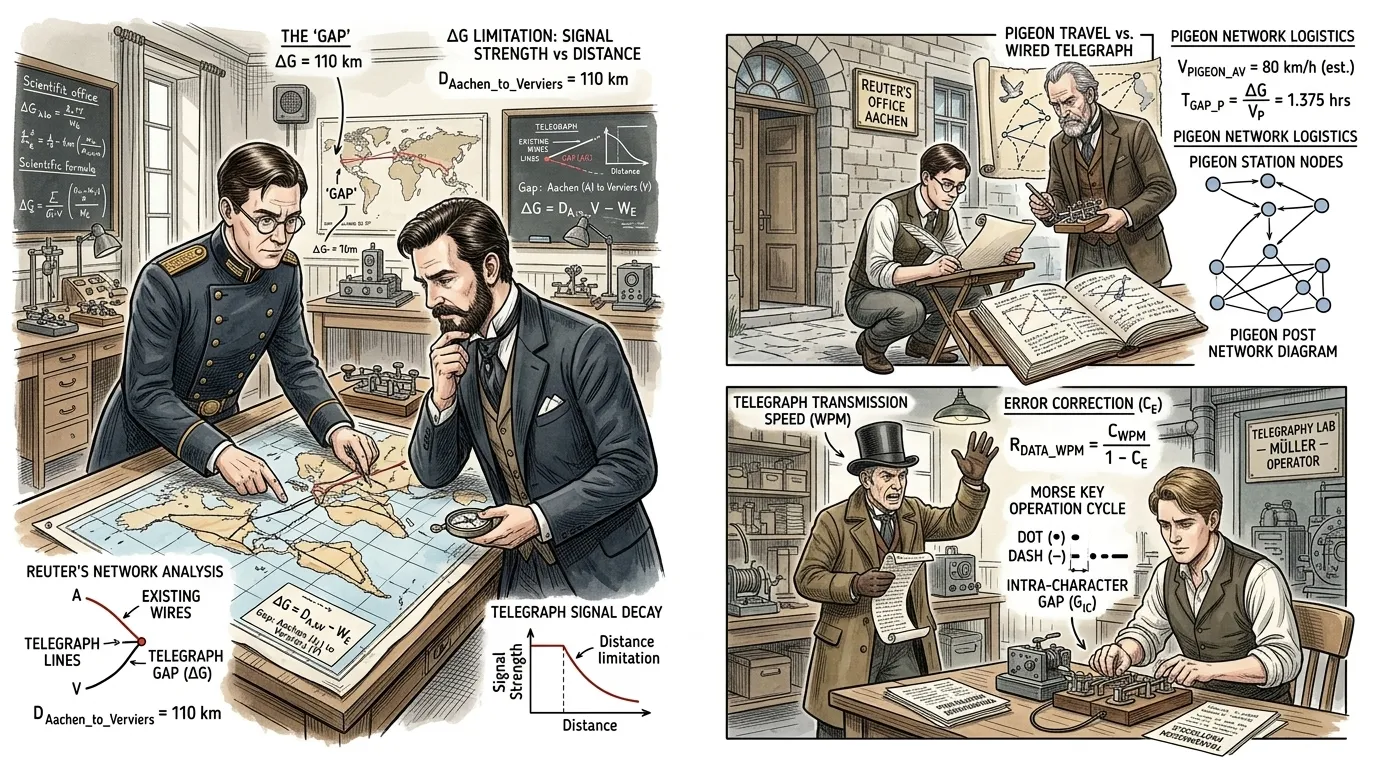
The electric telegraph offered a glimpse of the future, but its network remained incomplete. Paul Reuter, operating his fledgling news agency in Aachen, Germany, confronted a critical gap: the telegraph line from Berlin ended in Aachen, while the line from Paris ended in Brussels. A crucial 110-kilometer stretch remained unconnected.
""The telegraph is a marvel, Herr Reuter," stated a German telegraph operator, Herr Schmidt, a man with spectacles perched on his nose and a stiff uniform, pointing at a map detailing the incomplete network. "Yet, the financial markets of Paris and Brussels are still isolated from Berlin by this frustrating void between Aachen and Verviers. The cost of laying cable across this mountainous terrain is prohibitive right now." Reuter thoughtfully stroked his chin. "Indeed, Herr Schmidt. But what if we could bridge this precise 110-kilometer gap not with wire, but with wings? The speed of information hinges on closing this exact physical divide." He pointed to the map, marking the gap with a pencil. "This 110-kilometer section is the lynchpin.""
Page 4
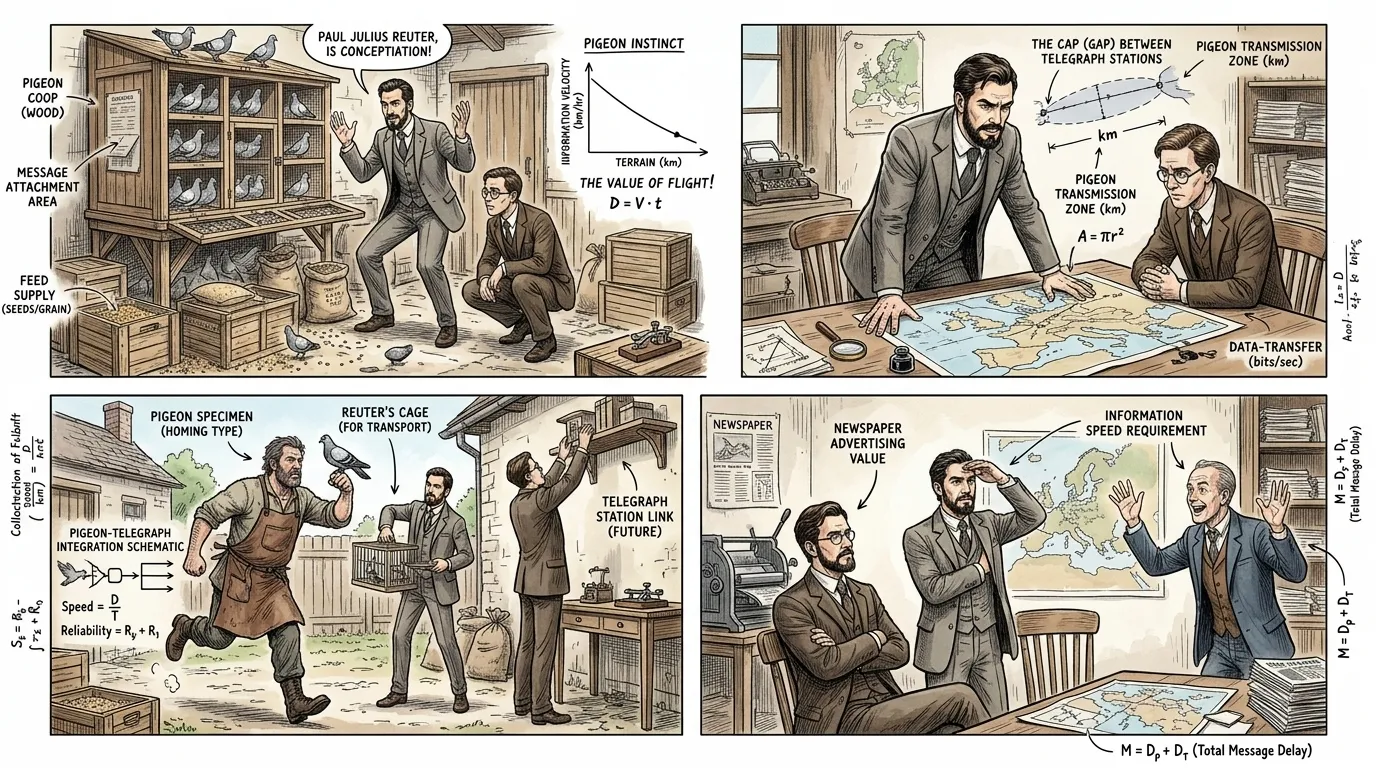
Driven by the conviction that speed was paramount, Paul Reuter devised an ingenious, albeit temporary, solution to the telegraphic void. His vision was to create a hybrid system, combining the speed of the electric telegraph with the reliability of homing pigeons. This wasn't merely about transmitting news, but about establishing a service.
""My colleagues in Berlin and Paris simply cannot afford to wait weeks for market updates," Reuter asserted to his chief assistant, Mr. Hoffmann, a younger man with spectacles and a serious demeanor. "We shall establish a pigeon post that connects Aachen directly to Verviers, Belgium. My birds will carry the latest stock prices and news across that 110-kilometer divide, faster than any train or rider." Hoffmann, looking at the pigeon coops, hesitated. "Pigeons, Herr Reuter? It's an old method. Will it truly be fast enough to give us an edge?" Reuter replied with conviction, "It is the fastest available bridge for this specific gap, Mr. Hoffmann. Every hour saved is a victory in the race for information. As the Roman philosopher Seneca the Younger might have said, 'Luck is what happens when preparation meets opportunity.' We are preparing for the opportunity of speed.""
Page 5
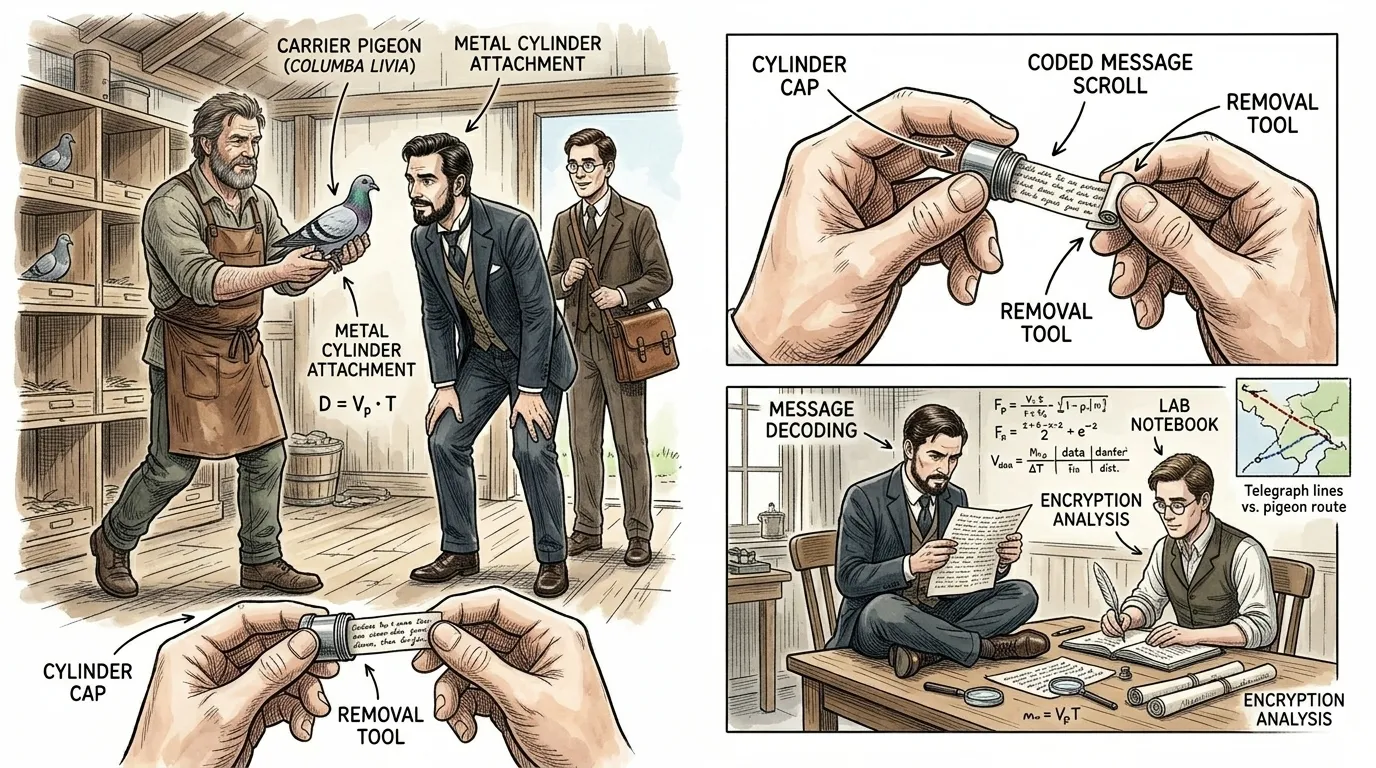
From 1849 to 1851, Reuter's pigeon service operated with remarkable efficiency, carrying financial news and urgent dispatches across the critical gap. Each morning, pigeons departed Aachen and Verviers, carrying tiny scrolls of telegraphic text, reducing information transit from hours or days to mere minutes. This ingenuity provided a vital, albeit temporary, competitive advantage.
""The birds are performing admirably, Herr Reuter!" exclaimed a delighted pigeon handler, a burly man with rough hands and a leather apron, presenting a small metal cylinder attached to a pigeon's leg. "This dispatch from Brussels arrived in just over an hour. Faster than any train!" Reuter carefully extracted the minuscule scroll of paper. "Excellent, Wilhelm! That hour saved is invaluable. Remember how we tracked the average time? This pigeon line consistently cuts the information lag for the 110-kilometer stretch by at least six hours, a crucial metric." He unfurled the tiny paper, scrutinizing the coded message. "These little messengers are proving the economic viability of rapid news transmission.""
Page 6
The pigeon express was a stopgap, but progress in telegraphy was swift. By 1851, the final stretch of electric telegraph line was completed, connecting Aachen directly to Paris and Brussels. This development rendered Reuter's pigeon service obsolete overnight, yet it also opened the door to his true vision: an interconnected, instantaneous news network.
""It's done, Herr Reuter! The telegraph lines are fully connected!" shouted Herr Schmidt, the telegraph operator, rushing into Reuter's London office, waving a piece of paper. "A direct transmission from Paris arrived moments ago! Our pigeons, while loyal, are now outpaced by lightning!" Reuter, a broad smile spreading across his face, clapped Schmidt on the shoulder. "A momentous day, Herr Schmidt! This is the dawn of true instantaneous communication. From this moment, we can relay news across the continent at the speed of electricity." He turned to his assistants. "Prepare to disseminate this news. Our service is no longer limited by wing, but by wire alone!""
Page 7
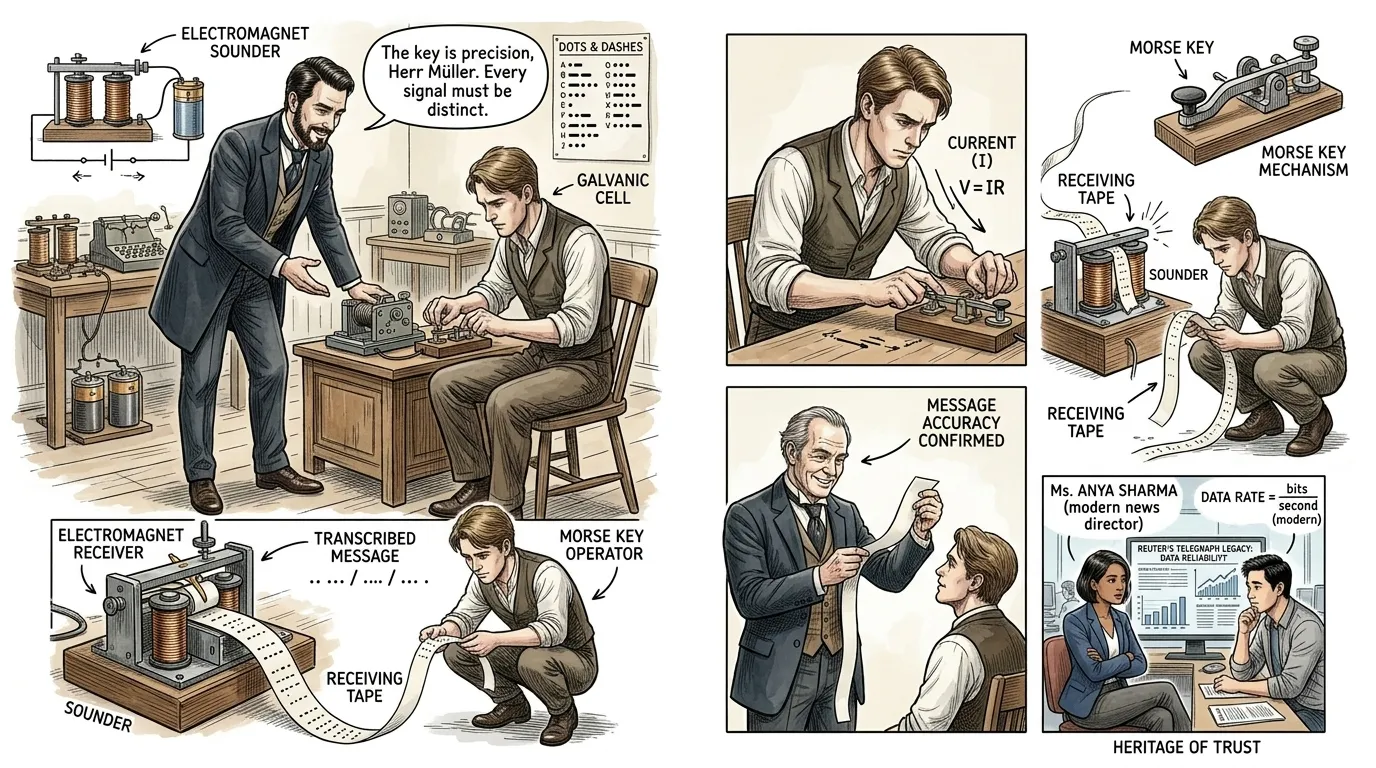
The operation of Reuter's News Wire Service was a sophisticated blend of human intelligence and technological infrastructure. Reporters in key cities gathered information, which was then condensed and encoded. Telegraph operators, skilled in Morse code, transmitted these dispatches across vast distances. At the receiving end, messages were decoded, printed, and rapidly distributed to subscribers.
""Precision and speed are paramount," Reuter instructed a new telegraph operator, Herr Müller, a young man with intense concentration etched on his face, as Müller tapped rapidly on a Morse key. "Each character, each pause, carries vital information. Our correspondents gather the facts, but you are the conduit. Misinterpretations cause delays and errors." Müller looked up, wiping his brow. "It's demanding work, Herr Reuter, ensuring every dot and dash is correct across miles of wire." Reuter nodded. "Indeed, Herr Müller. But this synchronized effort – reporting, encoding, transmitting, and decoding – creates the very lifeline of modern information. Accuracy at every stage ensures our reputation.""
Page 8
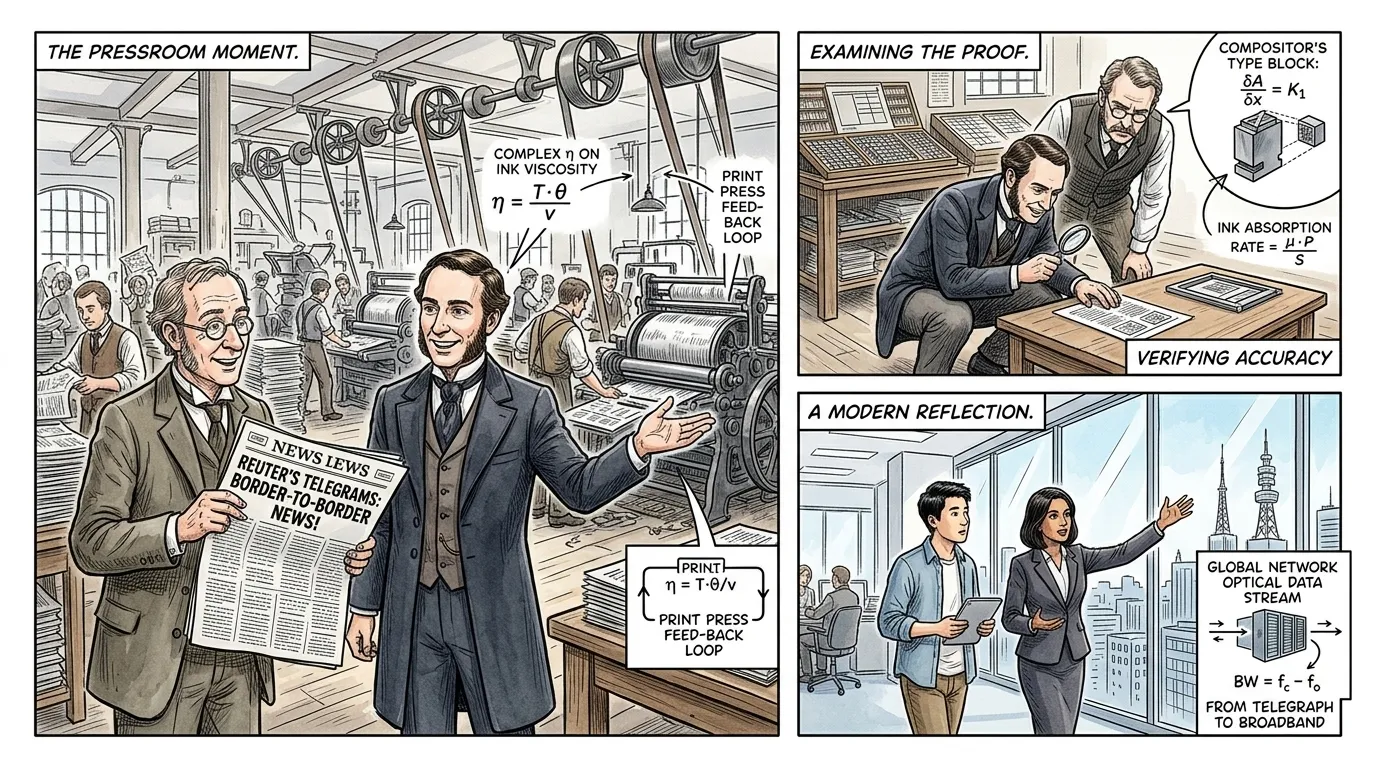
The impact of the News Wire Service was immediate and profound, revolutionizing journalism. Newspapers, once limited by geographical constraints, could now publish up-to-the-minute reports from around the globe, fundamentally changing editorial processes and public expectations. The concept of 'breaking news' was born, thanks to this previously established capacity for rapid transmission.
""Mr. Reuter, your service has utterly transformed our newspaper!" exclaimed Mr. Sterling, the London editor, holding up a freshly printed edition with a bold, current headline. "News from Berlin, Paris, New York – all within hours! Our sales have skyrocketed. The public is insatiable for fresh information!" Reuter smiled, observing the bustling pressroom. "This is the realization of what we learned from that initial 110-kilometer gap, Mr. Sterling. The efficiency we refined with the pigeons and then transferred to the telegraph showed us the true potential for speed. We simply applied that core principle – bridging any information lag – on a global scale." Sterling nodded enthusiastically. "Indeed. This is no longer merely news; it is a live feed into the world.""
Page 9
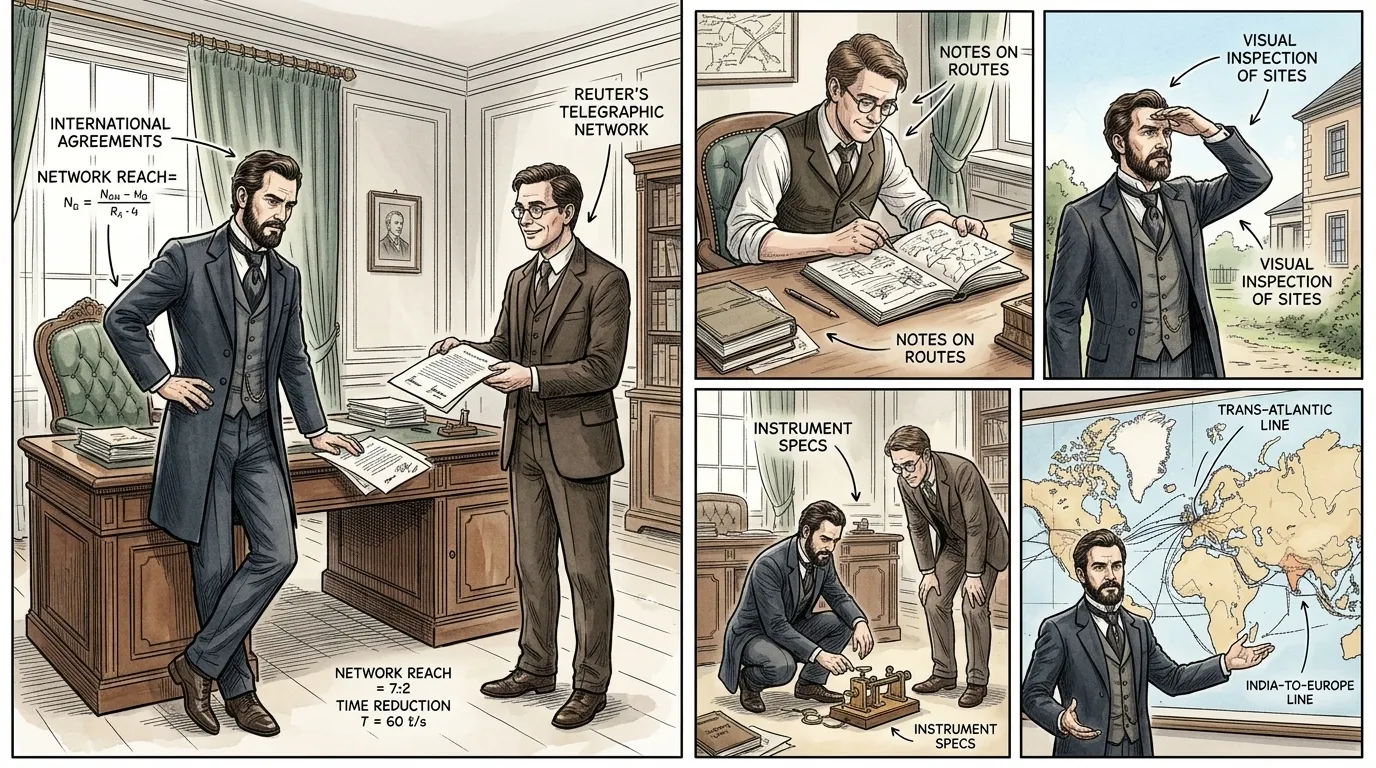
Reuter's agency rapidly expanded, establishing a global network of correspondents and telegraphic connections. It formed alliances with other emerging news agencies like Havas in France and Wolff in Germany, effectively creating a cartel that carved up the world for news collection. This cooperation ensured comprehensive coverage and further cemented the wire service model.
""The agreements are finalized, Herr Reuter," announced Mr. Hoffmann, now a trusted senior manager, presenting Reuter with signed documents. "Havas will cover the French empire, Wolff the German states and Russia, and we, Reuter's, the British Empire and the Far East. Our integrated network now spans the globe!" Reuter reviewed the papers. "Excellent, Mr. Hoffmann. This international collaboration, based on shared infrastructure and mutually beneficial agreements, is vital. It guarantees reliable information flow from every corner of the world. Each agency, while distinct, forms part of one colossal, interconnected nervous system of global communication." Hoffmann added, "Our initial focus on rapid economic news has evolved into a comprehensive global news and intelligence operation.""
Page 10
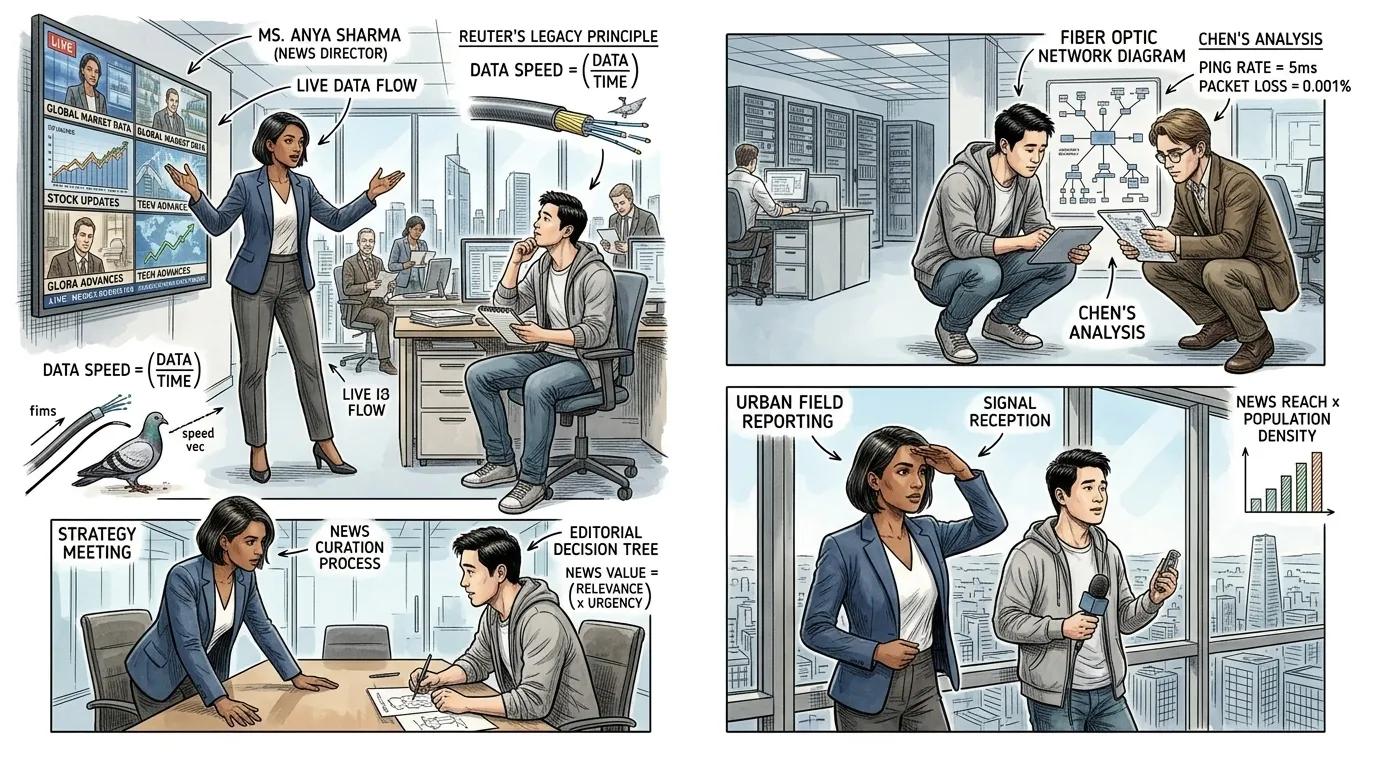
The News Wire Service laid the foundation for modern global communication, transforming information into a real-time commodity. It fostered the concept of objective journalism, established the economic model for news distribution, and irrevocably changed how society consumed and reacted to world events. Its legacy continues to shape the digital age of instant news.
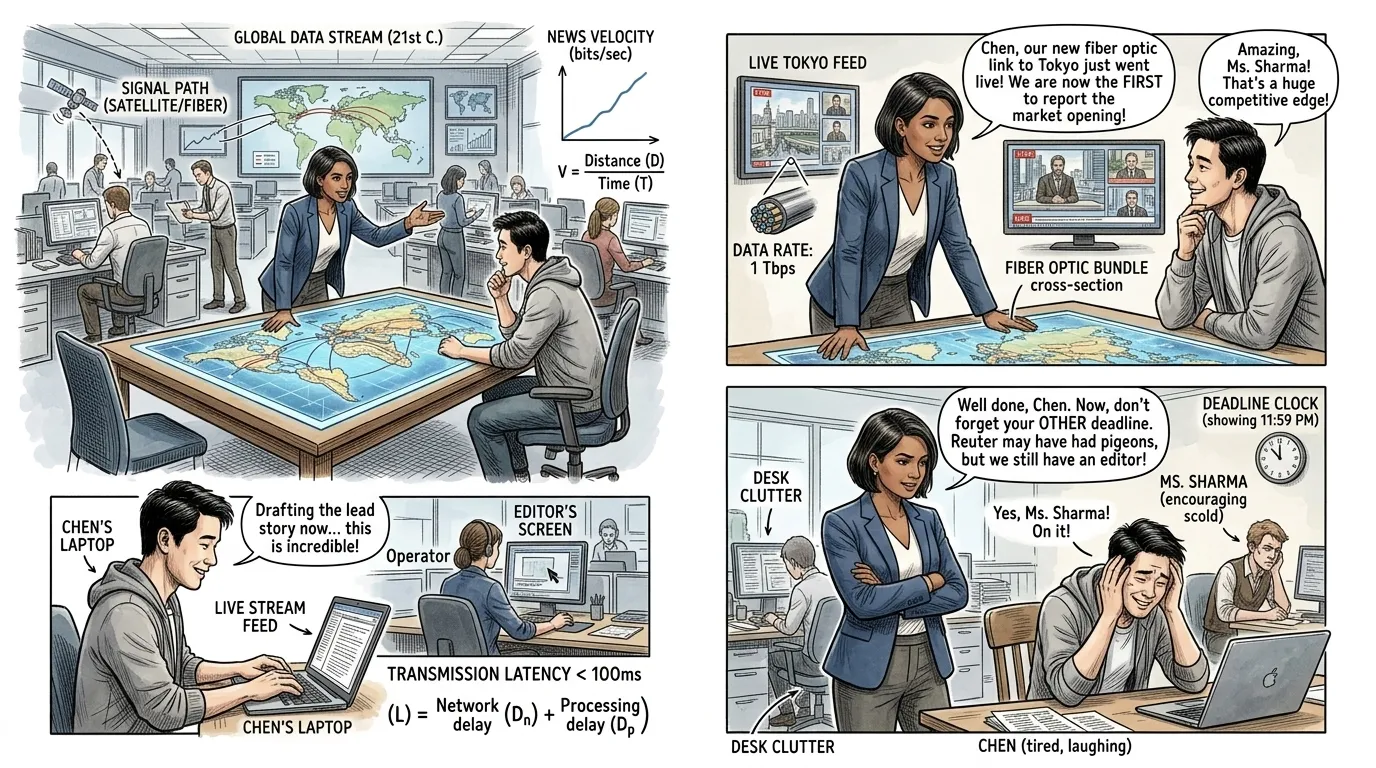
""From pigeons to satellites, the core principle remains," reflected a contemporary news director, Ms. Anya Sharma, addressing her team in a modern newsroom. "Reliable, rapid dissemination of facts. Reuter's vision still underpins our entire operation." She gestured to a large screen displaying live feeds. "While the technology evolves, the hunger for immediate, accurate news, the very thing Reuter's pigeons once delivered across 110 kilometers, is as strong as ever." A younger journalist, Mr. Chen, nodded. "It's astonishing how that single gap in telegraph lines led to this global tapestry of information. It truly began with that simple, urgent need to know.""
About this story
- Location: Global
- Audience: general readers
Questions and answers
Read Wonder Inventions on your phone
Wonder Inventions is available on Android. Get Wonder Inventions on Google Play.