MP3 Compression
MP3 Compression — an illustrated inventions story, set in Global. 10 illustrated pages, free to read on Wonder Inventions.
Page 1
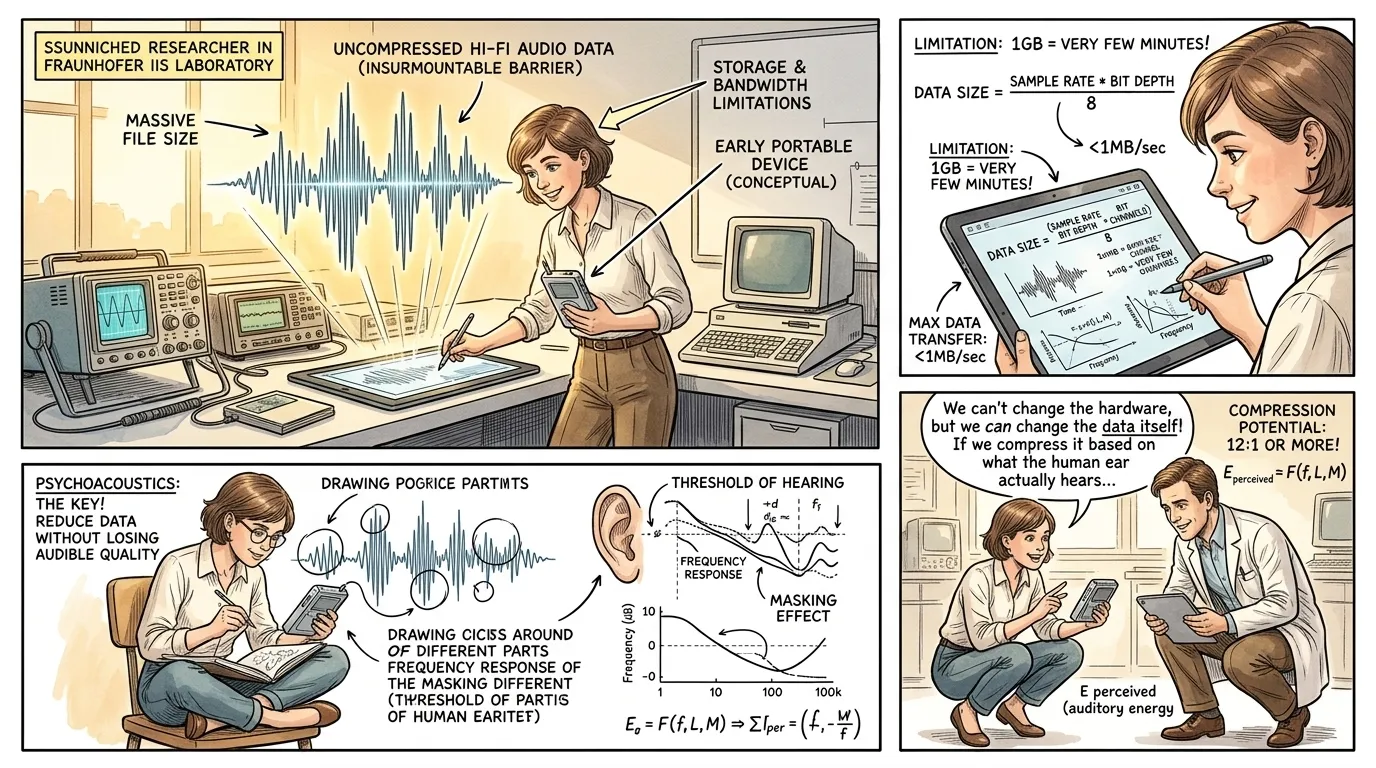
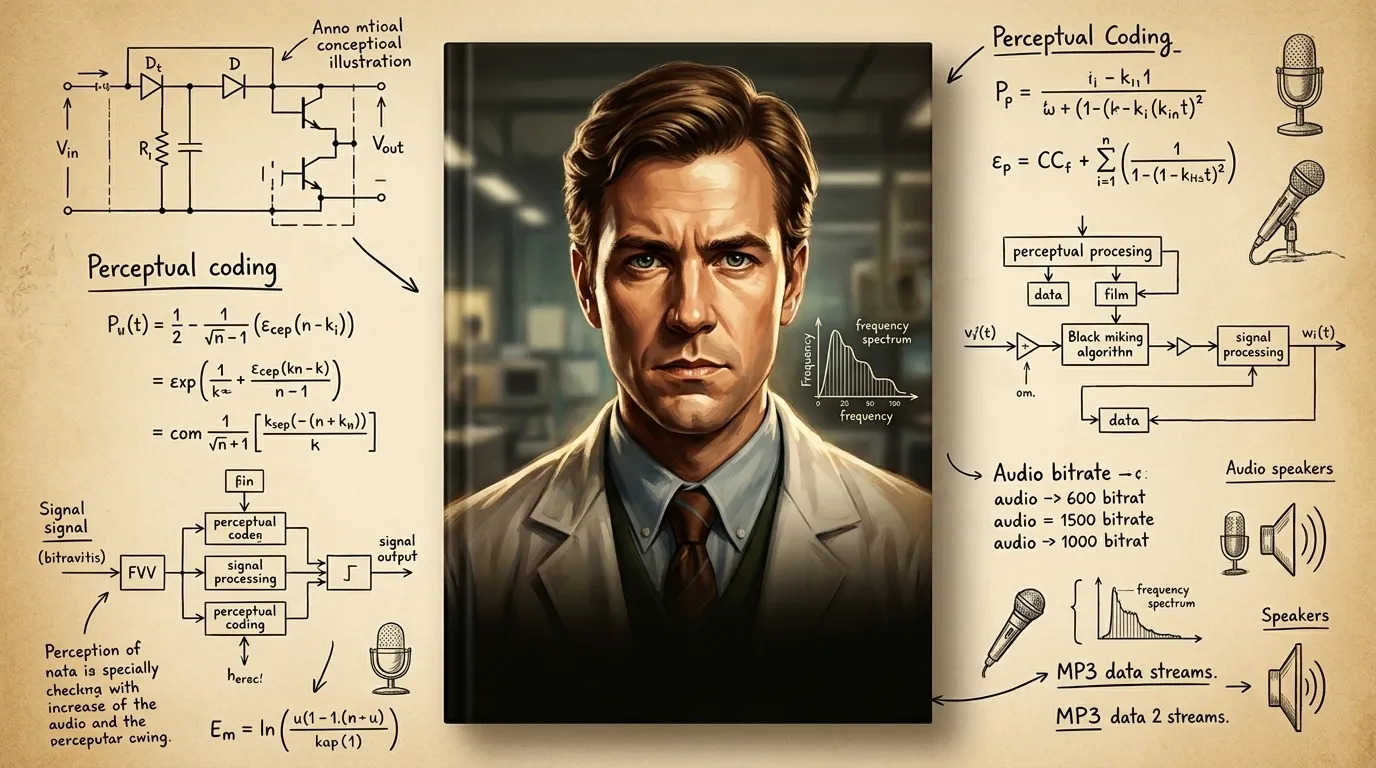
Before the ubiquitous streaming services and digital music libraries of today, the sheer size of high-fidelity audio files presented an insurmountable barrier to widespread digital distribution and portable listening. Uncompressed digital audio required immense storage and bandwidth, making it impractical for the nascent internet and early portable devices. The challenge was profound: how to significantly reduce audio file size without perceivably sacrificing sound quality.
Page 2
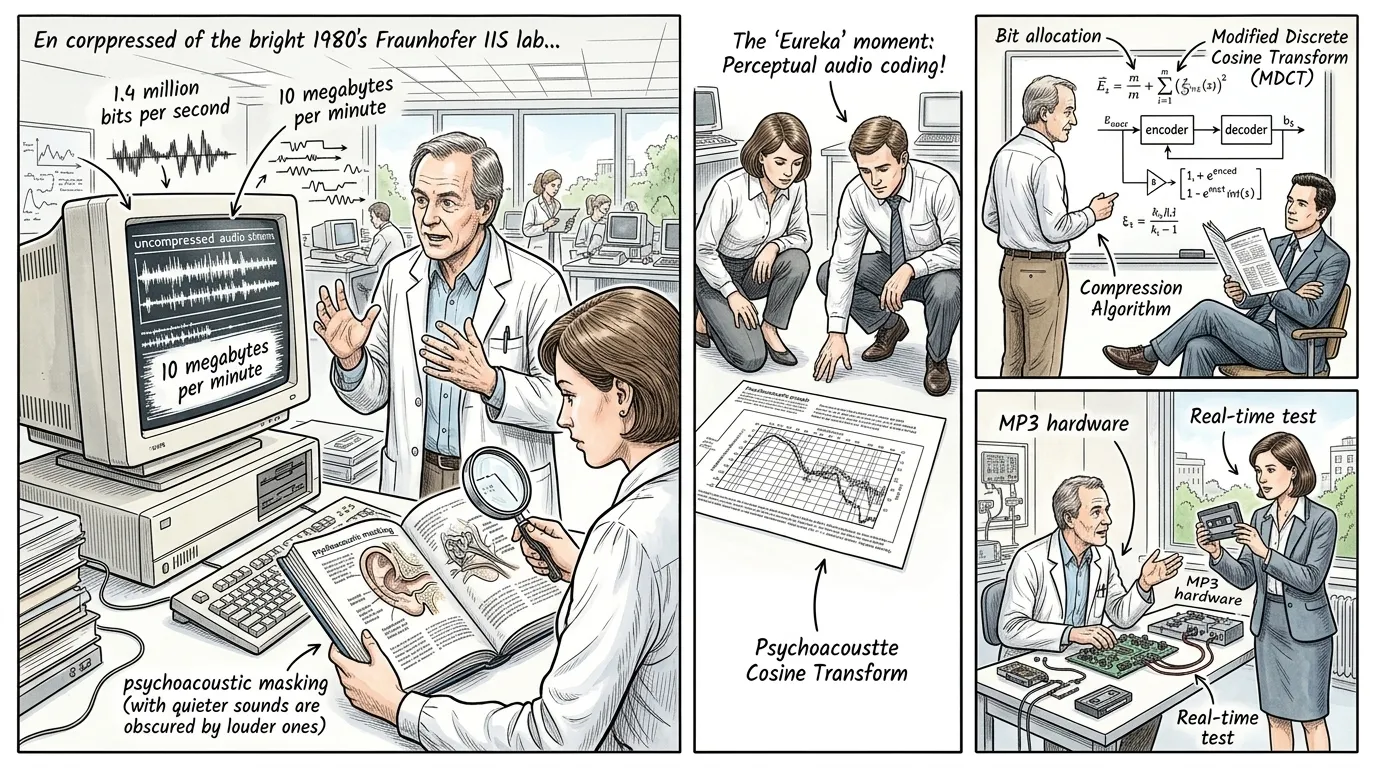
Standard uncompressed CD-quality audio, sampled 44,100 times per second with 16 bits of information per sample across two stereo channels, generated an enormous data stream: over 1.4 million bits per second. This translated to approximately 10 megabytes for a single minute of music. Such files quickly overwhelmed the storage capacities of early personal computers and were prohibitively slow to transmit over dial-up internet connections. The quest for smaller files demanded a radical new approach, one that understood not just data, but human perception itself. This pursuit led researchers to a fundamental understanding of how the human ear processes sound, a concept known as psychoacoustic masking, where louder sounds can 'mask' quieter ones, making them inaudible.
Page 3
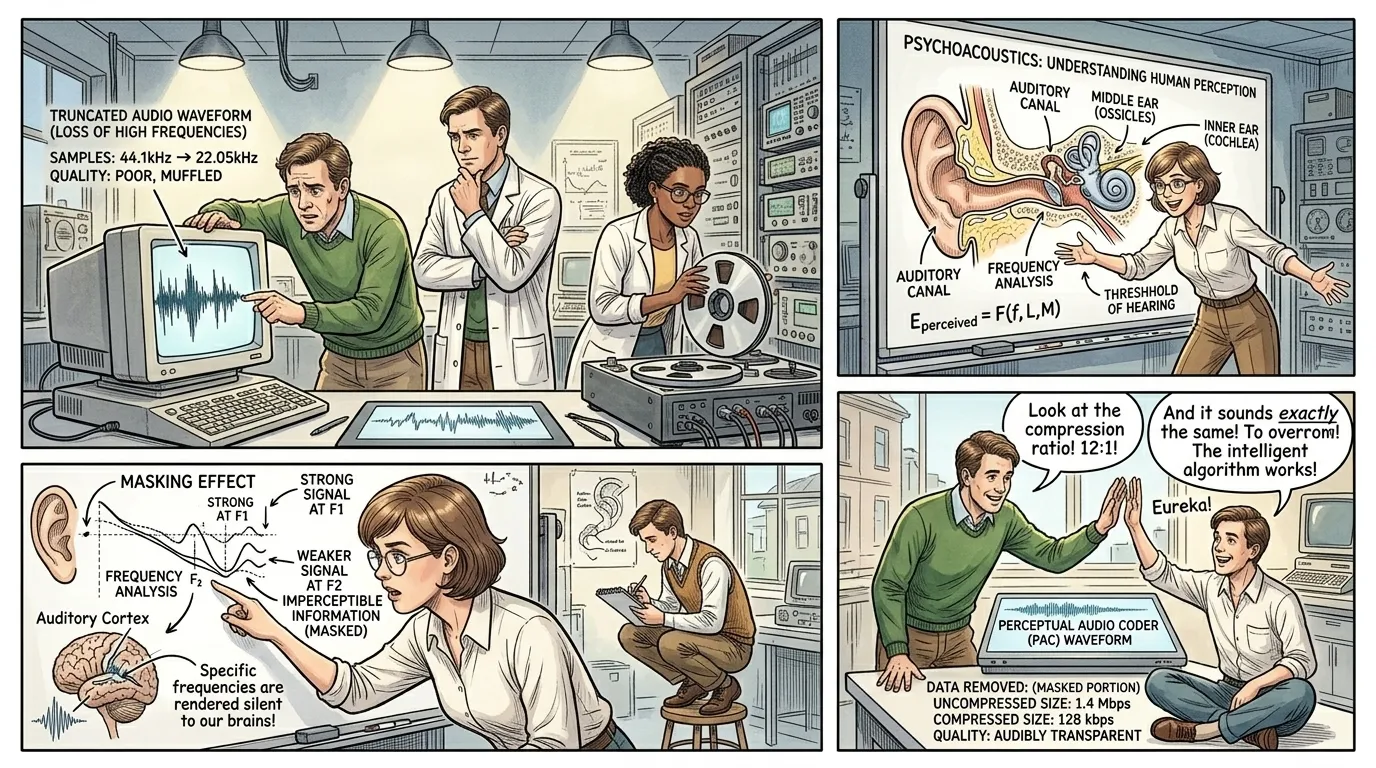
Initial attempts at reducing audio file sizes often involved simple truncation or aggressive filtering, leading to noticeably degraded sound quality. These methods failed because they treated all audio data as equally important, oblivious to the nuances of human hearing. The real challenge was to identify and eliminate redundant or imperceptible information without the listener noticing. This required a deep understanding of psychoacoustics: the study of how humans perceive sound. Researchers needed to develop algorithms that could intelligently 'decide' which parts of the audio spectrum could be removed without impacting the subjective listening experience, a delicate balance that eluded simple mathematical solutions.
Page 4
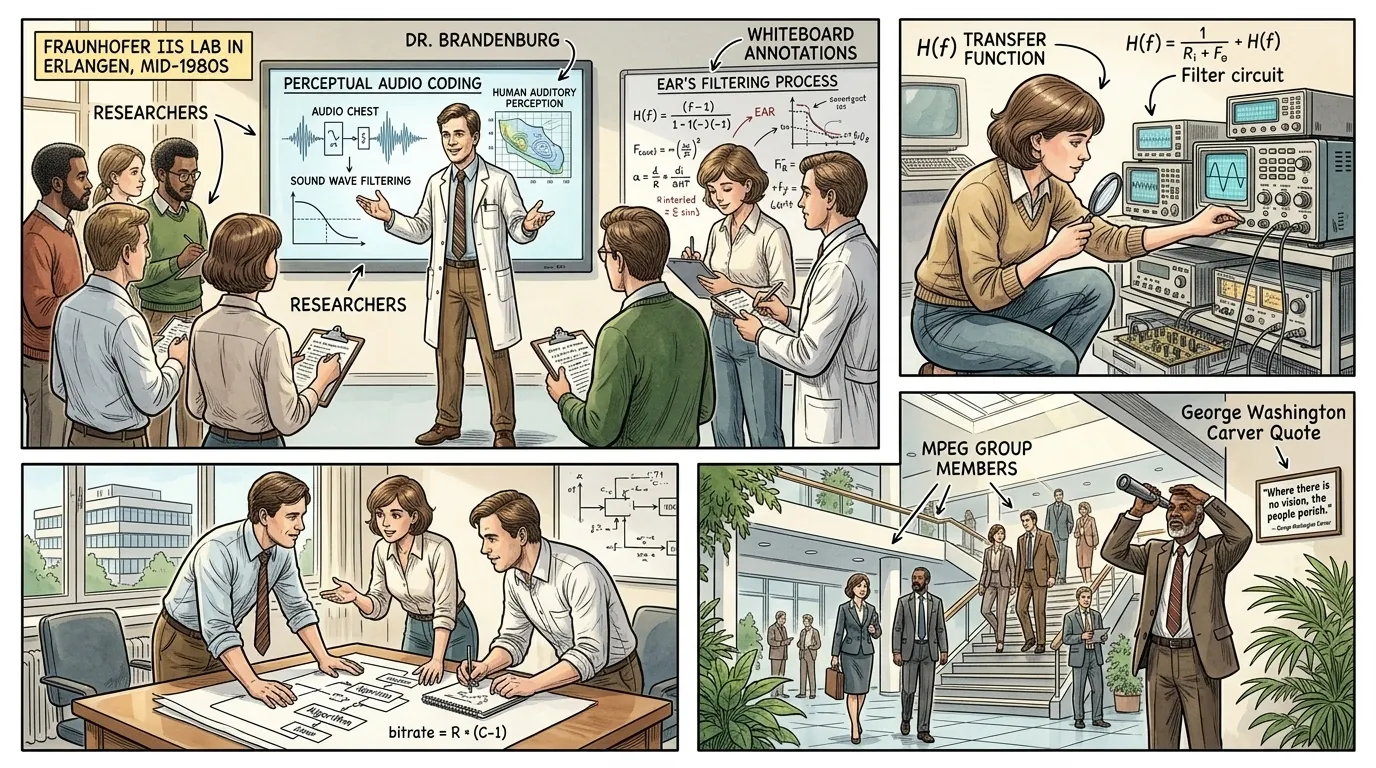
In the mid-1980s, the German Fraunhofer Society for Applied Research, specifically its Institute for Integrated Circuits (IIS) in Erlangen, became a hub for digital audio research. Dr. Karlheinz Brandenburg, a brilliant electrical engineer and mathematician, spearheaded much of this effort. His team focused on a concept called perceptual audio coding, aiming to compress audio data by exploiting the known limitations of human hearing. He understood that true efficiency wouldn't come from mere data reduction, but from an intelligent system that mimicked the ear's filtering process. This deep dive into how we perceive sound laid the groundwork for what would become a global standard.
Page 5
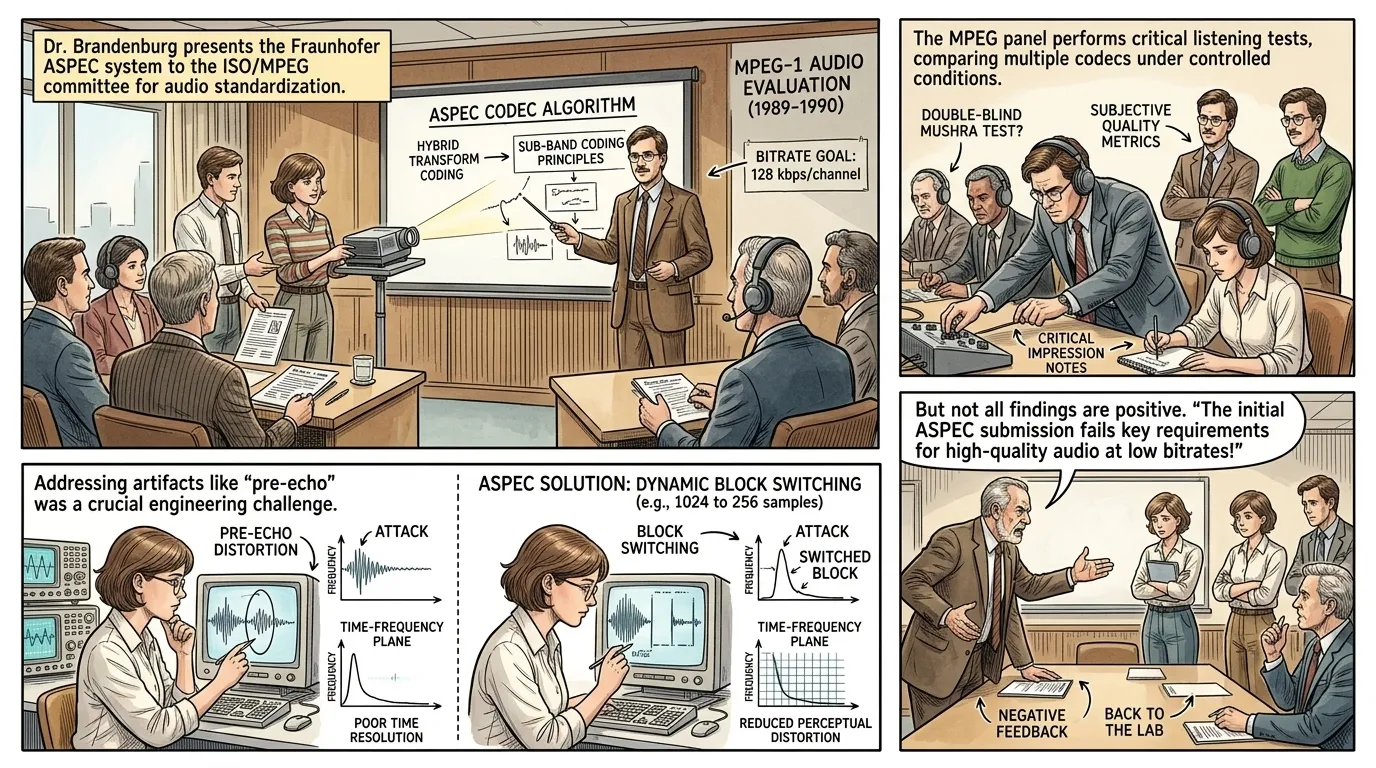
Brandenburg and his team were not alone in this pursuit; many groups were working on audio compression. The International Organization for Standardization (ISO) established the Moving Picture Experts Group (MPEG) in 1988 to develop standards for audio and video compression. Fraunhofer's proposed codec, known as ASPEC (Adaptive Spectral Perceptual Entropy Coding), was one of many competing proposals. The process involved rigorous listening tests and continuous algorithmic refinement, attempting to achieve significant compression ratios without introducing audible artifacts. Early versions were often plagued by 'pre-echo' or other distortions, pushing the team to constantly innovate and refine their psychoacoustic models.
Page 6
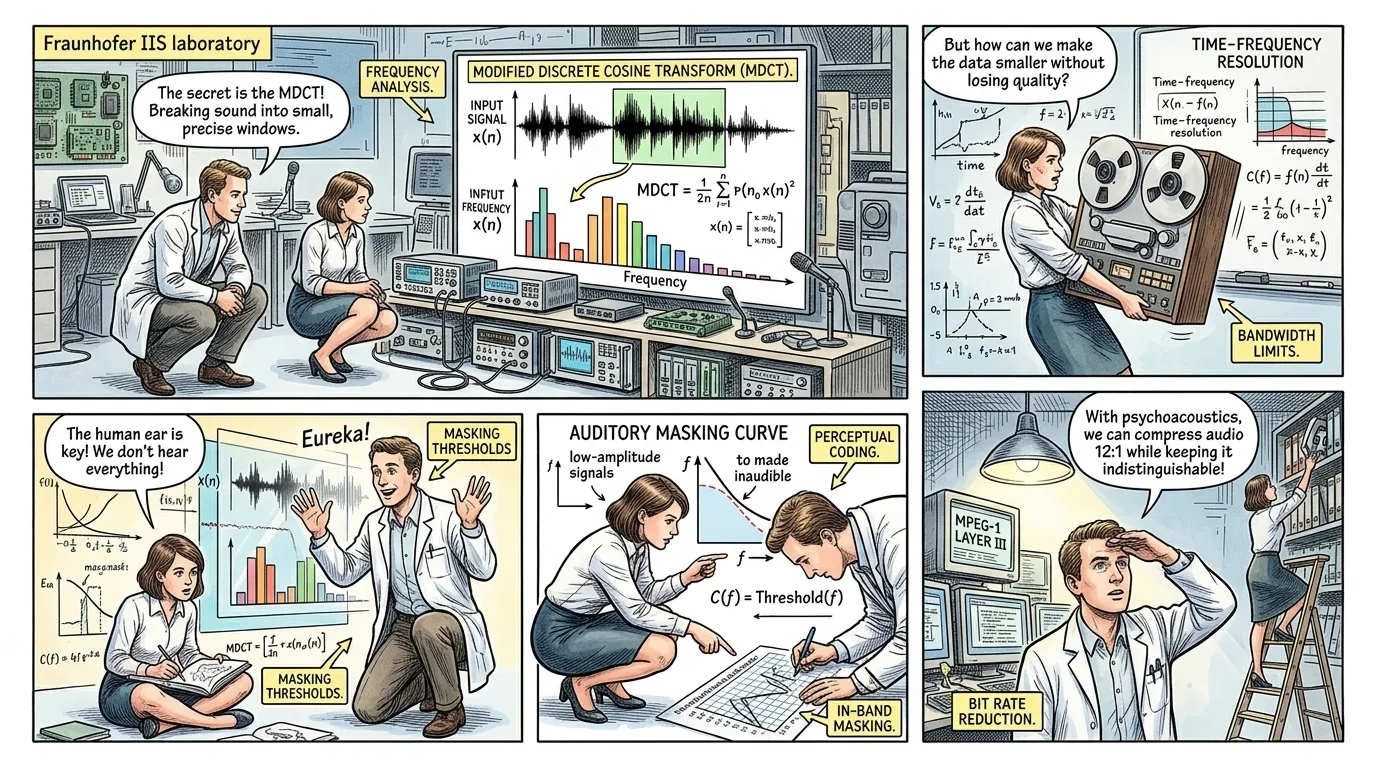
The core breakthrough of MP3 compression lay in two key techniques: the Modified Discrete Cosine Transform (MDCT) and a sophisticated psychoacoustic model. The MDCT acted like a finely tuned filter bank, taking a segment of audio and breaking it down into individual frequency components, much like a prism separating white light into its constituent colors. This allowed the algorithm to analyze the sound spectrum with great precision. Once the audio was decomposed into these frequency bands, the psychoacoustic model could then identify which parts of the sound were truly inaudible to the human ear, based on principles like auditory masking where a loud sound can obscure a quieter sound, particularly if they are close in frequency or time.
Page 7
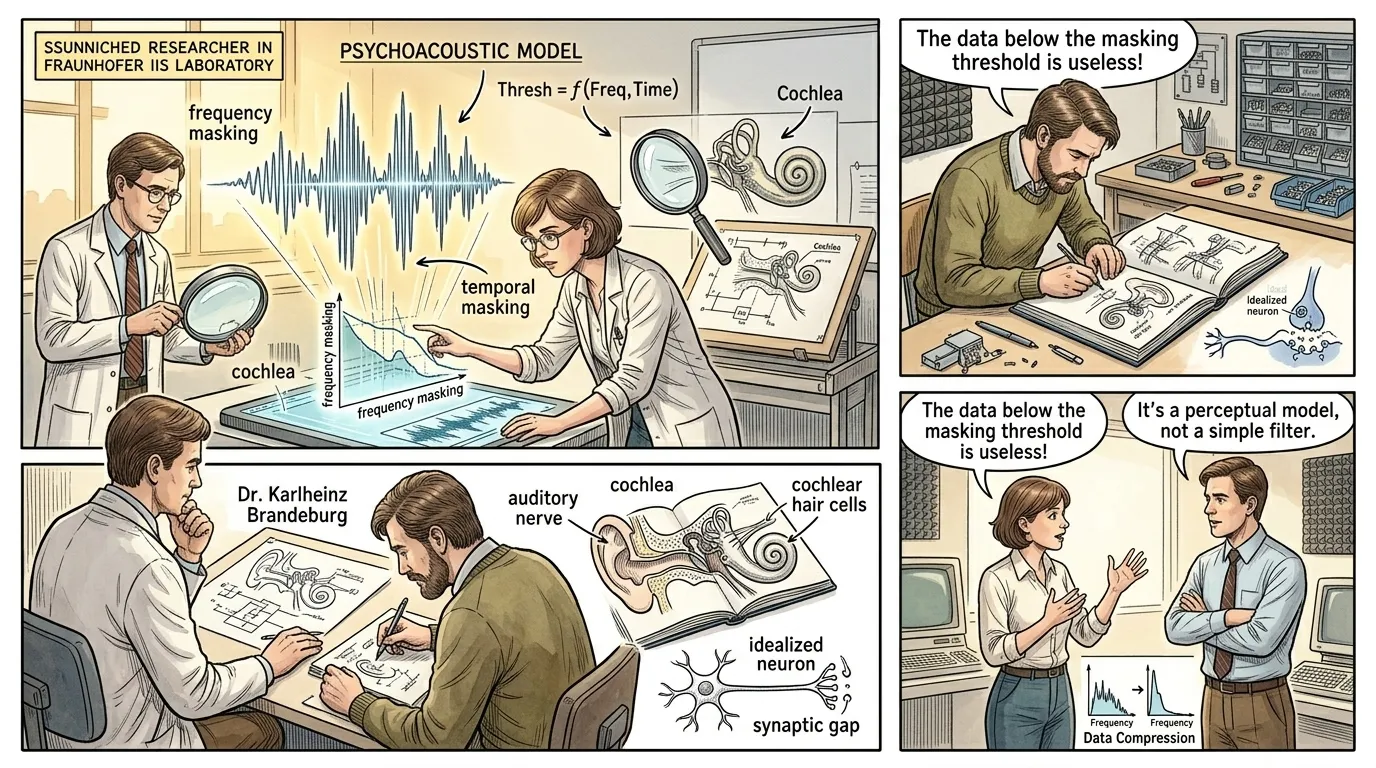
The psychoacoustic model was the true genius behind MP3. It leveraged two primary phenomena: frequency masking and temporal masking. Frequency masking occurs when a loud sound at one frequency makes a quieter sound at a nearby frequency inaudible. The human ear simply cannot distinguish the quieter sound. Temporal masking, on the other hand, describes how a loud sound can mask quieter sounds that occur immediately before or after it. By calculating the 'masking threshold' for each frequency band, the MP3 algorithm could discard all audio information below that threshold without the listener perceiving any loss. This intelligent discarding of psychoacoustically irrelevant data was key to achieving high compression ratios with minimal perceptual degradation, reducing file sizes by a factor of 10 or more.
Page 8
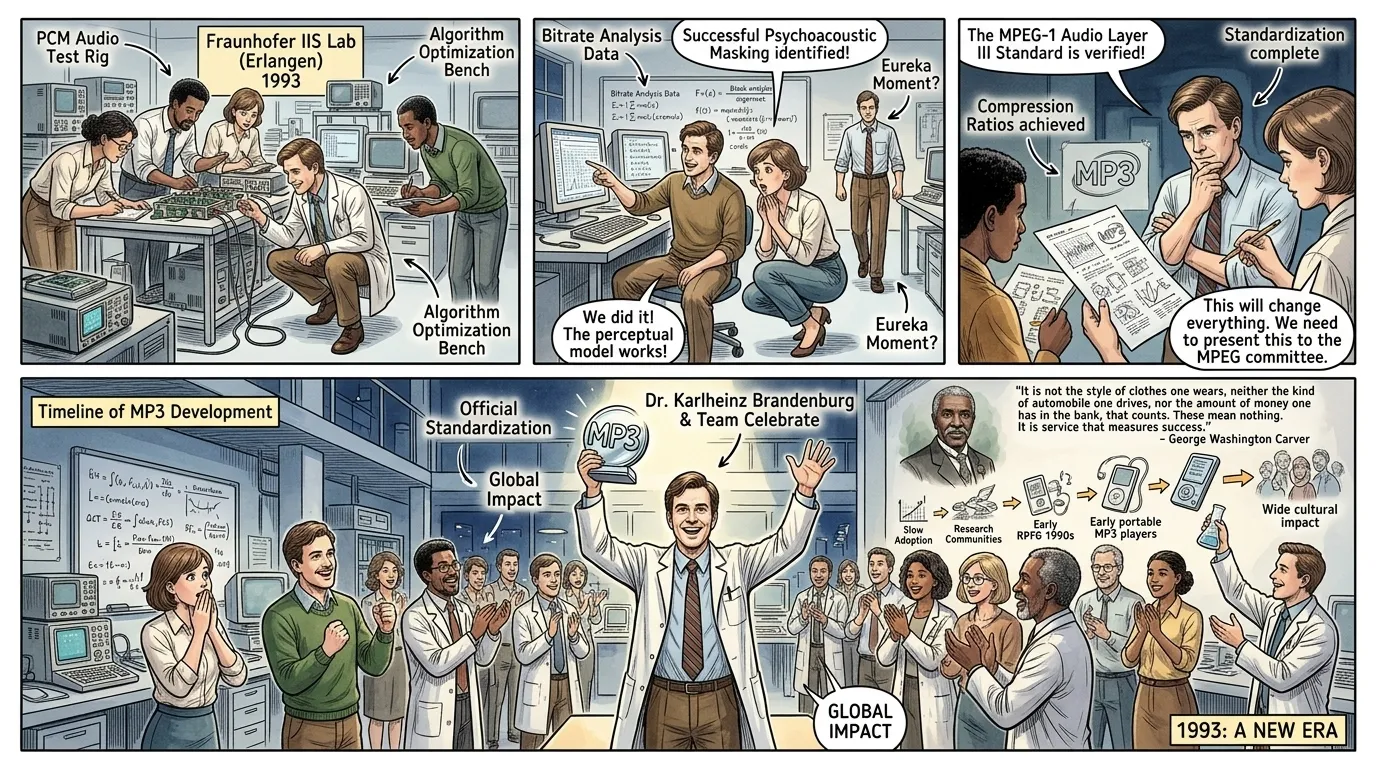
By 1993, the Fraunhofer team's efforts culminated in the creation of the MPEG-1 Audio Layer III, commonly known as MP3. It was officially standardized, offering remarkable compression efficiency, typically reducing audio files to about one-tenth of their original size while retaining near CD-quality sound. Initial adoption was slow, primarily within scientific and research communities. However, as internet speeds improved and early portable MP3 players emerged in the late 1990s, the format's potential became undeniable. The ease of sharing these smaller files rapidly propelled MP3 into the mainstream, fundamentally altering how music was consumed and distributed. As American inventor George Washington Carver once observed, 'Education is the key to unlock the golden door of freedom.' In this context, MP3 compression educated the world on what digital audio freedom could entail.
Page 9
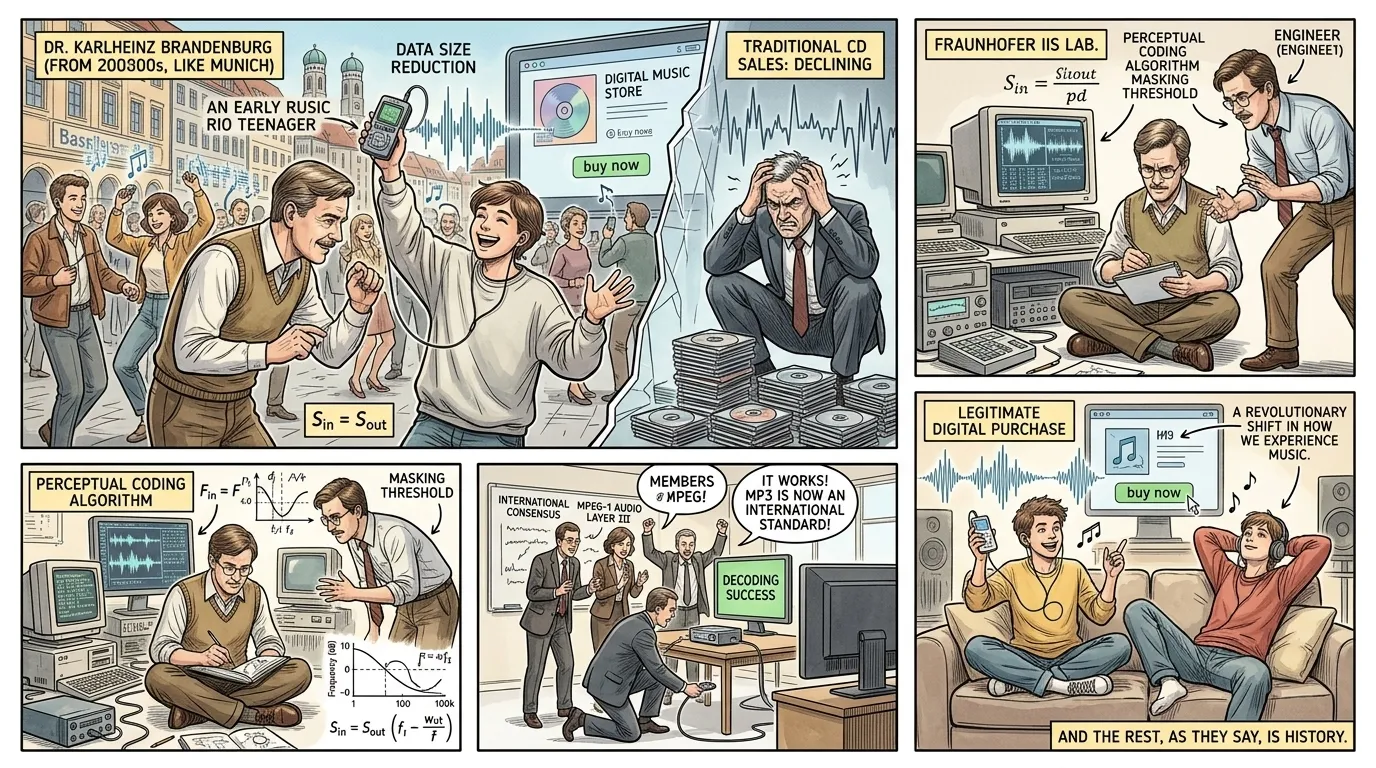
The widespread adoption of MP3 technology was nothing short of revolutionary. It democratized music access, making vast libraries of songs available to anyone with an internet connection and sufficient storage. This, however, ignited a fierce battle with the traditional music industry, which struggled to adapt to a world where physical media was no longer king. While the format facilitated widespread piracy, it also paved the way for legitimate digital music stores and streaming services. The MP3 format proved that efficient digital distribution was not only possible but inevitable, forever changing the economic and cultural landscape of music. It became the template for subsequent audio codecs, pushing the boundaries of what was achievable in digital sound.
Page 10
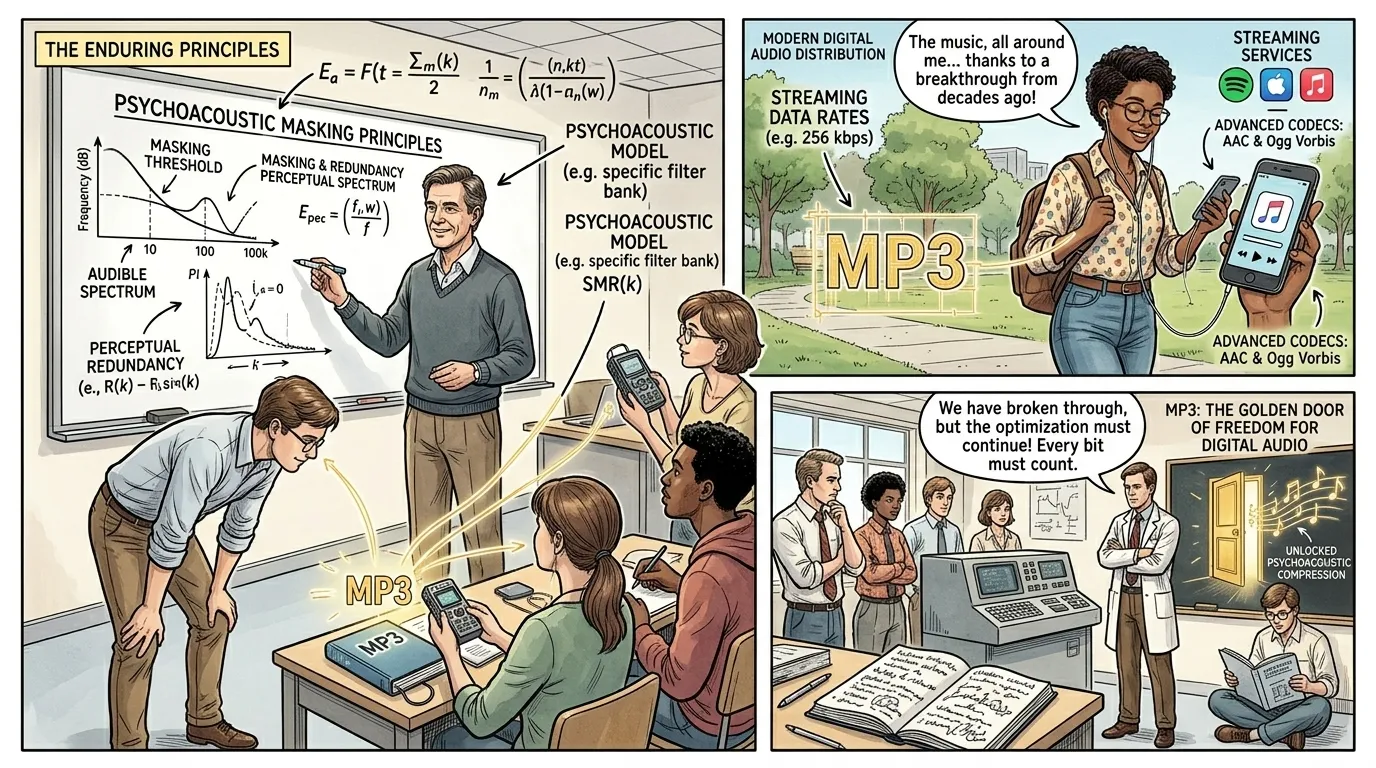
Though newer, more efficient audio codecs like AAC and Ogg Vorbis have emerged, the MP3 format's legacy endures. It fundamentally shifted paradigms, proving that high-quality audio could be delivered in small, manageable packages. This innovation directly enabled the rise of personal music players, digital music marketplaces, and eventually, the streaming economy that dominates today. The principles of psychoacoustic masking and efficient spectral coding developed by Brandenburg and his team continue to inform the design of modern audio compression algorithms. MP3 compression was not merely a file format; it was a catalyst that redefined our relationship with music, making it infinitely more accessible, personal, and ubiquitous in the digital age. It truly unlocked the golden door of freedom for digital audio.
About this story
- Location: Global
- Audience: general readers
Questions and answers
Read Wonder Inventions on your phone
Wonder Inventions is available on Android. Get Wonder Inventions on Google Play.