Mobile Phone
Mobile Phone — an illustrated inventions story, set in Global. 10 illustrated pages, free to read on Wonder Inventions.
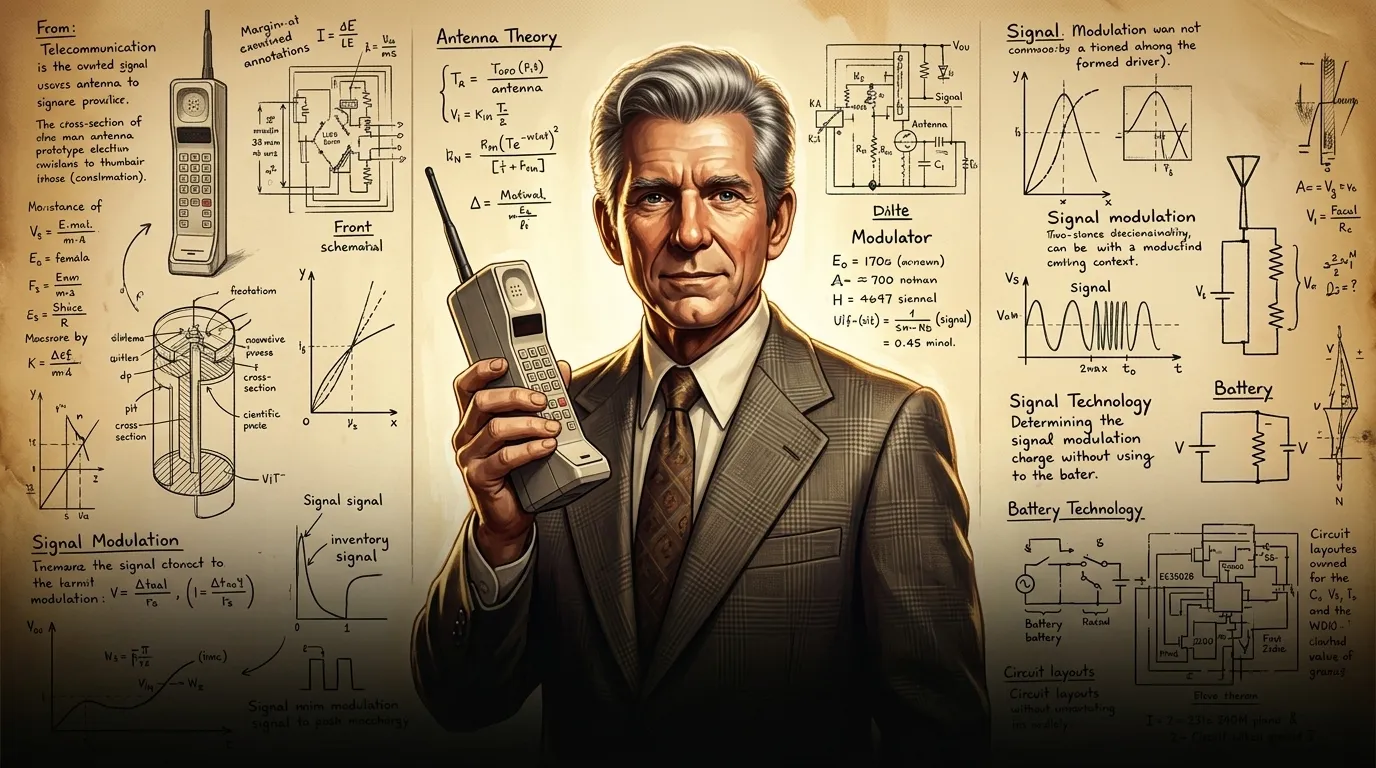
Page 1
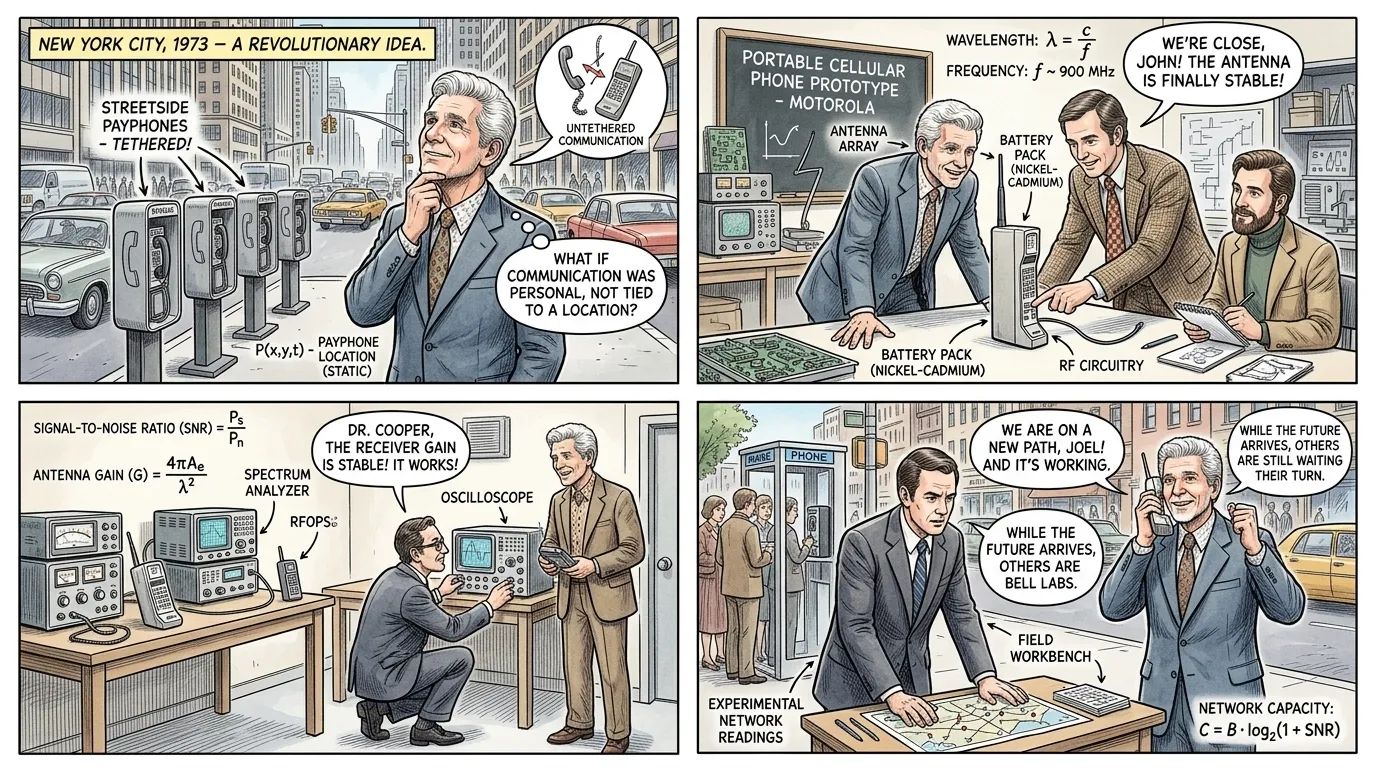
In the bustling canyons of 1970s New York City, communication remained largely a tethered affair. Public telephones, rows of grey metal boxes, dictated when and where connections could be made. Urgent messages often required a desperate dash, limiting spontaneity and personal freedom.
""The current system binds us to location, demanding we seek out communication rather than having it readily available," observed Martin Cooper, an engineer at Motorola, reflecting on the static nature of telephony. "We envisioned a world where a person could call a person, not a place, fostering true personal connection." Cooper and his team believed this limitation was not an immutable fact of life, but a technological hurdle waiting to be overcome."
Page 2
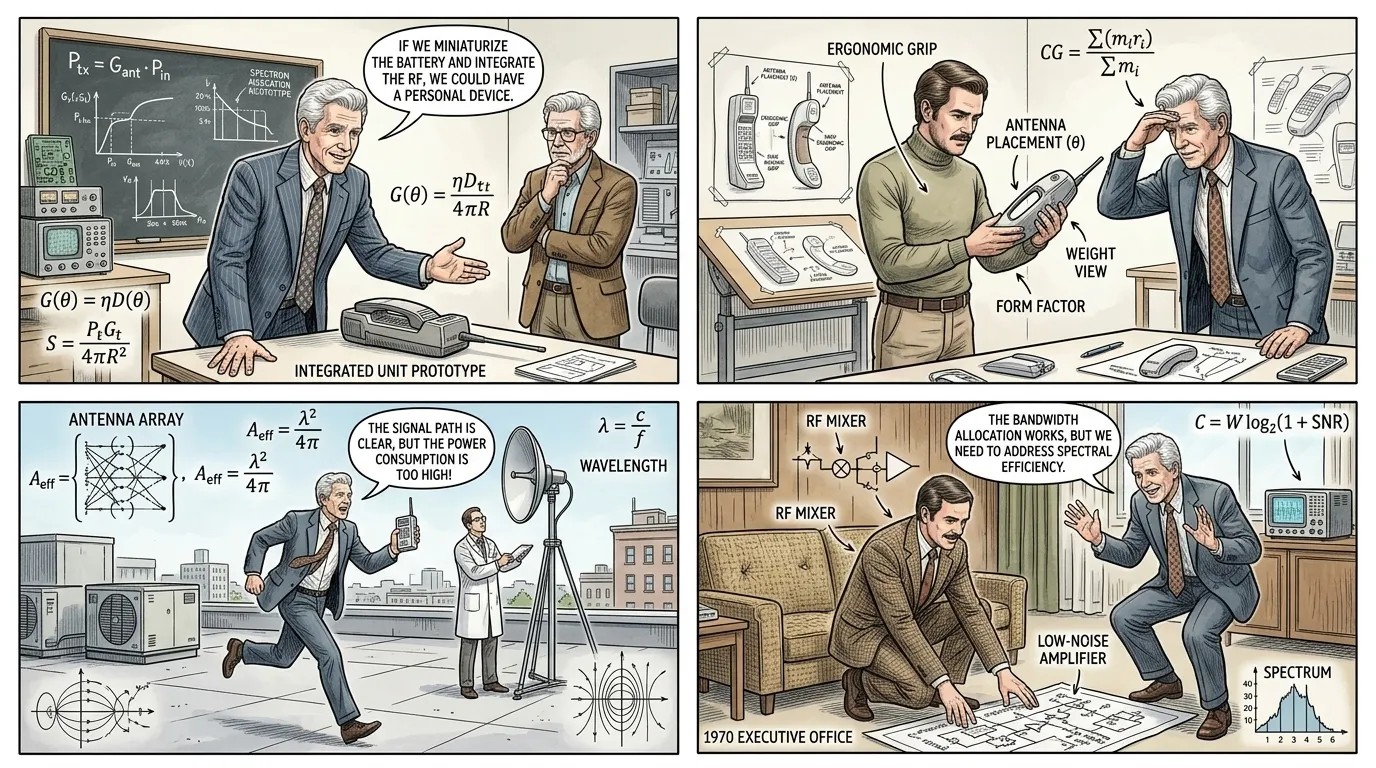
Before Cooper's breakthrough, the closest thing to mobile communication were car phones. These bulky, power-hungry devices, integrated into vehicles, served as extensions of the automobile, not the individual. They operated on a limited number of channels, restricting their utility to a select few.
""Our competitors at Bell Labs had explored cellular concepts, true, but their focus remained on expanding car telephony, not on a device carried by an individual," Martin Cooper explained during a brainstorming session. His colleague, Dr. Henryk Beken, responded, "The challenge isn't just signal transmission, but power consumption and miniaturization. How do we put a full radio station in someone's pocket without draining a car battery in minutes?" Cooper nodded, "Precisely. We must design a system that manages precious radio spectrum efficiently, allowing many users in a confined area, a concept Bell had theorized but never truly manifested in a personal device. This is the core knowledge we need to perfect.""
Page 3
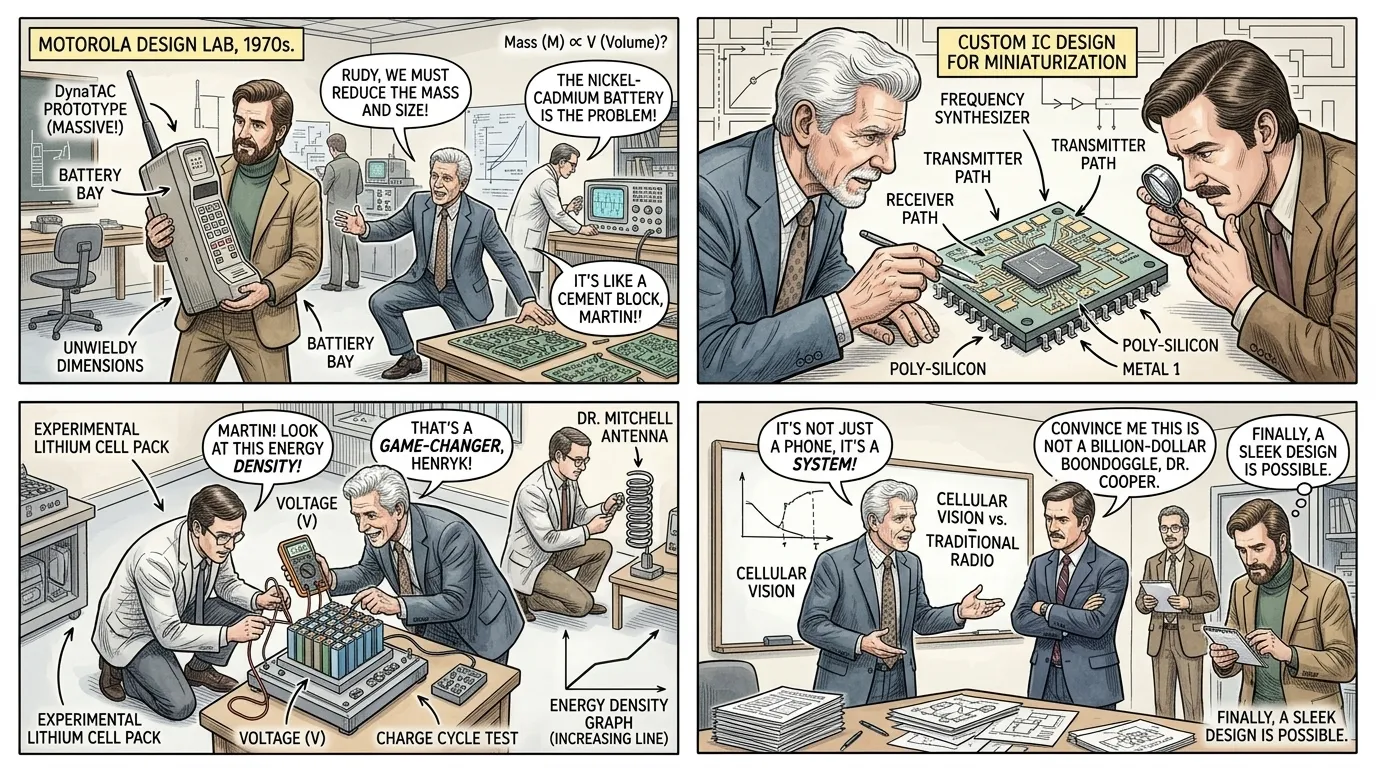
The path to a handheld mobile phone was fraught with technical obstacles. Shrinking complex radio equipment into a portable form factor, designing an efficient antenna, and securing a sufficient battery life were monumental tasks. Motorola's engineering teams worked under intense pressure, knowing Bell Labs was also pursuing its own mobile ambitions.
""Miniaturization is our greatest hurdle," observed Rudy Krolopp, Motorola's industrial designer, holding a crude prototype that resembled a brick. "How do we fit robust radio components, a powerful antenna, and a battery that lasts longer than twenty minutes into something manageable?" Martin Cooper replied, "We must innovate at every level, from integrated circuits to the battery chemistry. As the ancient Greek philosopher, Aristotle, once said, 'We are what we repeatedly do. Excellence, then, is not an act, but a habit.' This project demands our absolute commitment to a habit of excellence in design and engineering." They continued to discuss the intricacies of signal strength and battery capacity, detailing the need for lightweight, yet dense energy sources."
Page 4
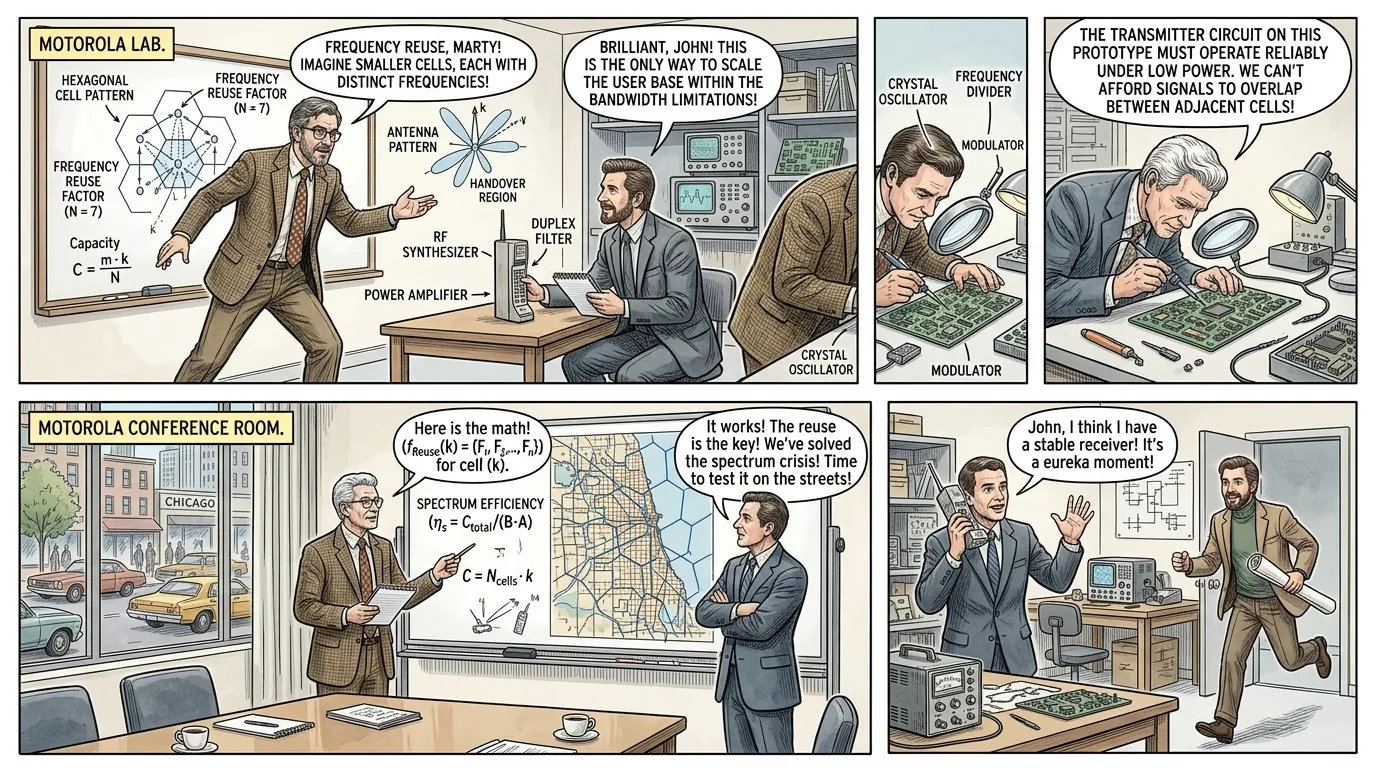
The fundamental innovation that made personal mobile telephony possible was the cellular network. Instead of a single, powerful transmitter covering a vast area, a cellular system divides a geographic region into smaller 'cells.' Each cell contains a low-power base station, allowing for efficient reuse of radio frequencies.
""The beauty of the cellular approach lies in frequency reuse," explained a Motorola engineer, Dr. John F. Mitchell, pointing to a schematic on a whiteboard. "By partitioning an area into these smaller cells, we can use the same set of radio frequencies in non-adjacent cells without interference. This dramatically increases our system's capacity." Martin Cooper nodded, adding, "And as a mobile phone user moves from one cell to another, the network 'hands off' the call seamlessly to the next base station, maintaining continuous communication. It's an elegant solution to the limited radio spectrum problem.""
Page 5
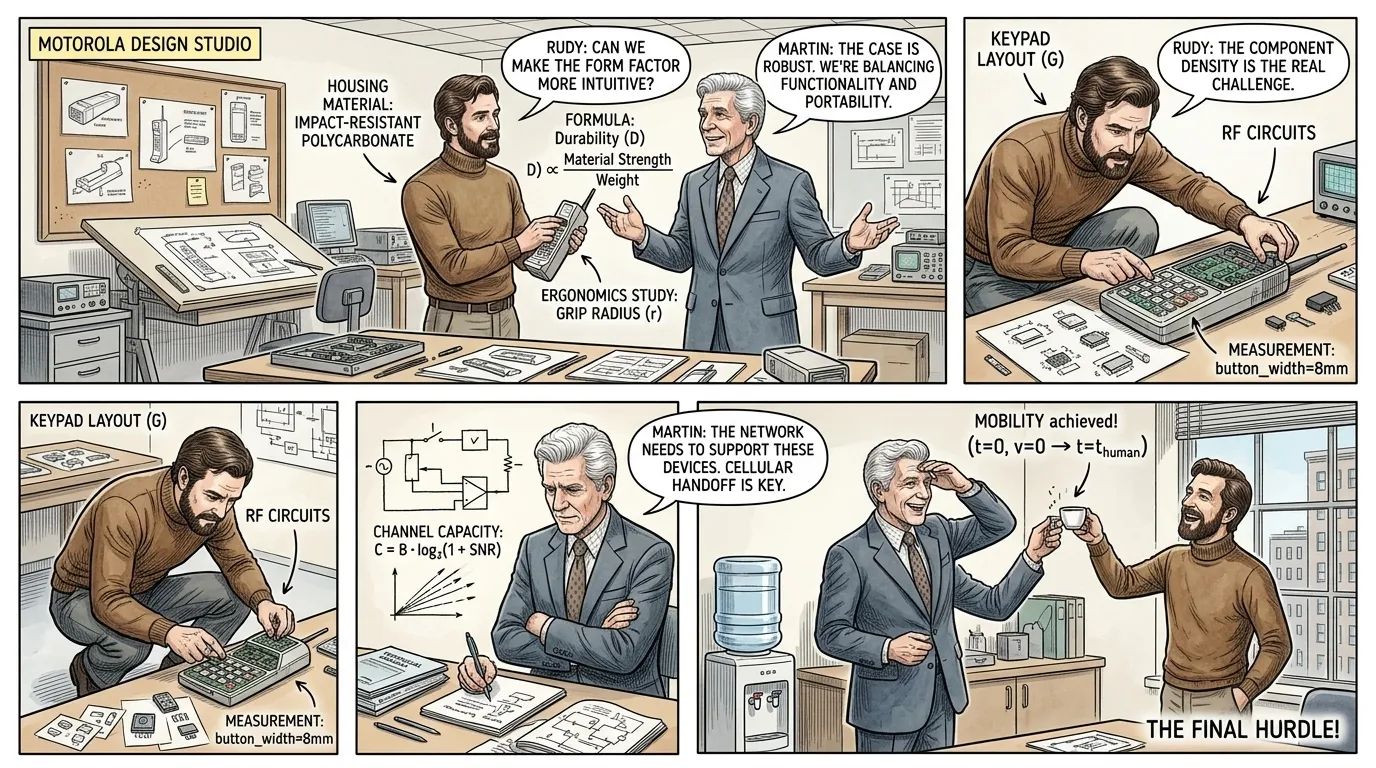
Motorola's DynaTAC 8000x prototype was a marvel of miniaturization for its time. Weighing 2.5 pounds and measuring 9 inches long, it was affectionately nicknamed 'the brick.' Despite its size, it represented a revolutionary leap, designed specifically to be held and carried by an individual, not merely installed in a vehicle.
""Our goal was to make it truly personal, something that felt like an extension of the user," stated Rudy Krolopp, examining the DynaTAC's robust plastic casing. "We balanced functionality with portability, even if it meant a significant weight." Martin Cooper chimed in, "While its talk time was only about 30 minutes, and recharging took ten hours, this device proved the concept was viable. It needed to be durable, too, capable of surviving the rigors of daily life outside a vehicle." They discussed how every design choice, from the oversized buttons to the robust antenna, served the primary purpose of user-centric mobility."
Page 6
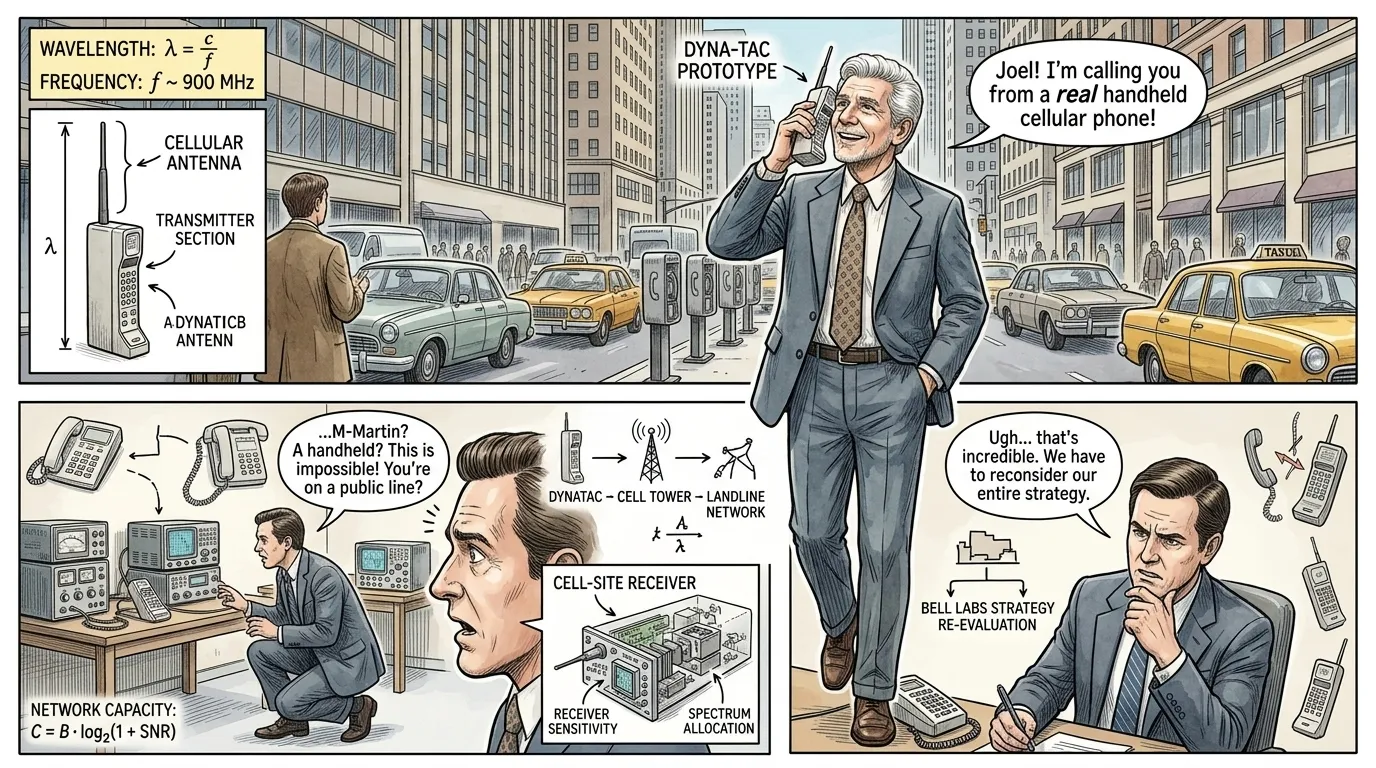
The culmination of years of intense research and development arrived on April 3, 1973. Standing on a street in New York City, Martin Cooper prepared to make history. With the world's first handheld mobile phone, he placed a call that would forever change global communication.
"With a confident smile, Martin Cooper lifted the DynaTAC prototype to his ear. "Joel, it's Marty," he announced, the words echoing through the device. "I'm calling you from a 'personal, handheld, portable cell phone.' Just wanted to tell you what we're doing here." On the other end, Bell Labs' Joel Engel, audibly stunned, could only manage, "That's... that's incredible, Marty!" This brief exchange marked not just a technological triumph but a profound shift in human connectivity, a moment of pure, unadulterated triumph and a new era dawning."
Page 7
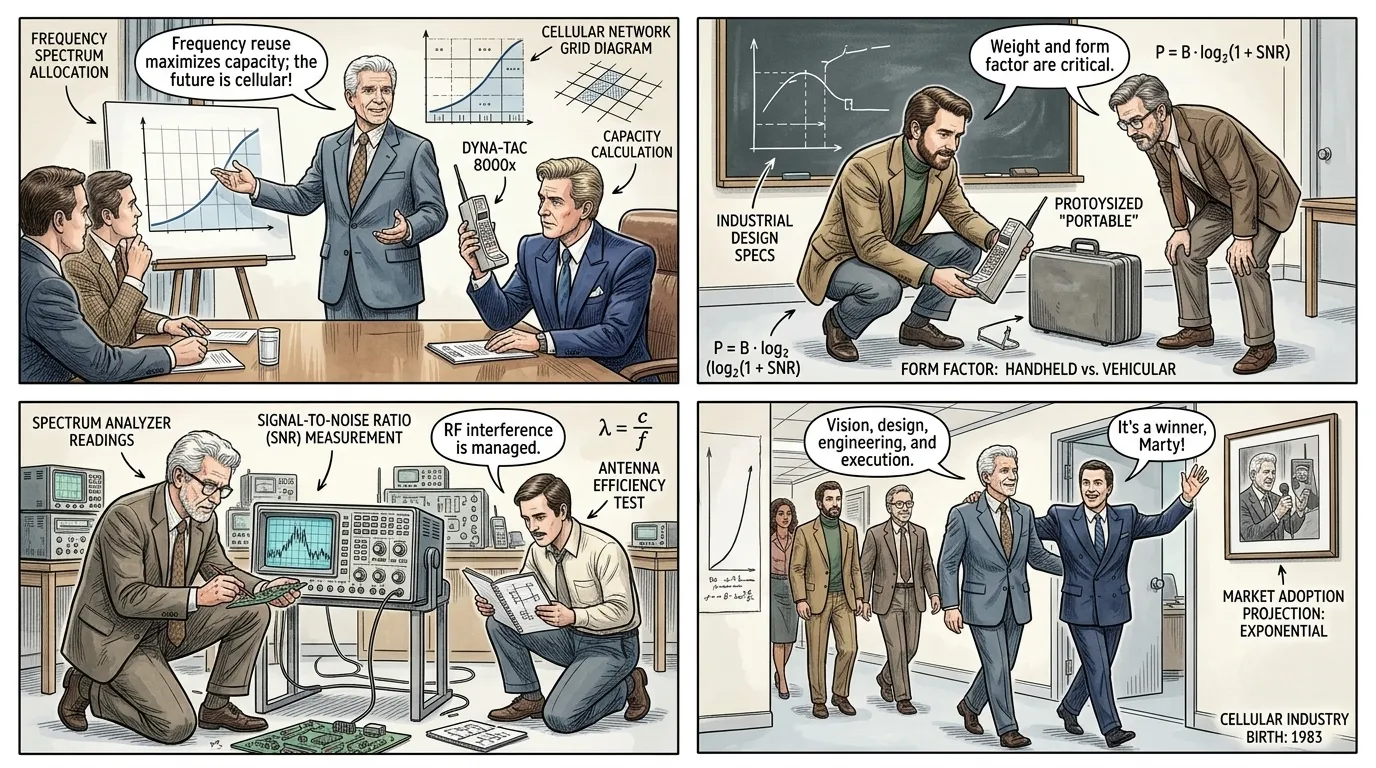
The iconic call of 1973 was merely the beginning. It took another ten years, until 1983, for the Motorola DynaTAC 8000x to become commercially available. This decade was filled with further engineering refinements, intense regulatory negotiations, particularly concerning radio spectrum allocation, and the arduous process of FCC approval.
""Securing regulatory approval from the FCC was as challenging as the engineering itself," Cooper recounted during a presentation to Motorola executives. "We demonstrated how efficient frequency reuse could serve a vast number of users without overloading the spectrum, a critical concept we honed from our initial understanding of cellular division. This allowed us to argue for the allocation needed for a truly public mobile service." An executive pondered, "And at nearly four thousand dollars, who will buy this?" Cooper asserted, "Early adopters, business leaders. It's an investment in unprecedented freedom and productivity. The demand will grow as the technology becomes more affordable.""
Page 8
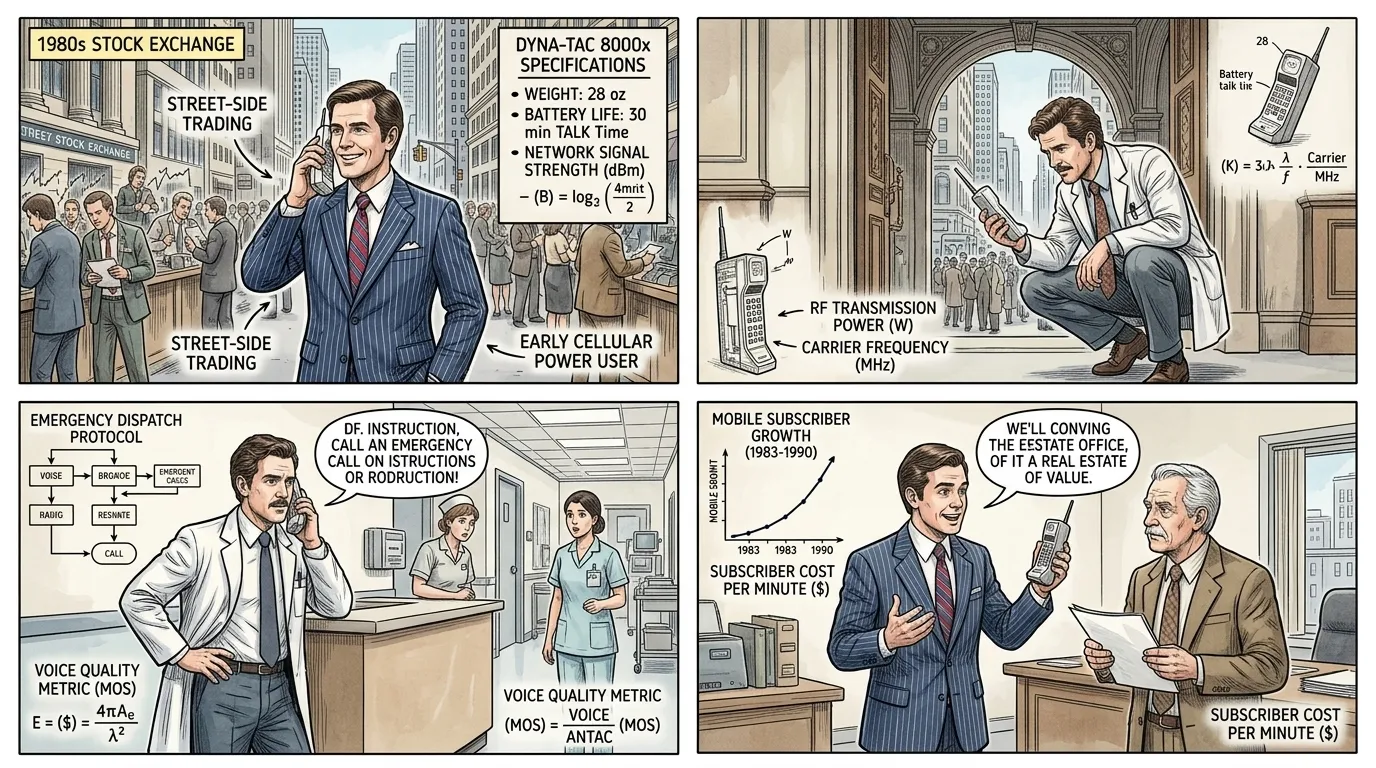
Upon its commercial release in 1983, the DynaTAC 8000x was an expensive luxury, primarily adopted by business executives and high-net-worth individuals. It quickly became a potent status symbol, signaling wealth, influence, and a cutting-edge approach to communication.
""This phone is more than a convenience; it's a competitive advantage," declared a sharply dressed executive in a 1980s power suit, taking a call outside a bustling stock exchange. "I can close deals from my car, manage teams remotely, and stay connected to clients no matter where I am." Across town, a doctor, making a house call, reassured a colleague via the DynaTAC: "I'm always reachable now. It's transformed my response time for emergencies." This widespread adoption by professionals underscored its immediate value, establishing it as an indispensable tool for those who needed constant, untethered connectivity."
Page 9
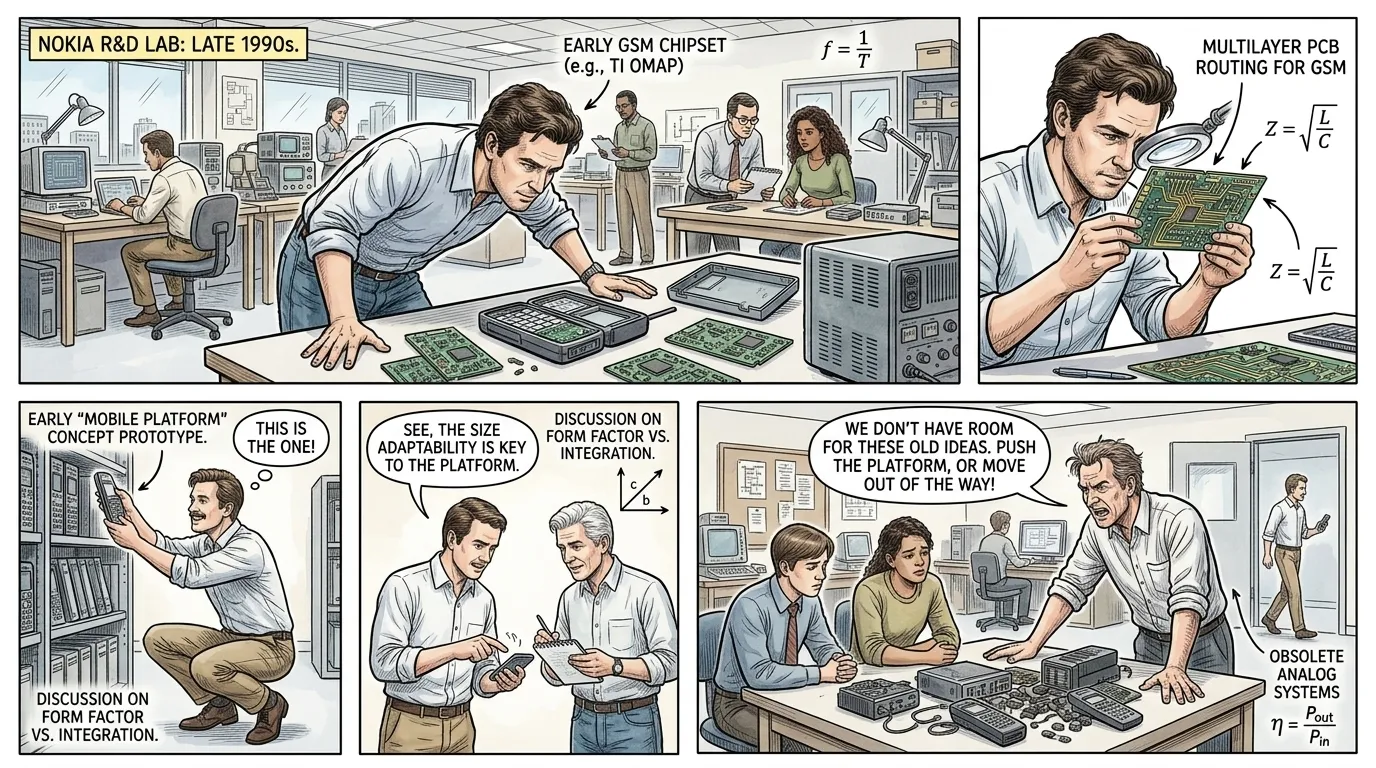
The mobile phone's initial analog '1G' phase was soon superseded by digital '2G' technologies like GSM, enabling greater capacity, better call quality, and rudimentary data services like SMS. This shift fueled an explosion in global adoption, moving the mobile phone from niche luxury to widespread utility.
""The transition to digital networks, particularly GSM, was a game-changer," asserted a Nokia engineer in the late 1990s, reviewing circuit diagrams. "It allowed for exponential growth in subscriber numbers and opened the door to new functionalities beyond just voice calls, like text messaging." An Ericsson product manager added, "We're no longer just selling a phone; we're selling a platform. Miniaturization allows us to pack more features into smaller, more affordable devices, truly democratizing mobile communication across continents." This relentless innovation meant phones shrank, battery life improved, and features multiplied, paving the way for the smartphone revolution."
Page 10
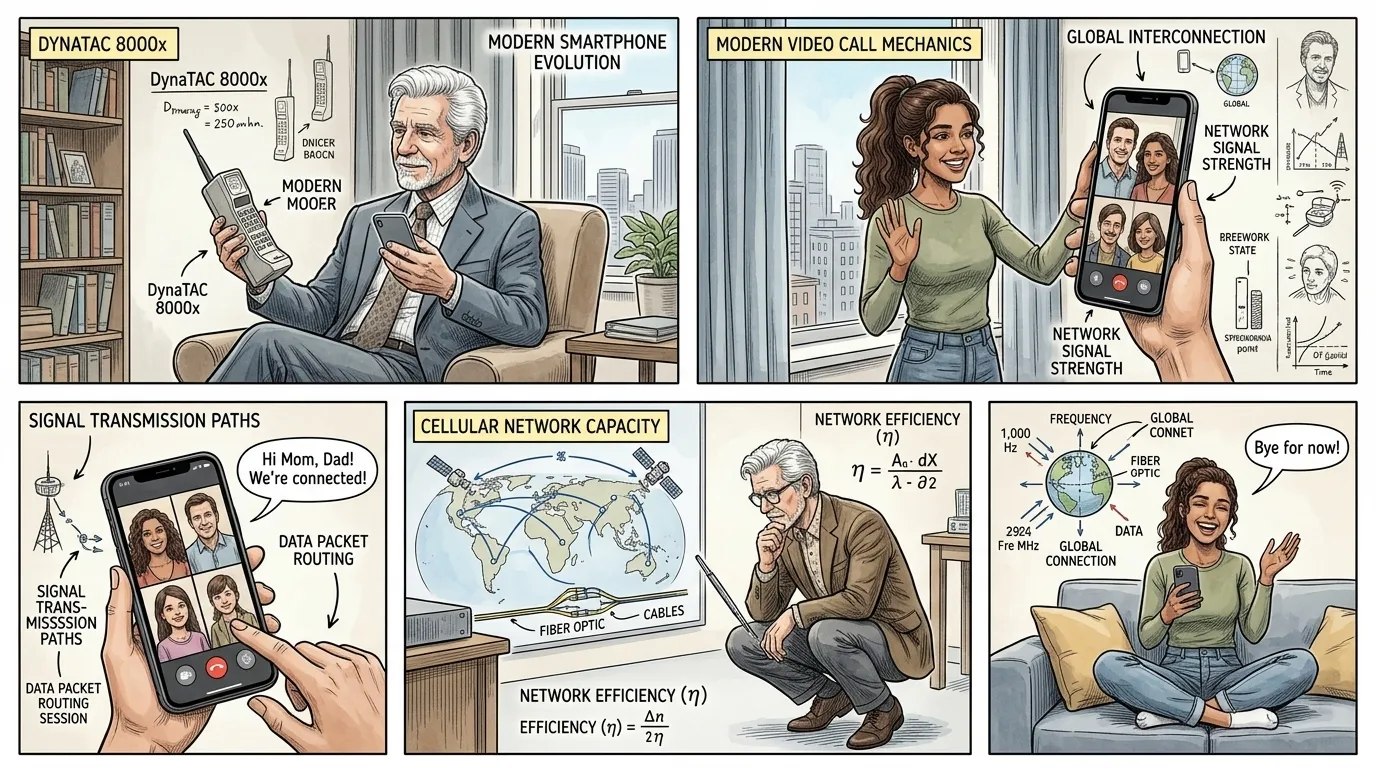
From a heavy 'brick' to a pocket-sized supercomputer, the mobile phone's evolution has been nothing short of astounding. It has profoundly reshaped every facet of human existence, transcending its initial purpose to become an indispensable tool for communication, information, commerce, and connection across the globe.
"Looking back, Martin Cooper mused in a recent interview, "We always dreamed of a personal communicator, but the sheer breadth of its impact, the way it has interwoven itself into the very fabric of global society, is truly humbling." A young woman, video-calling her parents from across the ocean, declared, "It's not just a phone; it's my connection to everything: family, friends, work, knowledge, safety. It's an extension of myself." The mobile phone, once a symbol of luxury, now stands as a testament to human ingenuity's power to create a truly interconnected world, a constant companion in the digital age."
About this story
- Location: Global
- Audience: general readers
Questions and answers
Read Wonder Inventions on your phone
Wonder Inventions is available on Android. Get Wonder Inventions on Google Play.