Machine Learning System
Machine Learning System — an illustrated inventions story, set in Global. 10 illustrated pages, free to read on Wonder Inventions.
Page 1
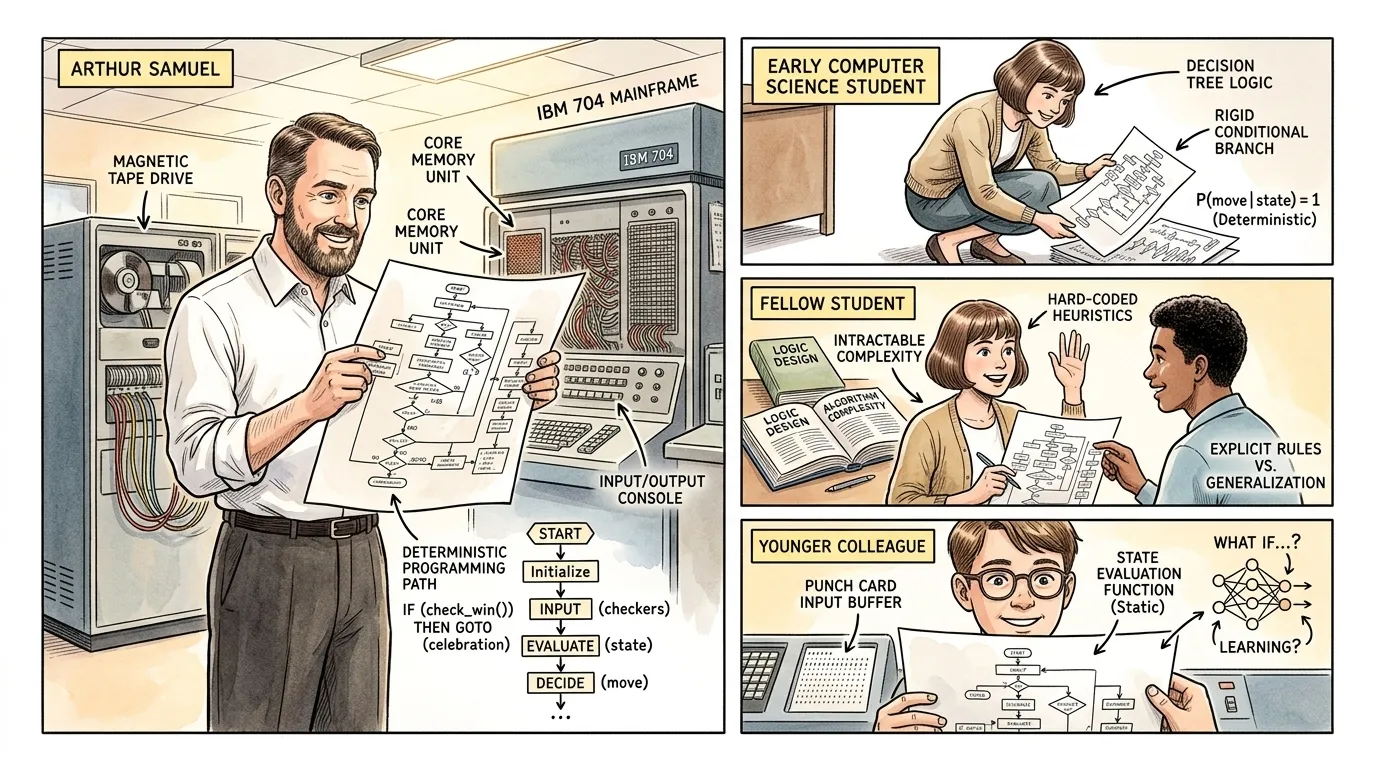
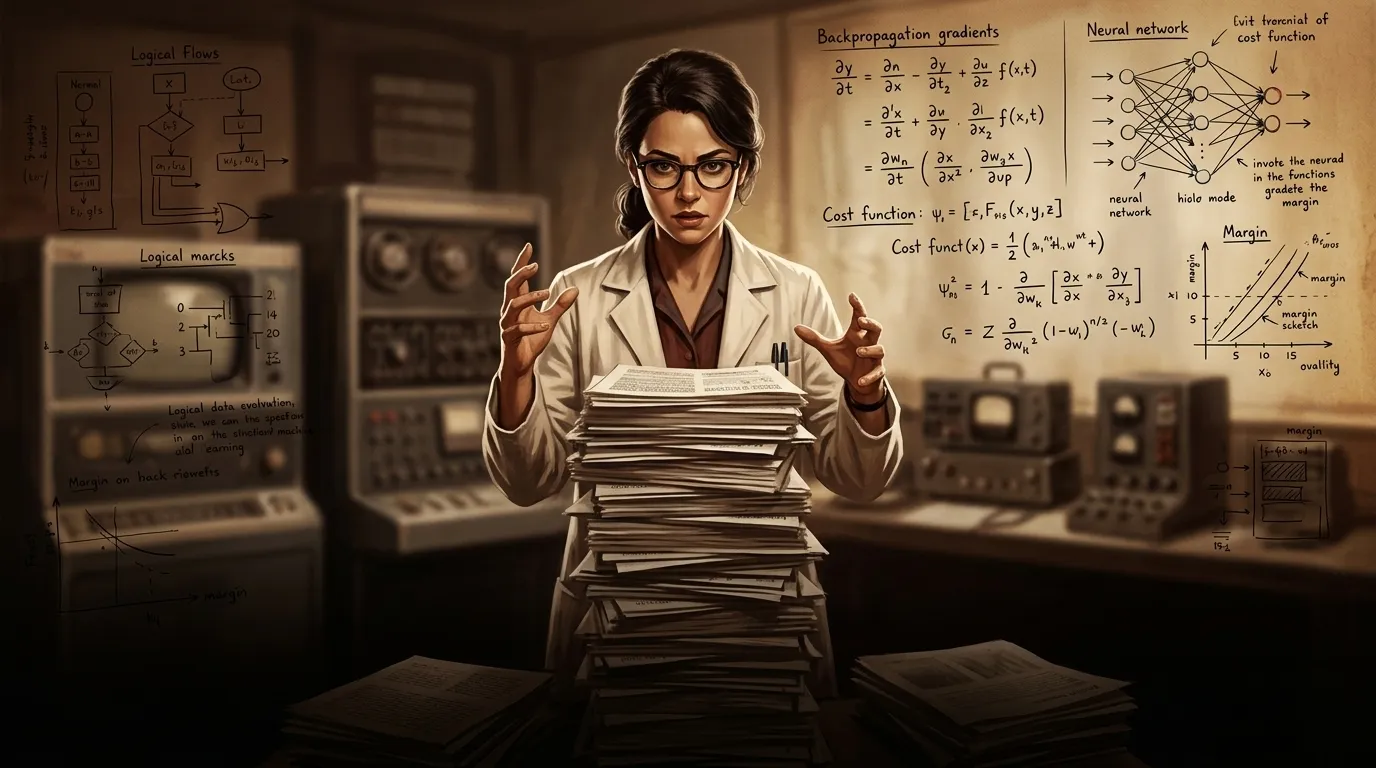
Before the advent of machine learning, computers were strictly logical machines, executing instructions precisely as programmed. Their power lay in rapid computation and deterministic output, yet this rigidity was also their fundamental limitation. For tasks requiring adaptation, pattern recognition, or nuanced decision-making, conventional programming struggled, demanding an exhaustive and often impossible enumeration of rules for every conceivable scenario.
Page 2
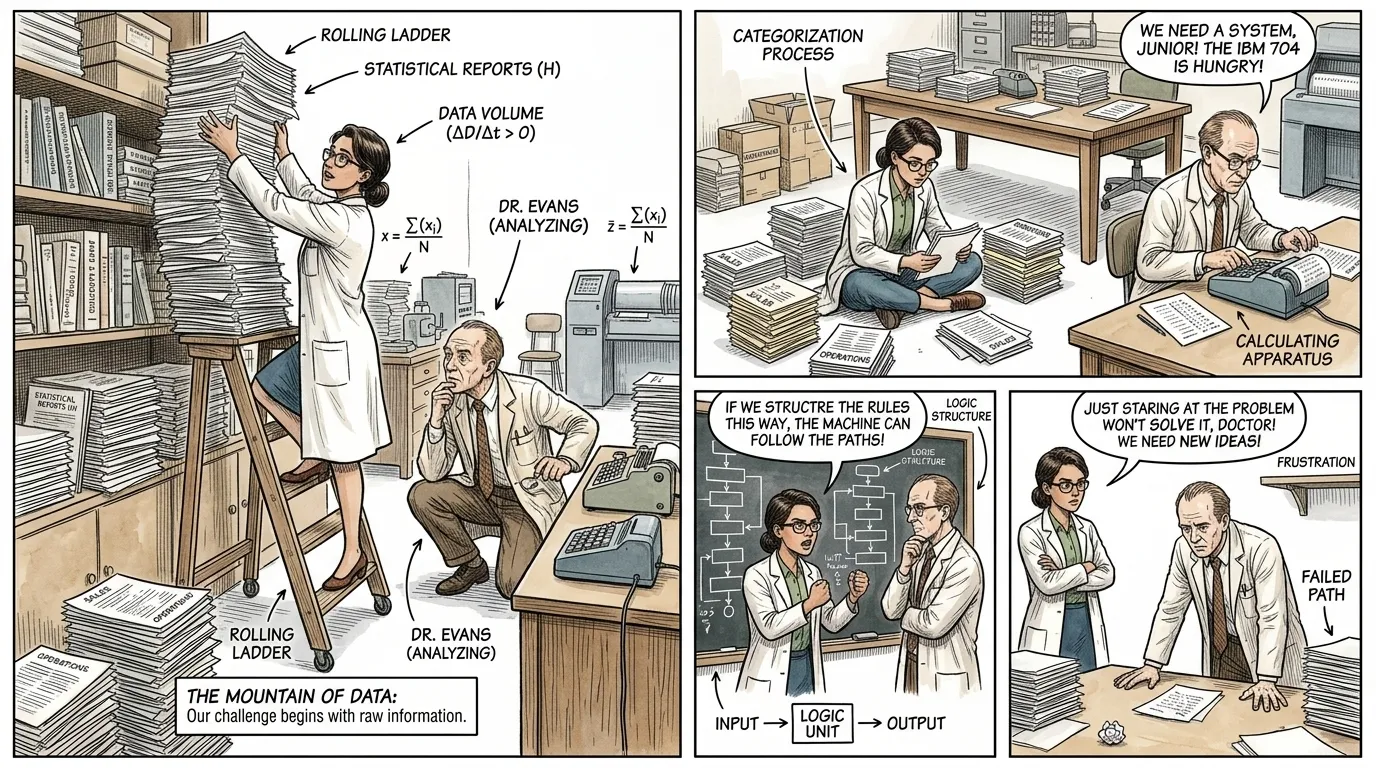
The mid-20th century saw an explosion of data, far outstripping human capacity for manual analysis and explicit rule definition. While humans effortlessly recognized faces, understood speech, and predicted trends based on subtle cues, programming computers to replicate this intuition proved profoundly difficult. Every pattern, every exception, every decision path had to be meticulously coded, rendering many complex problems intractable for deterministic systems.
"A junior researcher, a woman with dark, tied-back hair and glasses, clad in a professional 1950s-era lab coat, gestures emphatically at a towering stack of printed statistical reports. She turns to a senior male researcher, his brown hair thinning, wearing a similar lab coat, saying, 'This sheer volume of data overwhelms us, Dr. Evans. We need something that doesn't just calculate, but learns to generalize, much like a child grasping a new concept from just a few examples.'"
Page 3
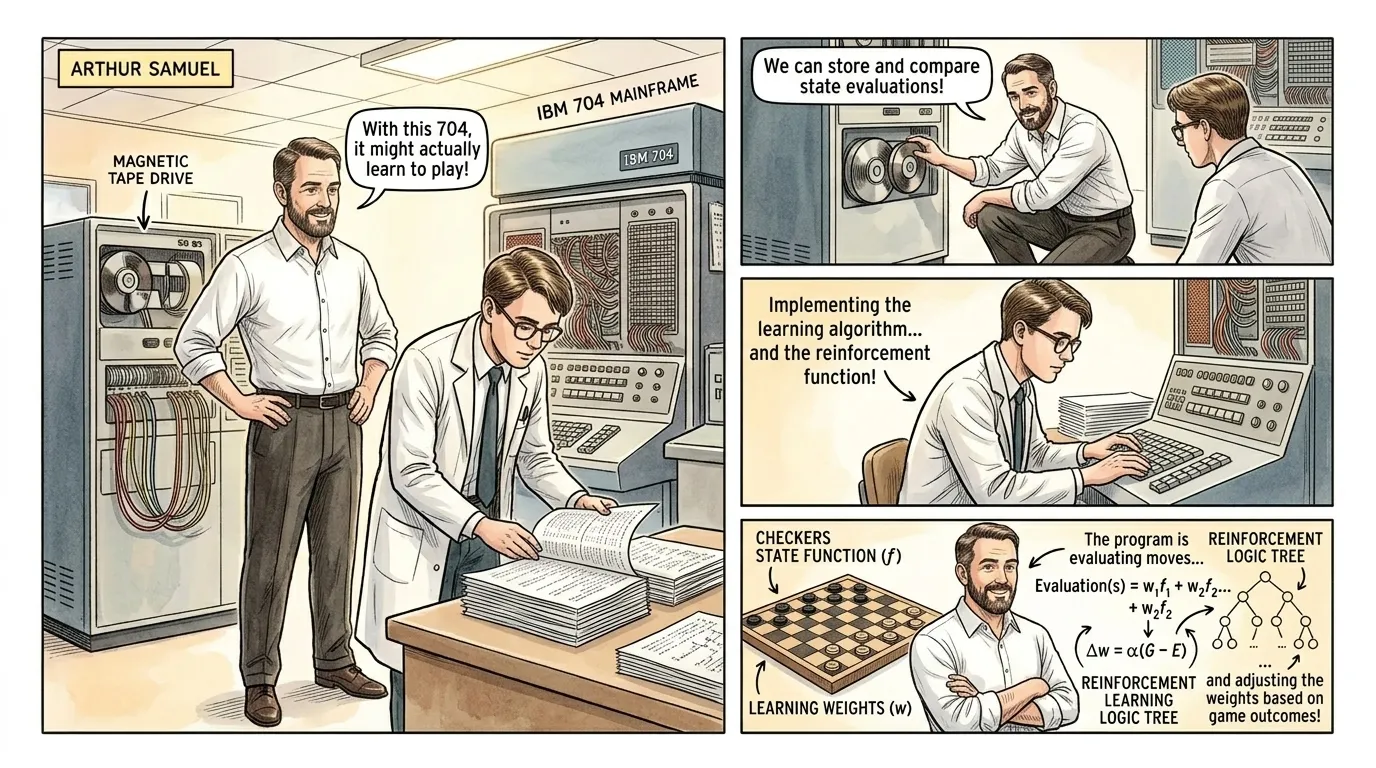
In 1959, IBM researcher Arthur Samuel made a groundbreaking leap. Instead of programming a computer with every possible checkers move and counter-move, he envisioned a program that could learn by playing against itself. His goal was to create a system that could assess board states, make moves, and crucially, improve its strategy through repeated experience, marking a definitive departure from purely deterministic computation.
"Arthur Samuel, a confident man in his late 40s with a neatly trimmed beard, in a crisp white shirt and dark trousers, stands beside a large IBM 704 mainframe, its panels glowing. He looks at a colleague, a younger man with spectacles poring over printouts. Samuel states with quiet determination, 'The challenge isn't just winning a game. It's building a machine that improves its game. We must teach it to evaluate, to adapt, not just to follow preset rules.'"
Page 4
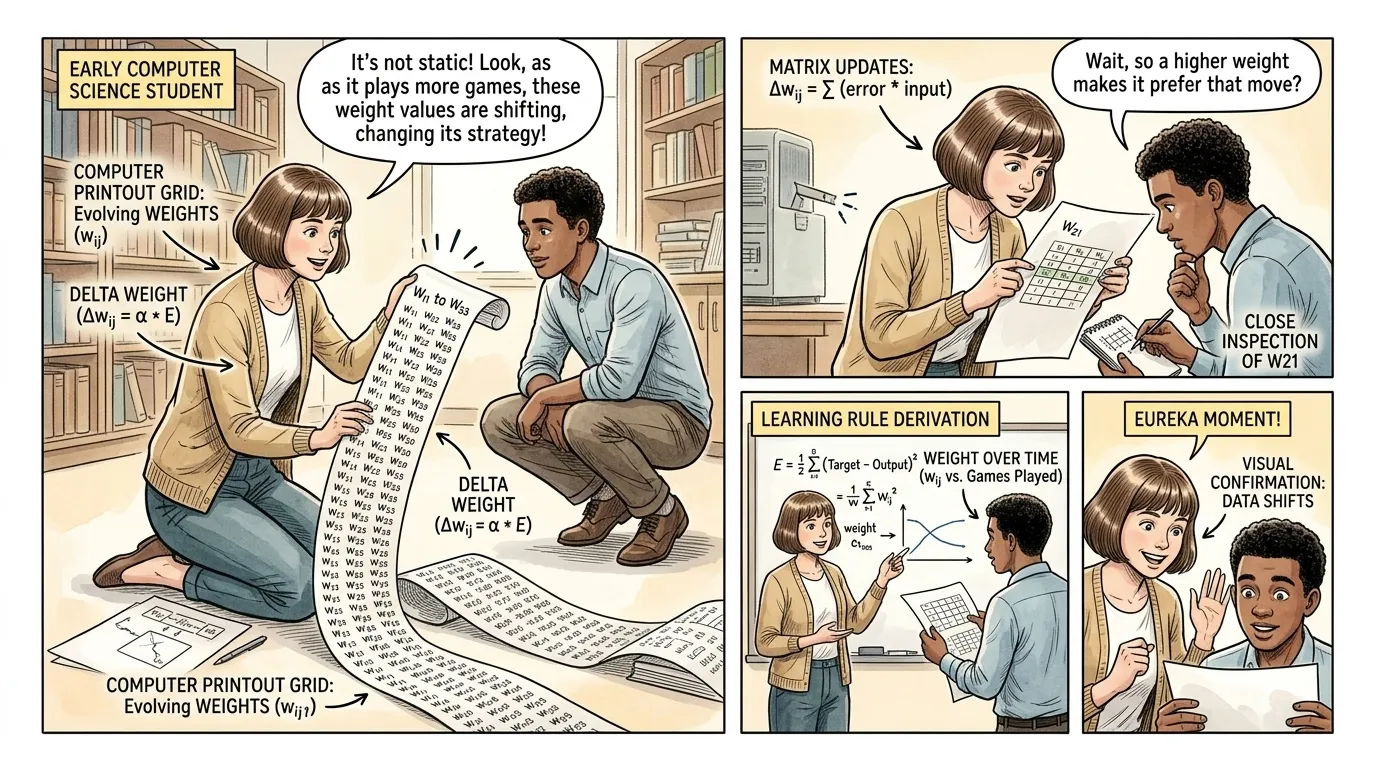
Samuel's program learned using an 'evaluation function' that assigned a numerical score to different board configurations based on various features: piece count, mobility, king advantage. Crucially, the program adjusted the 'weights' associated with these features over thousands of games. If a move led to a win, the weights for the features contributing to that win were strengthened; if it led to a loss, they were weakened. This iterative self-correction was the genesis of machine learning.
"An early computer science student, a young woman with a short bob and a focused expression, wearing a simple cardigan, points to a printout of the program's evolving 'weights.' She explains to a fellow student, 'See here? After thousands of games, the program no longer relies on explicit human instruction for every move. It has learned which board states are more valuable by adjusting these numerical weights. It's like it's developing its own intuition.'"
Page 5
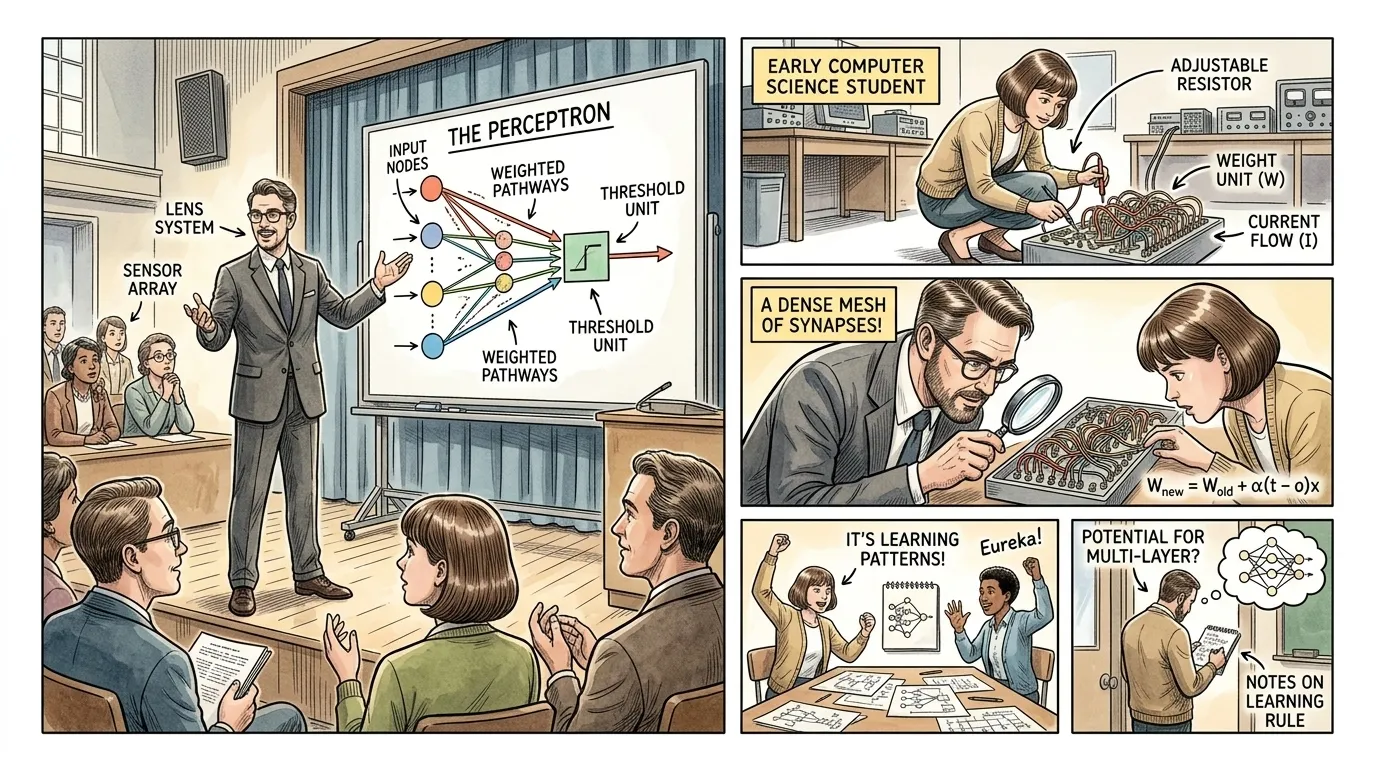
Concurrently, Frank Rosenblatt, inspired by the biological brain, developed the Perceptron in 1957. This was an algorithm for a simple neural network capable of learning to classify patterns. It comprised input nodes connected to an output node, with each connection having an adjustable 'weight.' The Perceptron learned by processing input patterns, comparing its output to the desired result, and then iteratively adjusting these weights to reduce error, mimicking a neuron's plasticity.
"Frank Rosenblatt, a charismatic man with dark, swept-back hair, wearing a suit and glasses, gestures passionately at a large diagram. He says to a group of attentive colleagues, 'This isn't just computation; it's an attempt to model fundamental learning. The Perceptron shows us that a machine can adapt its internal connections, its 'synaptic weights,' to distinguish between different inputs. It makes its own decisions, learning from its mistakes to refine its internal pathways.'"
Page 6
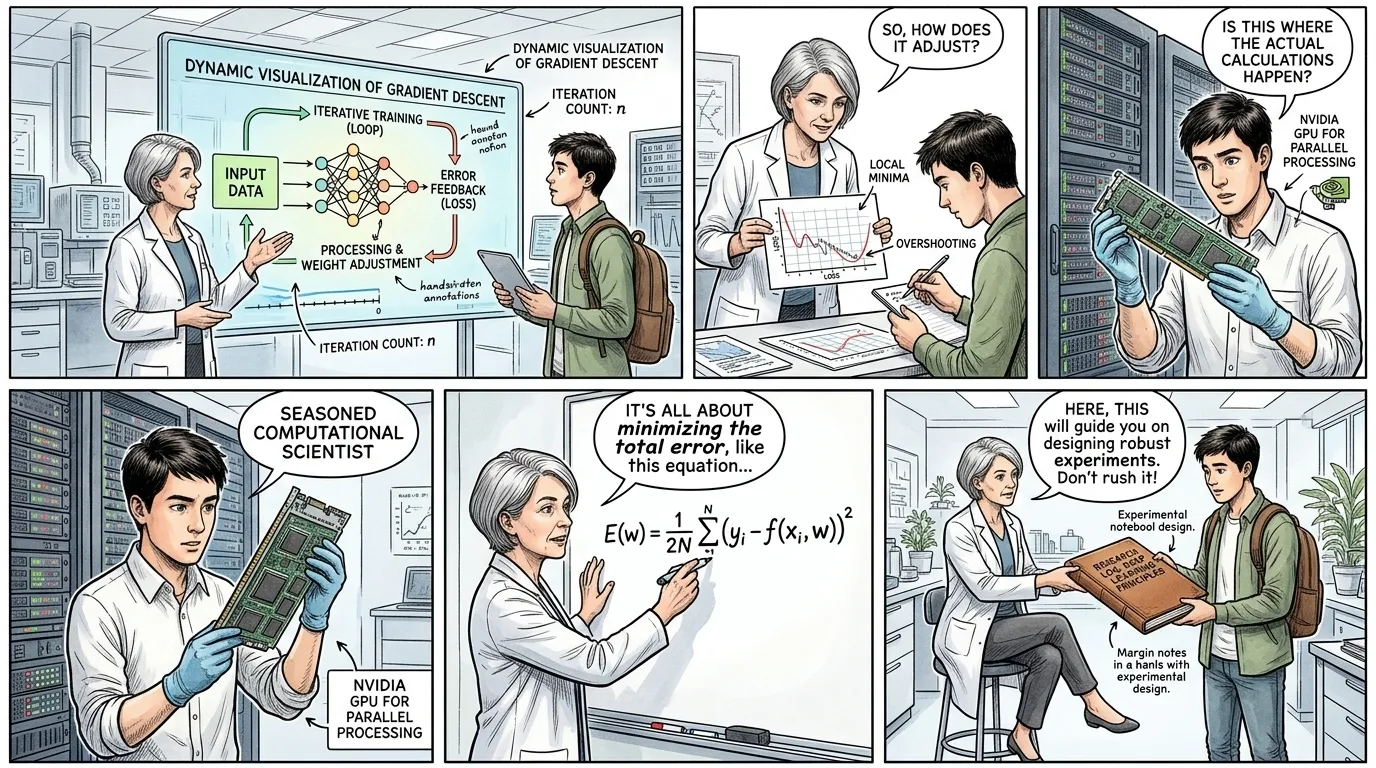
The common thread uniting these early efforts was the 'iterative training loop.' Regardless of the specific algorithm or task, the fundamental mechanism involved a repetitive cycle: a model processes input data to make a prediction; this prediction is compared against the true outcome, generating an error signal; this error then drives an adjustment to the model's internal parameters (weights, biases). This continuous refinement allowed the system to incrementally improve its performance and 'learn' complex relationships within the data.
"A seasoned computational scientist, a woman with short, practical grey hair and a lab coat, gestures toward a dynamic visualization on a large screen in a modern data lab. She explains to a visiting research student, 'This visual demonstrates the core principle. The system isn't just calculating; it's constantly self-correcting. Each cycle, it gets a tiny bit better, refining its understanding based on feedback. That's the essence of the training loop.'"
Page 7
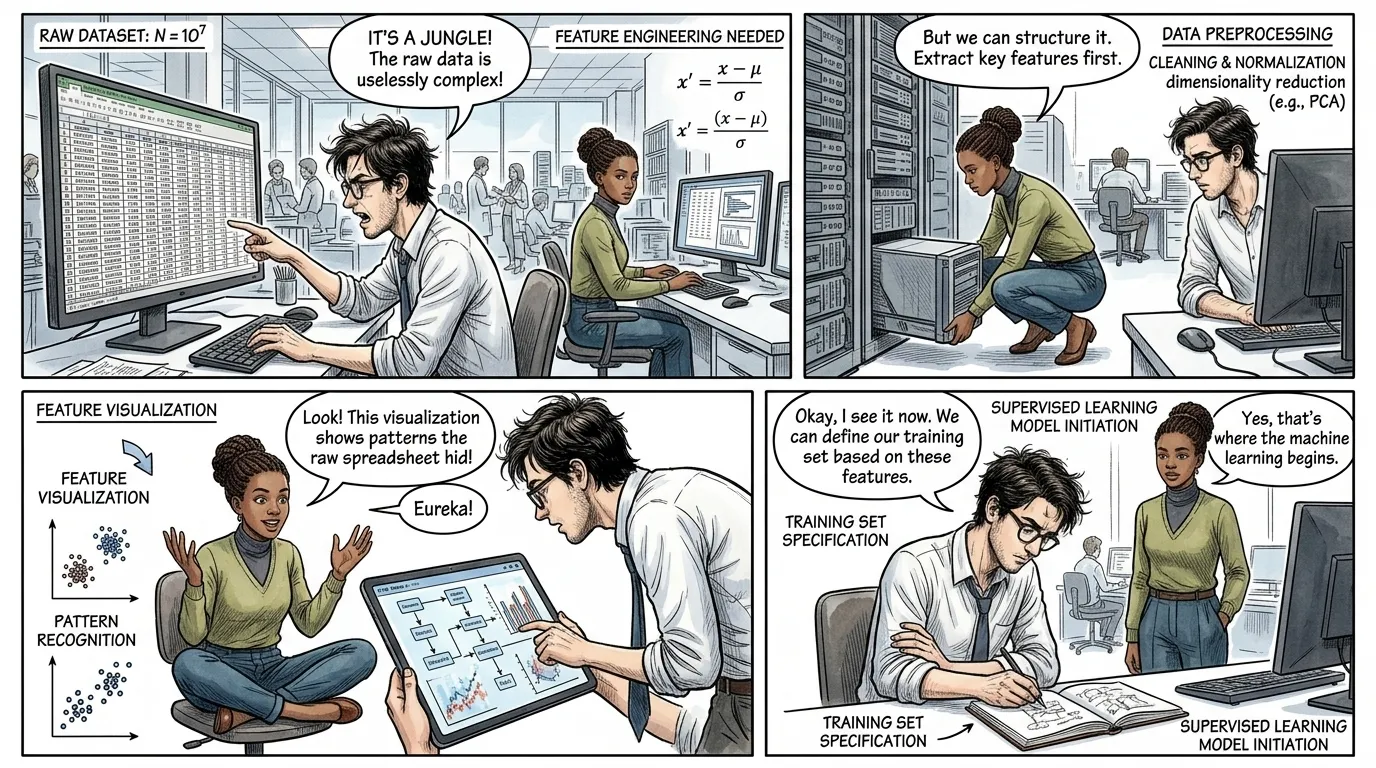
Despite the promise of learning machines, early systems often required immense human effort in 'feature engineering.' Data scientists had to meticulously identify, extract, and transform relevant characteristics from raw data into a format suitable for the model. For instance, classifying images required humans to define features like 'edge detectors' or 'corner detectors.' This manual pre-processing was a bottleneck, limiting the complexity and autonomy of the learning process.
"A frustrated data analyst, a young man with disheveled dark hair and glasses, taps impatiently on a complex spreadsheet of raw sensor data on his monitor. He turns to his colleague, a focused woman with a neatly braided bun, in a lab setting, exclaiming, 'We spend more time manually extracting and shaping these 'features' than the machine spends learning! As the great physicist Richard Feynman once observed, 'What I cannot create, I do not understand.' For a long time, we had to create the features for our models, but true understanding would come when the machines could create their own understanding from the raw data itself.'"
Page 8
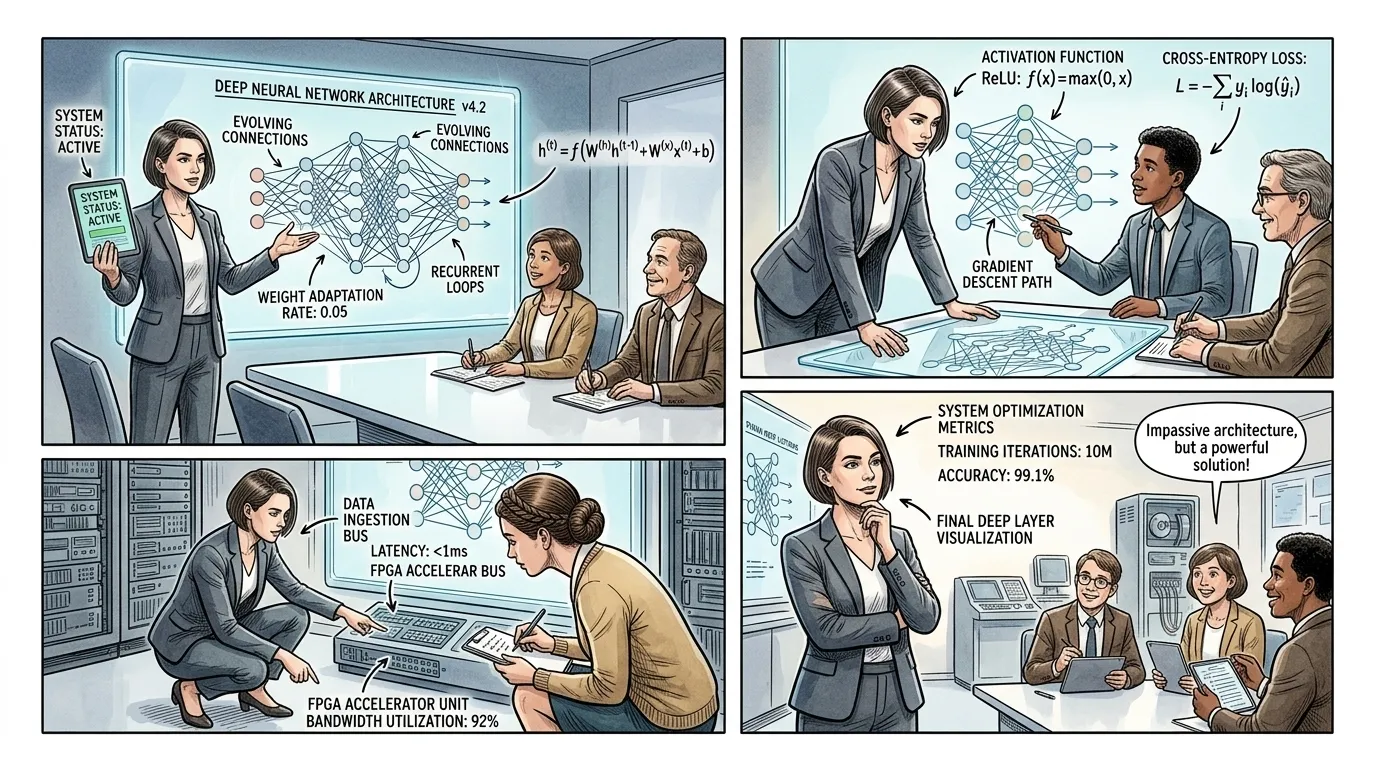
Decades of relentless research, coupled with exponential increases in computational power and massive datasets, led to the 'deep learning' revolution. Multi-layered neural networks, inspired by the brain's hierarchical processing, emerged as a paradigm shift. These systems could learn intricate, abstract features directly from raw data, without explicit human engineering. Each layer transformed input into increasingly complex representations, enabling unprecedented generalization and accuracy across vast and varied domains.
"A lead AI architect, a woman with sleek, modern short hair, in a smart blazer, stands before a large, transparent display showcasing a dynamically evolving deep neural network architecture. She explains to a panel of executives, 'This architecture isn't just processing; it's discovering. The system itself learns the optimal representations from raw data, layer by layer. It truly allows the system to 'generalize' in ways those early researchers only dreamed of, learning from the data itself, just as was once hoped.' She gestures towards the intricate connections."
Page 9
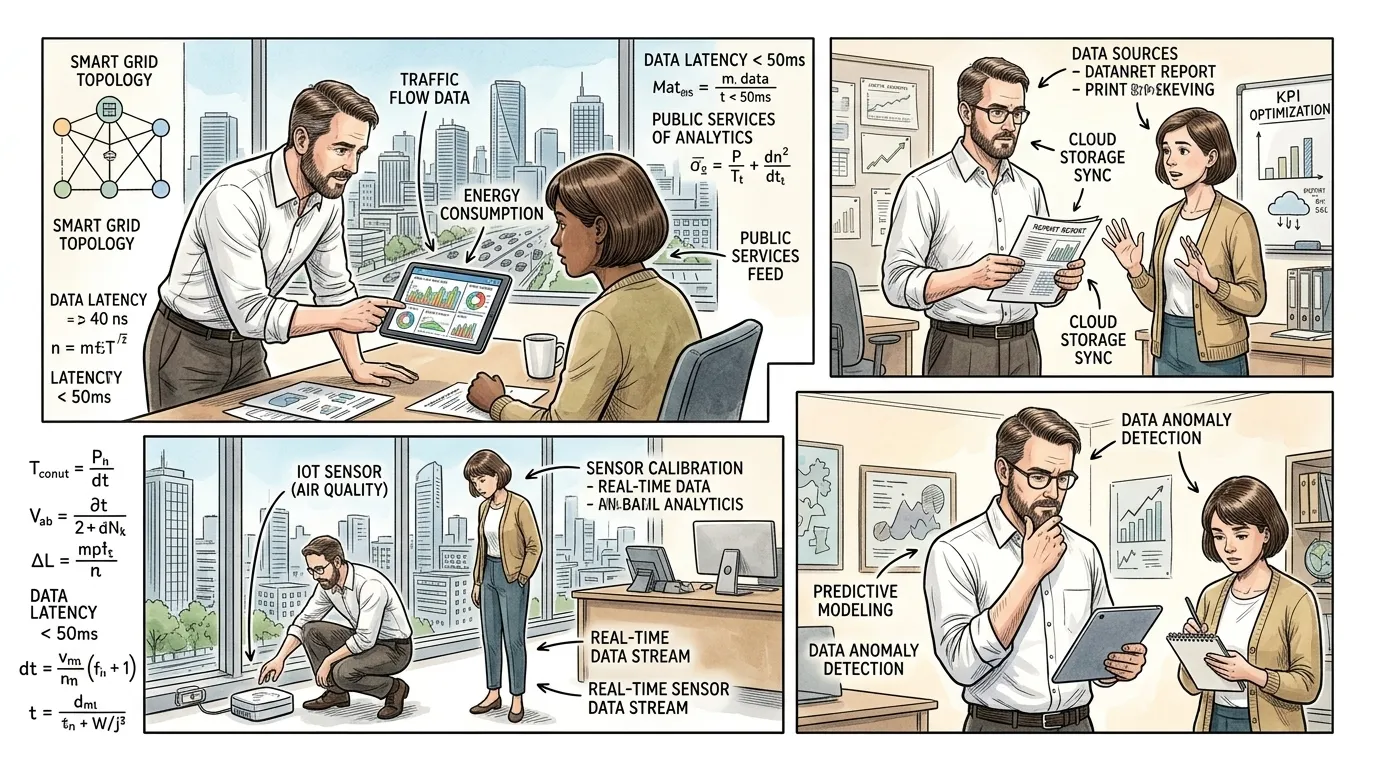
The capabilities unlocked by advanced machine learning systems led to their pervasive adoption across virtually every industry. From powering recommendation engines that personalize our online experiences to enabling sophisticated medical diagnostics, fraud detection, and autonomous navigation, machine learning became an indispensable tool. It allowed organizations to derive actionable insights from colossal datasets, automate complex tasks, and create intelligent systems previously confined to science fiction.
"A project manager, a man in a crisp shirt, looks at his tablet, which displays real-time analytics for a smart city initiative. He remarks to a colleague, 'It's astonishing how rapidly this technology has integrated into our daily lives. Just a decade ago, this level of predictive analysis and automation was unimaginable. Now, it's optimizing everything from traffic flow to energy grids.'"
Page 10
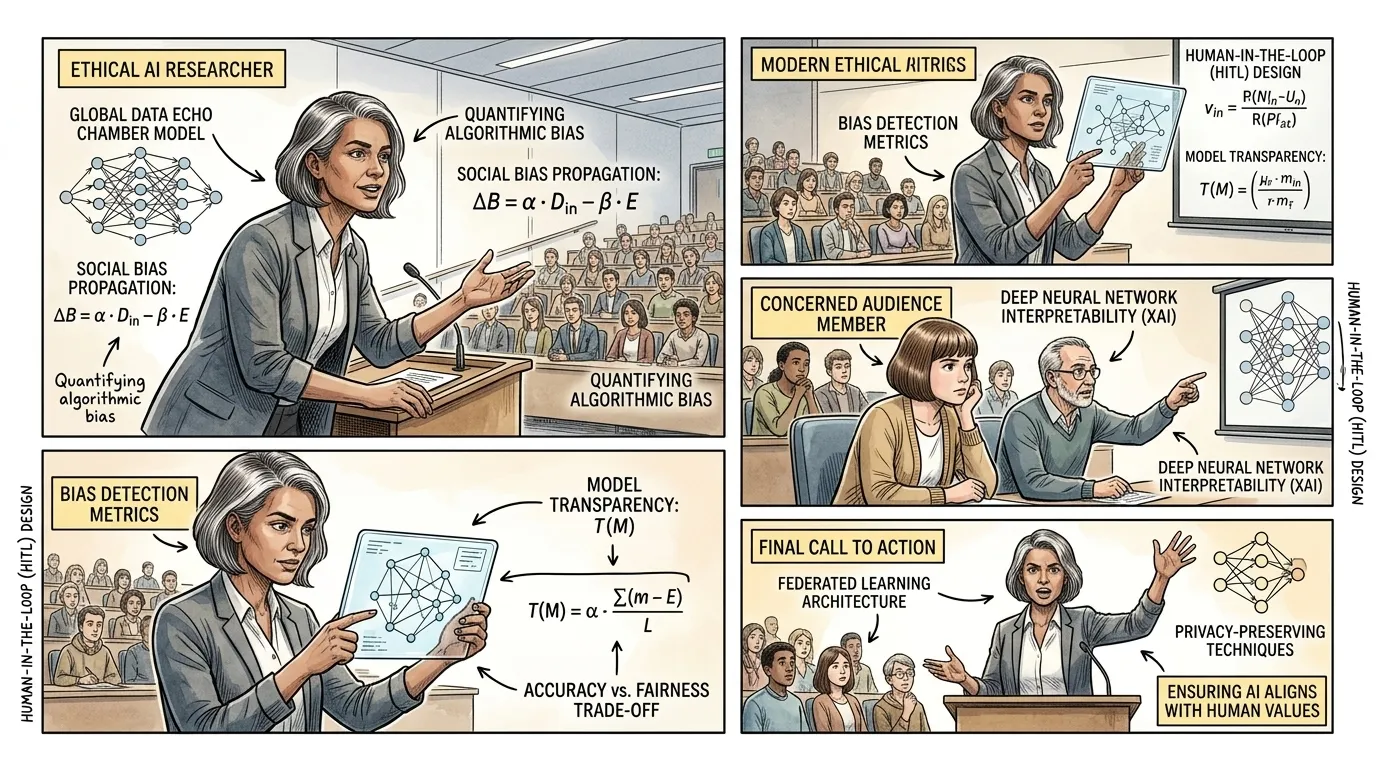
Today, machine learning continues its rapid evolution, driving breakthroughs in generative AI, scientific discovery, and human-computer interaction. Yet, its transformative power brings profound ethical considerations: the potential for algorithmic bias, the imperative for model explainability, the societal impact on employment, and the paramount need for responsible governance. The journey from Samuel's checkers program to today's complex neural networks is a testament to human ingenuity, presenting both immense promise and critical challenges for the future.
"An ethical AI researcher, a woman with a thoughtful expression and silver streaks in her dark hair, stands before a large, public forum. She addresses the audience, stating, 'As we push the boundaries of machine intelligence, we must simultaneously deepen our commitment to ethical frameworks. The intelligence we build must be transparent, fair, and accountable. Our greatest invention demands our greatest responsibility.'"
About this story
- Location: Global
- Audience: general readers
Questions and answers
Read Wonder Inventions on your phone
Wonder Inventions is available on Android. Get Wonder Inventions on Google Play.