Solar Cell
Solar Cell — an illustrated inventions story, set in Global. 10 illustrated pages, free to read on Wonder Inventions.
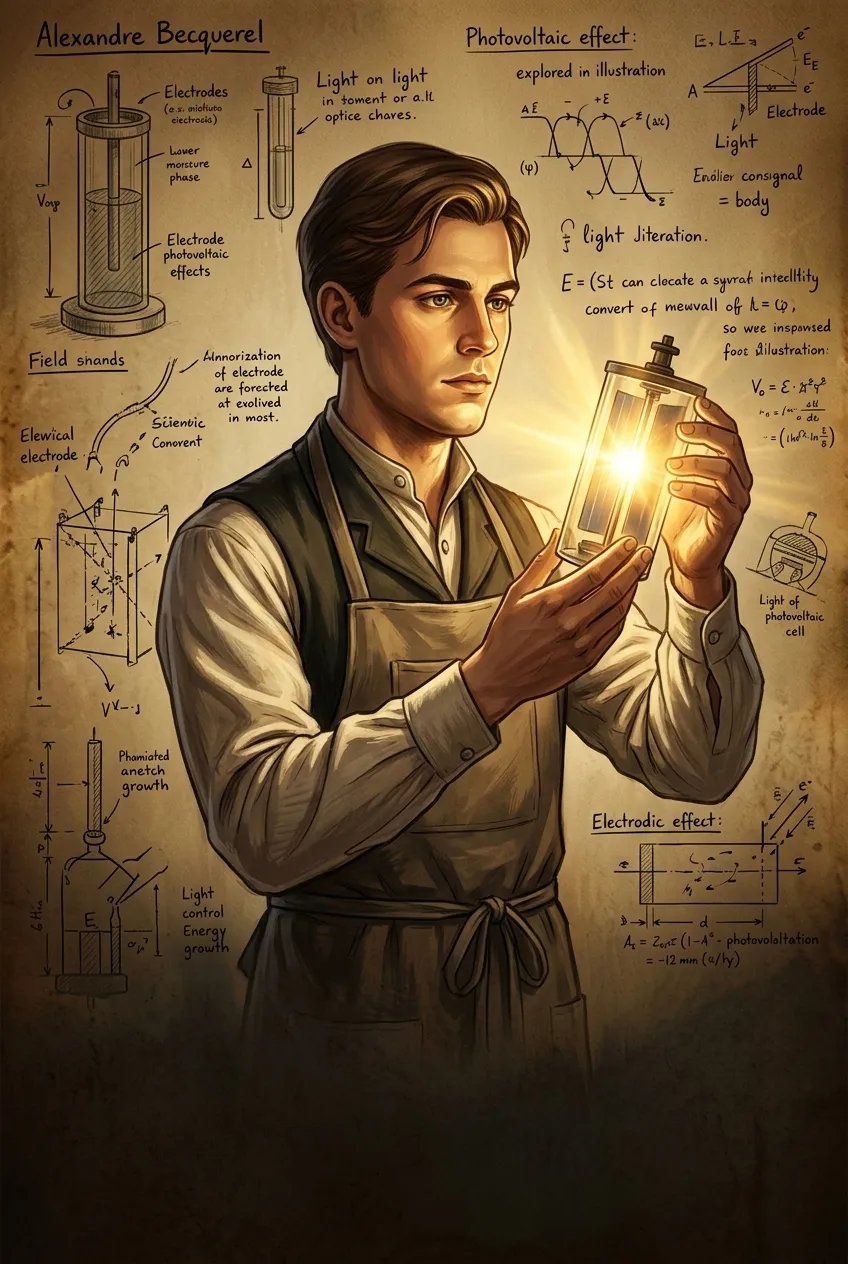
Page 1
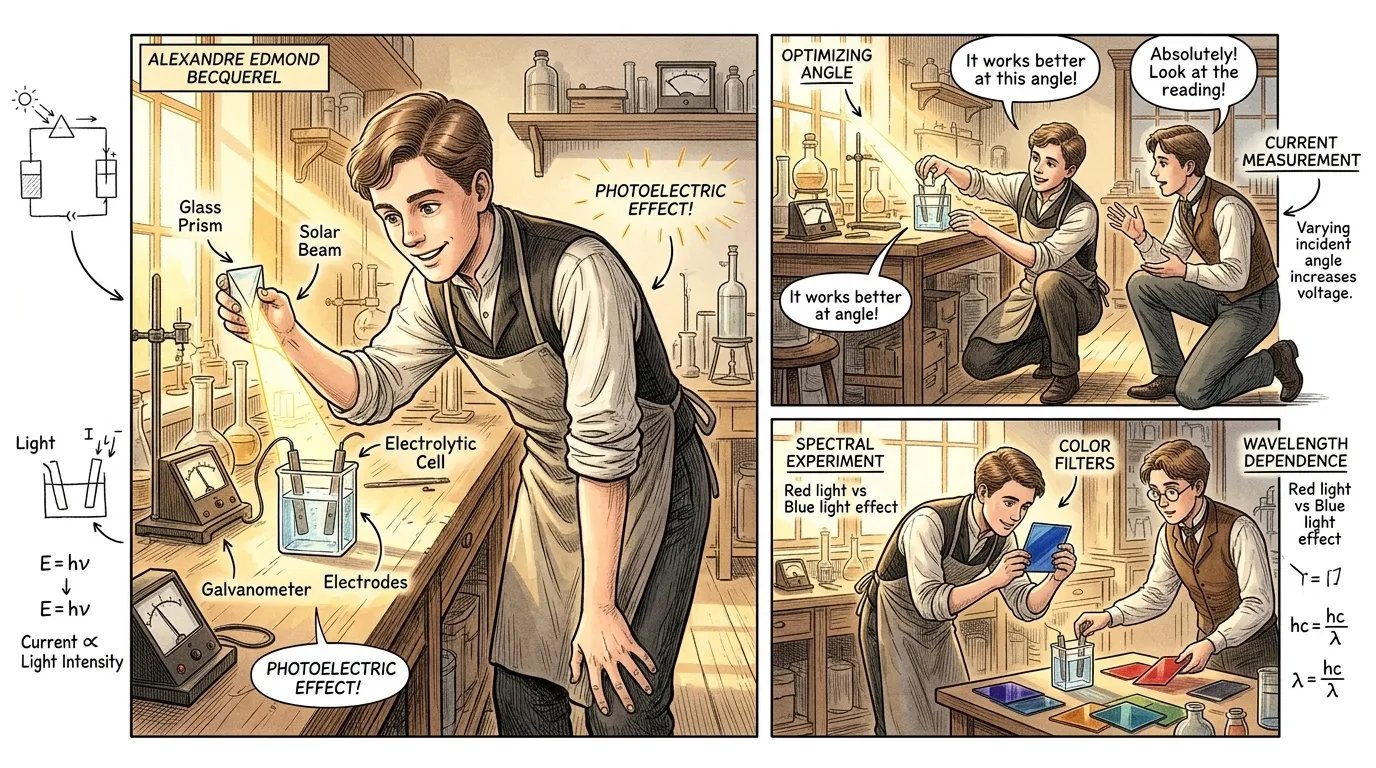
Before the advent of widespread electrical grids, humanity relied on sporadic energy sources, often burning fuels or harnessing hydro-power locally. The dream of clean, direct electricity from an omnipresent, celestial source seemed a distant fantasy. Yet, a fundamental discovery in 1839 by the French physicist Alexandre Edmond Becquerel laid the groundwork for a revolution. Working in his father's laboratory, Becquerel observed an astonishing phenomenon: when he illuminated an electrolytic cell with sunlight, the current between its electrodes increased, establishing the very first recognition of the photovoltaic effect.
Fact: Alexandre Edmond Becquerel's 1839 discovery of the photovoltaic effect marked the genesis of solar energy, revealing that certain materials could generate an electric current when exposed to light, a profound insight that would eventually redefine our relationship with energy.
Page 2
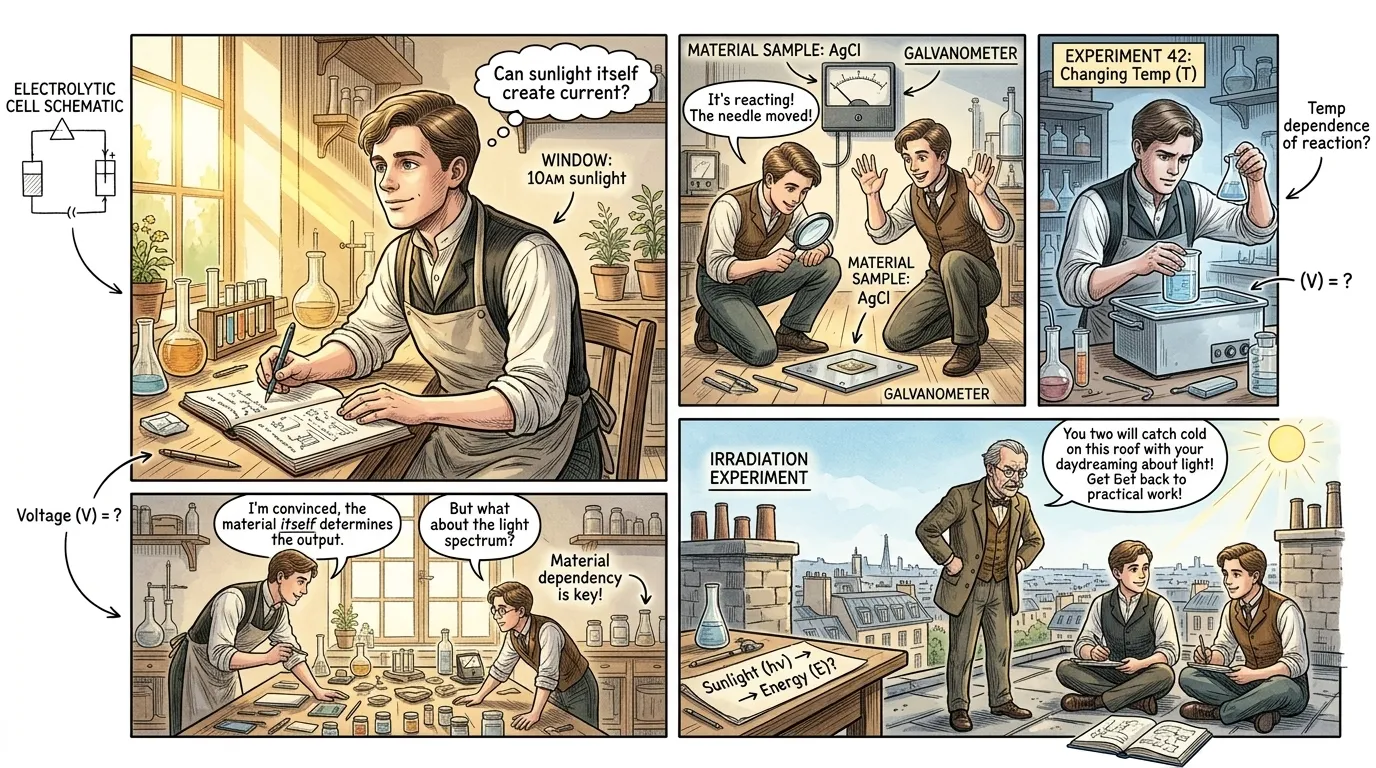
In Becquerel's experiments, the effect was subtle, yielding only a minuscule current, far from practical applications. He meticulously documented how different electrolytes and electrode materials influenced the generated electricity, identifying that certain substances were more responsive to light. This early, foundational understanding, though limited, opened a new avenue of scientific inquiry. It presented a compelling challenge: how to amplify this faint phenomenon into a usable power source.
"Becquerel often mused about the potential, perhaps quietly stating, 'The sun, a colossal furnace in the sky, could it truly fuel our future?'"
Fact: The initial discovery of the photovoltaic effect, while scientifically profound, yielded an electric current too small for practical use, prompting decades of research into more efficient materials and designs.
Page 3
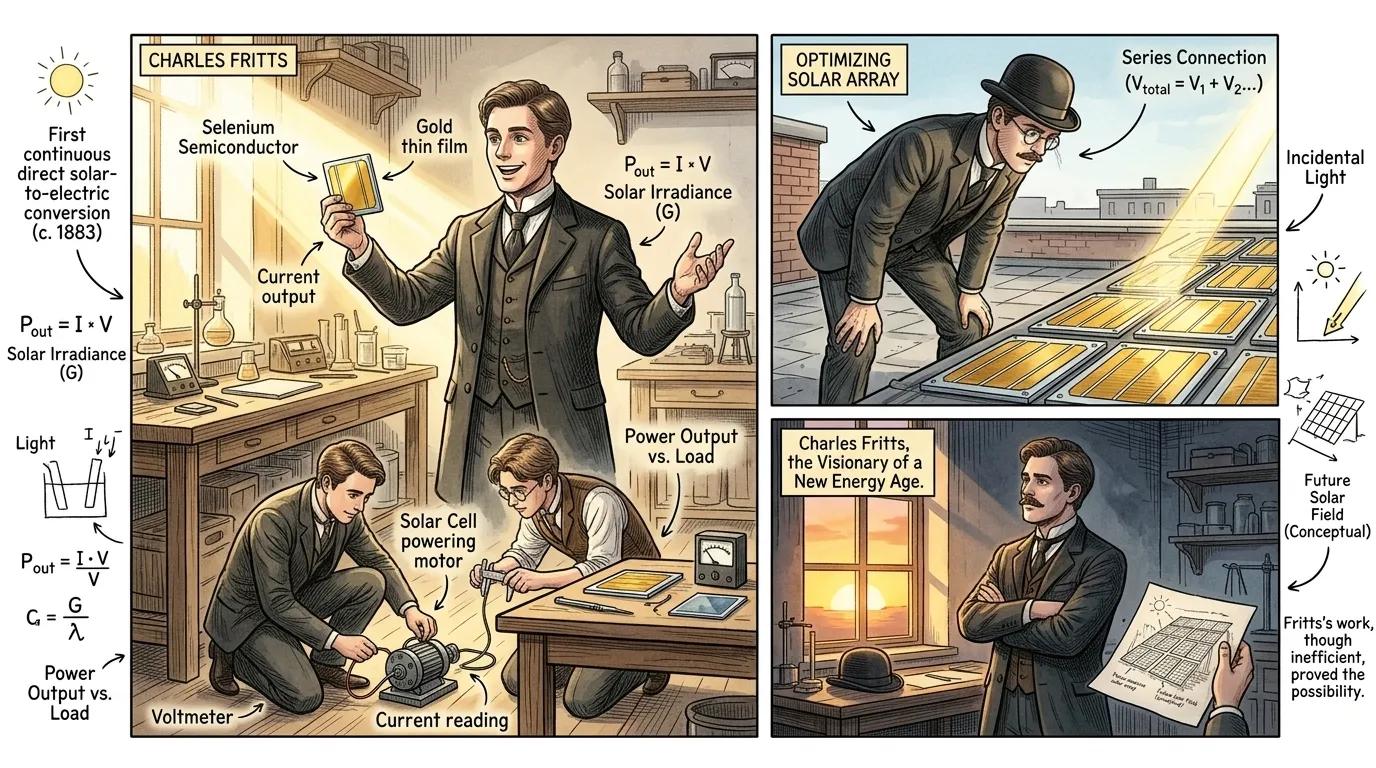
Decades after Becquerel's initial observation, the pursuit of a solid-state material to harness this effect intensified. In 1883, the American inventor Charles Fritts constructed the world's first true solar cell. He coated the semiconductor element selenium with a thin layer of gold, creating a junction where light could liberate electrons. Fritts achieved an efficiency of just 1-2%, insufficient for large-scale power but a monumental leap from the electrolytic cell, proving that a solid device could indeed convert light directly into electricity.
"Fritts, demonstrating his device, might have declared to observers, 'We are harnessing the sun directly! A boundless, clean energy source!'"
Fact: Charles Fritts' 1883 selenium cell represented the first solid-state photovoltaic device, achieving a groundbreaking, albeit low, efficiency of 1-2% and validating the potential for direct solar energy conversion.
Page 4
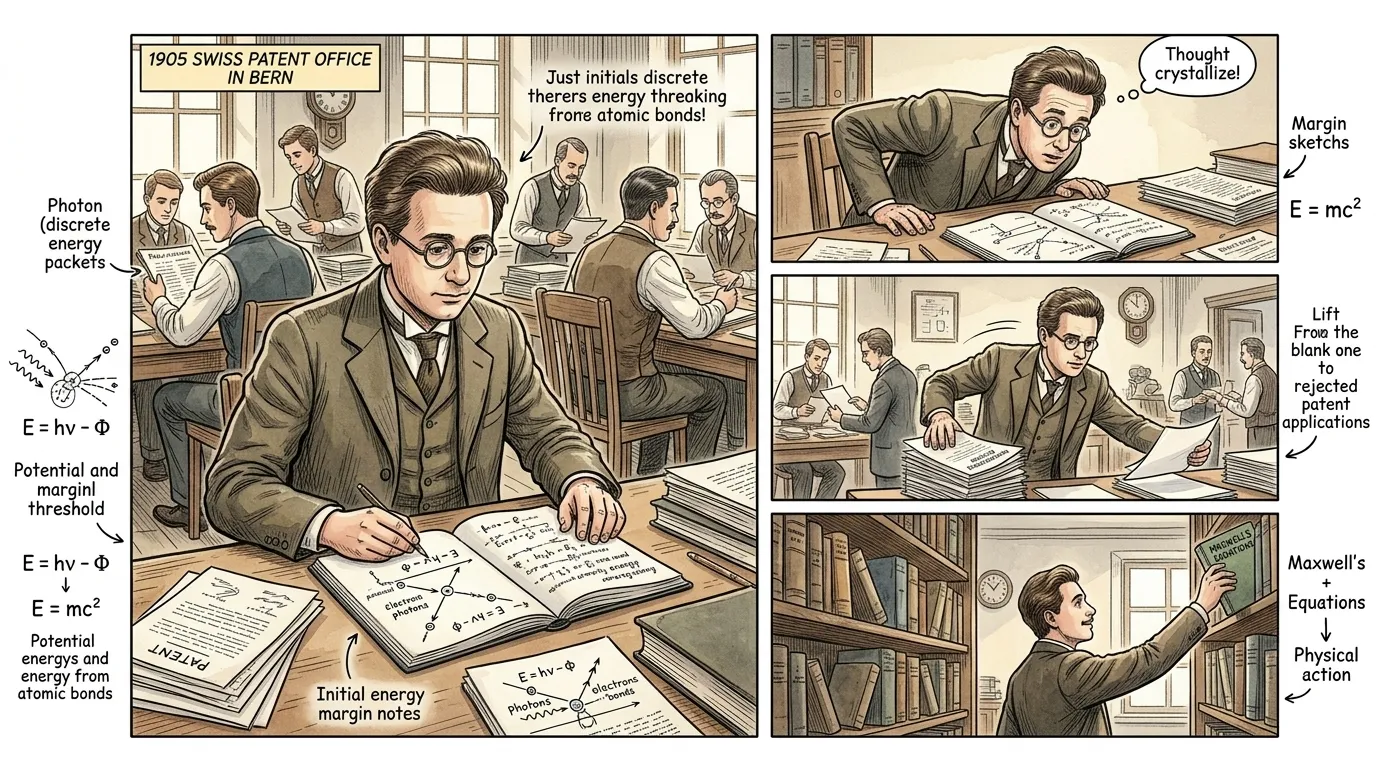
While Fritts demonstrated a working solar cell, the underlying physics of how light transferred energy to electrons remained a mystery. It was not until 1905 that Albert Einstein, then a relatively unknown patent clerk, provided a revolutionary theoretical explanation. His paper on the photoelectric effect proposed that light consists of discrete energy packets, or photons, which, when absorbed by an electron, can impart enough energy to free it from its atomic bond. This groundbreaking work earned him the Nobel Prize in Physics in 1921, providing the crucial theoretical framework that would guide future solar cell development. Einstein's profound insight into the quantum nature of light was the 'knowledge' that paved the way.
"As Albert Einstein once famously reflected, 'The important thing is not to stop questioning. Curiosity has its own reason for existence.' This ethos perfectly encapsulates the relentless pursuit of understanding the photoelectric effect."
Fact: Albert Einstein's 1905 explanation of the photoelectric effect, positing light as discrete photons, provided the critical theoretical underpinning for understanding how light energy is absorbed by materials to release electrons, a concept fundamental to solar cell function.
Page 5
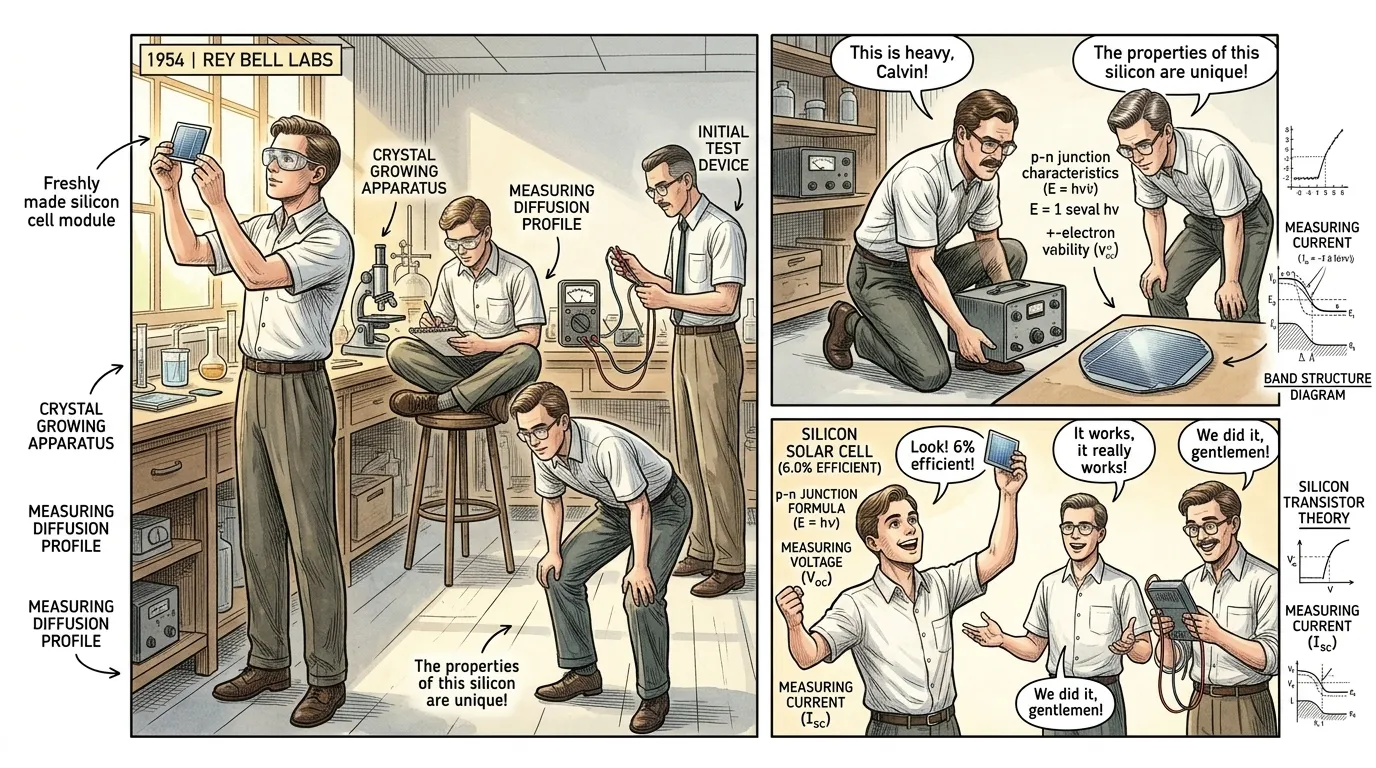
Despite Einstein's theoretical brilliance, practical solar cell efficiency remained stubbornly low for decades. The breakthrough that would finally unlock the solar cell's true potential came in 1954, at Bell Laboratories in New Jersey. Researchers Daryl Chapin, Calvin Fuller, and Gerald Pearson, while experimenting with silicon for transistors, discovered that silicon treated with impurities (doped) could achieve unprecedented efficiencies in converting sunlight to electricity. Their work resulted in the first silicon solar cell with a remarkable 6% efficiency, a pivotal moment that launched the modern photovoltaic era.
"Chapin, Fuller, and Pearson, in a joint announcement, might have exclaimed, 'We've harnessed the sun with unprecedented efficiency! This changes everything for remote power and beyond!'"
Fact: The 1954 Bell Labs team of Chapin, Fuller, and Pearson achieved a pivotal 6% efficient silicon solar cell by employing semiconductor doping techniques, transforming photovoltaics from a laboratory curiosity into a viable energy technology.
Page 6
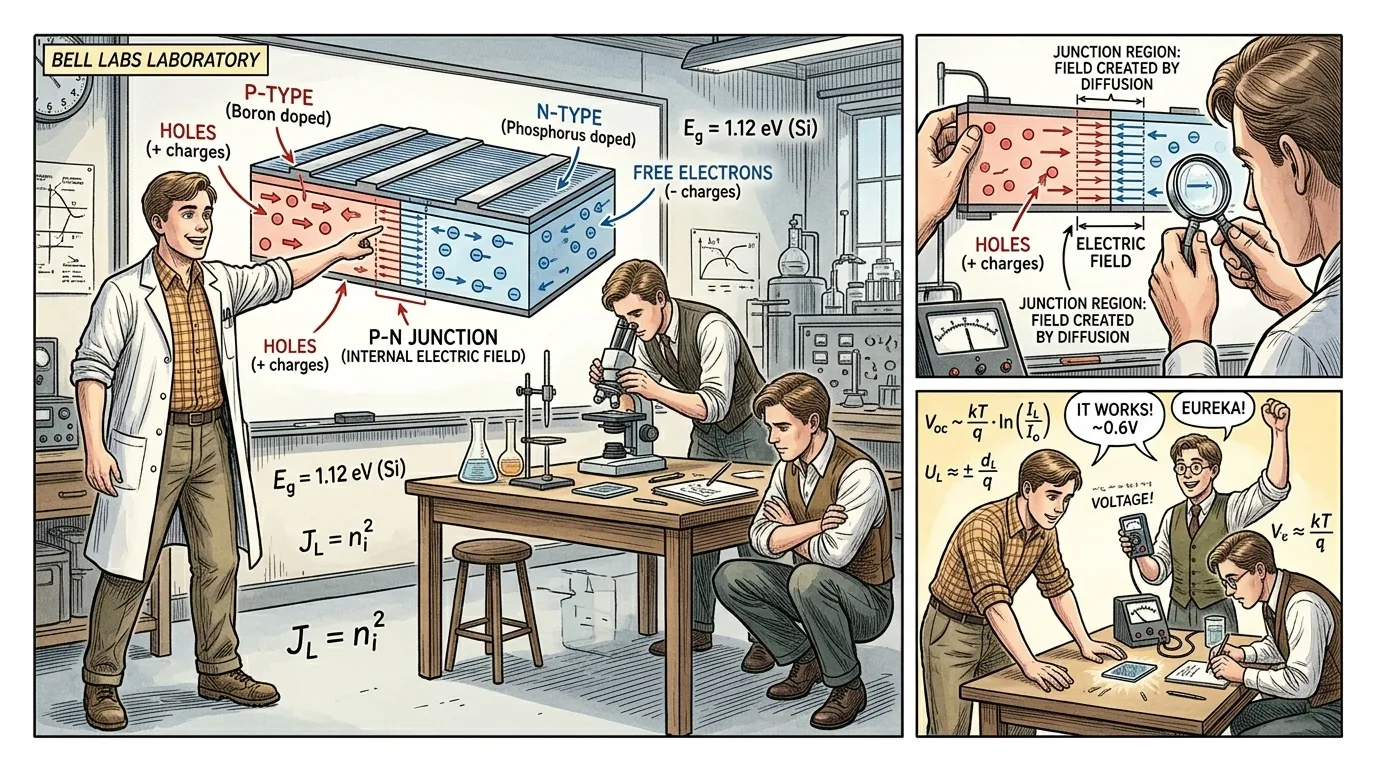
The genius of the Bell Labs cell lay in its precise engineering of the P-N junction within silicon. Silicon, a semiconductor, is 'doped' with impurities to create distinct electrical properties. One layer, the 'P-type' silicon, is doped with boron, creating a deficit of electrons, known as 'holes' (charge). The adjacent 'N-type' layer is doped with phosphorus, resulting in an excess of free electrons (- charge). At their interface, a powerful electric field forms, acting like a one-way gate for electrons. This ingenious structural design, the very 'specific, unique item' of knowledge built upon Einstein's theory, is the heart of the solar cell.
"Fuller, explaining the cell's design, would emphasize, 'The magic happens at the P-N junction; it's where we force the light's energy to create a directed flow of electrons!'"
Fact: The P-N junction, formed by doping silicon with different impurities, creates an internal electric field that separates charge carriers, directing the flow of electrons and establishing the fundamental mechanism for electricity generation in modern solar cells.
Page 7
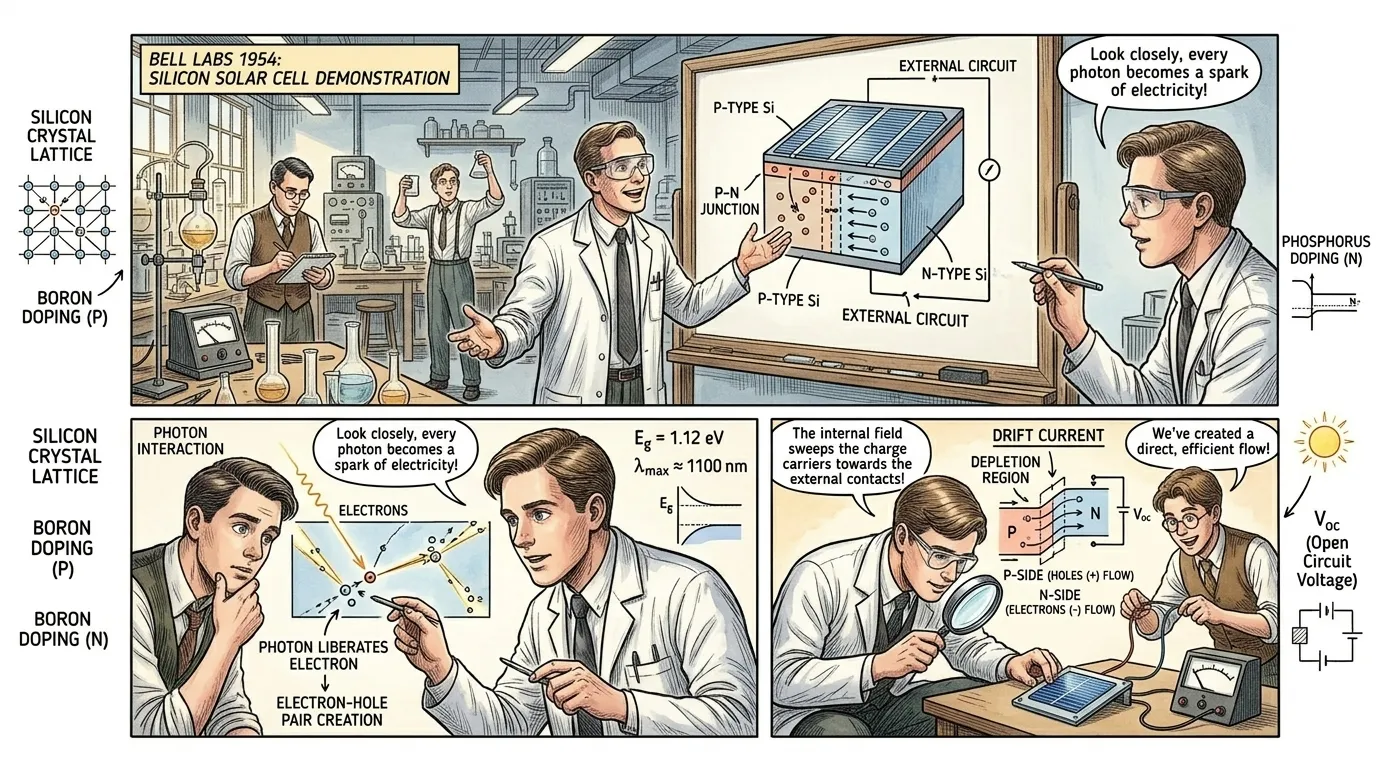
When sunlight, composed of photons, strikes the solar cell, these photons transfer their energy to electrons within the silicon. If a photon has sufficient energy, it liberates an electron from its atomic bond, creating a free electron and a corresponding 'hole.' Crucially, the electric field at the P-N junction then sweeps these newly freed electrons to the N-type side and the 'holes' to the P-type side. This separation of charges creates a voltage difference. If an external circuit is connected, these separated electrons flow through it to recombine with the holes, producing an electric current, thus directly converting light into usable power.
"Pearson, demonstrating the principle, might remark, 'Every photon that hits our carefully engineered silicon becomes a tiny spark of electricity, guided by this intrinsic field!'"
Fact: Photons from sunlight energize electrons in the silicon, which are then separated by the P-N junction's electric field. This creates a voltage, driving a current through an external circuit, demonstrating the direct conversion of light energy into electrical power.
Page 8
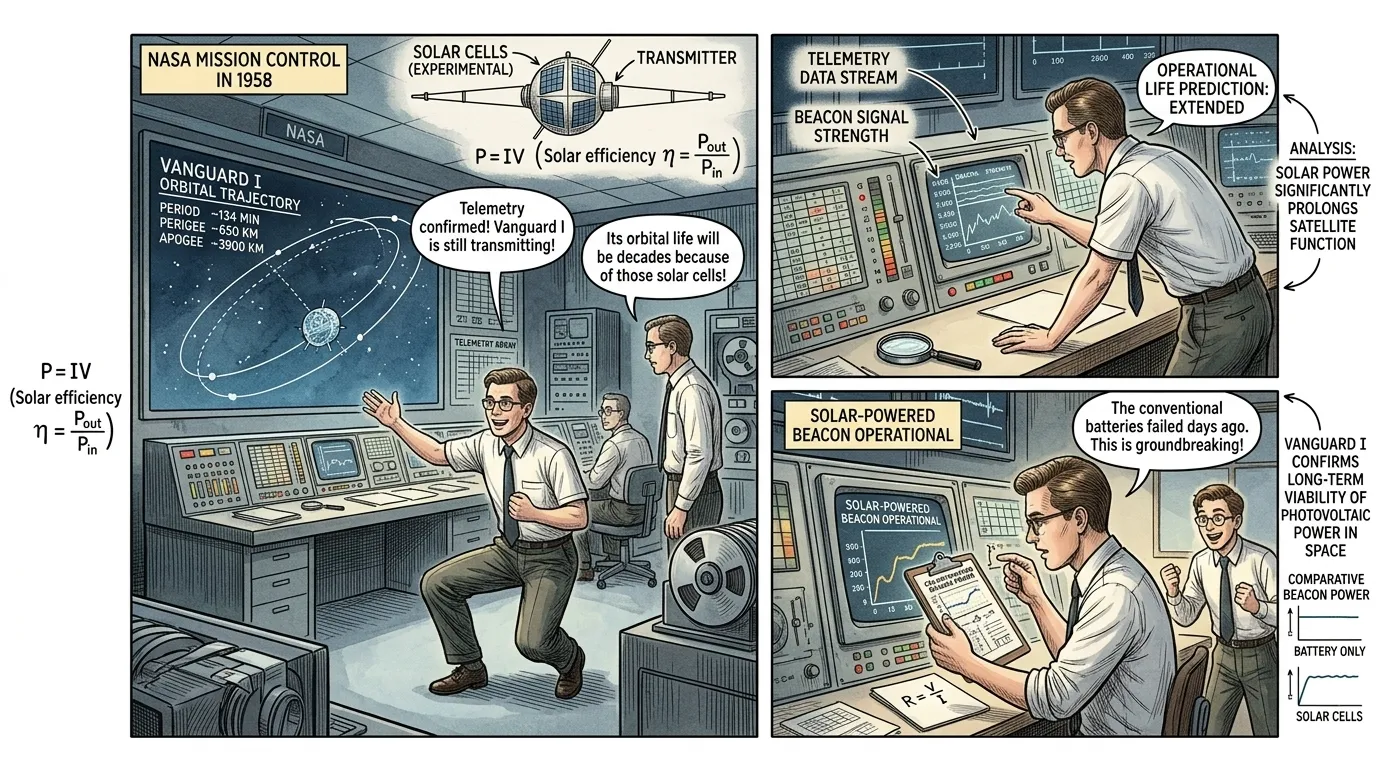
The immediate application of the silicon solar cell, given its cost and novelty, was not widespread terrestrial power. Instead, its unique ability to provide reliable, long-term electricity in remote, unserviced environments made it invaluable for the burgeoning space age. In 1958, Vanguard I, the United States' second artificial satellite, became the first spacecraft to be entirely powered by solar panels, extending its mission life far beyond what batteries alone could offer. Solar cells became indispensable for satellites, space probes, and eventually, the International Space Station, proving their reliability under extreme conditions.
"A mission control scientist, observing Vanguard I's extended life, might have declared, 'Solar power has just given us infinite reach in the cosmos!'"
Fact: The high cost and novelty of early solar cells initially limited their terrestrial use, but their unparalleled reliability in remote environments made them critical for the Space Age, commencing with Vanguard I in 1958.
Page 9
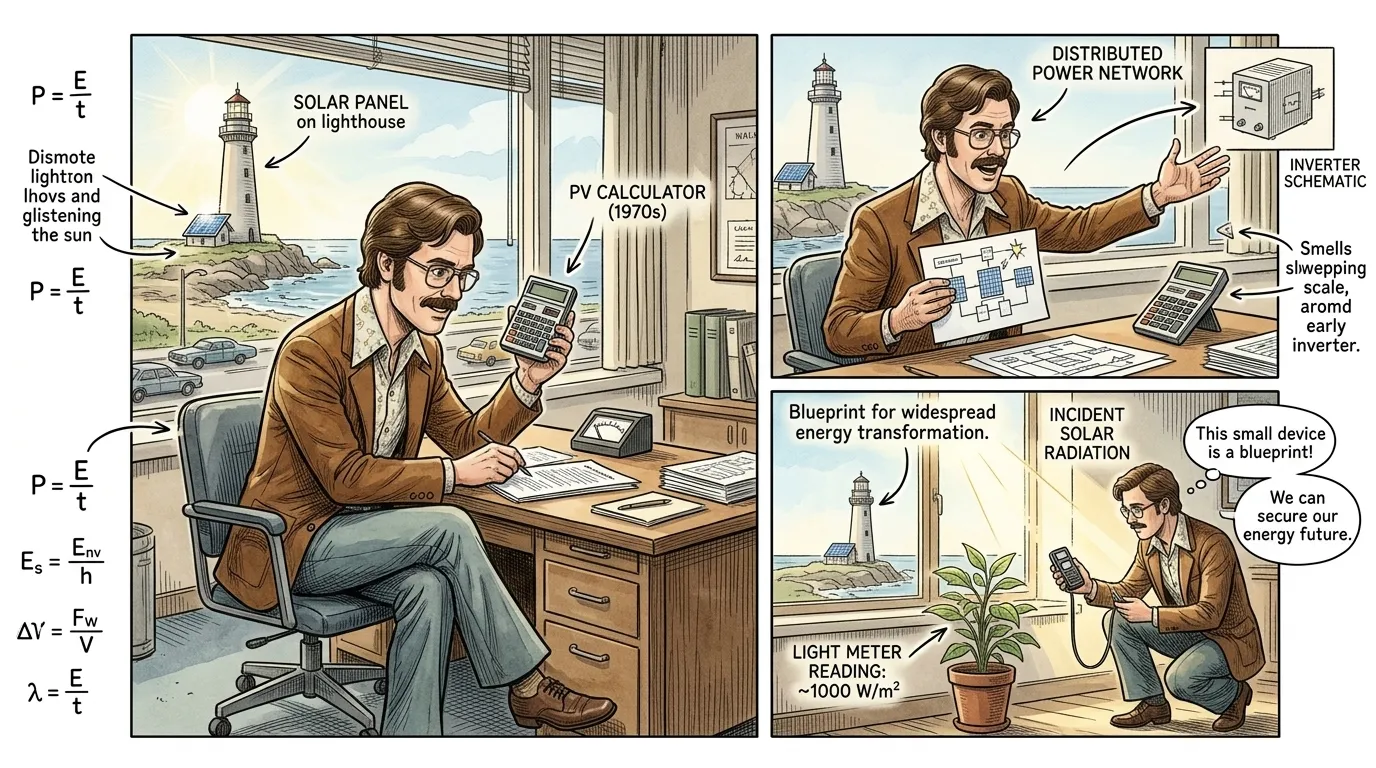
Following their success in space, solar cells slowly transitioned to terrestrial applications. Early uses included remote telecommunication systems, lighthouses, and railway signals where grid power was impractical or costly. The 1970s energy crises provided a significant impetus for research and development, as nations sought alternatives to fossil fuels. While still expensive, the growing awareness of energy independence and environmental concerns pushed solar technology into homes, powering small devices like calculators and watches, slowly beginning its journey towards mainstream adoption.
"A visionary energy analyst of the 1970s might have forecasted, 'The solar panel on this calculator today is the blueprint for our homes tomorrow, driven by the very real need for energy security!'"
Fact: The 1970s energy crises spurred terrestrial solar adoption, moving beyond remote applications to power consumer electronics and small-scale off-grid systems, laying the groundwork for wider commercialization and public awareness.
Page 10
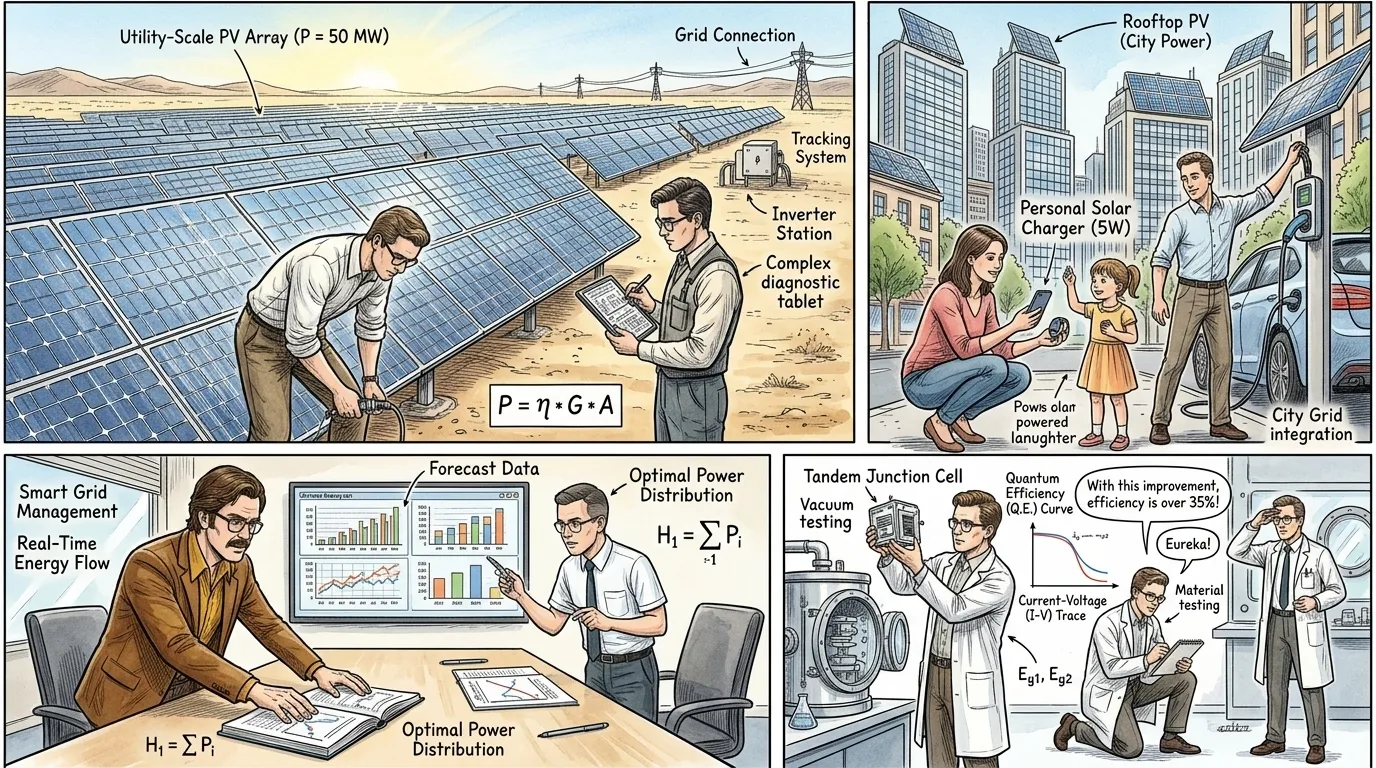
Today, the solar cell stands as a cornerstone of the global renewable energy transition. From vast utility-scale solar farms stretching across arid landscapes to individual rooftop panels adorning homes and businesses, photovoltaic technology has dramatically reshaped our energy infrastructure. It powers everything from wearable electronics and electric vehicles to entire cities, reducing reliance on fossil fuels and mitigating climate change. The journey from Becquerel's subtle observation to today's gigawatt-scale installations is a testament to persistent scientific inquiry and technological innovation, cementing the solar cell's legacy as a transformative invention for humanity's future.
Fact: From its humble origins, the solar cell has evolved into a pivotal technology for global energy sustainability, driving the transition towards renewable power and mitigating environmental impact across diverse applications.
About this story
- Location: Global
- Audience: general readers
Questions and answers
Read Wonder Inventions on your phone
Wonder Inventions is available on Android. Get Wonder Inventions on Google Play.