Tunnel Boring Machine
Tunnel Boring Machine — an illustrated inventions story, set in Global. 10 illustrated pages, free to read on Wonder Inventions.
Page 1
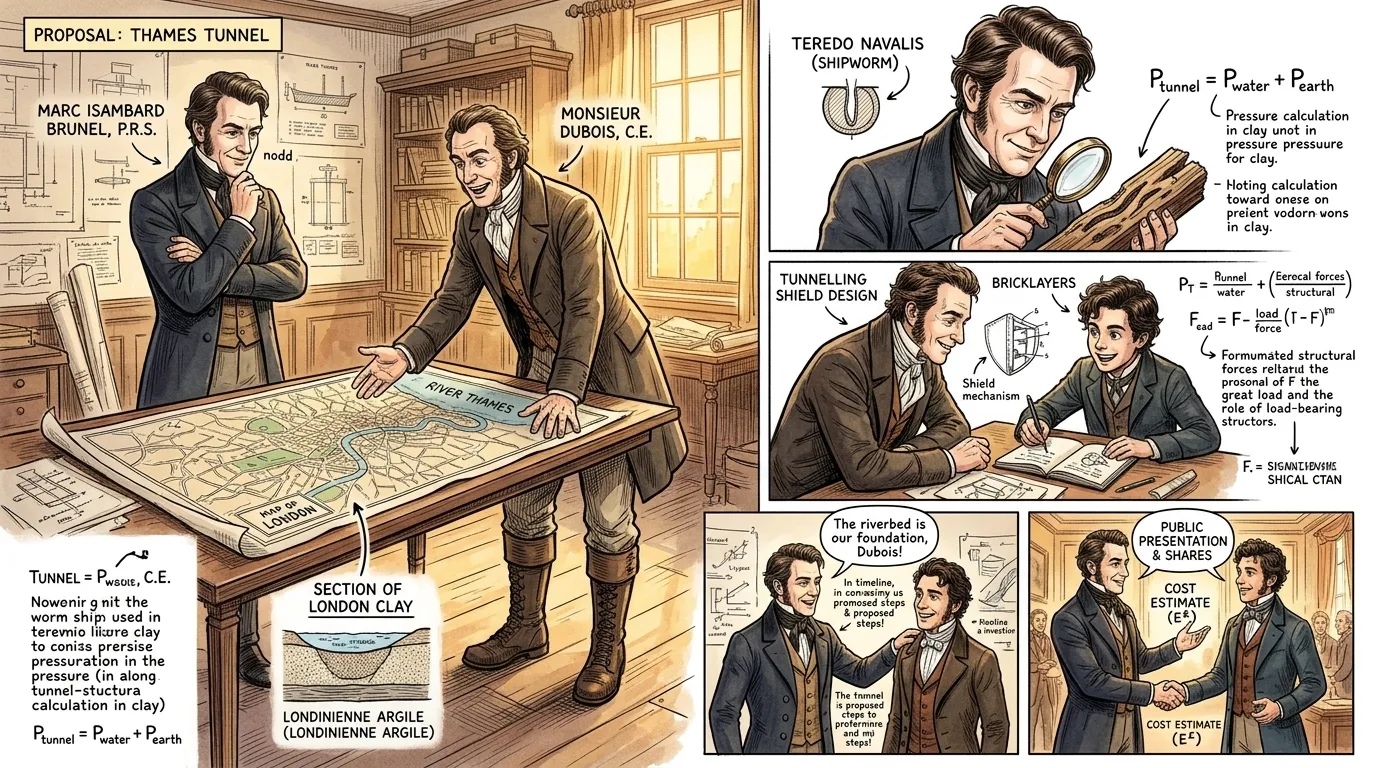
Before the advent of mechanized tunneling, humanity's attempts to pierce through unstable ground were fraught with peril, a testament to sheer willpower against nature's formidable resistance. Engineers dreamed of creating subterranean passages through earth and rock, but the crude methods available invited disaster with alarming frequency. It was in this era of ambitious yet deadly endeavor that Marc Isambard Brunel, a visionary engineer, conceived of a revolutionary approach.
""The very ground beneath our feet, once an insurmountable barrier, could become a path," a contemporary engineer, Monsieur Dubois, declared to Brunel, gesturing towards a map of London. "Imagine the Thames bridged not by stone above, but by passage below—a monumental feat, if only we could conquer the treacherous silt and clay." Brunel, his gaze fixed on the challenge, nodded thoughtfully, contemplating the immense difficulty."
Page 2
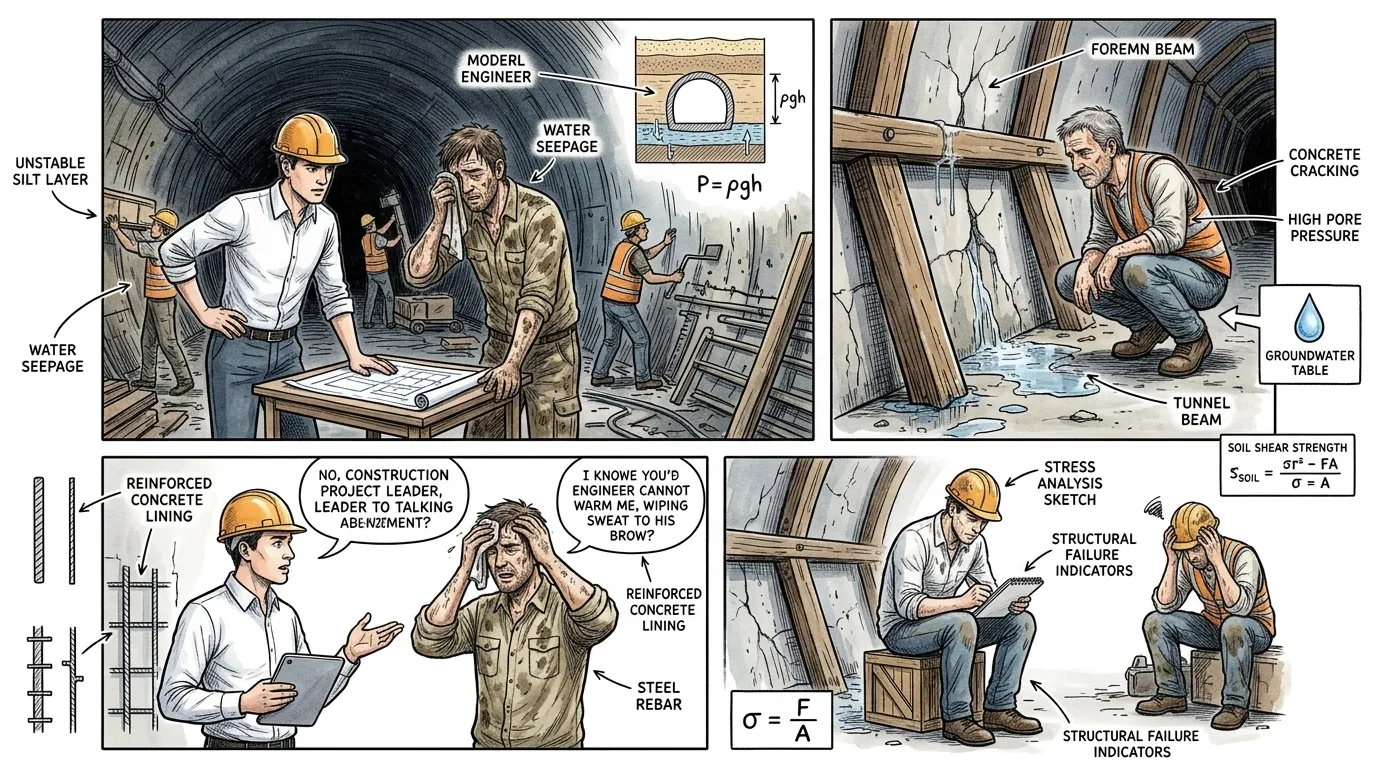
For centuries, tunneling was an ordeal of brute force, relying on picks, shovels, and the perilous placement of timber supports in a desperate race against gravity and groundwater. Each foot gained was a victory hard-won, often at the cost of human lives, as sudden collapses or inundations could trap and drown the unsuspecting diggers. The dream of extensive underground networks remained largely confined to short, hazardous mine shafts or carefully engineered rock tunnels, far from the unstable, waterlogged soils beneath growing cities.
""The sheer risk is intolerable," exclaimed a concerned foreman, wiping sweat from his brow, as he spoke to a group of anxious workers by a flickering lantern inside a cramped tunnel. "We shore up one section, and another gives way; the water seeps in relentlessly, turning the ground to sludge." A grizzled laborer, his face etched with fatigue, nodded grimly, adding, "Every shift is a gamble, a fight against the very earth itself, threatening to bury us alive.""
Page 3
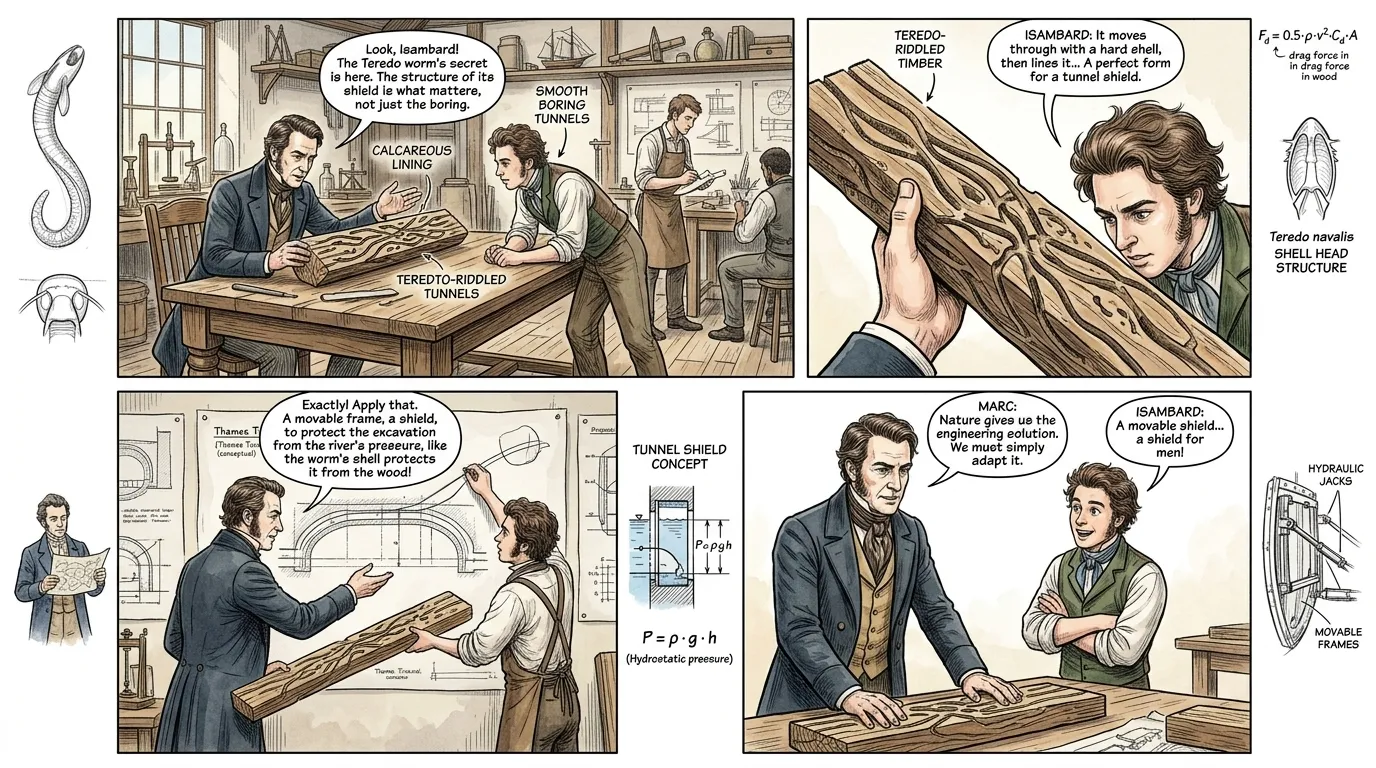
Marc Isambard Brunel, ever the keen observer of natural engineering, found his pivotal insight not in grand human structures, but in the humble Teredo worm, a mollusk notorious for its ability to bore through timber. He noticed how this small creature, while drilling, simultaneously lined its path with a smooth, protective shell, thereby shoring up its tunnel as it advanced. This elegant biological solution offered a radical new paradigm for human tunneling, suggesting a method to excavate and support simultaneously, rather than sequentially and precariously.
""Observe this marvel," Brunel remarked, holding up a piece of timber riddled with the perfect tunnels of the Teredo worm, to his son, Isambard Kingdom Brunel, a young, earnest man with dark, wavy hair and keen eyes, dressed in a practical dark coat. "Each passage is meticulously lined, shored against collapse even as the creature advances; it's an ingenious, self-supporting method." Young Isambard leaned closer, fascinated, contemplating the immense implications of such a simple biological principle for massive engineering challenges."
Page 4
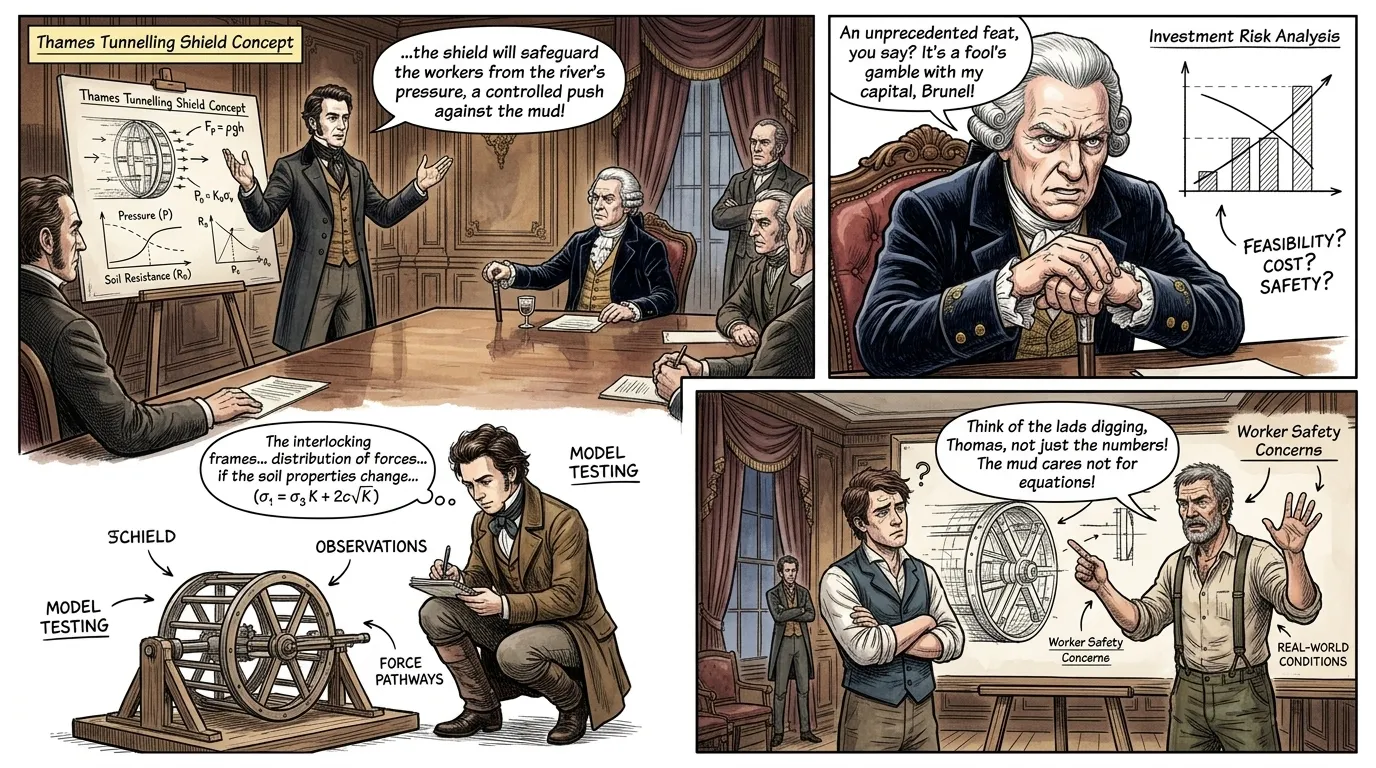
The vision for a tunnel beneath the River Thames, connecting Rotherhithe and Wapping, was monumental, demanding not only engineering prowess but also extraordinary financial and political will. Prior attempts by others had failed spectacularly, succumbing to the river's immense pressure and the instability of the underlying clay and gravel. Brunel's proposal for a tunneling shield, while ingenious, was met with considerable skepticism, requiring him to articulate his radical idea with unwavering conviction to secure funding and trust for such an unprecedented undertaking.
""The challenge is not merely digging; it's safeguarding the passage against the immense pressure of the river above," Brunel explained to a panel of stern-faced investors, seated at a long, polished table in a dimly lit, ornate room. "My shield provides a mobile, protected environment for excavation and lining." One skeptical investor, Sir John, his brows furrowed, retorted, "But to make them truly understand the mechanics, the vision—that is the difficulty. As the artist Edgar Degas once observed, 'The difficulty is to make the people see what you yourself see.' This tunnel is an unprecedented feat.""
Page 5
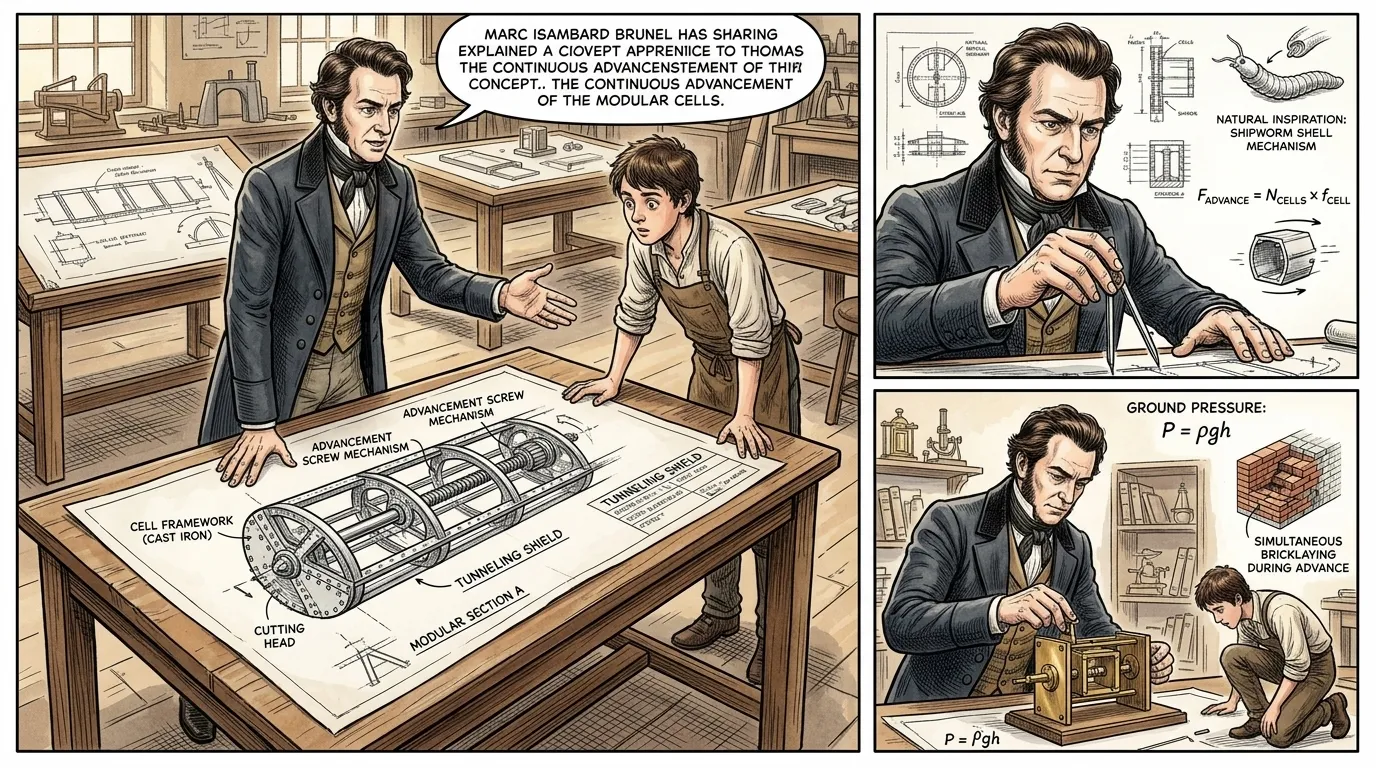
Brunel's revolutionary design was a colossal rectangular framework of cast iron, divided into twelve independent cells, each a fortified workspace for a single miner. This modular structure was a mobile fortress, allowing laborers to excavate small sections of the tunnel face in relative safety, protected from immediate collapse while the primary structure advanced. Crucially, the shield offered a continuously advancing barrier, an unprecedented solution for tunneling through soft, water-bearing ground where traditional methods invariably failed.
""Each cell operates as an independent chamber, allowing work to progress systematically and securely," Brunel pointed out, tracing lines on a detailed drawing of his shield for a curious young engineer apprentice, Thomas, who wore a practical workshop apron over his clothes. "A miner extracts earth from his compartment, and the support structure is always immediately behind him." Thomas, wide-eyed, absorbed the details, realizing, "So, the ground is never left unsupported for long; it's a constant, controlled advance, even in the weakest soil.""
Page 6
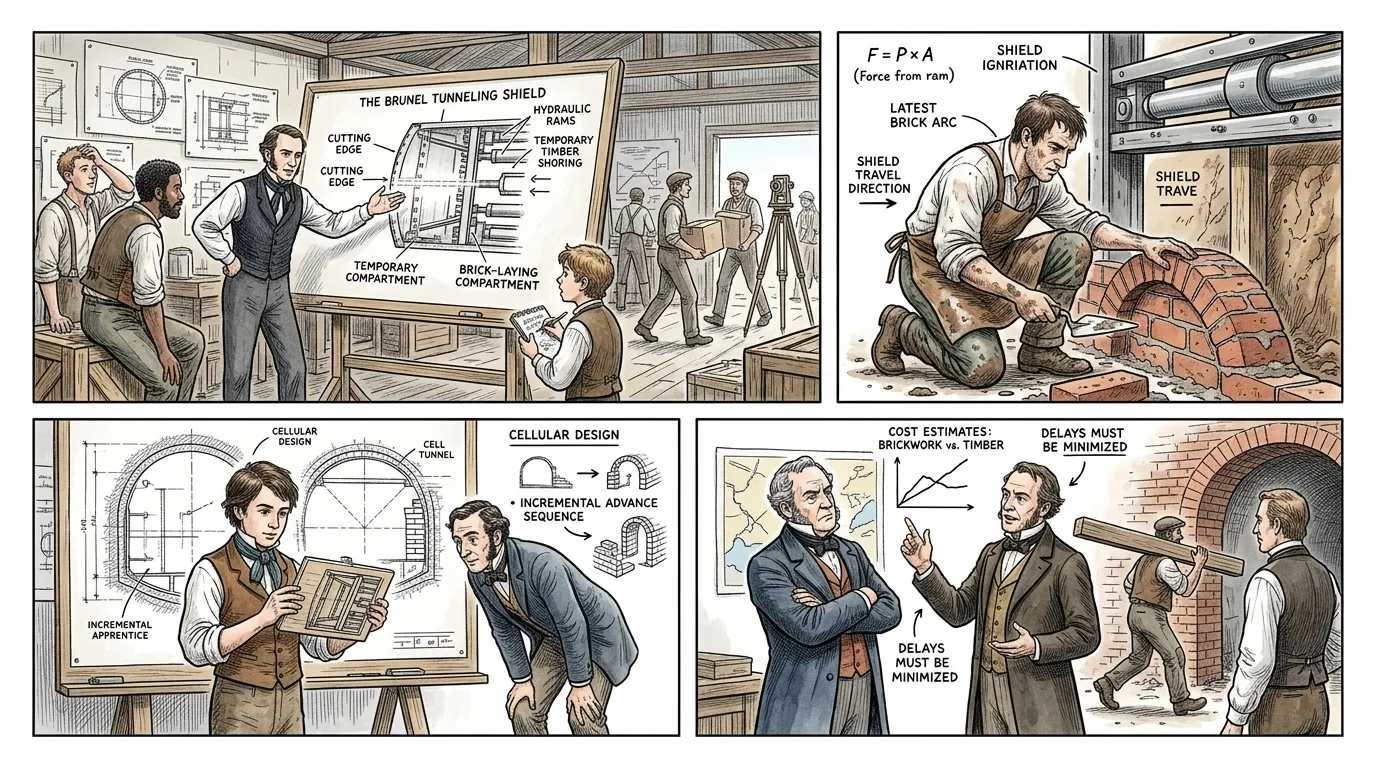
The genius of Brunel's tunneling shield lay in its ability to synchronize excavation with immediate structural reinforcement. Miners, protected within their individual cells, would carefully remove a small section of earth from the tunnel face. Once excavated, hydraulic rams, operated by the workers, would then push the heavy iron shield forward by a few inches. Immediately behind the advanced shield, bricklayers would construct the permanent tunnel lining, effectively creating a finished tunnel section even as excavation continued directly ahead, a continuous dance of destruction and creation.
""The process is methodical, a precise sequence of tasks within each cell," explained a project manager, Mr. Davies, observing a large, explanatory diagram of the shield's operation with a group of new workers. "One worker digs, another supports, then the rams push the entire frame forward; the ground is never exposed without immediate cover." A worker, holding a trowel, confirmed, "And as soon as the shield advances, we move in to lay the brick, sealing the path as we go, creating a solid, permanent arch.""
Page 7
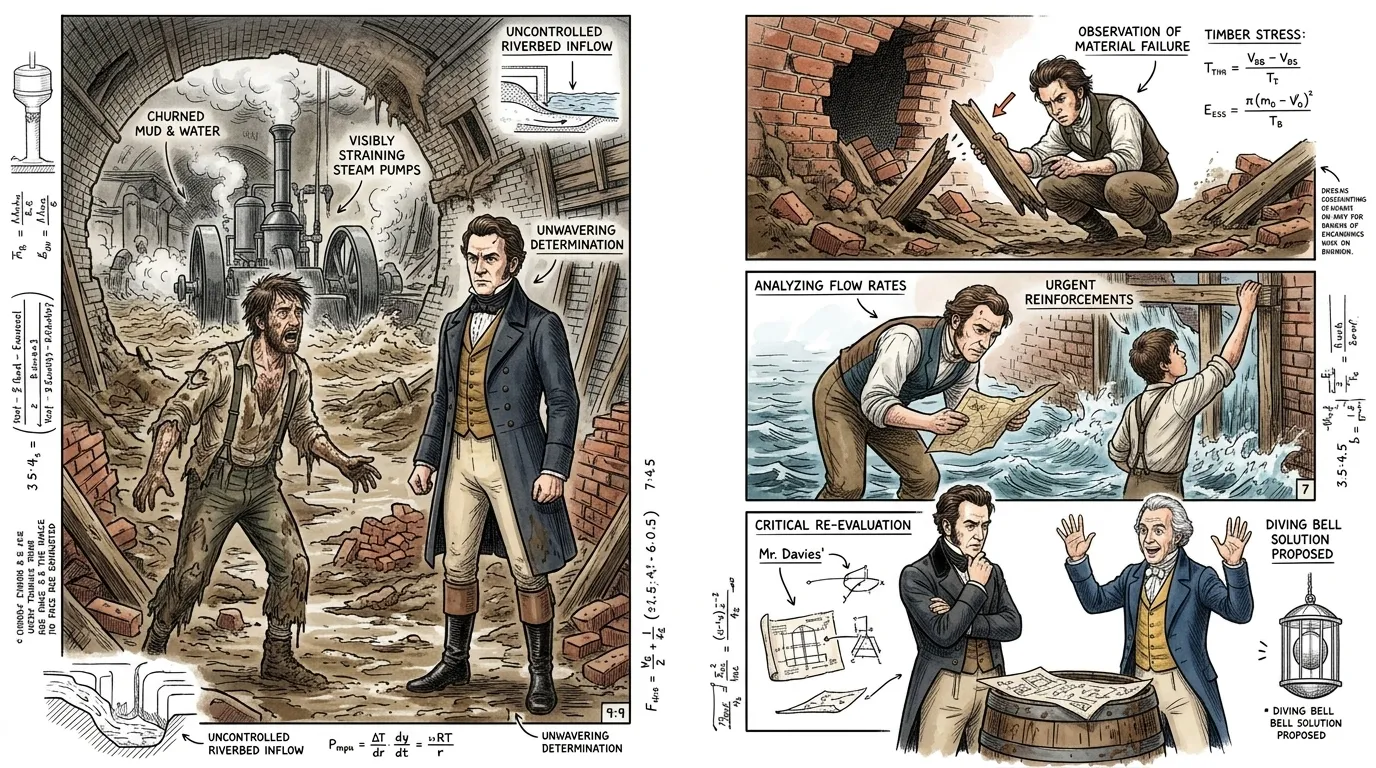
The construction of the Thames Tunnel was a grueling, seventeen-year saga plagued by immense technical challenges, including multiple catastrophic floods that breached the riverbed and inundated the workings. The pressure of the Thames above was relentless, sending torrents of mud and water into the tunnel, nearly claiming the lives of many, including Isambard Kingdom Brunel himself. Each disaster demanded innovative solutions, from sealing breaches with clay and cement to improving pumping mechanisms, showcasing an extraordinary human resolve in the face of overwhelming adversity.
""The river broke through again, a torrent of mud and despair," a weary engineer, covered in muck, reported to Brunel, his voice hoarse, as powerful pumps struggled in the background. "We nearly lost the entire section, and young Isambard was barely saved!" Brunel, though visibly shaken, responded with unwavering determination, his jaw set, "Then we find new ways to seal it, to reinforce it; we will not yield to the Thames. This tunnel will be completed, no matter the cost in effort or innovation.""
Page 8
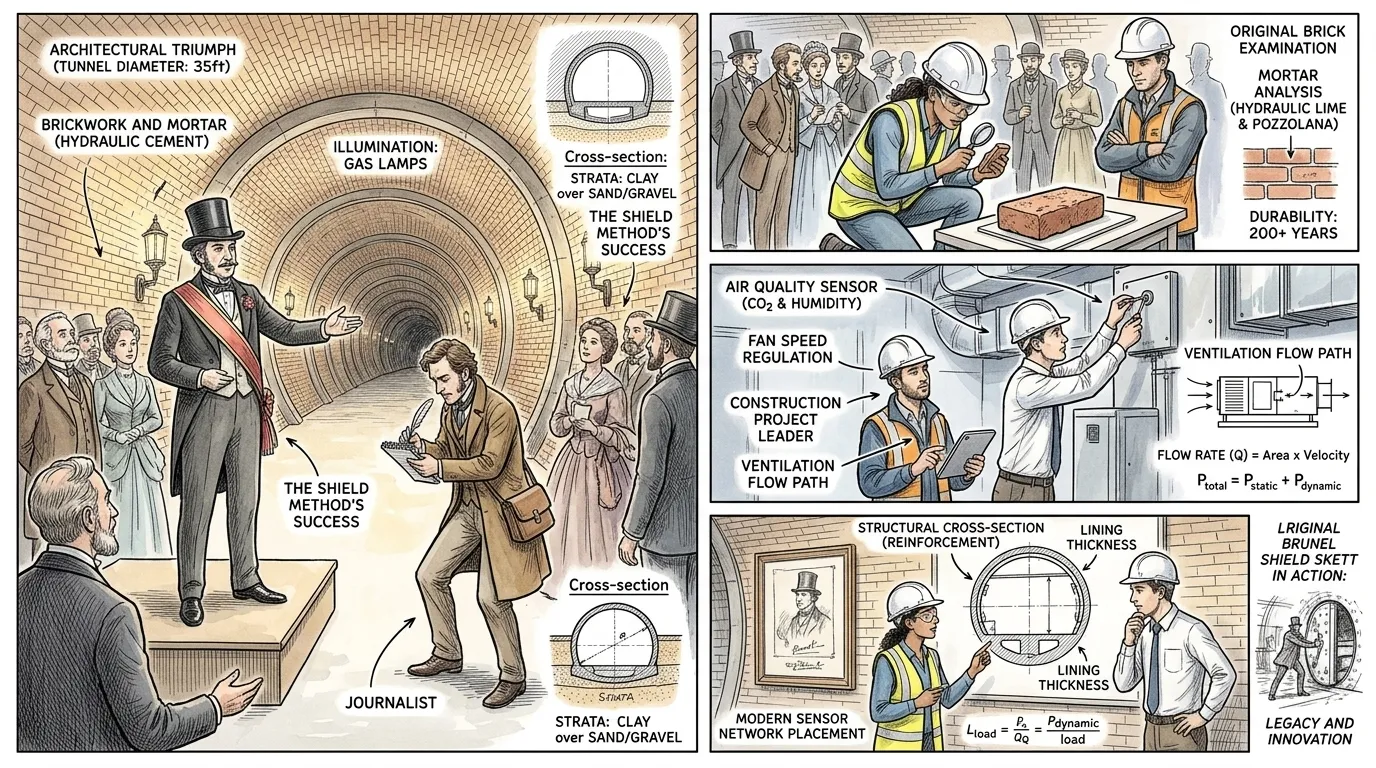
Completed in 1843, the Thames Tunnel stood as an unprecedented triumph of engineering, the first tunnel ever constructed successfully beneath a navigable river. This engineering marvel proved the viability of Brunel's tunneling shield and fundamentally reshaped approaches to subterranean construction. What began as a pedestrian and eventually a railway passage, quickly became a symbol of human ingenuity, demonstrating that complex, large-scale tunneling through challenging ground was not only possible but a practical solution for urban expansion and connectivity. The Teredo worm's lesson had transformed into a global breakthrough.
""After years of relentless struggle, the two sides finally met—a testament to human perseverance and ingenuity," proclaimed an official at the grand opening ceremony, gesturing towards the newly illuminated tunnel. "Brunel's shield, born from observing a tiny mollusk, has made the impossible possible, allowing us to connect what nature separated." A journalist, taking notes furiously, added, "This isn't just a tunnel; it's a blueprint for the future of urban infrastructure, a subterranean revolution that will redefine how cities grow and connect.""
Page 9
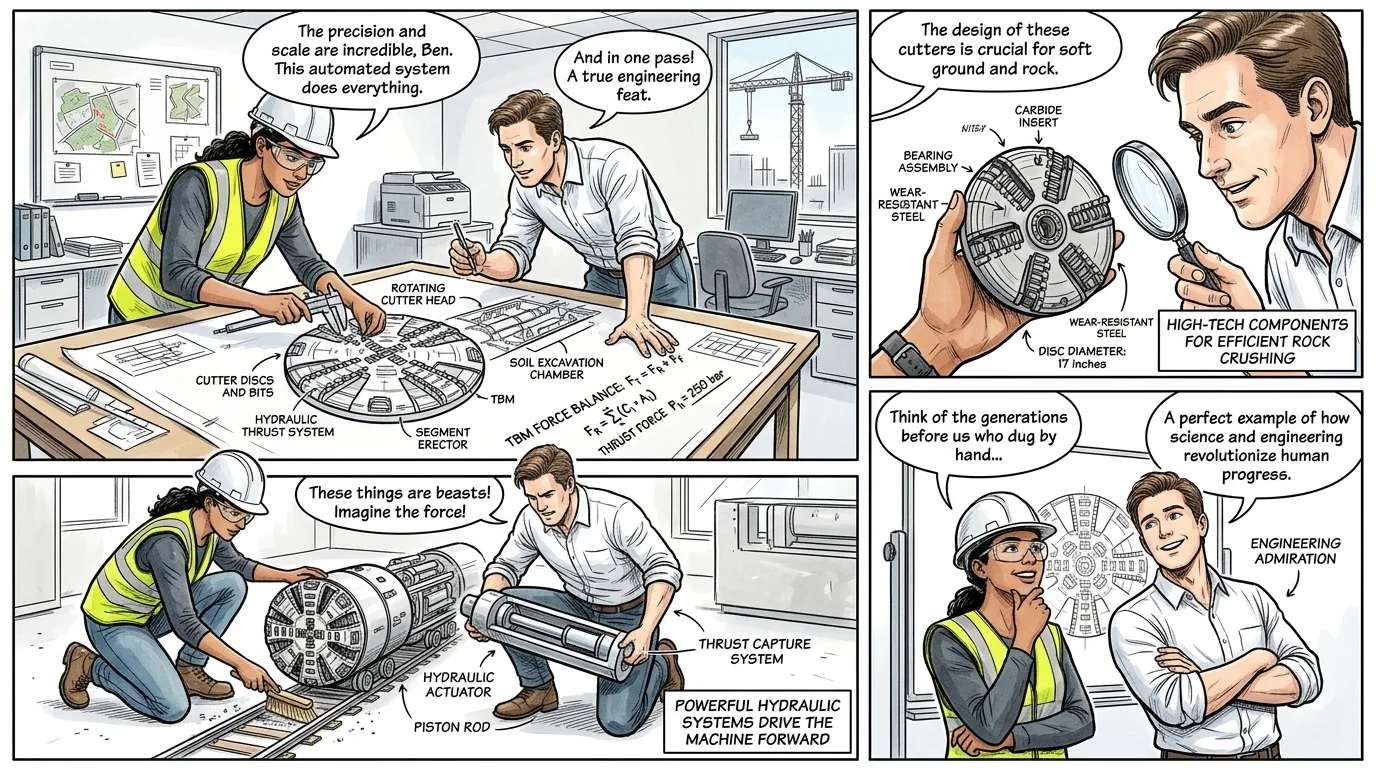
From Brunel's manually operated iron shield, tunneling technology underwent a radical transformation, culminating in the sophisticated, fully mechanized Tunnel Boring Machine (TBM) of today. These enormous 'underground moles' integrate excavation, spoil removal, and tunnel lining into a continuous, automated process. Featuring rotating cutter heads armed with discs and cutters, powerful hydraulic thrust systems, and automated segment erectors, modern TBMs can bore through rock and soil with unprecedented speed and precision, vastly reducing the dangers and labor demands of their predecessors.
""The leap from manual shields to these mechanized behemoths is staggering," observed a modern civil engineer, Dr. Anya Sharma, in a clean, high-visibility vest and hard hat, pointing to a diagram of a TBM in a contemporary construction office. "A modern TBM is a self-contained factory; it excavates, transports the spoil, and builds the tunnel wall, all simultaneously." Her colleague, Engineer Ben Carter, added, "They can bore through almost any geology, from soft clay to solid granite, making previously impossible projects feasible, transforming our approach to urban planning and resource management.""
Page 10
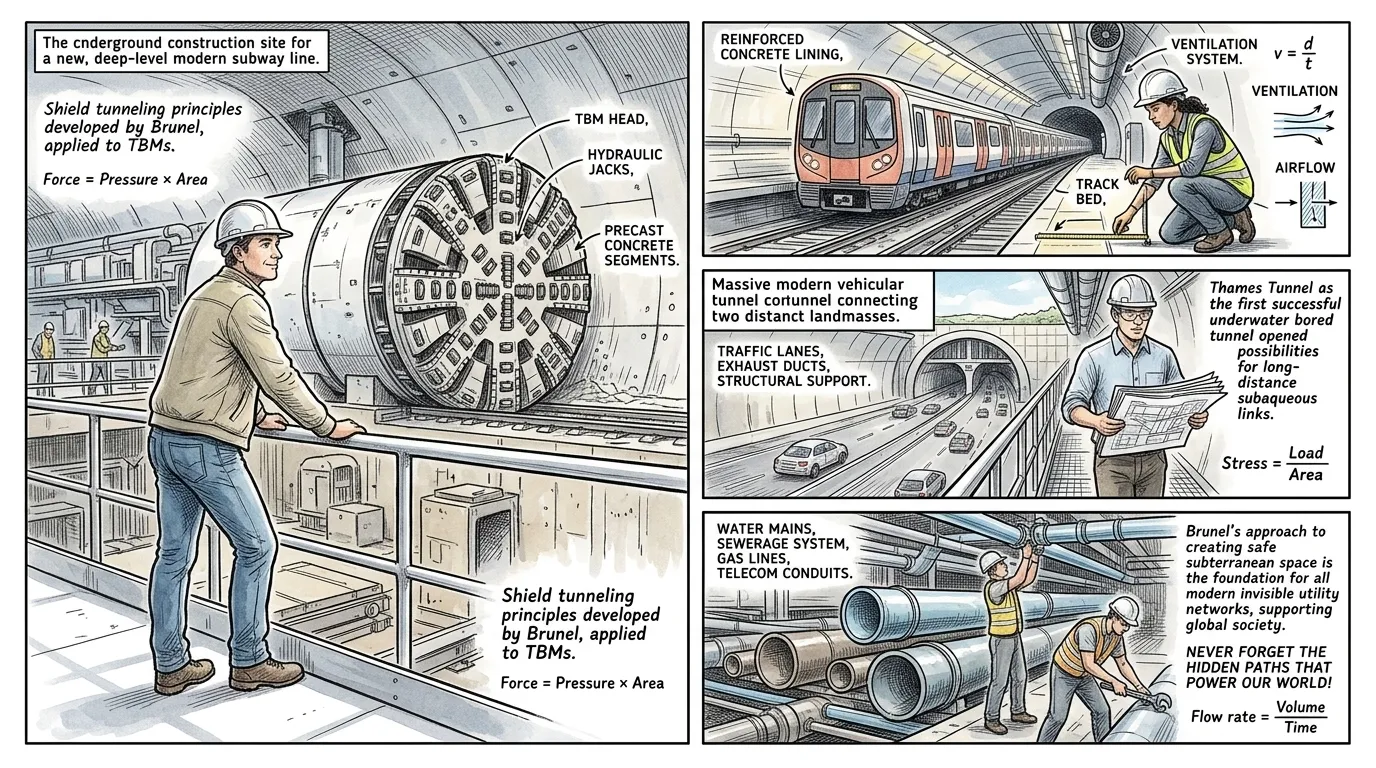
Today, Tunnel Boring Machines are indispensable to global infrastructure, silently weaving vast networks beneath our feet and across formidable natural barriers. They construct the critical arteries of our modern world: sprawling subway systems that move millions daily, massive vehicular tunnels connecting nations, essential water and wastewater conduits, and vital utility pathways. The legacy of Brunel's modest shield has blossomed into a technology that profoundly shapes our urban landscapes, facilitates international commerce, and ensures access to crucial resources, enabling a connected and thriving global society.
""From the London Underground to the Channel Tunnel, TBMs have redefined human connectivity and resilience," a narrator's voice-over might state, as a montage of bustling scenes unfolds. "They allow our cities to breathe, our goods to travel swiftly, and our vital resources to flow unimpeded, a testament to the enduring power of ingenuity." A construction project leader, overseeing a new subway line, mused, "Without these incredible machines, so much of our modern world – the fast transit, the clean water, the cross-border links – simply wouldn't exist. They are the invisible backbone of progress.""
About this story
- Location: Global
- Audience: general readers
Questions and answers
Read Wonder Inventions on your phone
Wonder Inventions is available on Android. Get Wonder Inventions on Google Play.