Elisha Otis
Elisha Otis — an illustrated biography story, set in Global. 10 illustrated pages, free to read on Wonder People.
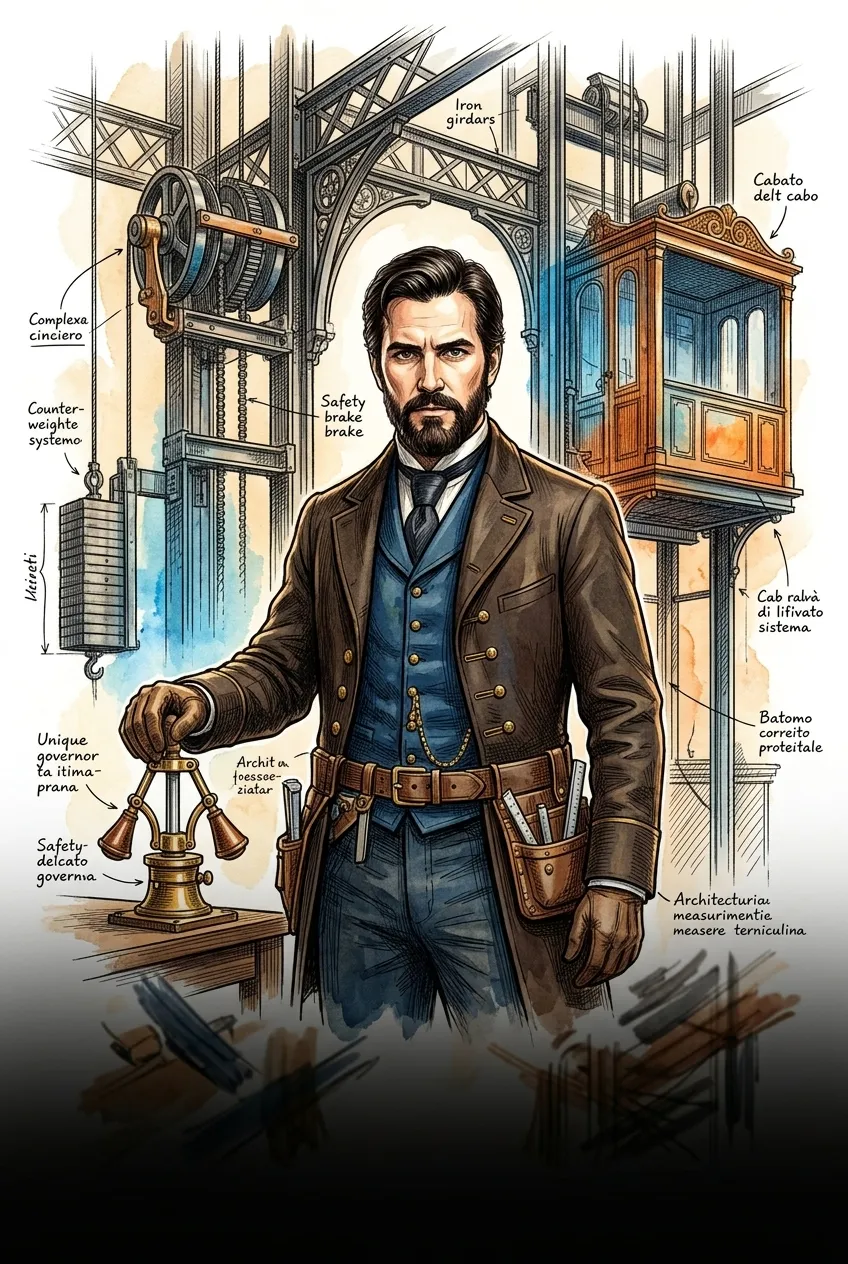
Page 1
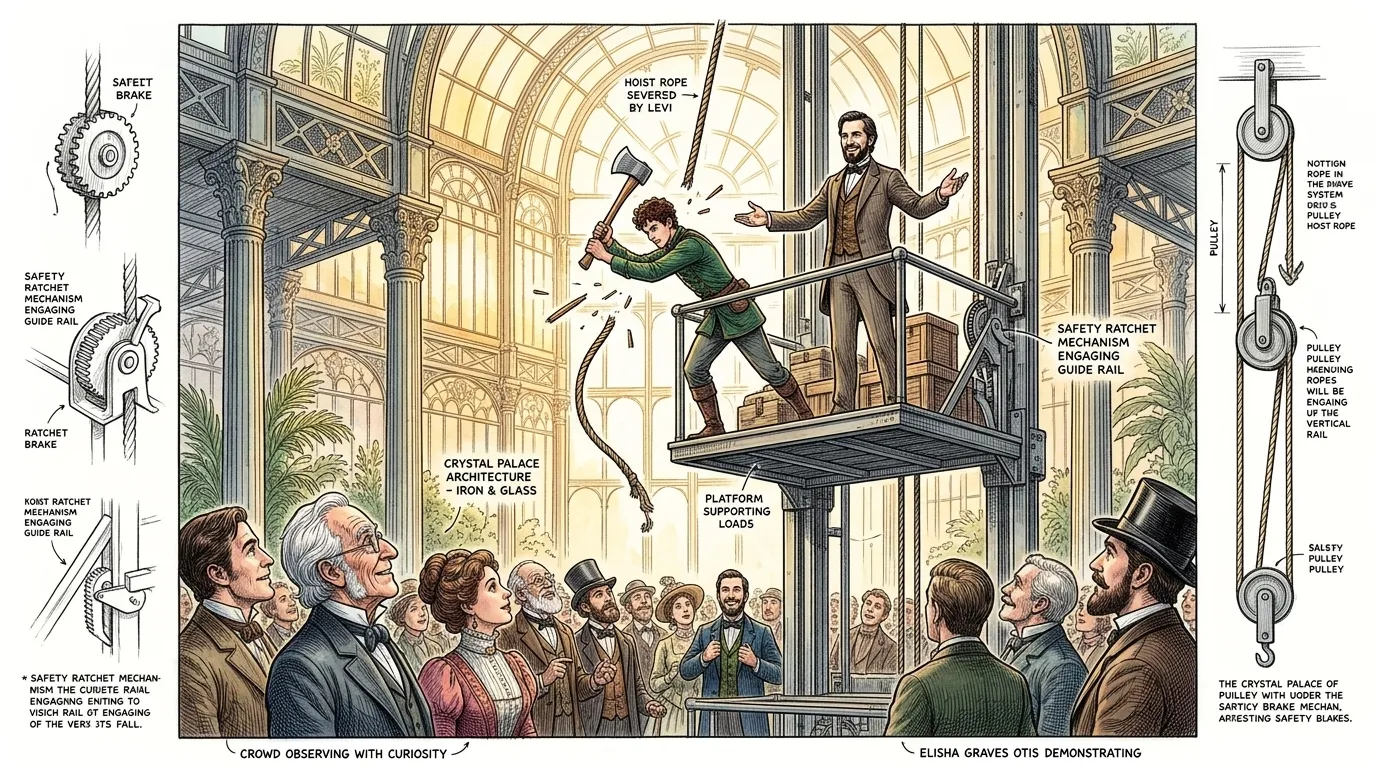
At the 1854 New York Crystal Palace Exhibition, Elisha Graves Otis presented a spectacle designed to shatter an ancient fear. From a towering shaft, he ascended on a loaded platform, observed by a skeptical crowd including prominent industrialists like Peter Cooper. With a dramatic gesture, Otis commanded his assistant, Levi, to sever the hoist rope, a bold act that would either prove his invention or result in catastrophe. The platform lurched, then caught, held fast by a revolutionary safety brake, demonstrating a 100% success rate in preventing freefall.
"'Ladies and gentlemen,' Elisha Graves Otis called out, his voice clear above the murmurs, 'I invite you to witness a demonstration of true safety. Mr. Levi, you may cut the rope!' He looked directly at the crowd, challenging their ingrained fear of heights and mechanical failure. 'For centuries, vertical ascent has been a perilous gamble. Today, that changes.'"
Page 2
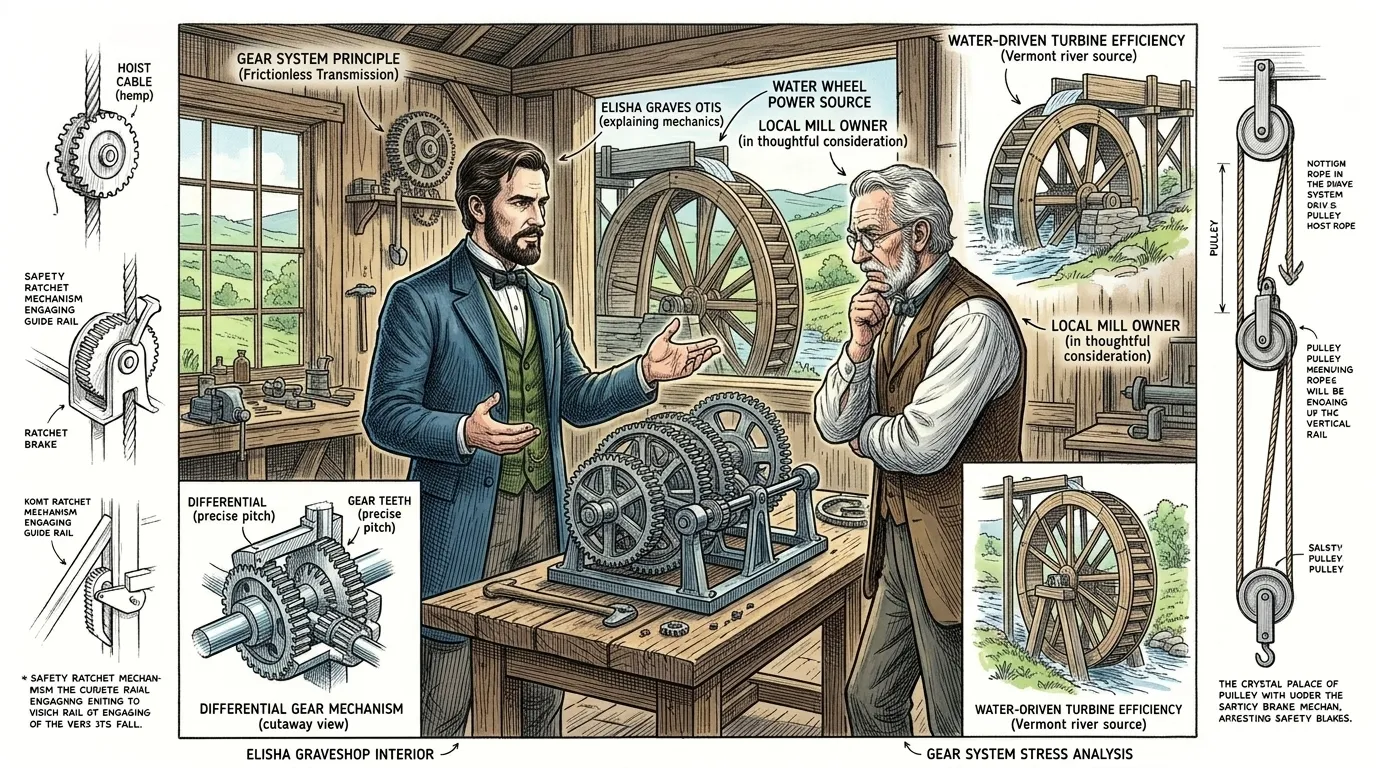
Born in Halifax, Vermont, Elisha Graves Otis began his life steeped in the practical mechanics of the early 19th century. From building water-powered sawmills to designing innovative railway car brakes, his mind constantly sought efficiency and safety in industrial processes. This formative period, marked by a relentless pursuit of practical solutions, laid the groundwork for his future endeavors, defining his identity as an engineer first.
"'Every machine, no matter how grand, begins with a simple need,' Elisha Graves Otis explained to a local mill owner, a grizzled man with spectacles, gesturing towards a complex gear system in his workshop. 'My early days, working on water wheels and simple hoists in Vermont, taught me that much. The challenge is not merely to lift, but to ensure that what goes up, stays up, safely, even if a single cable fails.' The mill owner nodded slowly, considering his words."
Page 3
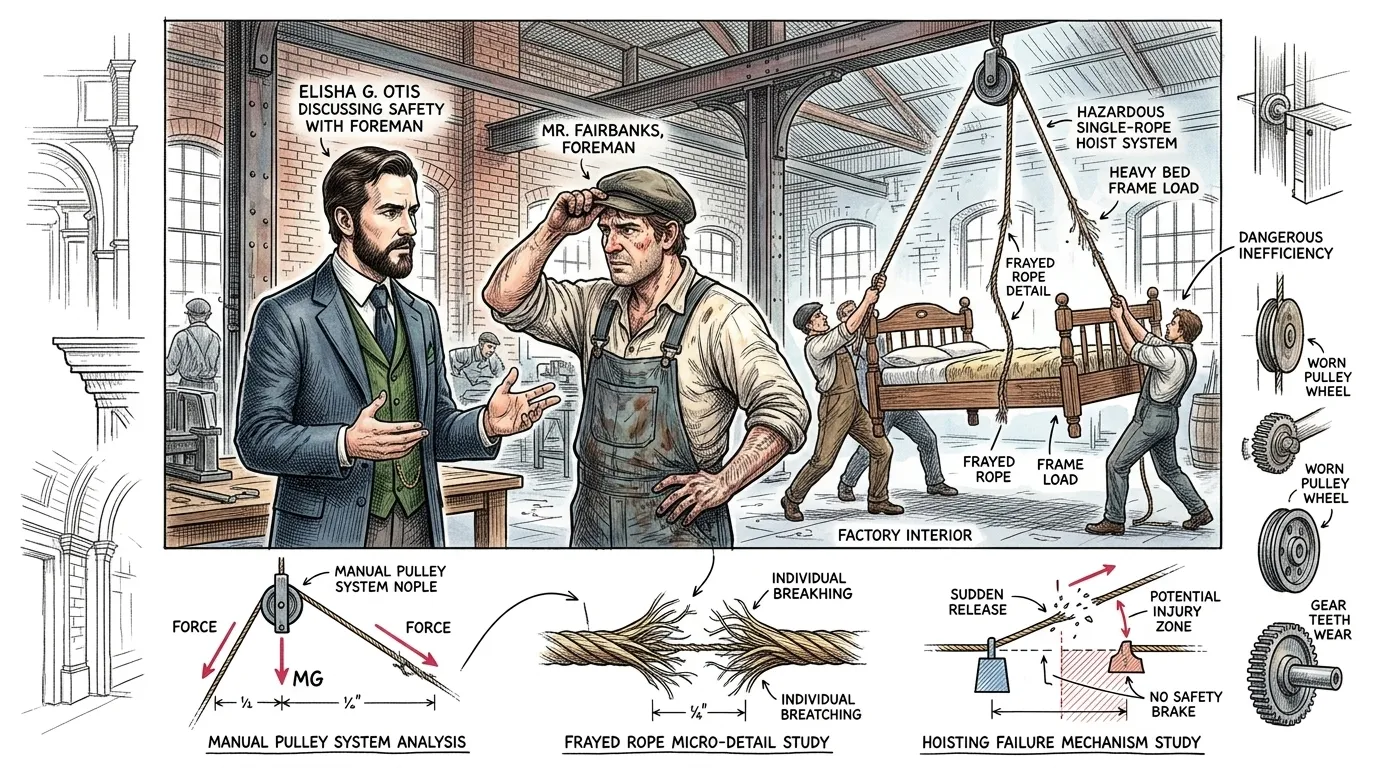
At the Bedstead Manufacturing Company in Yonkers, New York, Elisha Otis faced a persistent challenge: the dangerous and inefficient method of lifting heavy equipment to upper floors. Existing hoisting platforms relied on single ropes, a single point of failure that often led to catastrophic accidents and severe injuries. This stark reality, a constant threat to his workers, crystallized his resolve.
"'A single rope, Mr. Fairbanks, is a single point of catastrophic failure,' Elisha Graves Otis stated firmly to his factory foreman, a sturdy man with grease-stained hands, as they watched workers manually hoist a heavy bed frame. 'We cannot continue to operate under such a fundamental flaw in design. This reliance on one fragile link is unacceptable; it invites disaster. We need a system where, even if the primary support fails, the load remains secure.' Fairbanks wiped his brow, acknowledging the profound truth."
Page 4
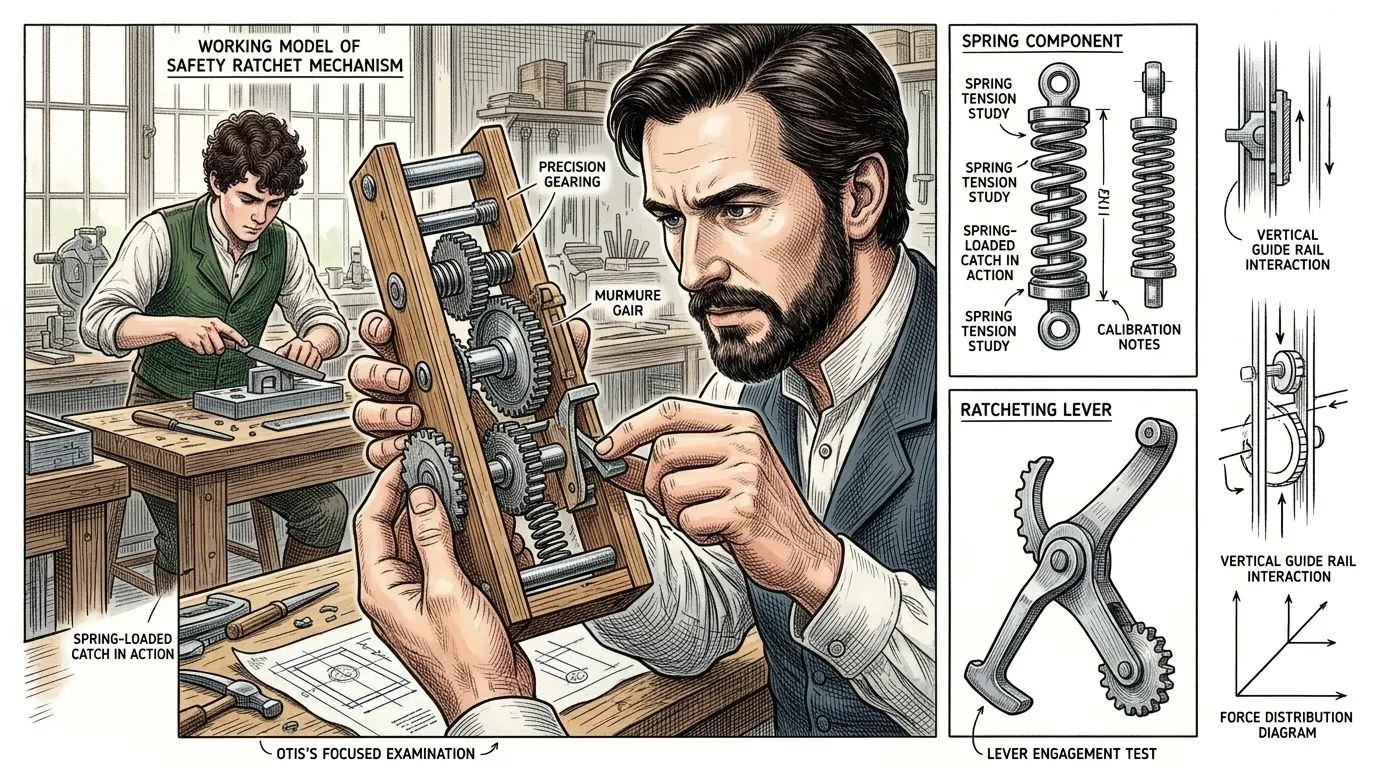
Driven by the factory's inherent dangers, Elisha Otis retreated to his workshop, convinced a solution lay in fundamental mechanical principles. He meticulously fashioned a spring-loaded ratcheting mechanism, a simple yet ingenious design intended to grip the guide rails if the primary hoisting rope failed. This first prototype, born from necessity, marked the crucial transition from concept to tangible invention.
"'This device, this simple 'safety catch,' is more than just gears and springs,' Elisha Graves Otis murmured to himself, holding up a small, intricately carved wooden and metal model of his new mechanism. He turned to his assistant, a young apprentice named Thomas, who was carefully filing a metal component. 'As the great inventor Thomas Edison once said, 'Genius is one percent inspiration and ninety-nine percent perspiration.' We are living that truth, Thomas, perfecting every cog, every spring, because lives will depend on this precision. This, my boy, is the breakthrough.'"
Page 5
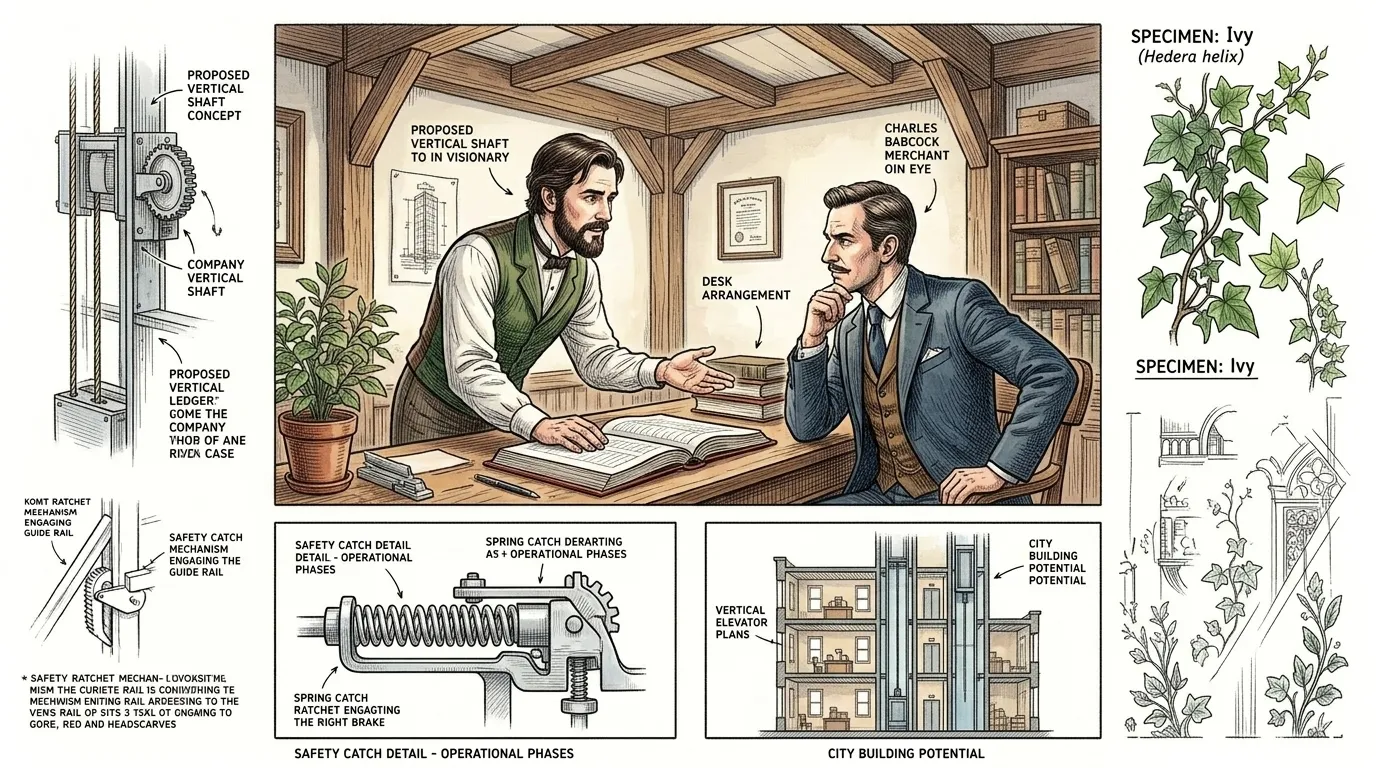
In 1853, Elisha Otis recognized the broader potential of his safety hoist beyond industrial applications, envisioning its role in passenger transportation. He founded E.G. Otis & Co., marking a pivotal shift from a factory safety device to a revolutionary concept for vertical transit in buildings. This strategic decision transformed his invention into the foundation of an entirely new industry.
"'The ambition cannot end at factory floors, Mr. Babcock,' Elisha Graves Otis articulated to his business associate, Mr. Charles Babcock, a sharp-dressed merchant with a critical eye, as they reviewed company ledgers in a modest office. 'Imagine a world where buildings climb to unimaginable heights, no longer constrained by stairs. This invention offers not just safety, but the very key to unlocking the vertical city. This company will build the future, one safe ascent at a time.' Babcock leaned back, a flicker of understanding in his eyes."
Page 6
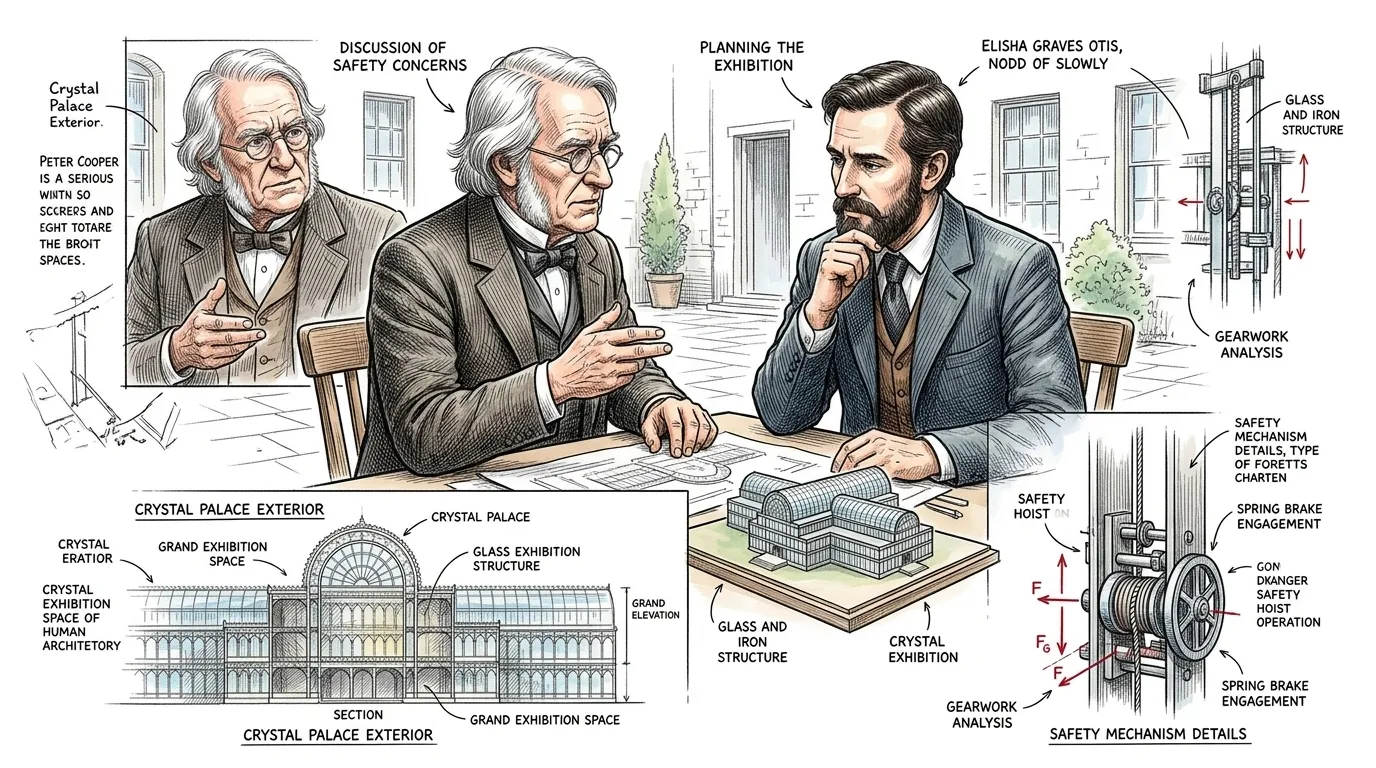
Despite the undeniable mechanics of his safety device, widespread public fear of falling presented a formidable barrier to adoption. Many perceived any form of vertical mechanical transport as inherently risky, preferring arduous stair climbs over the potential peril of a cable snap. Otis understood that mere invention was not enough; he needed a dramatic, unforgettable demonstration to earn public trust and silence the doubters.
"'The engineers at the exhibition committee remain hesitant, Elisha,' Peter Cooper, a respected industrialist and one of the organizers of the Crystal Palace Exhibition, informed Otis, his brow furrowed. 'They understand the mechanism, but the public's deep-seated fear of height and mechanical failure is a powerful adversary. They say, 'Who would trust their life to a machine?' We need more than schematics; we need an undeniable spectacle to overcome this ancient apprehension.' Otis nodded, already formulating his plan."
Page 7
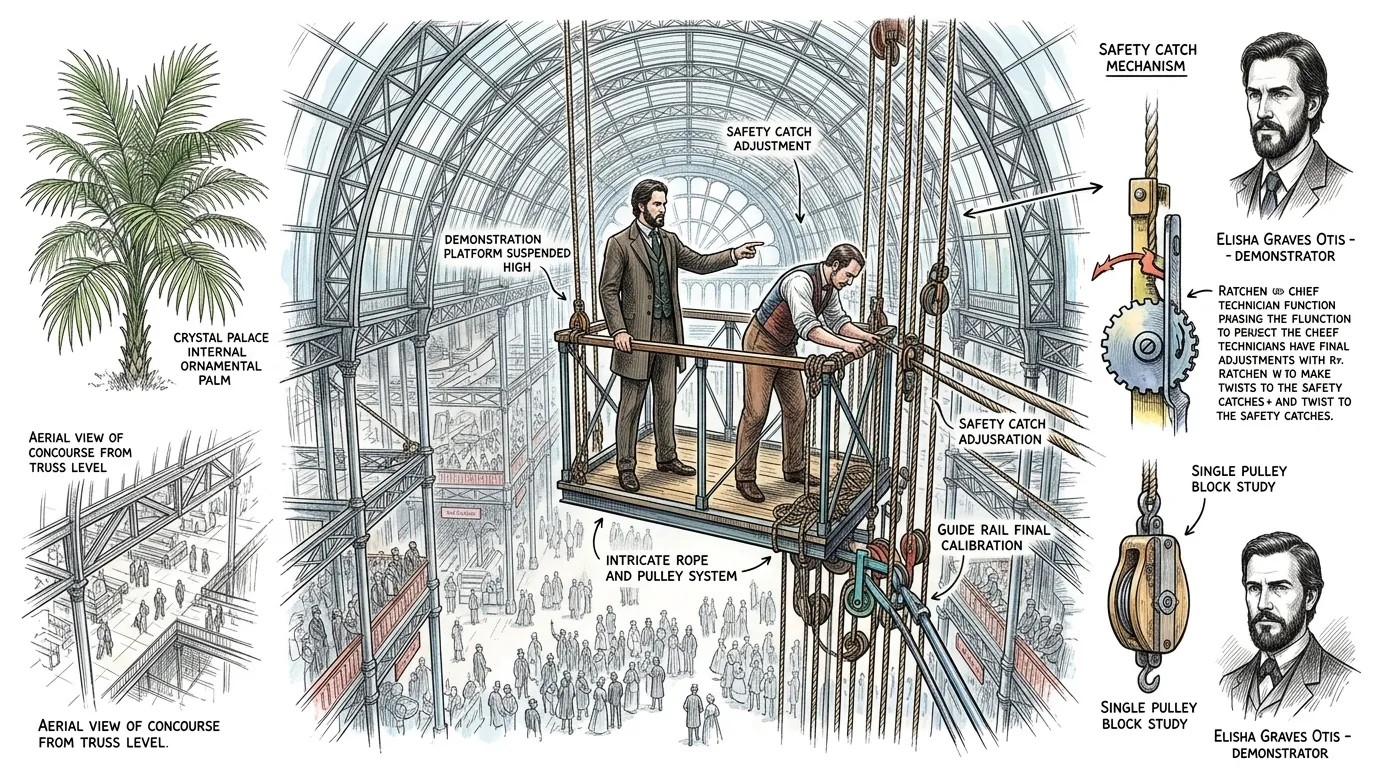
Days before the grand exhibition, Otis meticulously oversaw the installation of his safety hoist within the towering central space of the Crystal Palace. Every rope, every pulley, every guide rail was rigorously inspected under his watchful eye. He personally tested the platform, ensuring his mechanism would perform perfectly under the most extreme conditions. The weight of anticipation, both for his company and for the future of vertical transport, pressed heavily upon him as the crowds began to gather.
"'Ensure the tension is precise, Mr. Miller,' Elisha Graves Otis instructed his chief technician, a meticulous man with rolled-up sleeves, as they stood on the demonstration platform suspended high within the Crystal Palace. 'And double-check the engagement points of the safety catches against the guide rails. We must leave no margin for error. The reputation of this technology, and indeed, the very concept of the modern city, rests upon the integrity of this single, crucial demonstration.' Miller nodded, making final adjustments with a wrench."
Page 8
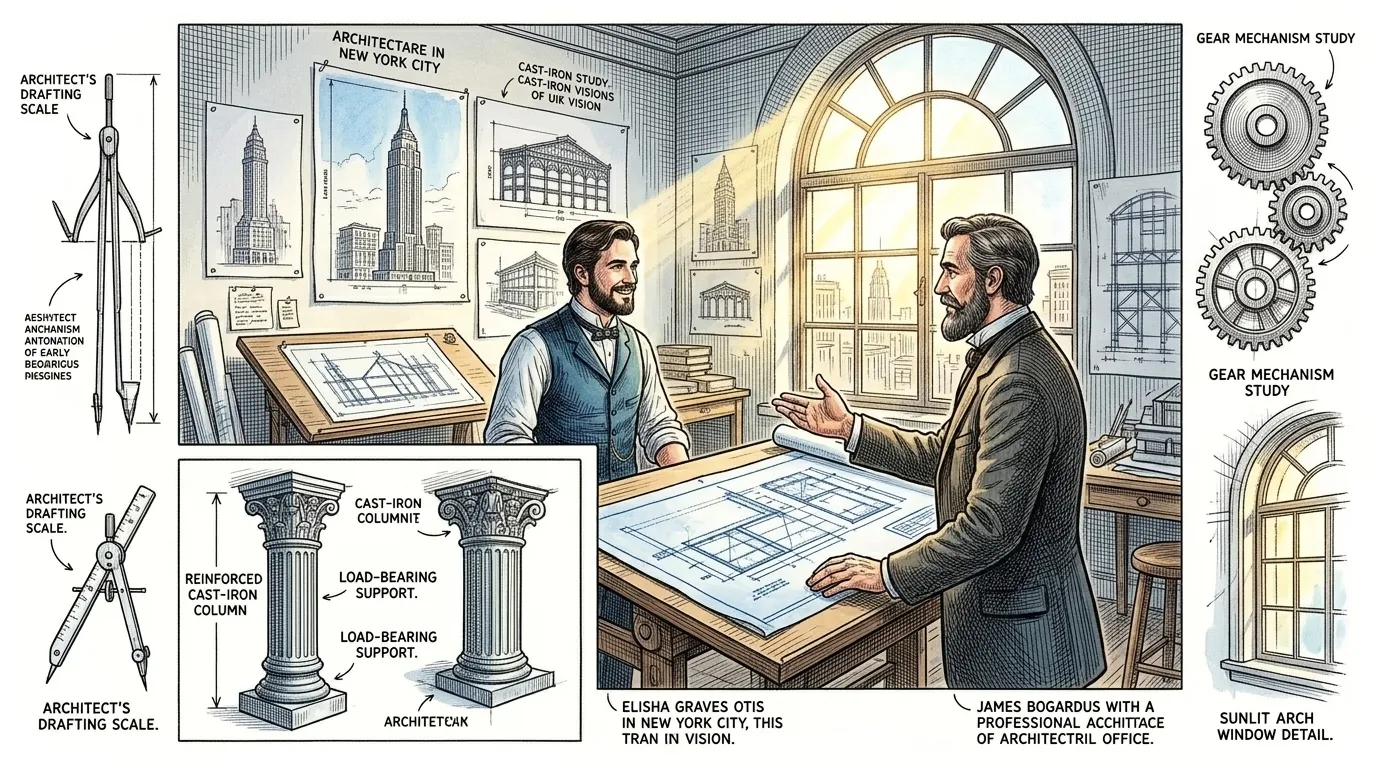
The audacious demonstration at the Crystal Palace irrevocably transformed public perception, opening the floodgates for the widespread adoption of Otis elevators. Architects and developers, now confident in vertical safety, began to envision structures previously deemed impossible. The inherent knowledge Otis had championed—that a single point of failure was unacceptable—became the bedrock of a new architectural paradigm, directly giving rise to the modern skyscraper.
"'This invention, Mr. Otis, will reshape our skylines,' a prominent architect, Mr. James Bogardus, declared to Elisha Graves Otis in a bustling architectural office in New York City. 'Your safety elevator solves the greatest challenge: the inherent vulnerability of old hoisting systems. By eliminating that single point of failure, you've made tall buildings not just possible, but practical and desirable. We can now design upward without fear.' Otis smiled, seeing his vision materialize."
Page 9
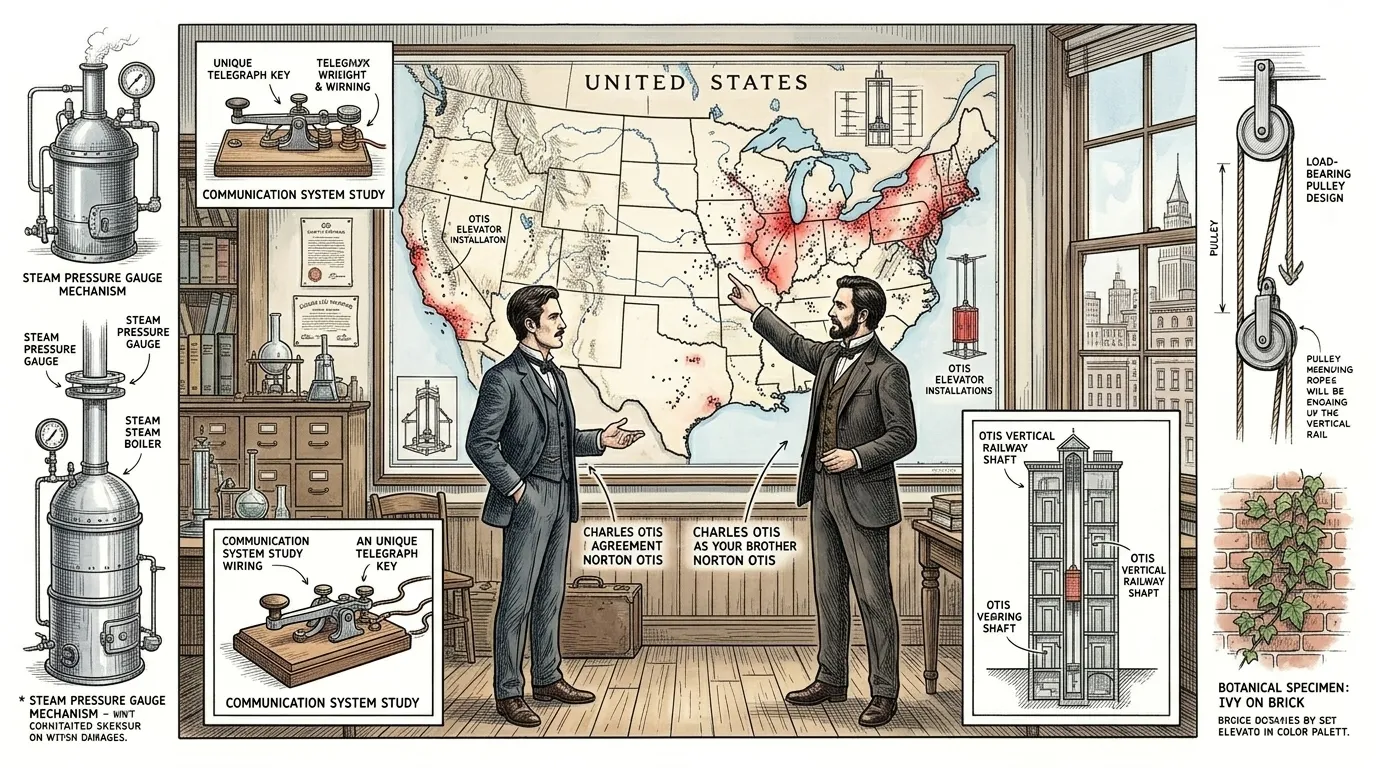
Elisha Graves Otis passed away in 1861, just seven years after his defining demonstration, never witnessing the full impact of his innovation. His sons, Charles and Norton, carried forward his legacy, transforming E.G. Otis & Co. into a global enterprise. They continuously refined his initial designs, further solidifying the trust that allowed cities to build ever higher. The company's expansion ensured Otis's name became synonymous with safe vertical transportation, a testament to his foundational work.
"'Father's vision was far grander than even he imagined, Charles,' Norton Otis, a focused young man, asserted to his brother, Charles Otis, the elder of the two, both dressed in somber yet determined business attire, as they stood before a large map of the United States dotted with emerging Otis elevator installations in their New York office, circa 1870. 'He gave the world the confidence to build upwards. Now, we must ensure his legacy of safety and innovation extends to every corner, allowing the vertical cities to truly flourish.' Charles nodded in agreement, pointing to a new installation site."
Page 10
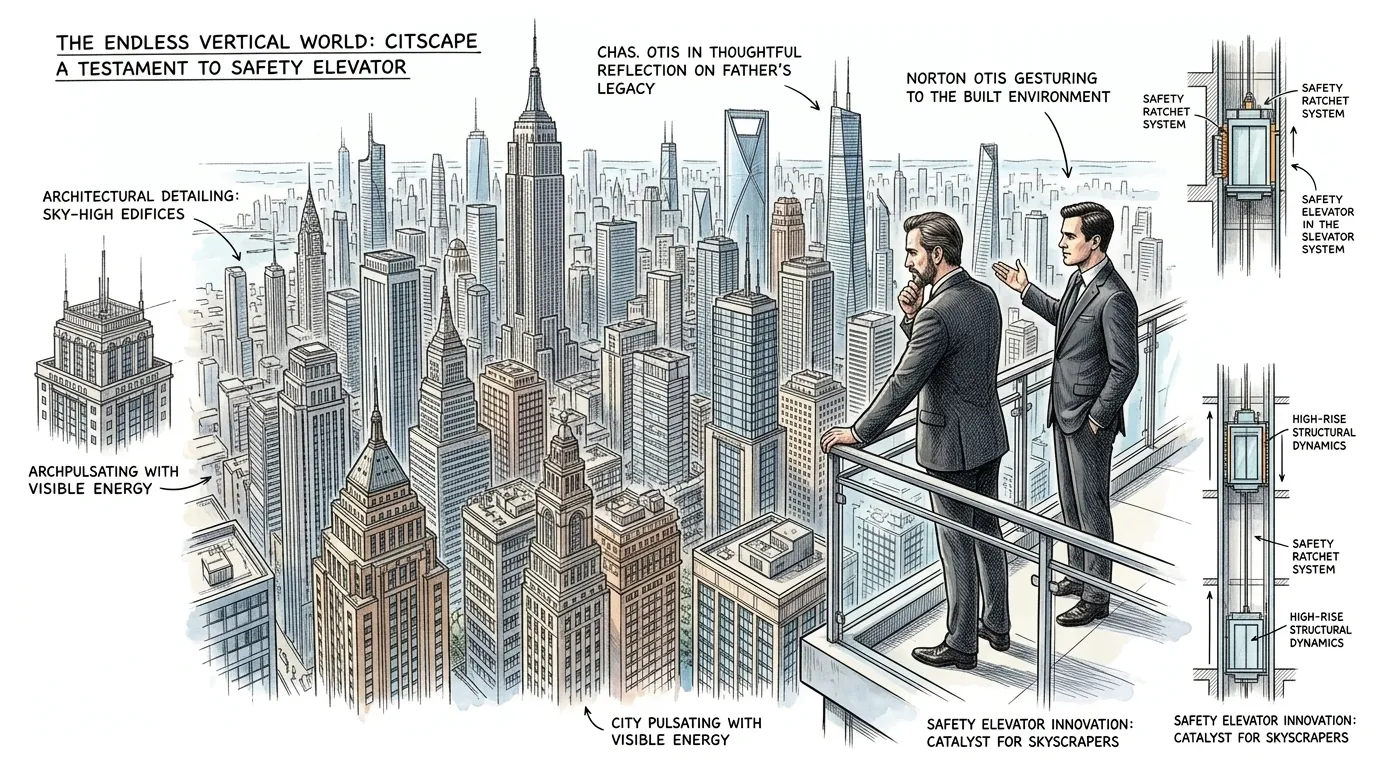
Elisha Graves Otis, through his relentless pursuit of mechanical safety, fundamentally reshaped the built environment and the human experience. His invention made the skyscraper possible, transforming urban centers into towering monuments of ambition and efficiency. From the bustling metropolises of today to the deepest mines, his legacy continues to quietly lift billions, an unseen architect of our modern vertical world. The safety elevator, once a mere demonstration, became an indispensable pillar of global infrastructure.
"'The very fabric of urban life now depends on what my father envisioned,' Charles Otis reflected, standing on a high-floor balcony overlooking a sprawling, rapidly developing cityscape, with Norton beside him. 'He removed the fear, and in doing so, he unlocked the potential for unprecedented human congregation and commerce in the skies. His invention, simple in principle, profound in consequence, truly made the impossible possible. The vertical world is his enduring monument.' Norton nodded, gesturing to the endless high-rises below."
About this story
- Location: Global
- Audience: general readers
Questions and answers
Read Wonder People on your phone
Wonder People is available on Android. Get Wonder People on Google Play.