Chien-Shiung Wu

Chien-Shiung Wu — an illustrated science story, set in Global. 10 illustrated pages, free to read on Wonder Science.
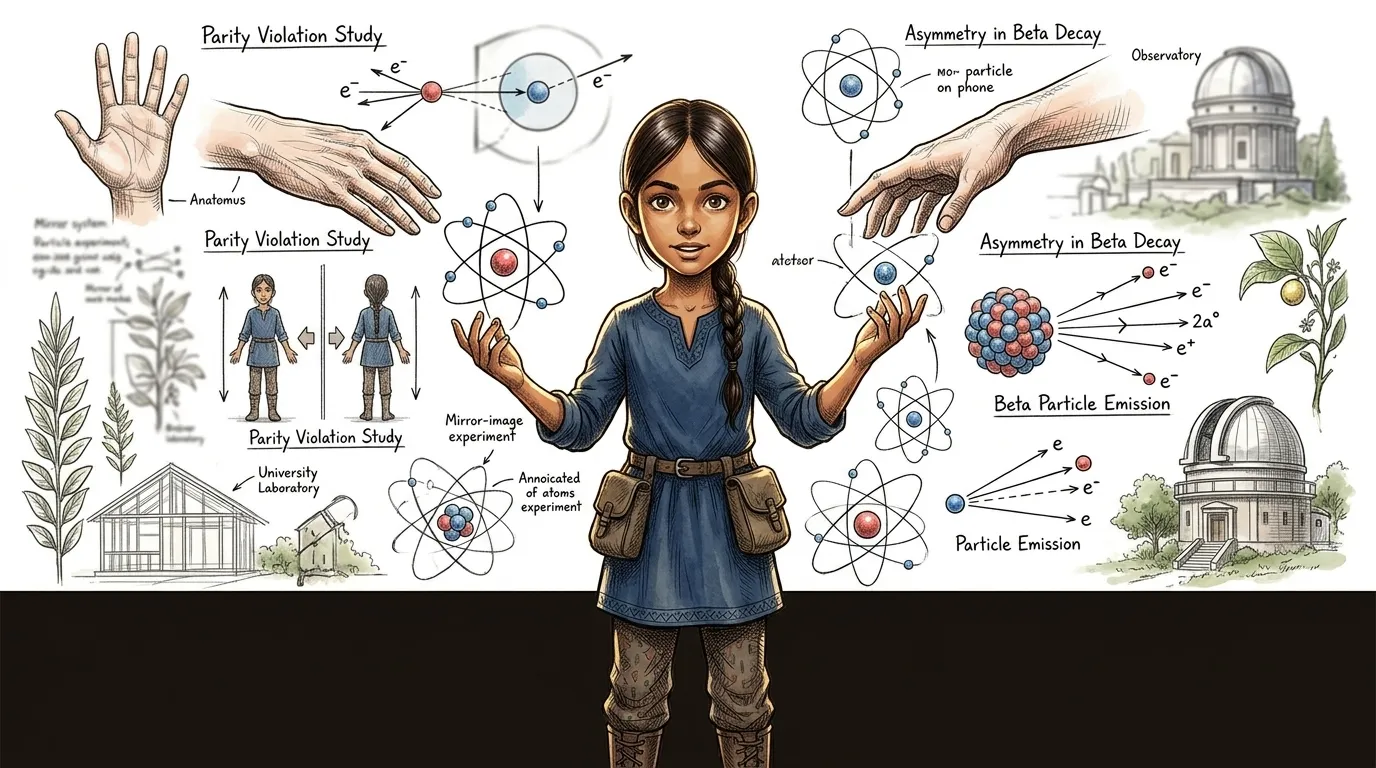
Chien-Shiung Wu — book cover — Wonder Science
Chien-Shiung Wu — an illustrated science story, set in Global. 10 illustrated pages, free to read on Wonder Science.

Page 1
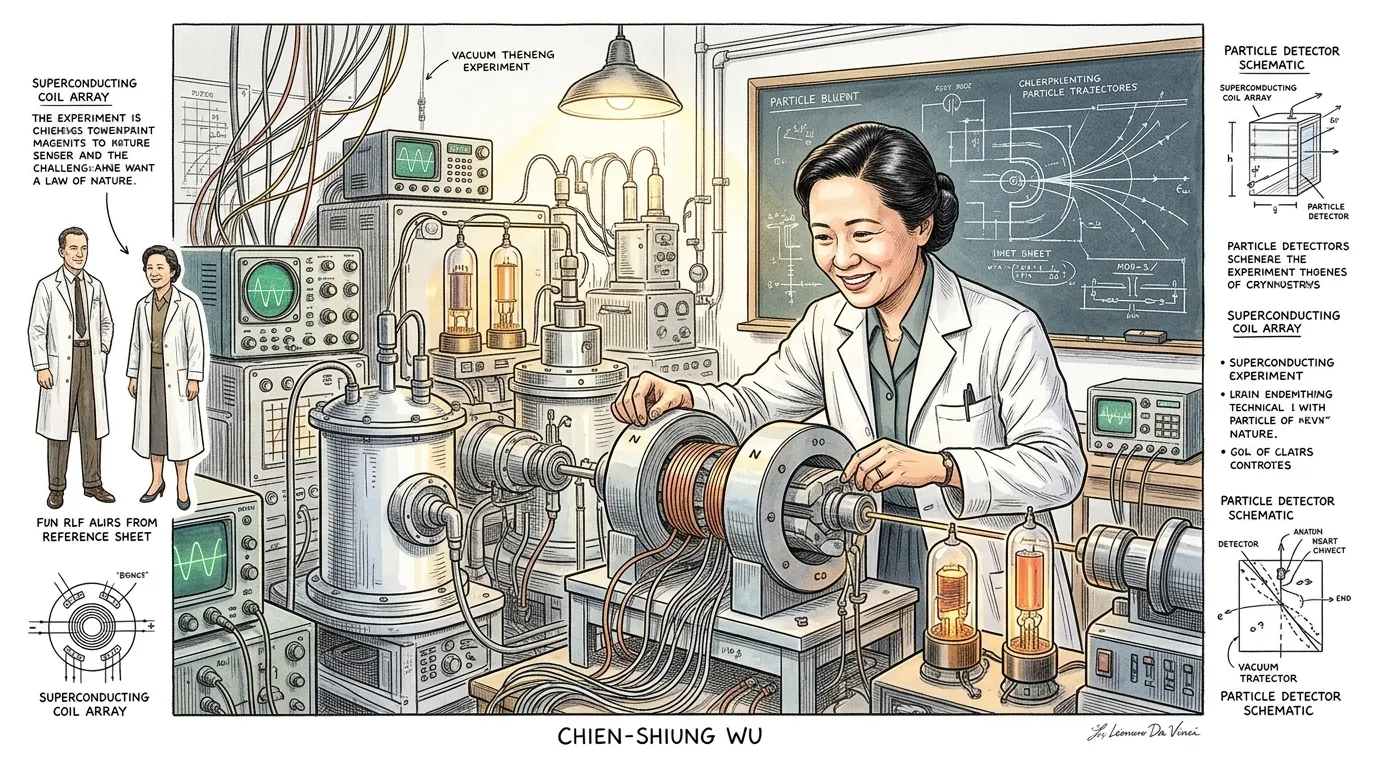
In the heart of a bustling physics lab, amidst a symphony of whirring machinery and flickering oscilloscopes, a groundbreaking experiment was underway.
In the heart of a bustling physics lab, amidst a symphony of whirring machinery and flickering oscilloscopes, a groundbreaking experiment was underway. Its goal? To challenge a fundamental law of nature. The scientist at the helm, Chien-Shiung Wu, known as the 'First Lady of Physics,' meticulously prepared for a test that would shake the foundations of particle physics.

In the heart of a bustling physics lab, amidst a symphony of whirring machinery and flickering oscilloscopes, a groundbreaking experiment was underway. Its goal? To challenge a fundamental law of nature. The scientist at the helm, Chien-Shiung Wu, known as the 'First Lady of Physics,' meticulously prepared for a test that would shake the foundations of particle physics. This moment would redefine our understanding of symmetry in the universe.\n\n Fact: Establishing shot of Chien-Shiung Wu's groundbreaking experiment.

Page 2
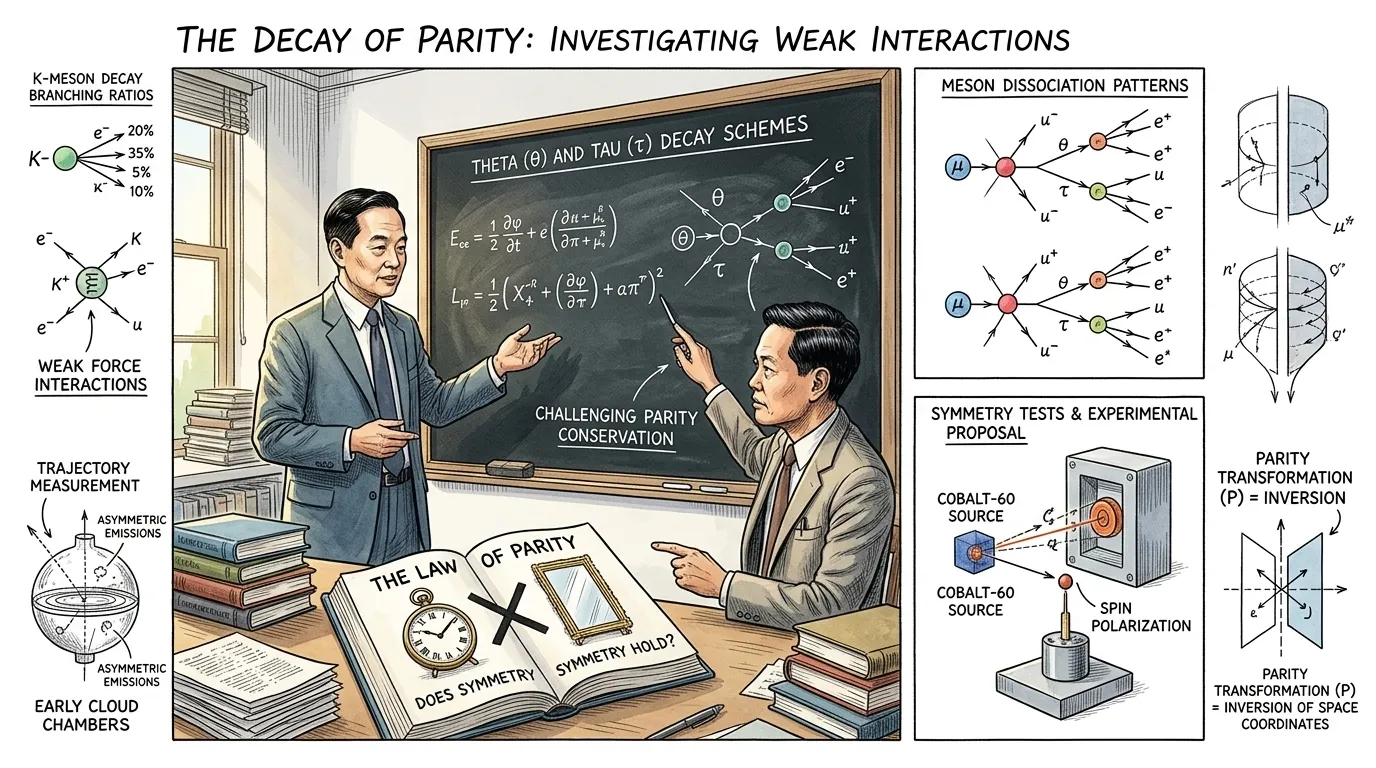
Before Wu's experiment, physicists believed in the 'law of parity,' a principle suggesting that the universe is symmetrical.
Before Wu's experiment, physicists believed in the 'law of parity,' a principle suggesting that the universe is symmetrical. Imagine a clock and its mirror image; both would behave identically. But a nagging puzzle arose: certain subatomic particles, like the 'theta' and 'tau' mesons, seemed to decay in different ways, defying this symmetry.

Before Wu's experiment, physicists believed in the 'law of parity,' a principle suggesting that the universe is symmetrical. Imagine a clock and its mirror image; both would behave identically. But a nagging puzzle arose: certain subatomic particles, like the 'theta' and 'tau' mesons, seemed to decay in different ways, defying this symmetry. This created a crisis, leading theoretical physicists Tsung-Dao Lee and Chen Ning Yang to propose a radical idea.\n\n Fact: The theoretical groundwork laid by Lee and Yang.

Page 3
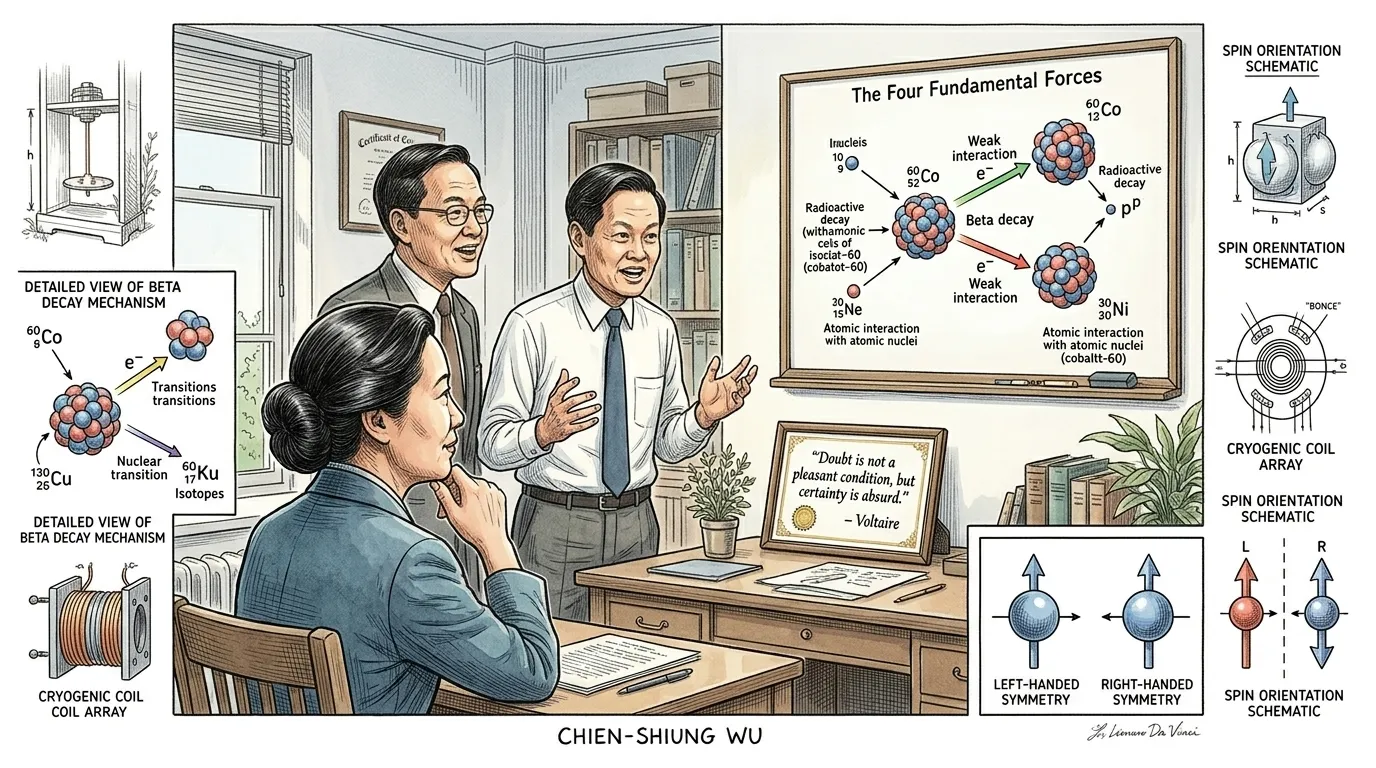
Lee and Yang hypothesized that parity might not hold true for the weak nuclear force, one of the four fundamental forces in nature.
Lee and Yang hypothesized that parity might not hold true for the weak nuclear force, one of the four fundamental forces in nature. This force governs certain types of radioactive decay. To prove their theory, they needed an experiment. 'Doubt is not a pleasant condition, but certainty is absurd,' said Voltaire. Wu understood this sentiment perfectly. They approached Wu, an expert in beta decay, to design a crucial test.

Lee and Yang hypothesized that parity might not hold true for the weak nuclear force, one of the four fundamental forces in nature. This force governs certain types of radioactive decay. To prove their theory, they needed an experiment. 'Doubt is not a pleasant condition, but certainty is absurd,' said Voltaire. Wu understood this sentiment perfectly. They approached Wu, an expert in beta decay, to design a crucial test. Her meticulous approach and deep understanding of experimental physics made her the ideal candidate.\n\n Fact: Camila's research into the fundamental forces of nature.

Page 4
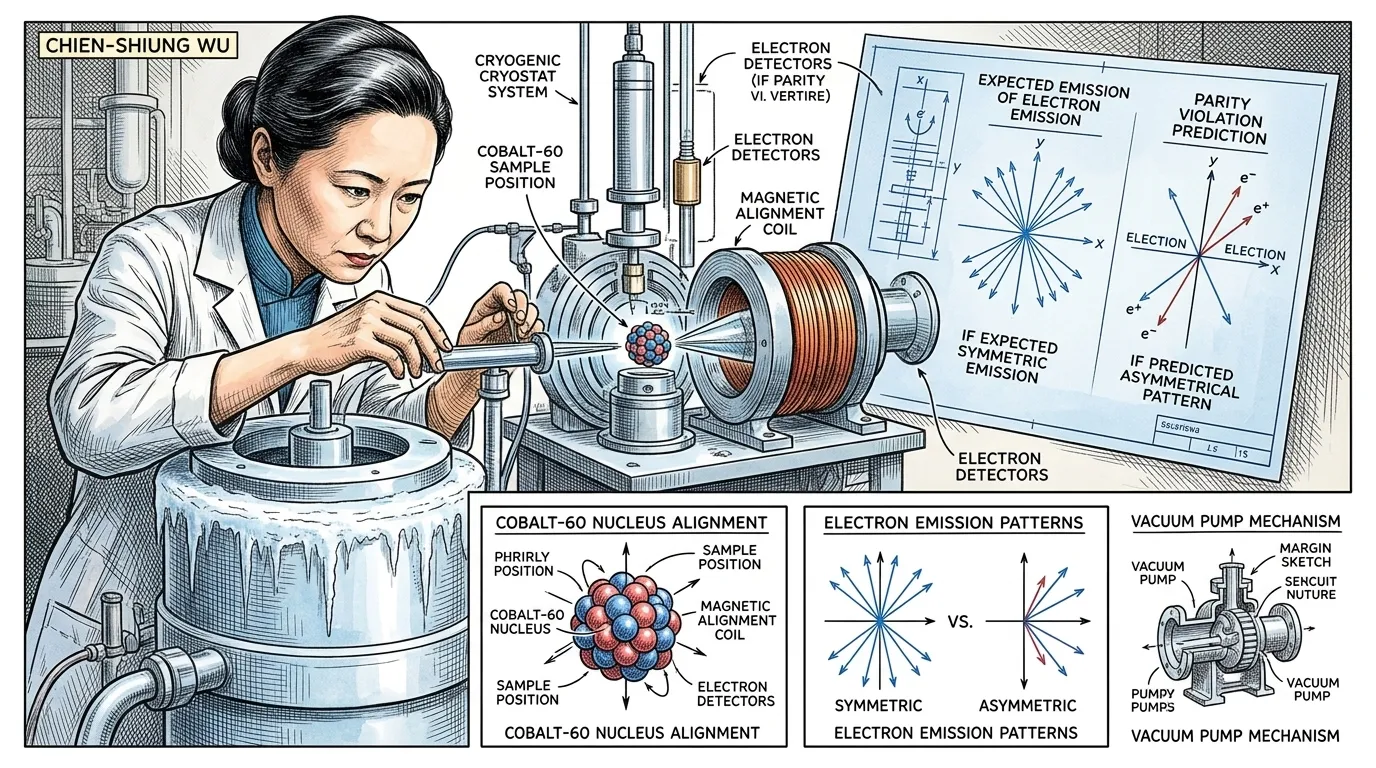
Wu designed an experiment using Cobalt-60, a radioactive isotope that undergoes beta decay. The key was to align the nuclei of Cobalt-60 atoms using a strong…
Wu designed an experiment using Cobalt-60, a radioactive isotope that undergoes beta decay. The key was to align the nuclei of Cobalt-60 atoms using a strong magnetic field at extremely low temperatures, just above absolute zero. If parity were conserved, the electrons emitted during beta decay would be ejected equally in both directions relative to the aligned nuclei. If not, there would be an asymmetry, proving parity violation.

Wu designed an experiment using Cobalt-60, a radioactive isotope that undergoes beta decay. The key was to align the nuclei of Cobalt-60 atoms using a strong magnetic field at extremely low temperatures, just above absolute zero. If parity were conserved, the electrons emitted during beta decay would be ejected equally in both directions relative to the aligned nuclei. If not, there would be an asymmetry, proving parity violation. This required extraordinary precision and technical skill.\n\n Fact: The experimental setup using Cobalt-60.

Page 5
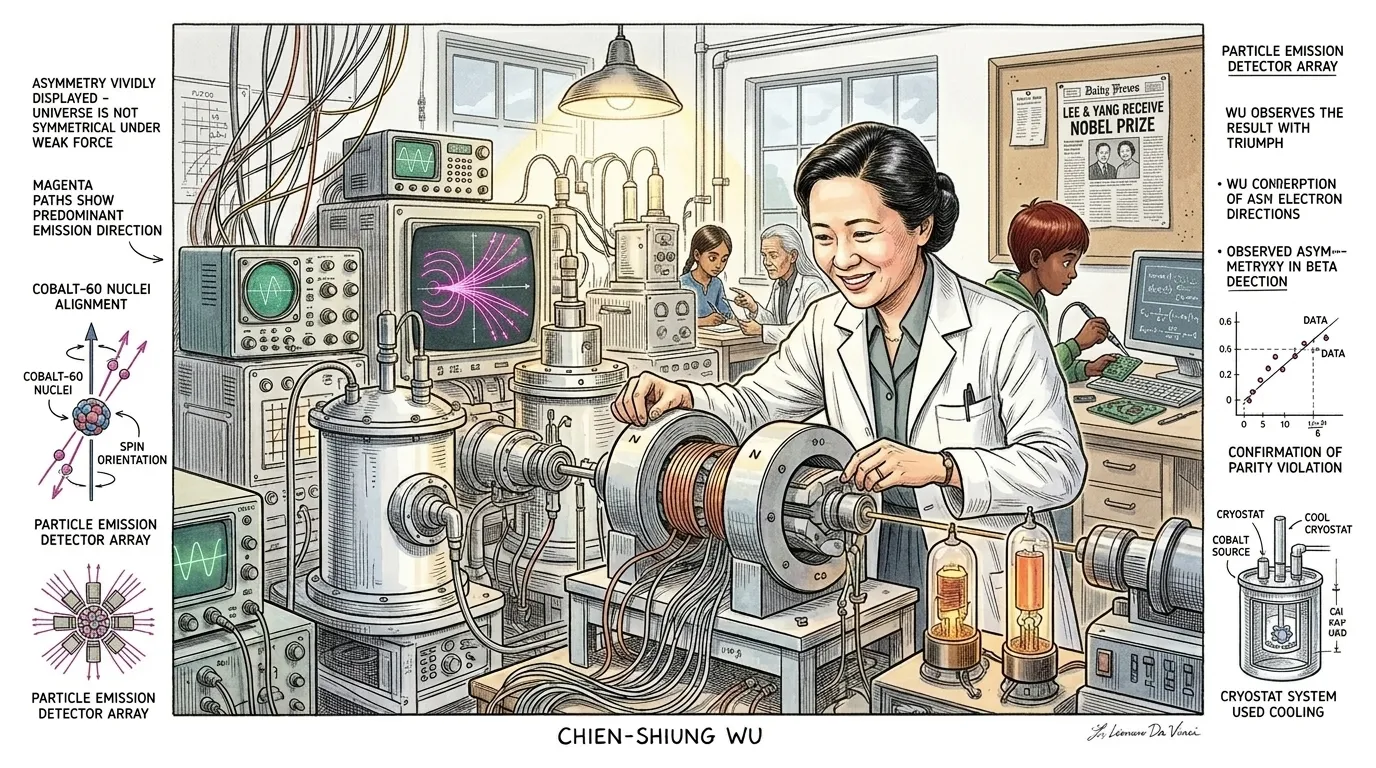
The results were astonishing. More electrons were emitted in one direction than the other, clearly violating parity. The universe, at least concerning the weak…
The results were astonishing. More electrons were emitted in one direction than the other, clearly violating parity. The universe, at least concerning the weak force, was not symmetrical! This groundbreaking discovery revolutionized particle physics. Lee and Yang were awarded the Nobel Prize in Physics in 1957.

The results were astonishing. More electrons were emitted in one direction than the other, clearly violating parity. The universe, at least concerning the weak force, was not symmetrical! This groundbreaking discovery revolutionized particle physics. Lee and Yang were awarded the Nobel Prize in Physics in 1957. Wu's pivotal experimental work, though essential, was not similarly recognized at the time, highlighting the historical biases women in science faced.\n\n Fact: Wu's triumphant moment of discovery.

Page 6
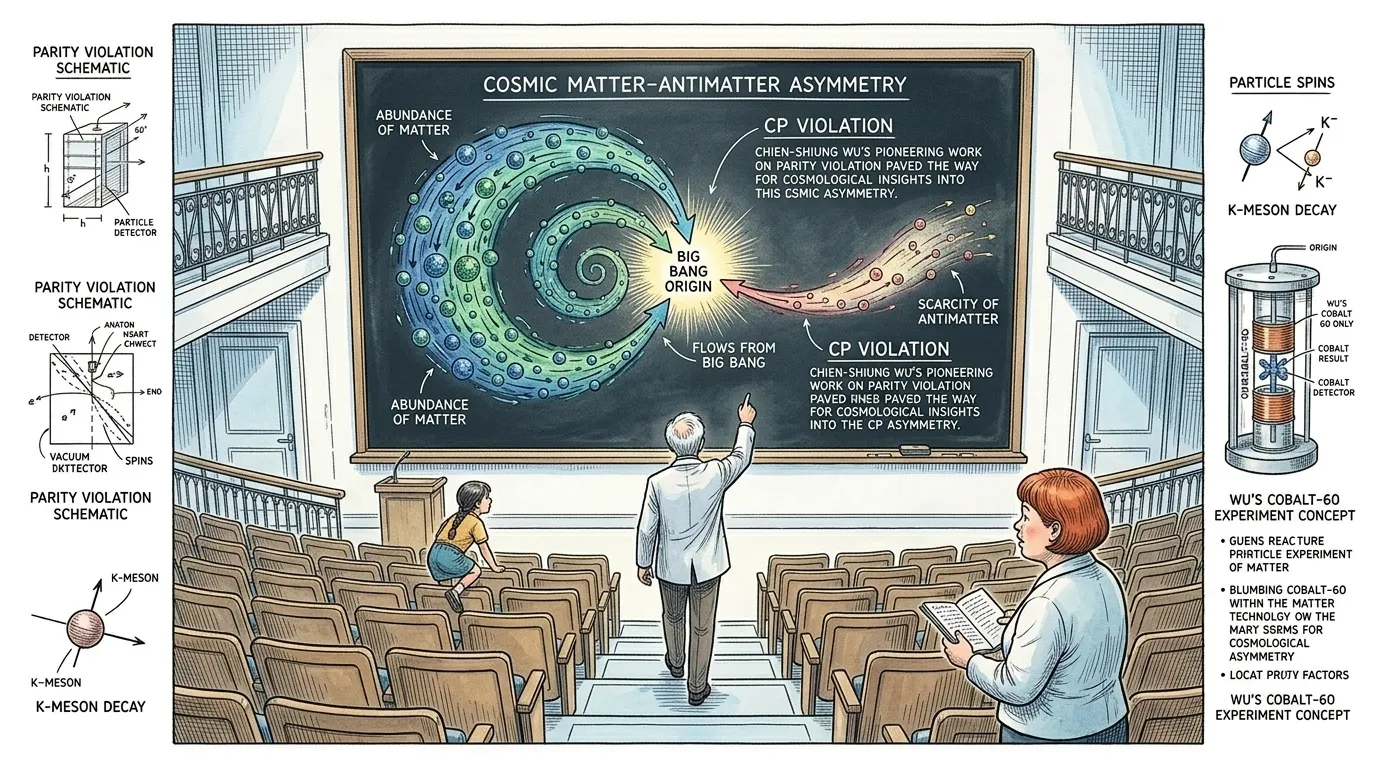
The discovery of parity violation opened up new avenues of research in particle physics. It led to a deeper understanding of the weak force and its role in the…
The discovery of parity violation opened up new avenues of research in particle physics. It led to a deeper understanding of the weak force and its role in the universe. Physicists began exploring other symmetries and their potential violations. CP violation, for example, explains why there is more matter than antimatter in the universe, a fundamental question in cosmology.

The discovery of parity violation opened up new avenues of research in particle physics. It led to a deeper understanding of the weak force and its role in the universe. Physicists began exploring other symmetries and their potential violations. CP violation, for example, explains why there is more matter than antimatter in the universe, a fundamental question in cosmology. Wu's experiment paved the way for these profound insights.\n\n Fact: Visualizing the matter-antimatter asymmetry in the universe.

Page 7
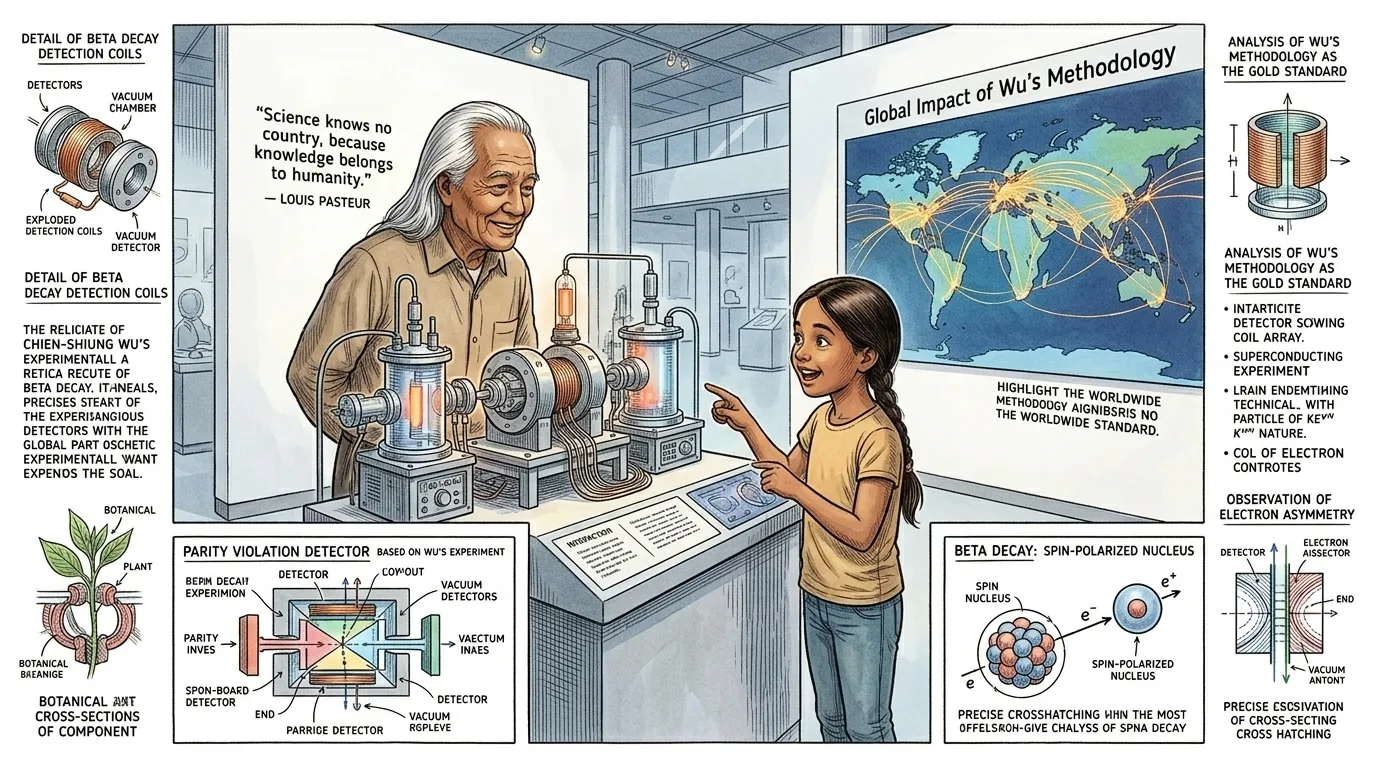
'Science knows no country, because knowledge belongs to humanity,' Louis Pasteur declared. Wu's work transcended geographical boundaries and had a global…
'Science knows no country, because knowledge belongs to humanity,' Louis Pasteur declared. Wu's work transcended geographical boundaries and had a global impact. Her meticulous experimental techniques became a gold standard in physics. She continued to make significant contributions to nuclear and particle physics throughout her career.

'Science knows no country, because knowledge belongs to humanity,' Louis Pasteur declared. Wu's work transcended geographical boundaries and had a global impact. Her meticulous experimental techniques became a gold standard in physics. She continued to make significant contributions to nuclear and particle physics throughout her career. Her story serves as an inspiration to aspiring scientists, especially women, demonstrating the power of perseverance and intellectual rigor.\n\n Fact: Wu's lasting impact on the world of physics.

Page 8
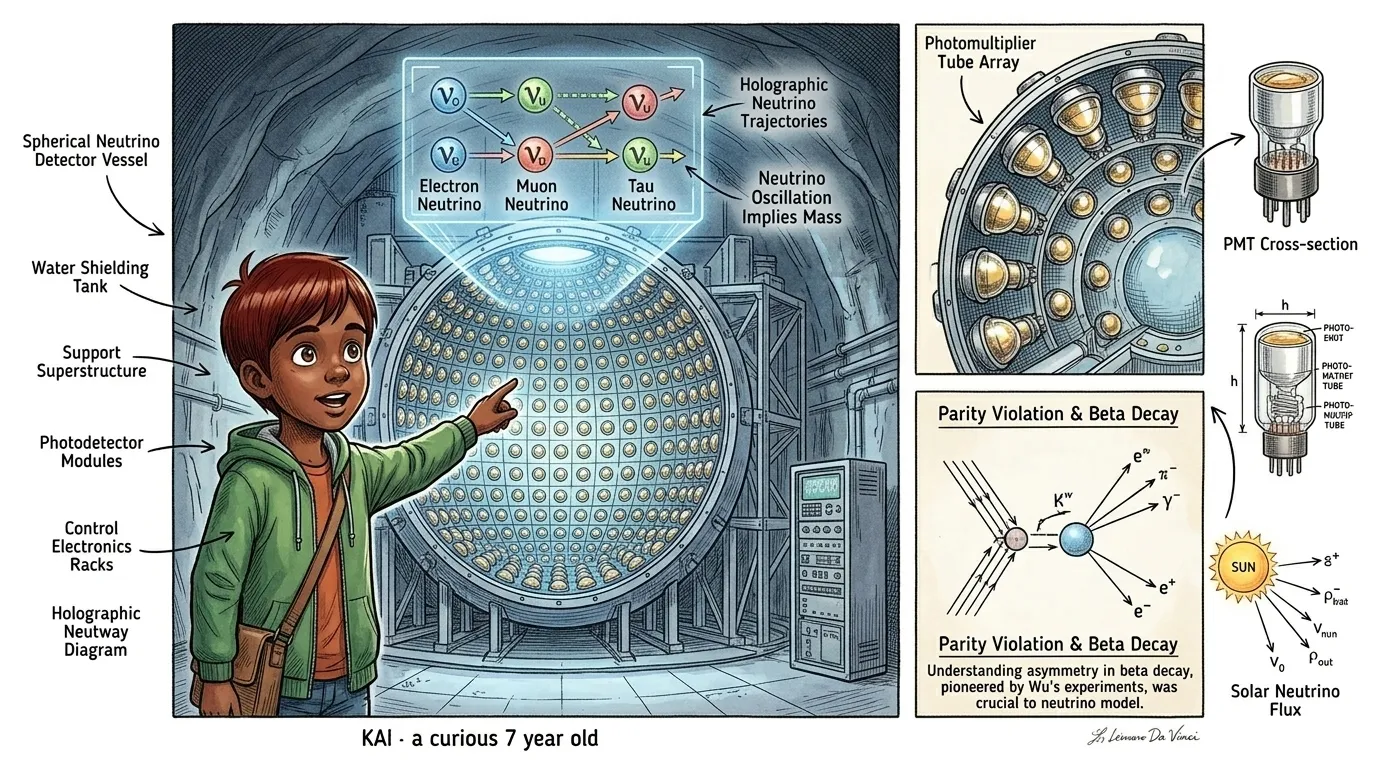
Wu's experiment also deepened our understanding of neutrinos, elusive subatomic particles that interact only through the weak force and gravity.
Wu's experiment also deepened our understanding of neutrinos, elusive subatomic particles that interact only through the weak force and gravity. By showing the weak force violated parity, physicists could better understand how neutrinos behave during radioactive decay. Further experiments built on Wu's work led to the discovery of neutrino oscillation, revealing that neutrinos have mass, a finding with major implications for our understanding of the cosmos.\n\n Fact…

Wu's experiment also deepened our understanding of neutrinos, elusive subatomic particles that interact only through the weak force and gravity. By showing the weak force violated parity, physicists could better understand how neutrinos behave during radioactive decay. Further experiments built on Wu's work led to the discovery of neutrino oscillation, revealing that neutrinos have mass, a finding with major implications for our understanding of the cosmos.\n\n Fact: Visualizing a modern neutrino experiment.

Page 9
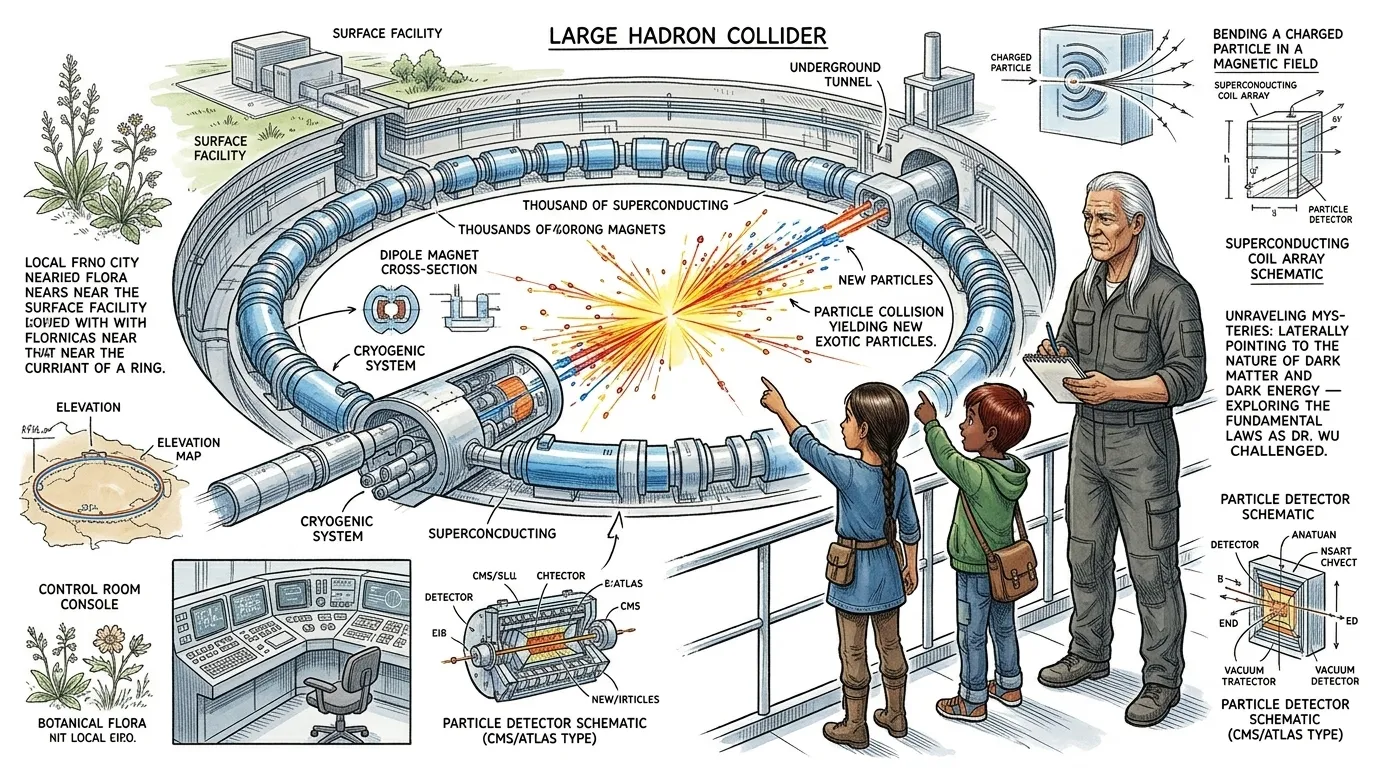
Today, particle physics continues to probe the fundamental laws of nature, inspired by Wu's pioneering work. Experiments at the Large Hadron Collider (LHC)…
Today, particle physics continues to probe the fundamental laws of nature, inspired by Wu's pioneering work. Experiments at the Large Hadron Collider (LHC) search for new particles and symmetries, seeking to unravel the mysteries of dark matter and dark energy. The legacy of Chien-Shiung Wu lives on in every experiment that challenges our understanding of the universe, proving that even the most fundamental laws can be questioned and refined.\n\n Fact: The LHC, a modern…

Today, particle physics continues to probe the fundamental laws of nature, inspired by Wu's pioneering work. Experiments at the Large Hadron Collider (LHC) search for new particles and symmetries, seeking to unravel the mysteries of dark matter and dark energy. The legacy of Chien-Shiung Wu lives on in every experiment that challenges our understanding of the universe, proving that even the most fundamental laws can be questioned and refined.\n\n Fact: The LHC, a modern instrument pushing the boundaries of physics.

Page 10
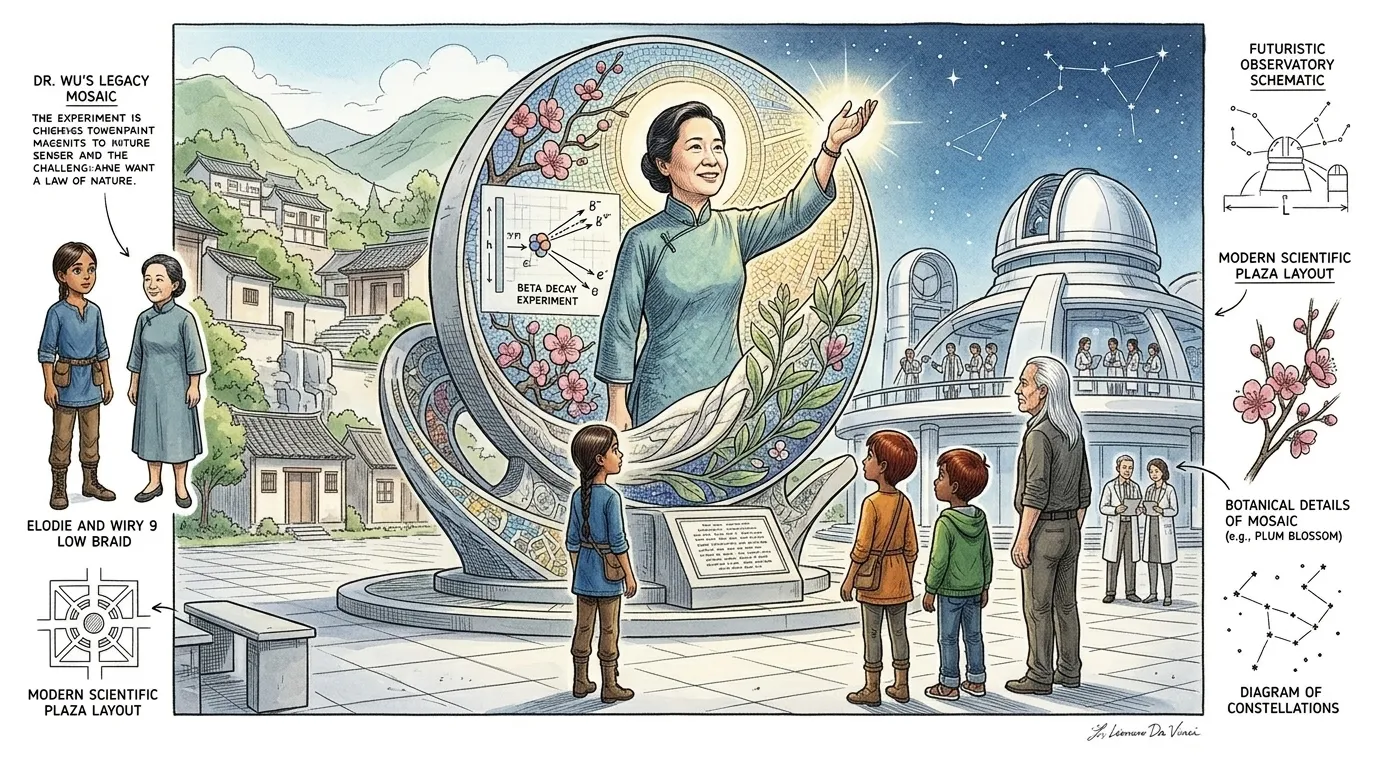
Chien-Shiung Wu's journey, from a small town in China to the forefront of physics, exemplifies the power of human curiosity and the relentless pursuit of…
Chien-Shiung Wu's journey, from a small town in China to the forefront of physics, exemplifies the power of human curiosity and the relentless pursuit of knowledge. Her experiment challenged established dogma, opening new frontiers in physics and inspiring generations of scientists. Her story serves as a testament to the enduring quest to understand the universe and our place within it.\n\n Fact: The lasting legacy of Chien-Shiung Wu on future generations.

Chien-Shiung Wu's journey, from a small town in China to the forefront of physics, exemplifies the power of human curiosity and the relentless pursuit of knowledge. Her experiment challenged established dogma, opening new frontiers in physics and inspiring generations of scientists. Her story serves as a testament to the enduring quest to understand the universe and our place within it.\n\n Fact: The lasting legacy of Chien-Shiung Wu on future generations.

About this story

  • Location: Global
  • Audience: kids (ages 6–12)

Questions and answers

Questions and answers about Chien-Shiung Wu

Read Wonder Science on your phone

Wonder Science is available on Android. Get Wonder Science on Google Play.

More Wonder Science stories

All Wonder Science stories · Open the library