Christiaan Huygens
Christiaan Huygens — an illustrated science story, set in Global. 10 illustrated pages, free to read on Wonder Science.

Page 1
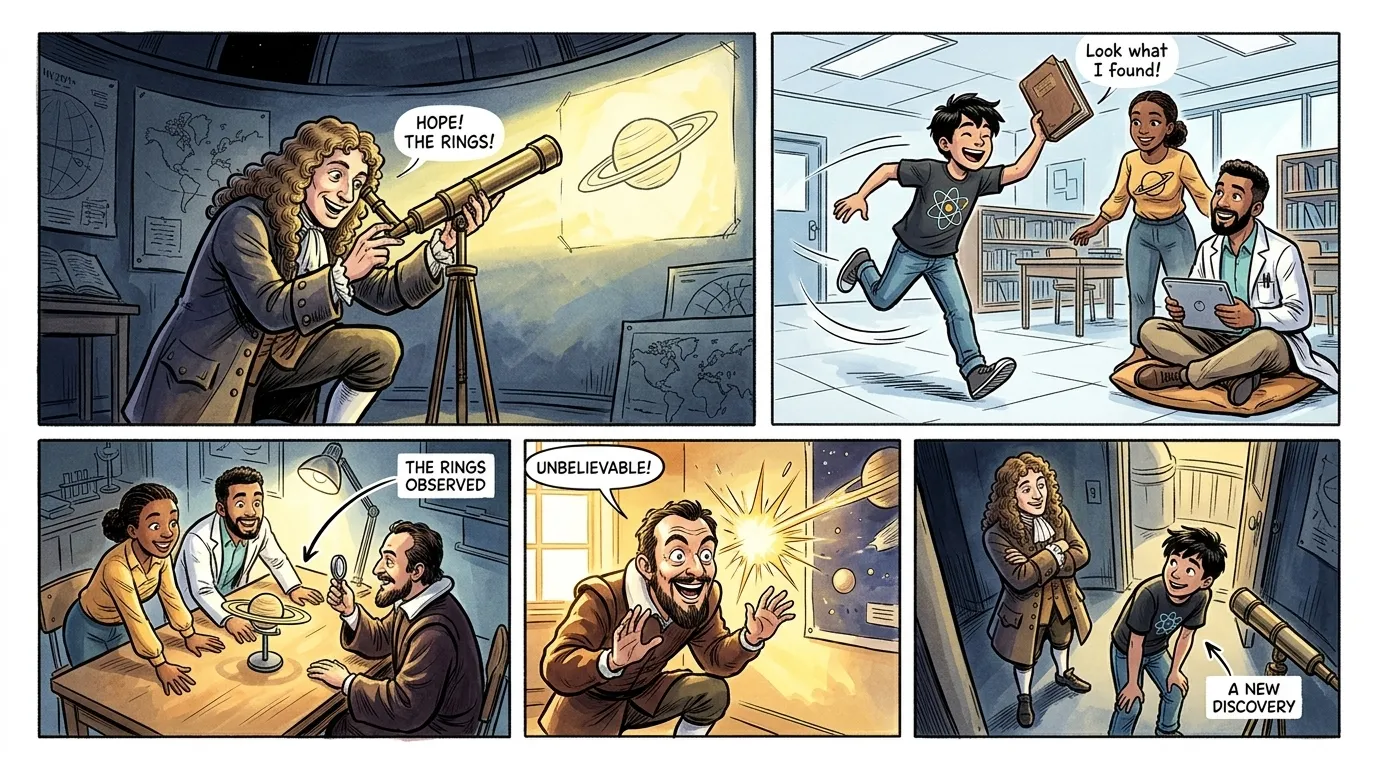
The year is 1655. In a dimly lit observatory in The Hague, Dutch polymath Christiaan Huygens meticulously adjusted his homemade refracting telescope. Through its vastly improved optics, he peered into the dark, revealing details of Saturn that had eluded all before him, fundamentally reshaping humanity's understanding of our solar system. This single observation transformed Saturn from a puzzling enigma into a celestial marvel.
Page 2
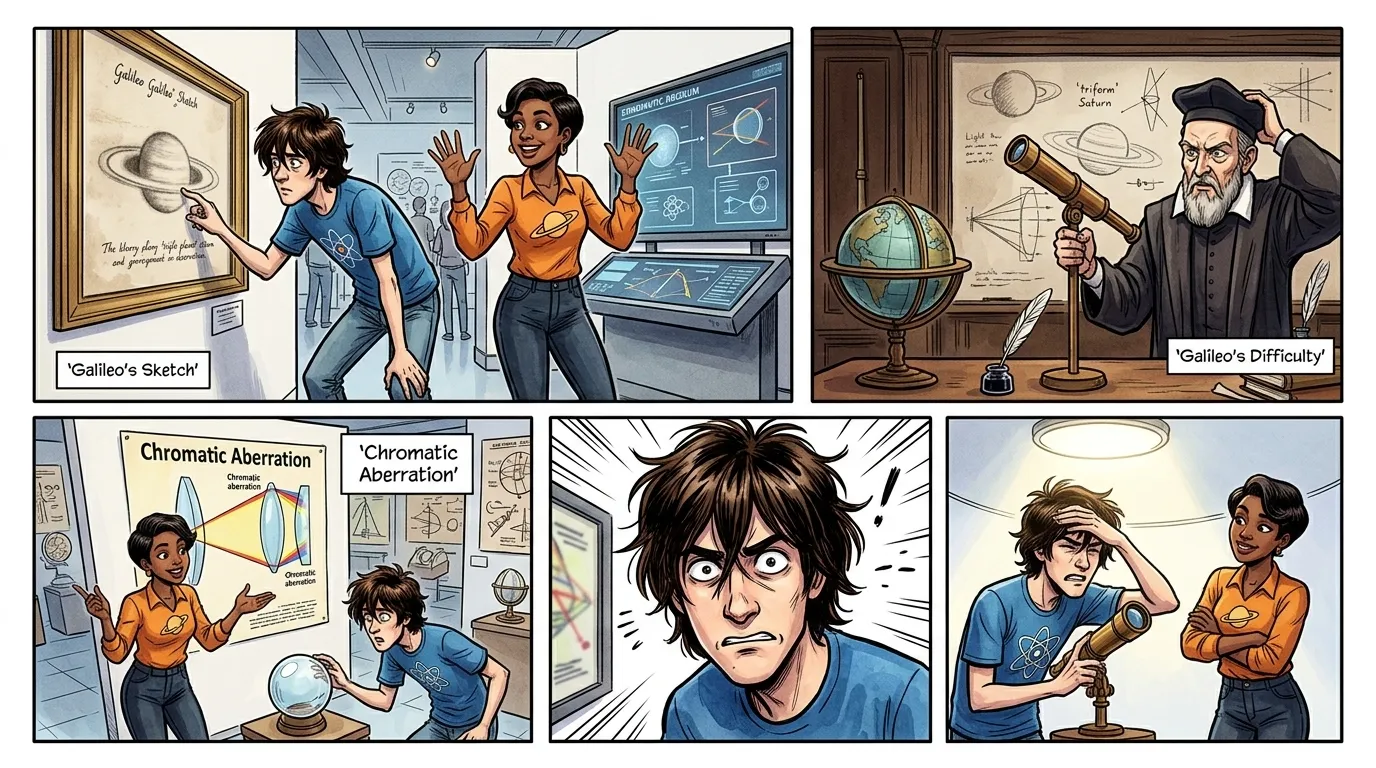
For centuries, the distant planets remained mysterious, their true forms obscured by the limitations of early telescopes and atmospheric interference. Galileo Galilei, with his pioneering instrument in the early 17th century, could only perceive Saturn as a 'triple planet' or an object with 'ears,' a perplexing observation that baffled astronomers. The raw power of magnification alone was not enough to reveal the subtle truths of the cosmos.\n\n"'Why couldn't Galileo see the rings clearly, Adaeze?' Kai asked, tracing a finger over a historical drawing of Galileo's blurry Saturn observation. 'His telescopes were revolutionary for their time, Kai,' Adaeze replied, pointing to a diagram of Galileo's early lens design. 'But they suffered from severe chromatic aberration, blurring colors and making distant details nearly impossible to discern accurately.'"
Page 3
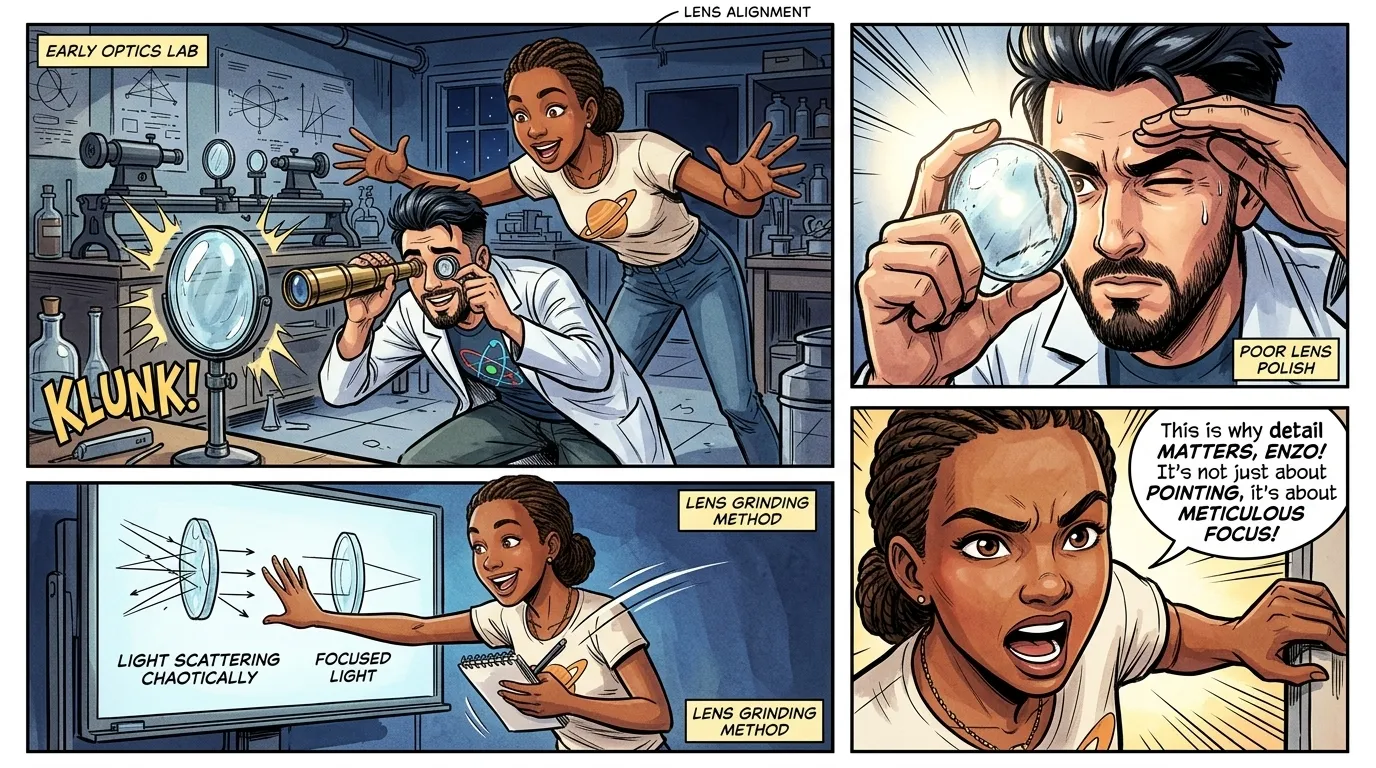
Before Huygens, even the most dedicated astronomers struggled with the inherent flaws of telescope design. The quest for clearer vision required not just bigger lenses, but fundamentally better ones, ground with unprecedented precision to minimize distortions. This relentless pursuit of optical perfection became the key to unlocking the solar system's secrets, demanding innovation in both theory and practical craftsmanship.\n\n"'So, improving the glass was the secret?' Enzo wondered, looking at a replica of a rough lens. 'Exactly, Enzo,' Adaeze confirmed, tapping a finger on a schematic illustrating light passing cleanly through a finely polished lens versus scattering through a flawed one. 'Huygens knew that merely magnifying a fuzzy image only made it a bigger fuzzy image; clarity was paramount, and it came from his meticulous lens grinding techniques.'"
Page 4
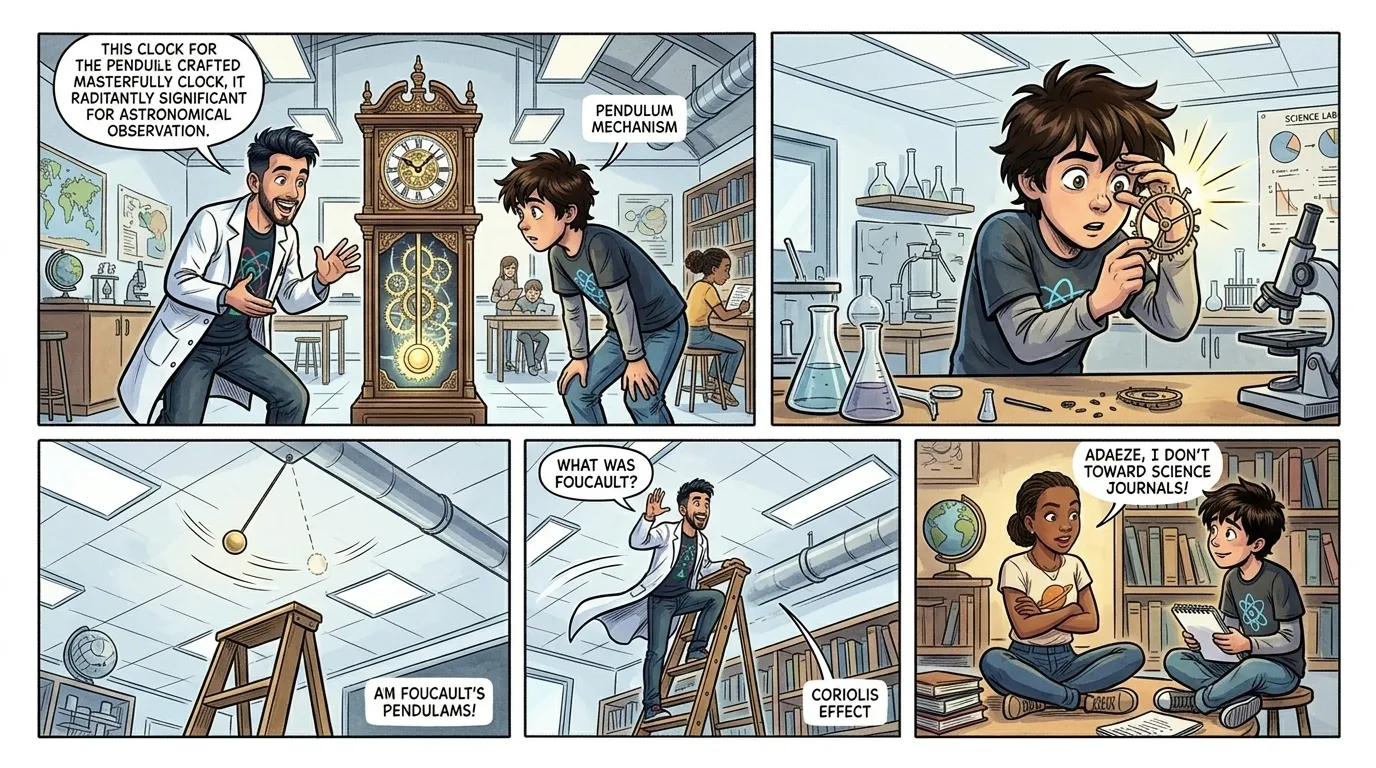
Beyond optics, accurate timekeeping was crucial for astronomical observation, allowing precise measurement of celestial movements and predicting transits. Before the 17th century, clocks were notoriously inaccurate, varying by many minutes a day. Huygens' invention of the pendulum clock in 1656 dramatically improved this, offering an unprecedented level of precision that enabled a new era of scientific measurement and navigation.\n\n"'How could he track a tiny moon without a super accurate clock?' Kai asked, gazing at an intricate model of a pendulum clock. 'He couldn't, not reliably!' Enzo exclaimed, gesturing towards the clock's swinging pendulum. 'That's why he invented the pendulum clock, Kai. It was the first device accurate enough for serious astronomical observation, reducing error from minutes to mere seconds per day.'"
Page 5
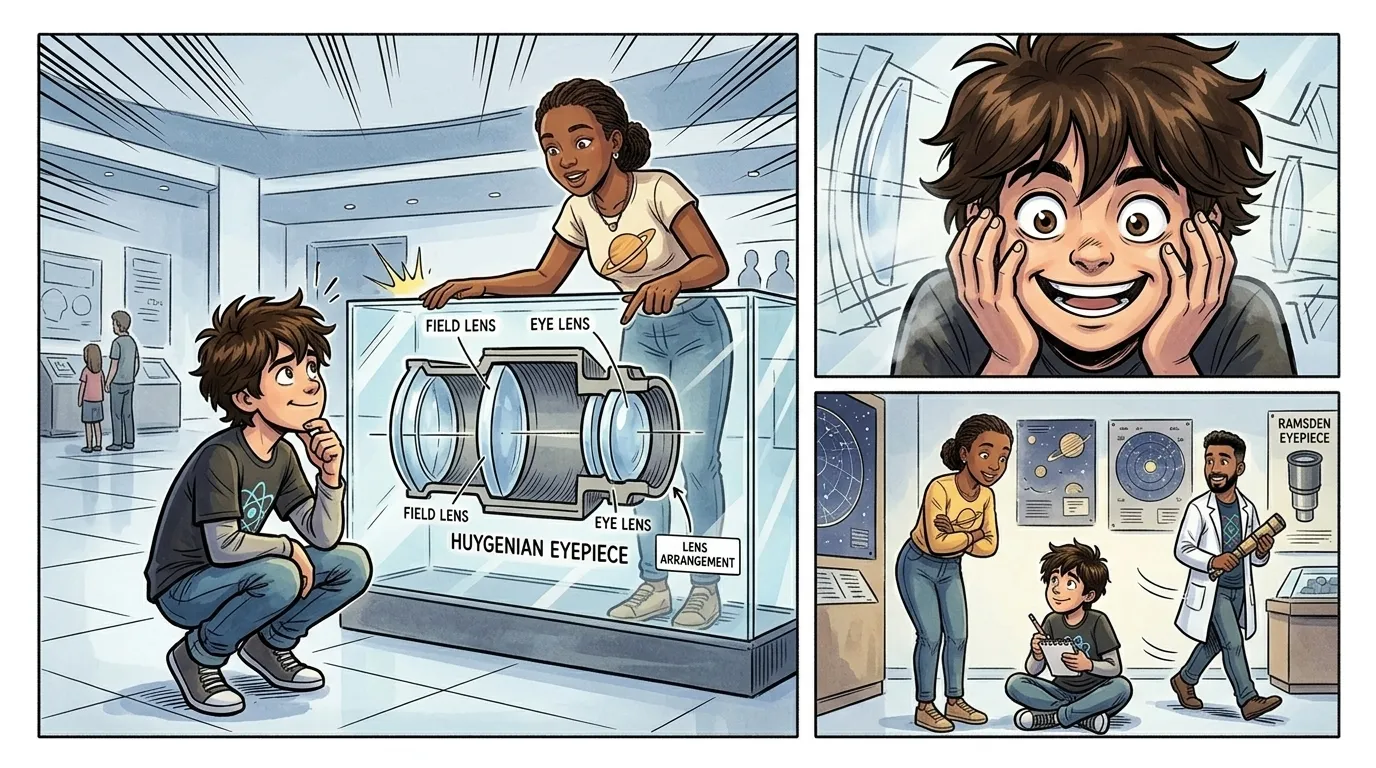
Huygens' genius extended beyond grinding individual lenses; he pioneered the design of complex multi-element eyepieces. His 'Huygenian eyepiece,' consisting of two plano-convex lenses, significantly reduced both spherical and chromatic aberration, creating a wider, flatter, and far clearer field of view. This innovation was pivotal, allowing astronomers to finally see distant celestial bodies with true definition, revealing previously unseen details.\n\n"'So his eyepiece design was like adding a special pair of glasses to the telescope?' Kai mused, examining a cutaway diagram of the Huygenian eyepiece. 'Precisely, Kai!' Adaeze affirmed, pointing to the two lenses within the diagram. 'By combining lenses in a specific way, Huygens cancelled out many of the distortions that plagued earlier designs, making objects like Saturn's rings truly distinct.'"
Page 6
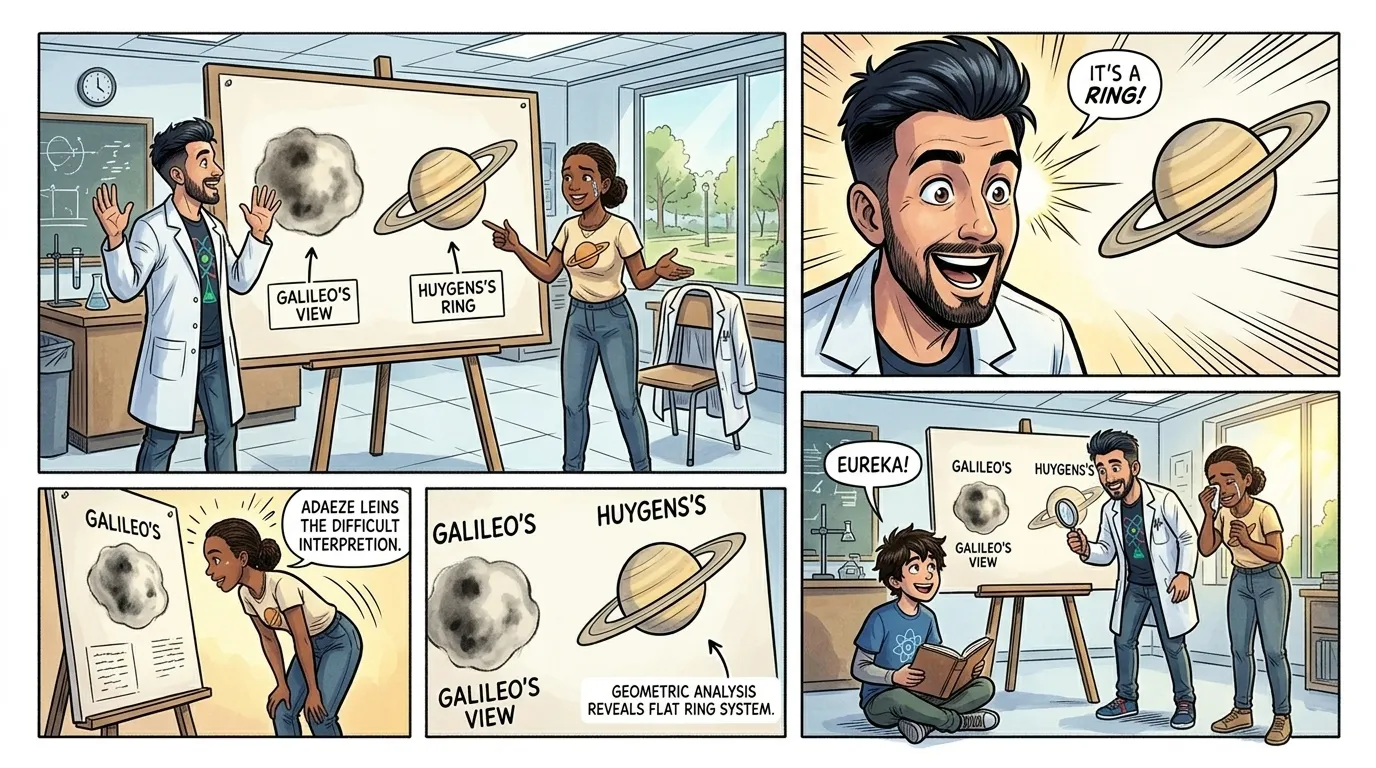
Through his advanced optics, Huygens wasn't just observing; he was interpreting. Galileo's 'ears' had morphed into distinct, separate features, but their nature remained elusive. Huygens, through painstaking observation and geometric analysis, deduced that these were not discrete moons or appendages, but a thin, flat ring system encircling the planet, tilted relative to the ecliptic. This was a radical departure from previous theories.\n\n"'It's amazing how a better view changed everything!' Enzo exclaimed, looking at a comparative illustration. 'Imagine seeing 'ears' turn into a giant, beautiful ring!' Adaeze added, gesturing between a blurred Galileo sketch and Huygens' sharp depiction of Saturn's rings. 'It wasn't just seeing, Enzo, it was understanding the geometry. Huygens had to figure out why the rings sometimes seemed to disappear from Earth's view, linking it to their tilt.'"
Page 7
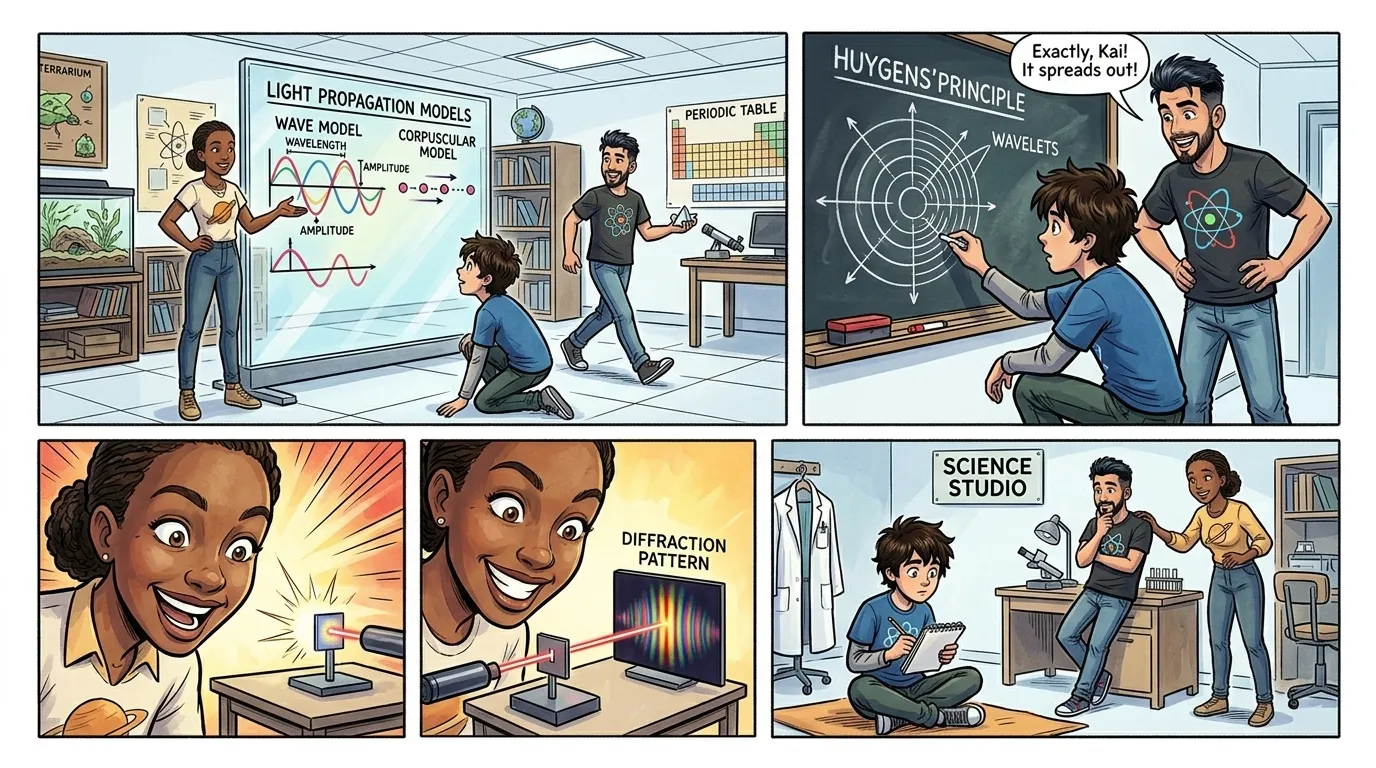
Huygens' contributions weren't limited to physical instruments. His 'Traité de la lumière' (Treatise on Light), published in 1690, laid the foundational principles of the wave theory of light. He proposed that light propagated as a wave, not particles, explaining phenomena like reflection, refraction, and double refraction. This groundbreaking work challenged prevailing Cartesian and Newtonian views, setting the stage for centuries of debate.\n\n"'So, he didn't just look at stars, he figured out how the light works?' Kai asked, eyes wide, looking at a diagram of a wave. 'Exactly, Kai,' Enzo confirmed, pointing to lines illustrating light waves. 'He imagined light as tiny waves, spreading out in all directions, like ripples in a pond. He explained how light could bend and bounce, a truly radical idea for his time, challenging even Isaac Newton's ideas.'"
Page 8
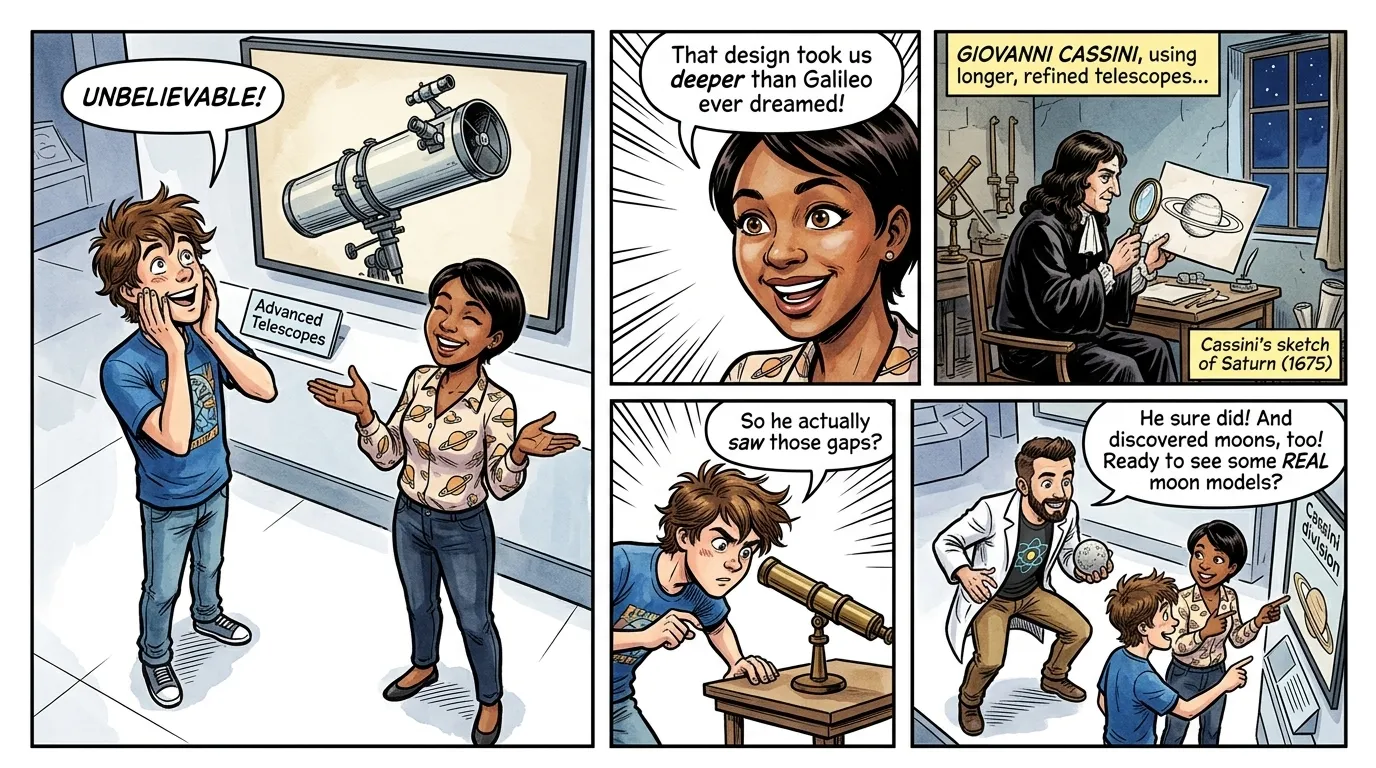
Huygens' innovations extended far beyond immediate astronomical discoveries. His pendulum clock revolutionized navigation and timekeeping, crucial for global exploration and precise scientific experiments. His optical advancements continued to influence telescope design for generations, enabling further celestial discoveries by astronomers like Giovanni Cassini, who would later identify divisions within Saturn's rings.\n\n"'Wow, so his ideas helped other scientists make discoveries too!' Kai exclaimed, looking at an image of a later, more advanced telescope. 'That's the power of foundational work, Kai,' Adaeze said, smiling. 'As the Roman philosopher Seneca once said, 'Every new beginning comes from some other beginning's end.' Huygens' ending, or rather his breakthrough, was Cassini's new beginning for understanding Saturn, allowing for even finer details to be seen!'"
Page 9

The seeds of Huygens' work, from improving optical clarity to understanding the nature of light, blossomed into the very technologies that would one day carry humanity to Saturn itself. The Cassini-Huygens mission, a testament to his enduring legacy, deployed a probe, aptly named 'Huygens,' to land on Titan, the very moon he discovered. This incredible feat cemented his place as a pioneer whose vision paved the way for interstellar exploration.\n\n"'It's like his spirit went to Saturn!' Kai whispered, looking at a model of the Cassini-Huygens probe. 'More than his spirit, Kai,' Enzo corrected softly, pointing to the 'Huygens probe' section of the model. 'His science, his precision, his deep understanding of light and mechanics — all of it was built into that probe, enabling it to land on a moon he first saw with a simple telescope hundreds of years ago.'"
Page 10
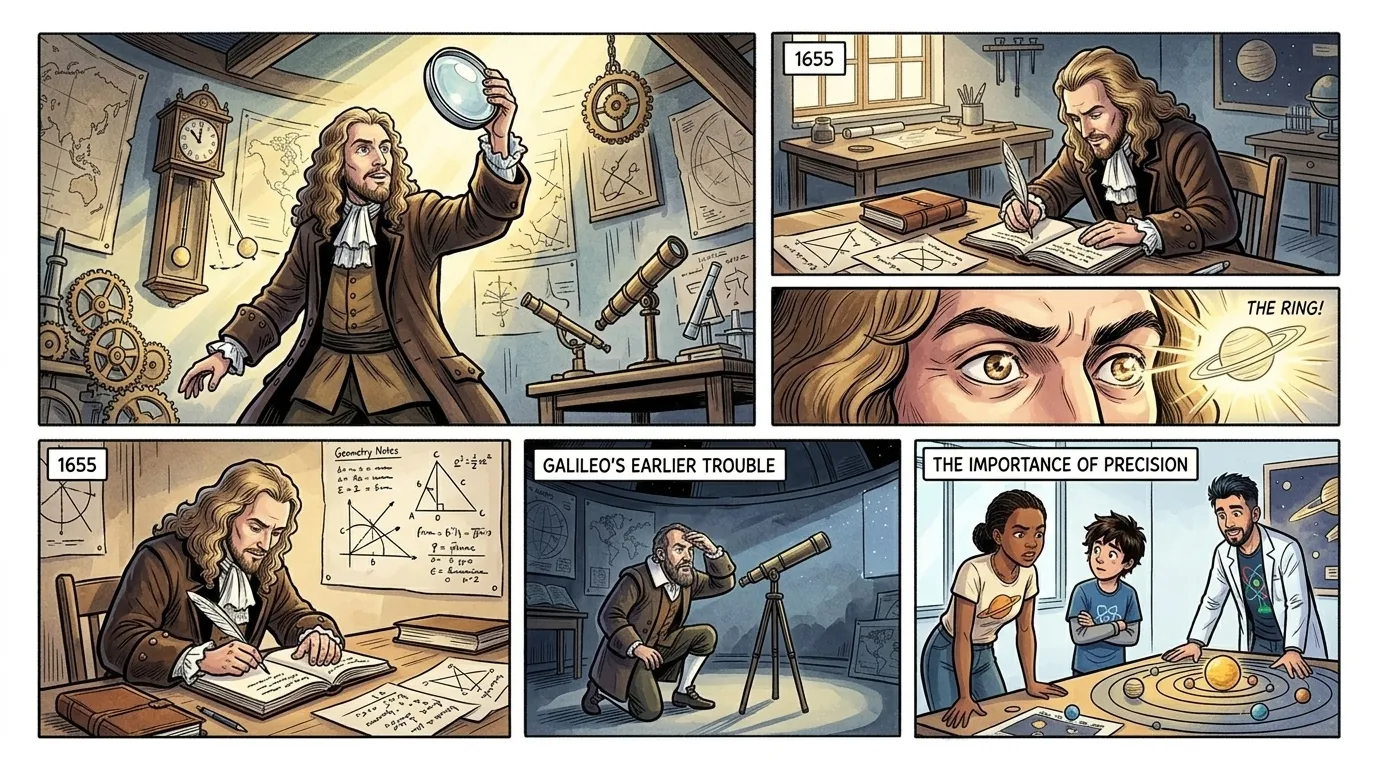
Christiaan Huygens was more than a discoverer; he was an architect of scientific method, driven by meticulous observation, precise engineering, and rigorous theoretical thought. His impact resonates through astronomy, physics, and engineering, reminding us that every journey into the unknown begins with a single, clear-eyed gaze. His legacy is a testament to the power of human intellect to unravel the most profound mysteries of the universe, layer by painstaking layer.
About this story
- Location: Global
- Audience: general readers
Questions and answers
Read Wonder Science on your phone
Wonder Science is available on Android. Get Wonder Science on Google Play.