David Gross
David Gross — an illustrated science story, set in Global. 10 illustrated pages, free to read on Wonder Science.
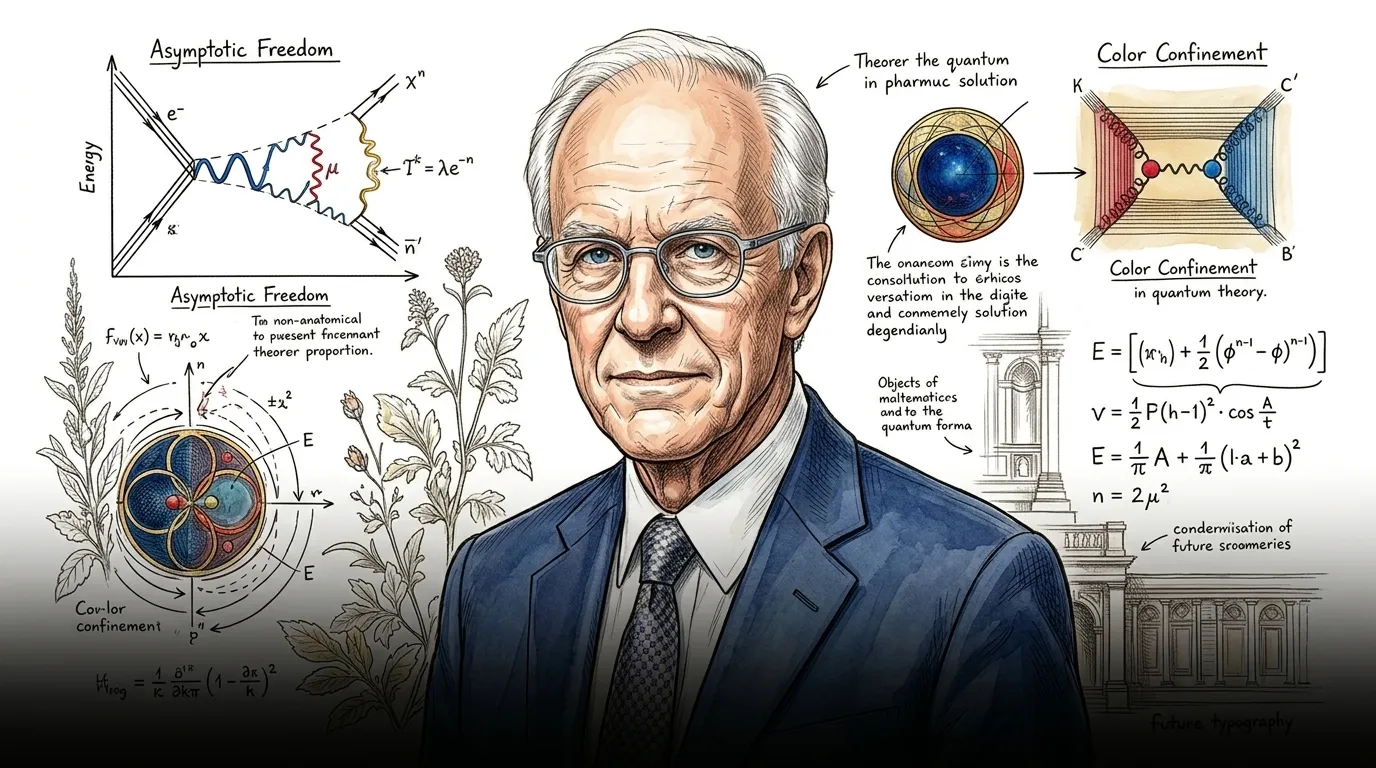
Page 1
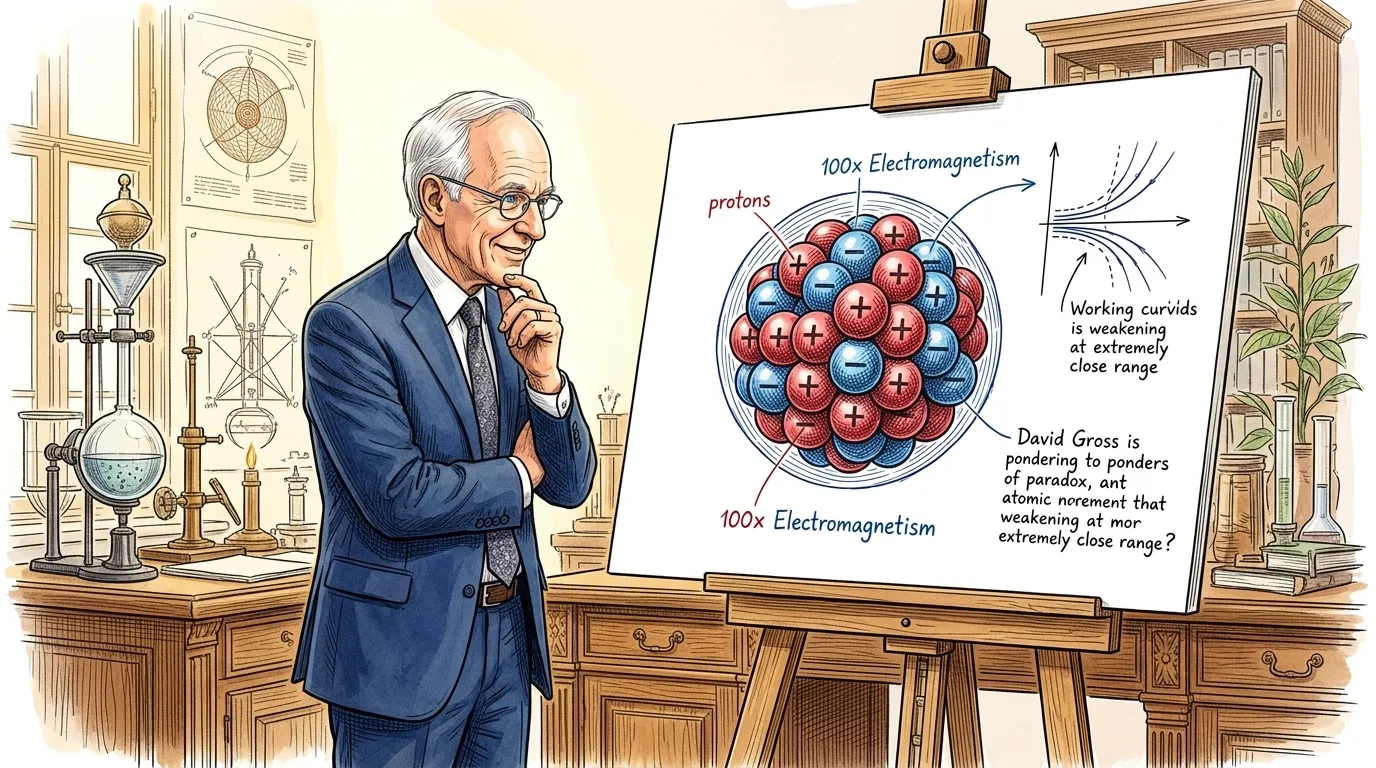
Deep within the heart of every atom, an invisible, colossal force wages a constant battle against itself. Protons, positively charged and naturally repulsive, are packed tightly into the atomic nucleus, bound by a power so immense it dwarfs electromagnetism by a factor of 100. This is the strong nuclear force, a fundamental interaction that dictates the very stability of matter and, by extension, our universe. For decades, its mysteries eluded physicists, presenting a paradox: how could a force so potent at short ranges paradoxically weaken at infinitesimally small distances? This profound question set the stage for one of modern physics' most elegant discoveries, spearheaded by David Gross.
Page 2
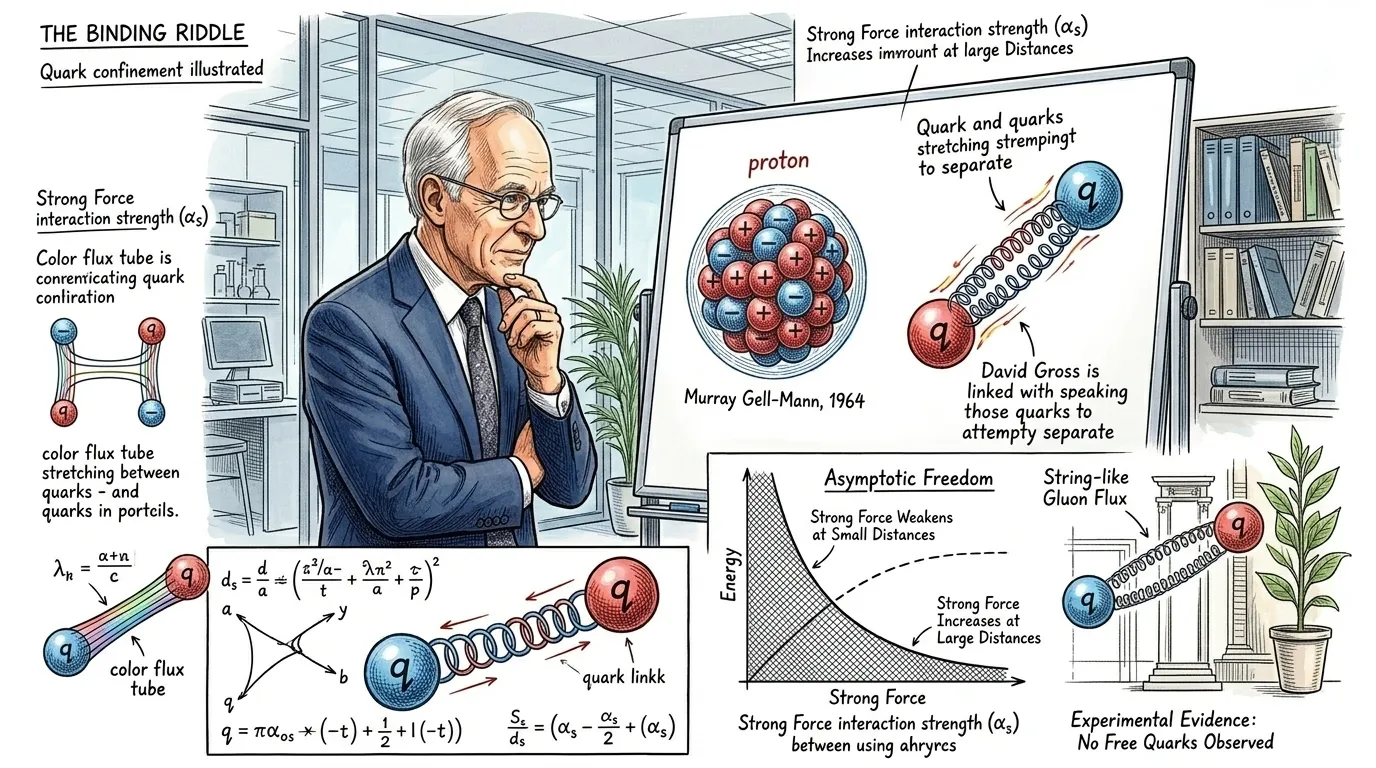
Before the 1970s, the strong force, responsible for holding quarks together to form protons and neutrons, was a frustrating enigma. Experiments revealed that protons and neutrons themselves weren't fundamental particles; they were composed of even smaller entities, which Murray Gell-Mann famously named 'quarks' in 1964. Yet, quarks presented a baffling problem: they could never be isolated. Despite immense efforts to smash atoms apart and extract a single quark, they stubbornly remained confined within their composite particles, an observation dubbed 'quark confinement.' This implied a unique, counter-intuitive behavior for the strong force—it had to grow stronger as quarks tried to pull apart.
Page 3
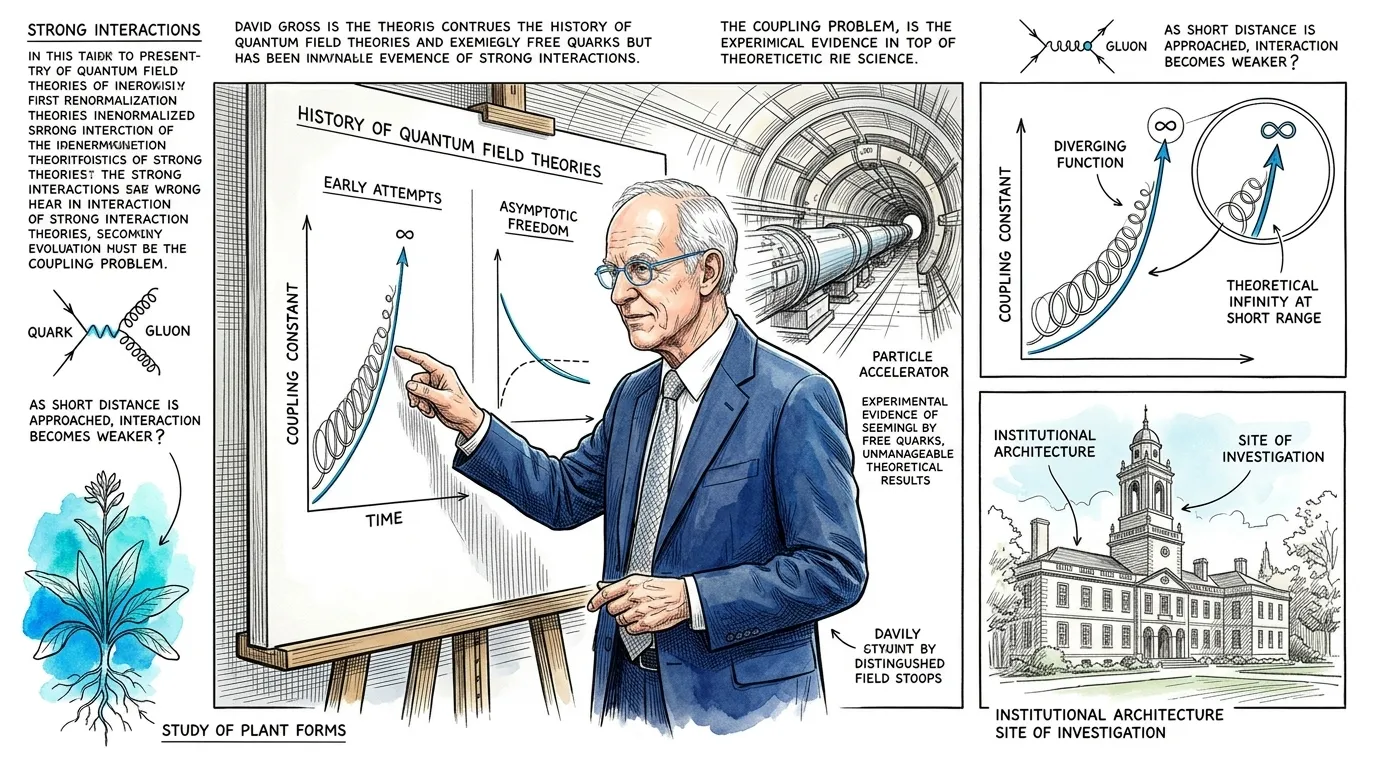
The challenge was to develop a quantum field theory that could accurately describe these strong interactions, much like Quantum Electrodynamics (QED) described electromagnetism. Early attempts to model the strong force, however, consistently failed. When physicists tried to apply conventional theories, they found that the calculations became hopelessly complex and often yielded infinite results, particularly at high energies. The 'coupling constant'—a measure of a force's strength—seemed to grow without bound, implying that the strong force was unmanageably strong at short distances, contradicting the emerging experimental evidence from particle accelerators that suggested quarks behaved almost as free particles when deeply probed.
Page 4
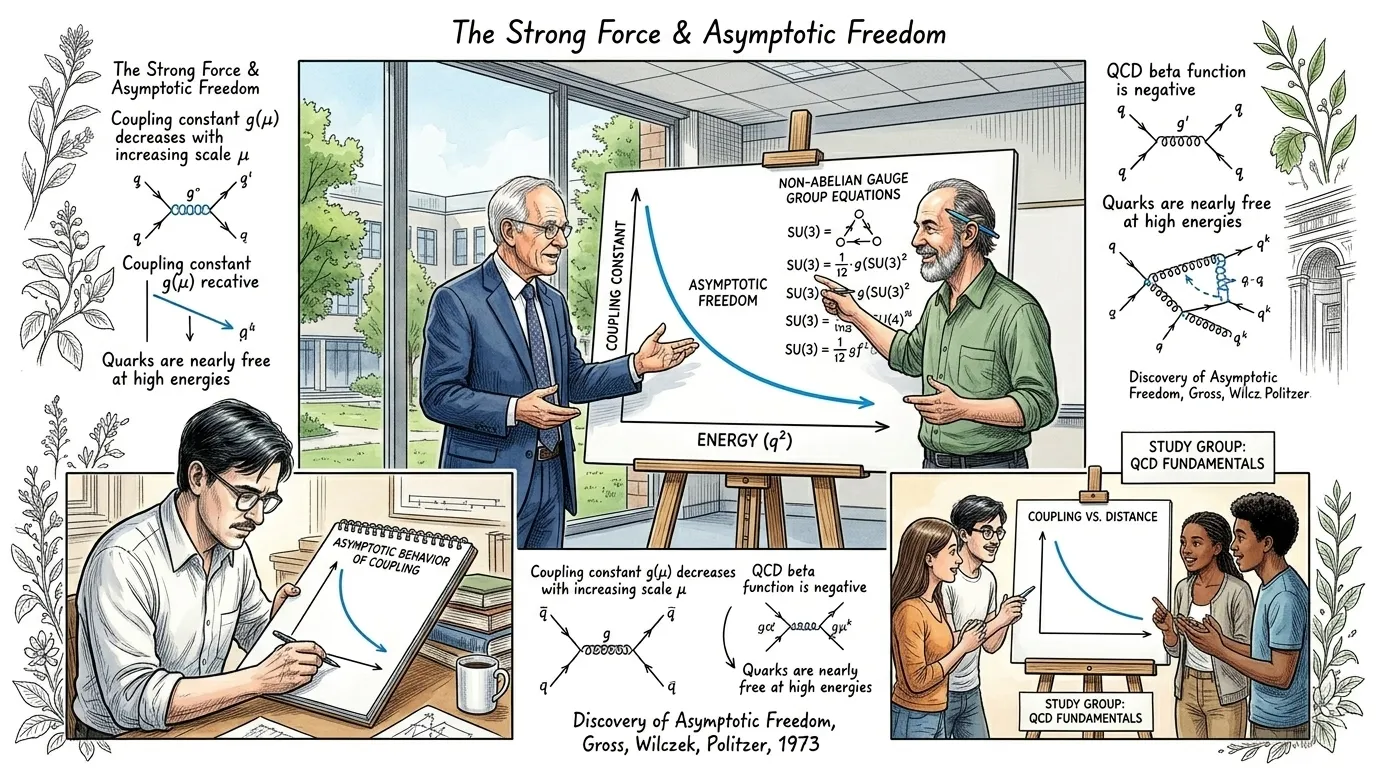
In 1973, David Gross, working with his graduate student Frank Wilczek at Princeton University, made a groundbreaking discovery that would revolutionize particle physics. Independently, H. David Politzer made the same crucial insight. They found that in certain quantum field theories, specifically those involving non-abelian gauge groups (a complex mathematical structure), the coupling constant did not increase with energy; it actually decreased. This meant that at extremely short distances or very high energies, the strong force effectively vanished, allowing quarks to behave almost as free particles. They named this counter-intuitive phenomenon 'asymptotic freedom.' It was the missing piece, providing a consistent theoretical framework for the strong interaction.
Page 5
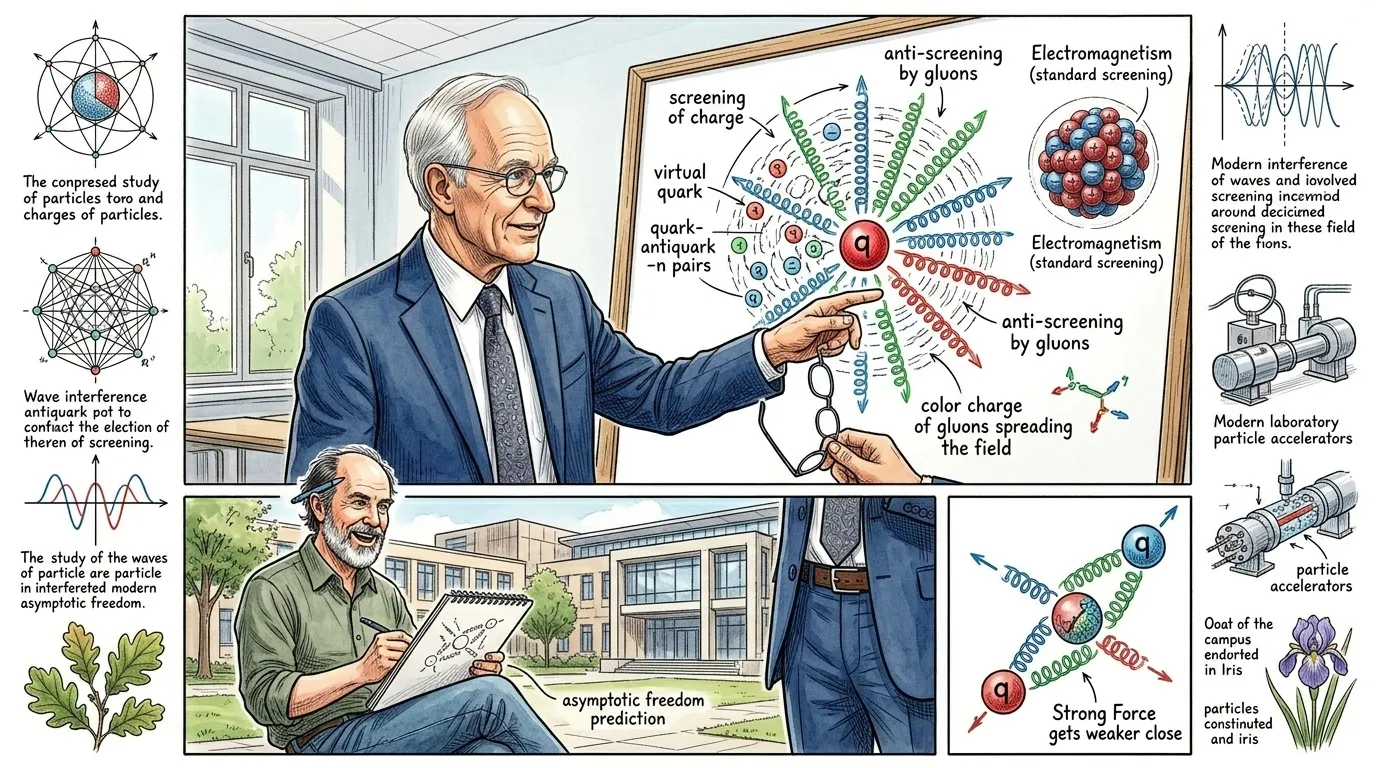
The magic of asymptotic freedom lies in the peculiar nature of the strong force's mediators: gluons. Unlike photons, which are electrically neutral, gluons carry a 'color charge' themselves. This leads to a unique 'anti-screening' effect. Imagine a quark surrounded by a cloud of virtual quark-antiquark pairs and virtual gluons that constantly pop in and out of existence. While virtual quark-antiquark pairs screen the quark's color charge (like electron-positron pairs screen an electron's charge), the gluons, by carrying color charge, spread out the color field. This spreading effectively diminishes the apparent color charge as you get closer to the quark, making the force weaker at short distances. This is a complete reversal of what happens in electromagnetism.
Page 6
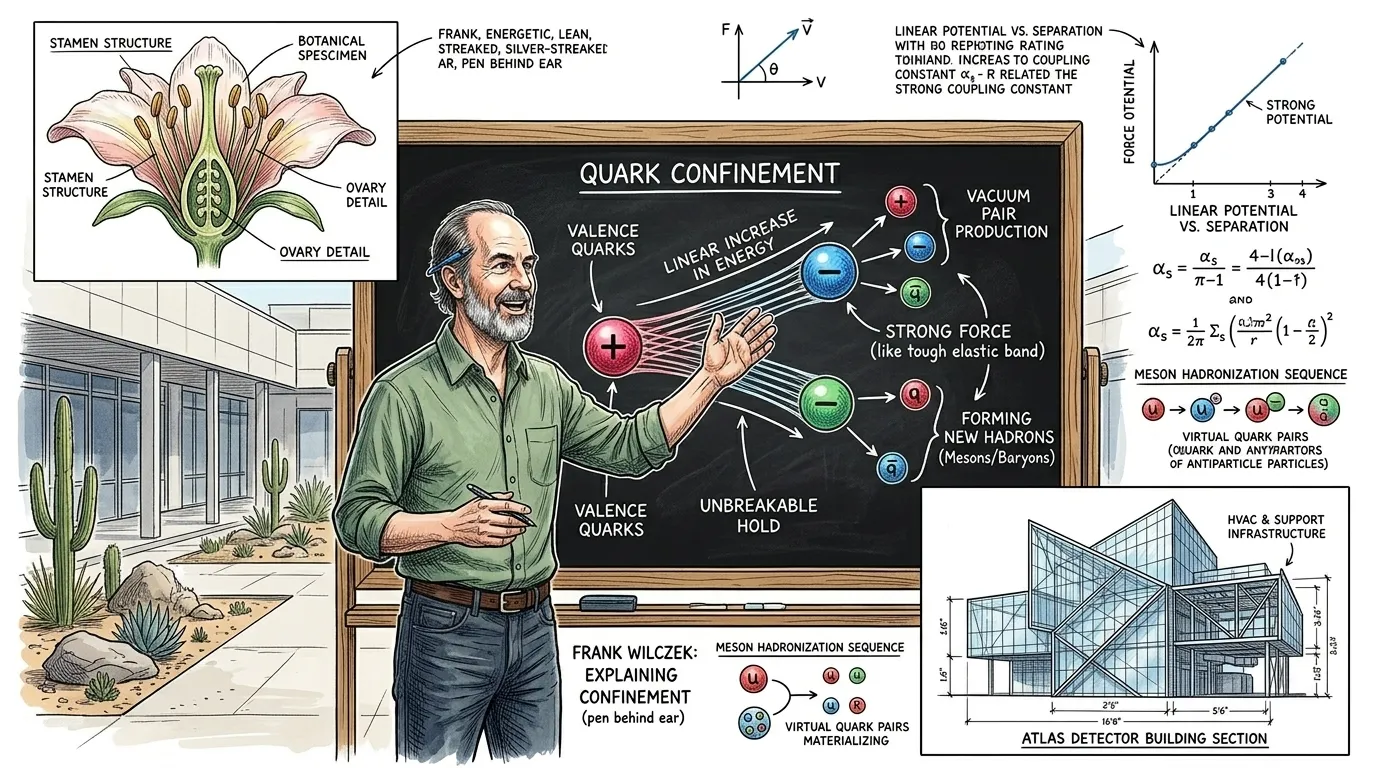
The inverse of asymptotic freedom is just as profound: quark confinement. As the distance between quarks increases, the strong force doesn't weaken; it actually strengthens, much like stretching an incredibly tough elastic band. If you try to pull two quarks apart, the energy required grows linearly with distance. Eventually, the energy invested becomes so enormous that it's more energetically favorable to spontaneously create a new quark-antiquark pair from the vacuum. These newly formed quarks then bind with the original ones, forming new hadrons. This explains why free quarks are never observed and why they are forever bound within composite particles like protons and neutrons, illustrating the strong force's unique, unbreakable grip.
Page 7
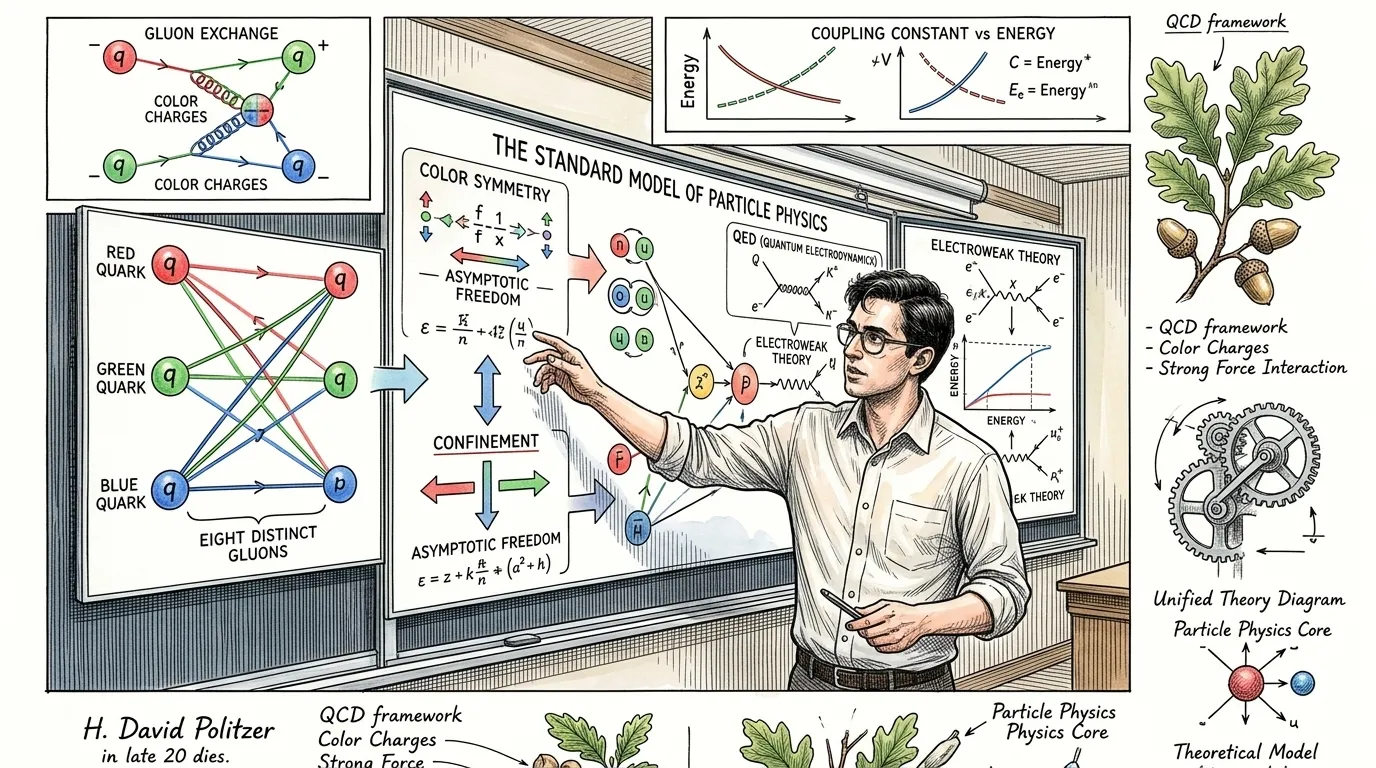
The discovery of asymptotic freedom paved the way for the full formulation of Quantum Chromodynamics (QCD), the theory of the strong interaction. QCD posits that quarks come in three 'colors' (red, green, blue – a metaphor, not actual color) and interact by exchanging eight types of gluons, which also carry color charge. This 'color' symmetry is what gives rise to the unique properties of the strong force, including both asymptotic freedom and confinement. QCD, along with Quantum Electrodynamics and the electroweak theory, forms the bedrock of the Standard Model of particle physics, providing a complete picture of the fundamental forces and particles that constitute all known matter in the universe.
Page 8
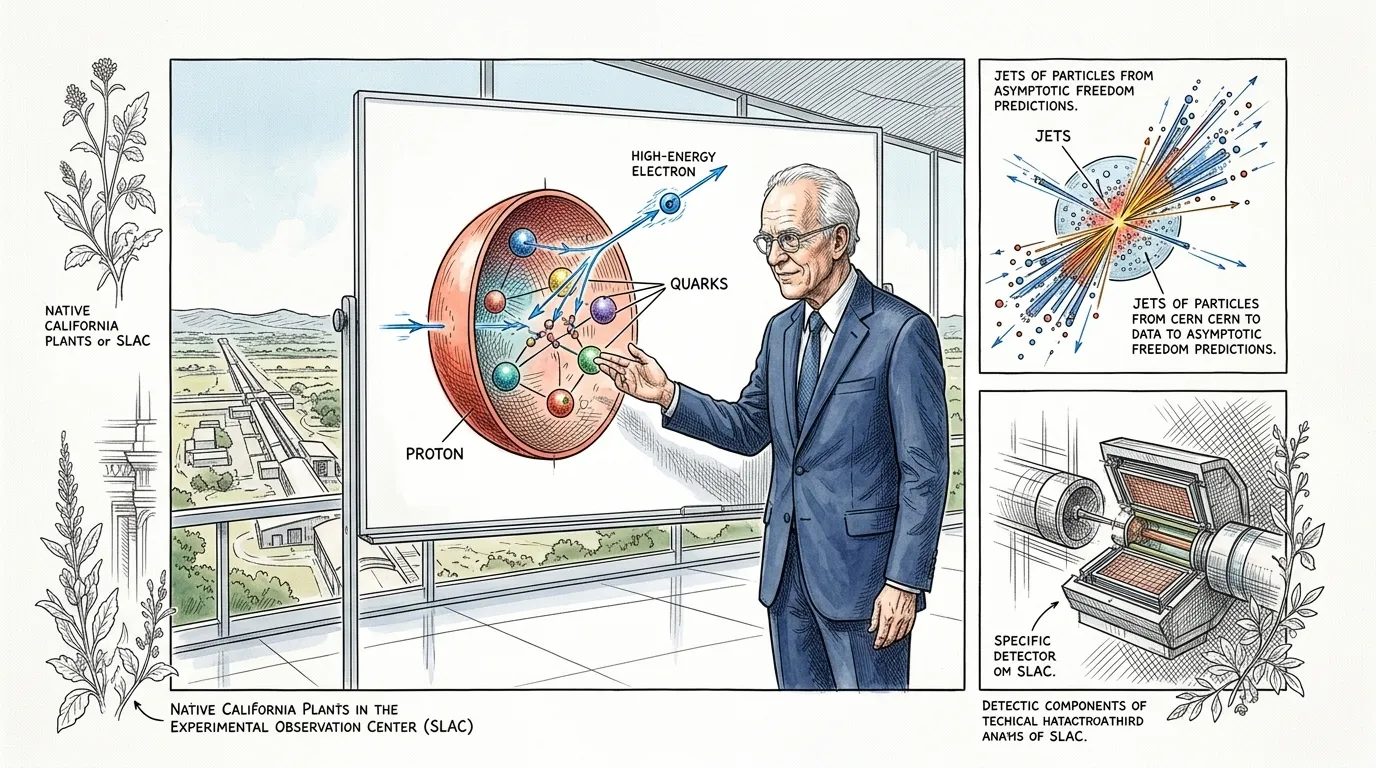
The theoretical predictions of asymptotic freedom and QCD quickly found powerful experimental validation. Early evidence came from 'deep inelastic scattering' experiments performed at the Stanford Linear Accelerator Center (SLAC) in the late 1960s and early 1970s. These experiments, which earned Jerome Friedman, Henry Kendall, and Richard Taylor the Nobel Prize in 1990, involved firing high-energy electrons at protons. The way these electrons scattered indicated that protons were indeed made of hard, point-like constituents (quarks), and that at very high energies, these quarks behaved as if they were nearly free within the proton—precisely what asymptotic freedom predicted. Later experiments at CERN, particularly those observing 'jets' of particles emerging from high-energy collisions, provided further, compelling proof of QCD's validity.
Page 9
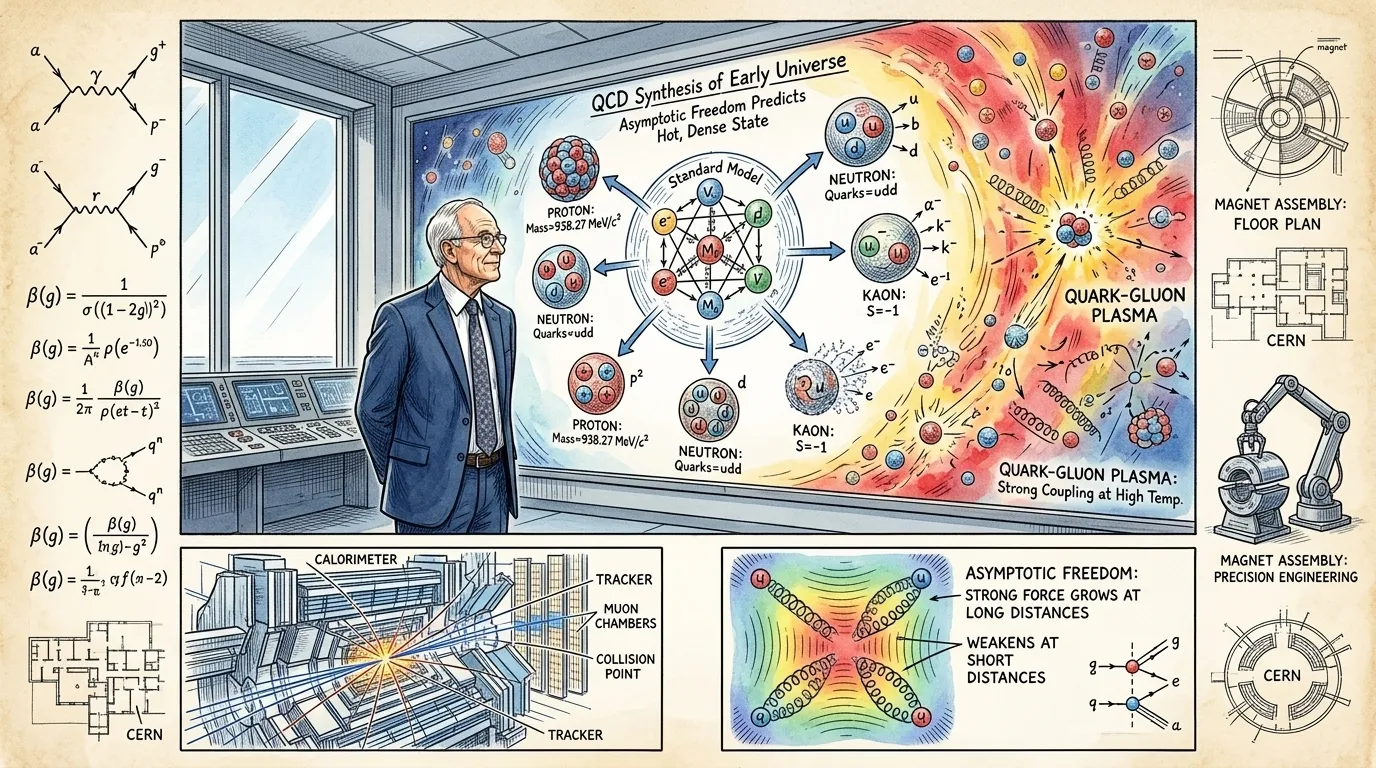
David Gross's discovery fundamentally shaped our understanding of the universe's most powerful force. Quantum Chromodynamics not only provided a consistent description of how quarks and gluons interact but also completed the Standard Model, making it a comprehensive theory of all known fundamental particles and three of the four fundamental forces (excluding gravity). This breakthrough enabled physicists to make precise predictions about the properties of protons, neutrons, and other exotic particles composed of quarks, and it offered crucial insights into the conditions of the early universe, just moments after the Big Bang, when matter existed as a hot, dense 'quark-gluon plasma.'
Page 10
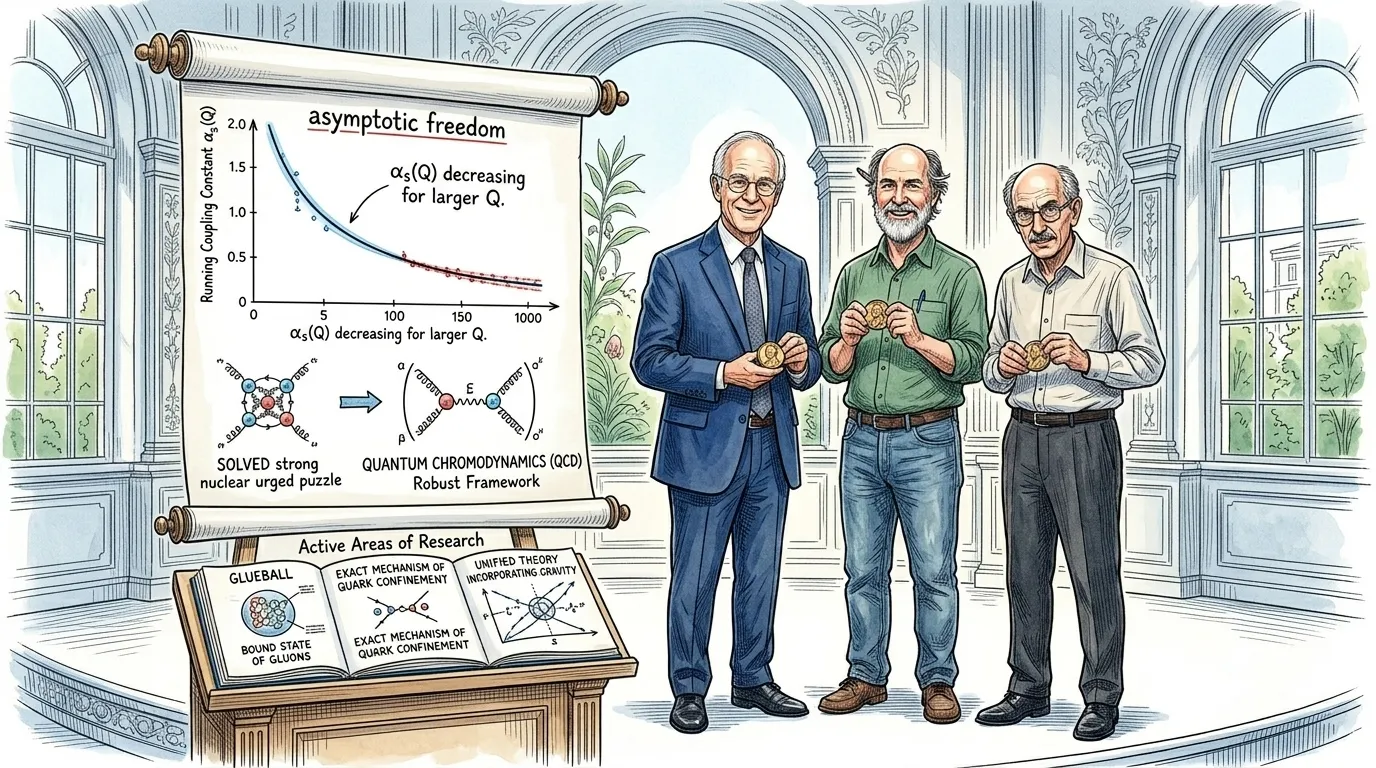
For their groundbreaking work on asymptotic freedom, David Gross, Frank Wilczek, and H. David Politzer were jointly awarded the Nobel Prize in Physics in 2004. Their discovery was not merely an incremental step but a paradigm shift, resolving a decades-old puzzle and providing a robust framework for understanding the strong nuclear force. While QCD has been immensely successful, some aspects, such as the exact mechanism of quark confinement, remain active areas of research. The quest continues for 'glueballs'—particles made solely of gluons—and for a unified theory that incorporates gravity. David Gross's legacy stands as a testament to the power of theoretical physics to uncover the deepest truths about the cosmos, inspiring new generations to push the boundaries of knowledge.
About this story
- Location: Global
- Audience: general readers
Questions and answers
Read Wonder Science on your phone
Wonder Science is available on Android. Get Wonder Science on Google Play.