Ernest Lawrence
Ernest Lawrence — an illustrated science story, set in Global. 10 illustrated pages, free to read on Wonder Science.

Page 1
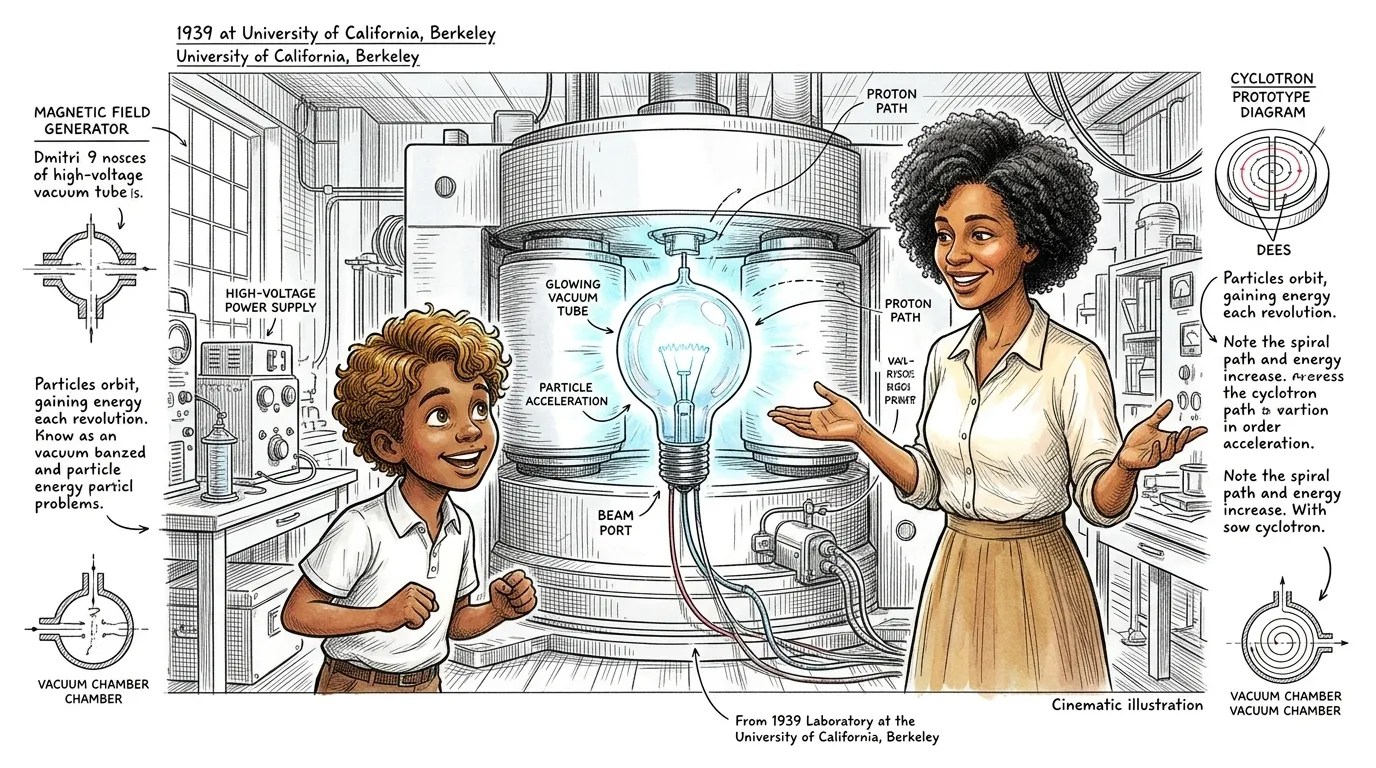
The University of California, Berkeley, 1939. A glowing, grapefruit-sized glass vacuum tube sits humming between the poles of a massive electromagnet. This was not just another lab experiment, but the prototype of Ernest Lawrence's revolutionary cyclotron, the first atom smasher. It was creating beams of accelerated particles, unseen bullets that would soon unlock the secrets of the atom and transform medicine.\n\n Fact: Establishing shot of Lawrence's cyclotron prototype in action.
Page 2
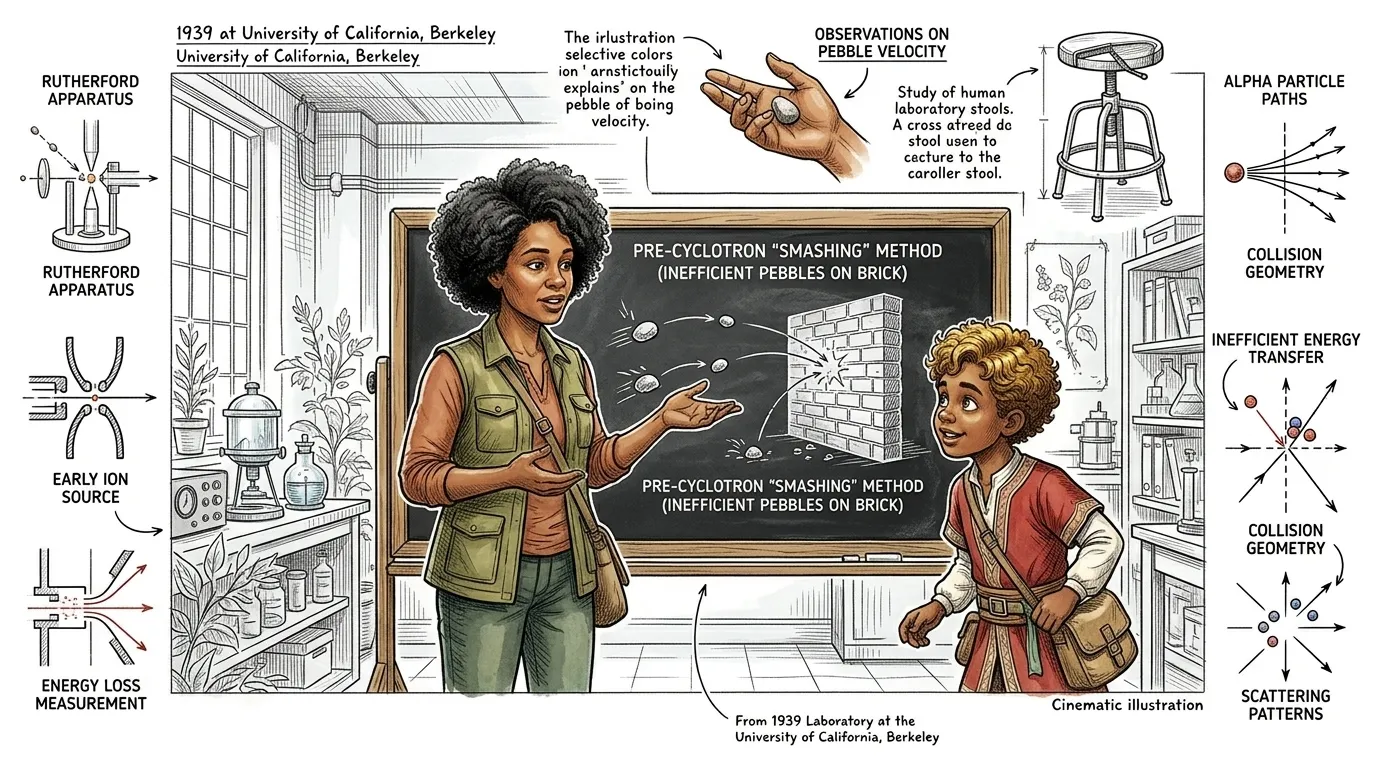
Before Lawrence, smashing atoms was a slow, inefficient process. Scientists like Rutherford used naturally radioactive materials to shoot alpha particles at targets. It was like trying to break a brick wall by throwing pebbles. 'We needed bigger hammers,' Noor explained. 'Lawrence realized the key was to accelerate particles repeatedly, giving them enough energy to really make an impact.'\n\n Fact: Visualizing the inefficiency of pre-cyclotron particle acceleration.
Page 3
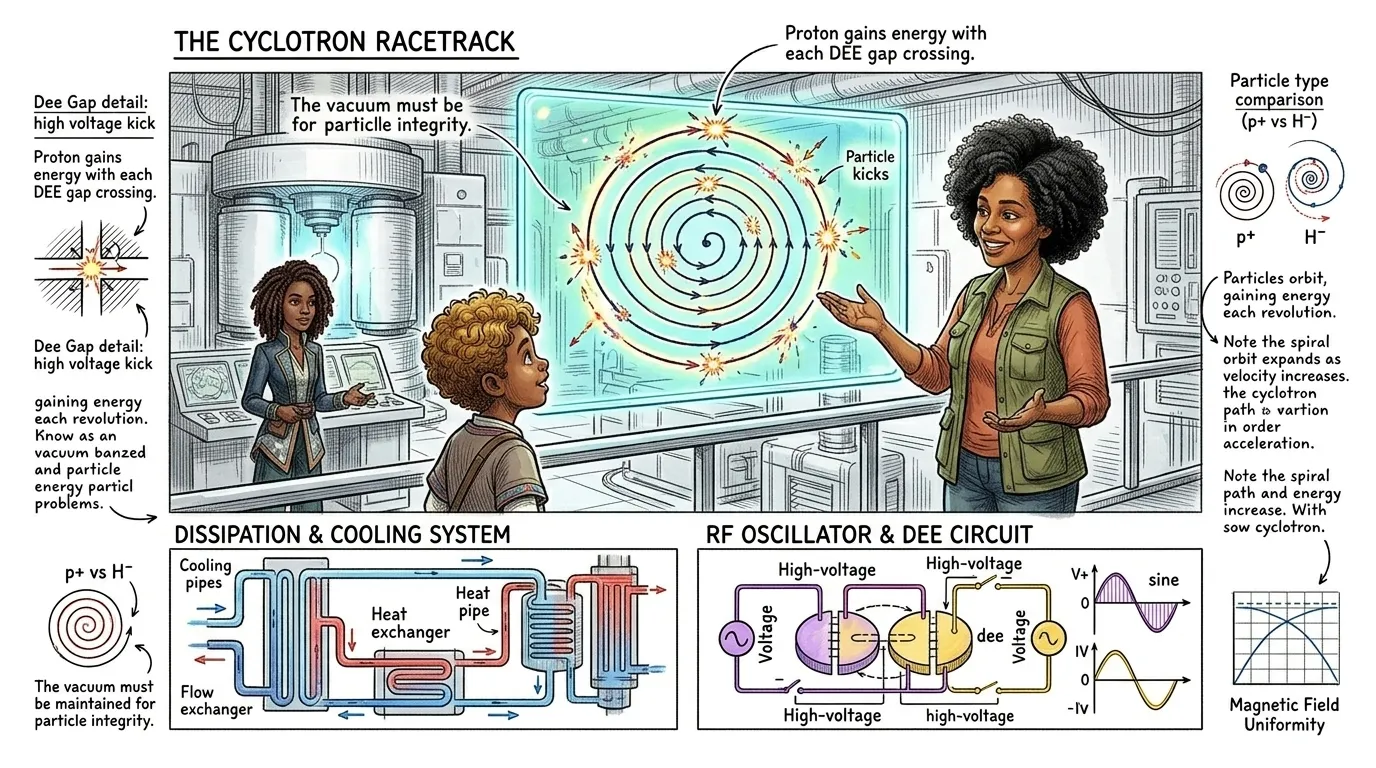
Lawrence's genius was to create a 'particle racetrack.' His cyclotron used electromagnets to bend particles into a spiral path. Each time they completed a half-circle, they received a 'kick' of energy from an oscillating voltage. By the time they reached the edge, they were traveling at tremendous speeds. Dmitri looked up in awe. 'So, it's like a tiny, atomic roller coaster?'\n\n Fact: Top-down view of the cyclotron's spiral acceleration path.
Page 4
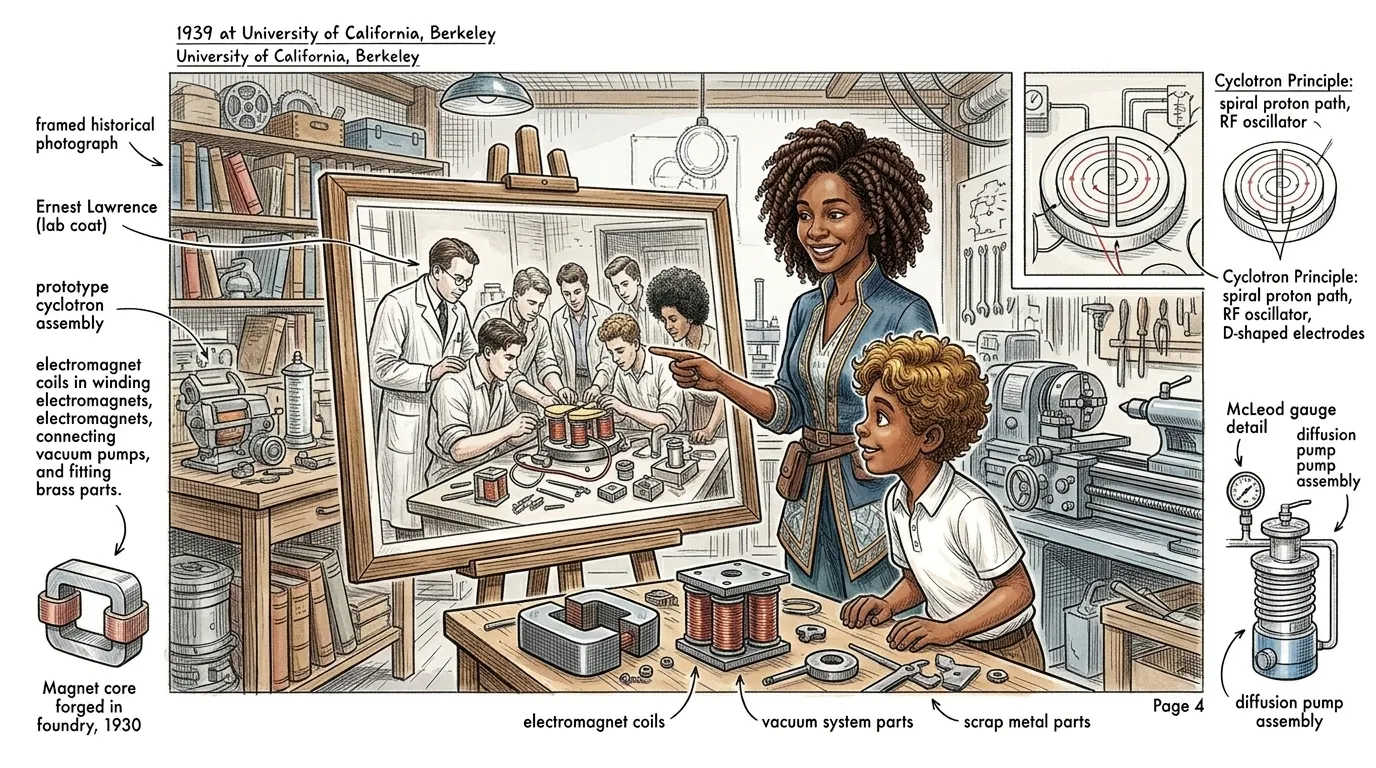
Lawrence's first cyclotron was just a few inches across, a proof-of-concept built on a shoestring budget. 'It was a marvel of ingenuity,' Anaya said. 'Lawrence and his students scrounged for parts, wound their own electromagnets, and built their own vacuum pumps.' It accelerated hydrogen ions to energies of 80,000 electron volts. It may sound small, but it was enough to prove the principle.\n\n Fact: Lawrence building his first cyclotron in a cluttered laboratory.
Page 5
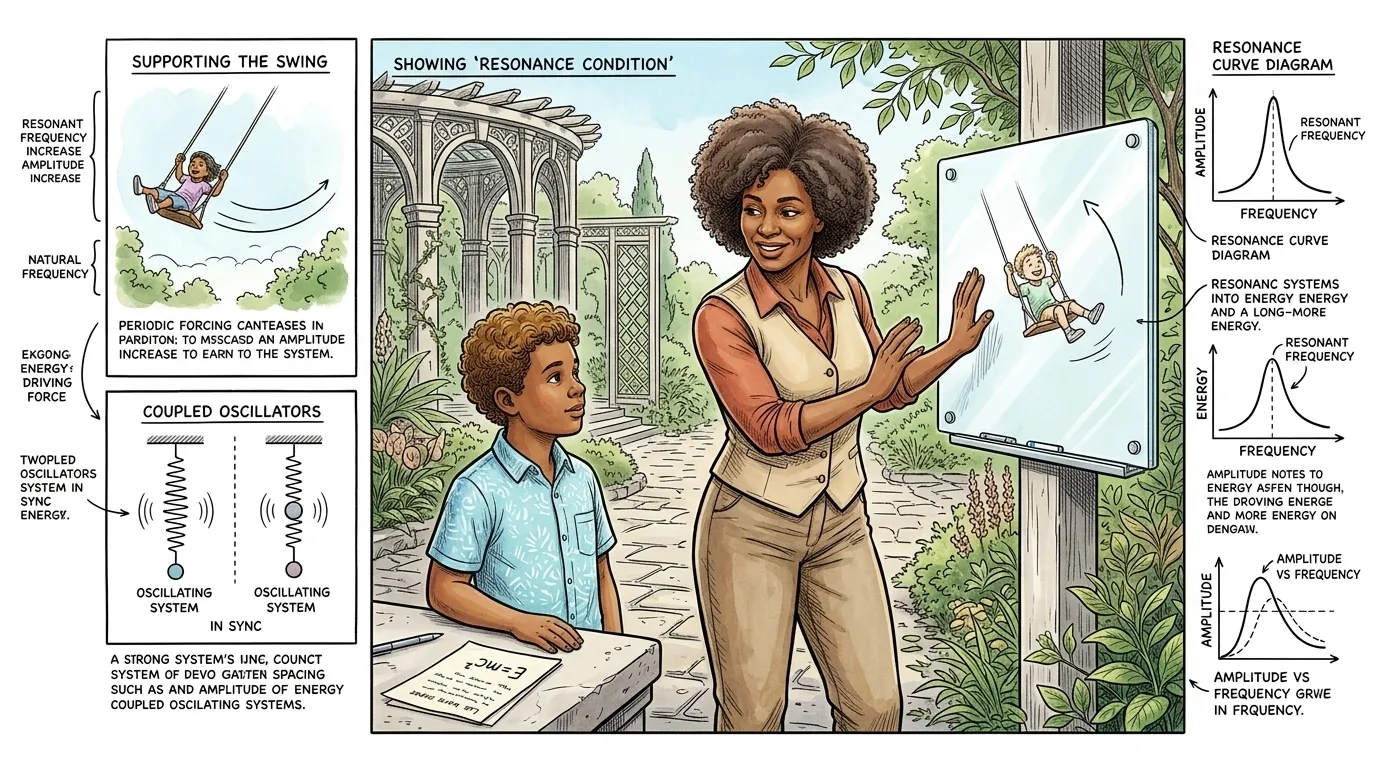
The real breakthrough, Noor explained, was understanding the 'resonance condition.' As the particles gained speed, they also gained mass, thanks to Einstein's famous equation. Lawrence realized that by carefully tuning the magnetic field and the oscillating voltage, he could keep the particles in sync, accelerating them continuously. 'It's like pushing a child on a swing,' Noor said. 'If you push at the right moment each time, you can make them go higher and higher.'\n\n Fact: Resonance analogy with pushing a swing.
Page 6
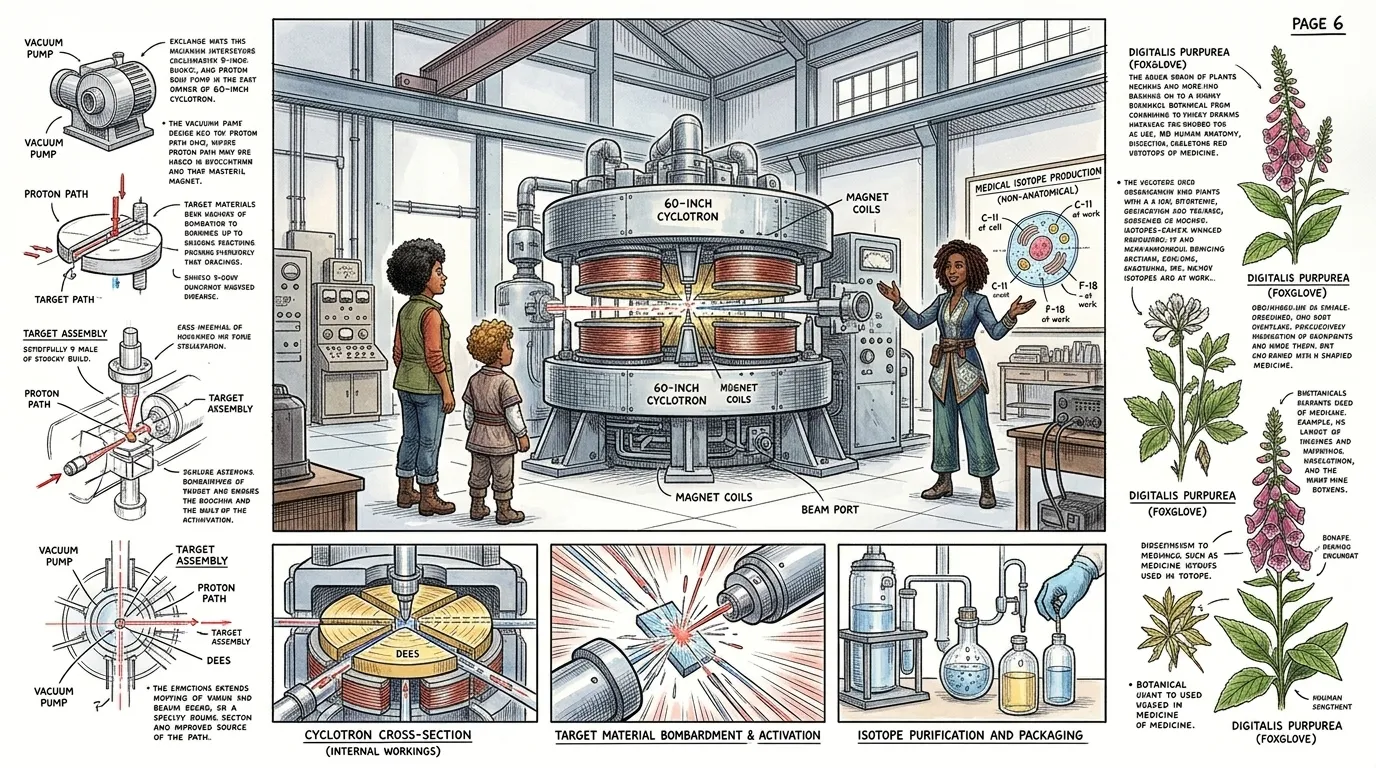
Lawrence's team built increasingly larger cyclotrons, culminating in the massive 60-inch machine. This behemoth could accelerate particles to millions of electron volts, enough to create new radioactive isotopes. These isotopes were quickly put to use in medicine, treating cancer and tracing biological processes. 'It was a revolution in nuclear medicine,' Anaya said.\n\n Fact: The massive 60-inch cyclotron dominates the laboratory.
Page 7
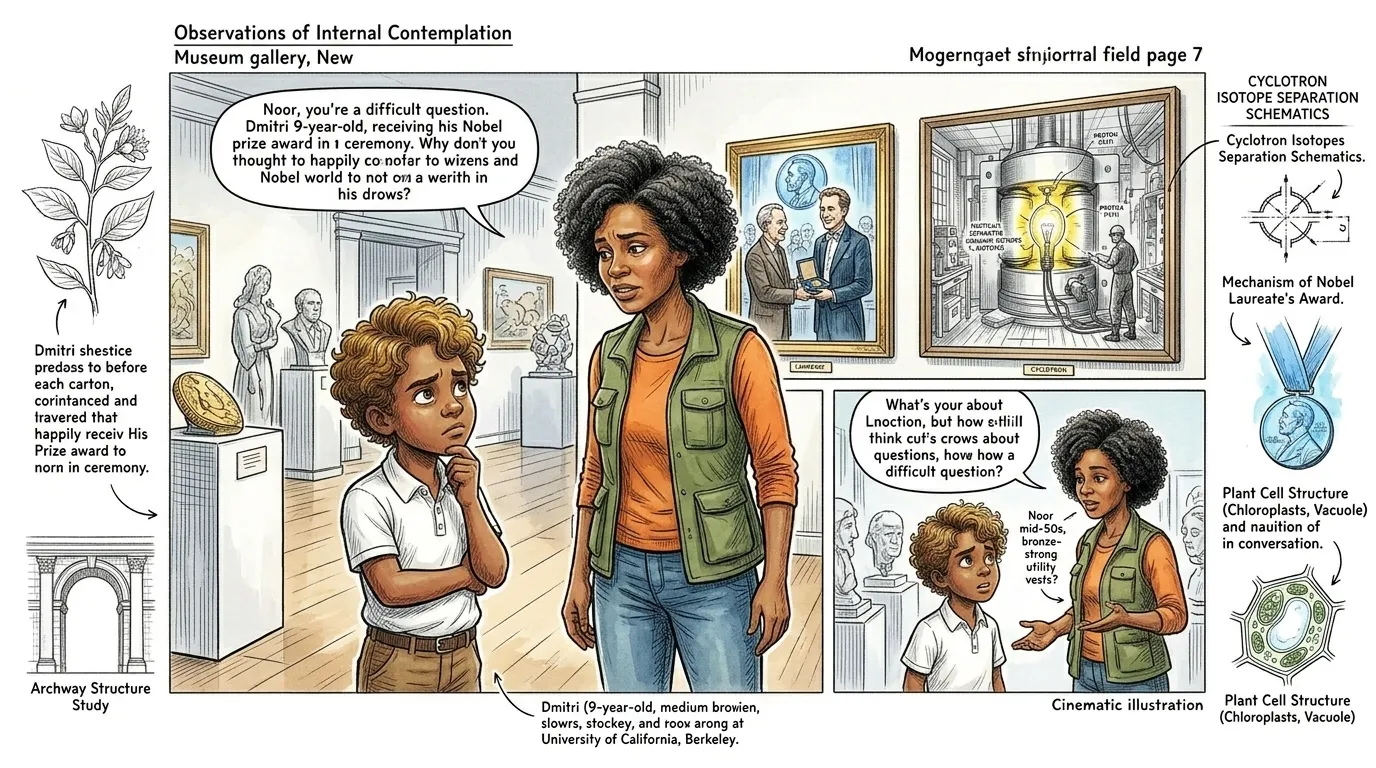
In 1939, Lawrence received the Nobel Prize in Physics for his invention of the cyclotron. His work also proved vital to the Manhattan Project during World War II, where cyclotrons were used to separate uranium isotopes for the atomic bomb. But Lawrence always hoped it would be used for positive ends. Dmitri asked, 'Did he ever feel bad about that?'\n\n Fact: Contrasting Nobel Prize celebration with Manhattan Project involvement.
Page 8
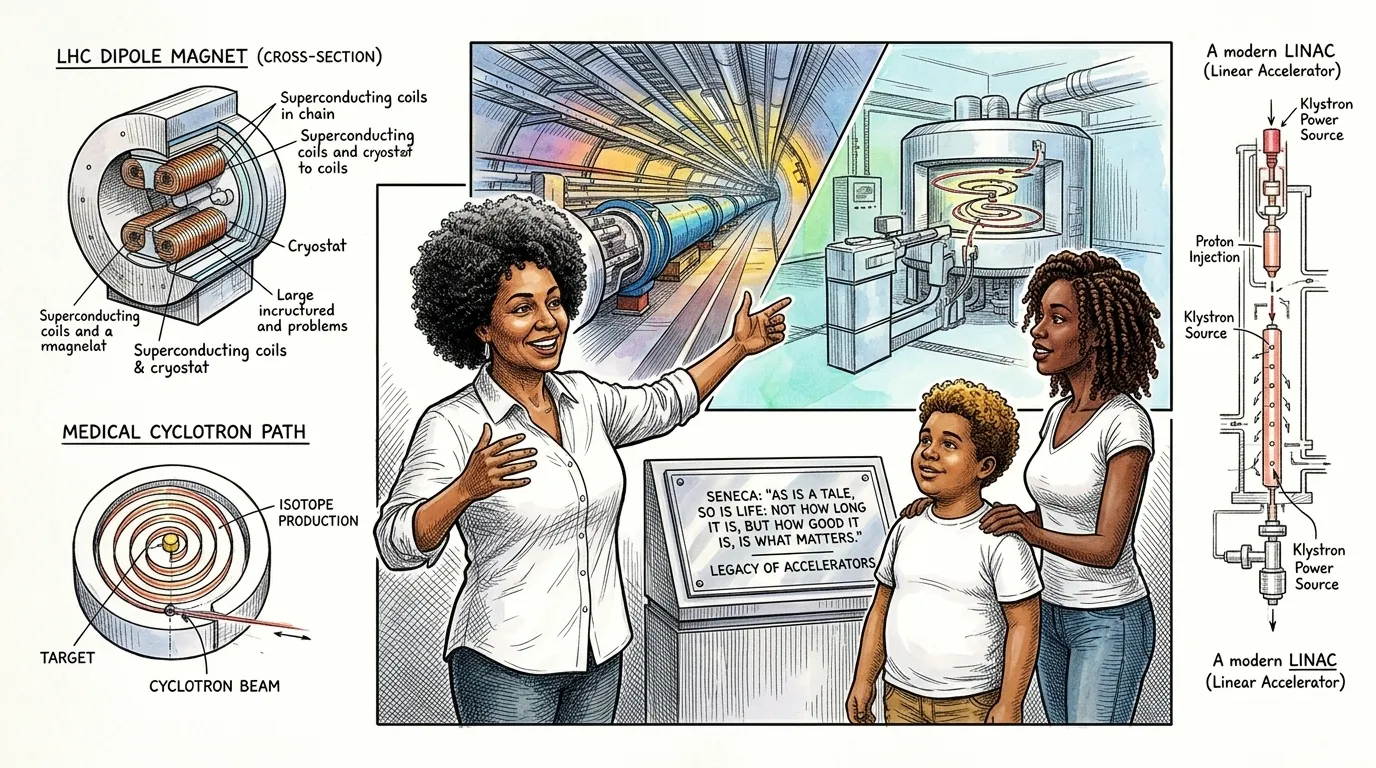
Today, particle accelerators are essential tools in science and medicine. From the Large Hadron Collider at CERN, probing the fundamental nature of matter, to hospital cyclotrons producing medical isotopes, Lawrence's legacy lives on. 'His work has touched countless lives,' Noor said. 'It's a perfect illustration of what Seneca meant when he said, 'Every new beginning comes from some other beginning's end.''\n\n Fact: Modern particle accelerators: LHC and hospital cyclotrons.
Page 9
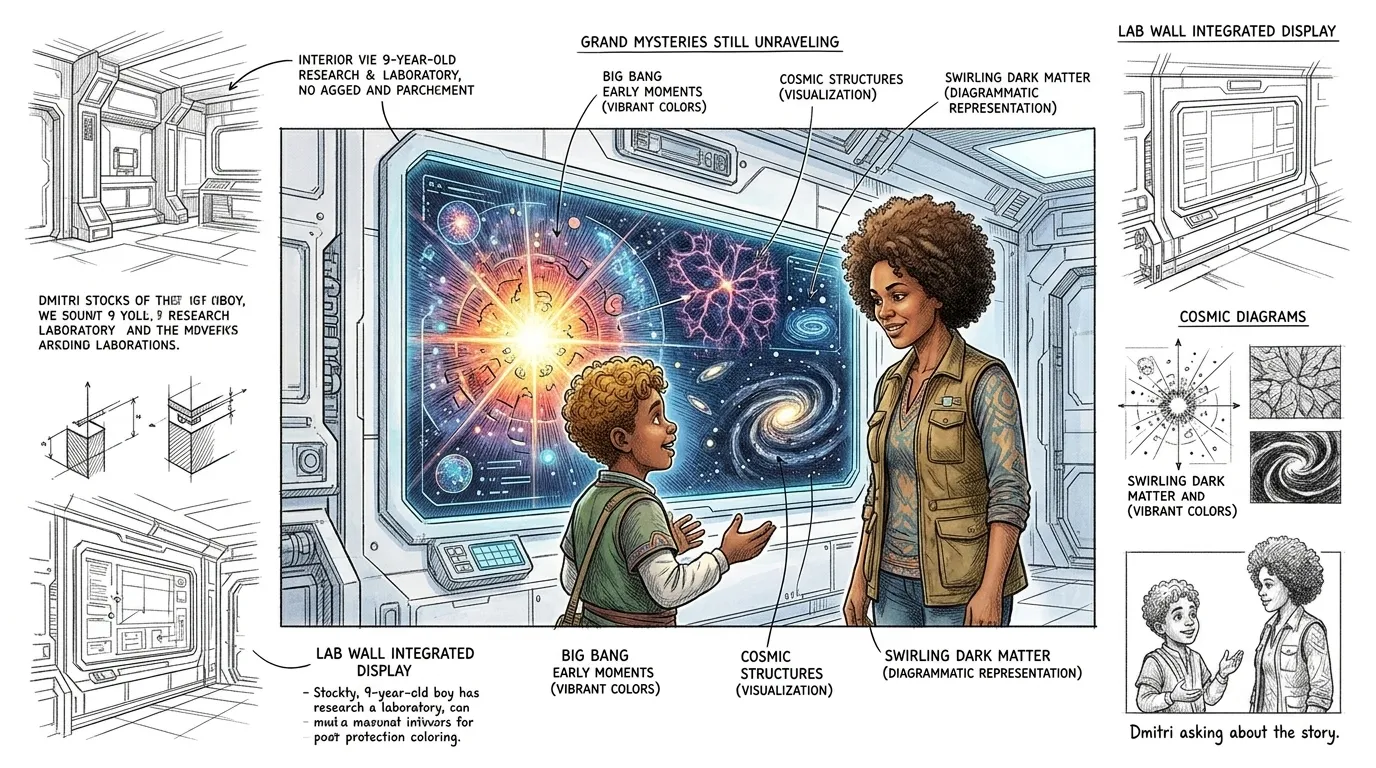
Even with powerful accelerators, many mysteries remain. What is dark matter? What happened in the first moments after the Big Bang? These questions drive scientists to build even larger and more powerful machines. Dmitri paused, looking at Noor, 'So, the story's not over?'\n\n Fact: Visualizing the mysteries of the cosmos and the quest for answers.
Page 10
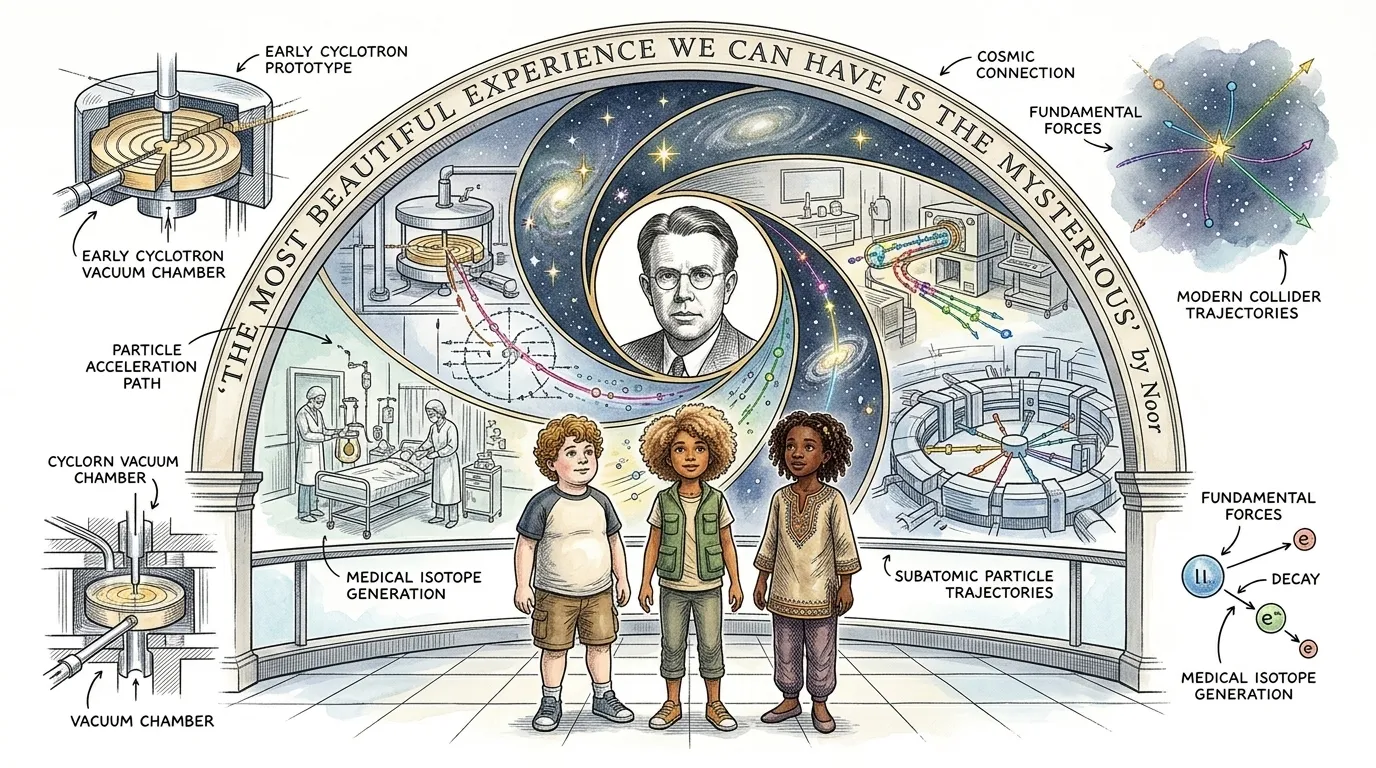
Ernest Lawrence's invention opened a new window into the universe, and his legacy continues to inspire scientists today. His cyclotrons have had profound impacts on the world. While some applications raised serious moral questions, Lawrence's life shows how human curiosity, combined with brilliant engineering, can change everything. As Noor always said, 'The most beautiful experience we can have is the mysterious.'\n\n Fact: Grand finale: montage of Lawrence's legacy and lasting impact.
About this story
- Location: Global
- Audience: kids (ages 6–12)
Questions and answers
Read Wonder Science on your phone
Wonder Science is available on Android. Get Wonder Science on Google Play.