Florence Nightingale
Florence Nightingale — an illustrated science story, set in Global. 10 illustrated pages, free to read on Wonder Science.
Page 1
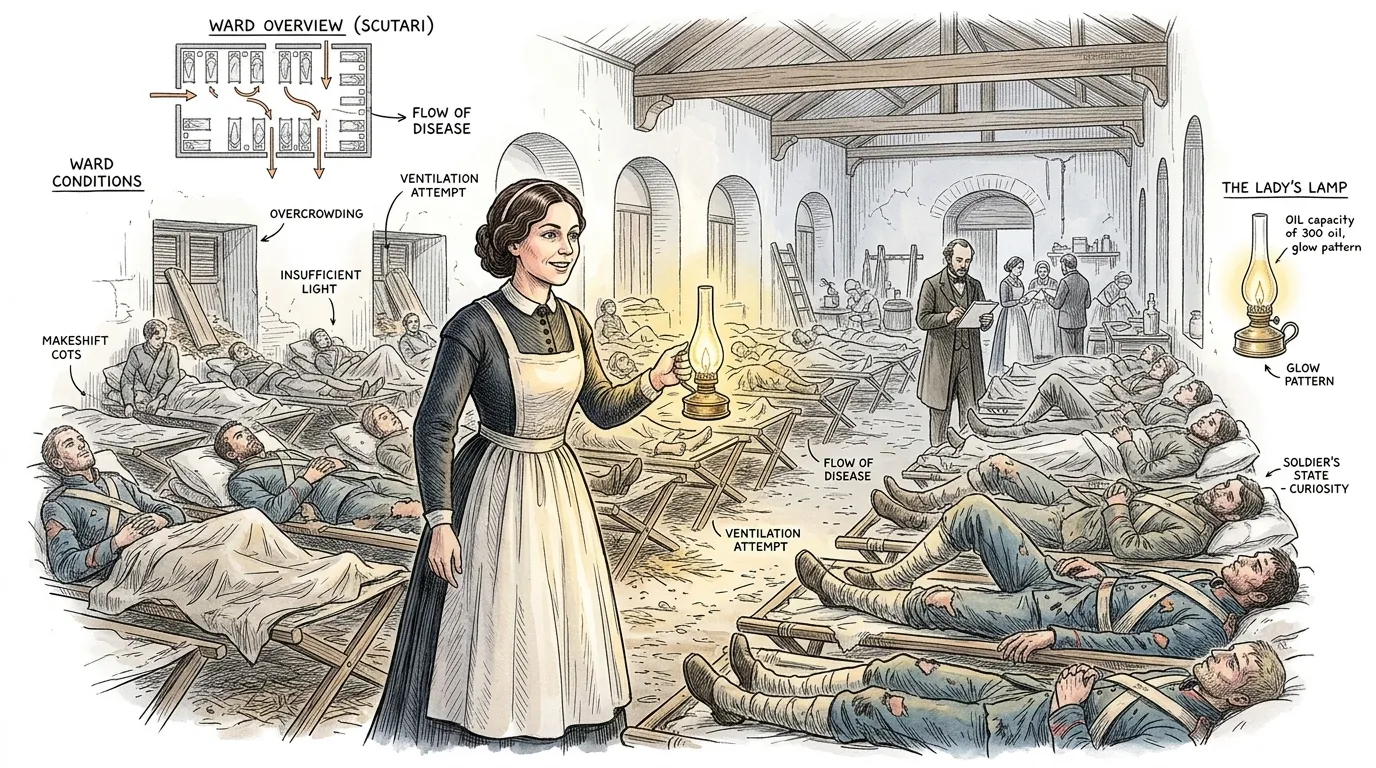
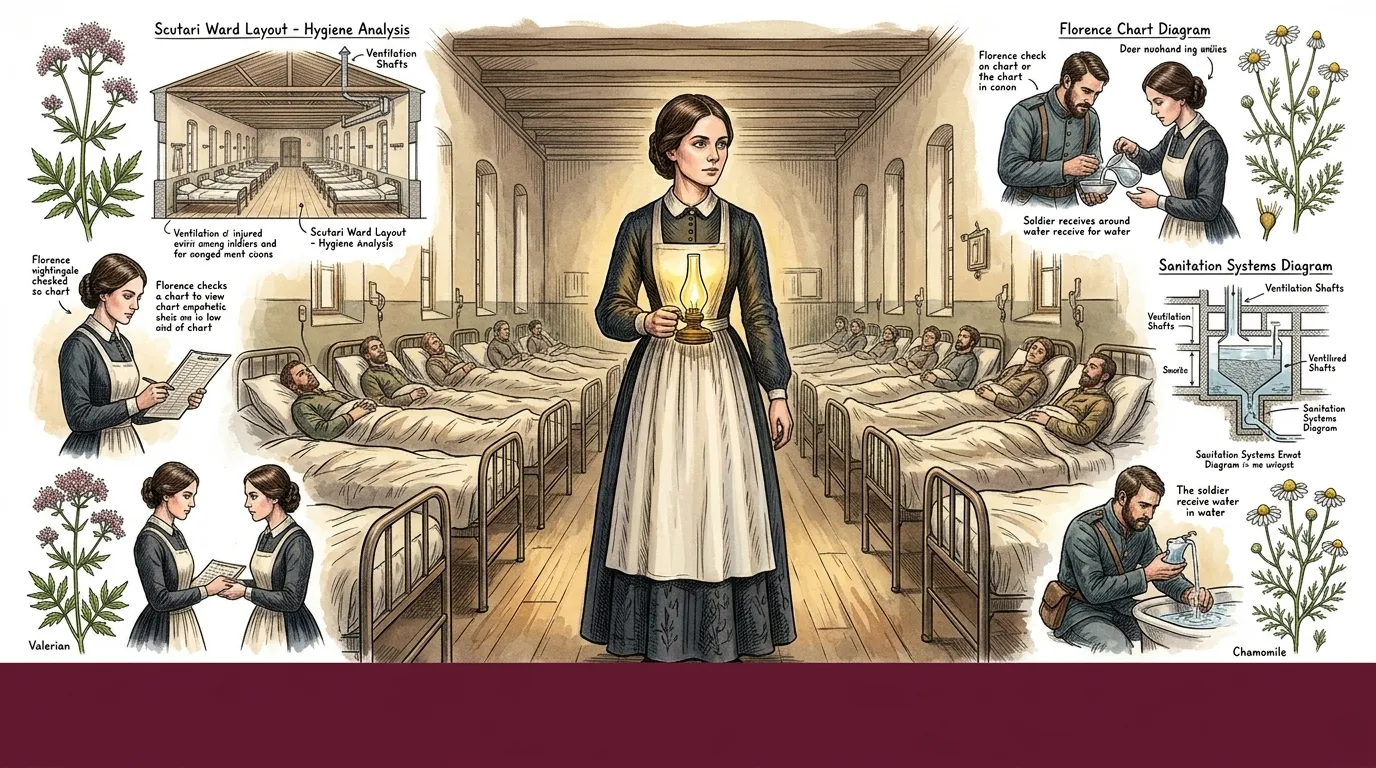
The year is 1855. On the desolate plains of Crimea, amidst the brutal siege of Sevastopol, thousands of British soldiers lie wounded and dying. Yet, it is not enemy fire that claims the vast majority, but unseen pathogens flourishing in the squalid conditions of military hospitals. In Scutari, a sprawling Ottoman barrack converted into a British hospital, the air hangs heavy with disease and despair. A solitary figure, Florence Nightingale, moves through the crowded wards, her lamp cutting through the gloom, observing a silent catastrophe far deadlier than any battle.\n\n Fact: This scene establishes the dire context and Nightingale's presence at the heart of the problem she would scientifically address, highlighting the scale of mortality.
Page 2
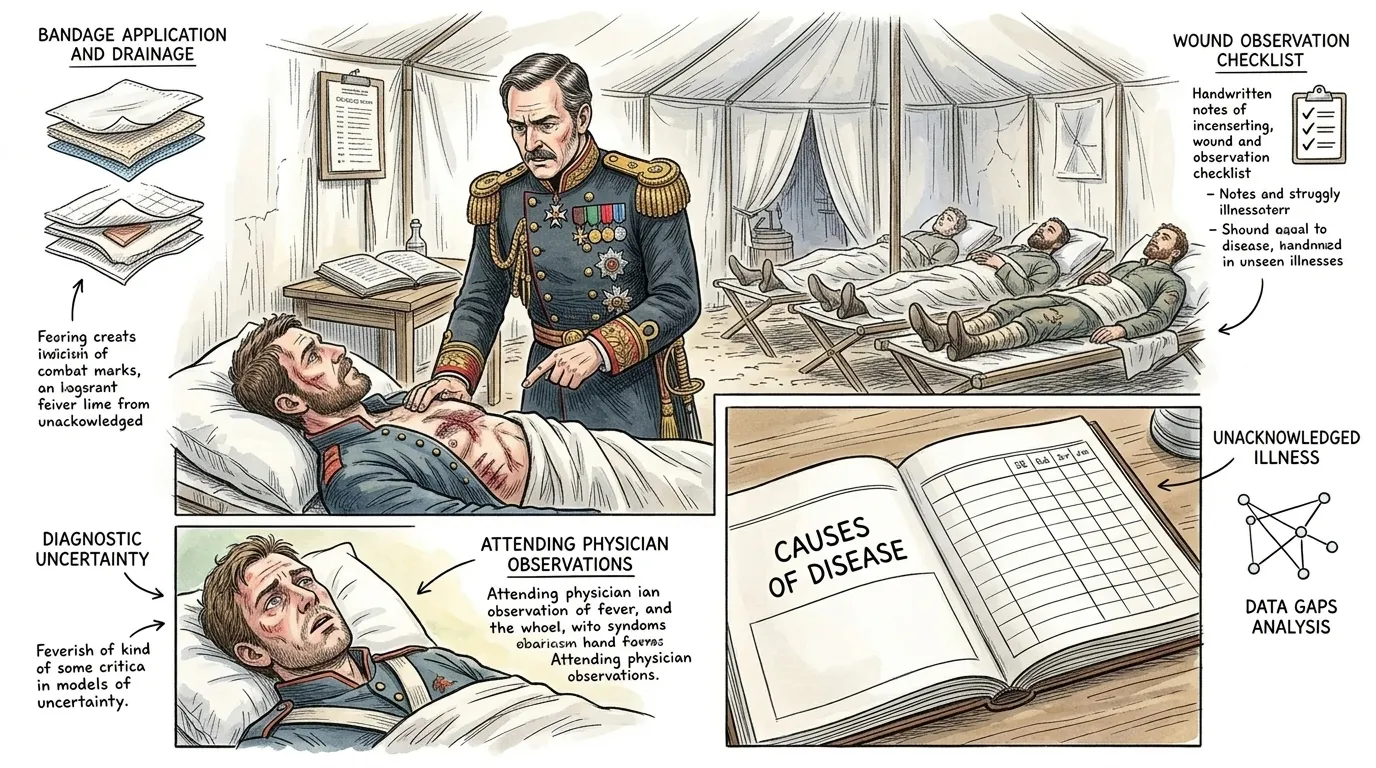
Before Nightingale's intervention, military medicine operated largely on traditional practices and anecdotal evidence. Commanders attributed high mortality rates primarily to combat wounds, overlooking the environmental factors exacerbating disease. There was no systematic collection of health statistics, no objective measure of the true scale or causes of death. This critical absence of data created an invisible enemy, allowing preventable illnesses like cholera, dysentery, and typhus to decimate regiments far from the battlefield, their silent toll unrecognized and unaddressed.\n\n Fact: Visually contrasts the perceived cause of death (combat) with the true, unmeasured reality (disease), emphasizing the pre-Nightingale data vacuum.
Page 3
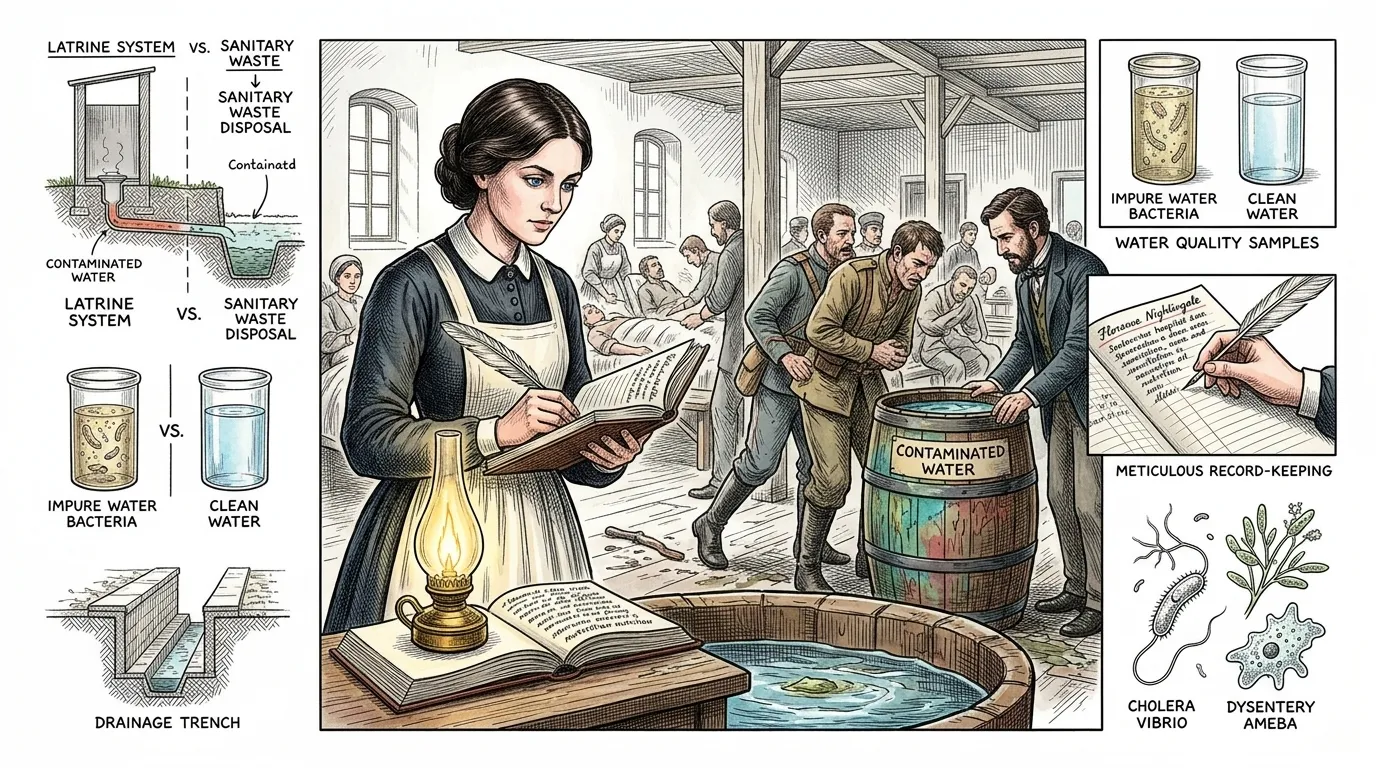
Upon her arrival at Scutari in November 1854, Nightingale quickly recognized that poor sanitation, contaminated water, and inadequate nutrition were the primary culprits, not just battlefield injuries. Dismissing the prevailing medical superstitions and assumptions, she initiated a radical, almost unprecedented, approach for her time: meticulous, systematic data collection. She understood that to fight the unseen enemy, one first had to measure it. Her work began not with medicine, but with observation, record-keeping, and the foundational principles of what would become public health epidemiology.\n\n Fact: Illustrates Nightingale's shift from chaotic observation to systematic data collection, showing her leadership and methodology.
Page 4
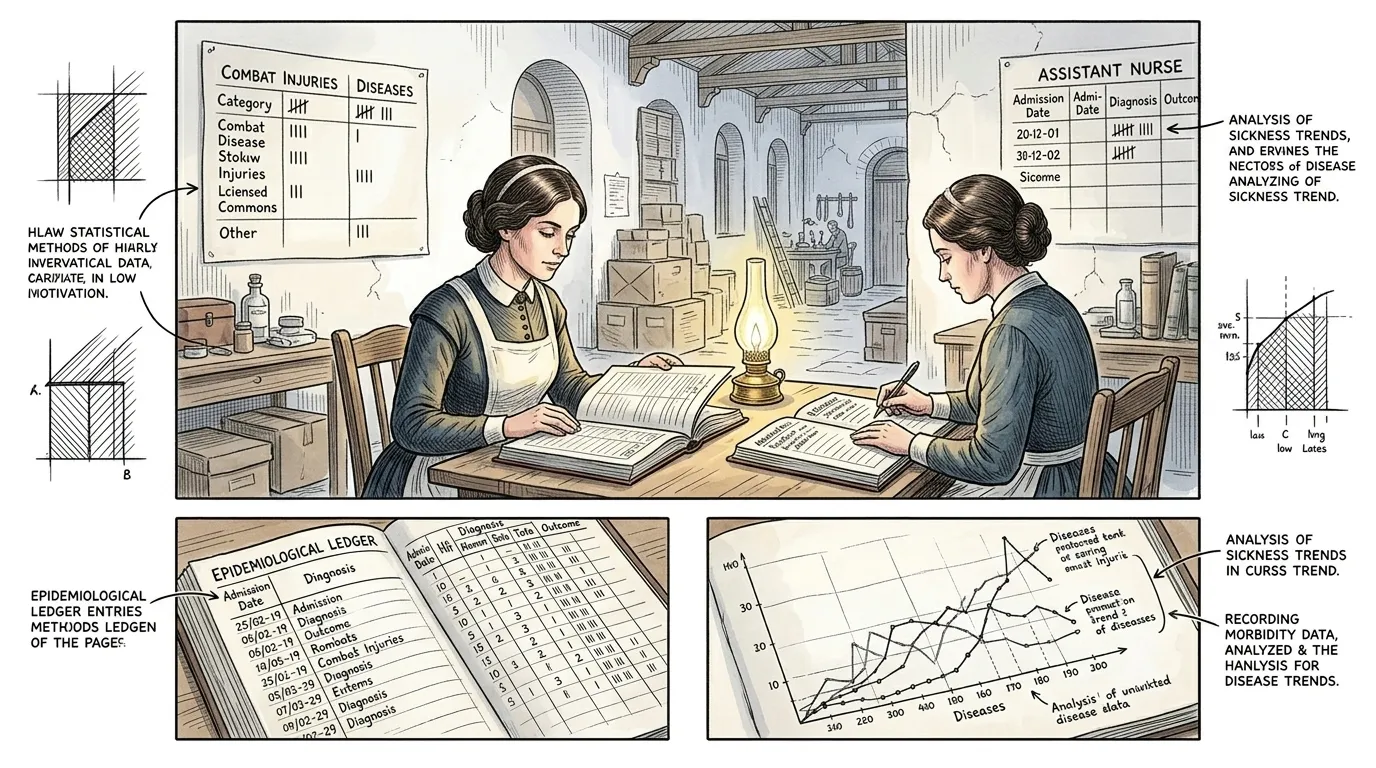
Nightingale and her team began compiling detailed records of every patient: admission date, diagnosis, treatment, and crucially, the ultimate outcome. They recorded not just deaths, but their specific causes, meticulously differentiating between combat wounds and diseases like typhus, cholera, or dysentery. This monumental effort transcended simple caretaking; it was an epidemiological survey conducted under wartime conditions, transforming raw, often overlooked information into invaluable statistical evidence. The data accumulated, revealing a stark, undeniable pattern.\n\n Fact: Focuses on the active process of data collection and categorization, highlighting the analytical rigor Nightingale applied.
Page 5
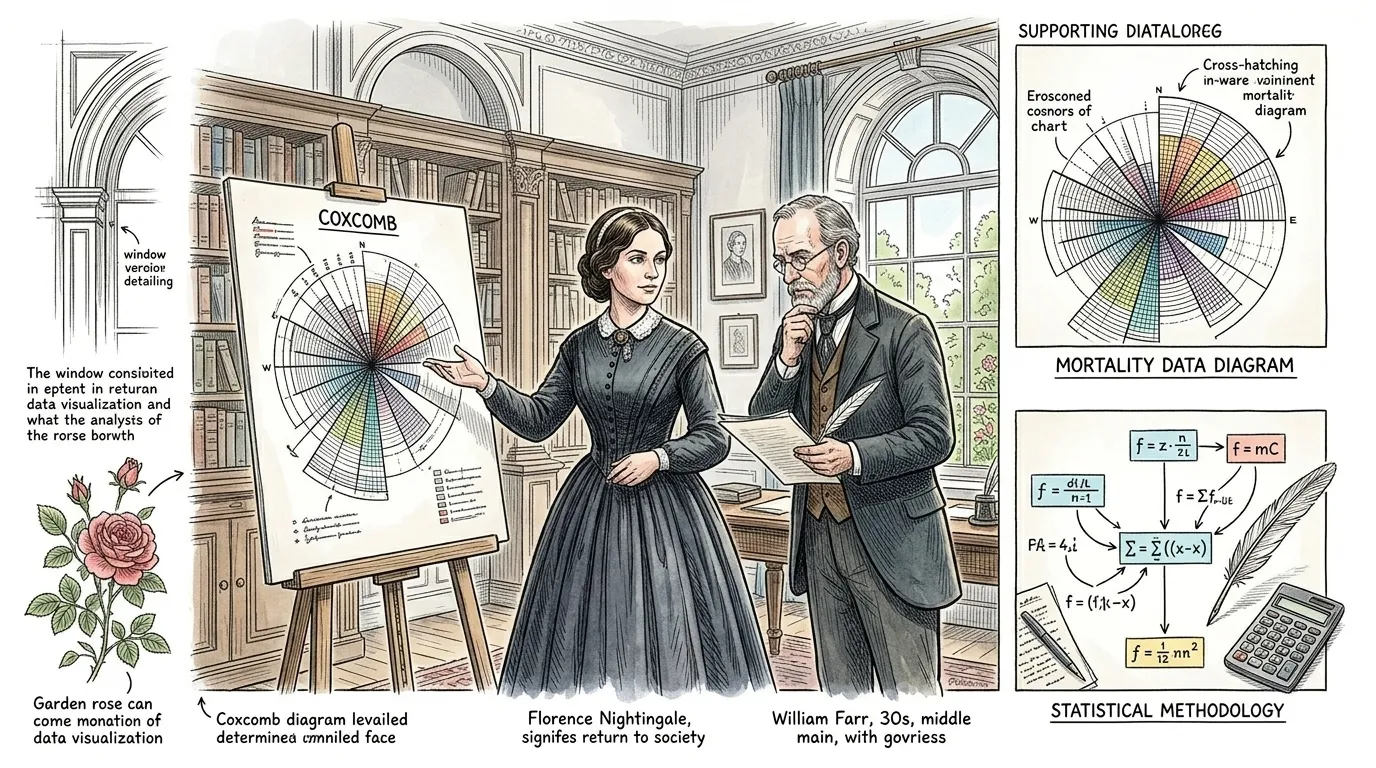
Back in England, Nightingale understood that raw data, however compelling, often failed to move politicians and the public. To make her findings undeniable, she needed a revolutionary method of presentation. Working with statistician William Farr, she devised the 'Diagram of the Causes of Mortality in the Army in the East' – later famously known as the 'Coxcomb' or 'Rose Diagram'. This pioneering graphical representation visually demonstrated that contagious diseases, not battle injuries, were the overwhelming cause of death, creating an immediate, visceral understanding of the crisis that words alone could not convey.\n\n Fact: Introduces the pivotal 'Coxcomb' diagram, showing Nightingale presenting it, and emphasizes its visual power to communicate complex data.
Page 6
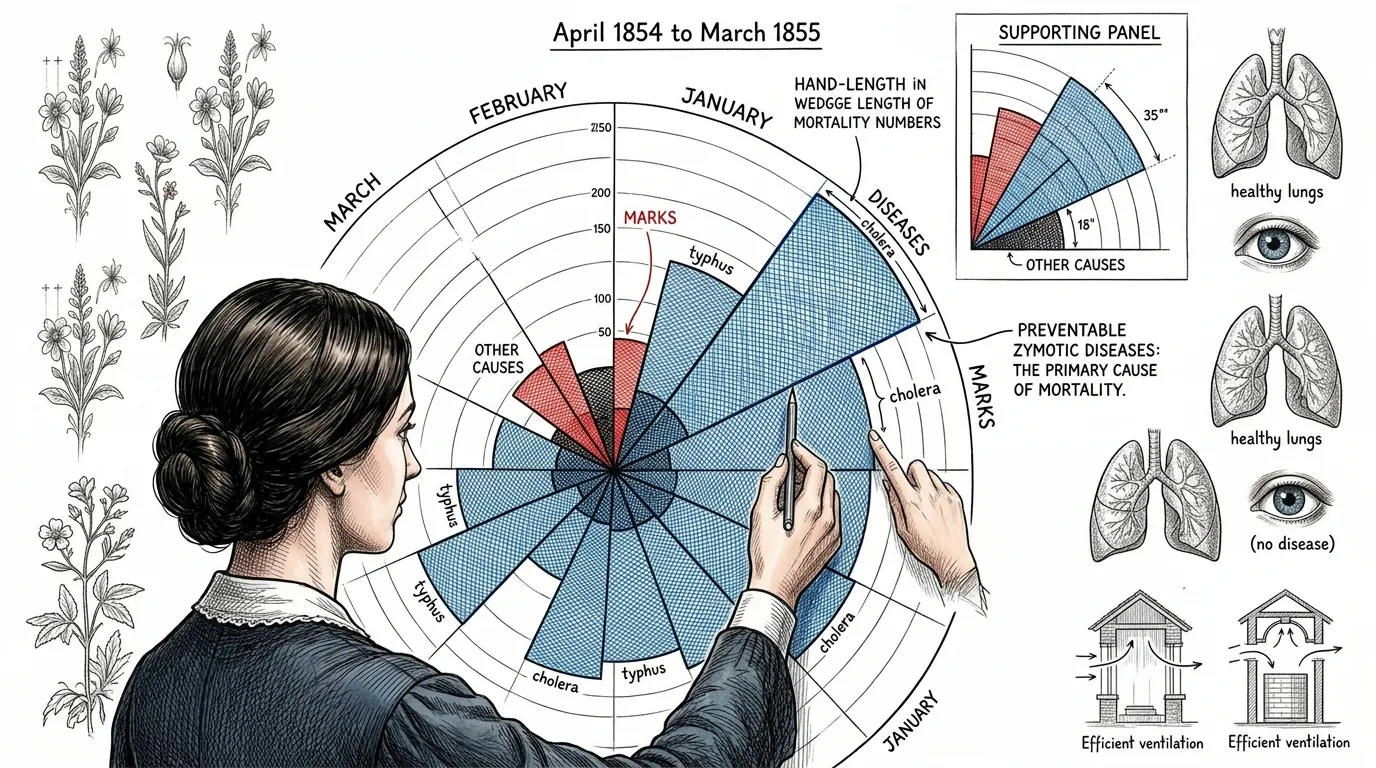
The Coxcomb diagram, a form of polar area graph, broke down the causes of mortality month by month. Each wedge represented a month, and the length of the wedge, radiating from the center, indicated the number of deaths. Different colors within the wedge depicted the specific cause: blue for preventable diseases (like typhus or cholera), red for wounds, and black for other causes. The diagram vividly illustrated the immense 'blue' segments, dwarfing the 'red' and 'black' through much of the war. It was a statistical weapon, converting abstract numbers into a stark, undeniable visual argument that bypassed rhetoric.\n\n Fact: Explains the mechanics of the Coxcomb diagram, showing how its visual structure translated raw data into clear evidence.
Page 7
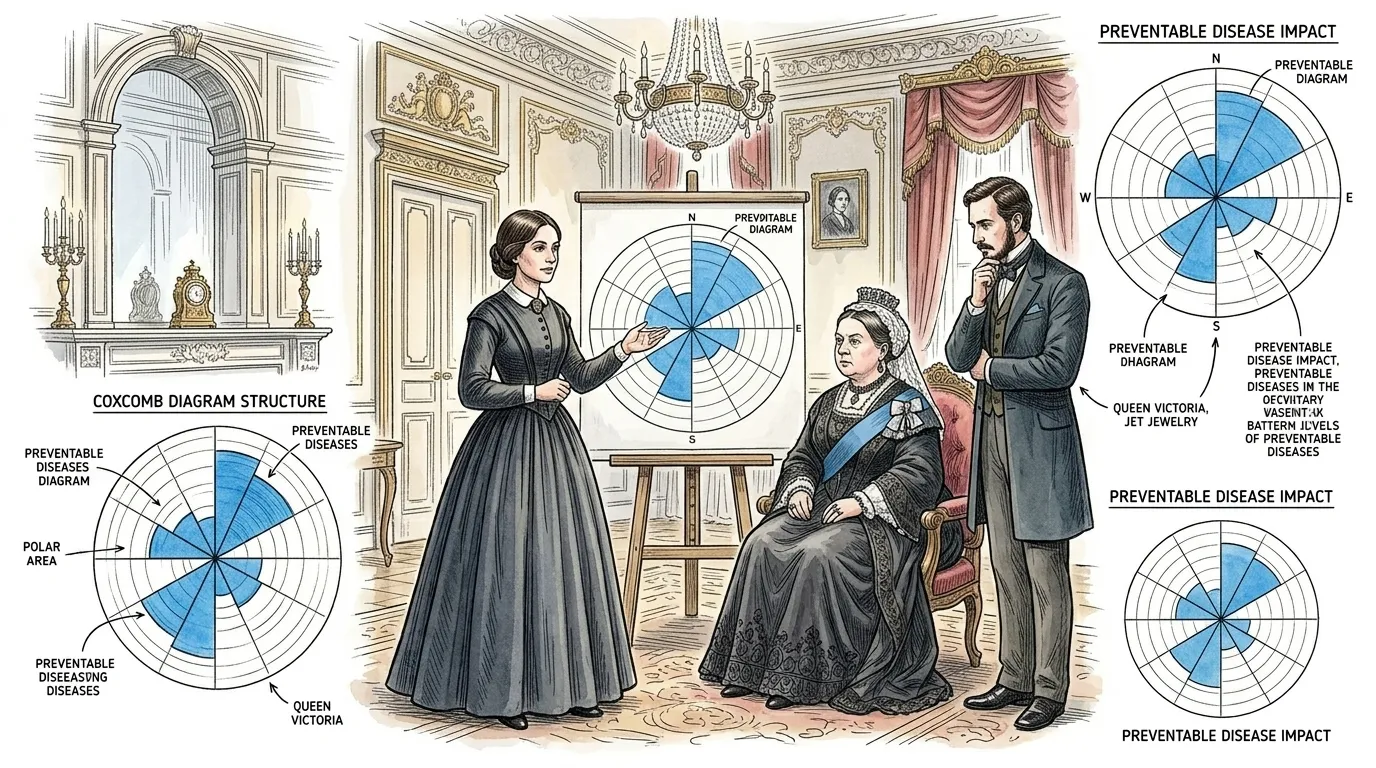
Armed with these powerful visualizations, Nightingale returned to Britain. She presented her findings not only to Queen Victoria and Prince Albert but directly to members of Parliament, military officials, and the public. The visual clarity of the Coxcomb diagram was irrefutable. It showed, without ambiguity, that the soldiers were dying from preventable causes at a rate ten times higher than actual combat wounds. Her rigorous statistical analysis and compelling graphical presentation cut through bureaucracy and denial, forcing a confrontation with the stark realities of military healthcare.\n\n Fact: Depicts Nightingale actively using her data visualization to influence policy and drive reform within powerful political circles.
Page 8
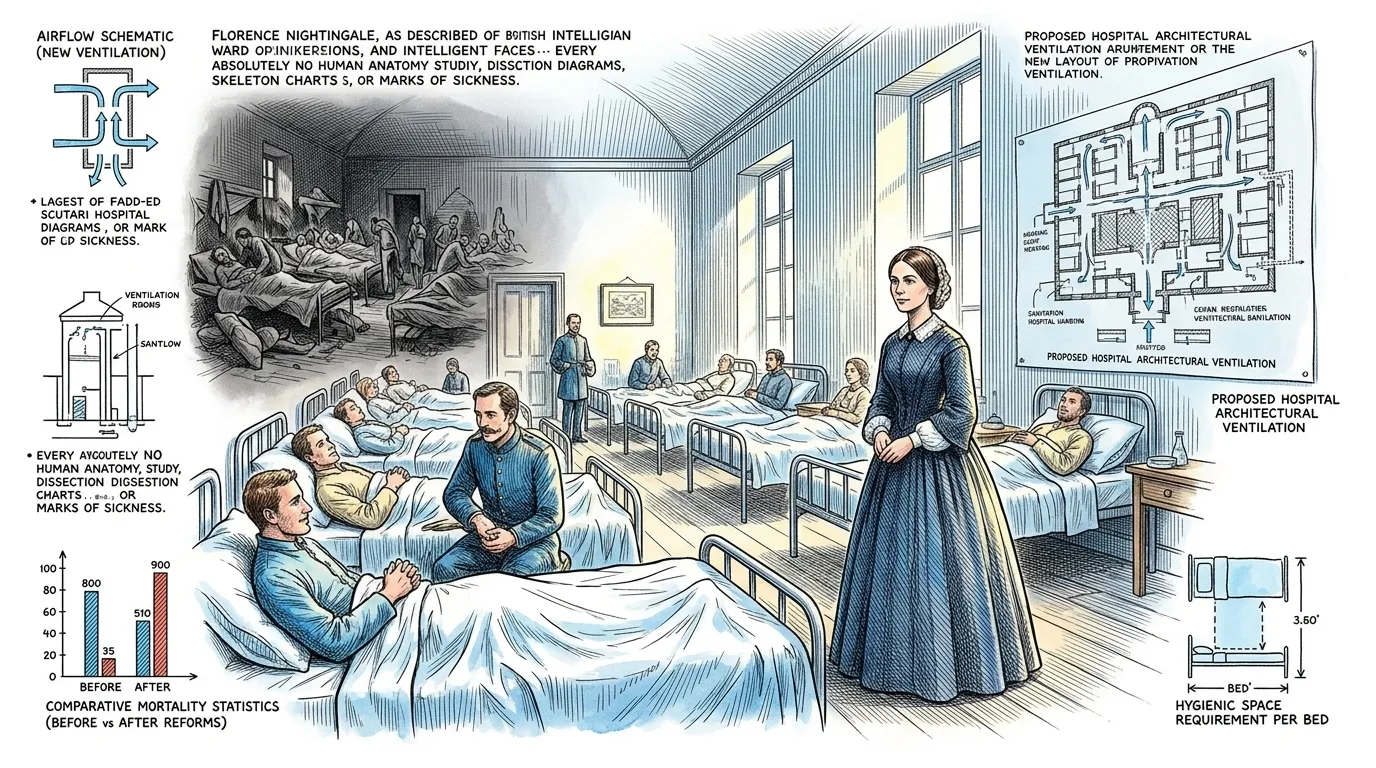
Nightingale's statistical prowess triggered immediate and profound change. Her evidence directly led to the establishment of the Royal Commission on the Health of the Army in 1857. This commission implemented sweeping reforms in military sanitation, hospital construction, and medical training. Within years, the death rate in army hospitals plummeted dramatically. It was a clear, quantifiable triumph of evidence-based policy over tradition. Nightingale's scientific method had not only exposed a crisis but provided the blueprint for its resolution, saving countless lives in subsequent conflicts.\n\n Fact: Shows the direct, positive consequence of Nightingale's statistical work: improved, sanitary hospital conditions and reduced mortality rates.
Page 9
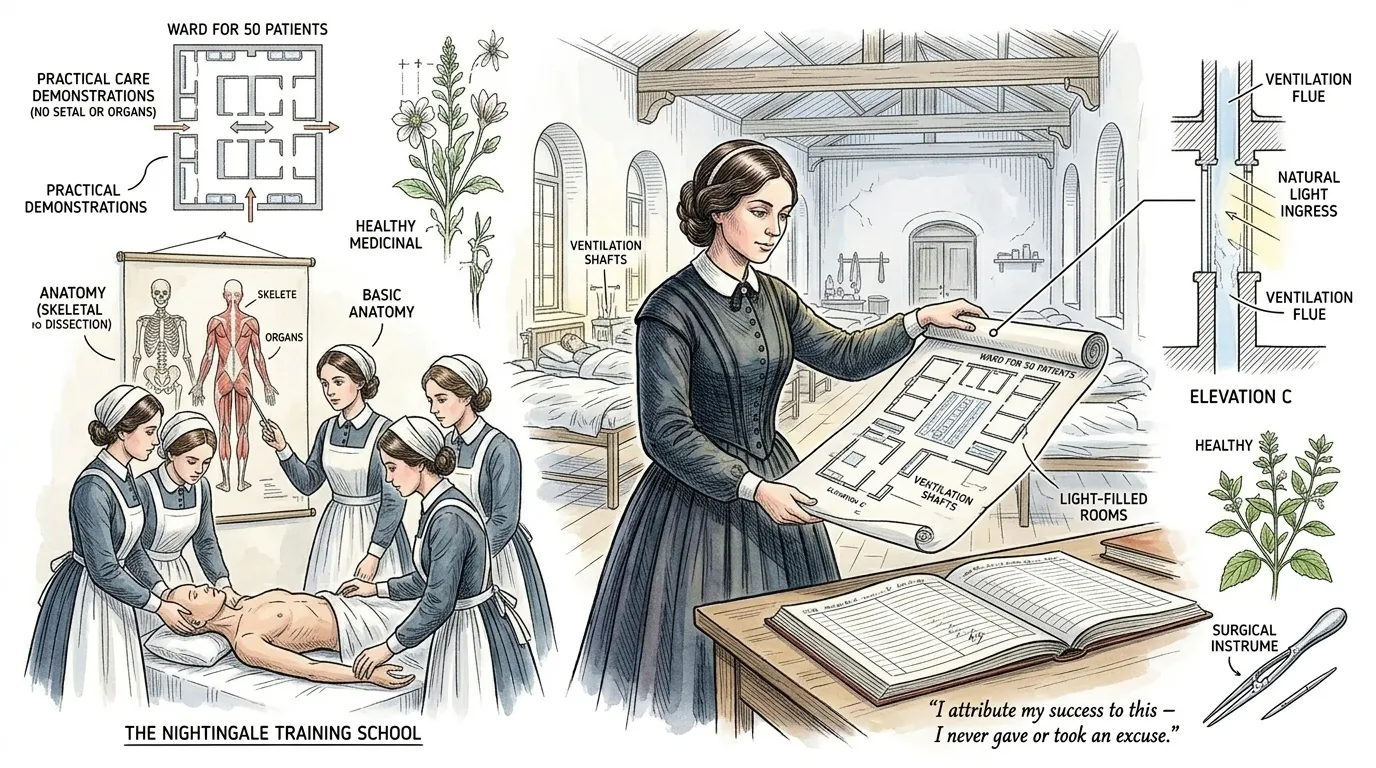
Nightingale's impact extended far beyond military reform. Her work laid the foundation for modern public health, advocating for the systematic collection of vital statistics in civilian hospitals and national census data. She designed innovative hospital layouts that maximized hygiene and fresh air, principles still influencing architecture today. She became a tireless advocate for the professionalization of nursing, establishing training schools rooted in scientific observation and practical experience. 'I attribute my success,' she once wrote, 'to this – I never gave or took an excuse.' This relentless pursuit of truth through data transformed not just hospitals, but the very understanding of how societies could prevent disease.\n\n Fact: Expands on Nightingale's broader influence, from hospital design and nursing education to public health data collection, with her quote integrated.
Page 10
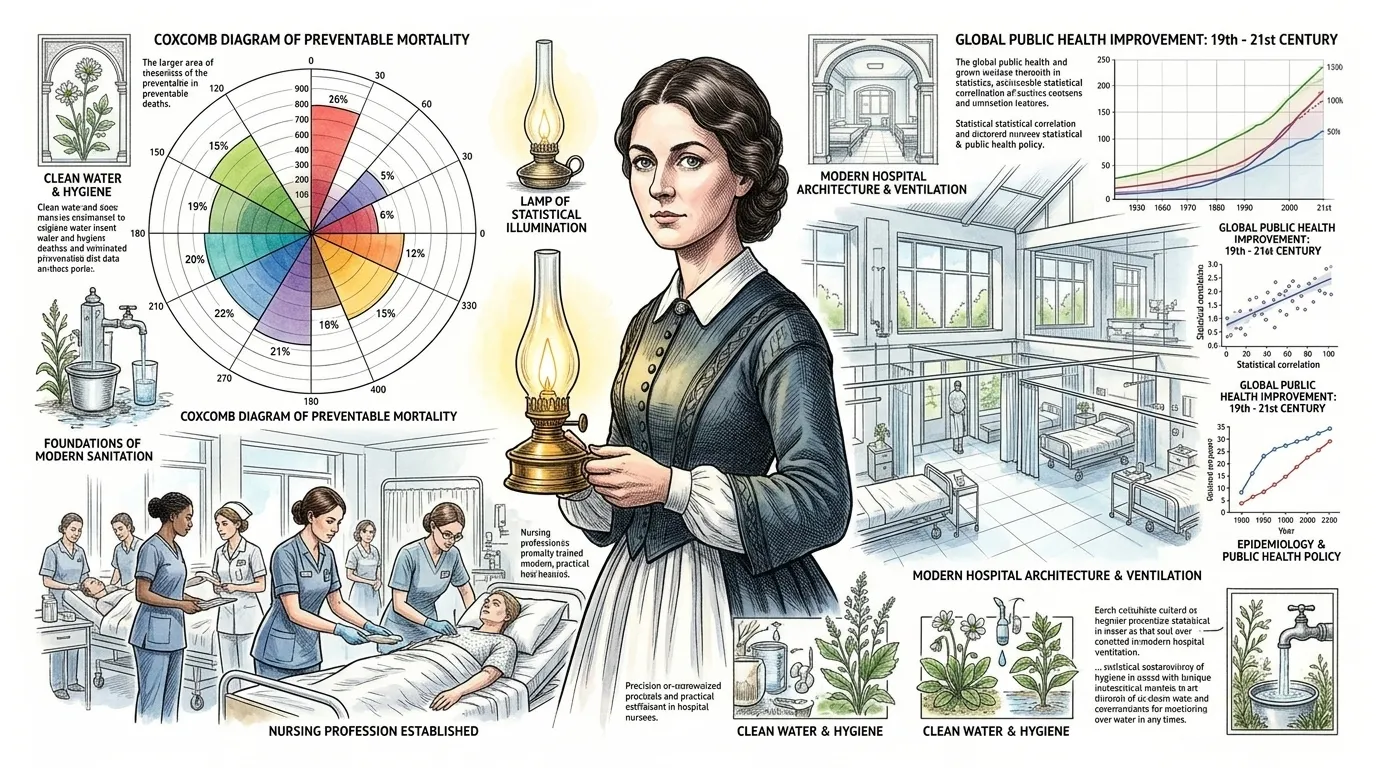
Florence Nightingale, the 'Lady with the Lamp,' was far more than a compassionate nurse; she was a pioneering statistician, an epidemiologist, and a relentless advocate for evidence-based reform. Her revolutionary use of data visualization made invisible suffering undeniable, compelling societies to act. She demonstrated that empathy, when combined with scientific rigor and statistical analysis, possessed the power to transform public health and save millions of lives. Her legacy endures in every meticulously collected healthcare statistic, every thoughtfully designed hospital, and every public health initiative grounded in the irrefutable power of numbers, forever cementing her place as a foundational figure in modern science.\n\n Fact: Concludes with a powerful montage demonstrating the lasting, diverse impact of Nightingale's scientific and public health contributions on the modern world.
About this story
- Location: Global
- Audience: general readers
Questions and answers
Read Wonder Science on your phone
Wonder Science is available on Android. Get Wonder Science on Google Play.