Frank Wilczek
Frank Wilczek — an illustrated science story, set in Global. 10 illustrated pages, free to read on Wonder Science.
Page 1

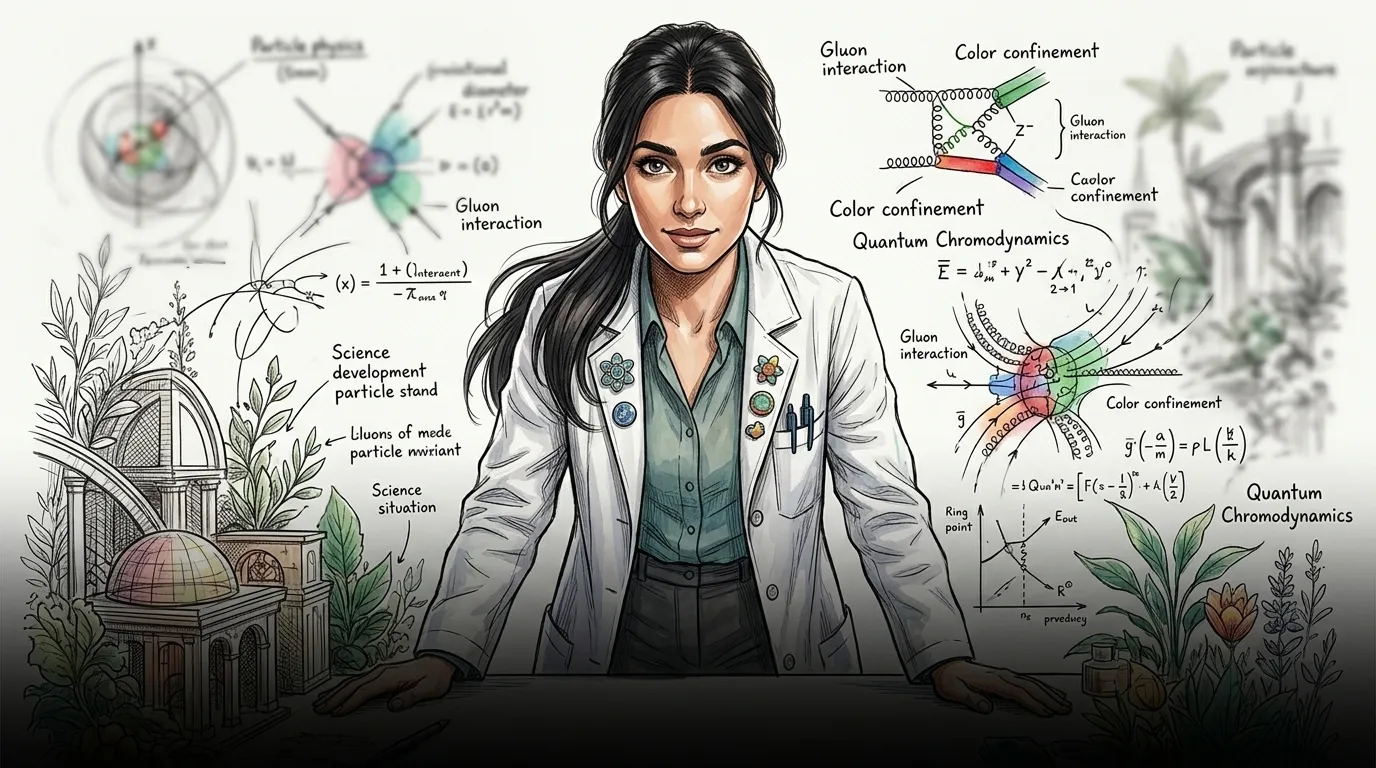
At the heart of every proton and neutron lies a dynamic, enigmatic realm governed by the strong nuclear force, one of the four fundamental interactions of nature. For decades, its behavior defied complete explanation, posing a profound challenge to physicists. Yet, in the early 1970s, a groundbreaking discovery by a young Frank Wilczek, alongside David Gross and H. David Politzer, unveiled a counterintuitive property: asymptotic freedom.\n\n"'It's incredible to think about,' Dr. Lena Petrova remarked, her gaze fixed on a complex particle collider simulation, 'protons, supposedly stable, are teeming with activity at their core.' Dr. Aris Thorne, adjusting his spectacles, nodded thoughtfully. 'Indeed. The strong force binding quarks together is so potent, yet the quarks themselves act almost as if they're free when probed at high energies. It's a paradox that confounded us for so long.'"
Page 2

Before asymptotic freedom, the prevailing understanding of forces suggested that interactions grew weaker with distance and stronger up close. Gravity and electromagnetism followed this pattern. But experimental data from electron-proton scattering experiments, notably at SLAC in the late 1960s, revealed a perplexing truth: when electrons struck protons with high energy, the quarks inside behaved as if they were nearly independent, massless particles.\n\n"'The deep inelastic scattering experiments at SLAC were the first real hint,' explained Dr. Aris Thorne, gesturing towards a historical graph projected onto a holographic screen, 'showing quarks acting almost unbound within the nucleon when struck hard. It was like trying to scoop water from a pond, only for the water to solidify the harder you tried.' Dr. Kenji Tanaka, a meticulous computational physicist in his early 30s, average build, short black hair, thoughtful dark eyes, wearing a sleek polo shirt and cargo pants, tapped a finger on his tablet. 'The problem was, we knew quarks couldn't exist freely; they're permanently confined within protons and neutrons. That observation was a genuine theoretical impasse.'"
Page 3
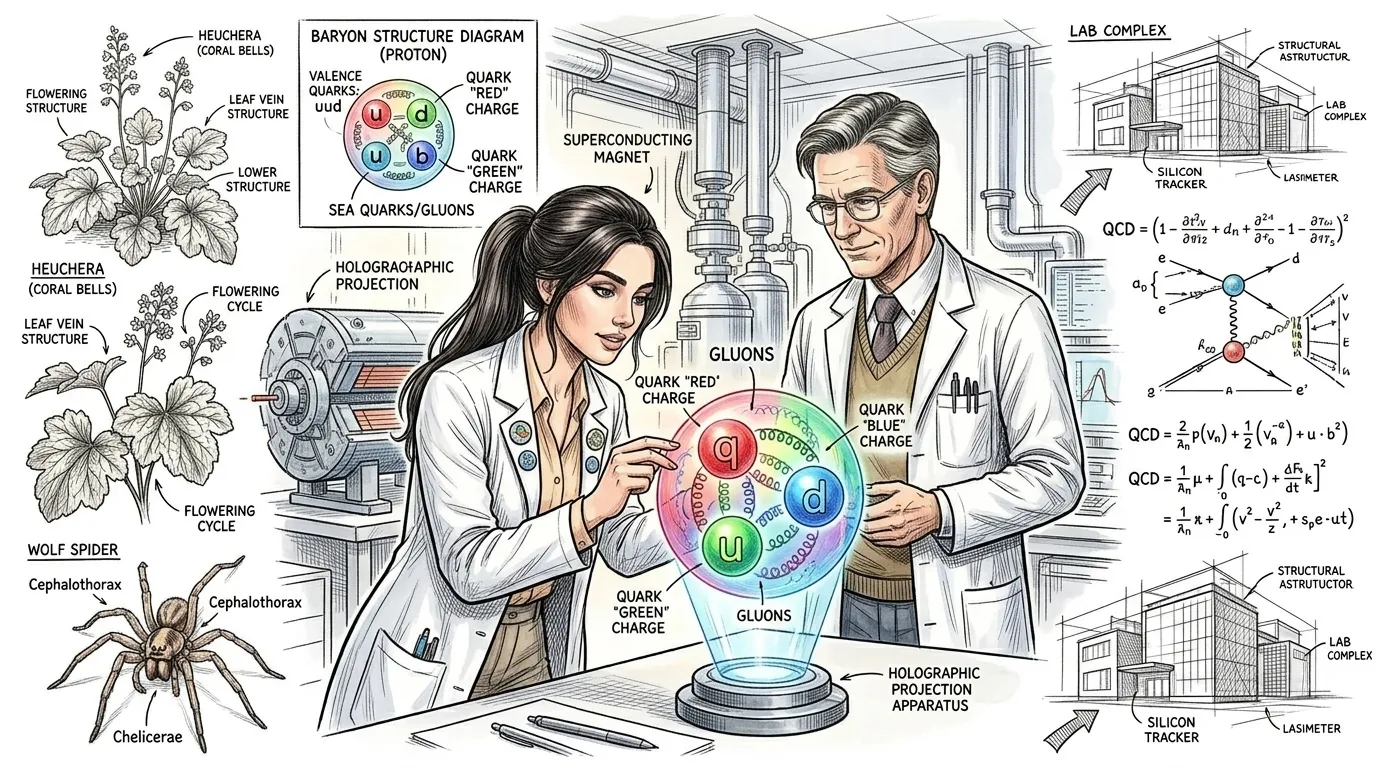
The theory that eventually described the strong force was Quantum Chromodynamics, or QCD. In QCD, quarks carry a 'color charge' (red, green, or blue), and gluons, the force carriers, also possess color charge. This makes QCD fundamentally different from electromagnetism, where photons are electrically neutral. The critical question was how this 'color charge' interaction could explain both confinement and quasi-free behavior.\n\n"'Understanding the strong force meant embracing the concept of 'color charge',' Dr. Lena Petrova stated, adjusting a holographic model of a proton, its internal quarks glowing with different 'colors'. 'It's not a physical color, of course, but a fundamental property, just like electric charge. Each quark carries one, and gluons carry two, allowing them to interact with other gluons.' Dr. Aris Thorne added, 'It's this gluon-gluon interaction that makes QCD so complex and fascinating. As the ancient Greek philosopher Aristotle famously said, 'The more you know, the more you realize you don't know.' This puzzle truly highlighted the limits of our knowledge at the time, pushing us to seek deeper truths about fundamental interactions.'"
Page 4
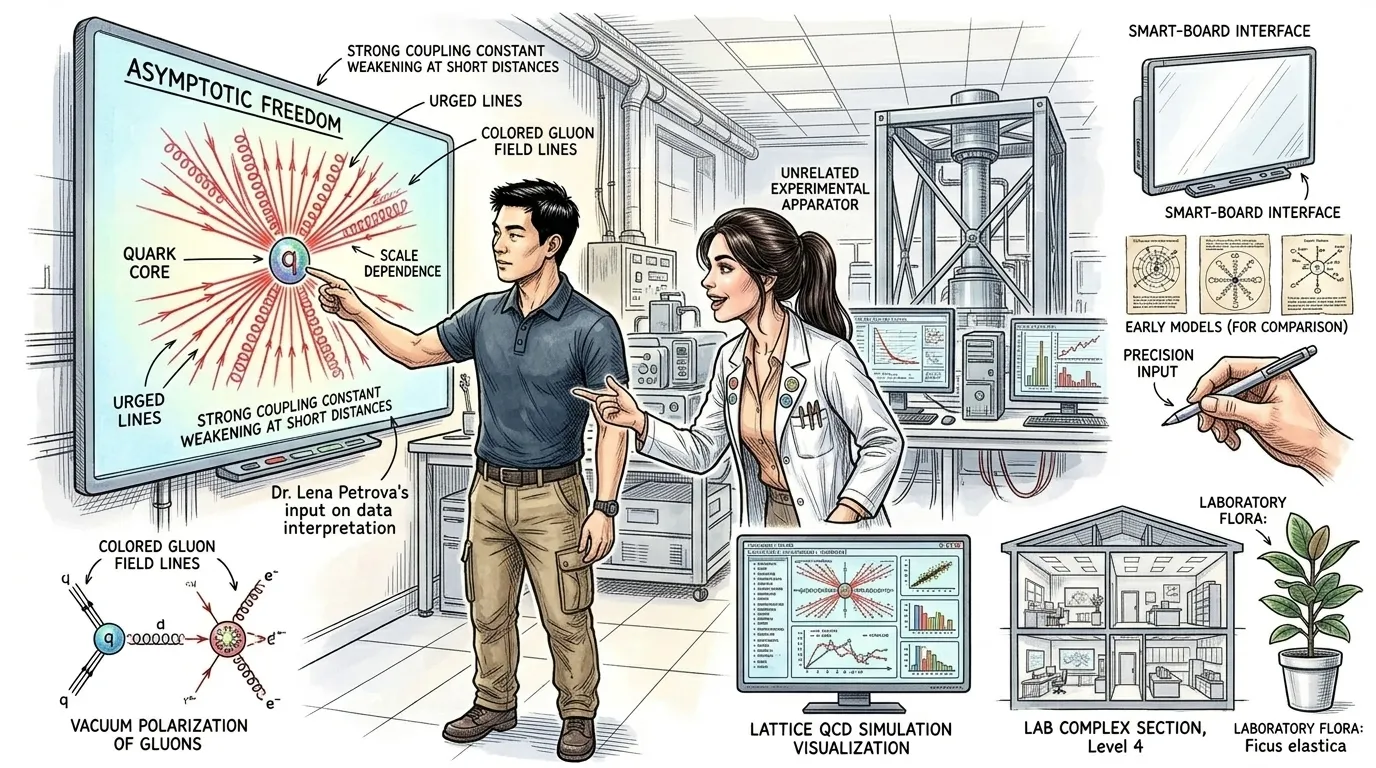
The puzzle centered on the 'coupling constant' of the strong force – a measure of its strength. In other theories, this constant usually increased at shorter distances. However, the experimental data suggested the opposite for the strong force within hadrons. Theorists needed a mechanism where the force weakened dramatically at short distances (high energies) but grew incredibly strong at longer distances, preventing quarks from ever escaping.\n\n"'The core issue was how the strong coupling constant behaved,' Dr. Kenji Tanaka articulated, pointing to a diagram of force lines radiating from a quark on a large digital whiteboard. 'Standard quantum field theories predicted that interactions grow stronger as particles get closer. But for quarks, the data screamed the opposite: the closer they were, the weaker the interaction effectively became.' Dr. Lena Petrova chimed in, 'It was like a strange quantum elastic band. Pull it gently, and it snaps back hard. But pull it incredibly fast and hard, and it seems to offer almost no resistance, only to yank you back in once you slow down.'"
Page 5
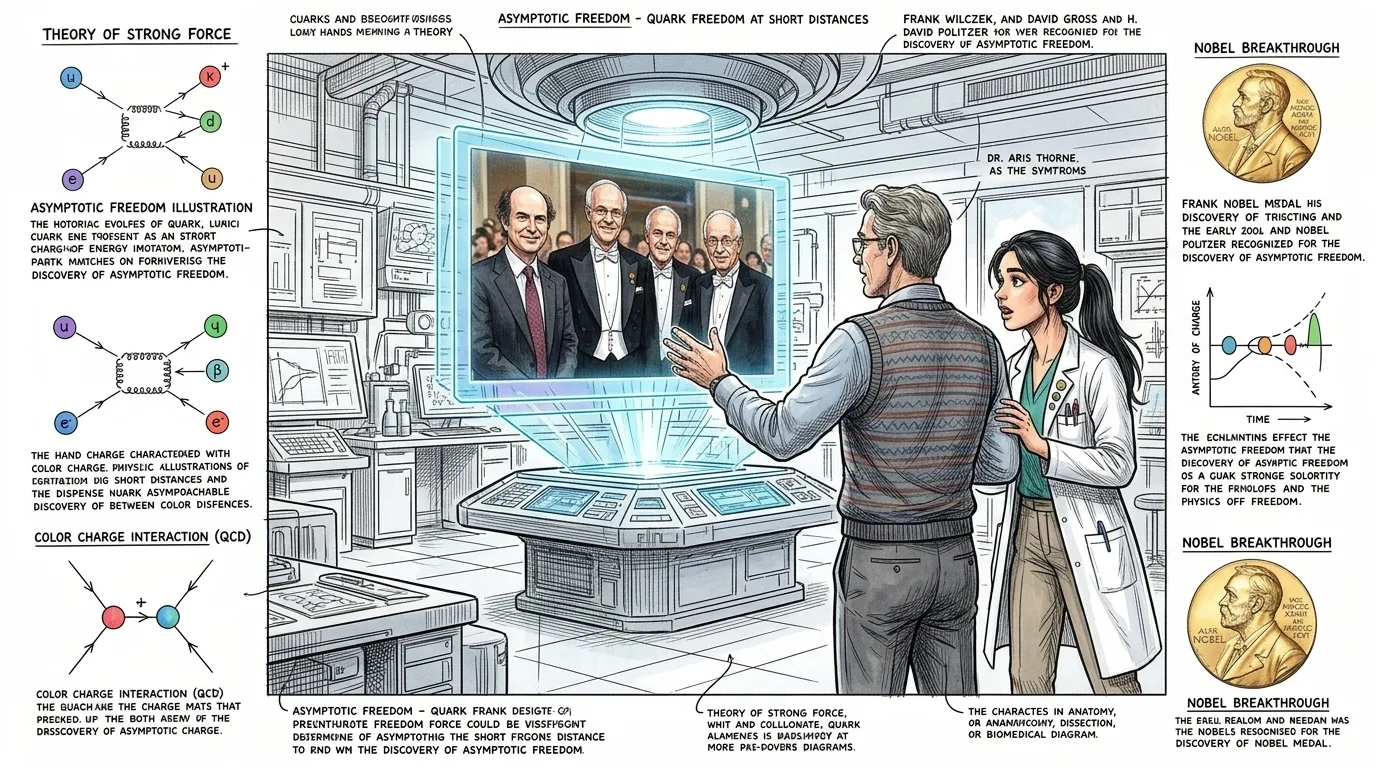
The breakthrough came in 1973. Frank Wilczek, David Gross, and H. David Politzer independently discovered that, unlike other forces, the strong force's coupling constant actually decreases at high energies (short distances) and increases at low energies (long distances). This counterintuitive behavior, termed asymptotic freedom, provided the missing piece of the puzzle. It was a revolutionary insight into the quantum vacuum.\n\n"'Wilczek, Gross, and Politzer's calculations truly turned our understanding on its head,' Dr. Aris Thorne stated, gesturing emphatically towards a holographic projection of Frank Wilczek, David Gross, and H. David Politzer. 'They showed that the quantum vacuum, far from being empty, acts like a medium that screens color charges in a unique way. The stronger the interaction, the more virtual particles it creates, which paradoxically dilutes the effective charge at short distances.' Dr. Lena Petrova added, 'It's almost as if the vacuum itself gets involved, weakening the force when quarks are close, allowing them to move 'asymptotically freely' within the proton.'"
Page 6
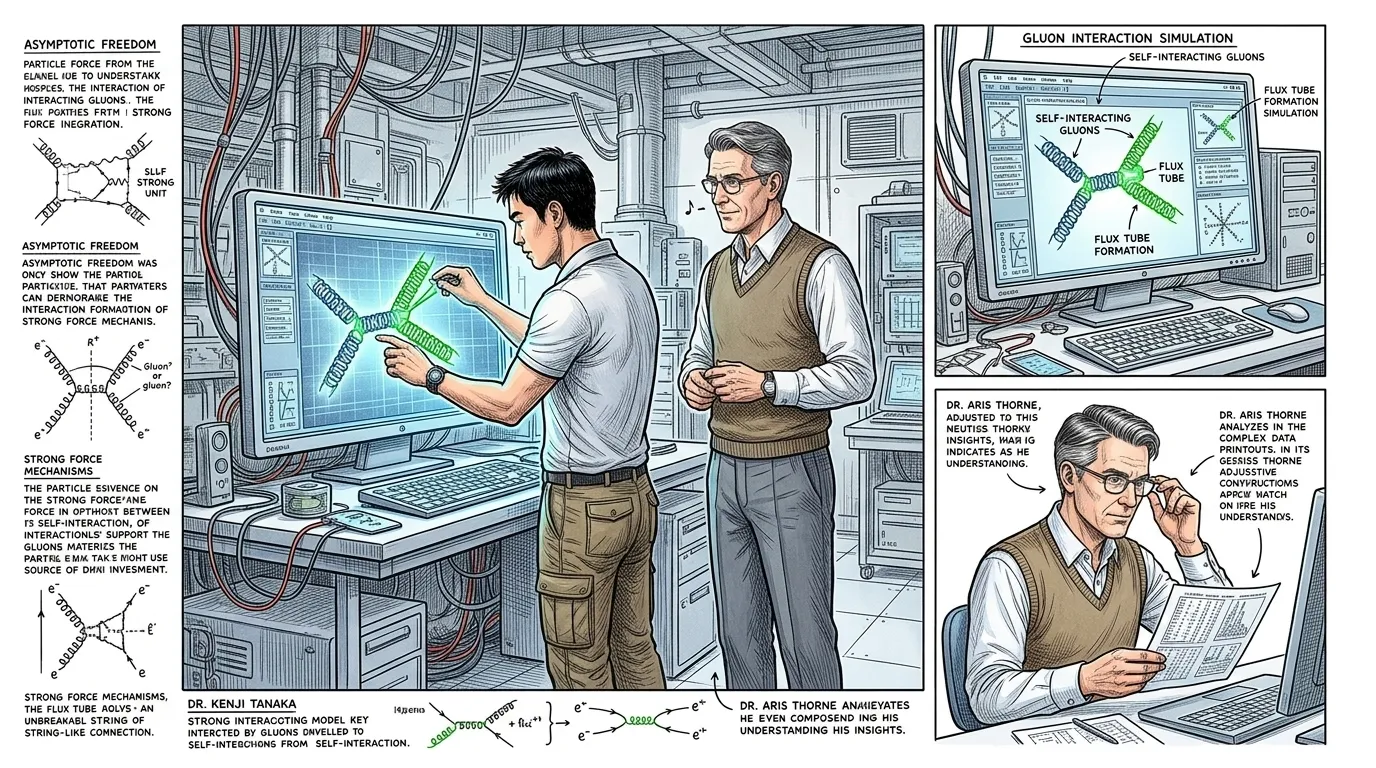
What makes asymptotic freedom unique is the behavior of gluons. Unlike photons, which are neutral, gluons carry color charge and can interact with each other. This gluon-gluon interaction leads to an 'anti-screening' effect. Instead of the quantum vacuum weakening the force at long distances, it actually strengthens it, confining quarks. At short distances, the effect is reversed.\n\n"'The key lies in the gluons themselves,' Dr. Kenji Tanaka elaborated, manipulating a 3D model of interacting gluons, some highlighted in green, on his workstation. 'Because gluons carry color charge, they self-interact. When you try to pull quarks apart, the vacuum gets filled with so many virtual gluons that they form a 'flux tube' – a sort of unbreakable string that pulls the quarks back. This is the anti-screening.' Dr. Aris Thorne, observing the model, added, 'Imagine stretching a rubber band. The farther you pull, the more resistance. For quarks, it's like the more you pull, the more rubber bands spontaneously appear between them, making it impossible to break.'"
Page 7

The discovery of asymptotic freedom provided the theoretical bedrock for Quantum Chromodynamics, firmly establishing it as the correct theory for the strong nuclear force. This was a monumental achievement, as it completed the theoretical framework of the Standard Model of particle physics, uniting the electromagnetic, weak, and strong forces under one cohesive quantum field theory.\n\n"'With asymptotic freedom, QCD finally provided a complete, consistent picture of the strong force,' Dr. Lena Petrova explained, tracing a finger across a large, illuminated diagram of the Standard Model of particle physics. 'It elegantly resolved the conundrum of quark confinement and their seemingly free behavior at high energies. For the first time, we had a robust theory that described how protons and neutrons are built.' Dr. Kenji Tanaka nodded, 'It was the missing puzzle piece that validated decades of experimental and theoretical work, solidifying the Standard Model as our most successful description of fundamental particles and forces.'"
Page 8
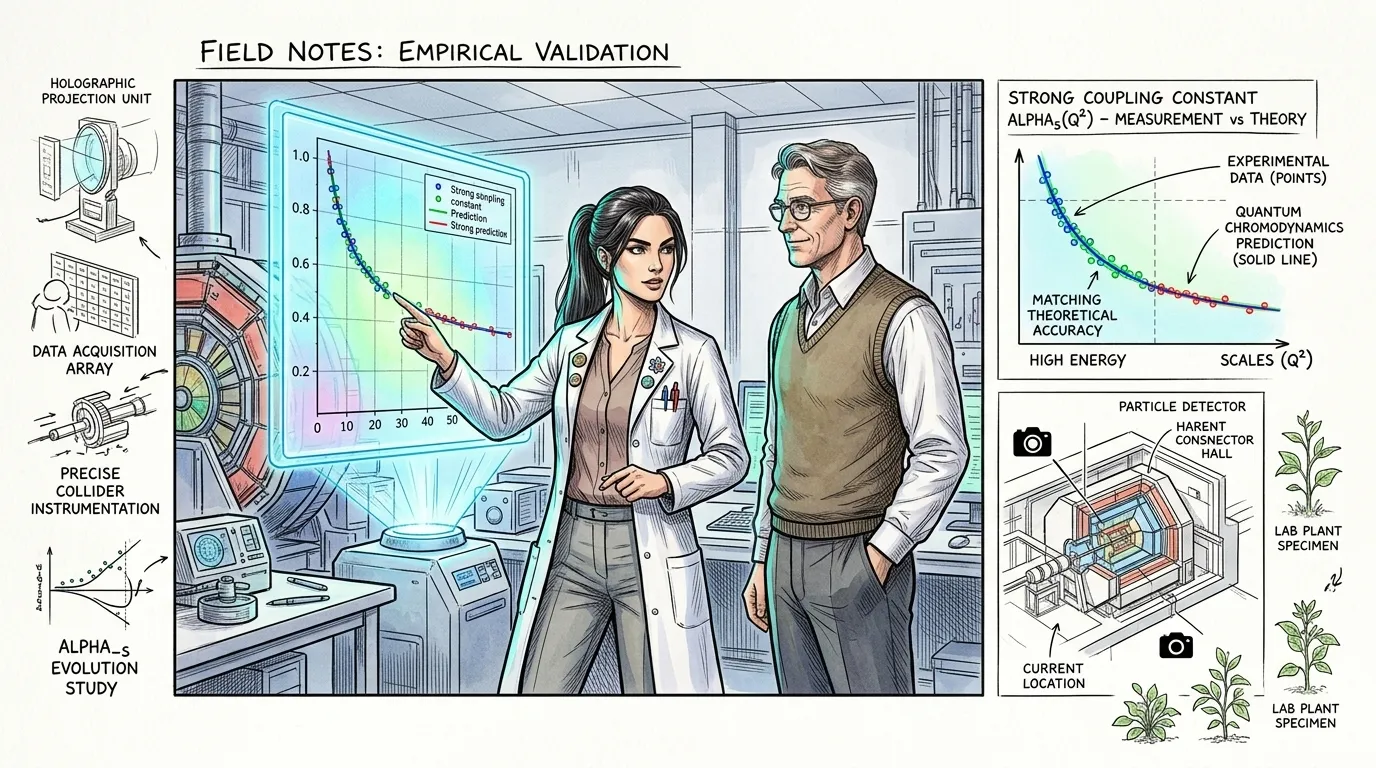
The predictions of QCD and asymptotic freedom were rigorously tested and confirmed by numerous experiments, particularly at particle accelerators like CERN and Fermilab. These experiments precisely measured the strong coupling constant at various energy scales, finding perfect agreement with the theoretical predictions. This validation cemented QCD's place as a fundamental pillar of physics.\n\n"'The experimental validation was crucial,' Dr. Lena Petrova emphasized, pointing to a vibrant data plot on a holographic screen showing the strong coupling constant's behavior across different energy scales, with a clear curve matching theoretical predictions. 'These plots, derived from real-world collider data, perfectly illustrate how the strong force weakens at high energies. This was the direct confirmation we needed, echoing those early SLAC results that first perplexed us, now fully understood.' Dr. Aris Thorne added, 'It's satisfying to see those initial, baffling observations from the late 60s and early 70s finally explained by such an elegant and fundamental principle. It was a triumph of theoretical prediction meeting empirical reality.'"
Page 9
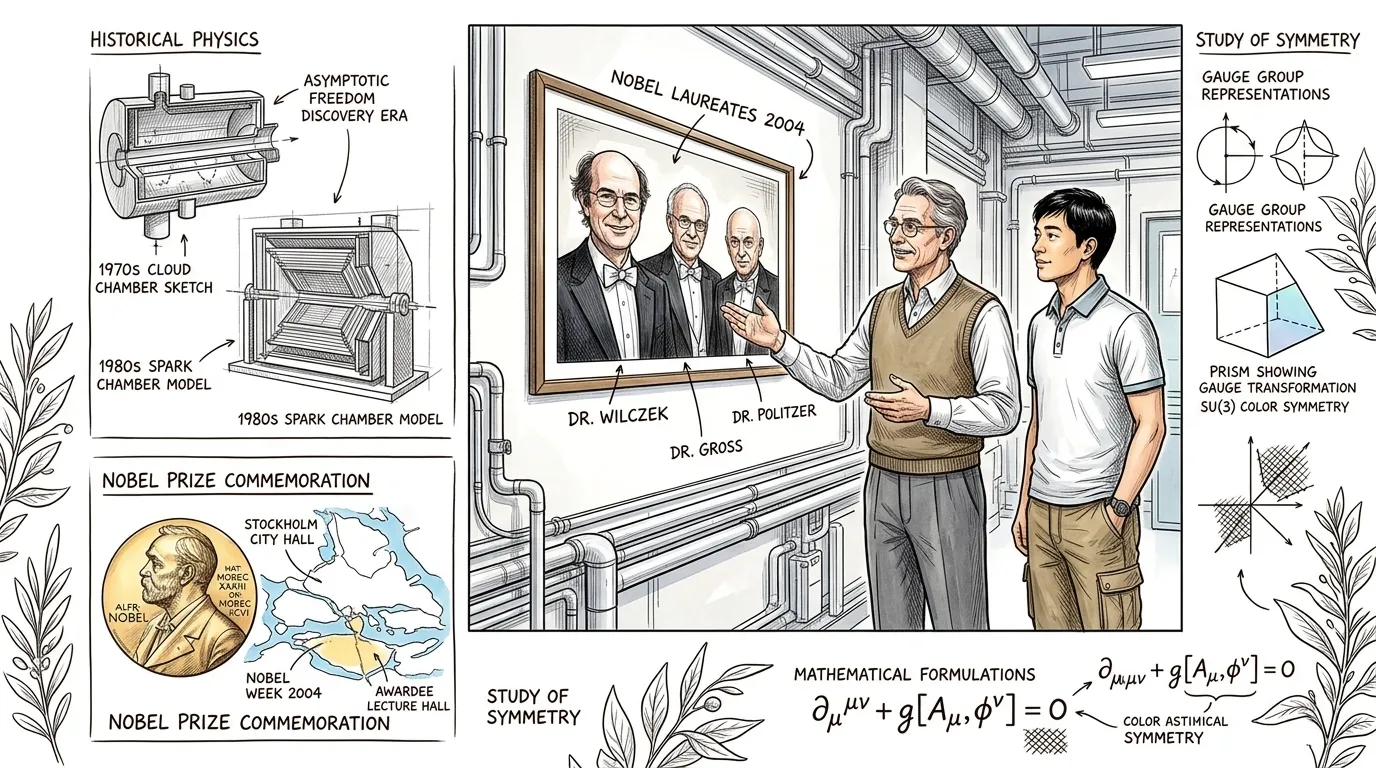
Frank Wilczek, David Gross, and H. David Politzer were awarded the Nobel Prize in Physics in 2004 for their discovery of asymptotic freedom. Their work not only completed the Standard Model but also opened new avenues for understanding the fundamental structure of matter and the early universe. Wilczek continues to explore profound questions, from the nature of dark matter to time crystals.\n\n"'Winning the Nobel Prize in 2004 was a well-deserved recognition,' Dr. Aris Thorne commented, gesturing towards a historical photograph of the three Nobel laureates, Frank Wilczek prominent among them. 'Their insight truly defined how we understand the very fabric of matter. It's a testament to the power of fundamental theoretical work.' Dr. Kenji Tanaka looked at the image with admiration. 'And Wilczek's intellectual curiosity didn't stop there. He continues to push the boundaries of physics, exploring exotic states of matter and even speculating on new forms of light. His legacy is one of perpetual inquiry.'"
Page 10
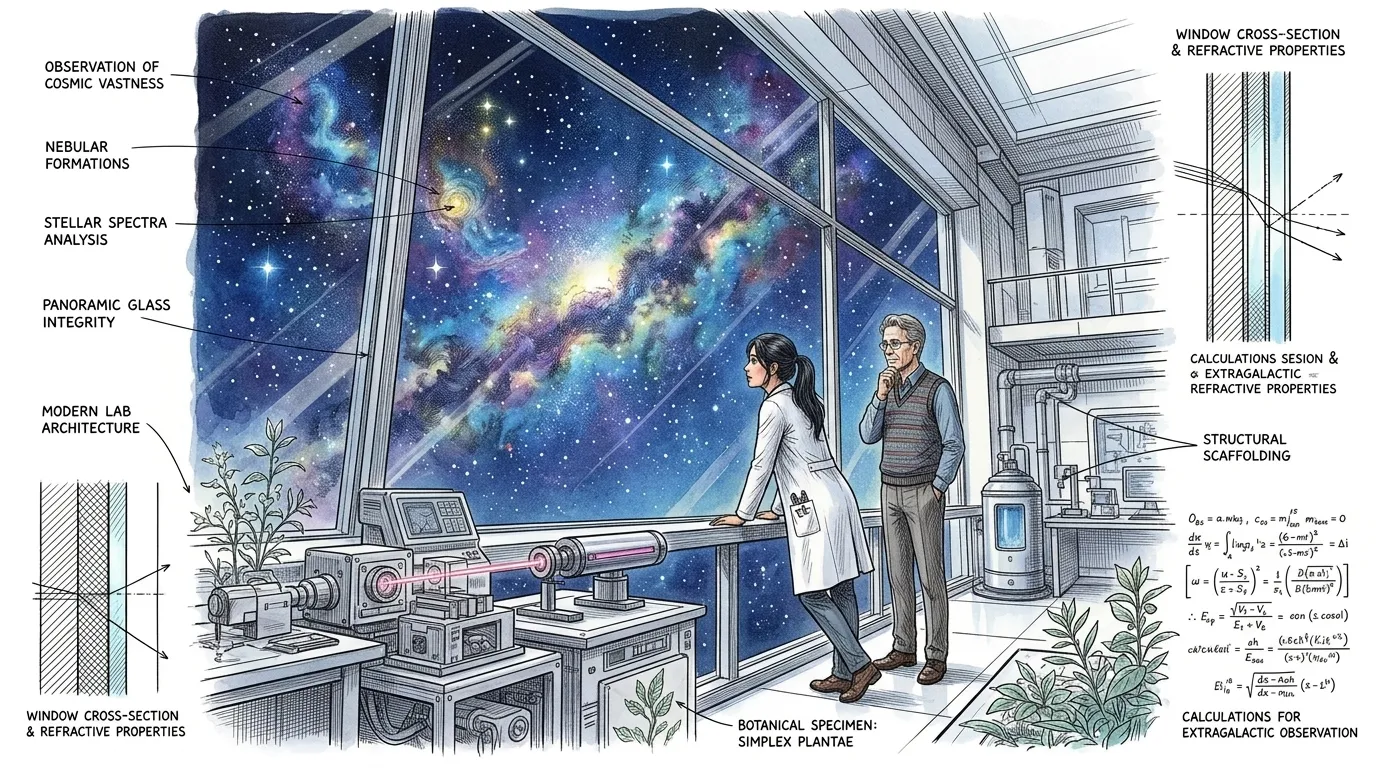
The discovery of asymptotic freedom solved a monumental puzzle, yet the universe continues to present new ones. From the mysteries of dark matter and dark energy, which constitute the vast majority of the cosmos, to the elusive quantum gravity, the journey of fundamental physics is far from over. Frank Wilczek's legacy reminds us that asking the right questions, however counterintuitive the answers, is the engine of scientific progress.\n\n"'Asymptotic freedom was a triumph, but the universe still holds vast, uncharted territories of knowledge,' Dr. Lena Petrova observed, gazing out a panoramic window at a starlit night sky, filled with subtle cosmic nebulae. 'Dark matter, dark energy, the unification of all forces... these are the next frontiers.' Dr. Aris Thorne nodded slowly. 'Indeed. The work of scientists like Wilczek ensures that we continue to chip away at the unknown, layer by layer. The beauty of physics is that every answer often reveals a deeper, more intriguing question.'"
About this story
- Location: Global
- Audience: general readers
Read Wonder Science on your phone
Wonder Science is available on Android. Get Wonder Science on Google Play.