Galileo Galilei
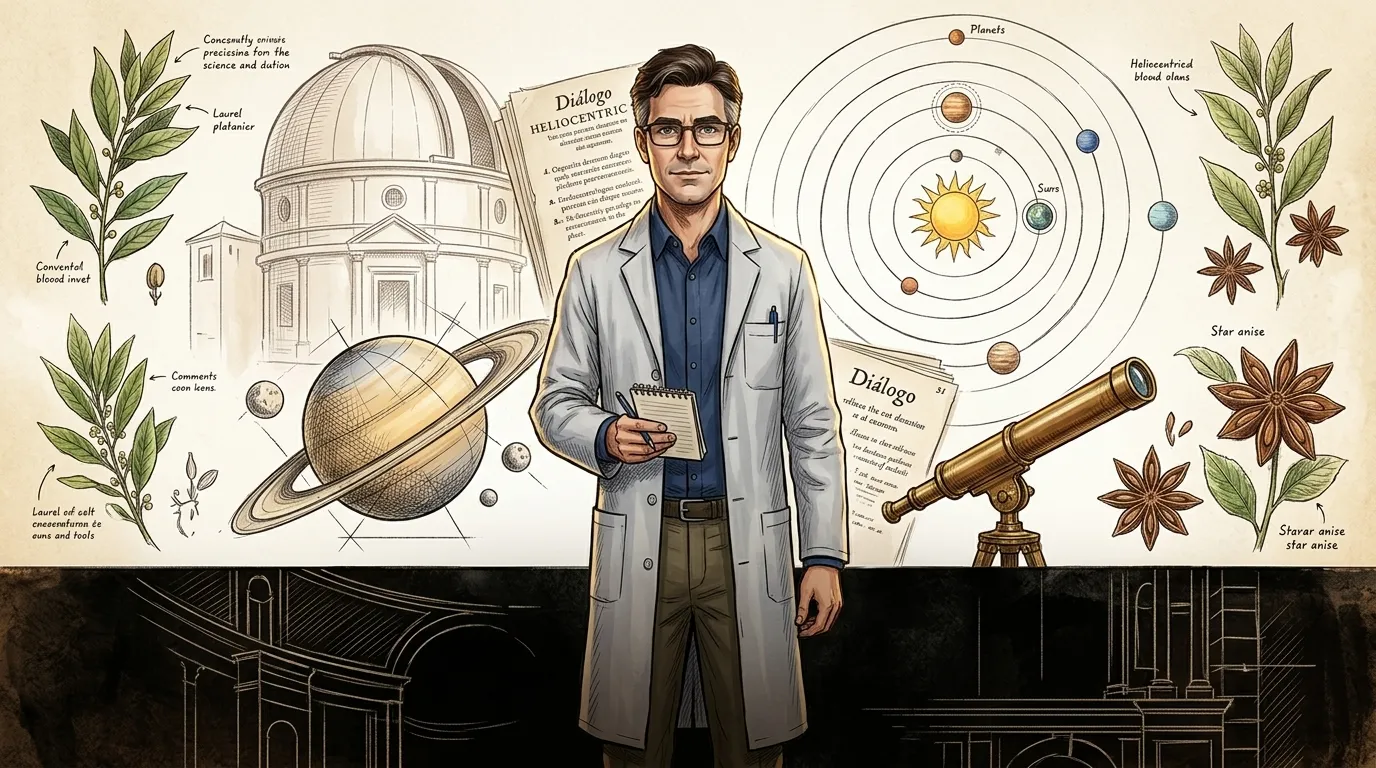
Galileo Galilei — an illustrated science story, set in Global. 10 illustrated pages, free to read on Wonder Science.
Page 1
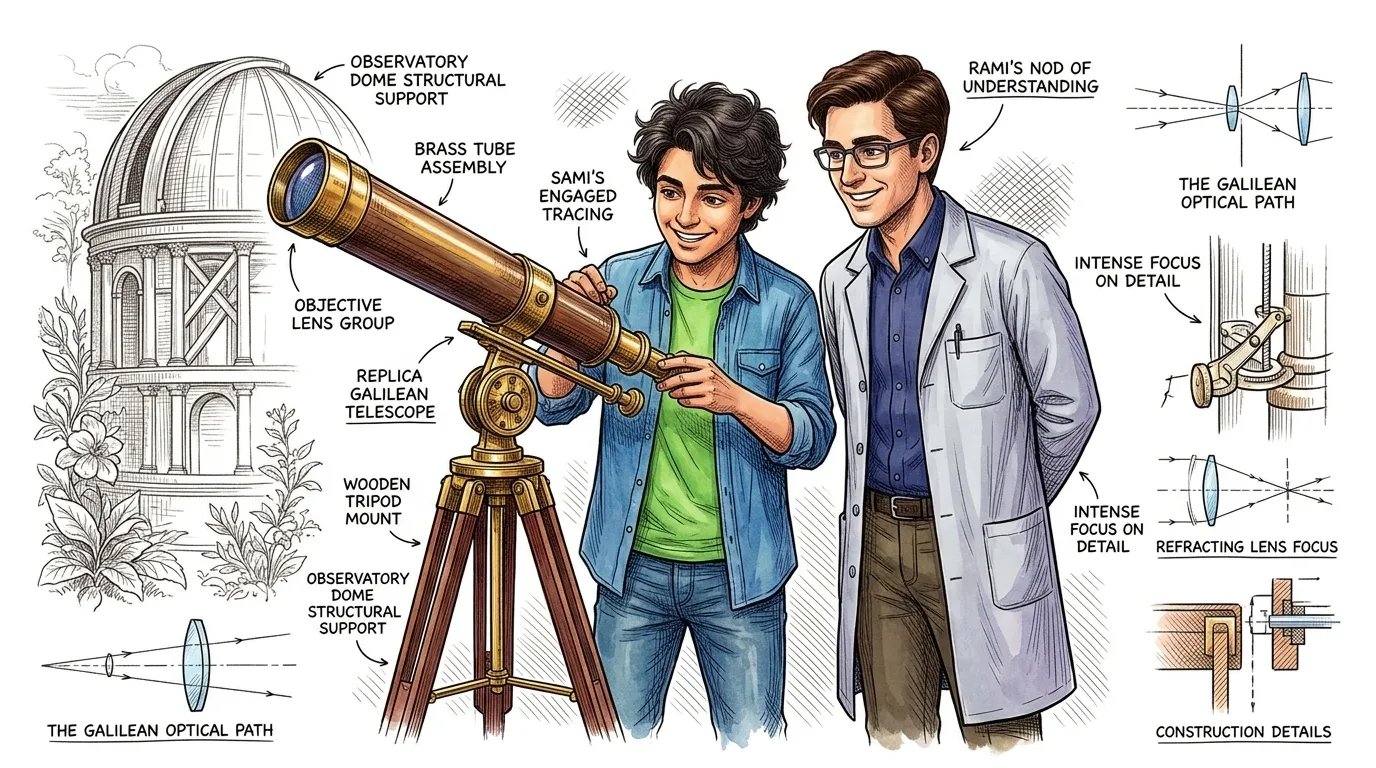
At the dawn of the 17th century, the universe was largely understood through ancient philosophy and naked-eye observation. Then, a remarkable instrument emerged, swiftly repurposed from a novelty into a profound scientific tool.\n\n""Rami, look at this incredible replica of Galileo's first telescope," Sami remarked, tracing the intricate brass work. "It's hard to believe this simple device utterly transformed our view of the cosmos." Rami nodded, "Indeed, Sami. This wasn't merely about seeing further; it was about seeing with unprecedented clarity, proving what was previously unthinkable.""
Page 2
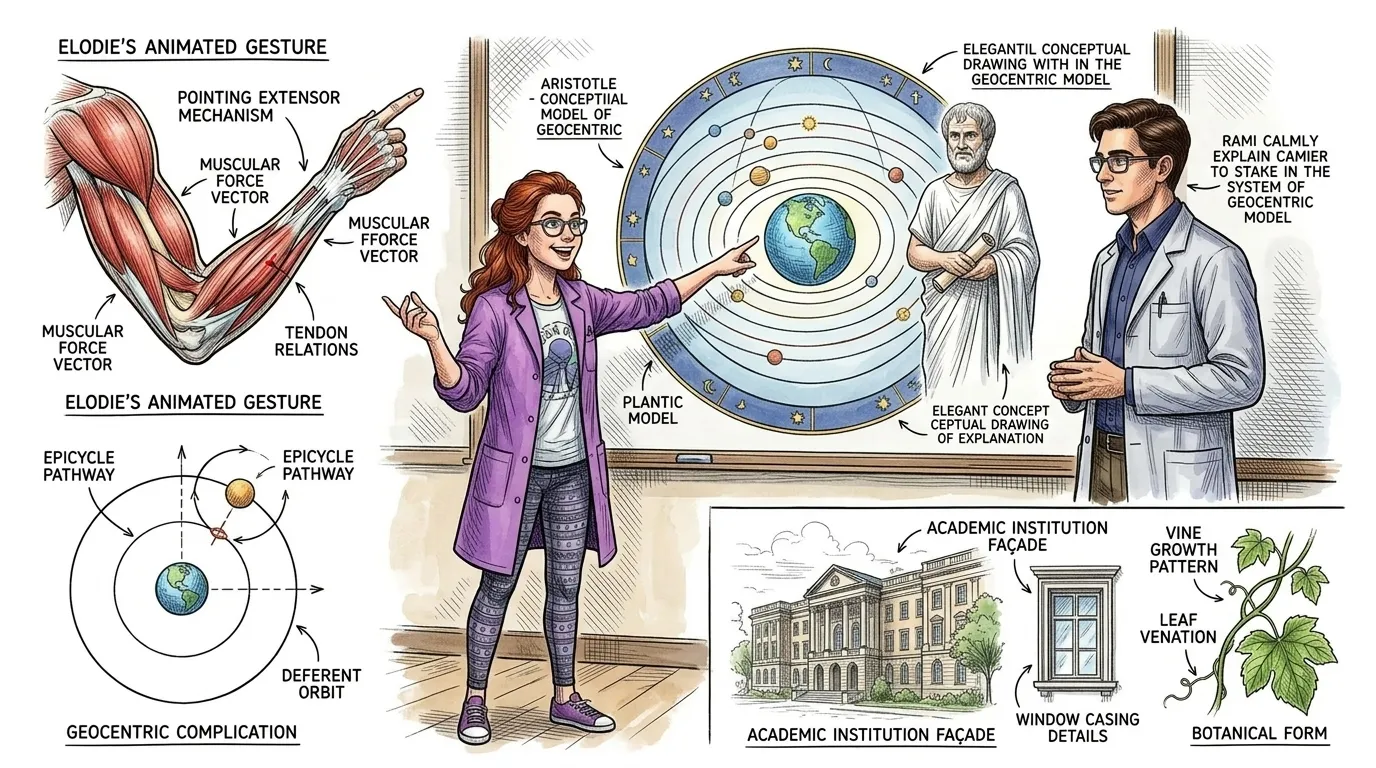
For nearly two millennia, the geocentric model, championed by Aristotle and formalized by Ptolemy, held sway. It placed Earth immovable at the universe's heart, encircled by perfect celestial spheres carrying the sun, moon, planets, and stars.\n\n""It's fascinating how entrenched the geocentric view was," Elodie commented, pointing to a diagram. "Earth at the center, everything else revolving around us." Rami clarified, "And for good reason, Elodie. It aligned with immediate human experience and philosophical principles. As the ancient Greek philosopher Aristotle argued, if Earth moved, we should feel it, and objects thrown upwards should not fall back in the same spot.""
Page 3
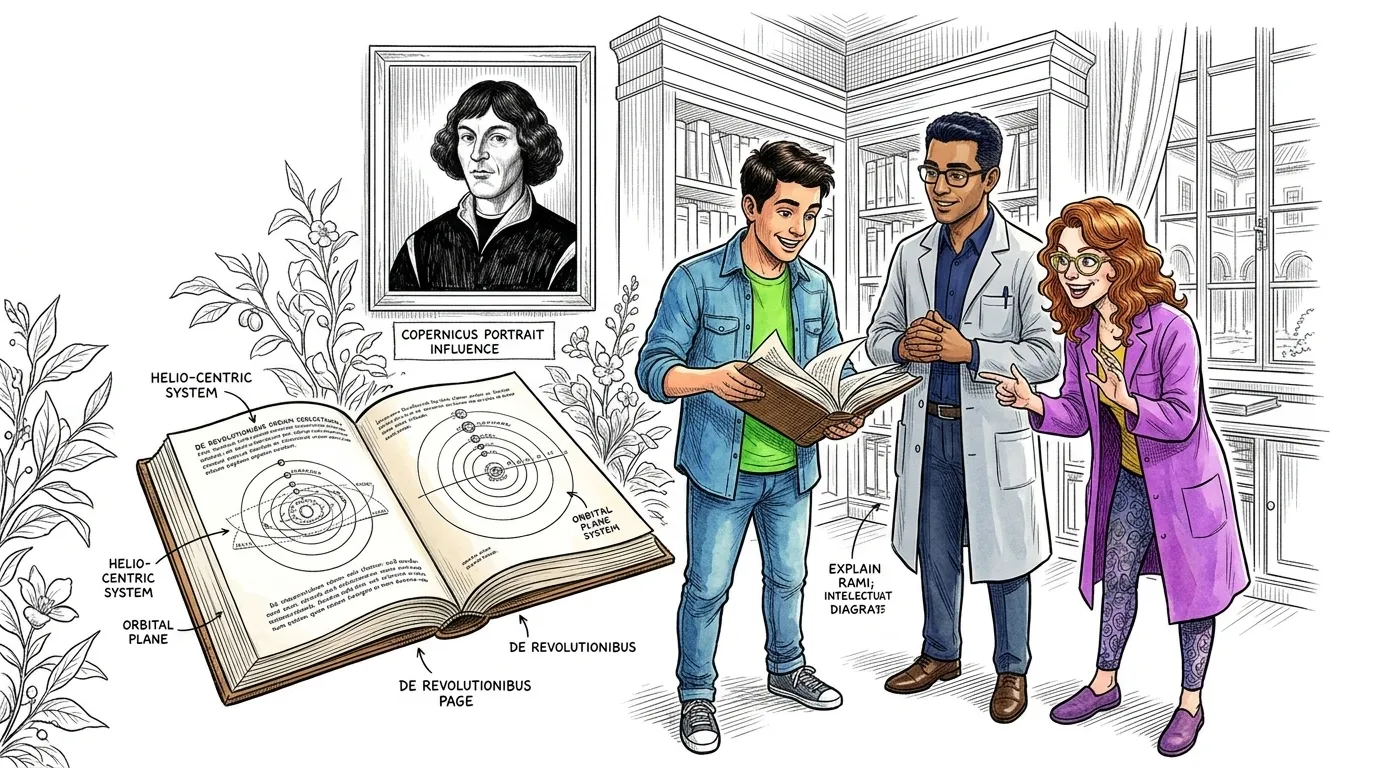
Nicolaus Copernicus, in the 16th century, dared to challenge this paradigm, proposing a heliocentric universe where Earth and other planets orbited the Sun. His model, however, lacked definitive observational proof.\n\n""So, Copernicus put the Sun at the center, but it was still mostly a mathematical idea, wasn't it?" Sami asked, flipping through a replica of 'De revolutionibus orbium coelestium'. Rami explained, "Exactly, Sami. Copernicus's model elegantly solved some planetary motion puzzles, but it clashed with common sense and lacked empirical validation visible to the naked eye. It was a revolutionary theory, but one without immediate, undeniable evidence." Elodie interjected, "So people believed what they could see and feel, not just smart math!""
Page 4
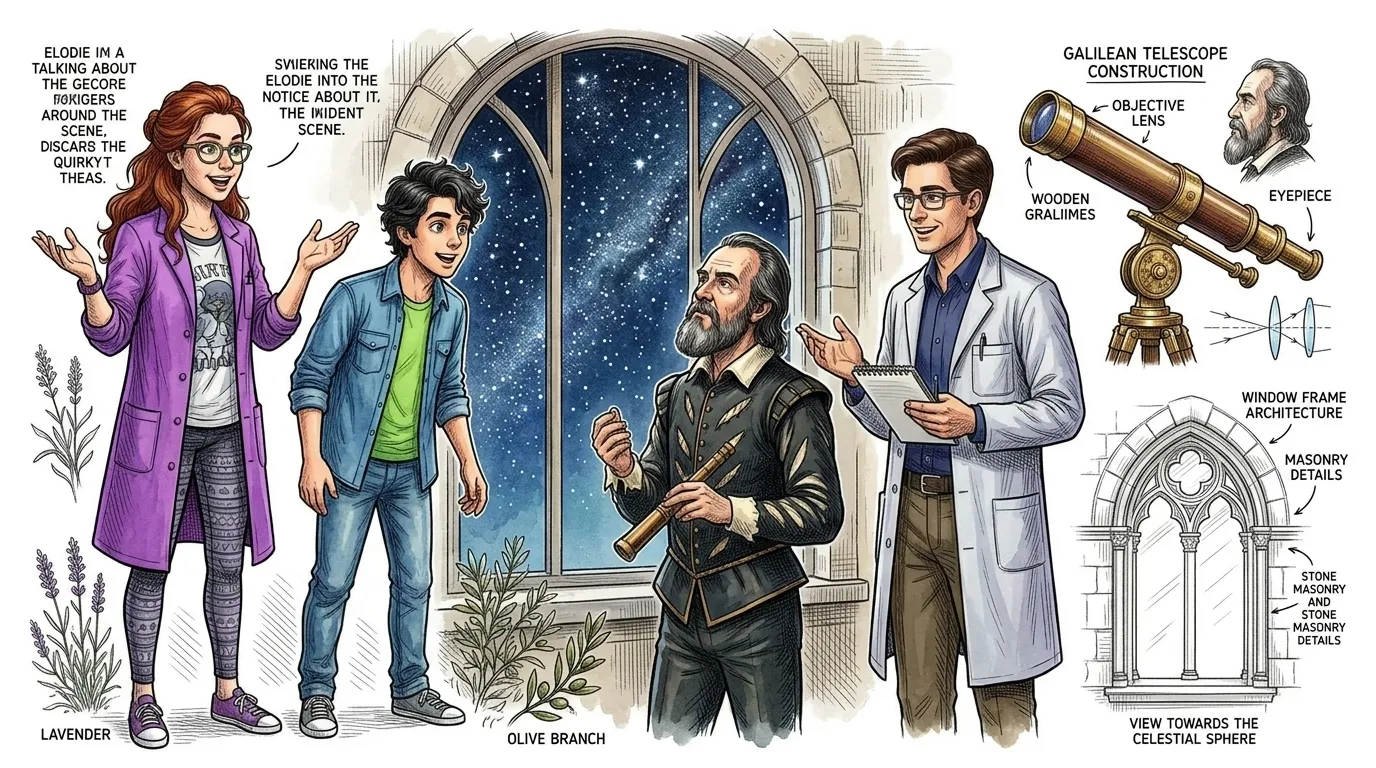
Galileo Galilei, hearing of a Dutch 'perspective glass', quickly built his own superior telescopes. He turned them not to distant ships, but to the heavens, initiating a new era of observational astronomy.\n\n""Imagine, simply improving a spyglass, then pointing it at the night sky!" Elodie exclaimed, her hands gesturing excitedly. Sami added, "And what he saw fundamentally changed everything, proving Copernicus right. No longer just a theory, but undeniable proof from the stars themselves." Rami clarified, "His genius wasn't just in building better instruments, but in applying them with rigorous scientific method and publishing his findings, ensuring they couldn't be ignored.""
Page 5
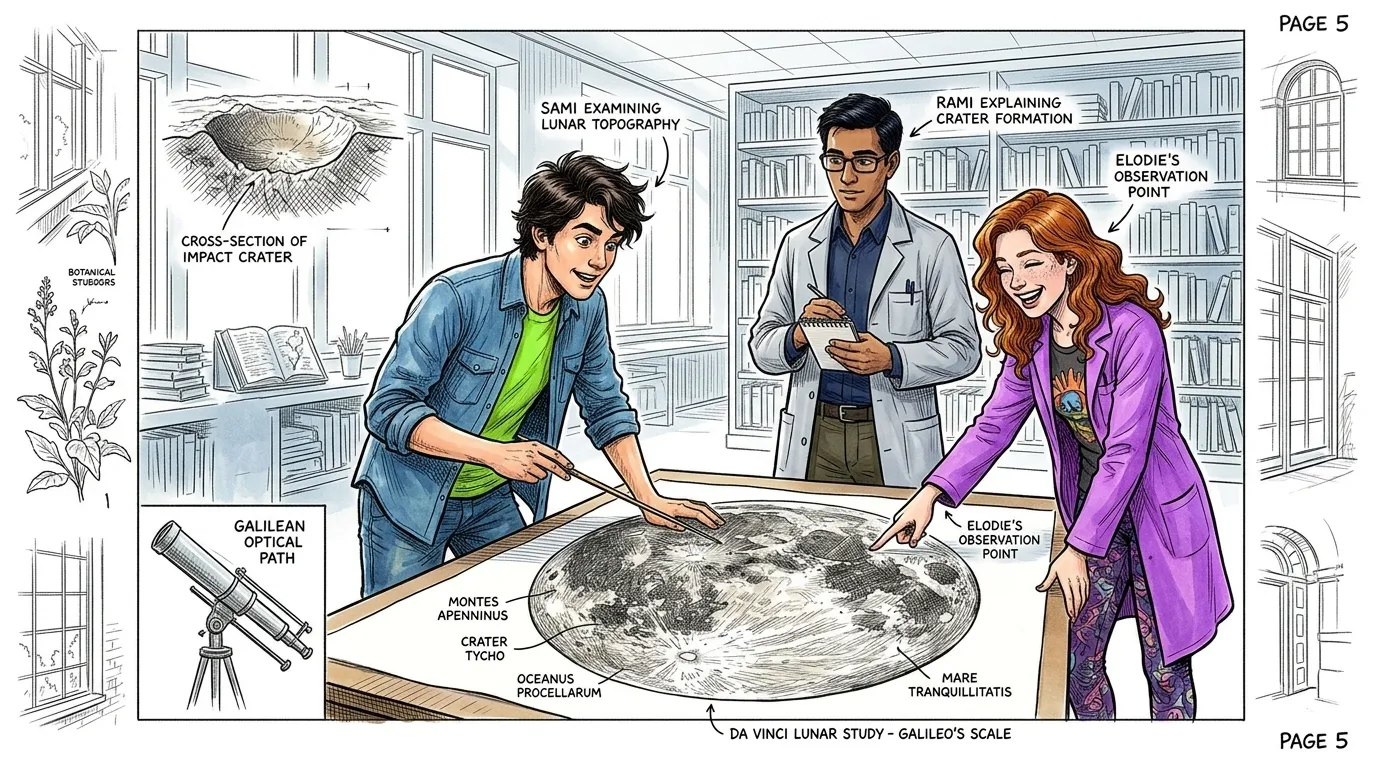
Galileo's telescopic observations of the Moon revealed a landscape of mountains, valleys, and craters, shattering the ancient belief that celestial bodies were perfect, unblemished spheres.\n\n""This is incredible," Sami murmured, examining a detailed drawing of the Moon. "He saw shadows, peaks, and depressions! Not a smooth, perfect orb at all." Rami explained, "Before Galileo, the Moon was thought to be a pristine, ethereal body. His observations, meticulously documented in 'Sidereus Nuncius', showed it was a world like Earth, irregular and rugged." Elodie giggled, "So the Moon has bumps and dimples, just like us!""
Page 6
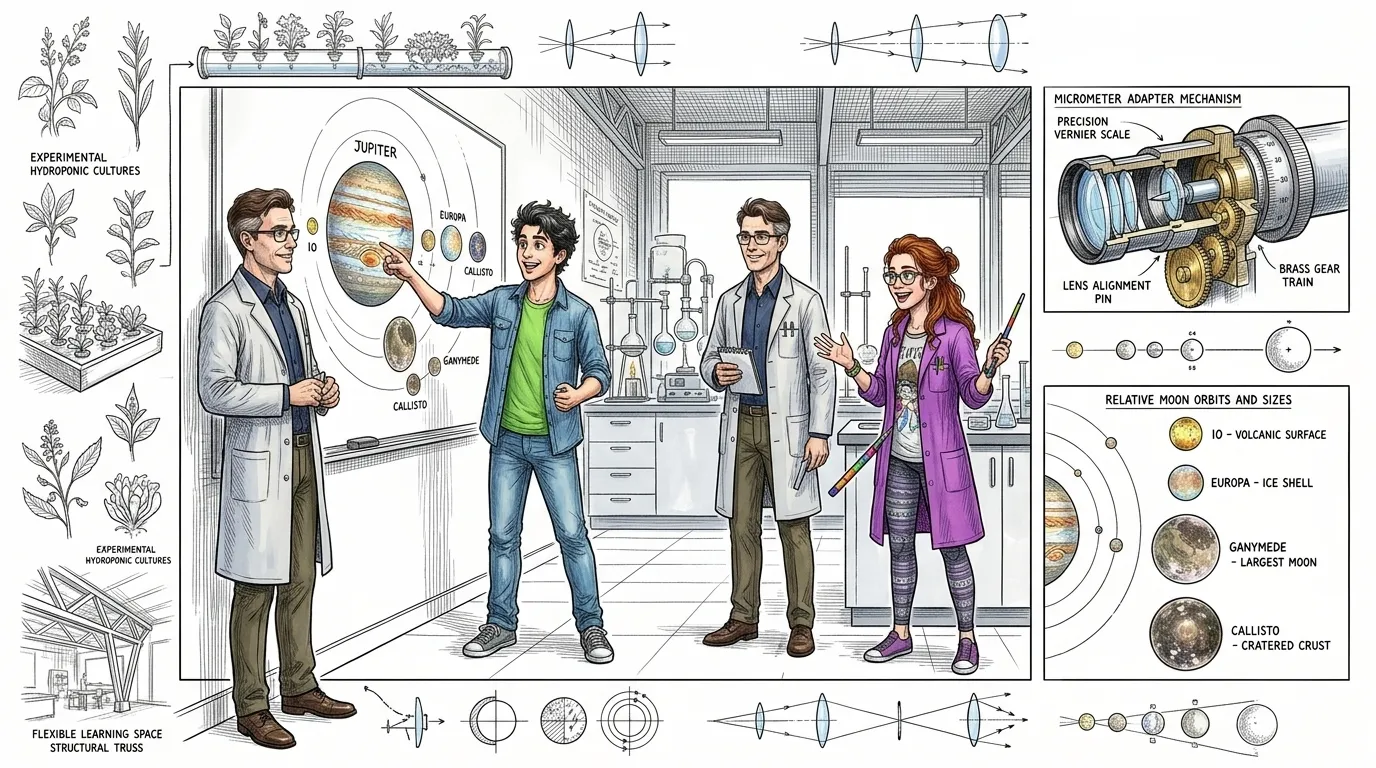
Perhaps his most profound discovery was the four celestial bodies orbiting Jupiter. This observation provided irrefutable proof that not everything revolved around Earth, offering a powerful analog for the heliocentric model.\n\n""This is the real game-changer," Sami stated with conviction, gesturing towards a diagram of Jupiter and its moons. "Seeing moons orbit Jupiter directly proves that a large body can have smaller ones revolving around it, not Earth." Rami added, "It's a 'miniature solar system' in action, directly visible! Before this, the dominant belief required everything to circle Earth, leaving no room for such independent celestial mechanics." Elodie chimed in, "So Jupiter has its own little family!""
Page 7
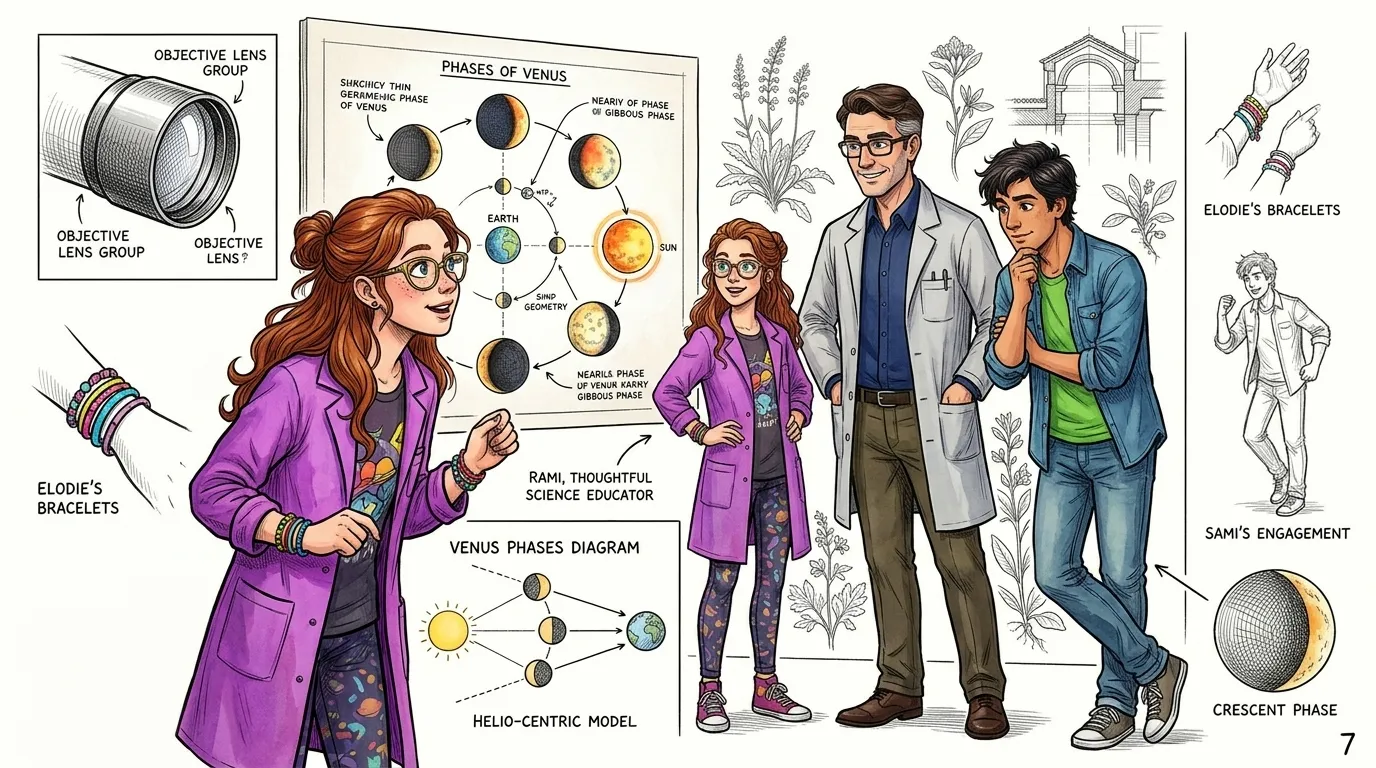
Further evidence against the geocentric model came from Venus. Galileo observed that Venus exhibited phases similar to the Moon, a phenomenon only explicable if Venus orbited the Sun.\n\n""The phases of Venus were another nail in the coffin for the geocentric model, weren't they?" Elodie inquired, looking at a diagram showing Venus's crescent and gibbous phases. Rami confirmed, "Absolutely, Elodie. In the Ptolemaic system, Venus, always between Earth and the Sun, could only show limited crescent phases. Galileo's telescopic view of a nearly full Venus was irrefutable. It unequivocally proved Venus orbited the Sun, not Earth." Sami mused, "So, it was one observation after another, chipping away at the old beliefs.""
Page 8
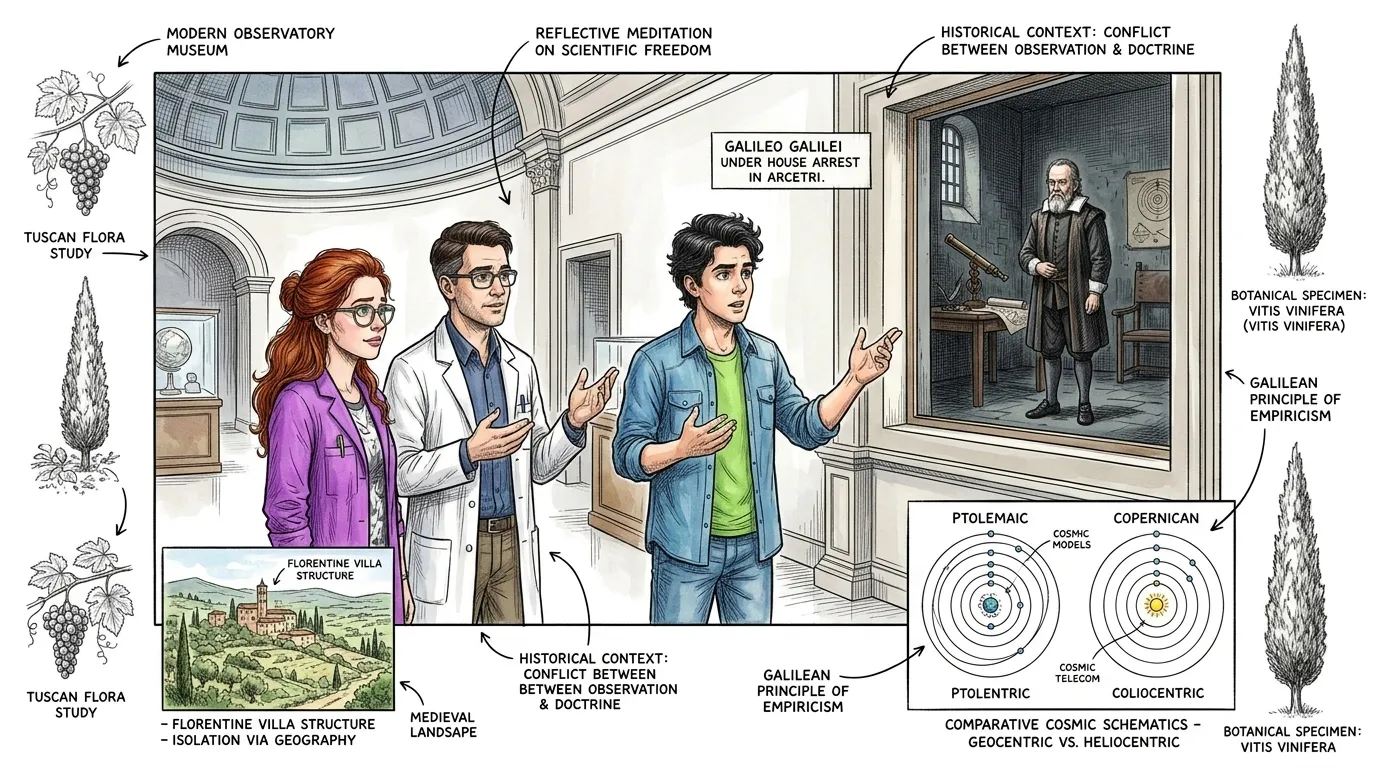
Galileo's scientific triumphs, however, clashed with the prevailing religious and intellectual doctrines of his time. His outspoken advocacy for the Copernican system led to his infamous trial by the Roman Inquisition in 1633.\n\n""Despite all his evidence, Galileo was put on trial for his scientific beliefs," Elodie observed sadly. Sami added, "And forced to recant his findings. It's hard to imagine science being so dangerous." Rami reflected, "Indeed. Galileo's story reminds us how deeply ingrained belief systems can resist empirical truth. As Carl Sagan once said, 'Science is a way of thinking much more than it is a body of knowledge.' Galileo's struggle was precisely about changing that way of thinking.""
Page 9
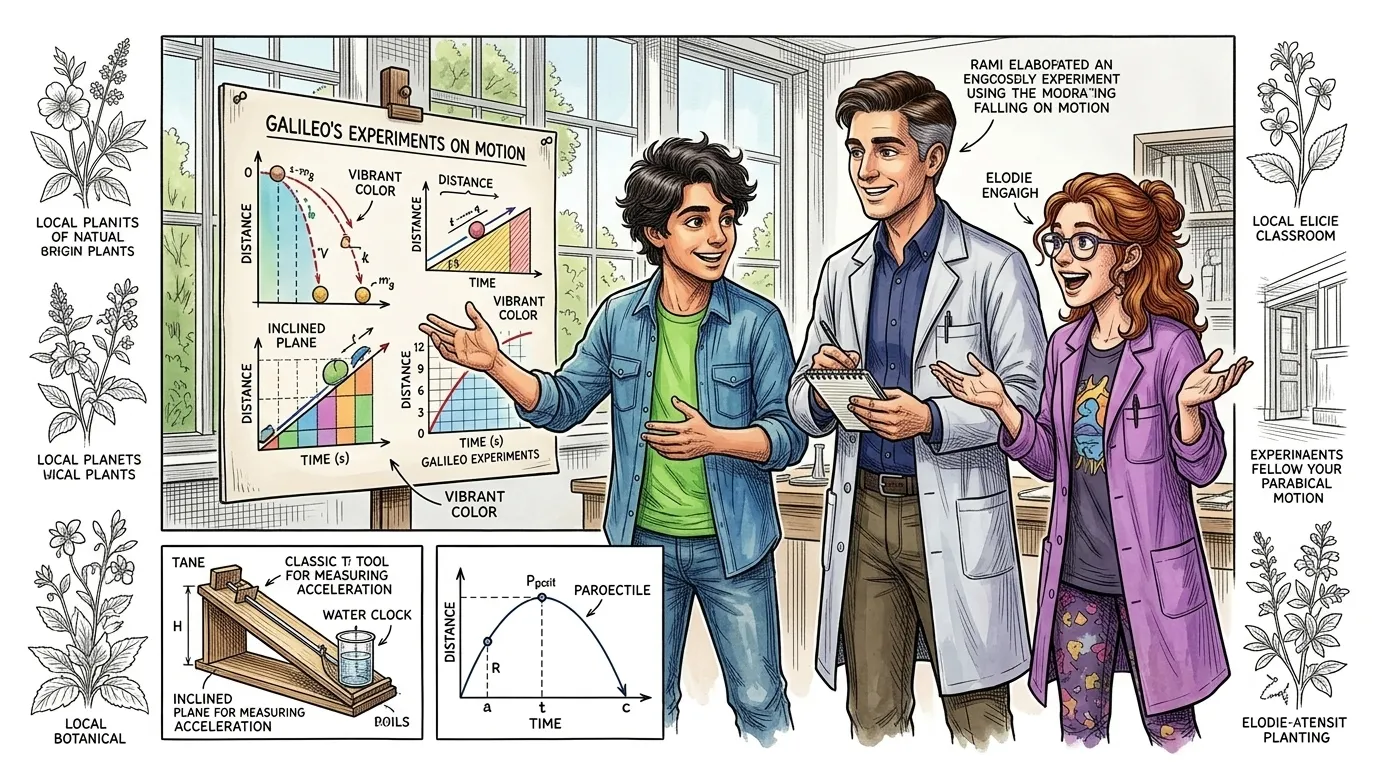
Despite his forced recantation and house arrest, Galileo continued his scientific work, notably on the principles of motion and mechanics. His foundational insights laid crucial groundwork for Isaac Newton's later synthesis of celestial and terrestrial physics.\n\n""Even under house arrest, he kept working on motion, not just astronomy," Sami noted, gesturing towards a diagram showing falling objects. Rami elaborated, "Yes, his work on inertia and acceleration, though often overshadowed by his astronomy, was equally revolutionary. It provided Newton with the framework needed to understand how gravity worked, bridging Earth and the cosmos." Elodie exclaimed, "So, without Galileo, maybe no apples falling and understanding gravity?""
Page 10
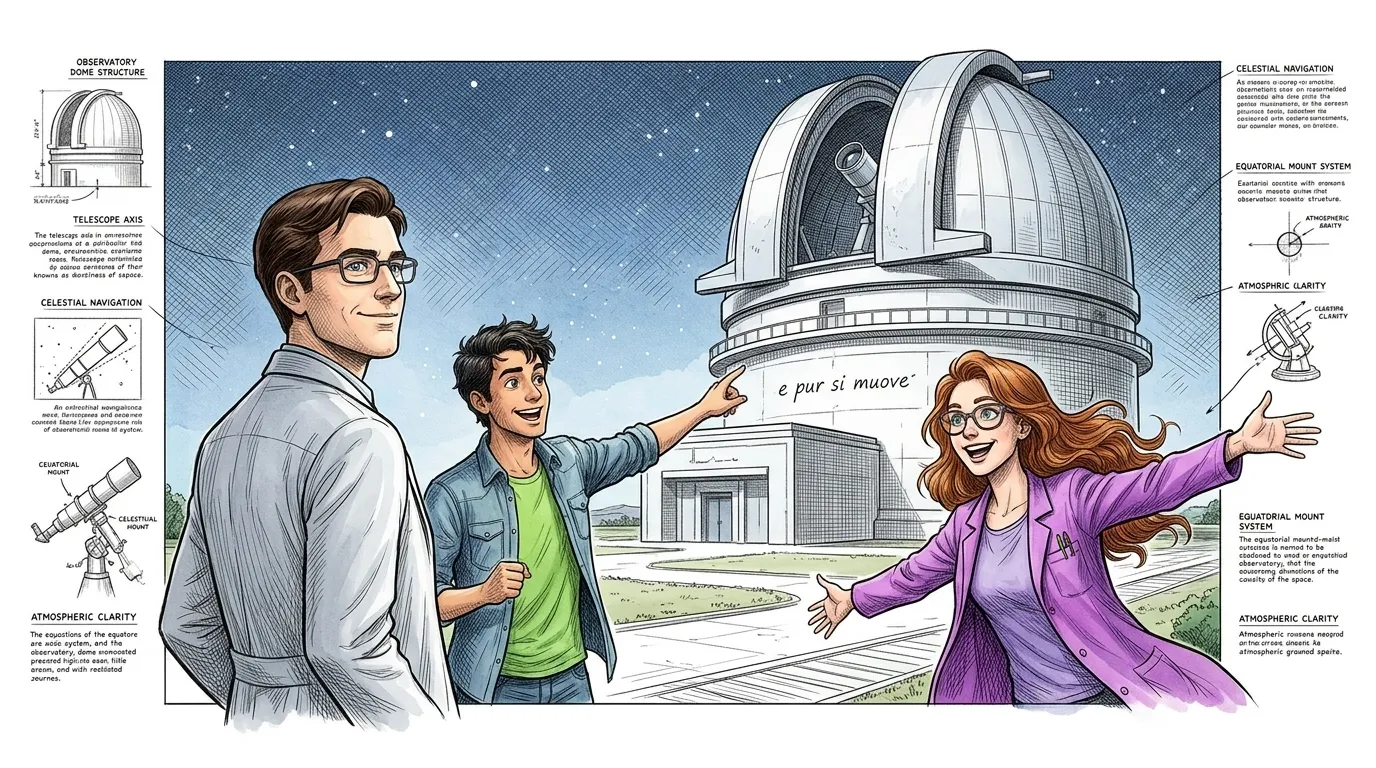
Galileo Galilei's legacy extends far beyond his astronomical observations. He championed empirical evidence, mathematical description of nature, and the scientific method itself, forever changing humanity's relationship with the universe.\n\n""His story is a powerful reminder that observation and evidence can challenge even the oldest beliefs," Rami concluded, looking out at a modern observatory. Sami added, "And that curiosity, even against immense pressure, can truly move the world." Elodie grinned, "Like 'e pur si muove' – and yet it moves!""
About this story
- Location: Global
- Audience: general readers
Questions and answers
Read Wonder Science on your phone
Wonder Science is available on Android. Get Wonder Science on Google Play.