Gerard t Hooft

Gerard t Hooft — an illustrated science story, set in Global. 10 illustrated pages, free to read on Wonder Science.

Gerard t Hooft — book cover — Wonder Science
Gerard t Hooft — an illustrated science story, set in Global. 10 illustrated pages, free to read on Wonder Science.

Page 1
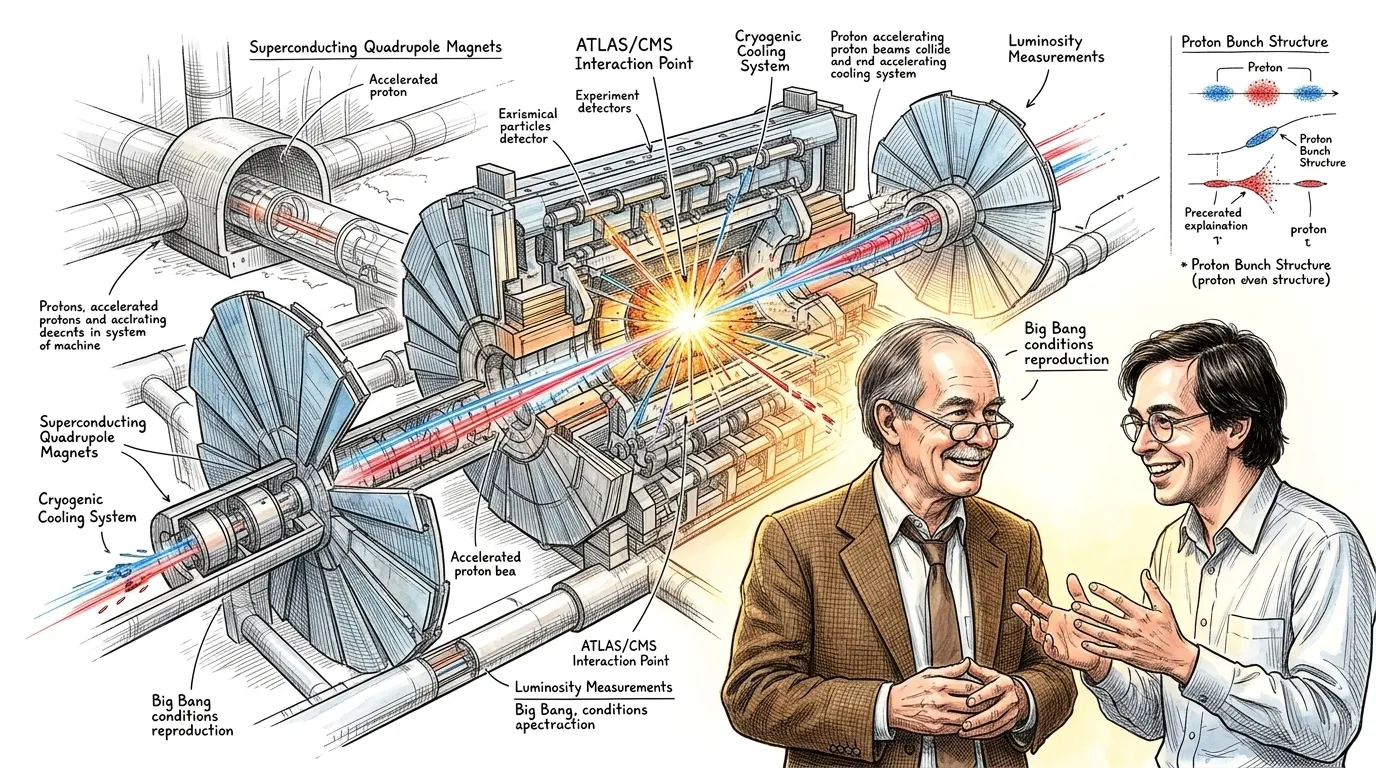
Deep beneath the Franco-Swiss border lies a technological marvel: the Large Hadron Collider. Here, particles are accelerated to near light speed, smashing into…
Deep beneath the Franco-Swiss border lies a technological marvel: the Large Hadron Collider. Here, particles are accelerated to near light speed, smashing into each other to recreate conditions moments after the Big Bang. This colossal experiment, driven by the quest for fundamental truths, stands as a testament to the predictive power of the Standard Model of particle physics.

Deep beneath the Franco-Swiss border lies a technological marvel: the Large Hadron Collider. Here, particles are accelerated to near light speed, smashing into each other to recreate conditions moments after the Big Bang. This colossal experiment, driven by the quest for fundamental truths, stands as a testament to the predictive power of the Standard Model of particle physics.

Page 2
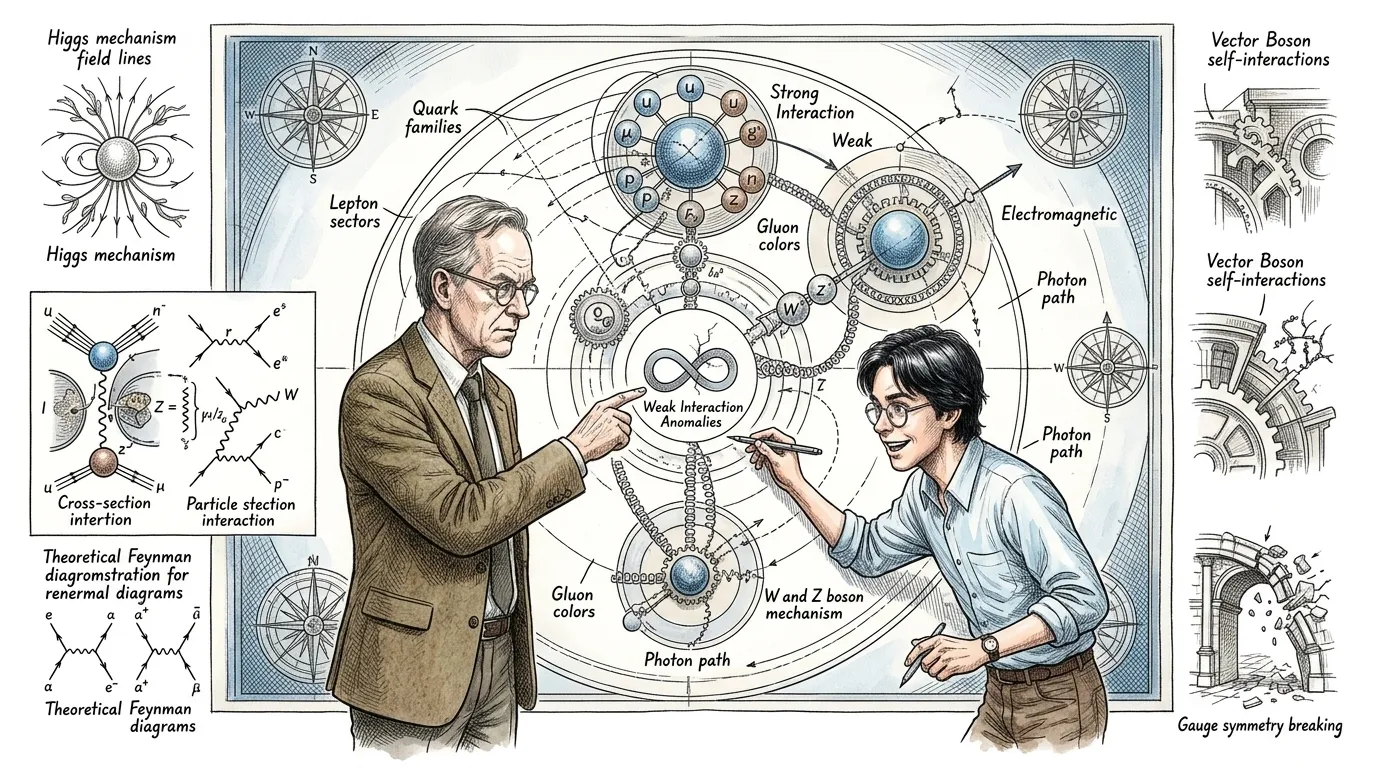
The Standard Model describes the universe's most fundamental building blocks and three of its four fundamental forces: the strong, weak, and electromagnetic…
The Standard Model describes the universe's most fundamental building blocks and three of its four fundamental forces: the strong, weak, and electromagnetic interactions. It is our most successful theory of matter, accurately predicting the existence and behavior of countless subatomic particles. Yet, for decades, a critical theoretical hurdle threatened its very foundation: mathematical inconsistencies.

The Standard Model describes the universe's most fundamental building blocks and three of its four fundamental forces: the strong, weak, and electromagnetic interactions. It is our most successful theory of matter, accurately predicting the existence and behavior of countless subatomic particles. Yet, for decades, a critical theoretical hurdle threatened its very foundation: mathematical inconsistencies.

Page 3
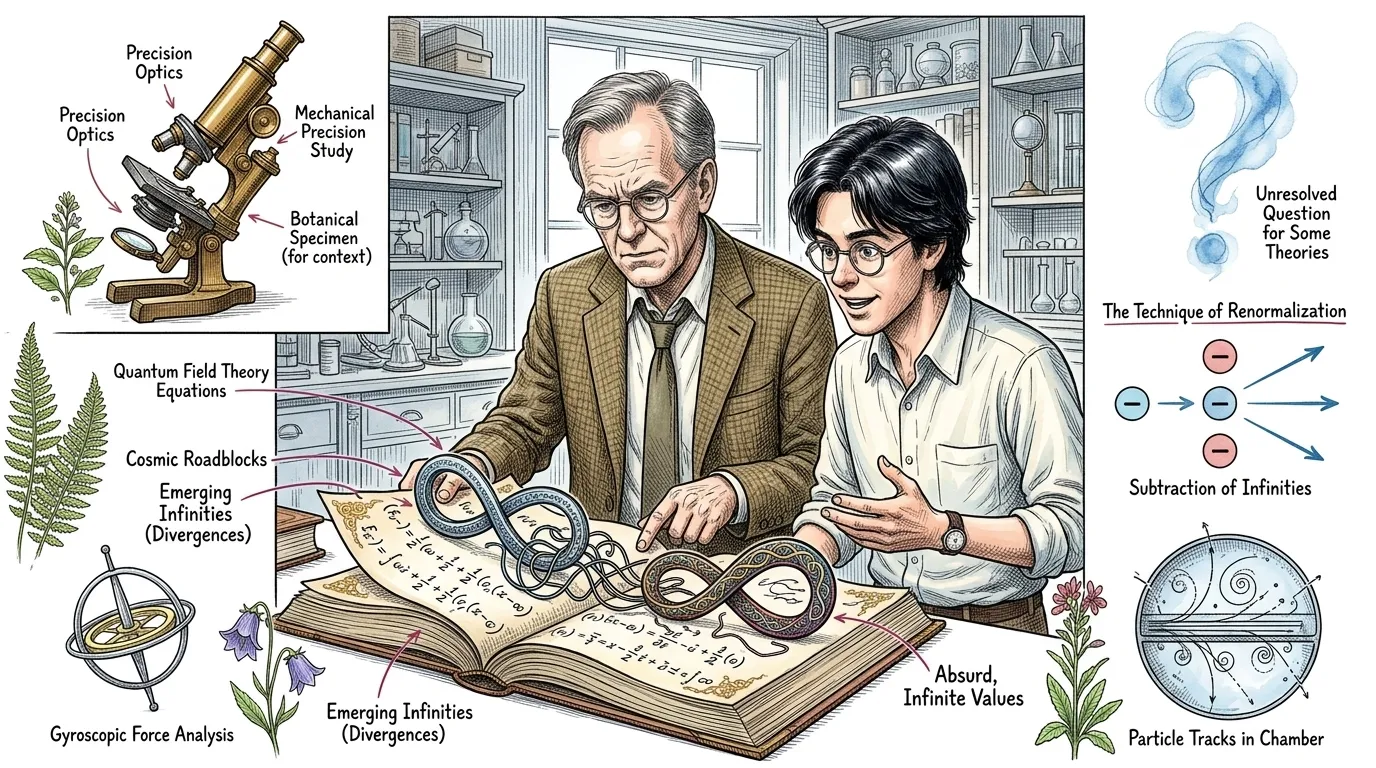
Early quantum field theories, while powerful, often produced absurd, infinite values when calculating particle interactions.
Early quantum field theories, while powerful, often produced absurd, infinite values when calculating particle interactions. These 'infinities' were like cosmic roadblocks, making predictions impossible. Physicists employed a technique called 'renormalization' to subtract these infinities, a method that worked for some theories but lacked a rigorous mathematical proof for others, leaving a cloud of doubt over their true consistency.

Early quantum field theories, while powerful, often produced absurd, infinite values when calculating particle interactions. These 'infinities' were like cosmic roadblocks, making predictions impossible. Physicists employed a technique called 'renormalization' to subtract these infinities, a method that worked for some theories but lacked a rigorous mathematical proof for others, leaving a cloud of doubt over their true consistency.

Page 4
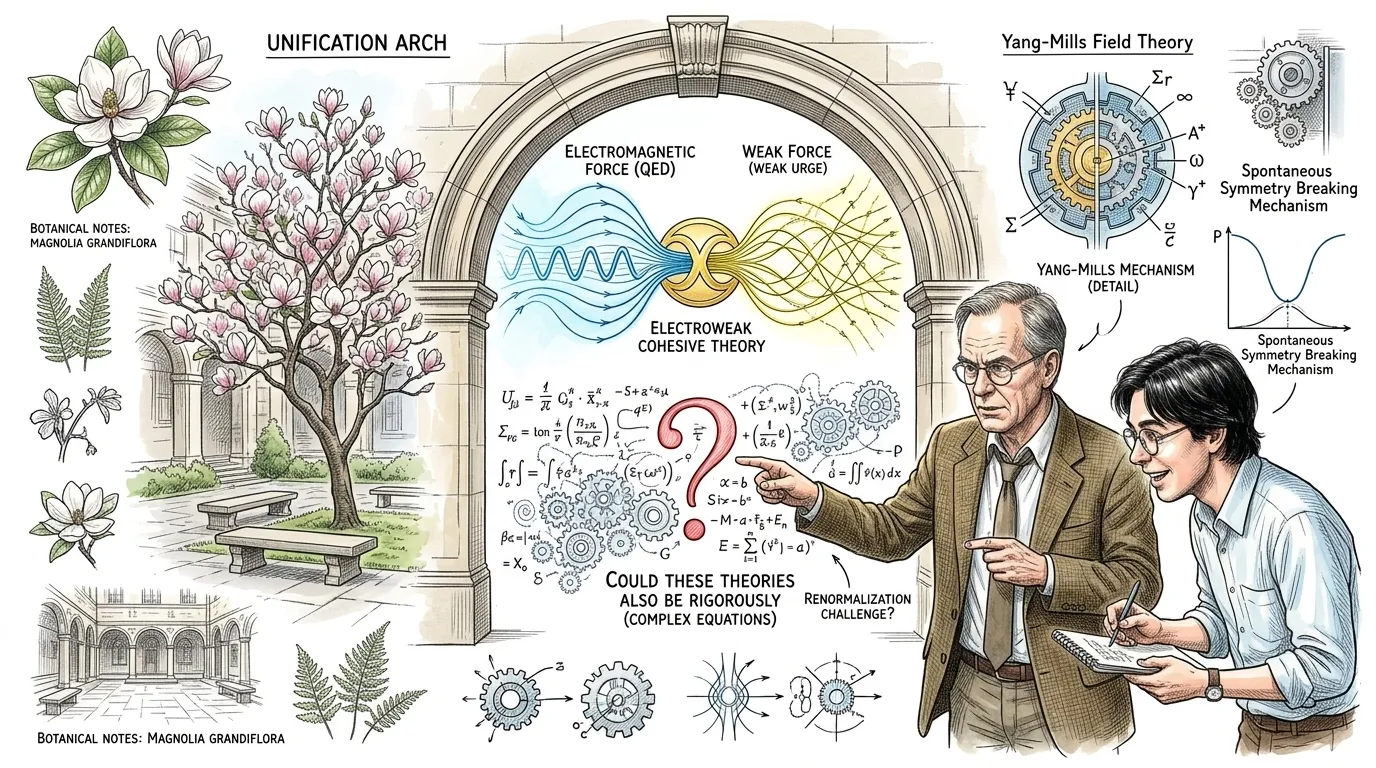
A cornerstone of the Standard Model was the electroweak theory, unifying the electromagnetic and weak forces into a single interaction.
A cornerstone of the Standard Model was the electroweak theory, unifying the electromagnetic and weak forces into a single interaction. This 'gauge theory' promised a grander understanding, but it belonged to a class known as 'non-abelian' gauge theories. The crucial question lingered: could these complex theories also be rigorously renormalized, making them consistently predictive and physically valid?

A cornerstone of the Standard Model was the electroweak theory, unifying the electromagnetic and weak forces into a single interaction. This 'gauge theory' promised a grander understanding, but it belonged to a class known as 'non-abelian' gauge theories. The crucial question lingered: could these complex theories also be rigorously renormalized, making them consistently predictive and physically valid?

Page 5
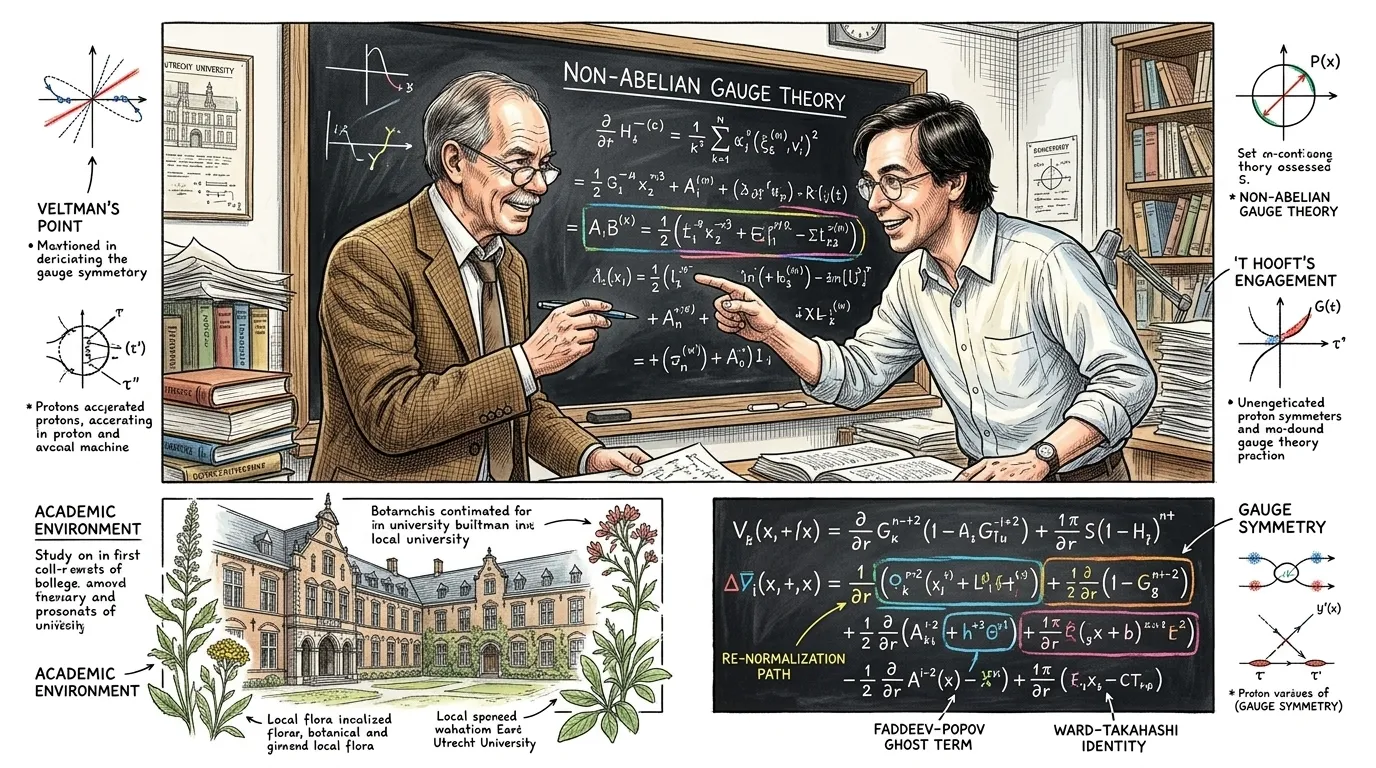
In the late 1960s and early 1970s, two Dutch physicists, Martinus Veltman and his doctoral student Gerard 't Hooft, embarked on this daunting challenge.
In the late 1960s and early 1970s, two Dutch physicists, Martinus Veltman and his doctoral student Gerard 't Hooft, embarked on this daunting challenge. Working at Utrecht University, they developed revolutionary techniques to tackle the complex calculations of non-abelian gauge theories. Their rigorous mathematical framework provided the unequivocal proof that these theories were, in fact, renormalizable.

In the late 1960s and early 1970s, two Dutch physicists, Martinus Veltman and his doctoral student Gerard 't Hooft, embarked on this daunting challenge. Working at Utrecht University, they developed revolutionary techniques to tackle the complex calculations of non-abelian gauge theories. Their rigorous mathematical framework provided the unequivocal proof that these theories were, in fact, renormalizable.

Page 6
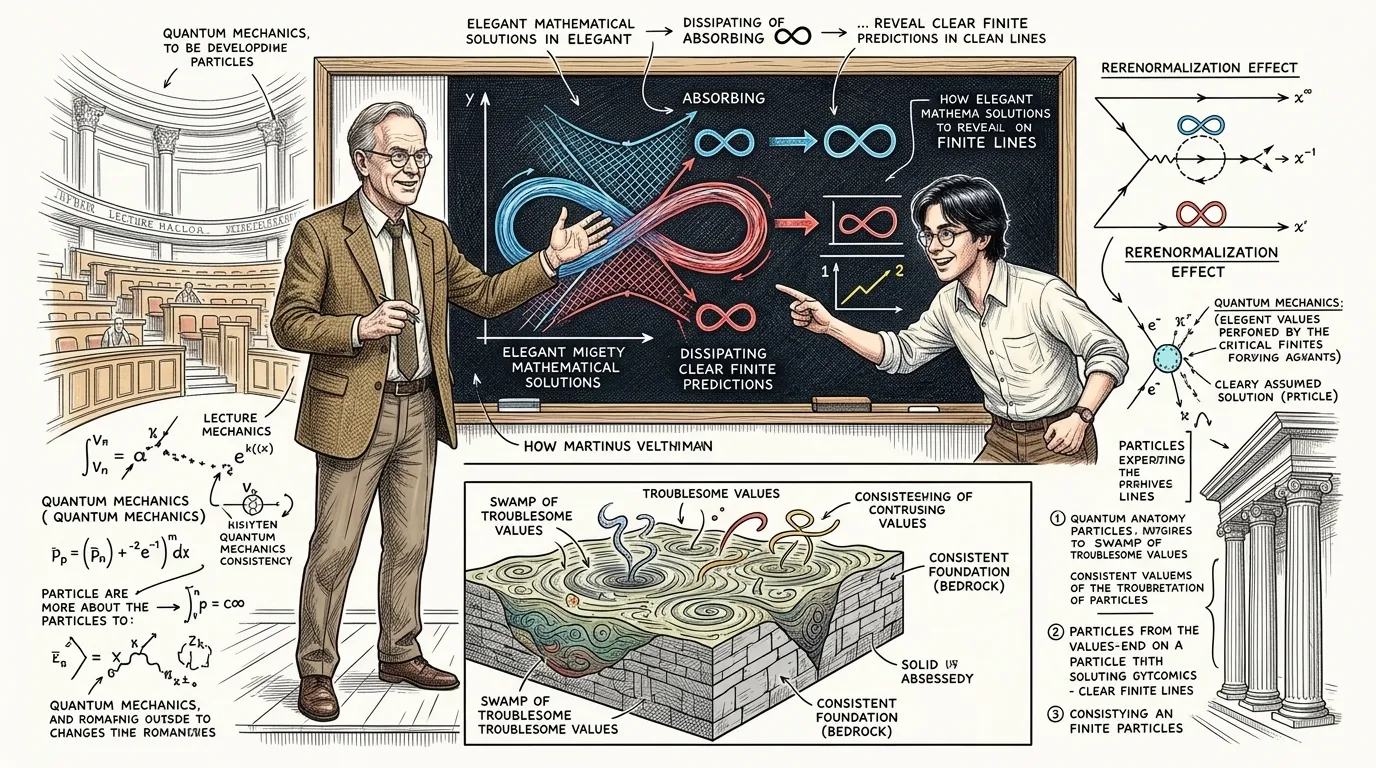
Their work demonstrated that the troubling infinities could indeed be systematically removed from non-abelian gauge theories without violating fundamental…
Their work demonstrated that the troubling infinities could indeed be systematically removed from non-abelian gauge theories without violating fundamental principles. This wasn't merely a mathematical trick; it revealed a deep consistency within these theories, proving they could be used to make precise, finite predictions about particle masses and interactions. It was akin to finding the bedrock beneath a seemingly bottomless swamp.

Their work demonstrated that the troubling infinities could indeed be systematically removed from non-abelian gauge theories without violating fundamental principles. This wasn't merely a mathematical trick; it revealed a deep consistency within these theories, proving they could be used to make precise, finite predictions about particle masses and interactions. It was akin to finding the bedrock beneath a seemingly bottomless swamp.

Page 7
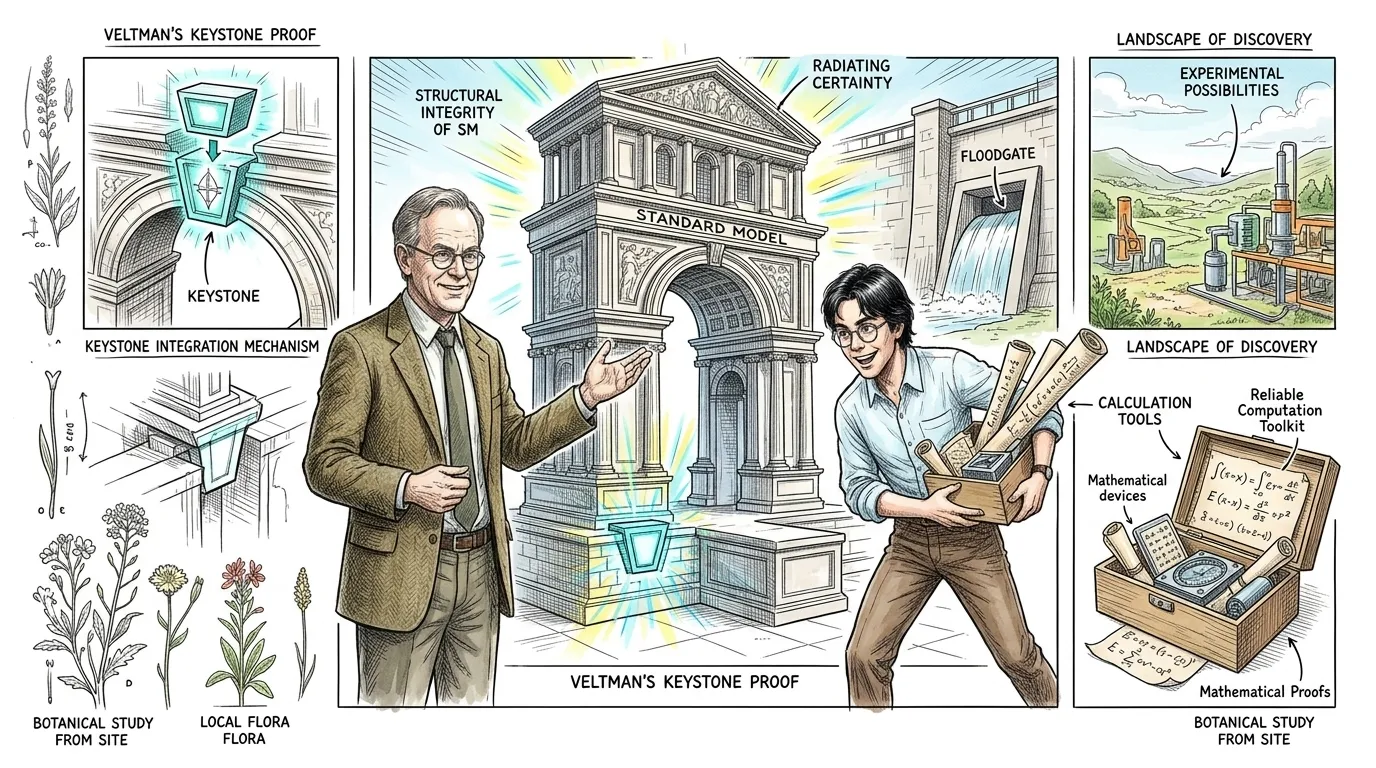
't Hooft and Veltman's proof validated the electroweak theory, providing the crucial theoretical underpinning for the Standard Model.
't Hooft and Veltman's proof validated the electroweak theory, providing the crucial theoretical underpinning for the Standard Model. It transformed a promising but uncertain theoretical framework into a robust, predictive scientific edifice. Suddenly, physicists had a reliable toolkit to calculate the properties of particles and the strengths of their interactions, opening the floodgates for experimental verification.

't Hooft and Veltman's proof validated the electroweak theory, providing the crucial theoretical underpinning for the Standard Model. It transformed a promising but uncertain theoretical framework into a robust, predictive scientific edifice. Suddenly, physicists had a reliable toolkit to calculate the properties of particles and the strengths of their interactions, opening the floodgates for experimental verification.

Page 8
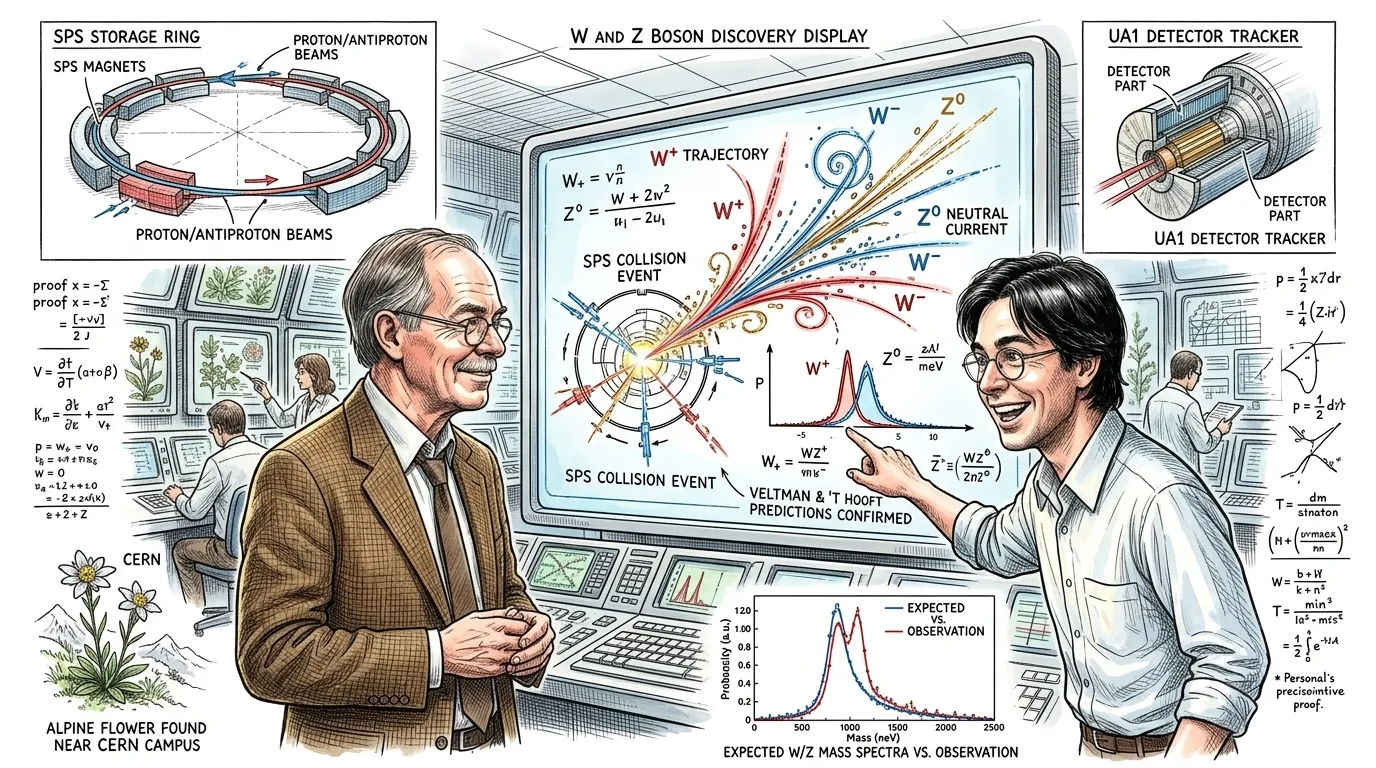
Armed with this new theoretical certainty, experimentalists at CERN's Super Proton Synchrotron embarked on a dedicated search.
Armed with this new theoretical certainty, experimentalists at CERN's Super Proton Synchrotron embarked on a dedicated search. In 1983, their efforts paid off spectacularly with the discovery of the W and Z bosons, the carriers of the weak nuclear force. These particles, predicted by the electroweak theory and now precisely calculable thanks to 't Hooft and Veltman, had finally been observed, cementing the Standard Model's accuracy.

Armed with this new theoretical certainty, experimentalists at CERN's Super Proton Synchrotron embarked on a dedicated search. In 1983, their efforts paid off spectacularly with the discovery of the W and Z bosons, the carriers of the weak nuclear force. These particles, predicted by the electroweak theory and now precisely calculable thanks to 't Hooft and Veltman, had finally been observed, cementing the Standard Model's accuracy.

Page 9
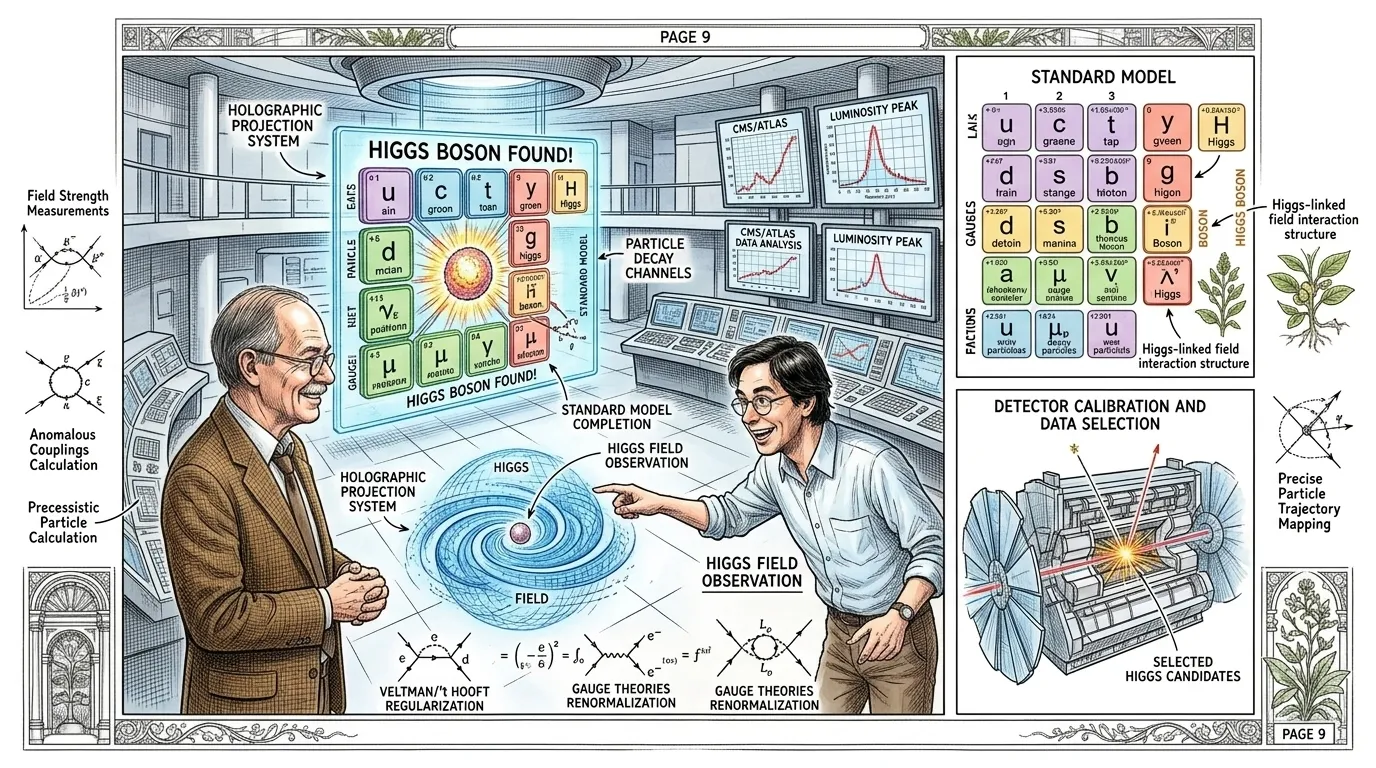
The ultimate triumph arrived decades later. In 2012, at the Large Hadron Collider, the Higgs boson was discovered, providing the final piece of the Standard…
The ultimate triumph arrived decades later. In 2012, at the Large Hadron Collider, the Higgs boson was discovered, providing the final piece of the Standard Model puzzle. Its existence, crucial for explaining why fundamental particles have mass, was entirely consistent with the electroweak theory whose calculability Gerard 't Hooft and Martinus Veltman had so brilliantly proven. Their work made this monumental discovery possible.

The ultimate triumph arrived decades later. In 2012, at the Large Hadron Collider, the Higgs boson was discovered, providing the final piece of the Standard Model puzzle. Its existence, crucial for explaining why fundamental particles have mass, was entirely consistent with the electroweak theory whose calculability Gerard 't Hooft and Martinus Veltman had so brilliantly proven. Their work made this monumental discovery possible.

Page 10
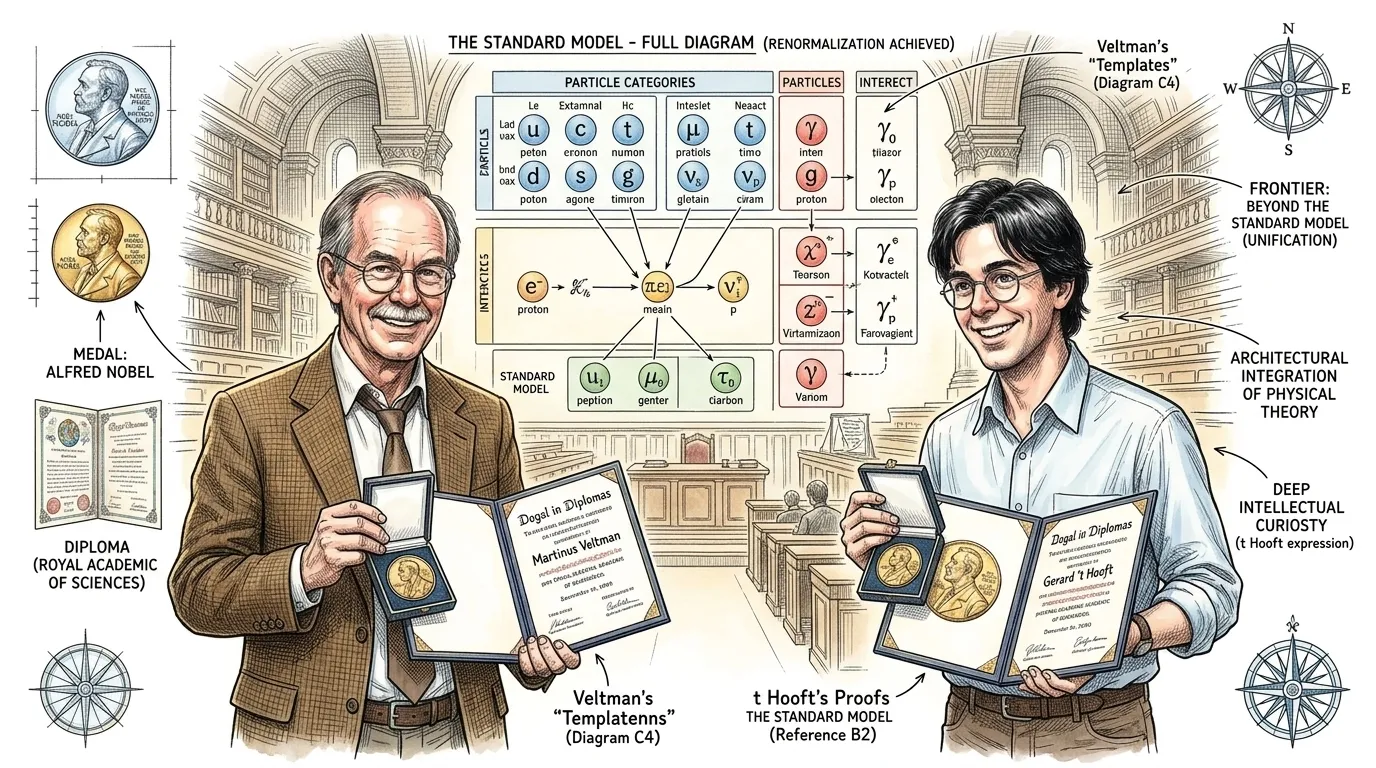
Gerard 't Hooft and Martinus Veltman were awarded the Nobel Prize in Physics in 1999 for their foundational contributions.
Gerard 't Hooft and Martinus Veltman were awarded the Nobel Prize in Physics in 1999 for their foundational contributions. Their mathematical rigor not only solidified the Standard Model, enabling precision tests of electroweak theory, but also provided a template for understanding quantum field theories in general.

Gerard 't Hooft and Martinus Veltman were awarded the Nobel Prize in Physics in 1999 for their foundational contributions. Their mathematical rigor not only solidified the Standard Model, enabling precision tests of electroweak theory, but also provided a template for understanding quantum field theories in general. While the Standard Model remains incredibly successful, their legacy continues to inspire the search for new physics beyond its boundaries, pushing the frontiers of our understanding of the universe.

About this story

  • Location: Global
  • Audience: general readers

Questions and answers

Questions and answers about Gerard t Hooft

Read Wonder Science on your phone

Wonder Science is available on Android. Get Wonder Science on Google Play.

More Wonder Science stories

All Wonder Science stories · Open the library