Gerty Cori
Gerty Cori — an illustrated science story, set in Global. 10 illustrated pages, free to read on Wonder Science.
Page 1

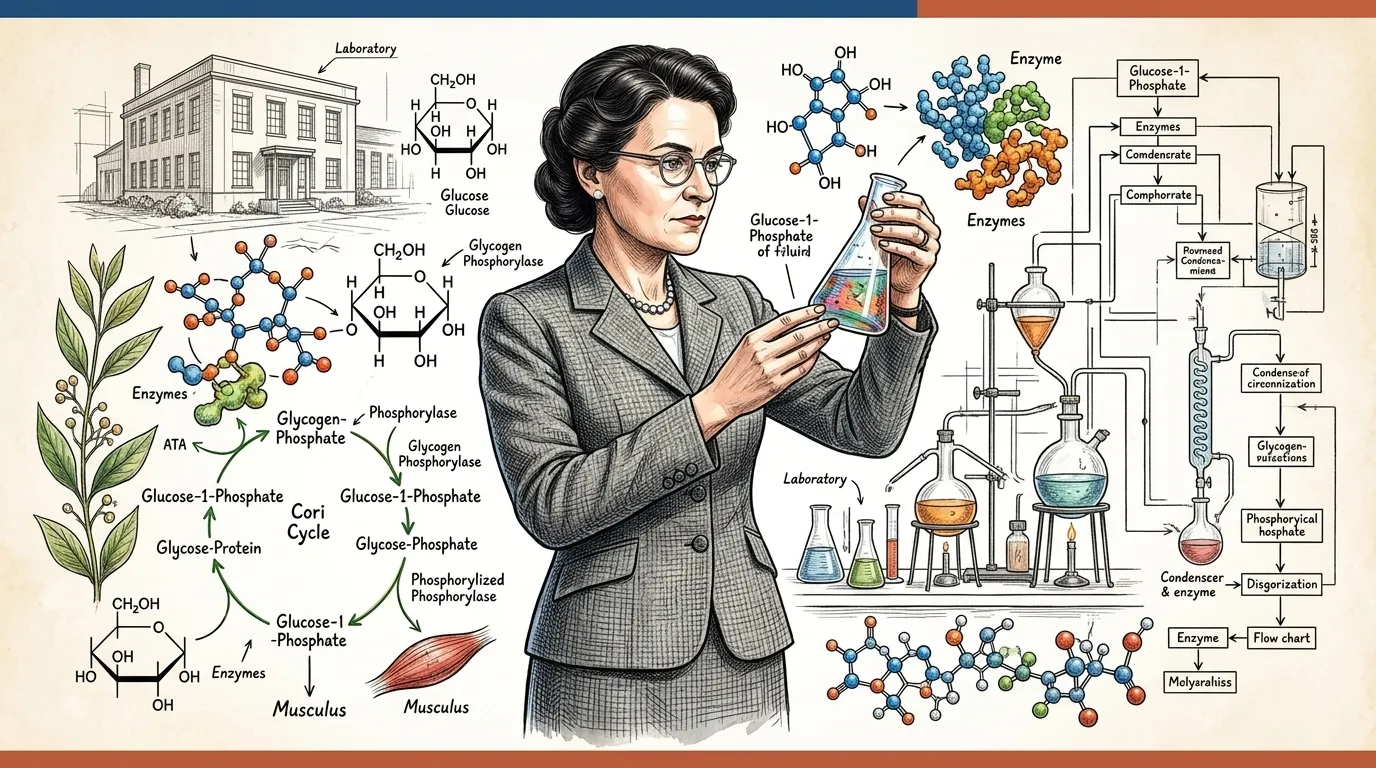
In 1947, a paradigm-shifting revelation emerged from the laboratories of Washington University in St. Louis. Gerty Cori, alongside her husband Carl, uncovered the intricate metabolic pathway by which the body processes and recycles glucose, a fundamental energy source. This groundbreaking work, known today as the Cori cycle, earned them a Nobel Prize in Physiology or Medicine, forever altering our understanding of biological energy conversion. Their meticulous research elucidated the dynamic interplay between muscle and liver, revealing how the body efficiently manages its fuel supply under varying physiological demands.
Page 2

At the heart of cellular life lies glucose, the primary fuel molecule. Our bodies store excess glucose as glycogen, a complex carbohydrate, primarily in the liver and muscles. For decades, scientists understood that muscles break down glycogen into glucose during activity, providing energy for contraction. However, the exact fate of certain byproducts and the rapid recovery of muscle energy reserves posed a significant biochemical enigma, hinting at a more sophisticated system at play than simple consumption.
Page 3

Intense muscle activity often leads to the accumulation of lactic acid, or lactate, a metabolic byproduct known to contribute to fatigue. Historically, lactate was viewed primarily as a waste product, signaling cellular distress. Yet, observations showed that lactate levels would eventually drop, and glycogen stores would replenish, often without equivalent dietary intake immediately following exertion. This suggested that lactate might not merely be discarded, but rather integrated into a larger, more efficient recycling process, a paradox that puzzled biochemists.
Page 4

The Cori's initial hypothesis challenged prevailing dogma: what if lactate, instead of being solely a metabolic dead-end, could be reconverted into glucose? This radical idea proposed a metabolic loop where the liver played a crucial role, not just in storing glucose, but in regenerating it from substances previously thought to be waste. Their experimental design focused on tracing the path of lactate, using tissue slices and later, animal models, to observe this potential conversion firsthand and identify the responsible enzymes.
Page 5

The first critical phase of the Cori cycle begins in the muscle, a process known as glycolysis. Here, glucose-6-phosphate, derived from glycogen, undergoes a series of enzymatic transformations. Through this pathway, a six-carbon glucose molecule is broken down into two molecules of three-carbon pyruvate. Under anaerobic conditions, or during intense exertion when oxygen supply is limited, pyruvate is then converted into lactate, releasing a small but immediate burst of energy vital for muscle contraction.
Page 6

The generated lactate doesn't simply linger; it travels via the bloodstream to the liver. It is in the liver that the second, equally crucial phase of the Cori cycle unfolds: gluconeogenesis. This is essentially the reverse of glycolysis, where lactate is converted back into pyruvate, and then through a series of distinct enzymatic steps, into glucose. The liver then releases this newly synthesized glucose back into the bloodstream, making it available for energy to other tissues, including the very muscles that initially produced the lactate.
Page 7

The Cori cycle, therefore, represents an elegant and highly efficient metabolic partnership between muscle and liver. Muscles, through glycolysis, generate rapid energy and lactate, while the liver, through gluconeogenesis, recycles that lactate back into glucose. This allows muscles to continue functioning during intense bursts of activity, even when oxygen is scarce, by outsourcing the glucose regeneration to the liver. It's a testament to the body's remarkable capacity for maintaining energy homeostasis under demanding physiological conditions, showcasing a beautiful biological efficiency.
Page 8

The discovery of the Cori cycle fundamentally transformed sports physiology and exercise science. Coaches and athletes could now better understand muscle fatigue and recovery, optimizing training regimes and nutritional strategies. It clarified why 'hitting the wall' occurs during endurance events, as glycogen stores deplete and lactate accumulates, and how strategic carbohydrate loading can delay this. Furthermore, it provided a framework for understanding conditions where this cycle might be disrupted, impacting athletic performance and general well-being.
Page 9

Beyond exercise, the Cori cycle has profound implications for understanding various metabolic diseases. Disorders affecting enzymes crucial to glycolysis or gluconeogenesis can severely impair the body's ability to manage glucose, leading to conditions like glycogen storage diseases or certain forms of lactic acidosis. The Coris' work laid essential groundwork for diabetes research, highlighting the liver's role in glucose regulation and informing therapeutic approaches aimed at maintaining metabolic balance. Their insights continue to guide contemporary medical research into metabolic health.
Page 10

Gerty Cori's relentless pursuit of scientific truth, often in the face of gender-based barriers in academia, established her as a titan of biochemistry. Her work, alongside Carl's, demystified fundamental processes of energy metabolism, providing the intellectual scaffolding for countless subsequent discoveries. The Cori cycle remains a cornerstone of biochemistry and physiology, taught in medical schools and research institutions worldwide. Her legacy is not only in the elucidation of a critical biological pathway but also in inspiring generations of scientists, particularly women, to push the boundaries of knowledge and challenge conventional wisdom in the pursuit of scientific understanding.
About this story
- Location: Global
- Audience: general readers
Questions and answers
Read Wonder Science on your phone
Wonder Science is available on Android. Get Wonder Science on Google Play.