Giovanni Cassini
Giovanni Cassini — an illustrated science story, set in Global. 10 illustrated pages, free to read on Wonder Science.
Page 1

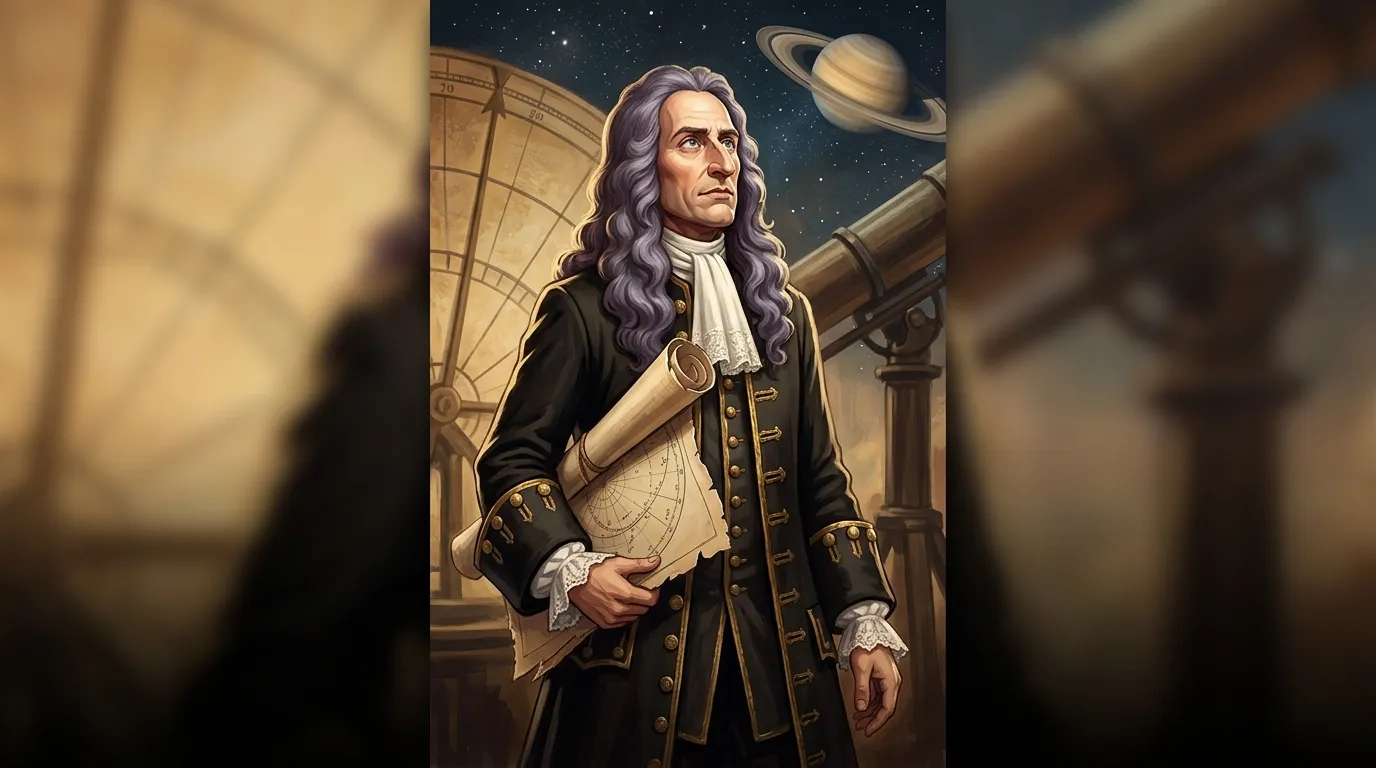
In the annals of cosmic discovery, few moments resonate with the profound shift in human understanding as Giovanni Cassini's detailed observations of Saturn. From the nascent Paris Observatory in the late 17th century, a new era of planetary science dawned, revealing the intricate dance of moons and the enigmatic structure of rings that had previously defied comprehension. Cassini's meticulous work not only reshaped our vision of the solar system but laid foundational principles for future exploration.\n\n Fact: Cassini's Revelations: Saturn's Moons and Rings
Page 2
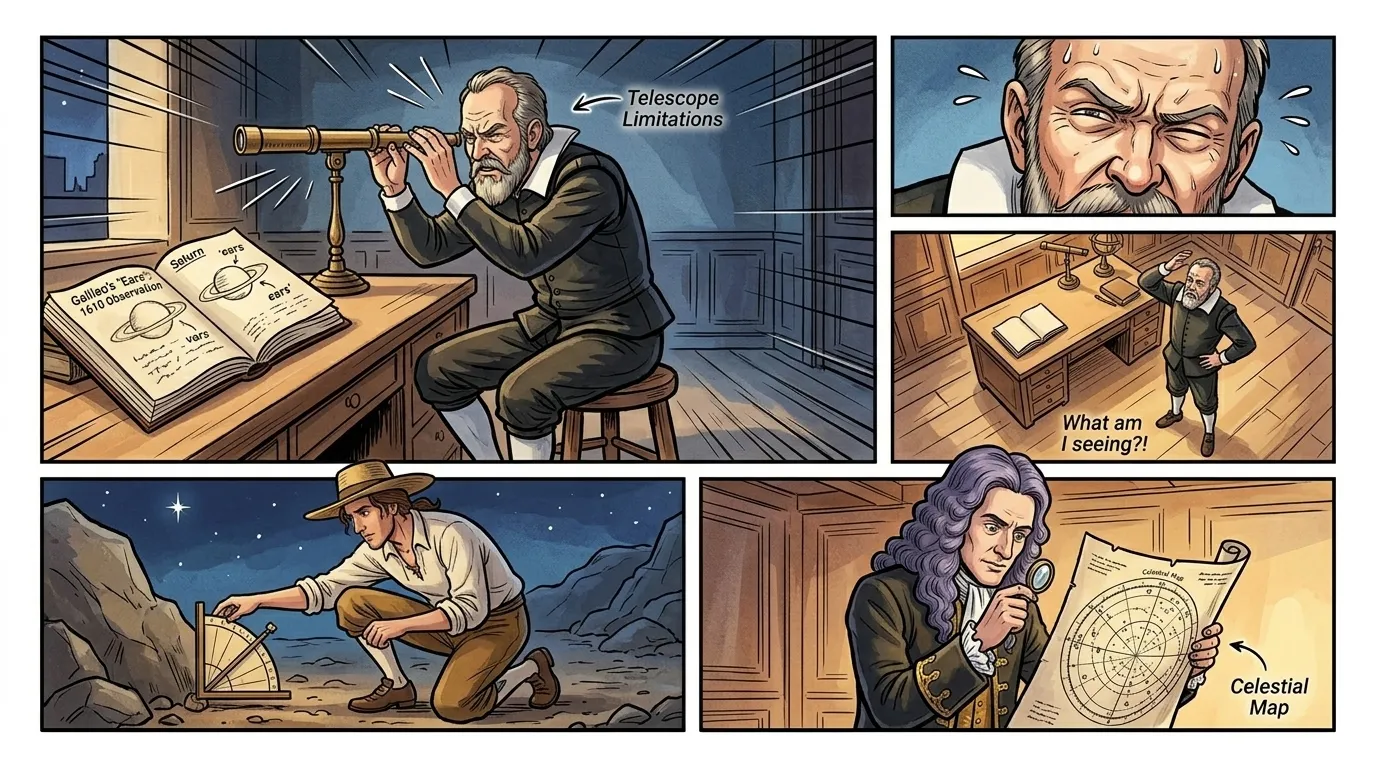
For centuries, Saturn remained a celestial mystery, its true form obscured by the limitations of early telescopes. Galileo Galilei, in 1610, was the first to observe what he described as 'ears' or 'ansae' flanking the planet, unable to resolve them as a continuous ring system due to the optical distortions of his instruments. This ambiguity highlighted a fundamental challenge for astronomers: distinguishing true planetary features from telescopic artifacts.\n\n Fact: Galileo's 'Ears': 1610 Observation
Page 3
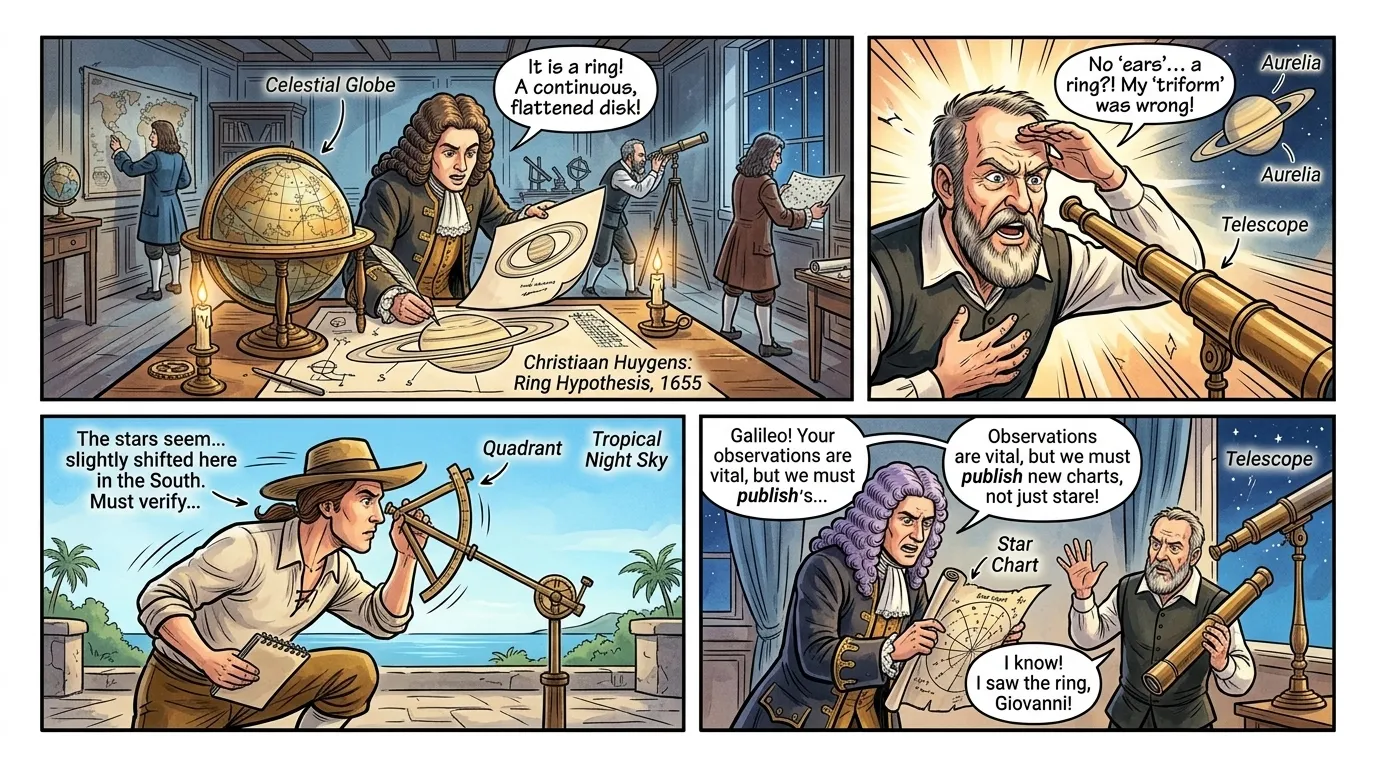
It wasn't until Christiaan Huygens, a Dutch contemporary of Cassini, proposed the revolutionary idea of a solid, thin ring surrounding Saturn in 1655 that the true nature of its appendages began to clarify. Huygens's superior telescope optics allowed him to observe a distinct, flattened structure, leading him to hypothesize that these 'ears' were in fact a singular, unbroken ring. His breakthrough paved the way for more detailed investigations into the planet's complex architecture.\n\n Fact: Christiaan Huygens: Ring Hypothesis, 1655
Page 4
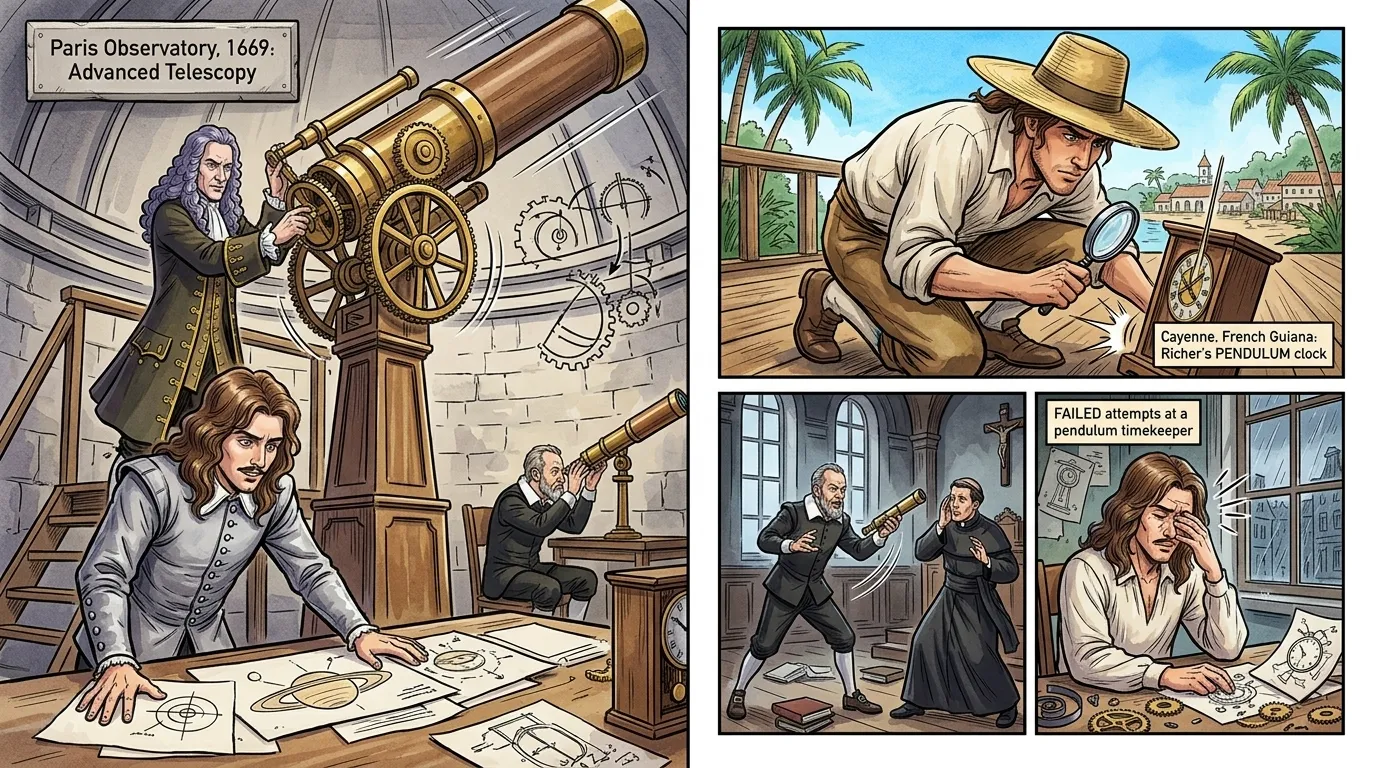
Giovanni Cassini arrived at the Paris Observatory in 1669, inheriting a legacy of astronomical inquiry and a mandate for precision. Equipped with some of the most powerful telescopes of his time—long, unwieldy instruments that required immense stability—Cassini embarked on a program of relentless observation. His methodical approach, combined with his exceptional skill in instrument calibration and data recording, set a new standard for celestial mechanics.\n\n Fact: Paris Observatory, 1669: Advanced Telescopy
Page 5
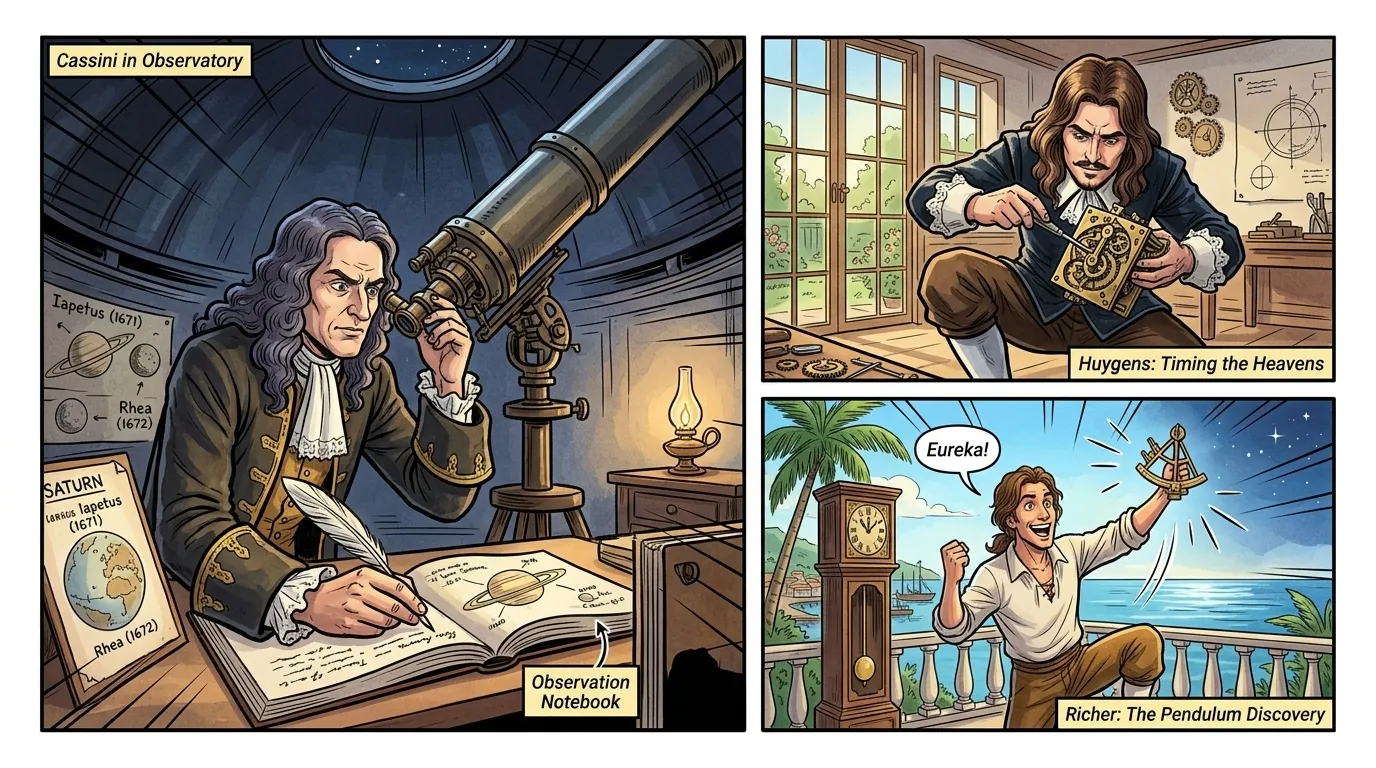
Through hundreds of hours staring into the night sky, Cassini began to peel back Saturn's veils. In 1671, he discovered Iapetus, observing its peculiar brightness variations as it orbited. Over the next decade, he added Rhea (1672), then Tethys and Dione (both in 1684) to Saturn's known retinue. Each discovery was a testament to his observational prowess and the increasing sophistication of his instruments, revealing a miniature planetary system within our own.\n\n Fact: Cassini's Moons: Iapetus (1671), Rhea (1672), Tethys & Dione (1684)
Page 6
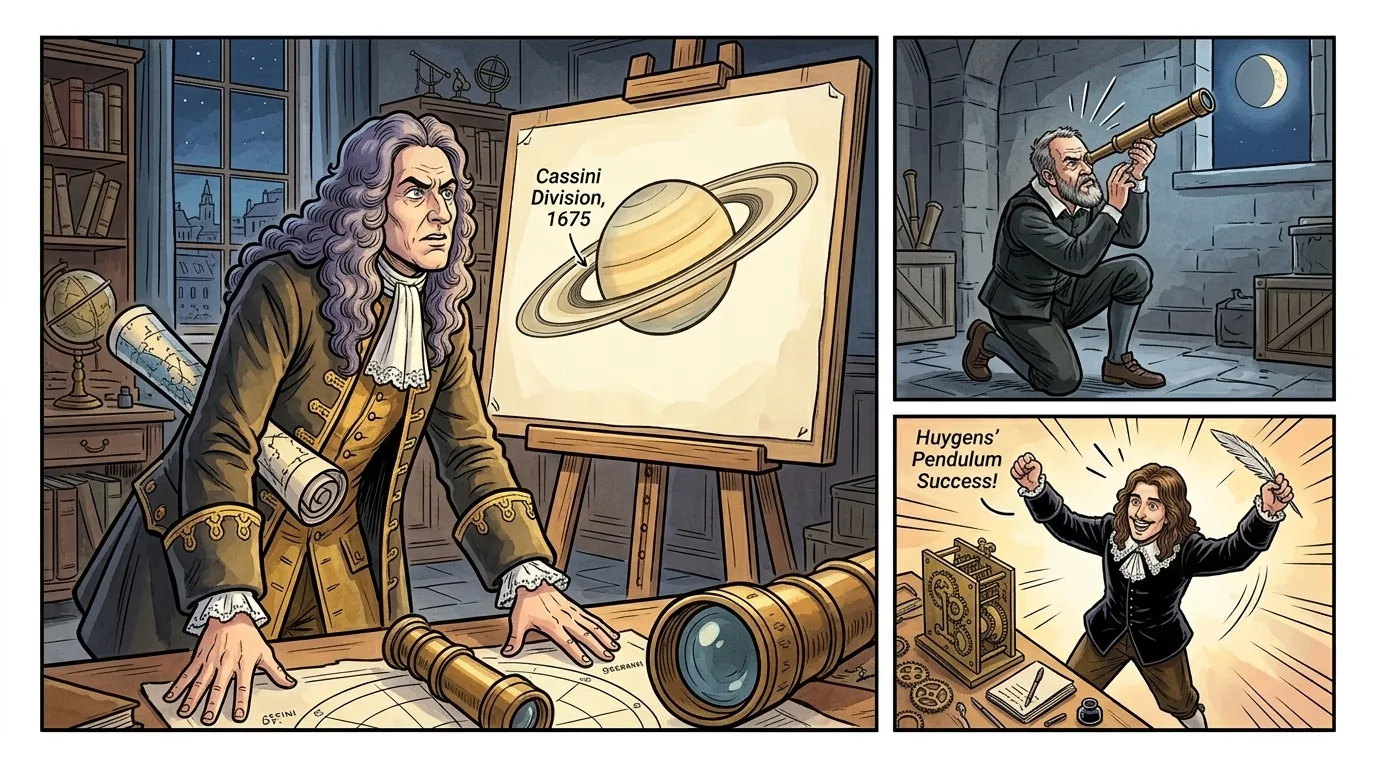
Perhaps Cassini's most iconic discovery regarding Saturn was the conspicuous gap within its rings, identified in 1675 and now famously known as the Cassini Division. This dark band, separating the outer A ring from the brighter B ring, proved that Saturn's ring system was not a single, continuous structure, but composed of multiple distinct components. This observation hinted at complex gravitational interactions at play, shaping the planetary landscape.\n\n Fact: Discovery of the Cassini Division, 1675
Page 7
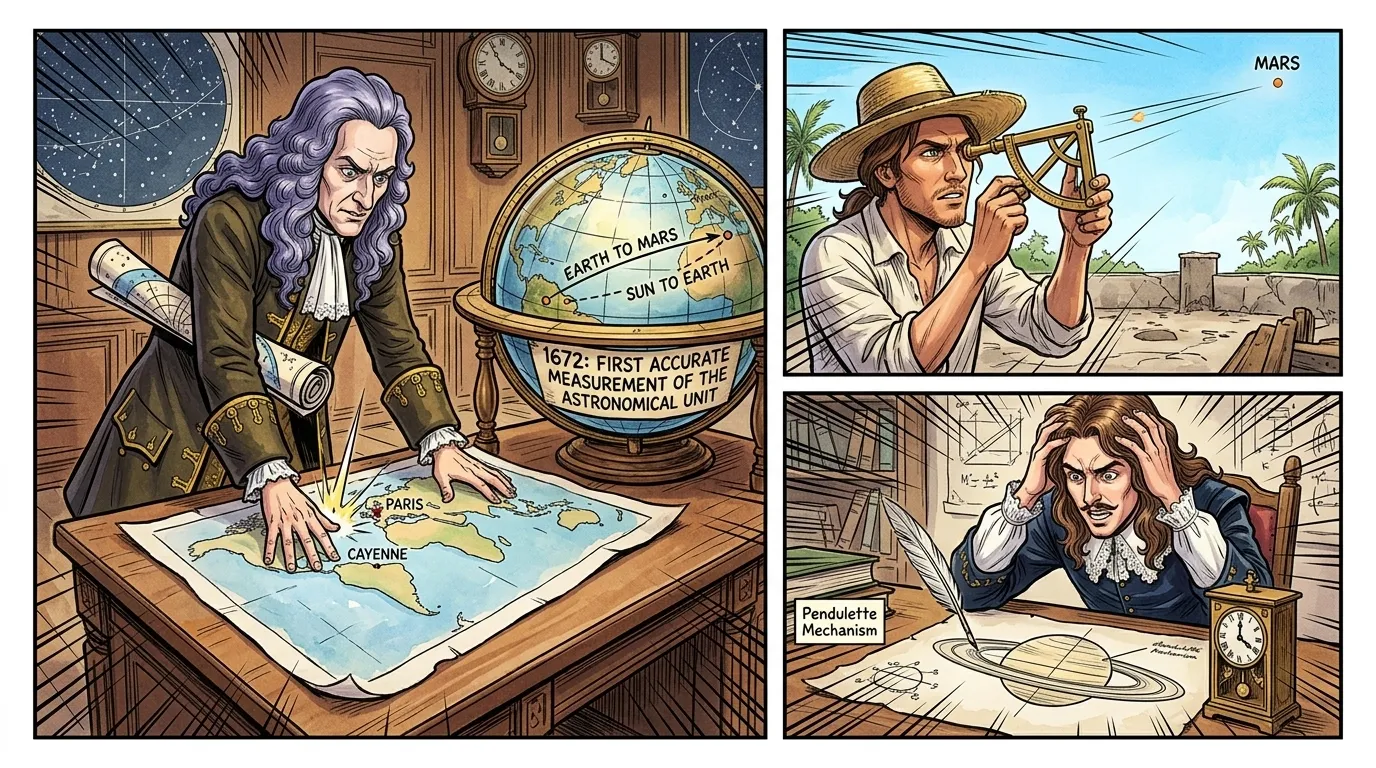
Cassini's ambition extended beyond Saturn. In 1672, by coordinating parallax measurements of Mars from Paris and Cayenne, French Guiana, he and Jean Richer calculated the distance to Mars, which in turn allowed for the first accurate determination of the Astronomical Unit (AU)—the distance from the Earth to the Sun. This monumental achievement provided the first reliable scale for the entire solar system, shrinking the vastness of space into a comprehensible framework.\n\n Fact: 1672: First Accurate Measurement of the Astronomical Unit
Page 8
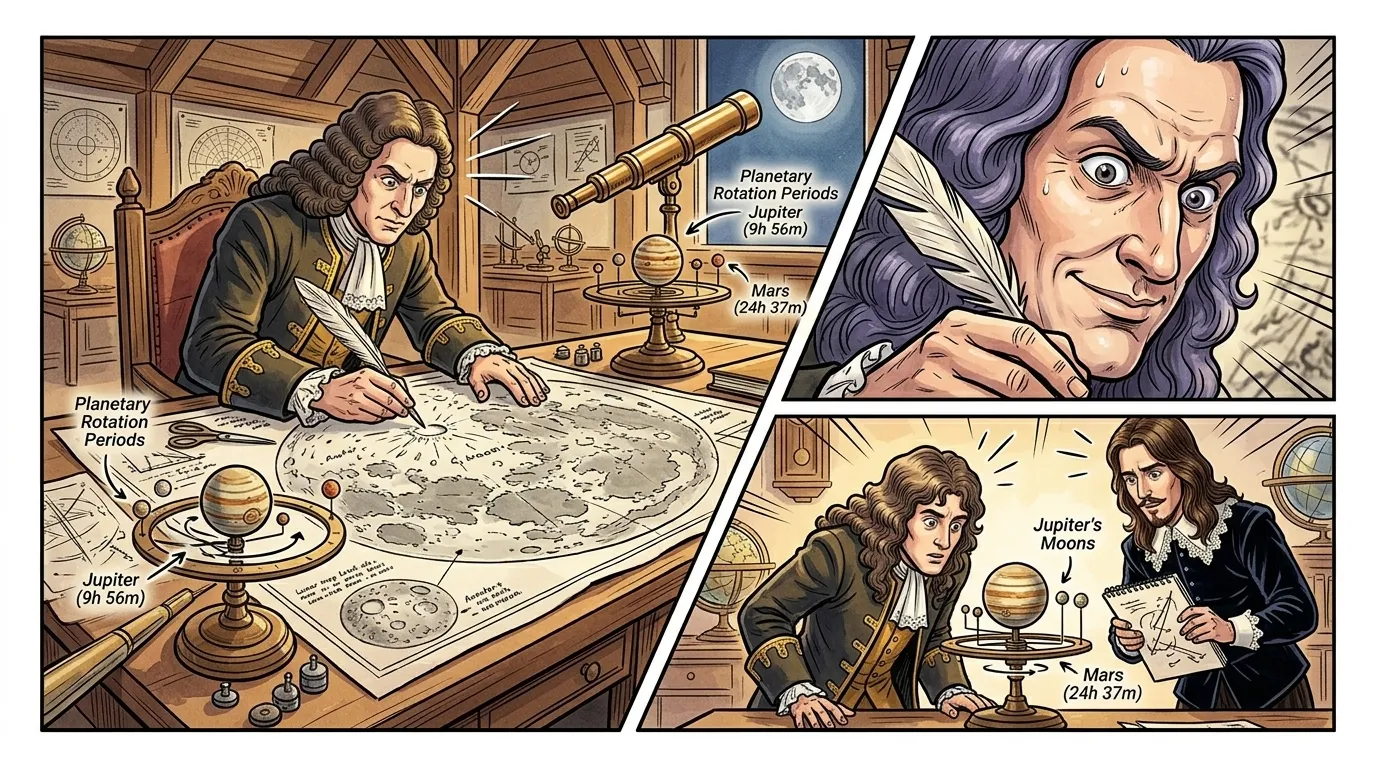
Beyond his groundbreaking discoveries, Cassini's dedication to precise observation fundamentally advanced cartography of celestial bodies. His detailed lunar maps, drawn from years of telescopic study, were among the most accurate of his time. He also made significant contributions to understanding planetary rotation, precisely determining the rotational periods of Jupiter and Mars, thereby providing critical insights into their physical characteristics and dynamics.\n\n Fact: Advanced Lunar Cartography and Planetary Rotation Periods
Page 9
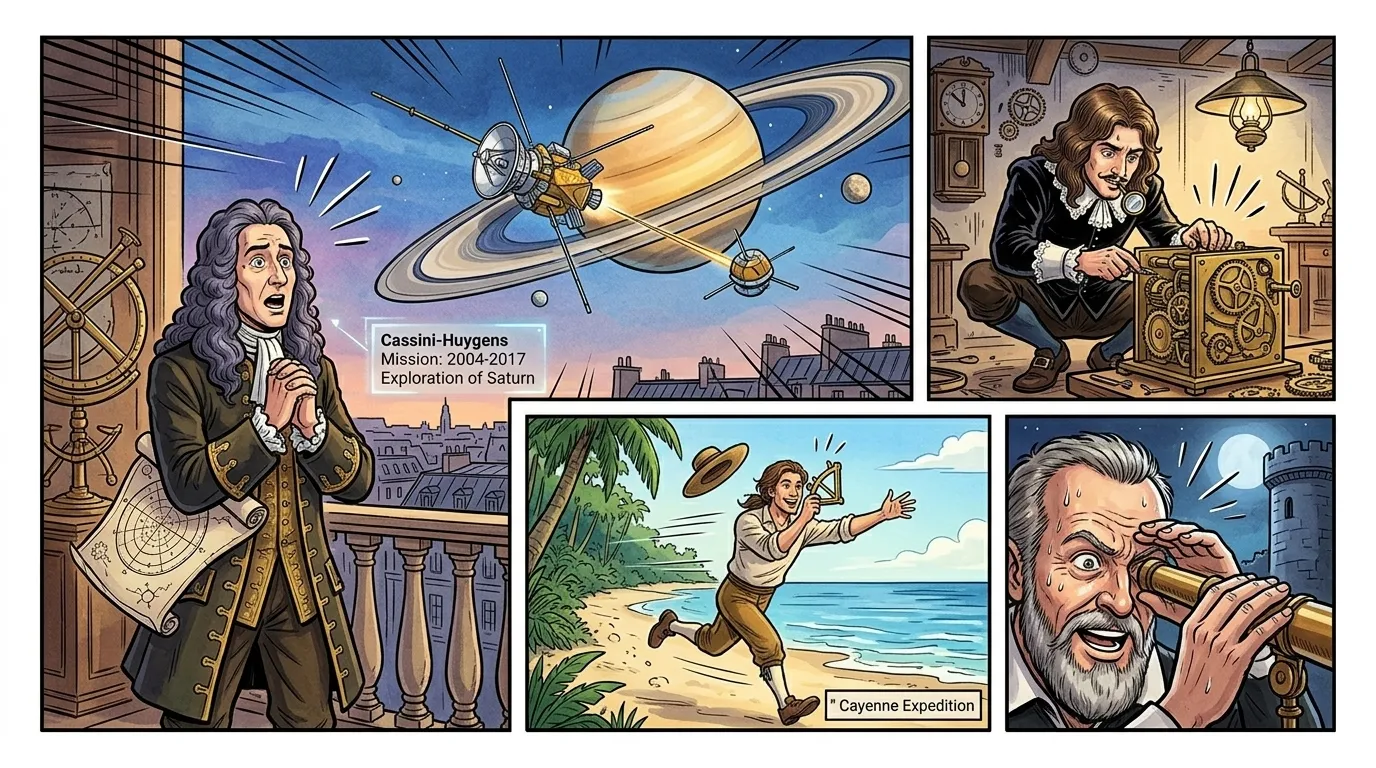
Giovanni Cassini's profound impact is etched into the very fabric of space exploration, his name synonymous with discovery. Centuries after his death, his legacy soared to new heights with the launch of the Cassini-Huygens mission—a joint NASA/ESA/ASI spacecraft that reached Saturn in 2004. This ambitious mission carried on Cassini's spirit of inquiry, providing unprecedented data and imagery of Saturn, its rings, and its moons, including the very ones he first sighted.\n\n Fact: Cassini-Huygens Mission: 2004-2017 Exploration of Saturn
Page 10
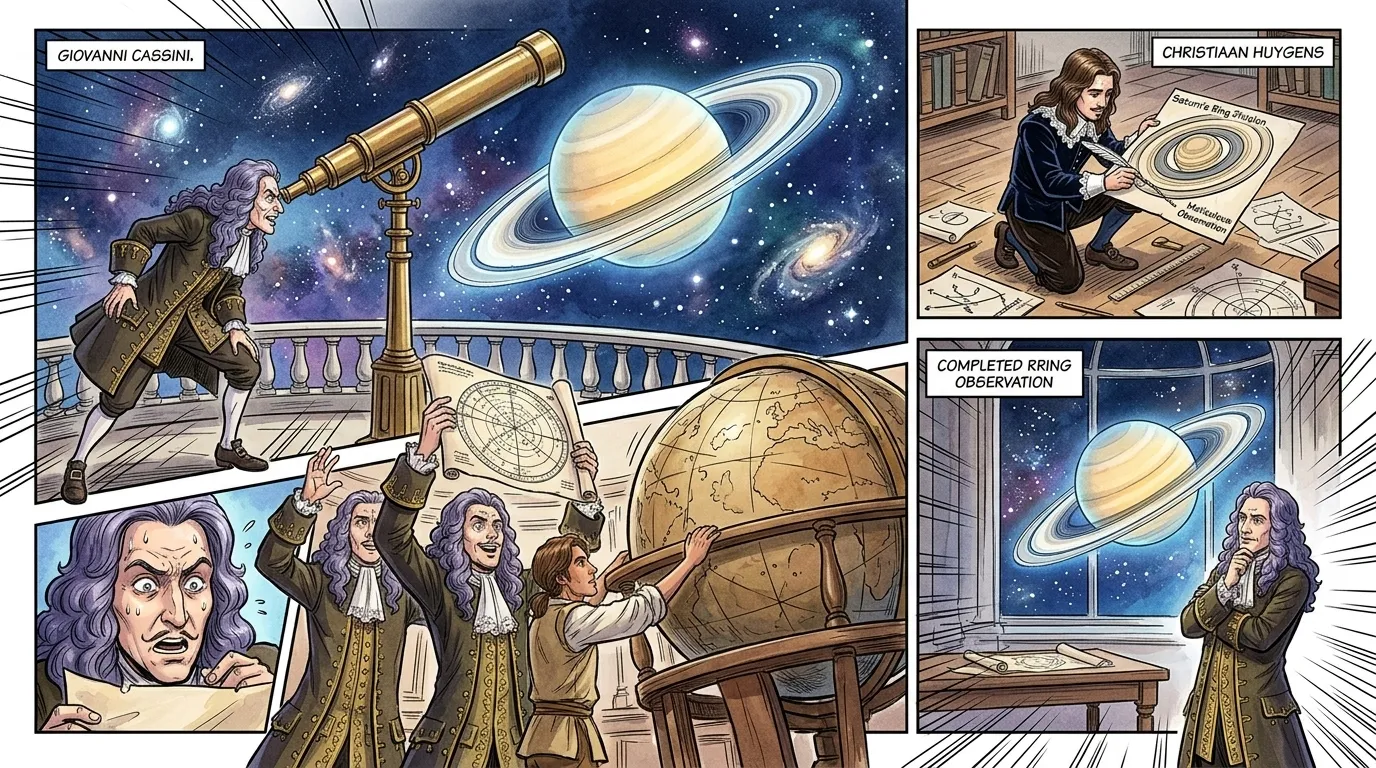
Giovanni Cassini's work remains a cornerstone of astronomy, a testament to the power of meticulous observation and intellectual courage. His discoveries not only defined Saturn for generations but inspired an enduring human quest to understand our place in the cosmos. From the distant rings of Saturn to the farthest reaches of the galaxy, the echo of Cassini's curiosity continues to drive humanity's relentless exploration, reminding us that every answered question only illuminates new ones waiting to be asked.\n\n Fact: Cassini's Lasting Legacy: Foundation for Modern Space Science
About this story
- Location: Global
- Audience: general readers
Questions and answers
Read Wonder Science on your phone
Wonder Science is available on Android. Get Wonder Science on Google Play.