Henrietta Swan Leavitt
Henrietta Swan Leavitt — an illustrated science story, set in Global. 10 illustrated pages, free to read on Wonder Science.
Page 1
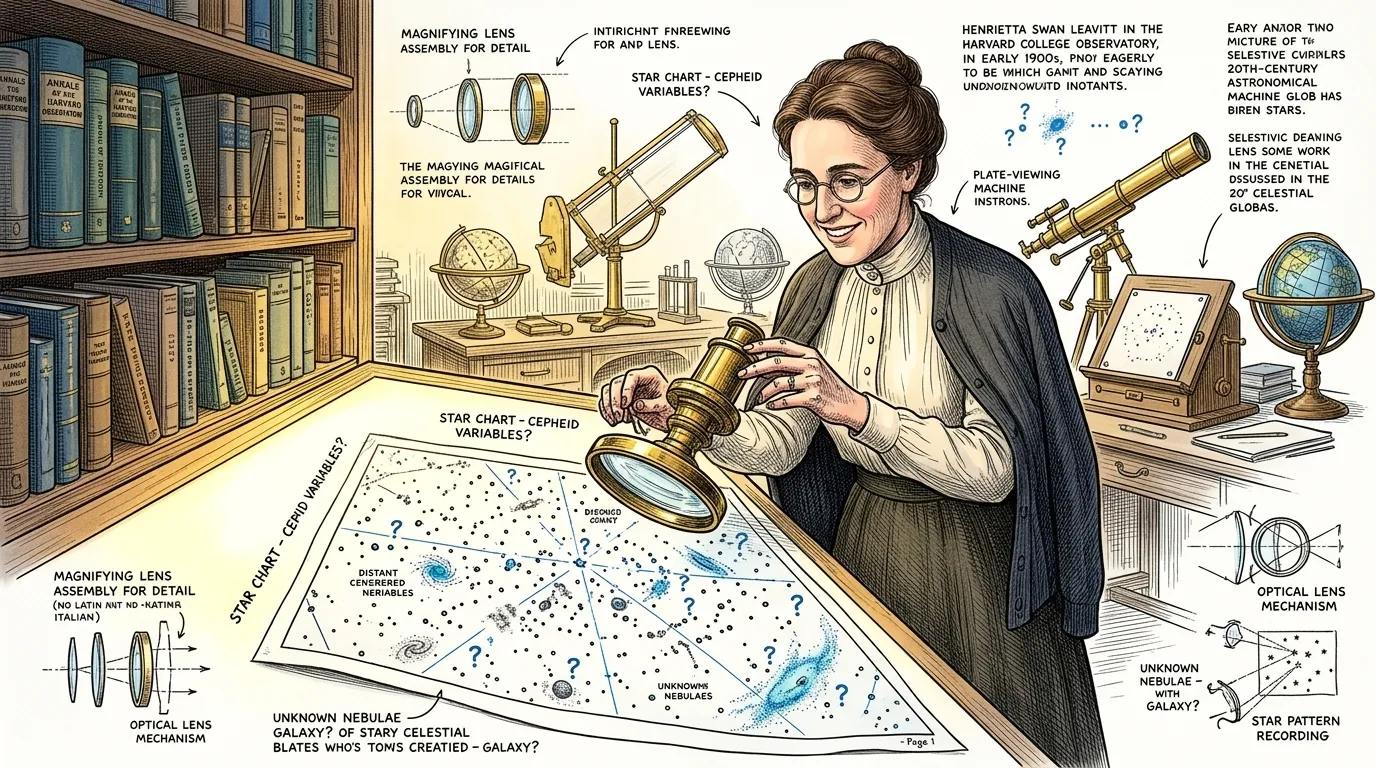
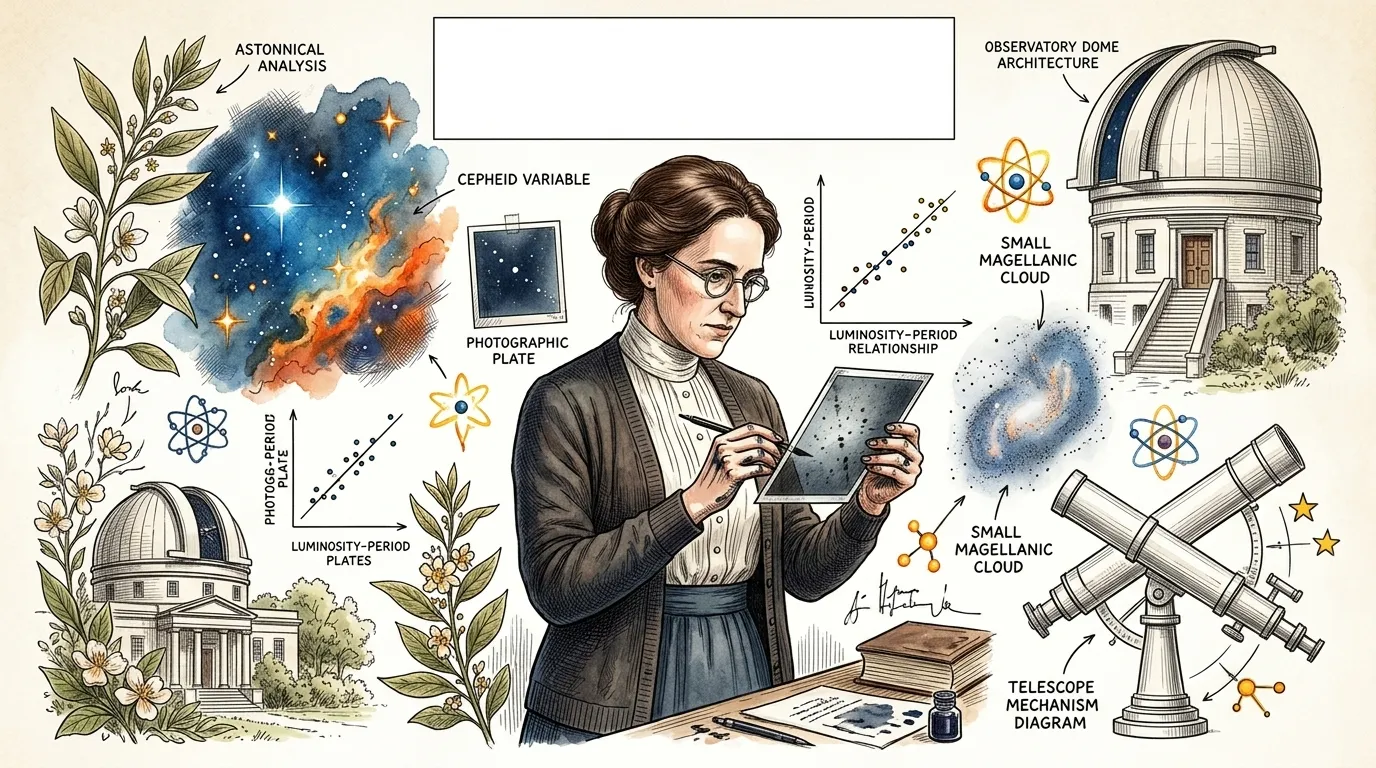
At the dawn of the 20th century, the universe was a vast, enigmatic expanse whose true scale remained largely unfathomable. Distances to stars beyond our immediate solar neighborhood were estimates, and the very nature of 'nebulae'—fuzzy celestial clouds—was a profound mystery. It was within this backdrop of cosmic uncertainty, at the Harvard College Observatory, that Henrietta Swan Leavitt embarked on a meticulous endeavor that would irrevocably redefine our understanding of the cosmos.
Page 2
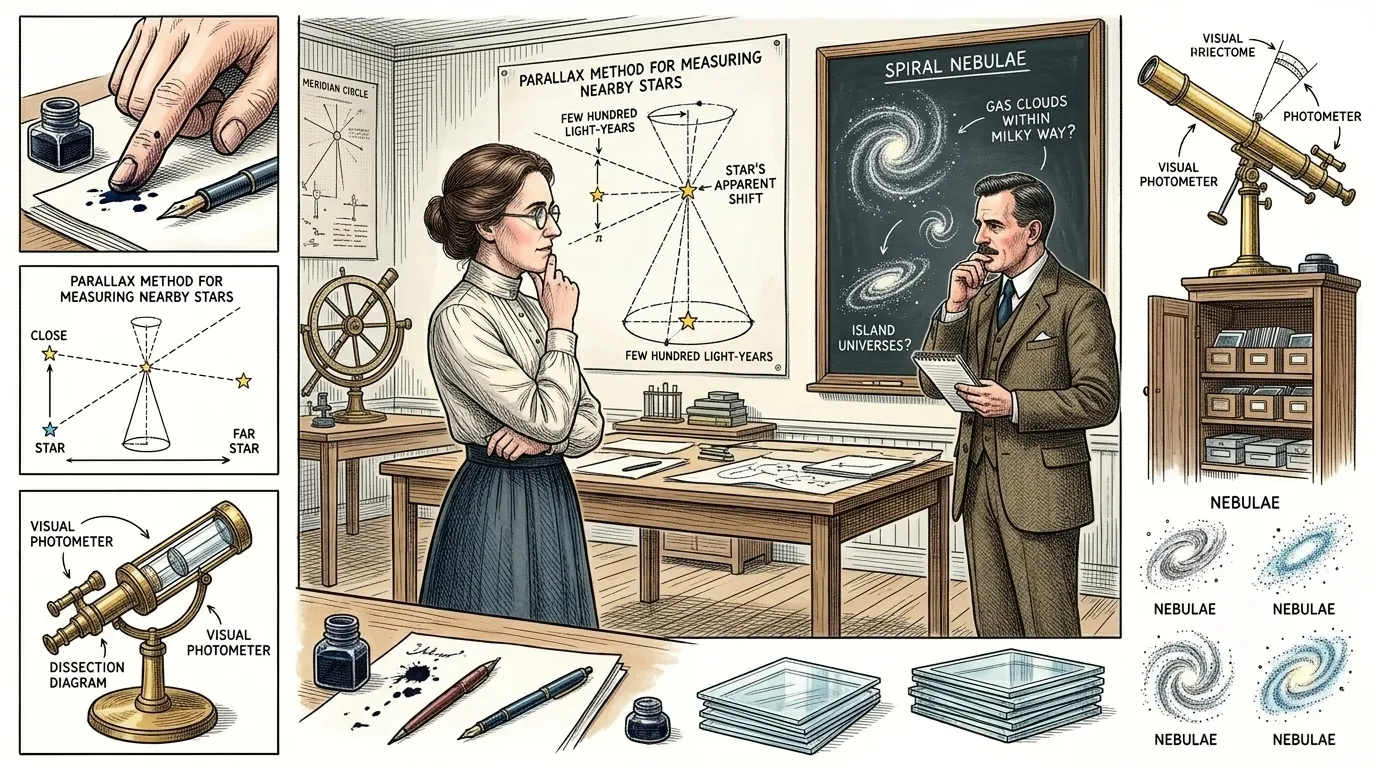
Before Leavitt's breakthrough, measuring cosmic distances was akin to navigating an ocean without a compass. For nearby stars, astronomers utilized parallax—the apparent shift in a star's position as Earth orbits the Sun—a method precise yet effective only for the closest celestial bodies, limited to distances of a few hundred light-years. Beyond this small cosmic neighborhood, the universe quickly became a realm of guesswork, its true dimensions shrouded in a fog of optical illusion and speculation. This limited perspective fueled intense scientific debate regarding whether the 'spiral nebulae' were gas clouds within our Milky Way or 'island universes' — galaxies entirely separate from our own.
Page 3
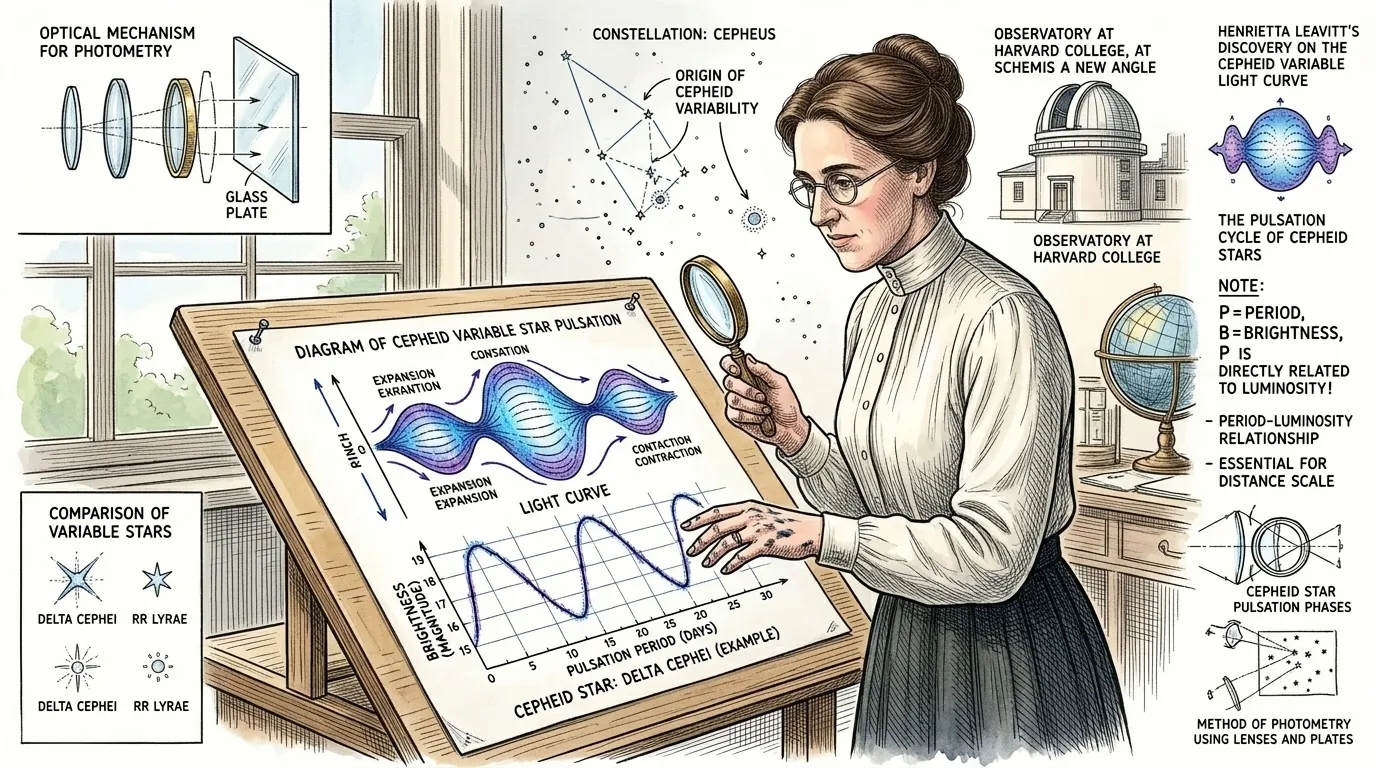
Among the myriad stars that populate the night sky, a particular class of variable stars, known as Cepheids, stood out. These luminous giants don't shine with constant brilliance; instead, they rhythmically expand and contract, causing their brightness to wax and wane over periods ranging from days to months. Discovered in the constellation Cepheus, these stars offered a tantalizing, yet uncracked, code to the universe's inherent order. Their periodic changes were observable, but their underlying significance, particularly for distance measurement, remained a puzzle awaiting the right observer.
Page 4
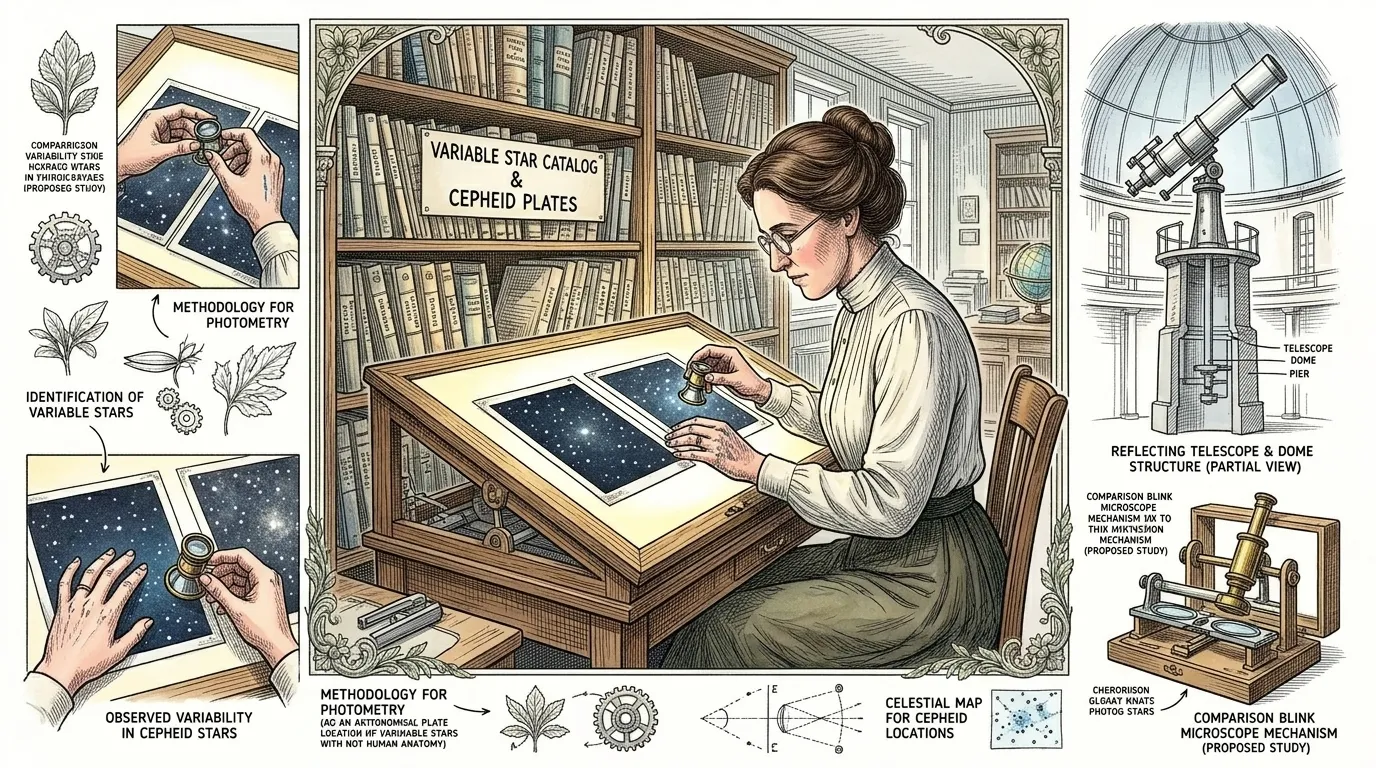
Henrietta Leavitt was part of a remarkable team of women at the Harvard College Observatory, colloquially known as 'Pickering's Harem' or the 'Harvard Computers.' These highly educated women performed the painstaking, meticulous work of analyzing astronomical photographic plates, a task considered too tedious for male astronomers. Each glass plate captured thousands of stars, offering a static glimpse of the cosmos on a given night. Leavitt's specific assignment was to identify and catalog variable stars, comparing plates taken on different dates to discern changes in stellar brightness. This methodical labor, though underpaid and undervalued, was the bedrock upon which epoch-making discoveries were built.
Page 5
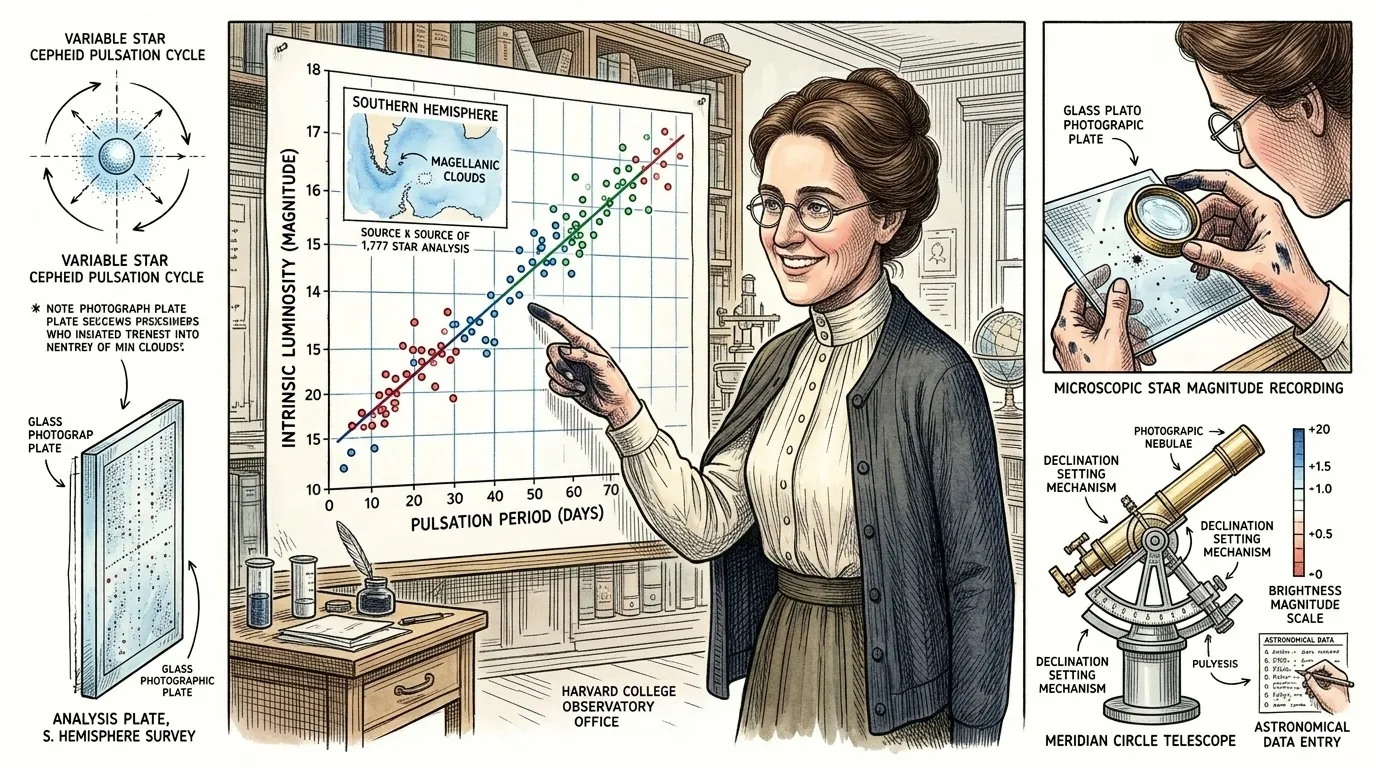
Leavitt's focus turned to the Magellanic Clouds, two dwarf galaxies visible from the Southern Hemisphere. Critically, because all stars within these clouds were assumed to be roughly the same distance from Earth, any observed difference in their apparent brightness had to be directly proportional to their intrinsic luminosity. Through painstaking analysis of 1,777 variable stars in the Small Magellanic Cloud (SMC), Leavitt made a profound observation: the brighter the Cepheid variable, the longer its pulsation period. This simple, elegant correlation was the key—a direct, measurable link between a star's observed behavior and its true energy output.
Page 6
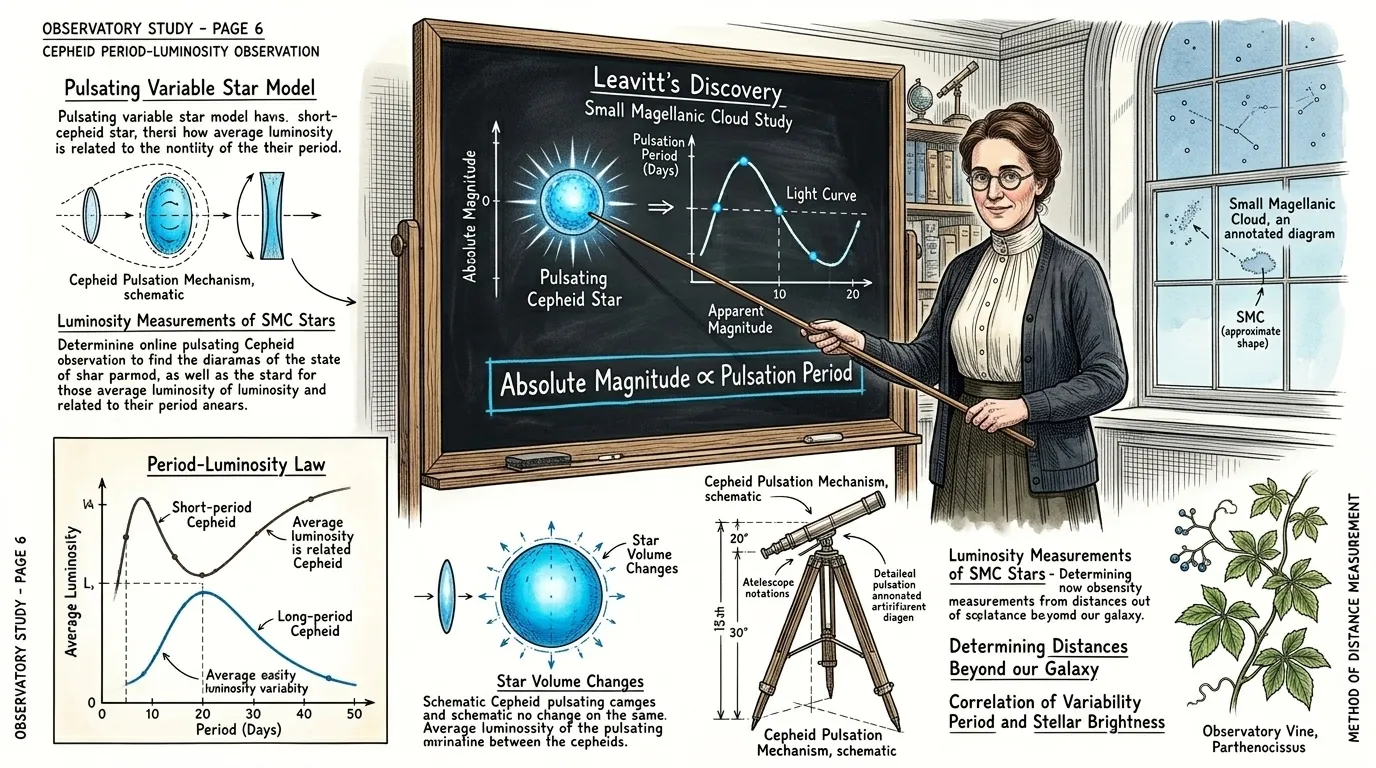
Leavitt's groundbreaking discovery, published in 1912, revealed what is now known as the Cepheid period-luminosity relationship: the absolute magnitude (intrinsic brightness) of a Cepheid variable star is directly proportional to its pulsation period. This meant that by simply observing how long it took a Cepheid to complete one cycle of brightness variation, astronomers could calculate its true luminosity. This was revolutionary because, for the first time, a celestial object offered an internal, measurable characteristic that directly revealed its intrinsic power, independent of its apparent brightness as seen from Earth.
Page 7
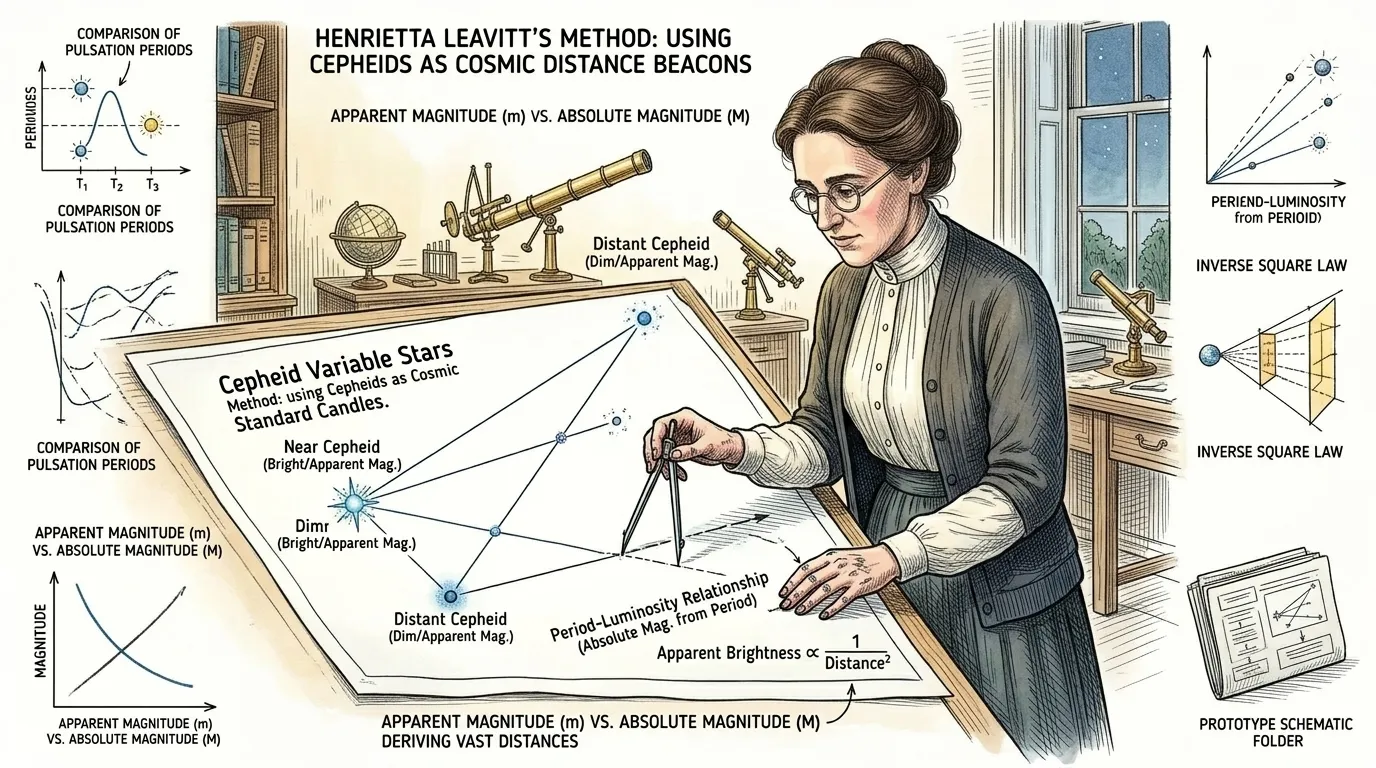
With the period-luminosity relationship established, Cepheid variables transformed into 'standard candles'—objects of known intrinsic brightness. The final step was simple yet profound: by comparing a Cepheid's known absolute magnitude (calculated from its period) with its observed apparent magnitude (how bright it appears from Earth), astronomers could calculate its precise distance. This method leverages the inverse square law of light, which states that an object's apparent brightness decreases with the square of its distance. Henrietta Leavitt had provided the missing piece, turning pulsating stars into cosmic beacons for measuring the vast distances across the universe.
Page 8
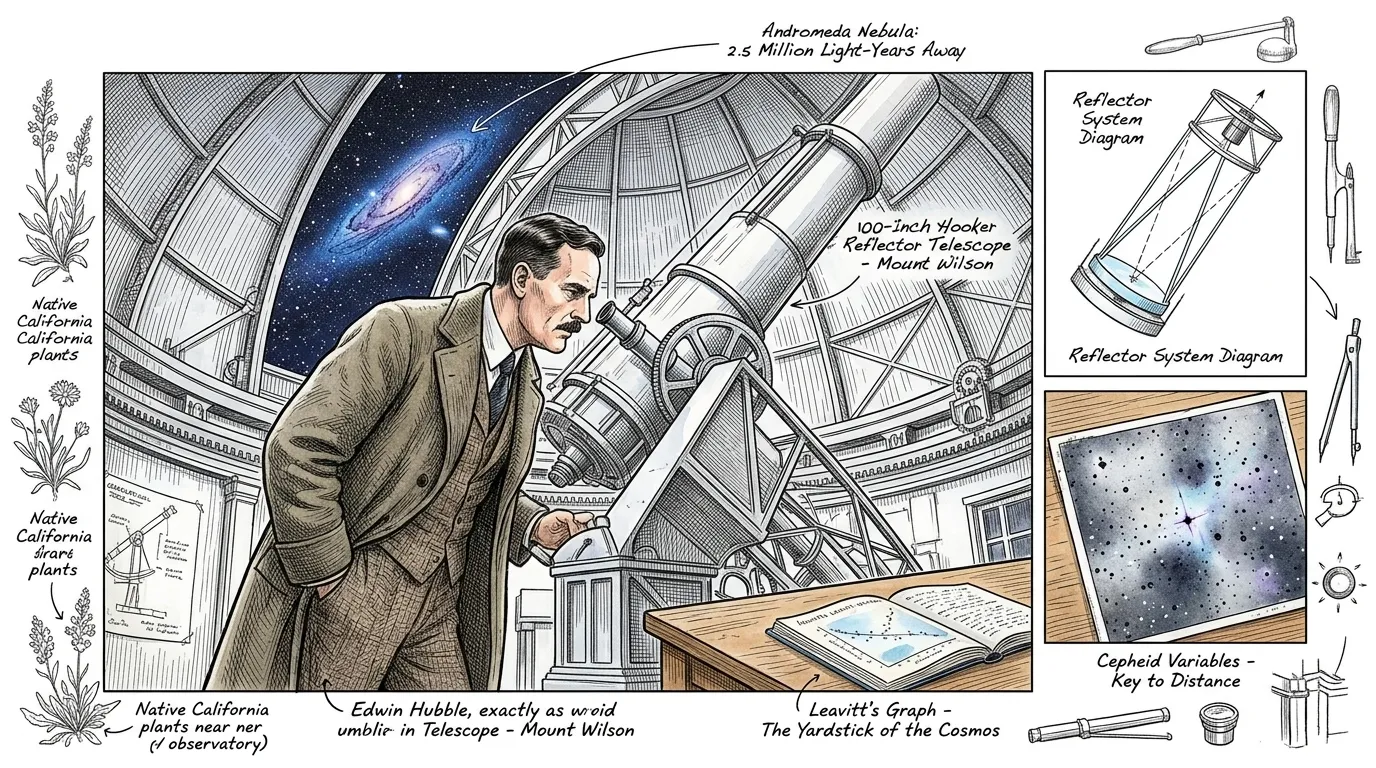
Just over a decade after Leavitt's publication, her work became the bedrock for one of the most significant discoveries in astronomy. In 1923, Edwin Hubble, using the then-new 100-inch Hooker telescope at Mount Wilson Observatory, identified Cepheid variables in the Andromeda Nebula. Applying Leavitt's period-luminosity relationship, Hubble calculated Andromeda's distance, proving it was not a gas cloud within the Milky Way, but an entirely separate galaxy millions of light-years away. This monumental finding shattered the prevailing view of the universe, demonstrating that our galaxy was just one of billions, and subsequently laid the groundwork for the discovery of the expanding universe.
Page 9
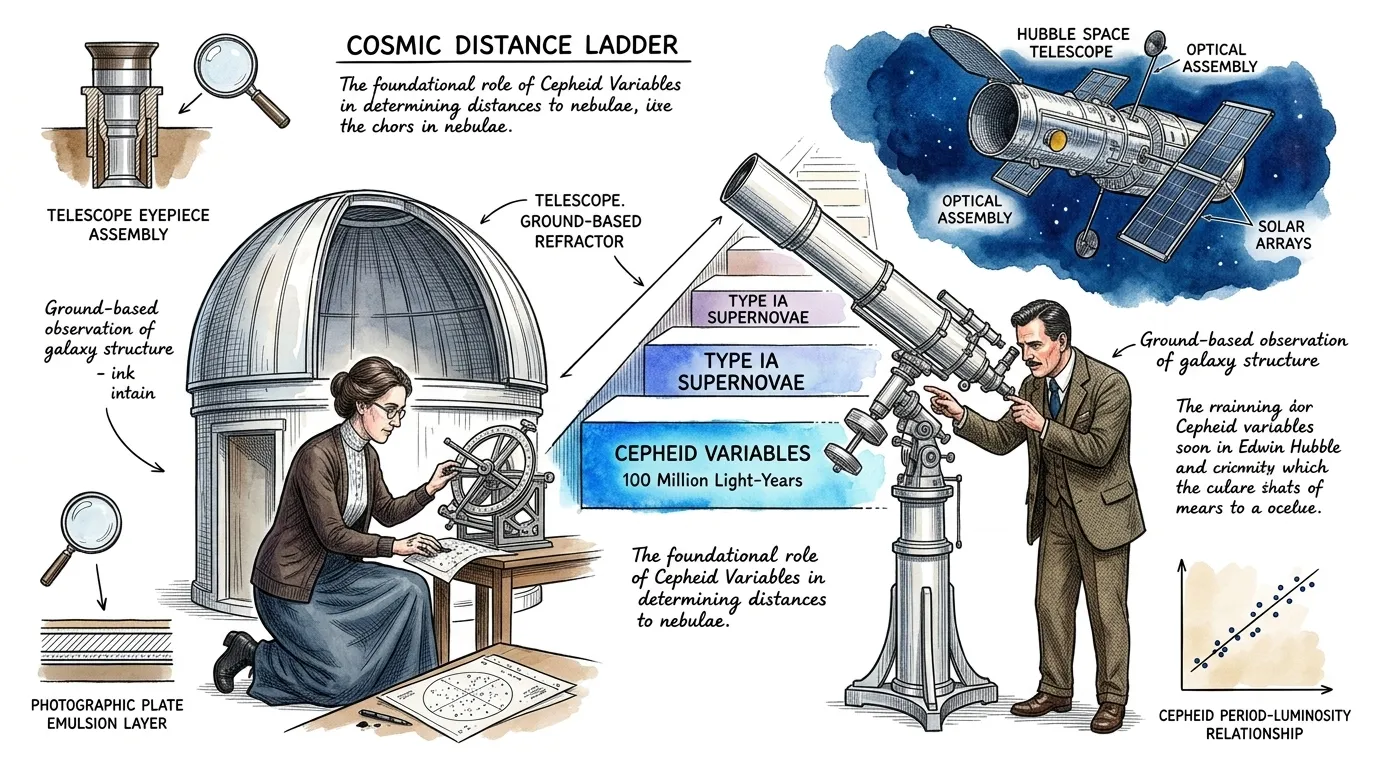
Henrietta Leavitt's period-luminosity relationship formed the foundational rung of the 'cosmic distance ladder'—a series of interconnected methods used by astronomers to determine the distances to increasingly remote objects. Cepheids allow astronomers to measure distances out to about 100 million light-years, providing a crucial calibration point for other, even more distant indicators, such as Type Ia supernovae. From ground-based observatories to the Hubble Space Telescope, Leavitt's discovery continues to be an indispensable tool, allowing us to map the universe, understand its structure, and probe its ultimate origins and fate.
Page 10
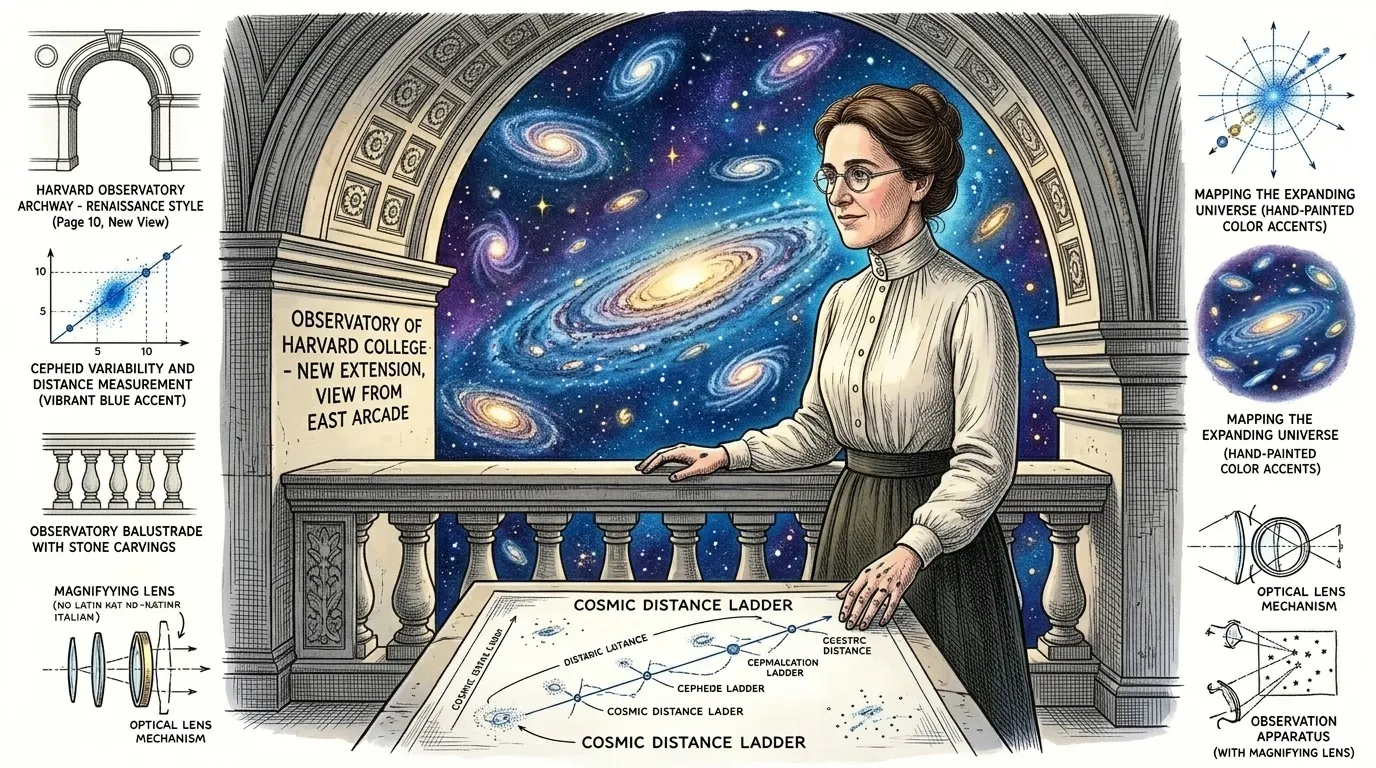
Henrietta Swan Leavitt, despite her profound contribution, received little recognition during her lifetime, dying in 1921 before the full implications of her work were widely understood. Yet, her meticulous and intellectually rigorous labor at Harvard College Observatory provided humanity with the first reliable 'standard candle' for measuring the cosmos. From confirming the existence of other galaxies to measuring the expansion rate of the universe and estimating its age, her discovery underpins nearly all modern cosmology. It is a testament to the power of fundamental research and the enduring legacy of a brilliant mind whose quiet work unlocked the true vastness of space.
About this story
- Location: Global
- Audience: general readers
Questions and answers
Read Wonder Science on your phone
Wonder Science is available on Android. Get Wonder Science on Google Play.