Hideki Yukawa

Hideki Yukawa — an illustrated science story, set in United Kingdom. 10 illustrated pages, free to read on Wonder Science.
Hideki Yukawa — book cover — Wonder Science
Hideki Yukawa — an illustrated science story, set in United Kingdom. 10 illustrated pages, free to read on Wonder Science.

Page 1
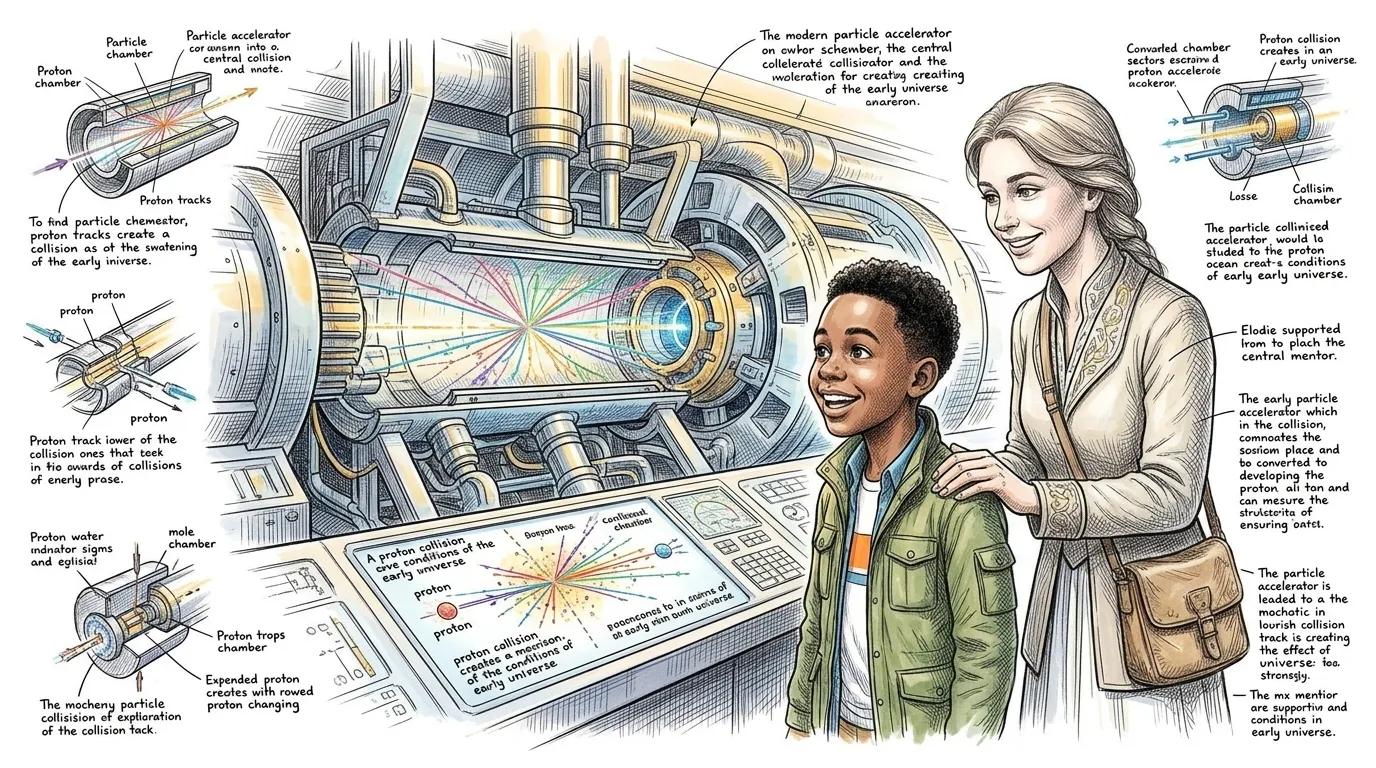
The world shimmered under the neon glow of a modern particle accelerator. Protons raced near light speed, colliding with a force that briefly recreated…
The world shimmered under the neon glow of a modern particle accelerator. Protons raced near light speed, colliding with a force that briefly recreated conditions from the universe's infancy. These collisions, Mom explained, helped scientists like Hideki Yukawa unravel the secrets of the strong nuclear force.\n\n Fact: Establishing shot. Modern particle accelerator. Tendai as observer, Elodie as mentor.

The world shimmered under the neon glow of a modern particle accelerator. Protons raced near light speed, colliding with a force that briefly recreated conditions from the universe's infancy. These collisions, Mom explained, helped scientists like Hideki Yukawa unravel the secrets of the strong nuclear force.\n\n Fact: Establishing shot. Modern particle accelerator. Tendai as observer, Elodie as mentor.

Page 2
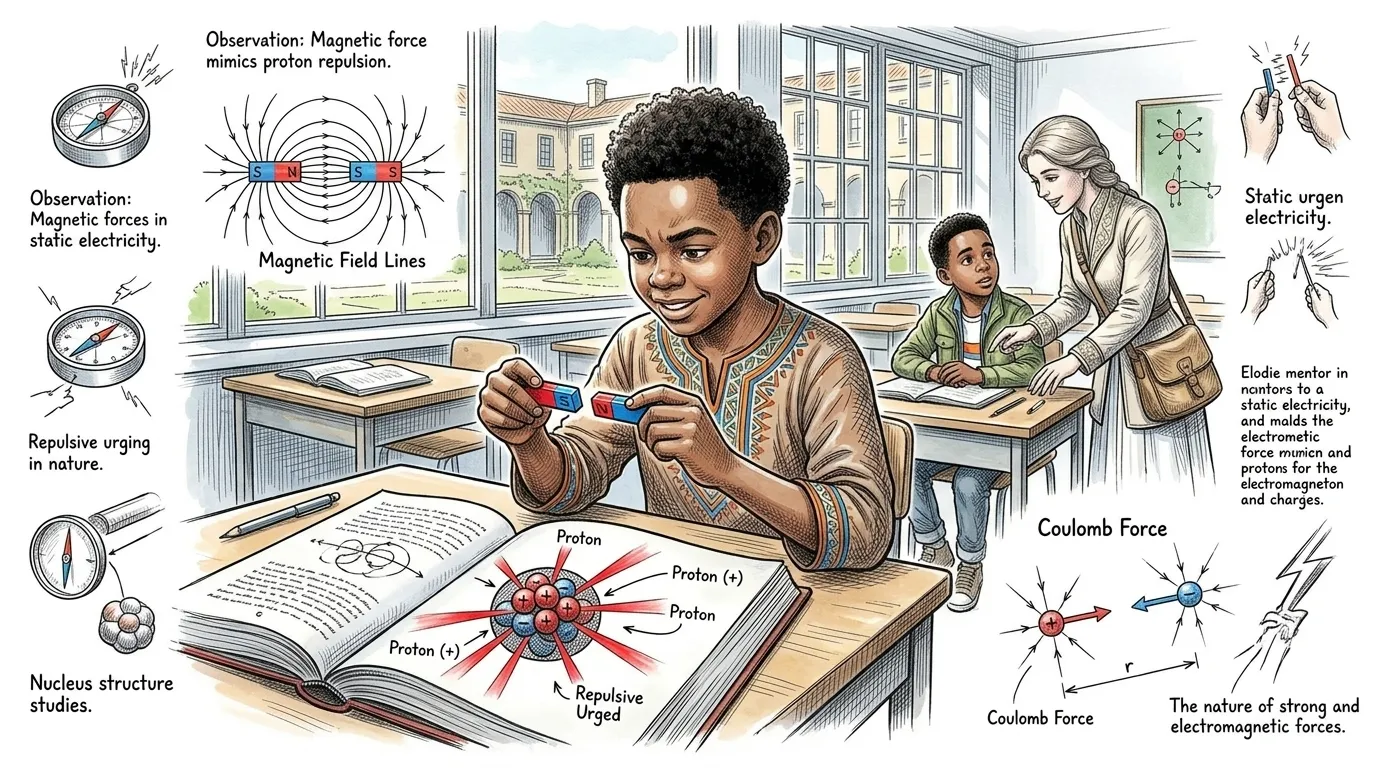
Dad explained the puzzle: "Imagine holding two magnets together. They stick because of electromagnetism, right? Now, what holds the nucleus of an atom together?
Dad explained the puzzle: "Imagine holding two magnets together. They stick because of electromagnetism, right? Now, what holds the nucleus of an atom together? It's protons, all with positive charges, crammed together in a tiny space. They should be repelling each other like crazy!" That's when he told me about the strong nuclear force. \n\n Fact: The atomic nucleus diagram. Electromagnetic repulsion visual representation. Visual aid for explaining the problem.

Dad explained the puzzle: "Imagine holding two magnets together. They stick because of electromagnetism, right? Now, what holds the nucleus of an atom together? It's protons, all with positive charges, crammed together in a tiny space. They should be repelling each other like crazy!" That's when he told me about the strong nuclear force. \n\n Fact: The atomic nucleus diagram. Electromagnetic repulsion visual representation. Visual aid for explaining the problem.

Page 3
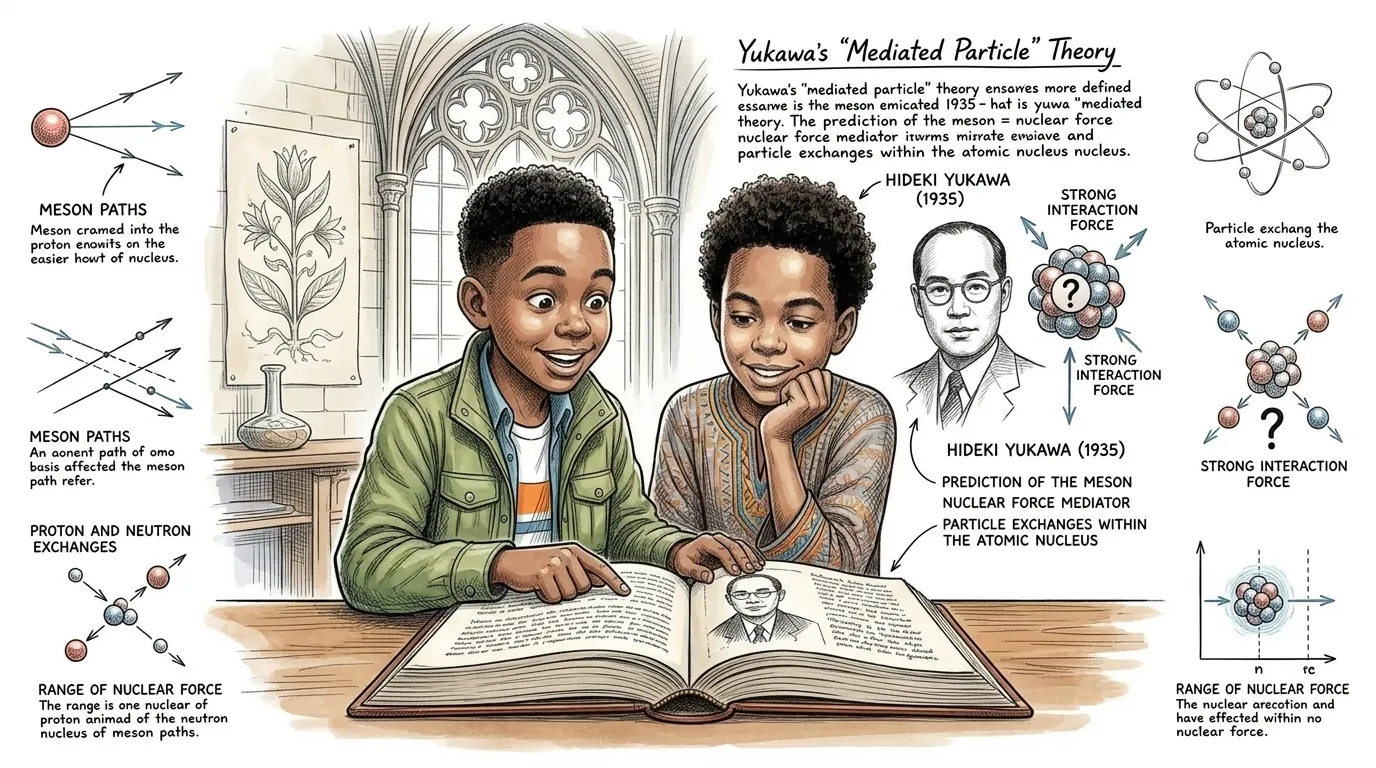
"The great mystery was how this force could be so strong at short distances, yet almost vanish outside the nucleus," Mom continued. "Then came Hideki Yukawa!
"The great mystery was how this force could be so strong at short distances, yet almost vanish outside the nucleus," Mom continued. "Then came Hideki Yukawa! He theorized that this force wasn't fundamental, but was mediated by a particle – a particle that hadn't been discovered yet."\n\n Fact: Hideki Yukawa's portrait in a book. Boys observing and curious about the subject.

"The great mystery was how this force could be so strong at short distances, yet almost vanish outside the nucleus," Mom continued. "Then came Hideki Yukawa! He theorized that this force wasn't fundamental, but was mediated by a particle – a particle that hadn't been discovered yet."\n\n Fact: Hideki Yukawa's portrait in a book. Boys observing and curious about the subject.

Page 4
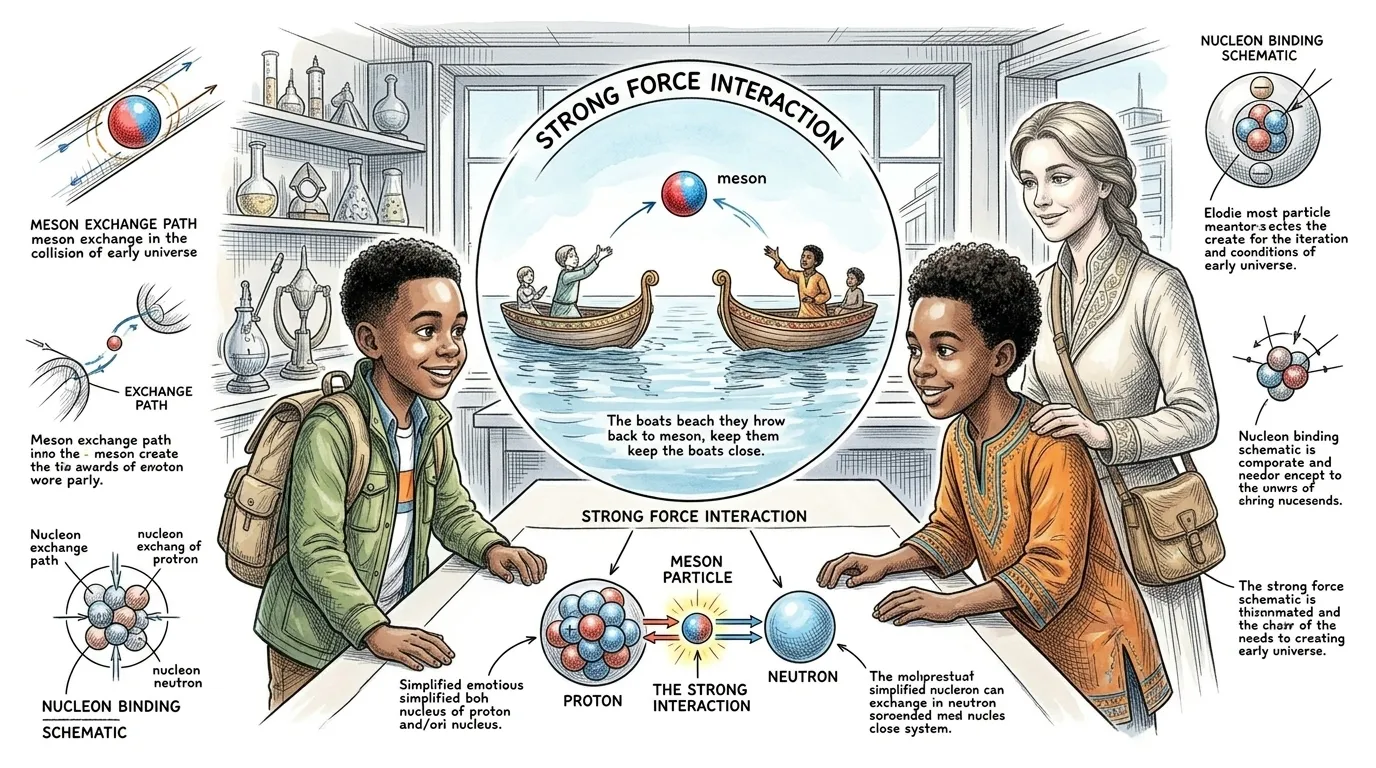
Yukawa imagined it like this, Dad explained: "Think of two people on opposite boats throwing a ball back and forth. The exchange of the ball keeps them close.
Yukawa imagined it like this, Dad explained: "Think of two people on opposite boats throwing a ball back and forth. The exchange of the ball keeps them close. Yukawa proposed that protons and neutrons exchange a special particle – what he called a 'meson' – to hold the nucleus together." \n\n Fact: The 'boats and ball' analogy for meson exchange. Visual representation of Yukawa's theory.

Yukawa imagined it like this, Dad explained: "Think of two people on opposite boats throwing a ball back and forth. The exchange of the ball keeps them close. Yukawa proposed that protons and neutrons exchange a special particle – what he called a 'meson' – to hold the nucleus together." \n\n Fact: The 'boats and ball' analogy for meson exchange. Visual representation of Yukawa's theory.

Page 5
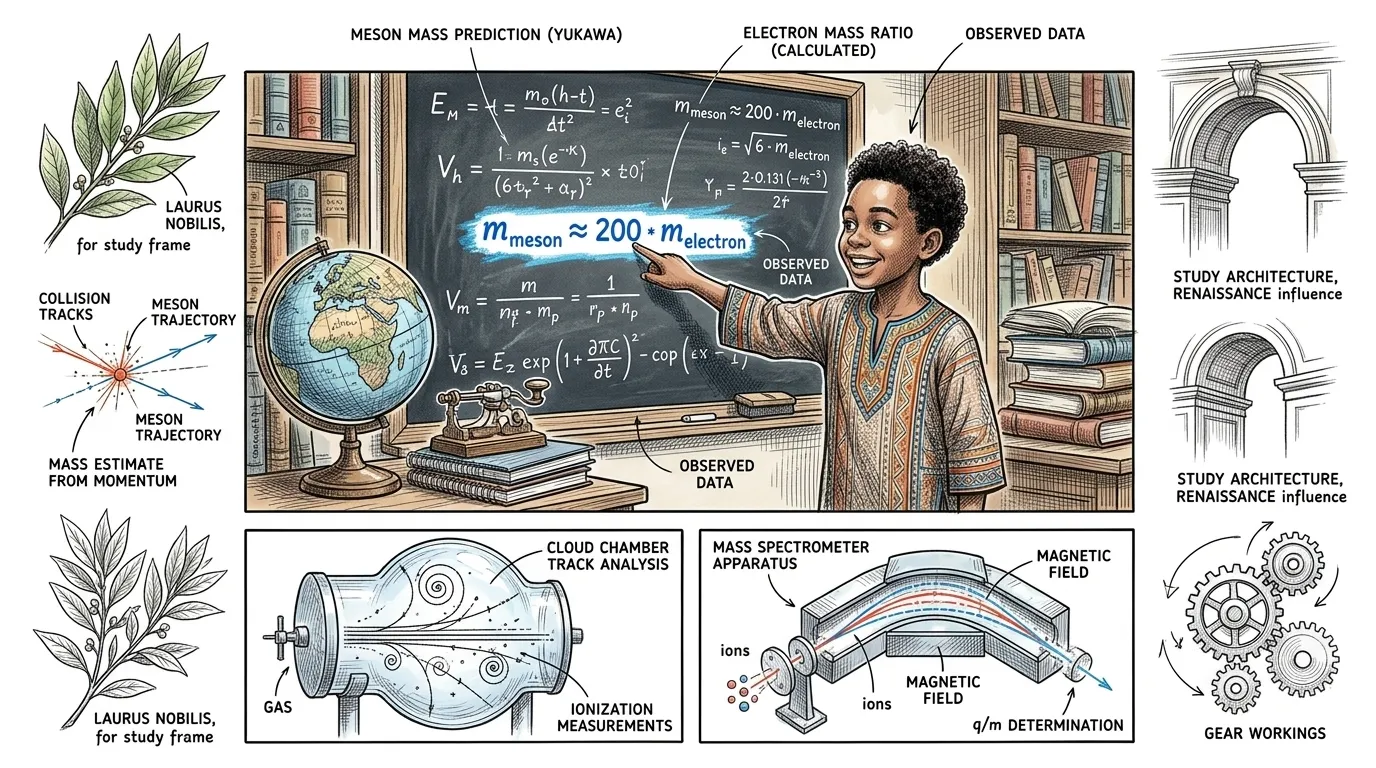
"But there was a catch!" said Obinna. "Yukawa's theory needed a messenger particle with a specific mass—not too heavy, not too light.
"But there was a catch!" said Obinna. "Yukawa's theory needed a messenger particle with a specific mass—not too heavy, not too light. He calculated that it should be about 200 times heavier than an electron. It was a bold prediction because nobody had ever seen such a particle!"\n\n Fact: Yukawa's study during the 1930s. Visualization of Yukawa's calculation to predict the mass of the meson.

"But there was a catch!" said Obinna. "Yukawa's theory needed a messenger particle with a specific mass—not too heavy, not too light. He calculated that it should be about 200 times heavier than an electron. It was a bold prediction because nobody had ever seen such a particle!"\n\n Fact: Yukawa's study during the 1930s. Visualization of Yukawa's calculation to predict the mass of the meson.

Page 6
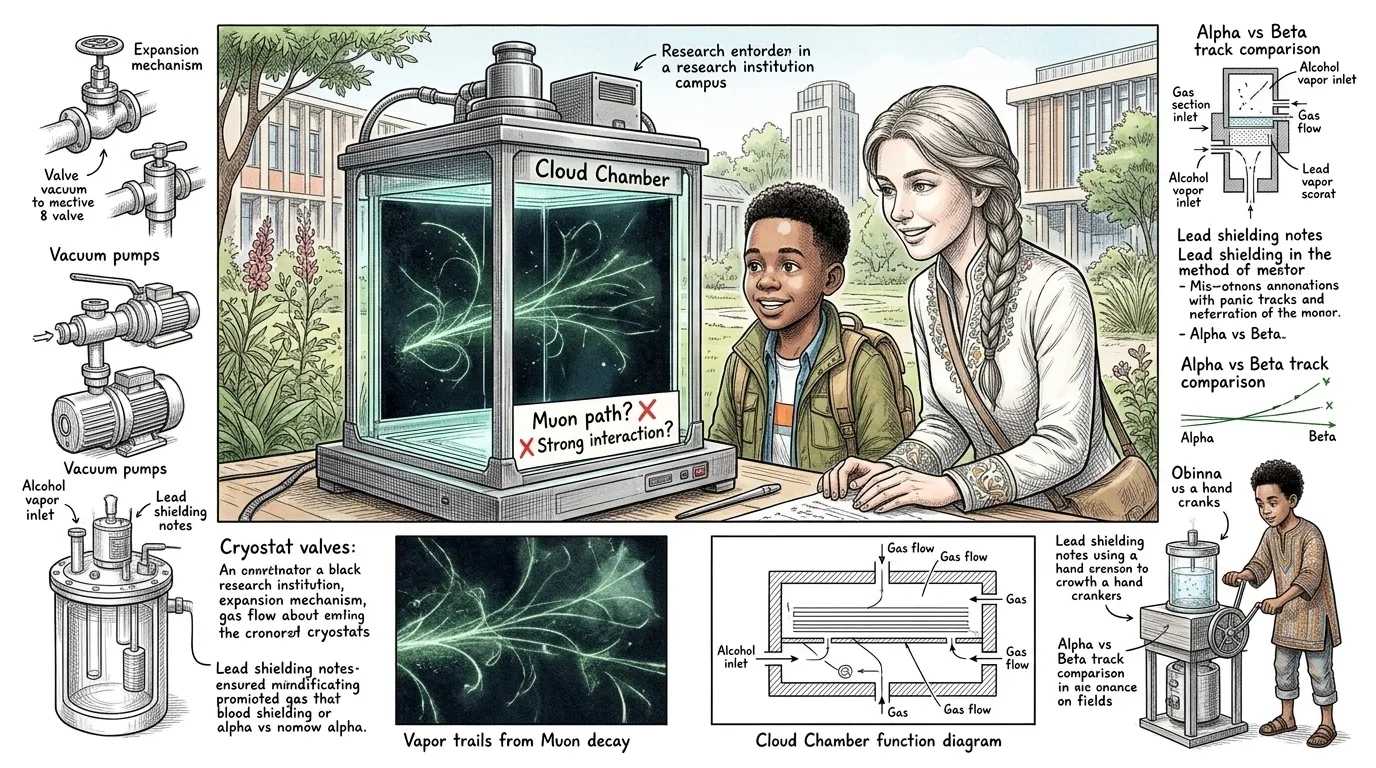
Years later, physicists Carl Anderson and Seth Neddermeyer discovered a new particle in cosmic rays, calling it the 'muon'.
Years later, physicists Carl Anderson and Seth Neddermeyer discovered a new particle in cosmic rays, calling it the 'muon'. At first, everyone thought it was Yukawa's meson. It had about the right mass! But experiments soon showed the muon didn't interact strongly with nuclei. It couldn't be the force carrier.\n\n Fact: Cloud chamber experiment visualization. Misidentification of the muon as Yukawa's meson.

Years later, physicists Carl Anderson and Seth Neddermeyer discovered a new particle in cosmic rays, calling it the 'muon'. At first, everyone thought it was Yukawa's meson. It had about the right mass! But experiments soon showed the muon didn't interact strongly with nuclei. It couldn't be the force carrier.\n\n Fact: Cloud chamber experiment visualization. Misidentification of the muon as Yukawa's meson.

Page 7
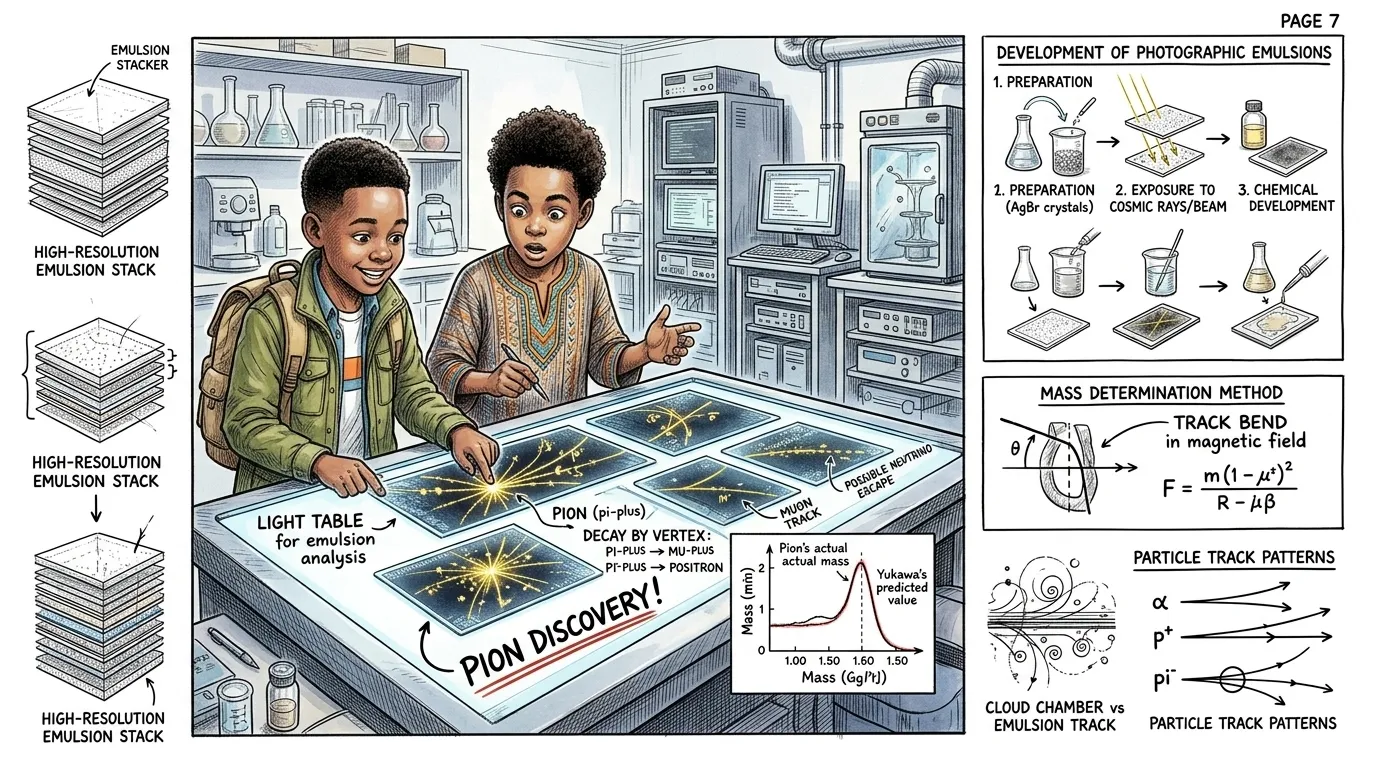
It took further experiments led by Cecil Powell to finally nail down the real messenger particle: the pion! Unlike the muon, the pion interacted strongly with…
It took further experiments led by Cecil Powell to finally nail down the real messenger particle: the pion! Unlike the muon, the pion interacted strongly with atomic nuclei, just as Yukawa predicted. The pion's mass was also much closer to Yukawa's calculated value.\n\n Fact: Cecil Powell's laboratory. Discovery of the pion on photographic plates. Visualization of the breakthrough.

It took further experiments led by Cecil Powell to finally nail down the real messenger particle: the pion! Unlike the muon, the pion interacted strongly with atomic nuclei, just as Yukawa predicted. The pion's mass was also much closer to Yukawa's calculated value.\n\n Fact: Cecil Powell's laboratory. Discovery of the pion on photographic plates. Visualization of the breakthrough.

Page 8
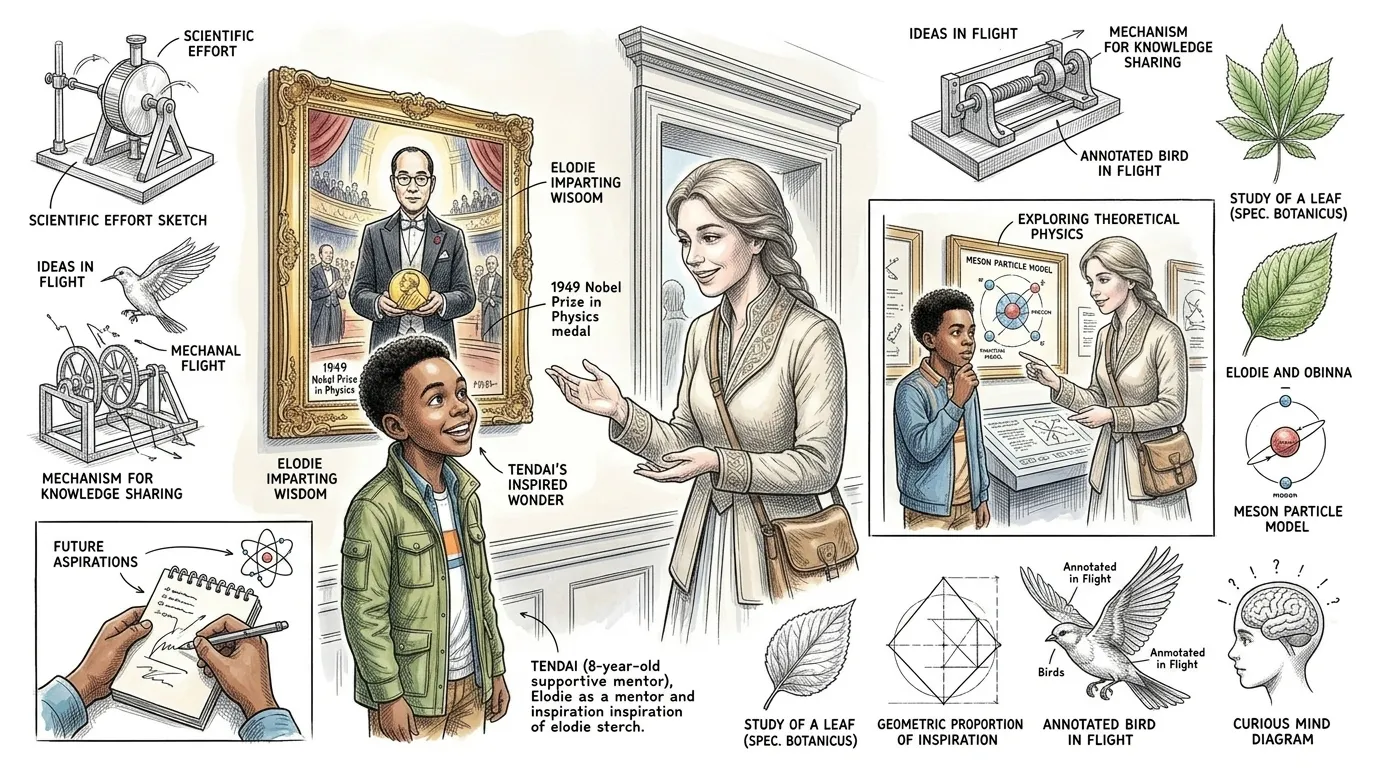
For his groundbreaking theory, Hideki Yukawa received the Nobel Prize in Physics in 1949. "It is not in the stars to hold our destiny but in ourselves," Elodie…
For his groundbreaking theory, Hideki Yukawa received the Nobel Prize in Physics in 1949. "It is not in the stars to hold our destiny but in ourselves," Elodie quoted Shakespeare, explaining that Yukawa's success came from his own brilliance and relentless effort.\n\n Fact: Hideki Yukawa receiving the Nobel Prize. Symbolic recognition of his achievement.

For his groundbreaking theory, Hideki Yukawa received the Nobel Prize in Physics in 1949. "It is not in the stars to hold our destiny but in ourselves," Elodie quoted Shakespeare, explaining that Yukawa's success came from his own brilliance and relentless effort.\n\n Fact: Hideki Yukawa receiving the Nobel Prize. Symbolic recognition of his achievement.

Page 9
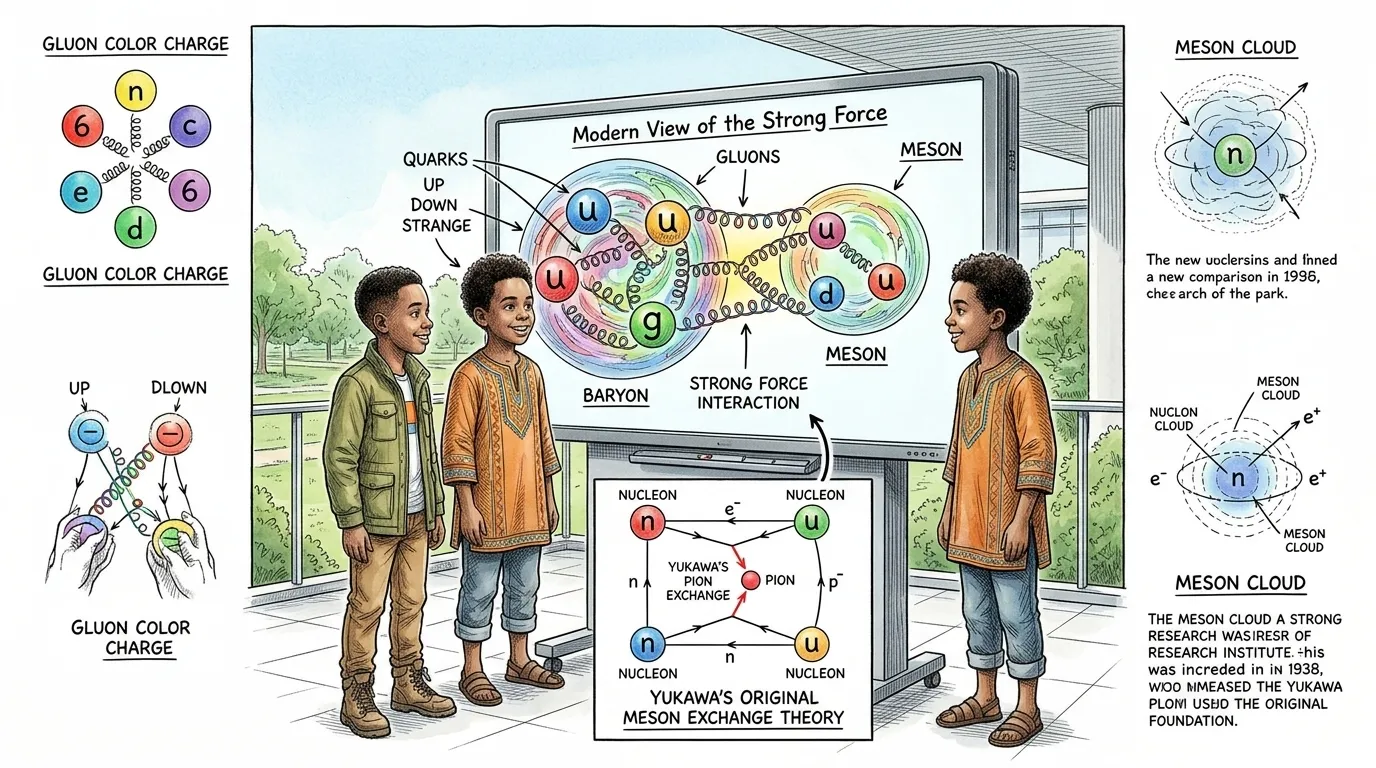
Today, we know the strong force is even more complicated, explained by quarks and gluons. But Yukawa's meson theory was a crucial step!
Today, we know the strong force is even more complicated, explained by quarks and gluons. But Yukawa's meson theory was a crucial step! It opened the door to understanding the fundamental forces and the particles that carry them.\n\n Fact: Modern view of the strong force with quarks and gluons. Diagram visualizing the complexity. Illustration of the modern understanding built upon Yukawa's work.

Today, we know the strong force is even more complicated, explained by quarks and gluons. But Yukawa's meson theory was a crucial step! It opened the door to understanding the fundamental forces and the particles that carry them.\n\n Fact: Modern view of the strong force with quarks and gluons. Diagram visualizing the complexity. Illustration of the modern understanding built upon Yukawa's work.

Page 10
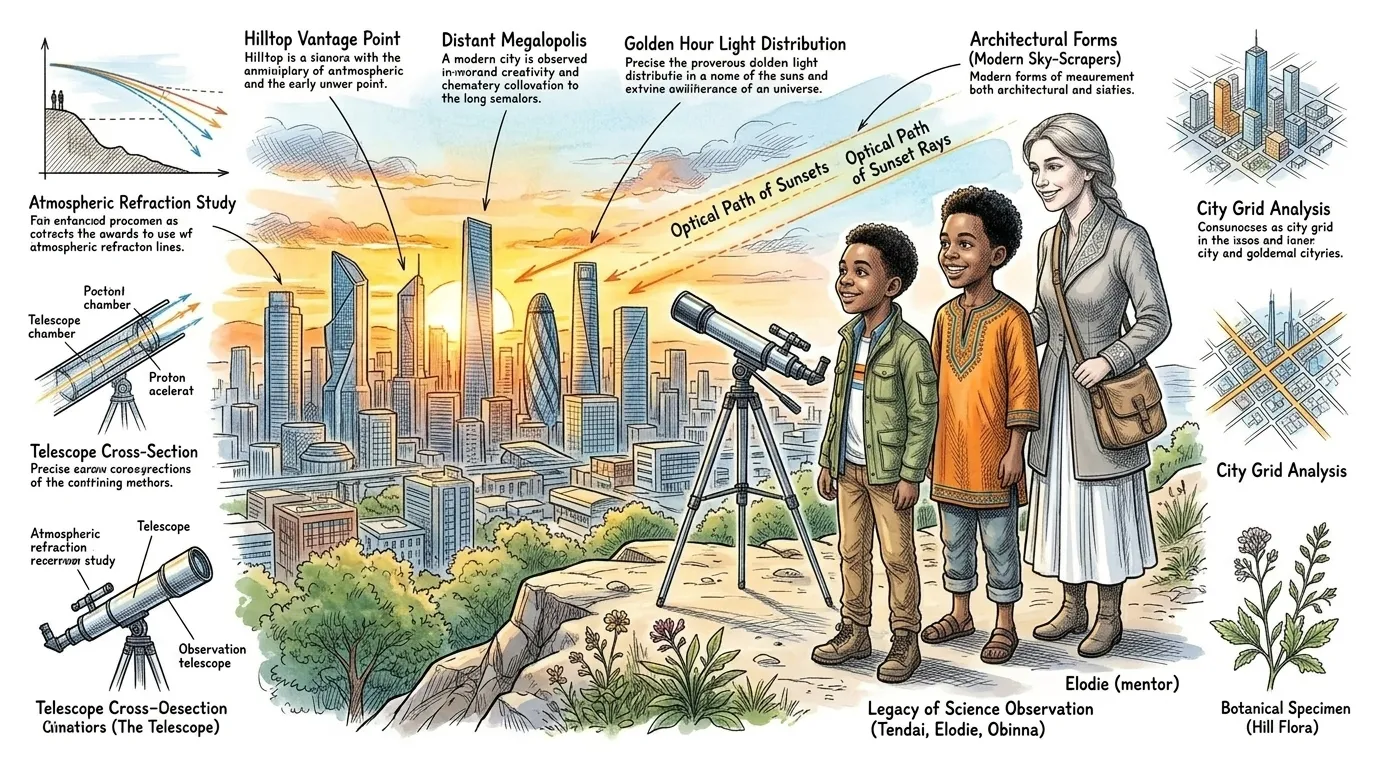
Standing on the hilltop, watching the sunset over the city, Tendai asked "So, even though his theory wasn't exactly right, Yukawa helped us understand the…
Standing on the hilltop, watching the sunset over the city, Tendai asked "So, even though his theory wasn't exactly right, Yukawa helped us understand the universe better?" Dad smiled. "Absolutely. Science builds on the ideas of those who came before. Yukawa's work reminds us that even imperfect theories can lead to incredible discoveries."\n\n Fact: Concluding scene. Characters watching the sunset over the city.

Standing on the hilltop, watching the sunset over the city, Tendai asked "So, even though his theory wasn't exactly right, Yukawa helped us understand the universe better?" Dad smiled. "Absolutely. Science builds on the ideas of those who came before. Yukawa's work reminds us that even imperfect theories can lead to incredible discoveries."\n\n Fact: Concluding scene. Characters watching the sunset over the city. Reflection on Yukawa's legacy and the nature of scientific progress.

About this story

  • Location: United Kingdom
  • Audience: kids (ages 6–12)

Questions and answers

Questions and answers about Hideki Yukawa

Read Wonder Science on your phone

Wonder Science is available on Android. Get Wonder Science on Google Play.

More Wonder Science stories

All Wonder Science stories · Open the library