How Crystals Grow Underground

How Crystals Grow Underground — an illustrated science story. 10 illustrated pages, free to read on Wonder Science.
How Crystals Grow Underground — book cover — Wonder Science
How Crystals Grow Underground — an illustrated science story. 10 illustrated pages, free to read on Wonder Science.

Page 1

Inside their bright San Francisco kitchen, River watched her mother refill a clear grinder with coarse rock salt. "Look at these, Mom!" she exclaimed, picking…
Inside their bright San Francisco kitchen, River watched her mother refill a clear grinder with coarse rock salt. "Look at these, Mom!" she exclaimed, picking up a single glistening piece from the counter. "They're perfect little see-through cubes—how do rocks grow into such perfect shapes?"

Inside their bright San Francisco kitchen, River watched her mother refill a clear grinder with coarse rock salt. "Look at these, Mom!" she exclaimed, picking up a single glistening piece from the counter. "They're perfect little see-through cubes—how do rocks grow into such perfect shapes?"

Page 2

Later, at the dining table, River's Father set down a piece of cloudy quartz next to the salt shaker. "It's not just salt," he said, his eyes twinkling.
Later, at the dining table, River's Father set down a piece of cloudy quartz next to the salt shaker. "It's not just salt," he said, his eyes twinkling. "This quartz, the sugar in that bowl—they are all crystals, built by nature." River leaned in, tracing the quartz's sharp edges. "But how do all the tiny invisible parts line up so perfectly to make these shapes?"

Later, at the dining table, River's Father set down a piece of cloudy quartz next to the salt shaker. "It's not just salt," he said, his eyes twinkling. "This quartz, the sugar in that bowl—they are all crystals, built by nature." River leaned in, tracing the quartz's sharp edges. "But how do all the tiny invisible parts line up so perfectly to make these shapes?"

Page 3

"To answer that, we have to imagine a journey deep underground, millions of years ago," her Father explained, his hands shaping a sphere in the air.
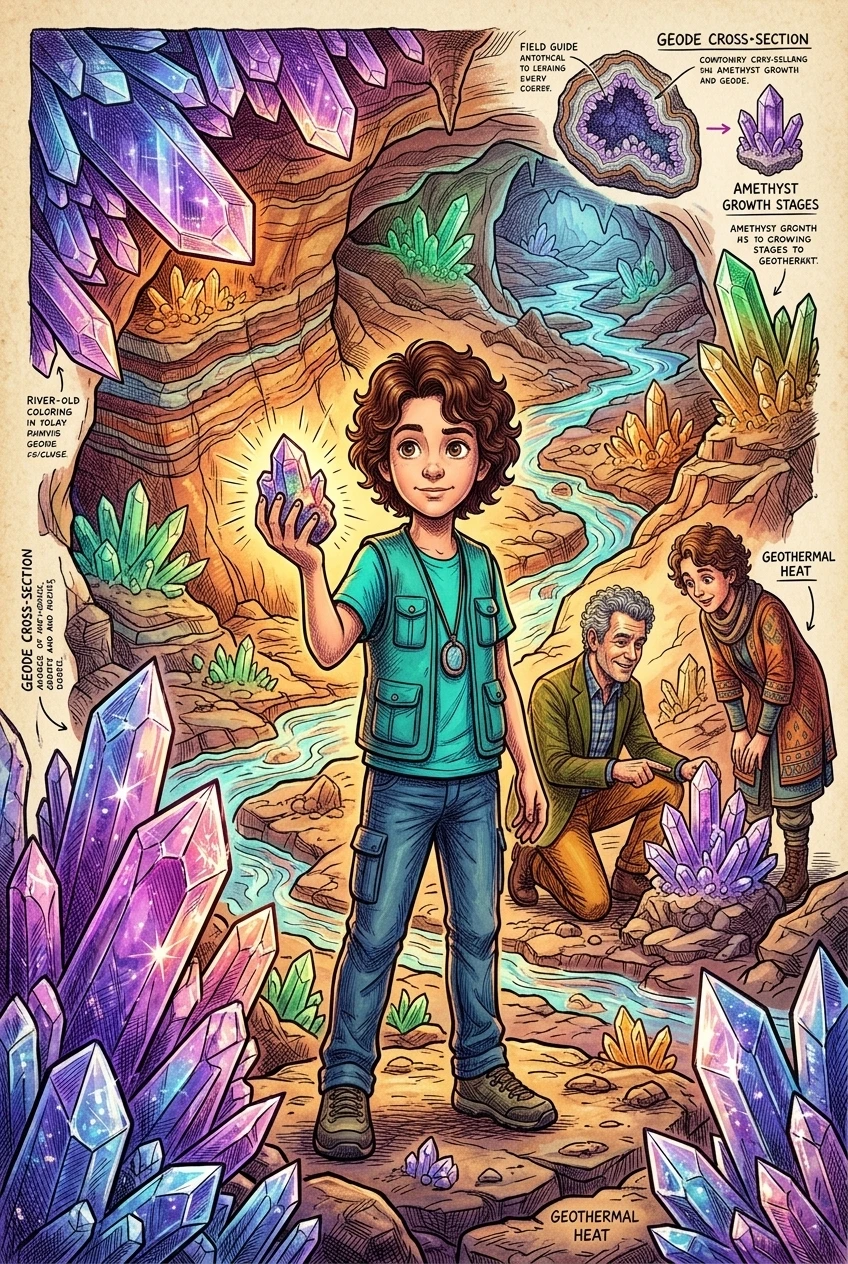
"To answer that, we have to imagine a journey deep underground, millions of years ago," her Father explained, his hands shaping a sphere in the air. "Imagine superheated water, rich with dissolved minerals like silica, being forced through cracks in the Earth's crust. This mineral soup is the secret ingredient for growing crystals."

"To answer that, we have to imagine a journey deep underground, millions of years ago," her Father explained, his hands shaping a sphere in the air. "Imagine superheated water, rich with dissolved minerals like silica, being forced through cracks in the Earth's crust. This mineral soup is the secret ingredient for growing crystals."

Page 4

"Long ago, people were just as curious as you are," her Father continued. "One of the first to study them seriously was a Danish scientist in the 1600s named…
"Long ago, people were just as curious as you are," her Father continued. "One of the first to study them seriously was a Danish scientist in the 1600s named Nicolaus Steno. He wasn't just a rock collector; he was a brilliant anatomist who became fascinated by the geometry of the natural world."

"Long ago, people were just as curious as you are," her Father continued. "One of the first to study them seriously was a Danish scientist in the 1600s named Nicolaus Steno. He wasn't just a rock collector; he was a brilliant anatomist who became fascinated by the geometry of the natural world."

Page 5

River's father smiled. "In his study around 1669, Steno noticed something incredible while examining quartz crystals from all over the world.
River's father smiled. "In his study around 1669, Steno noticed something incredible while examining quartz crystals from all over the world. He saw that even if one crystal was long and skinny and another was short and wide, the angles between their faces were always the same!"

River's father smiled. "In his study around 1669, Steno noticed something incredible while examining quartz crystals from all over the world. He saw that even if one crystal was long and skinny and another was short and wide, the angles between their faces were always the same!"

Page 6

"He realized the outside shape could be different, but the internal recipe was always the same," he explained. "This became Steno's Law, proving that crystals…
"He realized the outside shape could be different, but the internal recipe was always the same," he explained. "This became Steno's Law, proving that crystals are built by atoms stacking together in a fixed, repeating pattern. It's like they're all using the exact same set of microscopic building blocks."

"He realized the outside shape could be different, but the internal recipe was always the same," he explained. "This became Steno's Law, proving that crystals are built by atoms stacking together in a fixed, repeating pattern. It's like they're all using the exact same set of microscopic building blocks."

Page 7

"That basic discovery is why we have computers and smartphones!" her father exclaimed. "Scientists use this knowledge to grow perfect silicon crystals for…
"That basic discovery is why we have computers and smartphones!" her father exclaimed. "Scientists use this knowledge to grow perfect silicon crystals for computer chips and the tiny quartz crystals that keep time in our watches. In fact, even huge structures are affected by atomic arrangement; the Eiffel Tower actually grows 15 centimeters taller in the summer as its iron atoms expand!"

"That basic discovery is why we have computers and smartphones!" her father exclaimed. "Scientists use this knowledge to grow perfect silicon crystals for computer chips and the tiny quartz crystals that keep time in our watches. In fact, even huge structures are affected by atomic arrangement; the Eiffel Tower actually grows 15 centimeters taller in the summer as its iron atoms expand!"

Page 8

Back in the kitchen, River grabbed the salt grinder with a triumphant grin. "So that's it!" she declared. "The salt crystals are perfect cubes because their…
Back in the kitchen, River grabbed the salt grinder with a triumphant grin. "So that's it!" she declared. "The salt crystals are perfect cubes because their sodium and chloride atoms can only stack together in a cube shape!" Her Mom, now leaning against the counter, tapped her wrist. "And the tiny quartz crystal in this watch is ticking perfectly because its atoms are lined up in Steno's perfect pattern!"

Back in the kitchen, River grabbed the salt grinder with a triumphant grin. "So that's it!" she declared. "The salt crystals are perfect cubes because their sodium and chloride atoms can only stack together in a cube shape!" Her Mom, now leaning against the counter, tapped her wrist. "And the tiny quartz crystal in this watch is ticking perfectly because its atoms are lined up in Steno's perfect pattern!"

Page 9

River pointed to their granite countertop. "Look, the counter is full of tiny, sparkly crystals, too!" Her Father nodded.
River pointed to their granite countertop. "Look, the counter is full of tiny, sparkly crystals, too!" Her Father nodded. "That's right, mostly quartz and feldspar." River remembered a quote her teacher shared. "It's like the philosopher Aristotle said: 'In all things of nature there is something of the marvelous.' We're surrounded by these amazing crystal structures and we don't even notice them!"

River pointed to their granite countertop. "Look, the counter is full of tiny, sparkly crystals, too!" Her Father nodded. "That's right, mostly quartz and feldspar." River remembered a quote her teacher shared. "It's like the philosopher Aristotle said: 'In all things of nature there is something of the marvelous.' We're surrounded by these amazing crystal structures and we don't even notice them!"

Page 10

"So crystals just grow when hot, messy atoms cool down and lock together in a neat, repeating pattern," River summarized, opening her notebook.
"So crystals just grow when hot, messy atoms cool down and lock together in a neat, repeating pattern," River summarized, opening her notebook. Her Father looked out the window at the distant silhouette of the Marin Headlands. "All that heat and pressure makes crystals," he mused, "but what else does it do? It's powerful enough to bend and fold solid rock, even build entire mountains."

"So crystals just grow when hot, messy atoms cool down and lock together in a neat, repeating pattern," River summarized, opening her notebook. Her Father looked out the window at the distant silhouette of the Marin Headlands. "All that heat and pressure makes crystals," he mused, "but what else does it do? It's powerful enough to bend and fold solid rock, even build entire mountains."

About this story

  • Audience: kids (ages 6–12)

Questions and answers

Questions and answers about How Crystals Grow Underground

Read Wonder Science on your phone

Wonder Science is available on Android. Get Wonder Science on Google Play.

More Wonder Science stories

All Wonder Science stories · Open the library