Louis de Broglie
Louis de Broglie — an illustrated science story, set in Global. 10 illustrated pages, free to read on Wonder Science.

Page 1

Imagine a world where everything, even you, has a wave-like nature. It seems strange, right? But that's the idea proposed by Louis de Broglie, a French physicist who dared to challenge the conventional understanding of matter. His radical hypothesis revolutionized physics, earning him the Nobel Prize and forever changing how we see the universe. Let's dive into de Broglie's world and uncover the amazing wave-particle duality.\n\n Fact: Louis de Broglie proposed that matter, like electrons, has wave-like properties.
Page 2
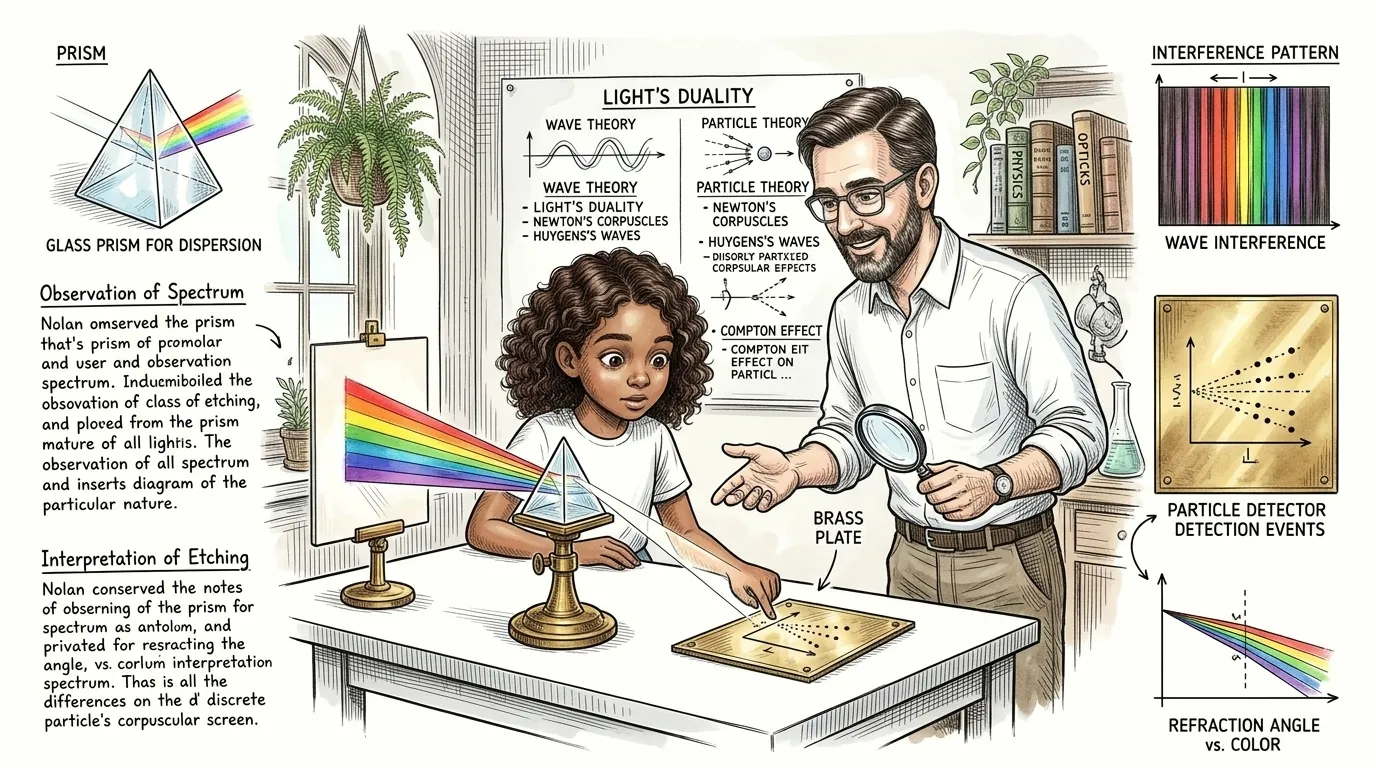
To understand de Broglie's genius, we need to travel back to the early 20th century. Physicists were grappling with a major puzzle: light. Some experiments showed light behaving like a wave, spreading and interfering, while others revealed it acting as a stream of particles, like tiny bullets. This wave-particle duality was a constant source of debate. Remember, as Robert Millikan said, 'The pursuit of science is a grand adventure!' This quest to understand light was definitely adventurous.\n\n Fact: Light exhibits wave-particle duality, behaving as both a wave and a particle.
Page 3
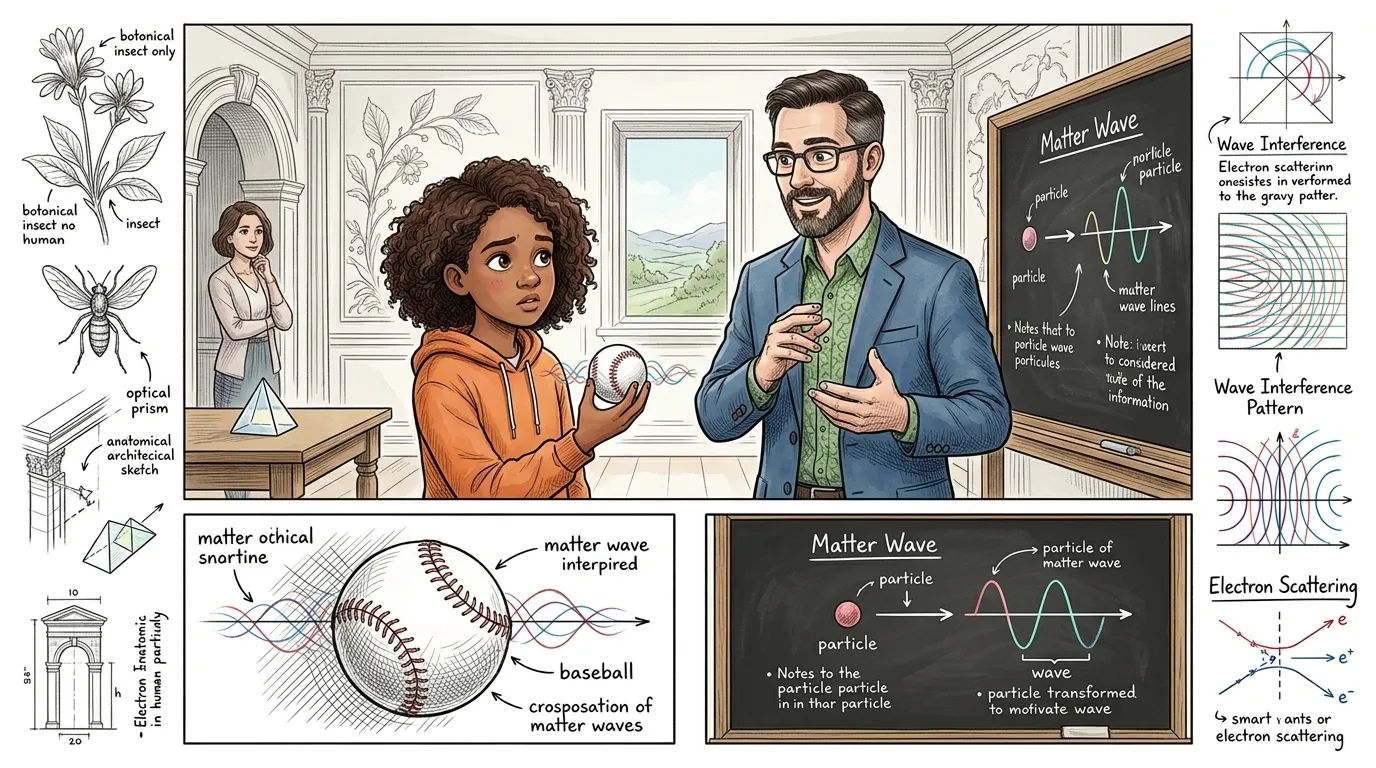
De Broglie asked a revolutionary question: if light, which everyone thought was a wave, could also be a particle, then couldn't matter, which everyone thought was made of particles, also be a wave? He proposed that every particle has an associated wavelength, inversely proportional to its momentum. This 'matter wave' concept was initially met with skepticism. Imagine suggesting that a baseball has a wavelength!\n\n Fact: De Broglie hypothesized that all matter has wave-like properties, with a wavelength inversely proportional to momentum.
Page 4
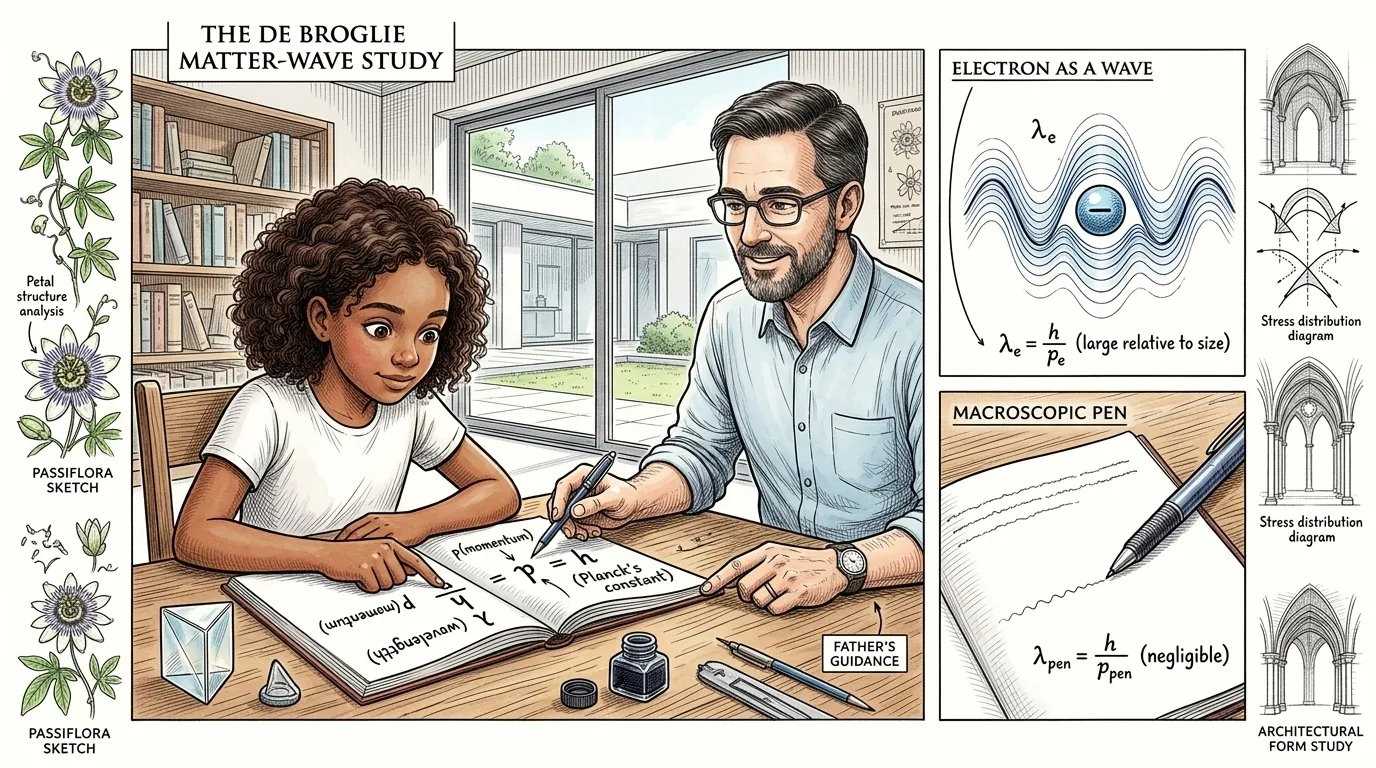
The equation that de Broglie came up with, λ h/p, tells us the wavelength (λ) of a particle is equal to Planck's constant (h) divided by the particle's momentum (p). Planck's constant is a tiny number, which is why we don't notice the wave nature of everyday objects – their wavelengths are incredibly small! But for tiny particles like electrons, with very small mass, the wavelength becomes significant.\n\n Fact: De Broglie's equation: λ h/p, where λ is wavelength, h is Planck's constant, and p is momentum.
Page 5
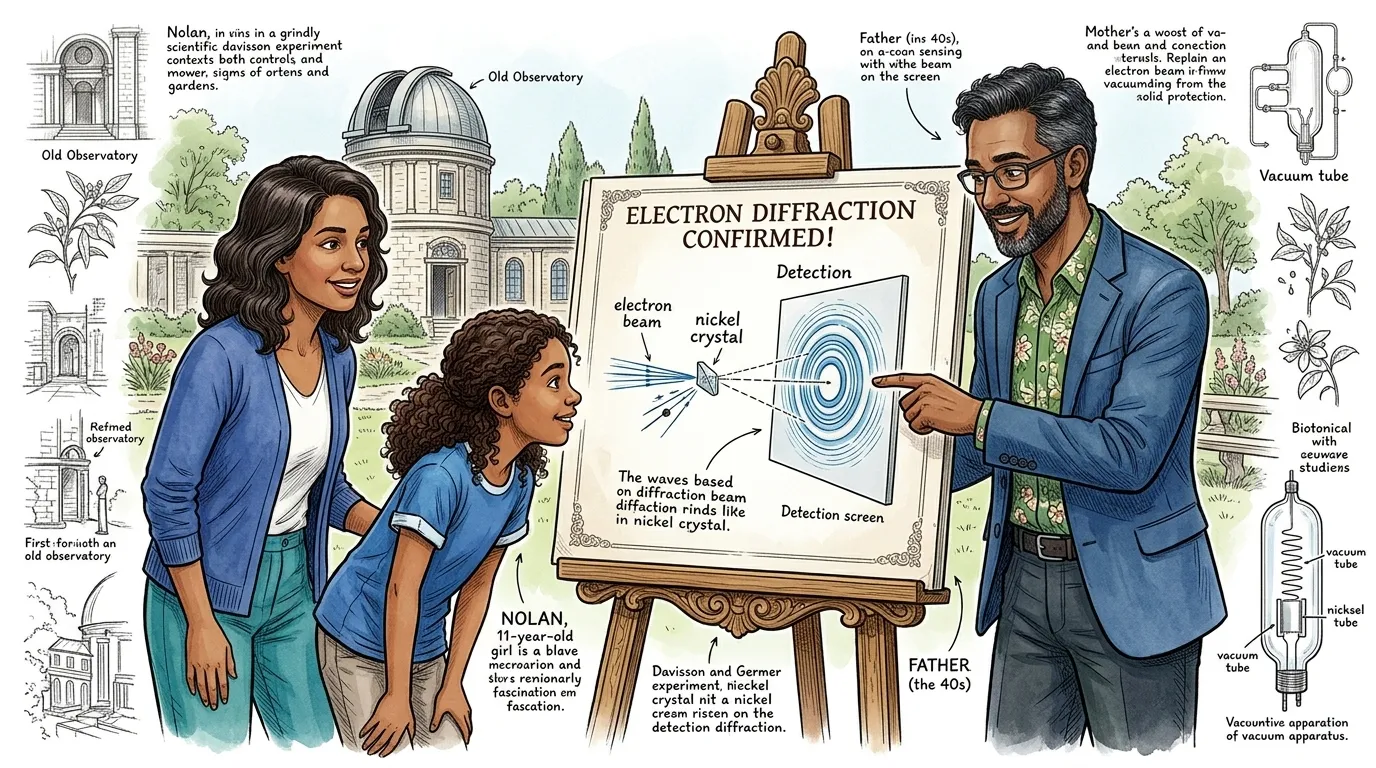
De Broglie's hypothesis was theoretical at first. But in 1927, Clinton Davisson and Lester Germer, while studying electron scattering off a nickel crystal, observed diffraction patterns – a behavior unique to waves! This was direct experimental evidence that electrons, like light, could act as waves. It validated de Broglie's theory and solidified the concept of wave-particle duality for matter.\n\n Fact: Davisson and Germer's experiment provided experimental evidence for electron diffraction, confirming de Broglie's hypothesis.
Page 6
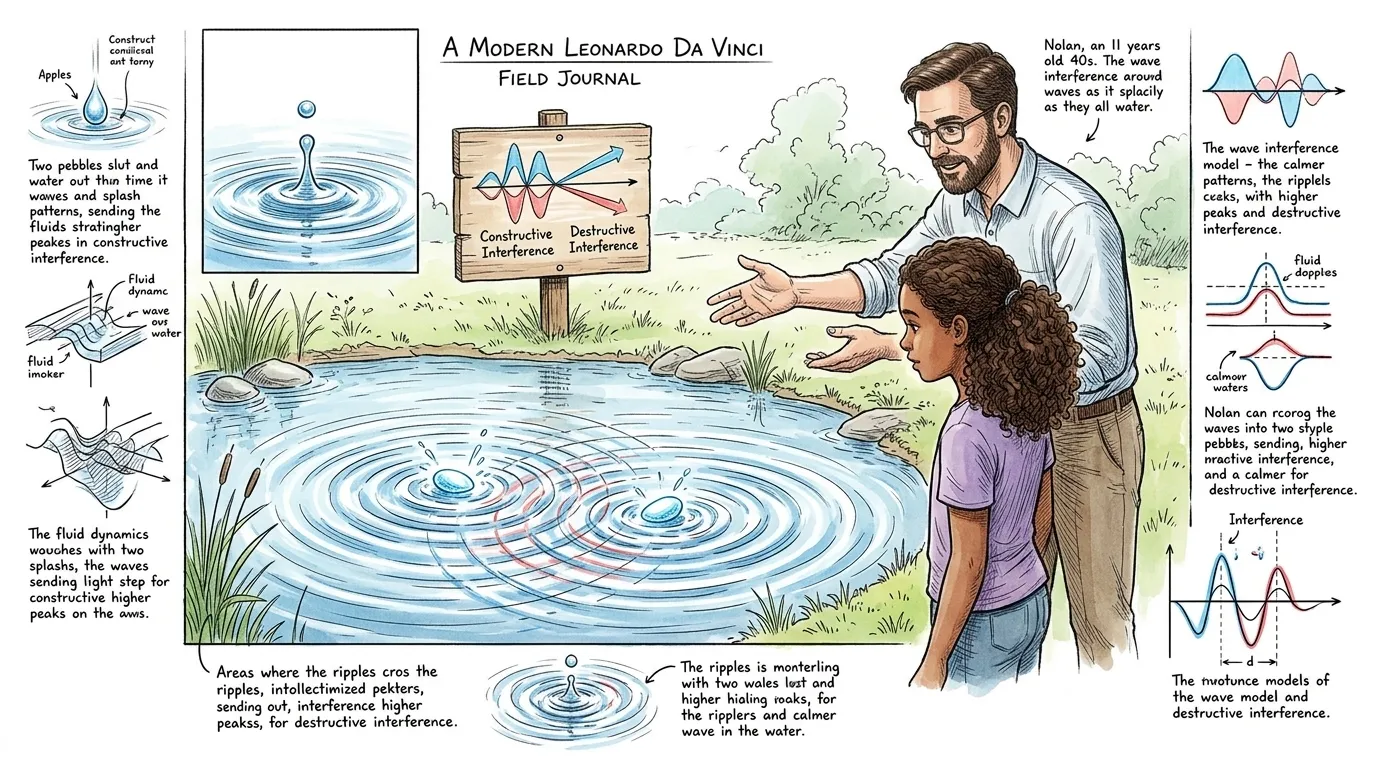
Imagine throwing two pebbles into a pond. The ripples will spread and interfere with each other, creating areas where the waves add up (constructive interference) and areas where they cancel out (destructive interference). Waves do this; particles don't. The observation of these interference patterns with electrons provided undeniable proof of their wave nature. It was a watershed moment in physics.\n\n Fact: Wave interference is a key characteristic of waves, where waves can add up (constructive) or cancel out (destructive).
Page 7
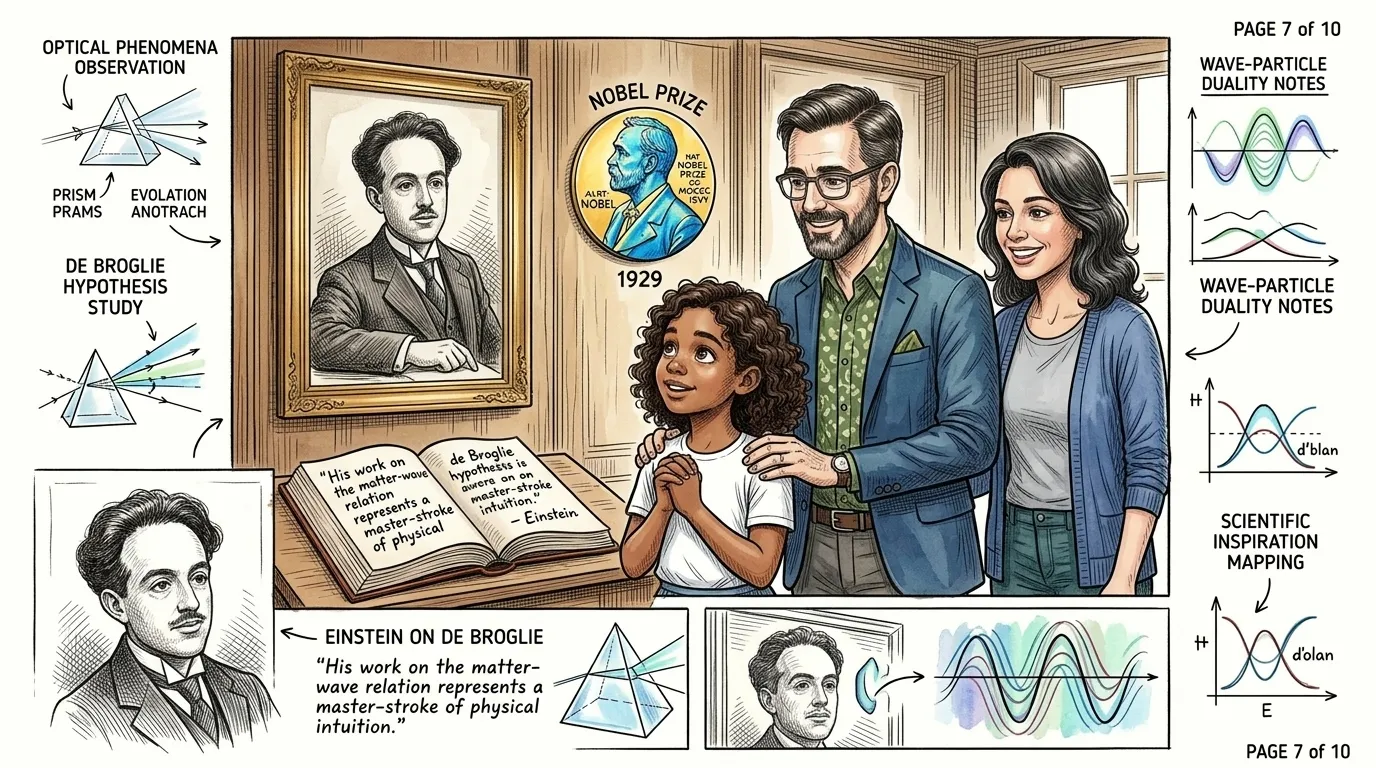
In 1929, Louis de Broglie was awarded the Nobel Prize in Physics for his groundbreaking discovery of the wave nature of electrons. His work laid the foundation for a new field of physics: quantum mechanics. Einstein himself had praised de Broglie's work, saying it was a 'great step forward.' He dared to think differently, challenging established beliefs and opening up new avenues of exploration.\n\n Fact: Louis de Broglie received the Nobel Prize in Physics in 1929 for his discovery of the wave nature of electrons.
Page 8
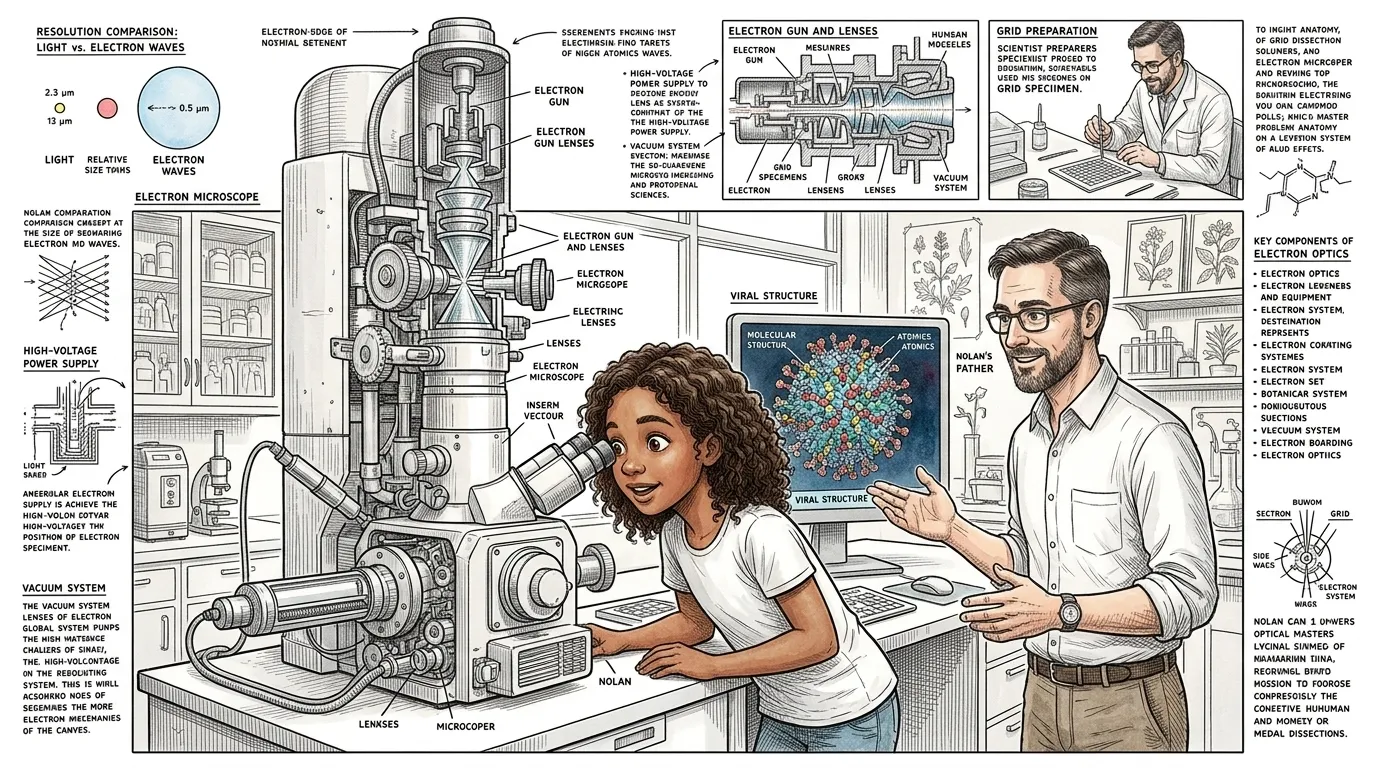
One of the most important applications of de Broglie's work is the electron microscope. Because electrons have much smaller wavelengths than light, electron microscopes can resolve much smaller details than optical microscopes. This allows us to see structures that were previously invisible, like viruses, molecules, and even atoms!\n\n Fact: Electron microscopes use the wave nature of electrons to achieve much higher resolution than optical microscopes.
Page 9
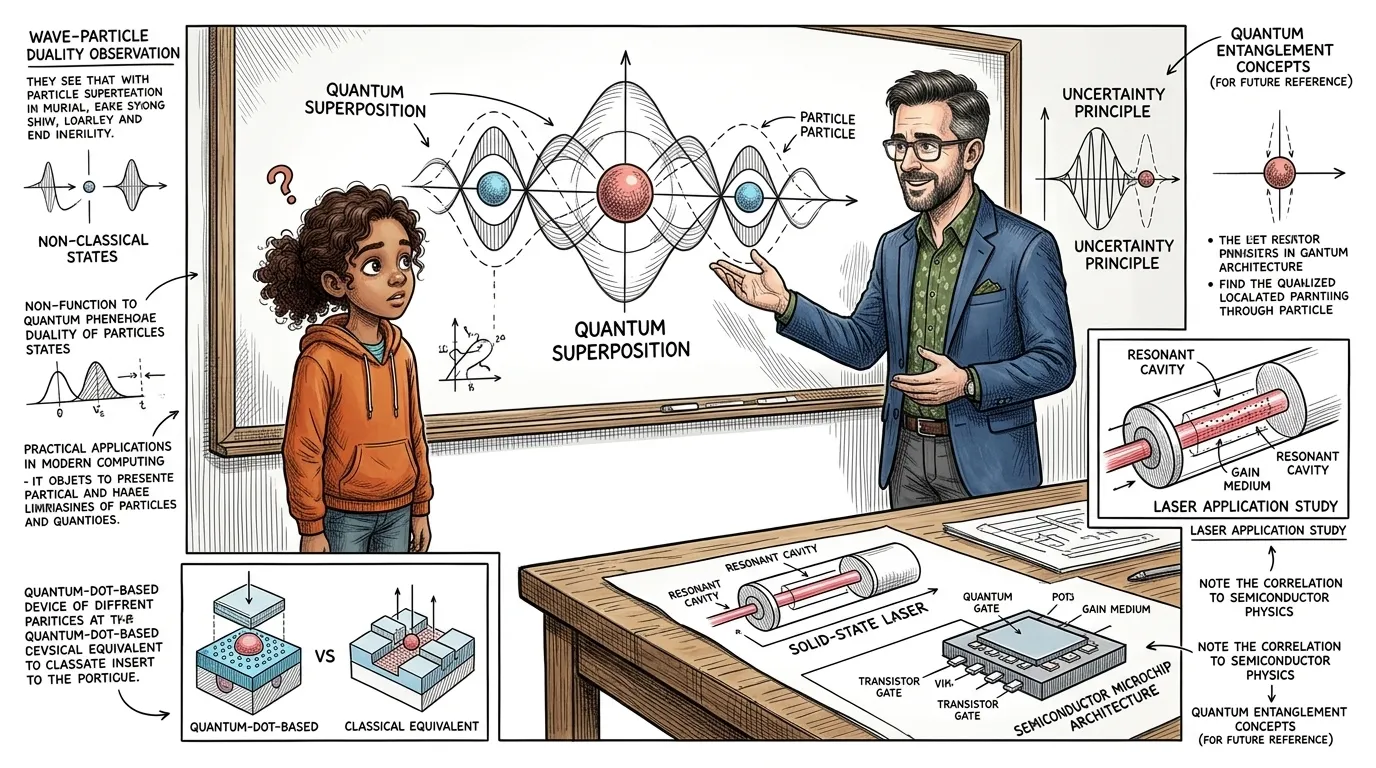
De Broglie's wave-particle duality is a cornerstone of quantum mechanics, the theory that governs the behavior of matter at the atomic and subatomic levels. It's a world where particles can be in multiple places at once, where observation changes reality, and where uncertainty reigns supreme. Quantum mechanics has led to countless technological advances, from lasers to computer chips.\n\n Fact: Wave-particle duality is a fundamental concept in quantum mechanics, influencing a range of modern technologies.
Page 10
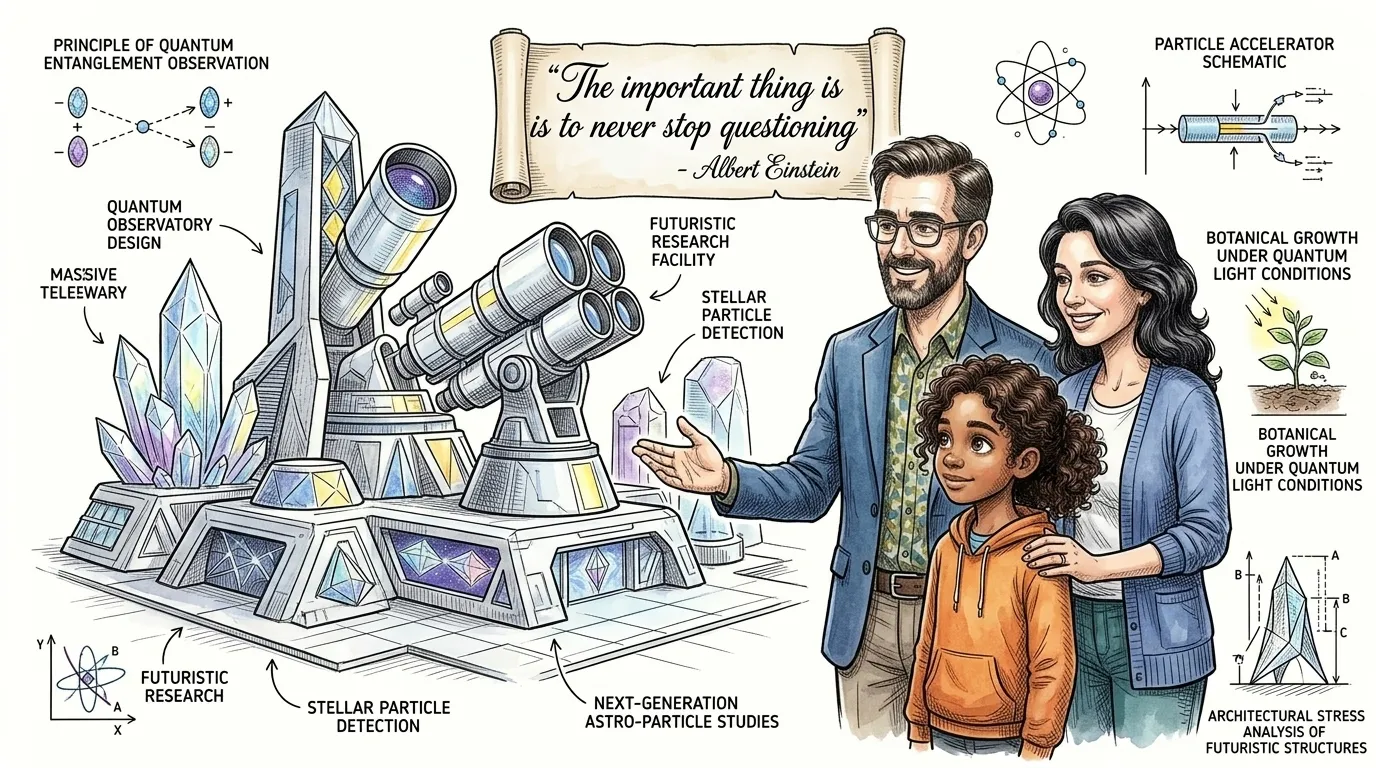
Louis de Broglie's work has had a profound impact on our understanding of the universe. He showed us that reality is far stranger and more wonderful than we ever imagined. His legacy continues to inspire scientists today to explore the mysteries of the quantum world. 'The important thing is to never stop questioning,' as Albert Einstein put it. De Broglie certainly never did!\n\n Fact: De Broglie's legacy continues to inspire scientists to explore the quantum world and the wave-particle duality of matter.
About this story
- Location: Global
- Audience: kids (ages 6–12)
Questions and answers
Read Wonder Science on your phone
Wonder Science is available on Android. Get Wonder Science on Google Play.