The First Moon Landing

The First Moon Landing — an illustrated science story. 10 illustrated pages, free to read on Wonder Science.
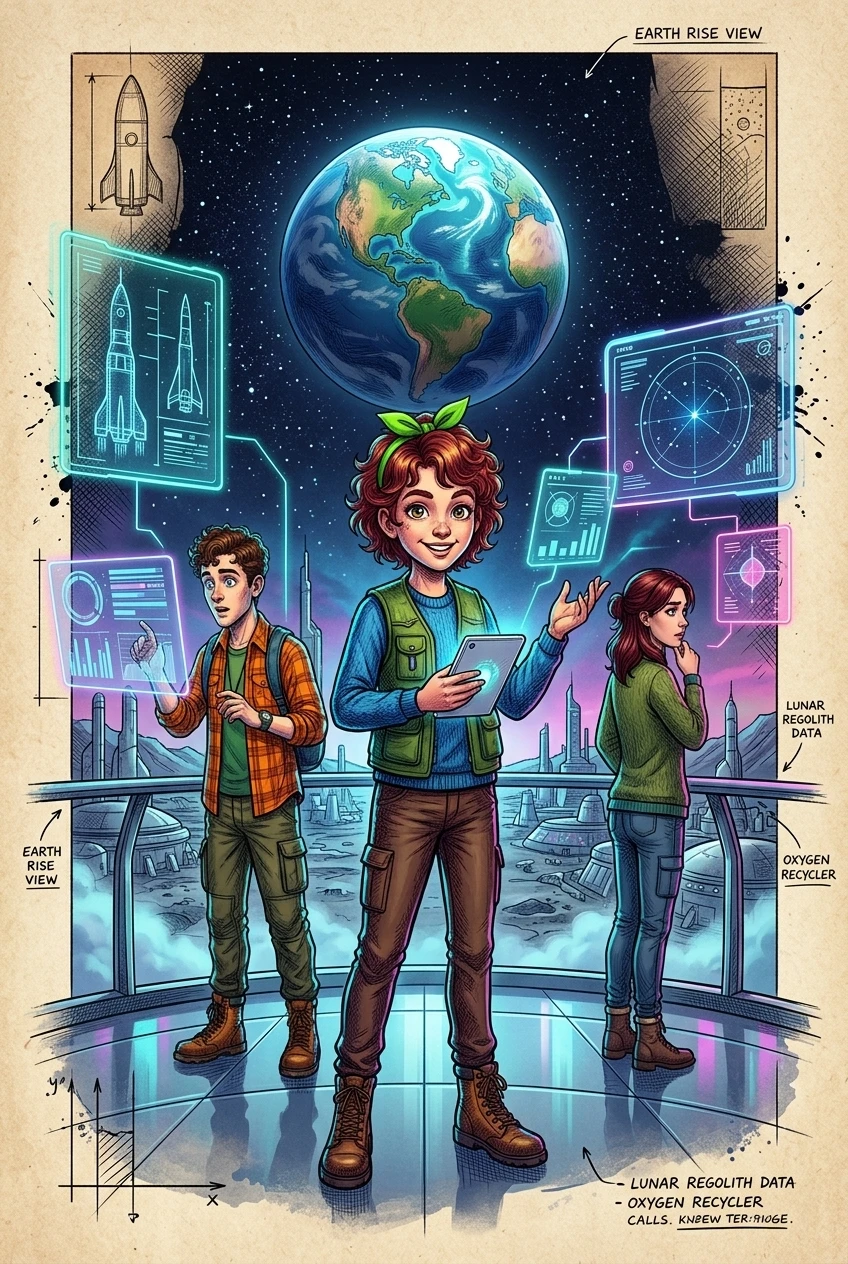
The First Moon Landing — book cover — Wonder Science
The First Moon Landing — an illustrated science story. 10 illustrated pages, free to read on Wonder Science.

Page 1

The lights in the planetarium dimmed, and the giant dome above filled with stars. Juniper and her friends, Liam and Chloe, leaned back in their seats at San…
The lights in the planetarium dimmed, and the giant dome above filled with stars. Juniper and her friends, Liam and Chloe, leaned back in their seats at San Francisco's California Academy of Sciences as an image of Earth rose over the Moon's horizon. "Whoa," whispered Chloe, her eyes wide with wonder, "can you imagine actually standing there and seeing that?" The narrator's voice faded, leaving them floating in a silent, star-filled space.

The lights in the planetarium dimmed, and the giant dome above filled with stars. Juniper and her friends, Liam and Chloe, leaned back in their seats at San Francisco's California Academy of Sciences as an image of Earth rose over the Moon's horizon. "Whoa," whispered Chloe, her eyes wide with wonder, "can you imagine actually standing there and seeing that?" The narrator's voice faded, leaving them floating in a silent, star-filled space.

Page 2

Walking out into the museum's bright hall, Liam shook his head in disbelief. "It looks impossible! How did anyone fly all the way to the Moon with the…
Walking out into the museum's bright hall, Liam shook his head in disbelief. "It looks impossible! How did anyone fly all the way to the Moon with the technology they had back then?" Juniper tapped her pencil on her discovery notebook. "Did you know that if you could fold a piece of paper 42 times, it would be thick enough to reach the Moon? The distance is immense, but they figured it out." She smiled, "It's an amazing story of perseverance."

Walking out into the museum's bright hall, Liam shook his head in disbelief. "It looks impossible! How did anyone fly all the way to the Moon with the technology they had back then?" Juniper tapped her pencil on her discovery notebook. "Did you know that if you could fold a piece of paper 42 times, it would be thick enough to reach the Moon? The distance is immense, but they figured it out." She smiled, "It's an amazing story of perseverance."

Page 3

Juniper imagined the world sixty years earlier, a time of fierce competition and bold dreams. "It all started with a challenge," she thought, picturing the…
Juniper imagined the world sixty years earlier, a time of fierce competition and bold dreams. "It all started with a challenge," she thought, picturing the grainy black-and-white broadcasts of the 1960s. A powerful voice filled the air, declaring a goal that seemed to belong to science fiction. The entire world was watching, holding its breath as two nations raced for the heavens.

Juniper imagined the world sixty years earlier, a time of fierce competition and bold dreams. "It all started with a challenge," she thought, picturing the grainy black-and-white broadcasts of the 1960s. A powerful voice filled the air, declaring a goal that seemed to belong to science fiction. The entire world was watching, holding its breath as two nations raced for the heavens.

Page 4

"But it wasn't just presidents and astronauts," Juniper explained to her friends, picturing the hidden heroes. "It took brilliant minds like Katherine Johnson…
"But it wasn't just presidents and astronauts," Juniper explained to her friends, picturing the hidden heroes. "It took brilliant minds like Katherine Johnson, a mathematician at NASA." She imagined a bustling room filled with people calculating, their minds the most powerful computers of the day. "They called her a 'human computer' because she could see the mathematical paths that would guide spaceships through the stars."

"But it wasn't just presidents and astronauts," Juniper explained to her friends, picturing the hidden heroes. "It took brilliant minds like Katherine Johnson, a mathematician at NASA." She imagined a bustling room filled with people calculating, their minds the most powerful computers of the day. "They called her a 'human computer' because she could see the mathematical paths that would guide spaceships through the stars."

Page 5

At her desk, Katherine meticulously checked every number, her pencil flying across graph paper. She once said, "I counted everything.
At her desk, Katherine meticulously checked every number, her pencil flying across graph paper. She once said, "I counted everything. I counted the steps to the road, the steps up to church, the number of dishes and silverware I washed..." This intense focus was her superpower; she had to plot the exact trajectory for the Apollo 11 mission. One tiny mistake in her calculations, and the astronauts would be lost in space forever.

At her desk, Katherine meticulously checked every number, her pencil flying across graph paper. She once said, "I counted everything. I counted the steps to the road, the steps up to church, the number of dishes and silverware I washed..." This intense focus was her superpower; she had to plot the exact trajectory for the Apollo 11 mission. One tiny mistake in her calculations, and the astronauts would be lost in space forever.

Page 6

Her work brought the mission to life. In a flash of fire and smoke, the Saturn V, the most powerful rocket ever built, began its slow climb into the sky.
Her work brought the mission to life. In a flash of fire and smoke, the Saturn V, the most powerful rocket ever built, began its slow climb into the sky. It pushed against Earth's gravity with unimaginable force, carrying three astronauts inside a tiny capsule at its peak. This single machine was the result of years of work from over 400,000 people, all focused on one shared goal.

Her work brought the mission to life. In a flash of fire and smoke, the Saturn V, the most powerful rocket ever built, began its slow climb into the sky. It pushed against Earth's gravity with unimaginable force, carrying three astronauts inside a tiny capsule at its peak. This single machine was the result of years of work from over 400,000 people, all focused on one shared goal.

Page 7

Four days later, the real test began as the Eagle lander separated from the main ship. Inside, Neil Armstrong and Buzz Aldrin guided their craft toward the…
Four days later, the real test began as the Eagle lander separated from the main ship. Inside, Neil Armstrong and Buzz Aldrin guided their craft toward the lunar surface. As they descended, Armstrong looked out the small triangular window. "The Eagle has wings," he reported back to a silent, listening Earth, more than 238,000 miles away.

Four days later, the real test began as the Eagle lander separated from the main ship. Inside, Neil Armstrong and Buzz Aldrin guided their craft toward the lunar surface. As they descended, Armstrong looked out the small triangular window. "The Eagle has wings," he reported back to a silent, listening Earth, more than 238,000 miles away.

Page 8

Suddenly, a sharp alarm blared through the cabin. "Program alarm!" Aldrin called out, his voice tense. "It's a 1202!" The lander's primitive computer was…
Suddenly, a sharp alarm blared through the cabin. "Program alarm!" Aldrin called out, his voice tense. "It's a 1202!" The lander's primitive computer was overloaded, a problem that could have ended the mission. But on the ground, a team of brilliant engineers recognized the code and made a split-second decision: "We're go! Hang tight, we're go!"

Suddenly, a sharp alarm blared through the cabin. "Program alarm!" Aldrin called out, his voice tense. "It's a 1202!" The lander's primitive computer was overloaded, a problem that could have ended the mission. But on the ground, a team of brilliant engineers recognized the code and made a split-second decision: "We're go! Hang tight, we're go!"

Page 9

Back at the museum, Liam pointed to an exhibit. "Look! The navigation computer in my phone is millions of times more powerful than the one that landed them on…
Back at the museum, Liam pointed to an exhibit. "Look! The navigation computer in my phone is millions of times more powerful than the one that landed them on the Moon!" Chloe added, "And that special insulation they invented to protect the spacecraft from extreme temperatures? We use a version of it today to keep buildings warm." They realized the science from that mission was all around them, hidden in everyday objects.

Back at the museum, Liam pointed to an exhibit. "Look! The navigation computer in my phone is millions of times more powerful than the one that landed them on the Moon!" Chloe added, "And that special insulation they invented to protect the spacecraft from extreme temperatures? We use a version of it today to keep buildings warm." They realized the science from that mission was all around them, hidden in everyday objects.

Page 10

As they walked out of the museum into the Golden Gate Park evening, Juniper finished a sketch of the Saturn V in her notebook.
As they walked out of the museum into the Golden Gate Park evening, Juniper finished a sketch of the Saturn V in her notebook. She wrote below it: Perseverance means solving impossible problems, one small step at a time. Liam gazed at the first star appearing in the twilight sky. "So if we figured out how to get to the Moon," he asked, "what's stopping us from going to Mars?"

As they walked out of the museum into the Golden Gate Park evening, Juniper finished a sketch of the Saturn V in her notebook. She wrote below it: Perseverance means solving impossible problems, one small step at a time. Liam gazed at the first star appearing in the twilight sky. "So if we figured out how to get to the Moon," he asked, "what's stopping us from going to Mars?"

About this story

  • Audience: kids (ages 6–12)

Questions and answers

Questions and answers about The First Moon Landing

Read Wonder Science on your phone

Wonder Science is available on Android. Get Wonder Science on Google Play.

More Wonder Science stories

All Wonder Science stories · Open the library