The Invisible Force of Friction
The Invisible Force of Friction — an illustrated science story, set in United States. 10 illustrated pages, free to read on Wonder Science.

Page 1

In the heart of Neo-San Francisco, where nature reclaims towering neon skyscrapers, a skateboarder attempts a daring grind. But what unseen force slows the board and brings the stunt to an abrupt halt? This is the invisible force of friction, slowing down everything in the city.\n\n Fact: Friction is the force that opposes motion between surfaces that are touching. It's everywhere, from the soles of our shoes to the tires of our cars. It is estimated that friction costs the US economy alone billions of dollars each year.
Page 2
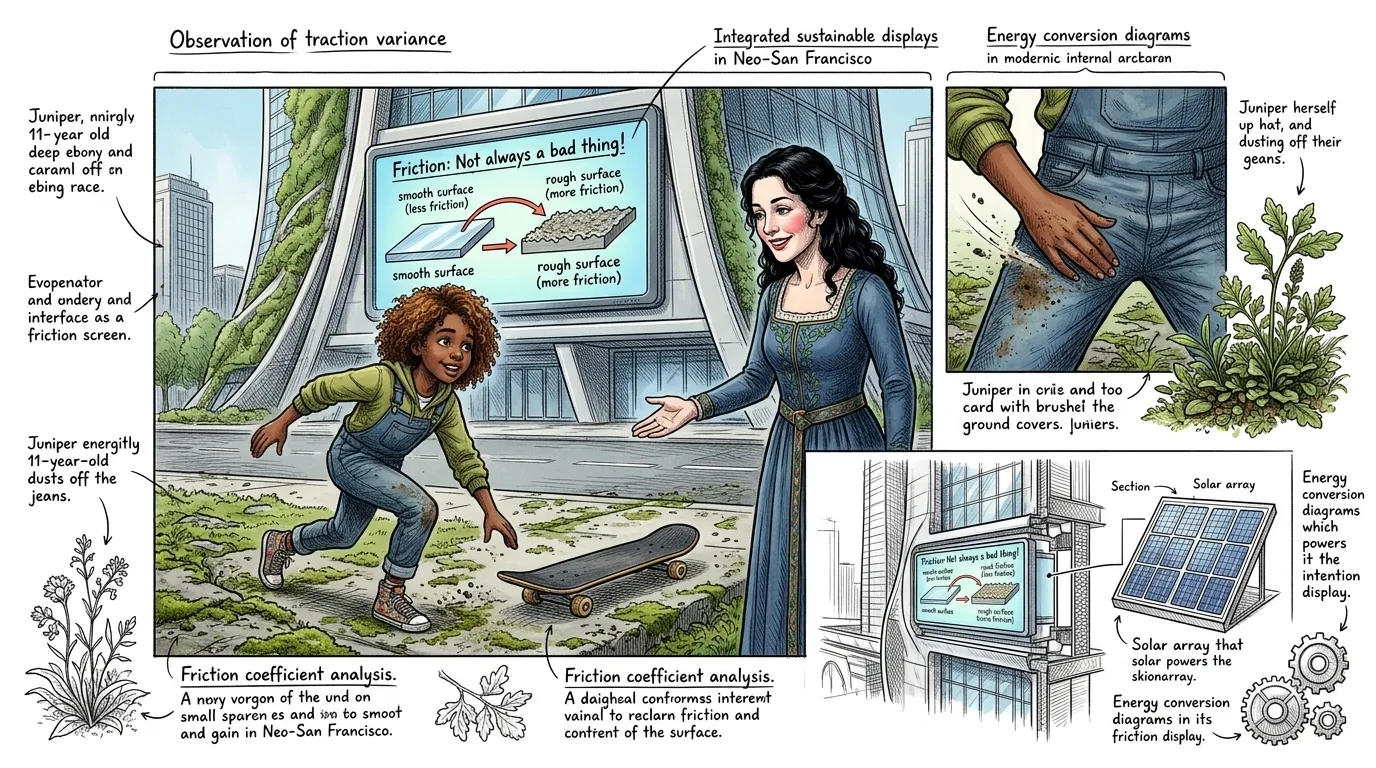
Juniper picks herself up, dusting off her jeans. 'Why did I fall?' she wonders aloud. Her friend, Vera, approaches. Vera explains that friction, the resistance to movement between surfaces, brought the skateboard to a halt. Understanding this force is crucial for everything from walking to driving.\n\n"'Ouch! What happened?' Juniper asked, rubbing her elbow.
'That's friction for you,' Vera chuckled. 'It's the force that resists motion when two surfaces rub together.'
'So, it's like an invisible brake?'
'Exactly!'"\n\n Fact: Friction is not always a bad thing. Without friction, we wouldn't be able to walk, drive, or even hold things! A smooth surface will have less friction than a rough surface.
Page 3
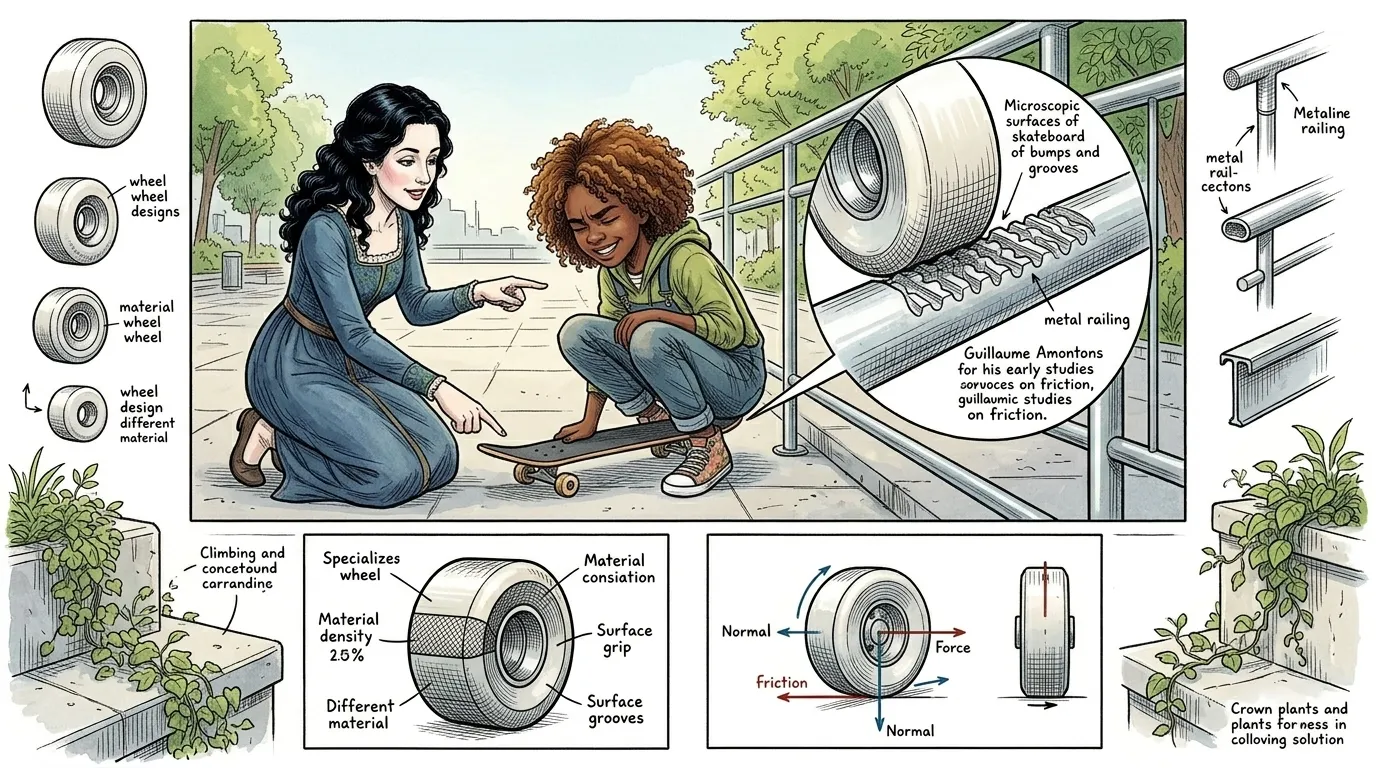
Vera points to the skateboard's wheels and the metal railing. 'See how those surfaces interact?' she asks. The roughness of the surfaces, even if they appear smooth, creates resistance. 'Everything, even at a tiny level, has bumps and grooves that catch on each other,' Vera adds.\n\n"'Look closely at the board's wheels and the railing,' Vera says. 'They seem smooth, right?'
Juniper squints. 'I guess so...'
'But even smooth surfaces have tiny bumps and grooves. These catch on each other, creating friction.'"\n\n Fact: The amount of friction between two surfaces depends on the materials they are made of and how hard they are pressed together. This was first studied in detail by Guillaume Amontons in the late 17th century.
Page 4
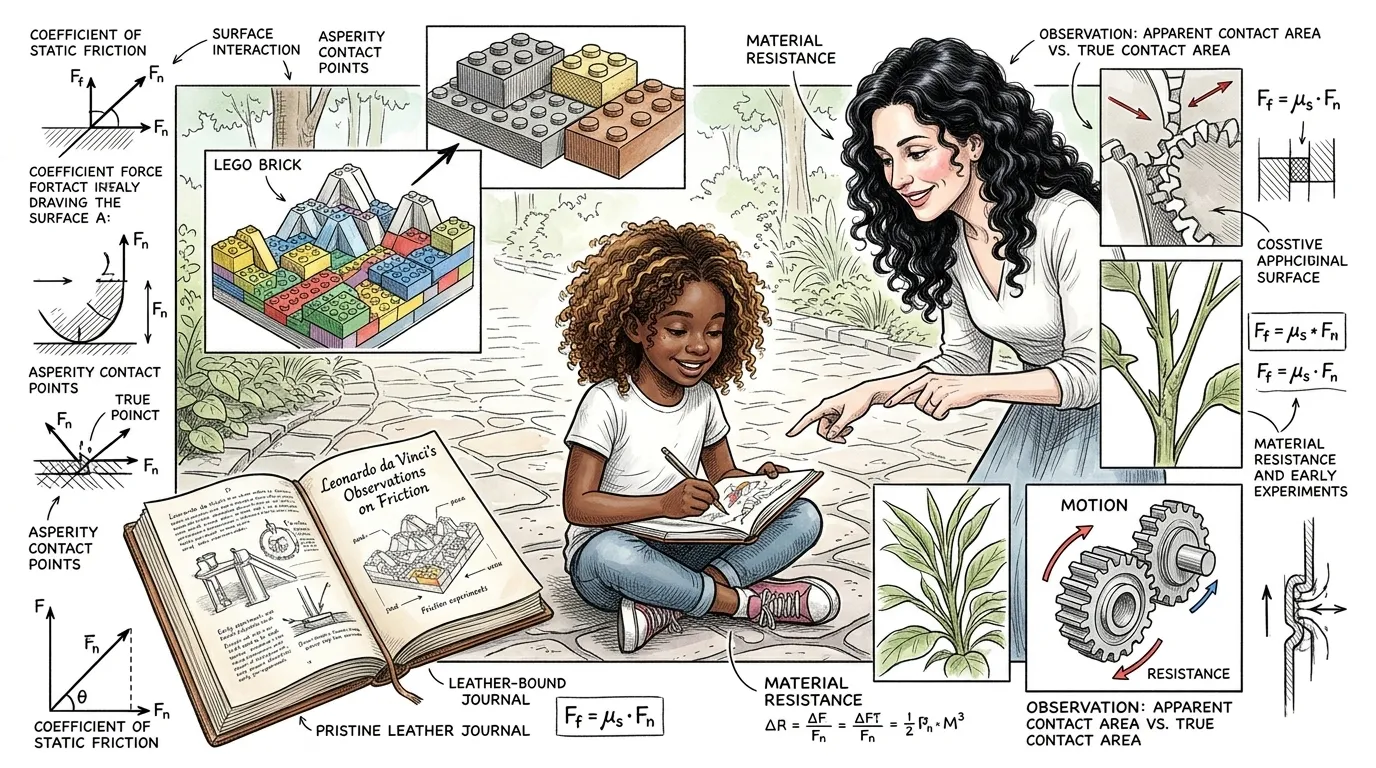
Juniper grabs her notebook and sketches the surfaces. She imagines zooming in to see the microscopic landscape of peaks and valleys. As the surfaces slide, these irregularities snag, creating resistance. This is the first step of understanding friction's fundamental mechanism.\n\n"'So, it's like everything is covered in tiny LEGO bricks?' Juniper asks, sketching furiously.
'That's a great way to picture it!' Vera replies. 'Those tiny interactions add up to the force we feel as friction.'"\n\n Fact: Leonardo da Vinci was one of the first to study friction systematically in the late 15th century, although his work was largely unpublished. He observed that the force needed to overcome friction is independent of the apparent area of contact.
Page 5

Beyond the surface roughness, the atoms of the two materials attract each other. This intermolecular attraction, though weak, adds to the overall friction. The stronger the attraction, the harder it is for the surfaces to slide. This is the second crucial step in friction.\n\n"'But it's not just the bumps, right?' Juniper asks, tapping her pen against her chin. 'There's something else holding them together.'
'You're right! It's the tiny forces of attraction between the atoms of the surfaces,' Vera says."\n\n Fact: These intermolecular forces are known as van der Waals forces, named after Dutch physicist Johannes Diderik van der Waals, who won the Nobel Prize in 1910 for his work on the equation of state for gases and liquids, which included these forces.
Page 6
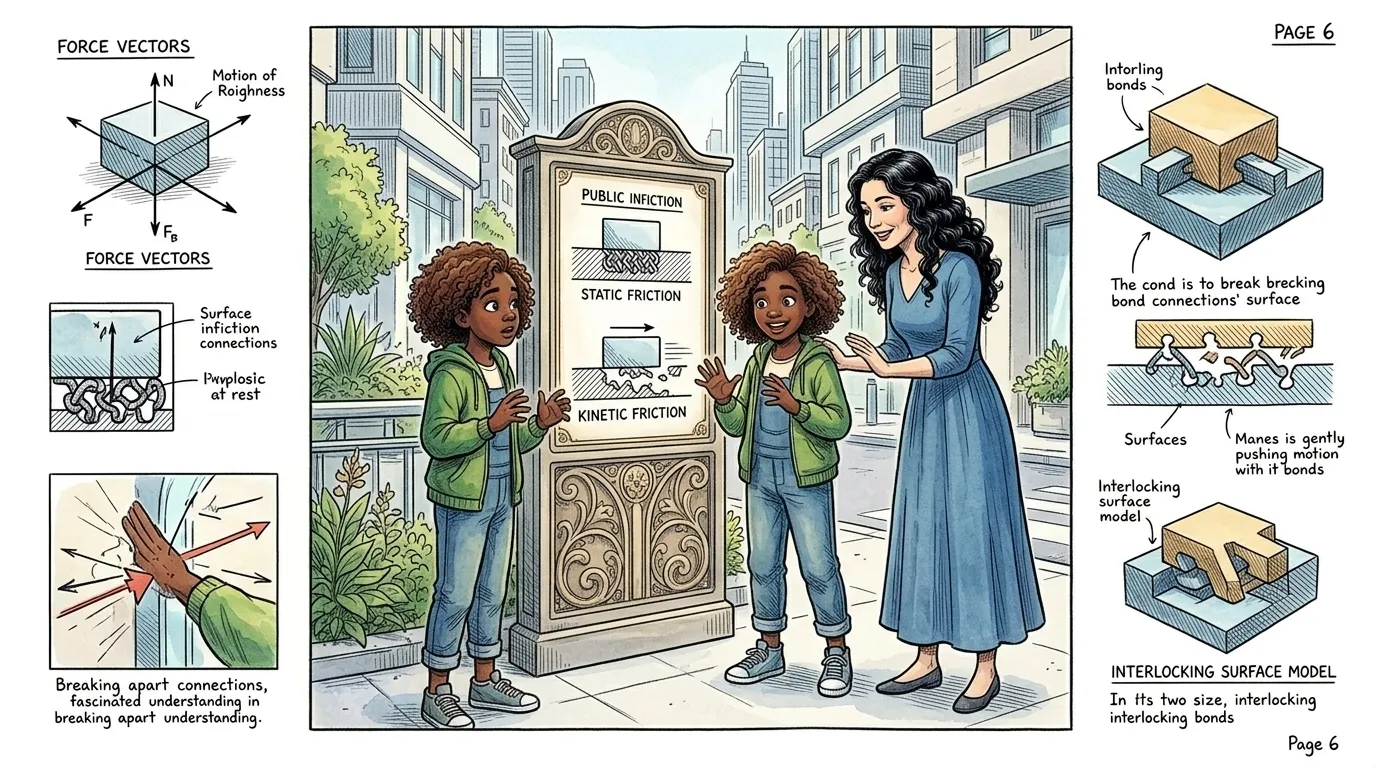
To initiate movement, enough force must be applied to overcome both the physical snagging and the atomic attraction. Once moving, the surfaces may continue to experience kinetic friction, which is often weaker than static friction. This dynamic interaction completes our understanding of friction.\n\n"'So, to get moving, you have to break all those tiny connections?' Juniper asks, eyes wide.
'Exactly! And once you're moving, it's usually easier to keep going because you're dealing with kinetic friction, which is often less than static friction,' Vera explains."\n\n Fact: Static friction is the force that prevents an object from starting to move, while kinetic friction is the force that opposes the motion of a moving object. Understanding this difference is essential in many engineering applications.
Page 7
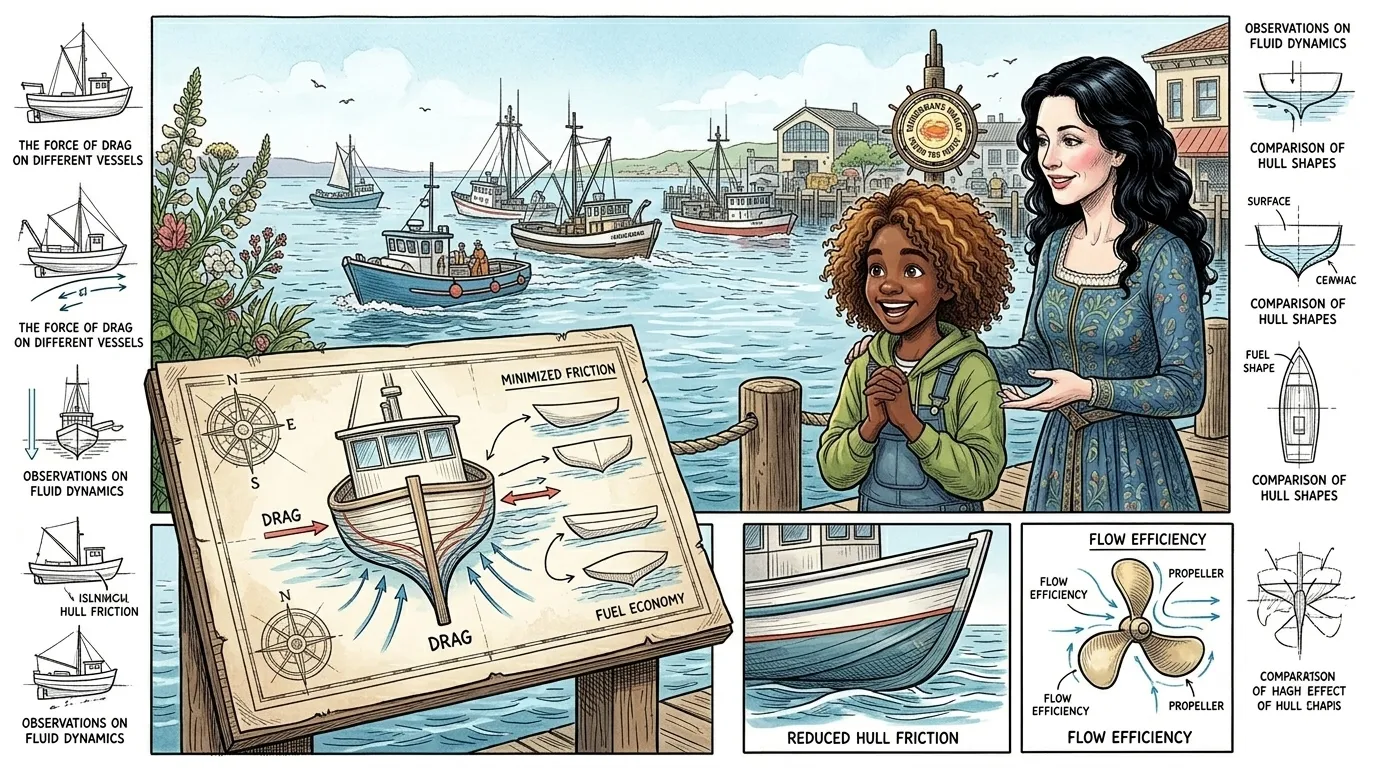
Juniper and Vera travel to Fisherman's Wharf, where they watch the bustling fishing boats. The engineers who design these boats must understand friction to ensure the vessels move efficiently through the water. Reducing friction is crucial for speed and fuel economy.\n\n"'Look at those fishing boats!' Juniper exclaims. 'How does friction affect them?'
Vera smiles. 'The designers have to think about friction all the time. They want to reduce it so the boats can move faster and save fuel.'"\n\n Fact: The shape of a boat's hull is carefully designed to minimize drag, which is a type of friction between the hull and the water. Drag increases with speed, so reducing it is vital for fast-moving vessels.
Page 8
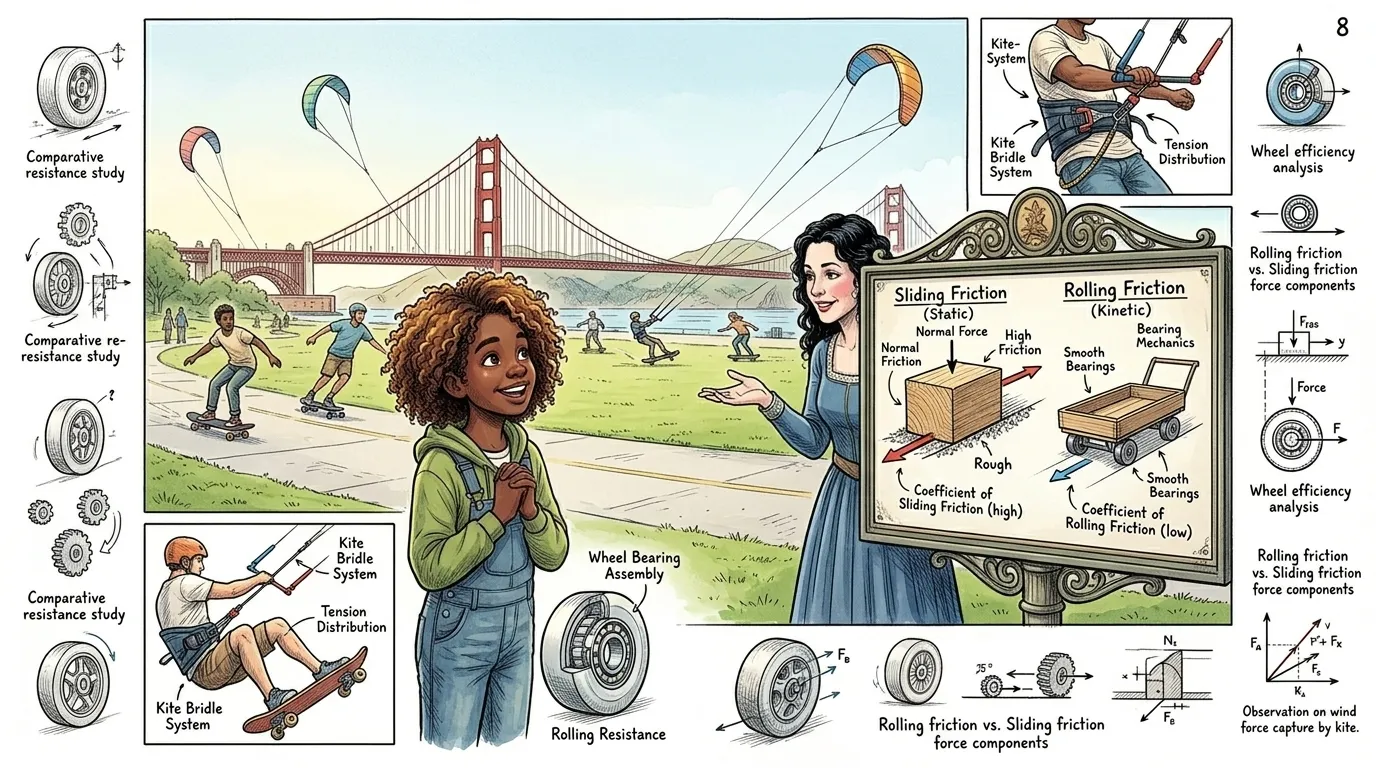
Next, they head to Crissy Field, where a group is flying kites. Wheels are a clever invention that reduces friction by replacing sliding friction with rolling friction. As the kite flyers run across the field, their wheeled skateboards allow for smoother, faster motion with less energy.\n\n"'Check out those kite flyers on skateboards!' Vera points out. 'Wheels are an amazing way to reduce friction.'
'How so?' Juniper asks.
'Instead of sliding against the ground, wheels roll, which has much less friction,' Vera says."\n\n Fact: Rolling friction is generally much lower than sliding friction because the contact area between the wheel and the surface is smaller. This principle is used in everything from cars to trains.
Page 9
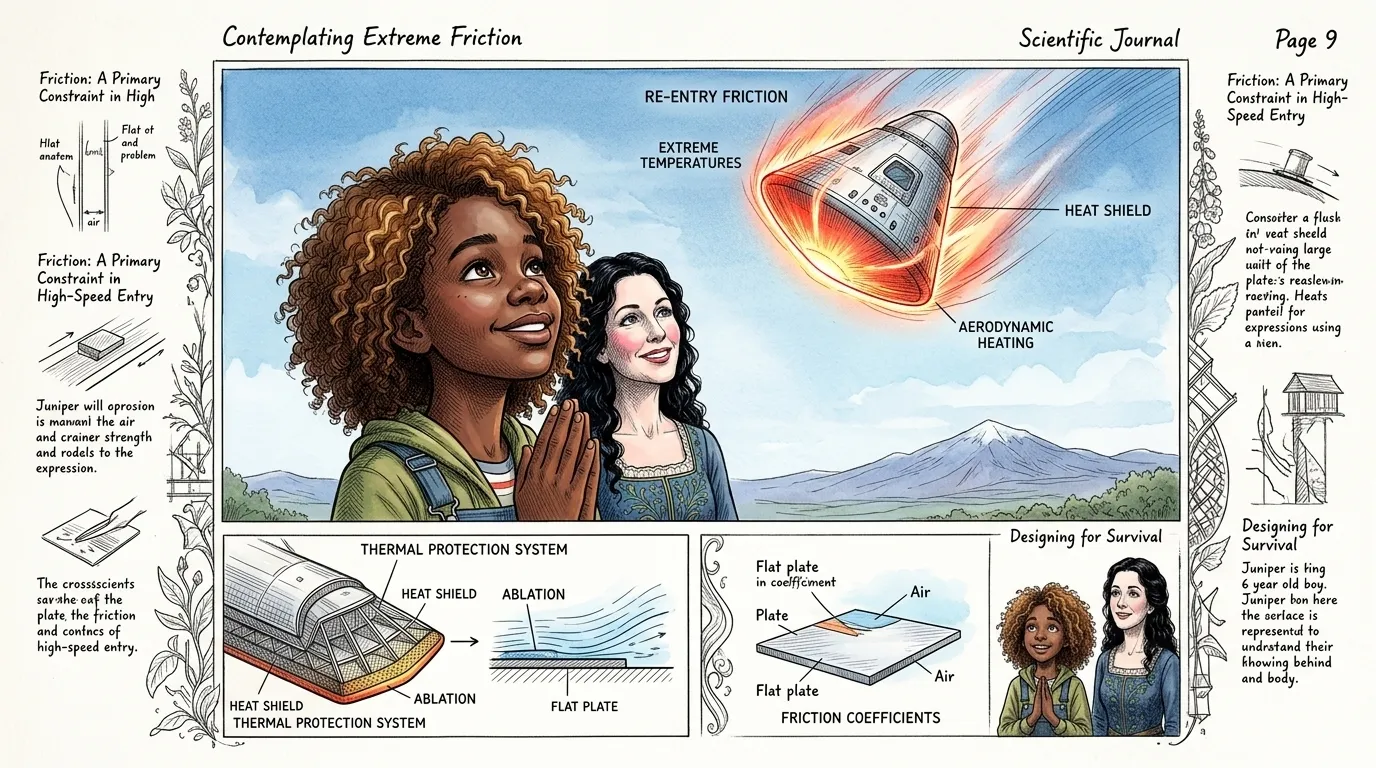
Juniper thinks about the extremes of friction: the intense heat generated by spacecraft re-entering Earth's atmosphere, or the near-frictionless conditions in space. 'It reminds me of what Isaac Newton said, 'If I have seen further it is by standing on the shoulders of giants.' We've built on the knowledge of those before us to understand these incredible forces!'\n\n"'Wow, friction can be incredibly powerful or almost non-existent!' Juniper exclaims, looking up at the sky.
Vera nods. 'Exactly! Think about spacecraft re-entering the atmosphere – the friction generates intense heat.'"\n\n Fact: Spacecraft are designed with heat shields to protect them from the extreme temperatures generated by atmospheric friction during re-entry. These temperatures can reach thousands of degrees Celsius.
Page 10
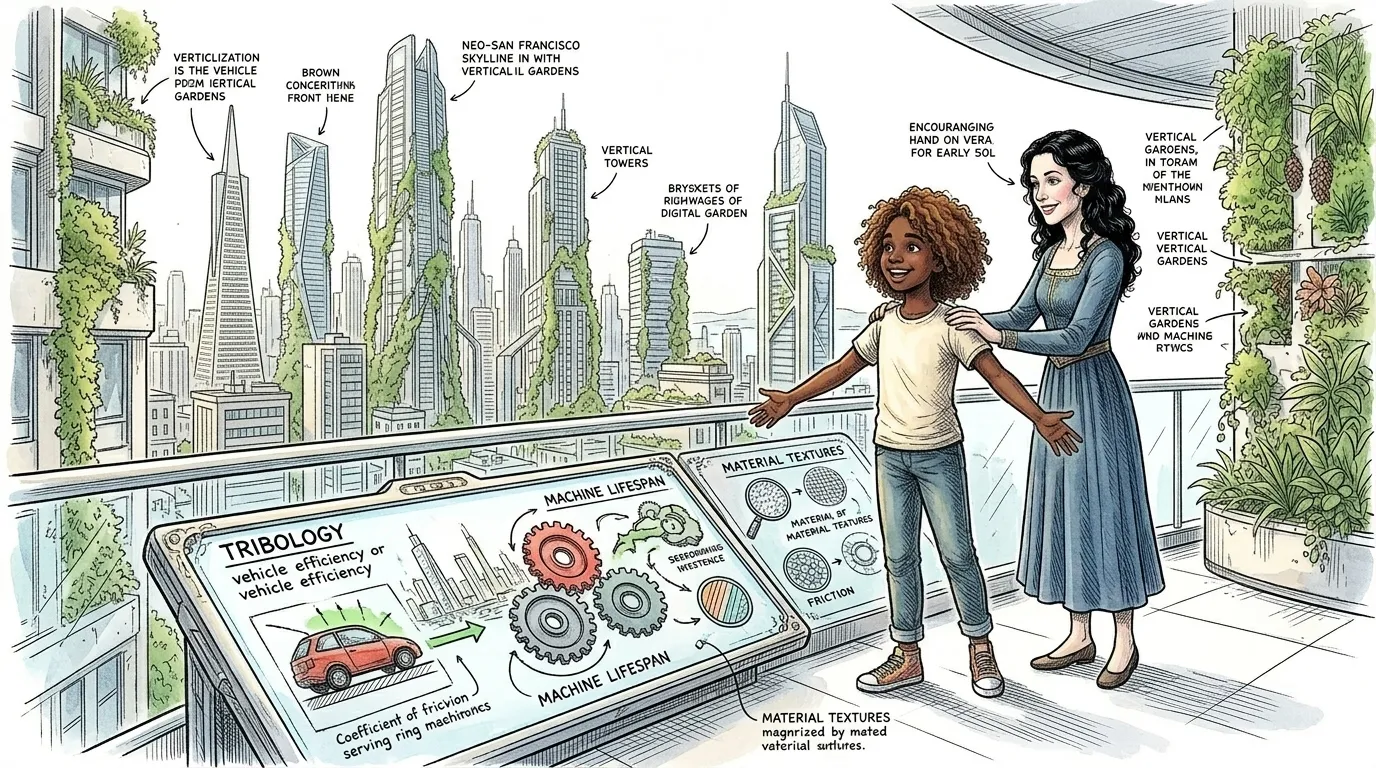
Understanding friction is fundamental to countless aspects of our lives. From designing efficient vehicles to developing new materials, a deep grasp of friction allows us to shape the world around us. It's a force that touches everything.\n\n"'So, understanding friction helps us build better things and explore new frontiers?' Juniper asks.
'Absolutely!' Vera says. 'It's a fundamental force that affects everything we do and create.'"\n\n Fact: The study of friction, known as tribology, is a multidisciplinary field that combines aspects of physics, chemistry, and materials science. Advances in tribology can lead to significant improvements in energy efficiency and the lifespan of machines.
About this story
- Location: United States
- Audience: kids (ages 6–12)
Questions and answers
Read Wonder Science on your phone
Wonder Science is available on Android. Get Wonder Science on Google Play.