Williamina Fleming
Williamina Fleming — an illustrated science story, set in Global. 10 illustrated pages, free to read on Wonder Science.
Page 1
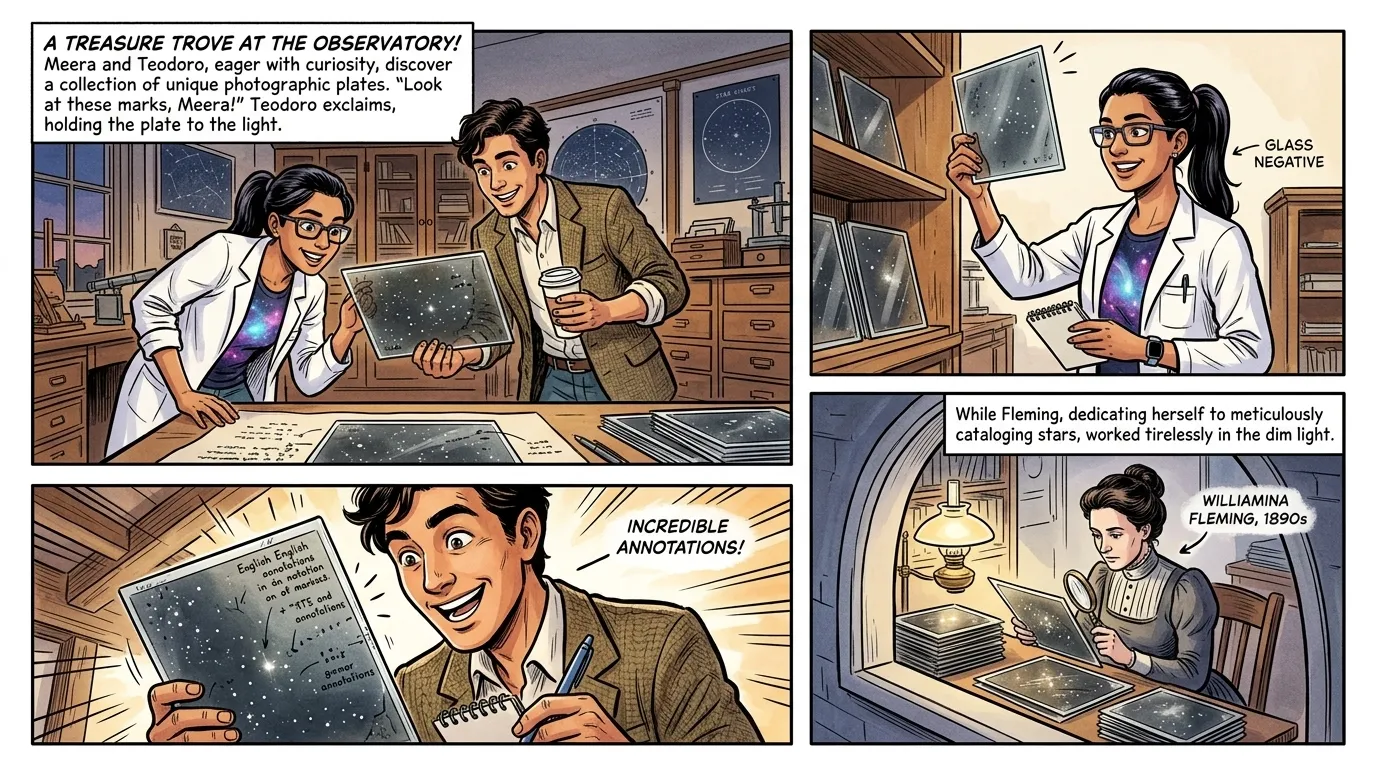
At the turn of the 20th century, the Harvard College Observatory was a beacon of astronomical discovery, fueled by an unexpected force: a team of meticulous women known as 'human computers.' Among them, Williamina Fleming, a Scottish immigrant who began as a housekeeper, revolutionized how we understood the cosmos. She didn't just organize stars; she saw what no one else had, charting tens of thousands of celestial objects and, most remarkably, identifying the universe's first confirmed white dwarf star, 40 Eridani B.
""Meera, look at this plate," Teodoro remarked, holding up a glass photographic negative carefully. "Fleming's meticulous annotations here are incredible. Each tiny dot, each faint smudge – she cataloged them all with such precision." Meera leaned closer, adjusting her glasses. "Indeed, Teodoro. Her work ethic, born from necessity, translated into a scientific legacy that reshaped stellar classification entirely. It's astounding.""
Page 2
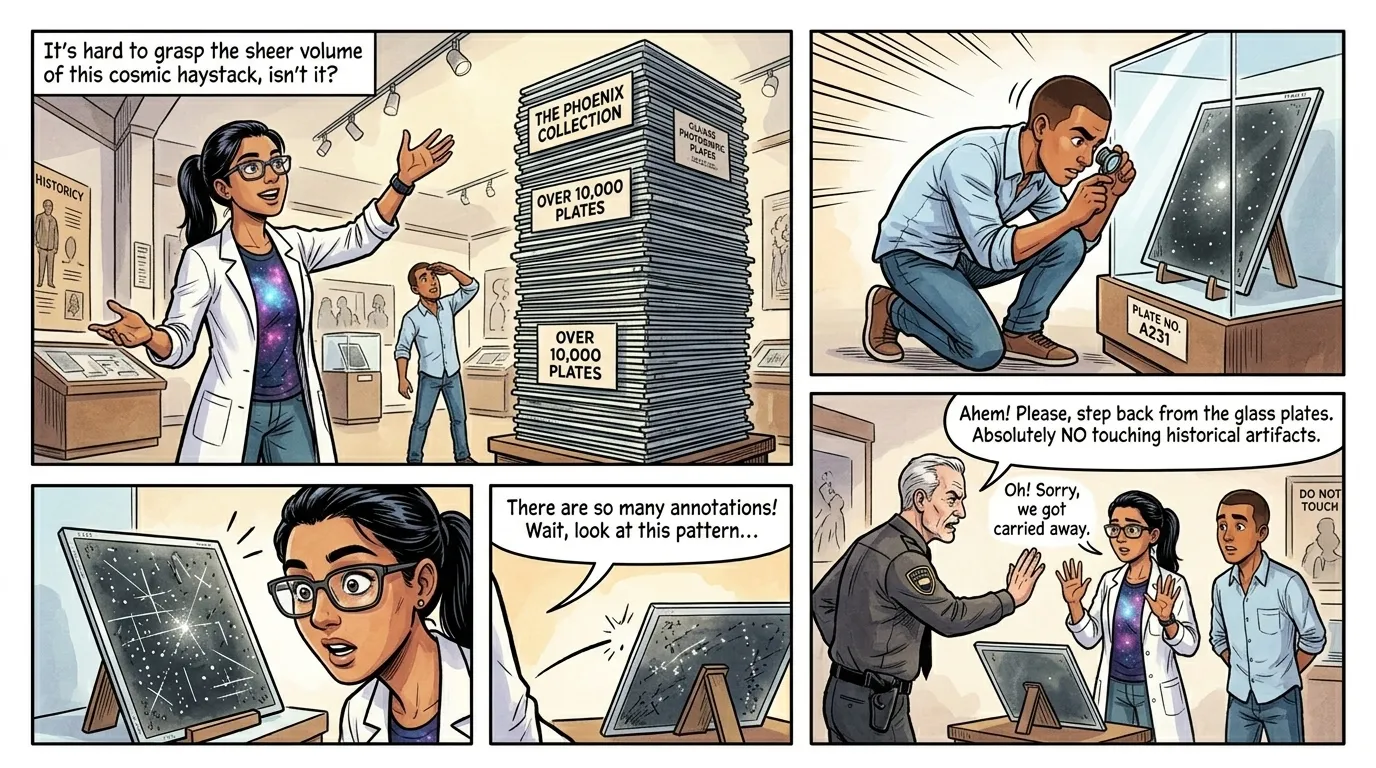
Before Fleming's systematic approach, astronomical data was a chaotic frontier. Telescopes captured vast amounts of light on glass photographic plates, each one a snapshot of thousands of stars. The sheer volume of these plates, depicting an overwhelming array of celestial bodies, presented an unprecedented challenge: how to organize, categorize, and make sense of such immense data. Without a coherent system, anomalies, and groundbreaking discoveries could easily be lost in the deluge of information.
""Imagine, Rafael, the sheer scale of data they were dealing with," Meera stated, gesturing towards a towering stack of oversized photographic plates displayed in a museum exhibit. "Tens of thousands of stars per plate, and hundreds of thousands of plates collected over decades. How could anyone find a single peculiar star in all of that?" Rafael, short and energetic, with warm olive skin and short cropped dark brown hair with a neat side part, nodded, examining a plate closely. "It's a needle in a cosmic haystack. Without a robust, standardized method, any anomalous observation, any subtle variation, would simply vanish into obscurity.""
Page 3
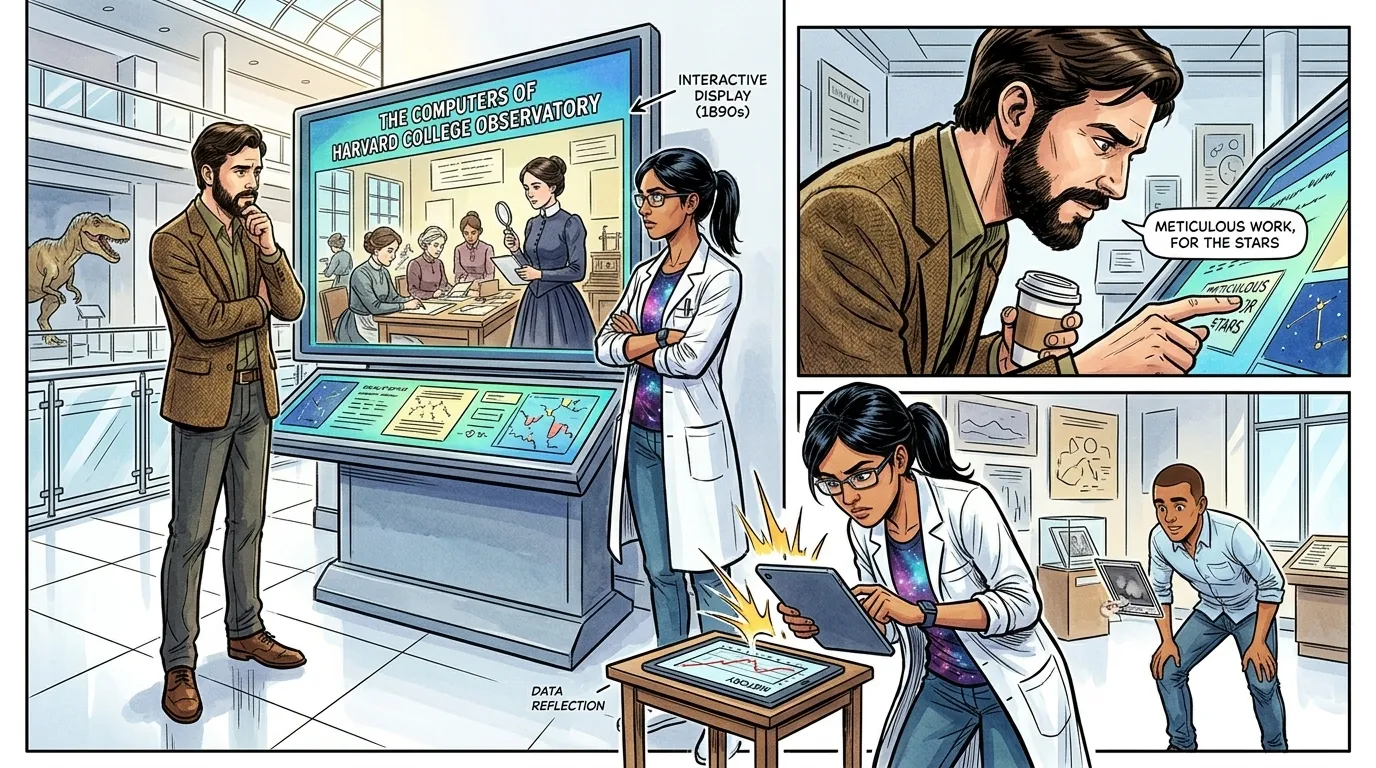
To tackle this monumental task, Edward Pickering, the director of Harvard Observatory, hired a team of women, often referred to as 'Pickering's Harem'—a derogatory term for what was in fact a groundbreaking scientific workforce. These women, many with college degrees, meticulously examined photographic plates, measured star positions, and classified stellar spectra. They were the 'human computers,' performing calculations and observations that laid the foundation for modern astrophysics, often for significantly less pay than their male counterparts. Williamina Fleming was a pivotal figure among them, quickly demonstrating an exceptional aptitude for cataloging and identifying cosmic patterns.
""The 'Harvard Computers' were truly remarkable," Teodoro observed, standing before an interactive display depicting the women at work. "They were conducting groundbreaking research, yet their contributions were often minimized, their roles relegated to mere 'computing.' It speaks volumes about the systemic barriers they faced." Meera nodded gravely. "Absolutely. As the suffragist Susan B. Anthony famously said, 'Failure is impossible.' These women, like Fleming, didn't just overcome obstacles; they redefined what was possible, building entire fields of study from their meticulous observations. Their tenacity is inspiring.""
Page 4
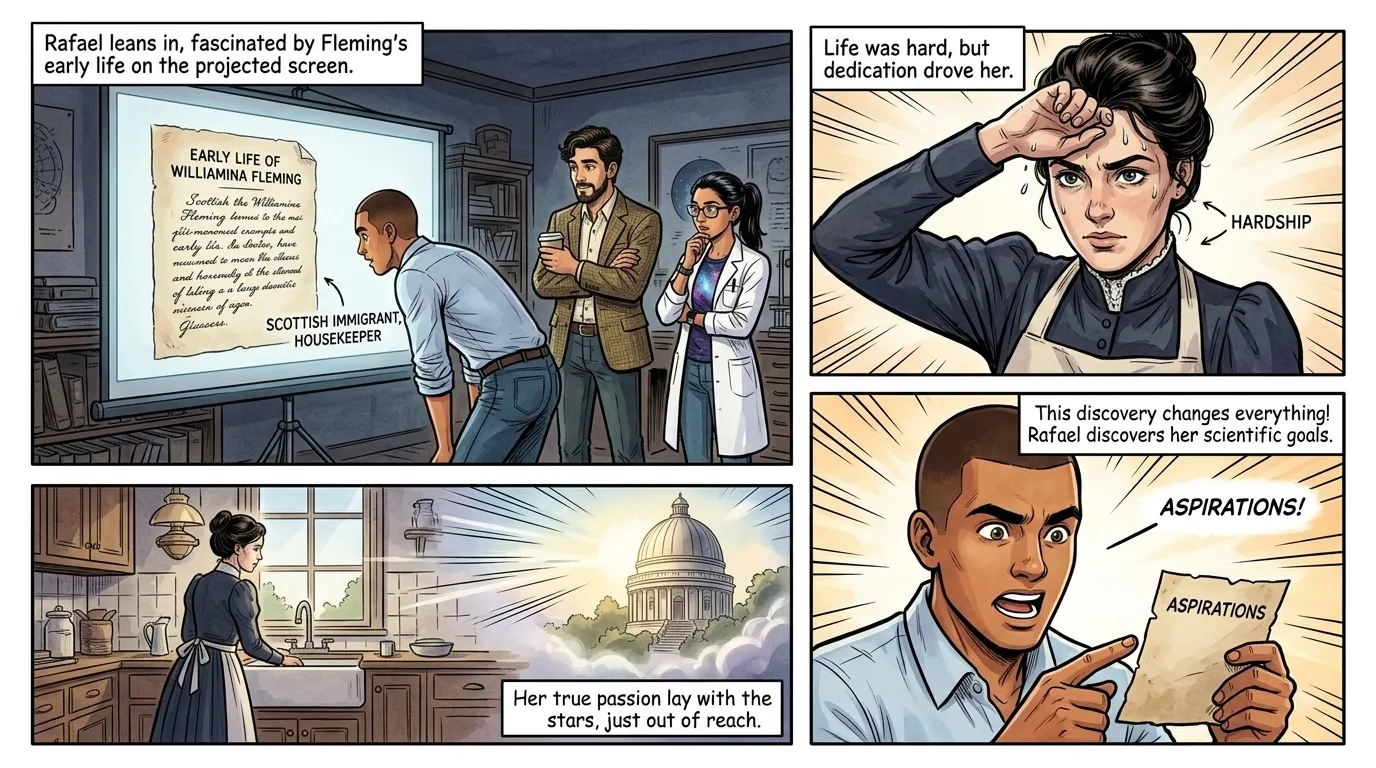
Williamina Fleming's journey into science was anything but conventional. A Scottish immigrant, she arrived in America pregnant and was soon abandoned by her husband. She took a job as a housekeeper for Edward Pickering, director of the Harvard College Observatory. Legend has it that Pickering, frustrated with his male assistants, declared, 'My Scots maid could do better!'—and he was right. Fleming quickly proved her exceptional aptitude, moving from domestic work to the rigorous classification of astronomical photographs, demonstrating an intuitive grasp of stellar patterns and an unparalleled eye for detail.
""It's incredible how her personal struggles propelled her into this scientific role," Rafael commented, studying a projected image of a historical document detailing Fleming's early life. "From housekeeper to groundbreaking astronomer—her story truly embodies resilience." Teodoro nodded thoughtfully. "Indeed. Her acute observational skills, honed perhaps by her practical experience, allowed her to see patterns and anomalies where others saw only noise. It wasn't just about hard work; it was about a unique way of seeing." Meera added, "She didn't come through traditional academic channels, yet her contributions surpassed many who did.""
Page 5
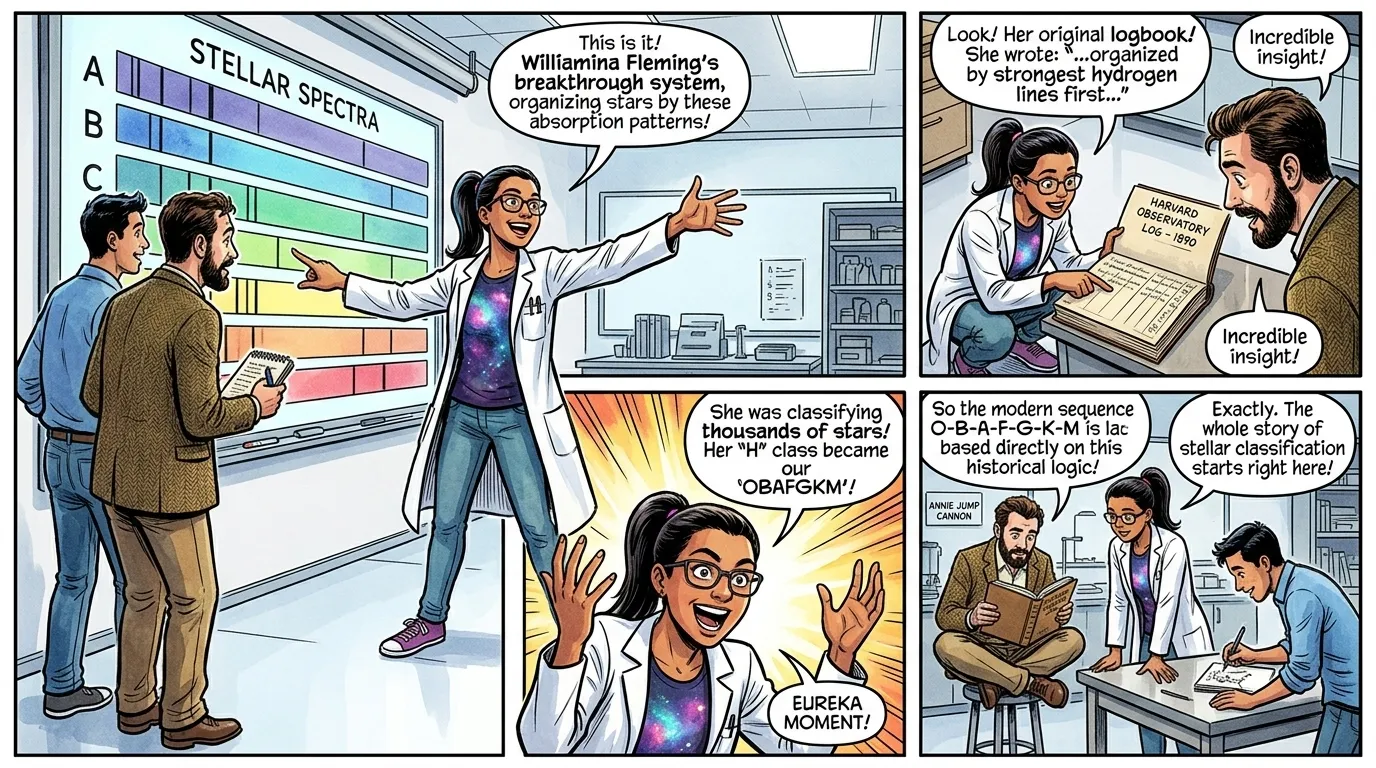
Fleming's primary method involved spectral classification, a technique that analyzes the light emitted by stars to determine their composition and temperature. By examining the unique patterns of dark absorption lines in a star's spectrum—essentially a stellar barcode—she could categorize thousands of stars. Her initial system, though later refined by Annie Jump Cannon, was a monumental step forward, classifying stars based on the strength of their hydrogen lines (labeled A, B, C, etc.). This systematic approach turned a chaotic sky into an organized, readable cosmic library.
""This is where her genius truly shone," Meera explained, pointing to a large, illuminated diagram on a laboratory wall, illustrating different stellar spectra. "She created a system that allowed them to understand the fundamental physics of stars just by looking at their light. Each line tells a story." Teodoro traced a finger over the diagram. "So, the 'A' type stars had the strongest hydrogen lines, indicating specific temperatures. It's like deciphering a cosmic language, right?" Rafael chimed in, "Exactly. This wasn't just observation; it was the birth of astrochemistry, allowing them to characterize objects light-years away without ever leaving Earth.""
Page 6
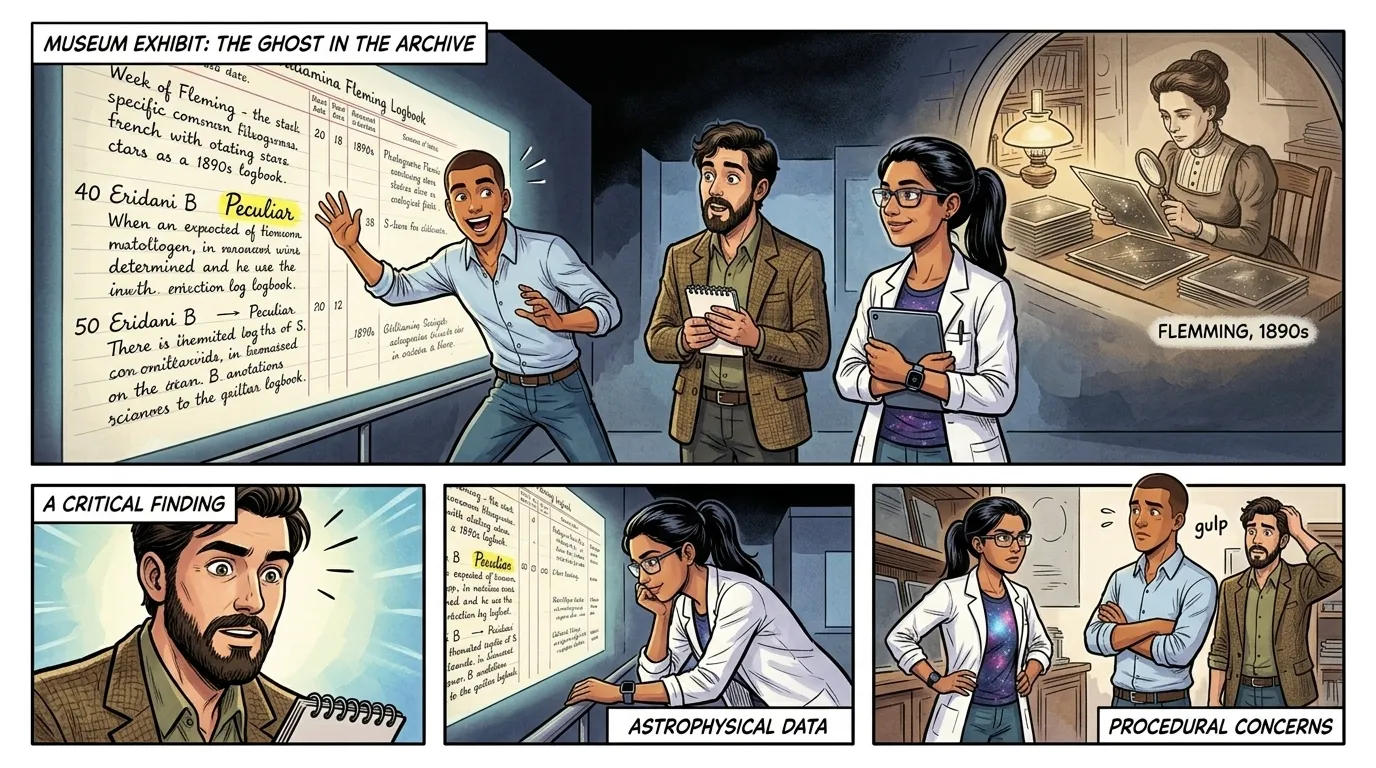
Amidst the tens of thousands of stars Fleming classified, one particular spectral pattern jumped out. On a photographic plate taken in 1886, she identified a faint star in the triple system of 40 Eridani. Its spectrum was unlike any she had seen—a strange, featureless continuum with few absorption lines. She simply noted it as 'Peculiar' in her logbook, understanding it was an anomaly, but without the theoretical framework to explain its true nature. This simple annotation marked the first detection of what scientists would later understand as a white dwarf.
""This is the precise moment, this simple note, that changed everything," Rafael declared, pointing to a projected digital recreation of Fleming's original logbook entry, showing the word 'Peculiar' next to 40 Eridani B. "She recognized something fundamentally different, even without knowing what it was." Teodoro, eyes wide, asked, "So, she saw the anomaly, documented it, and trusted her observation, even when it didn't fit existing models?" Meera added, "Exactly. It highlights the importance of recording everything, even the 'peculiar.' That initial observation paved the way for future theoretical breakthroughs—a silent discovery waiting for its explanation.""
Page 7
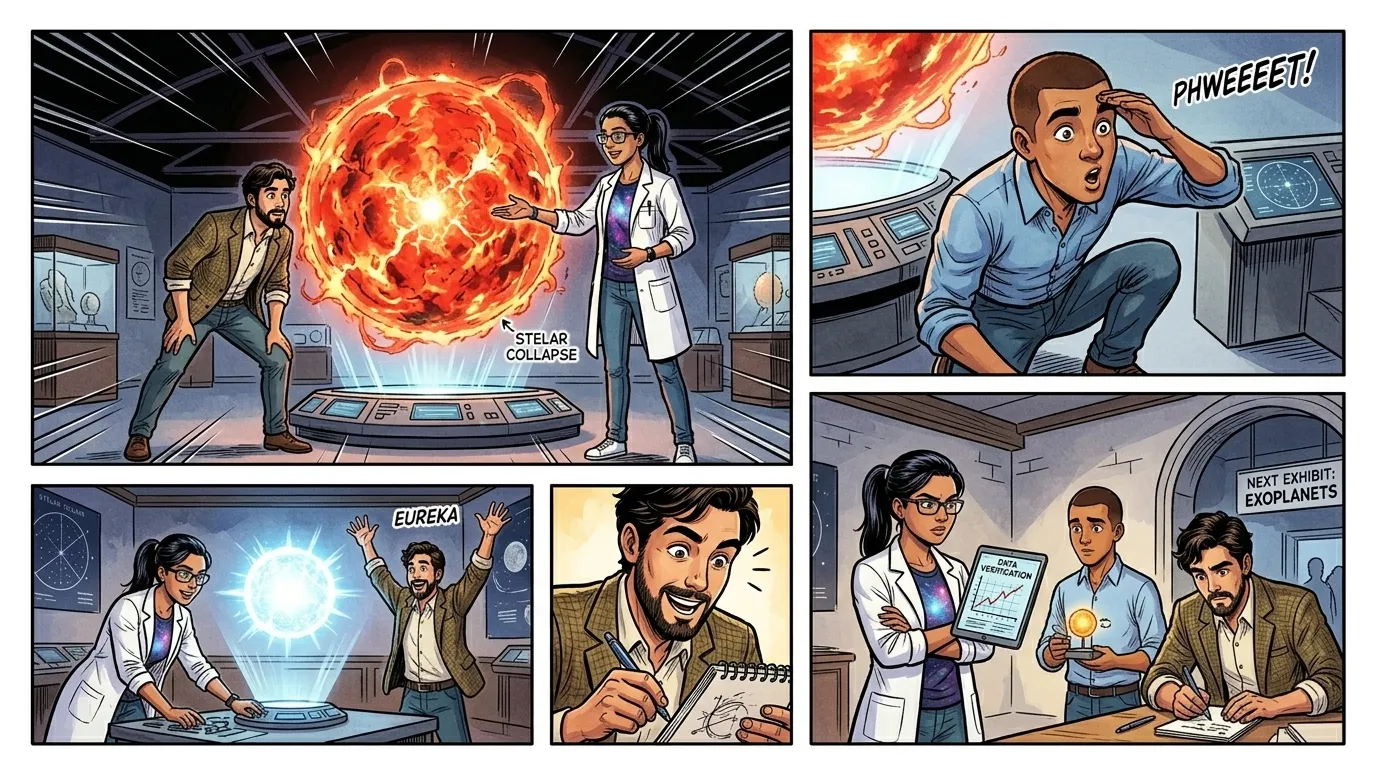
It would be decades before the true nature of Fleming's 'Peculiar' star was fully understood. A white dwarf is the super-dense remnant of a low-to-medium mass star that has exhausted its nuclear fuel. After shedding its outer layers, the core collapses under its own gravity, forming an incredibly compact object—a star the size of Earth, but with the mass of the Sun. A teaspoon of white dwarf material would weigh several tons. Fleming's 40 Eridani B was the first observed example of this exotic stellar endpoint, pushing the boundaries of astrophysical understanding and hinting at the extreme possibilities of stellar evolution.
""This is the mind-bending part," Teodoro exclaimed, gazing at a holographic projection showing a collapsing star transitioning into a white dwarf. "A star, once a fiery giant, shrinking to the size of Earth, yet retaining the mass of the Sun. It's like a cosmic paradox!" Meera elaborated, "Indeed. The density is almost unimaginable. Rafael, remember the concept of a neutron star's density? A white dwarf is its slightly less extreme, but equally astounding, cousin." Rafael whistled softly. "So, Fleming saw a faint dot, and inadvertently provided the first empirical evidence for one of the most extreme objects in the universe. Her observation was light-years ahead of the theory.""
Page 8
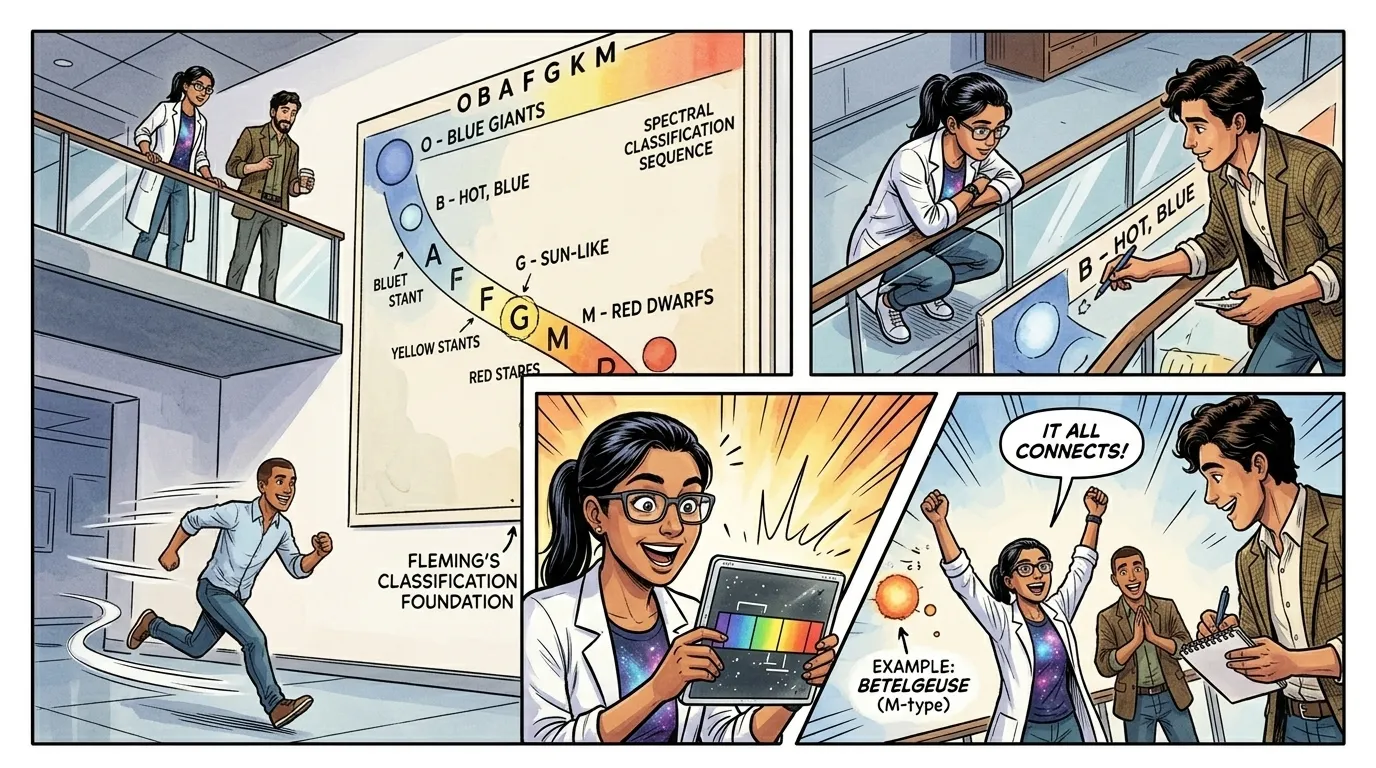
Fleming's pioneering spectral classification system became the bedrock for future astronomical research. Building upon her initial framework, astronomers like Annie Jump Cannon would refine and expand the system, leading to the universally adopted OBAFGKM classification sequence still used today. Her detailed catalogs of variable stars and nebulae provided an invaluable roadmap for astronomers worldwide, facilitating a deeper understanding of stellar life cycles, galactic structure, and the dynamics of the universe. The 'peculiar' observations she so diligently recorded sparked new theoretical inquiries, leading directly to the modern understanding of stellar endpoints.
""Fleming's work was the essential first step," Meera affirmed, standing beside a large, historically accurate diagram illustrating the spectral classification sequence (OBAFGKM) with examples of stars. "Without her systematic approach, later astronomers like Annie Jump Cannon wouldn't have had the organized data to build upon. It's a testament to the power of methodical data collection." Rafael added, "Exactly. Her catalogs weren't just lists; they were blueprints for understanding cosmic evolution. It's the perfect example of how foundational empirical data drives theoretical breakthroughs." Teodoro looked at the diagram. "So, her meticulousness laid the groundwork for everything we now know about how stars live and die.""
Page 9
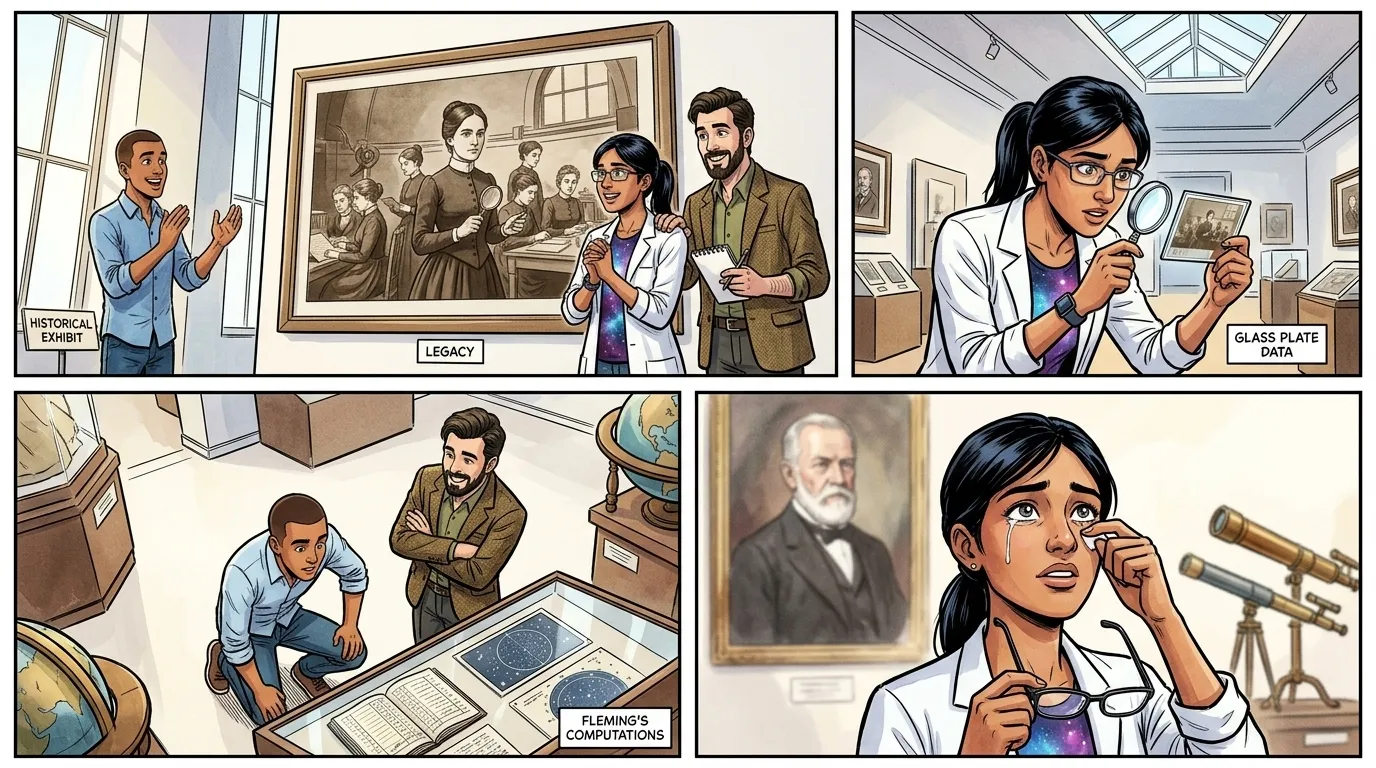
Beyond her scientific contributions, Williamina Fleming's story is a powerful testament to perseverance and the breaking of barriers. She proved that intellect and meticulous observation were not limited by gender or social standing. Rising from domestic service to Curator of Astronomical Photographs, she supervised a team of over a dozen women, edited observatory publications, and published over a dozen research papers. Her legacy inspired generations of women in astronomy, demonstrating that scientific rigor and impactful discovery could emerge from the most unexpected places. Her work wasn't just about stars; it was about shining a light on unrecognized potential.
""Her journey is incredibly inspiring, not just scientifically but culturally," Meera reflected, looking at a framed historical photograph of Fleming with her team of women computers. "She broke so many barriers in an era when women were largely excluded from scientific leadership roles. She didn't just discover stars; she empowered others to do the same." Rafael agreed, "Absolutely. She wasn't an anomaly in her scientific aptitude, but a pioneer in opportunity. Her rise paved the way for figures like Cecilia Payne-Gaposchkin to make even greater strides in understanding stellar composition." Teodoro added, "Her story is a reminder that talent can be found anywhere if given the chance.""
Page 10
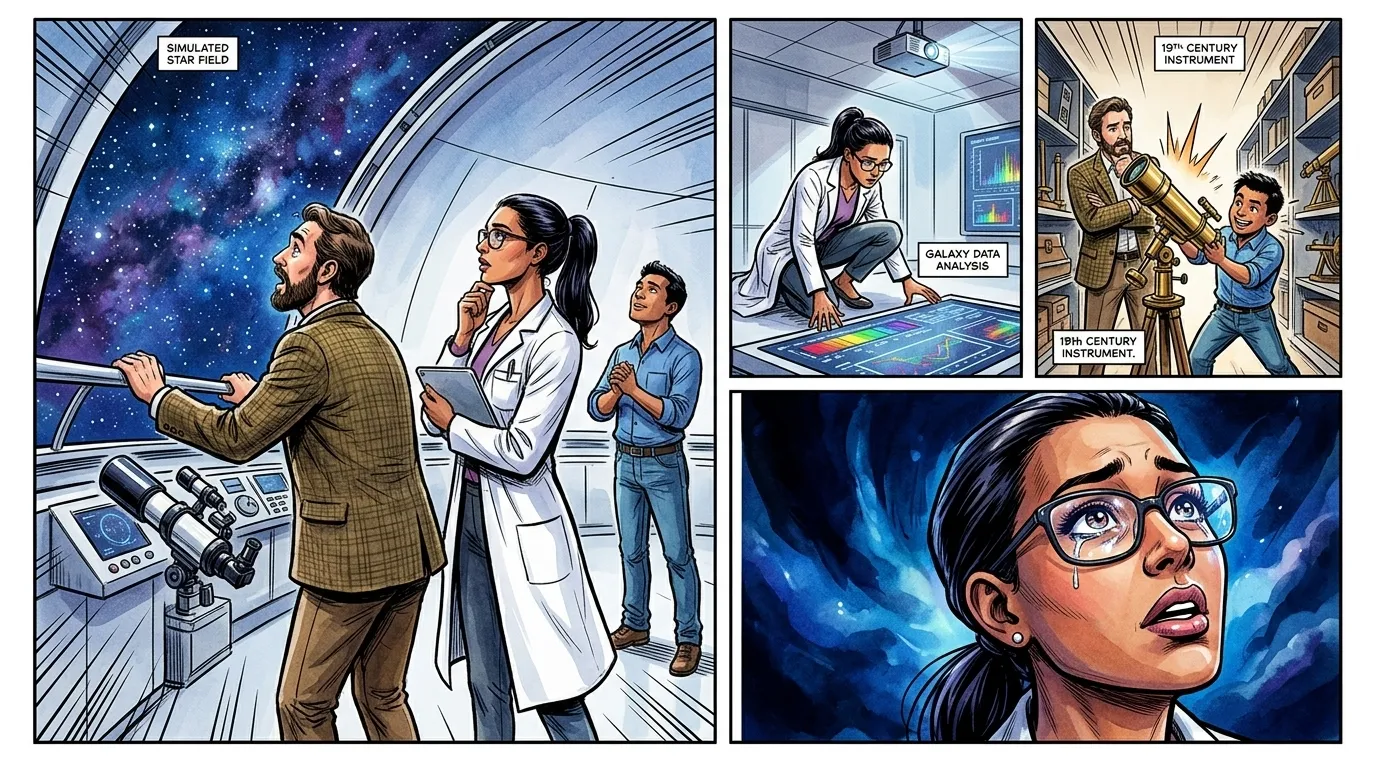
Williamina Fleming's indelible mark on astronomy endures, centuries after her birth. Her precise catalogs of variable stars remain valuable resources, and the methods she developed for spectral classification laid the groundwork for all subsequent stellar taxonomy. From a housekeeper with no formal scientific training, she rose to become a leading astronomer, celebrated for her observational acumen and her relentless dedication to deciphering the universe's complexities. Her work not only expanded our knowledge of the cosmos but also highlighted the immense, often untapped, potential of individuals traditionally excluded from scientific pursuits, cementing her place as a true pioneer of space exploration and scientific inquiry.
""It's truly remarkable how her meticulous work, done with simple magnifying glasses and photographic plates, continues to impact us today," Teodoro mused, looking out over a simulated starry night sky in a modern observatory. "Her spirit of discovery, despite all odds, still lights the way." Meera nodded, a thoughtful expression on her face. "Her legacy teaches us that groundbreaking science is often built on careful, systematic observation, not just grand theories. She made the invisible visible." Rafael concluded, "And in doing so, she didn't just classify stars; she illuminated the path for countless aspiring scientists, proving that curiosity and dedication are truly universal forces.""
About this story
- Location: Global
- Audience: general readers
Questions and answers
Read Wonder Science on your phone
Wonder Science is available on Android. Get Wonder Science on Google Play.