The Venice Palace That Ran an Empire From One Room
The Doge's Palace was not just a ruler's residence. Its single largest hall — one of the biggest rooms in Europe — was where up to 1,200 Venetian nobles governed a trading empire.
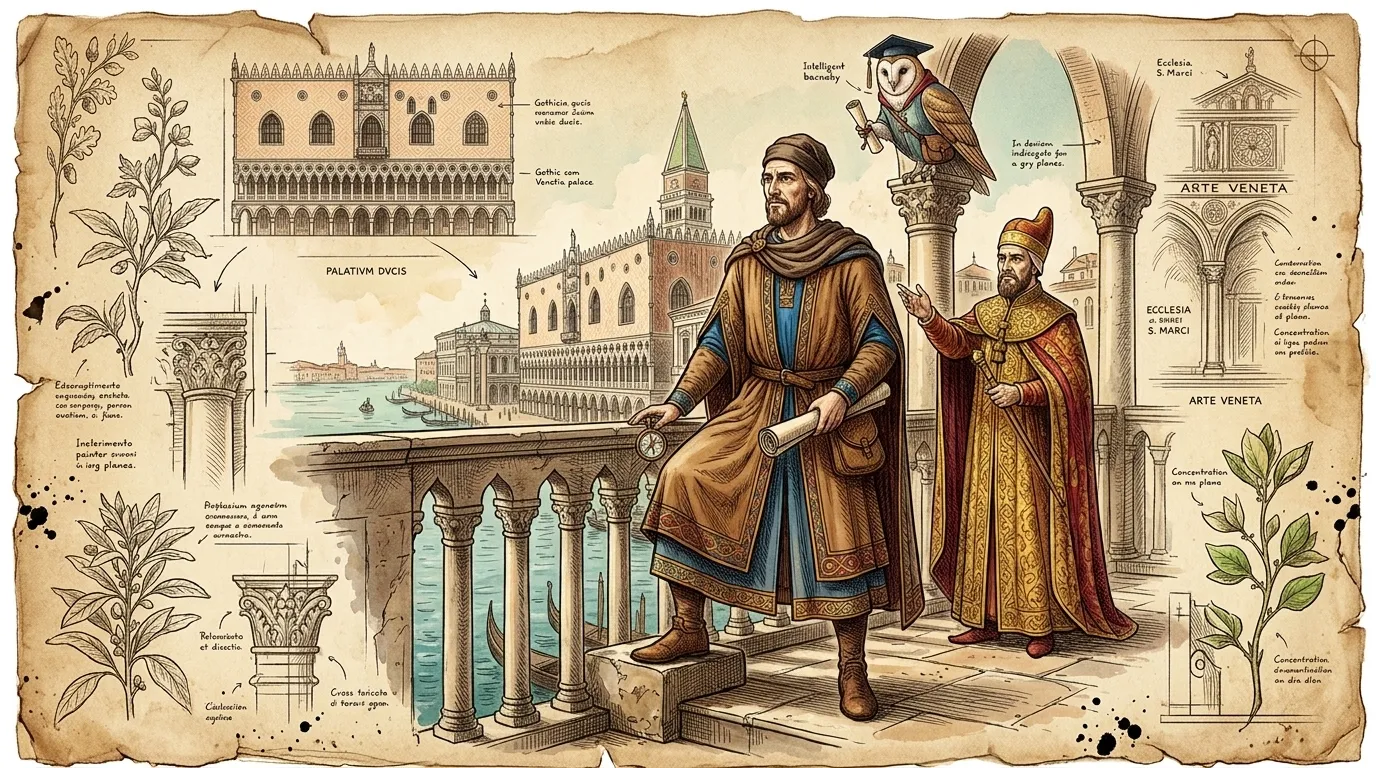
The Doge's Palace sits at the heart of Venice, its pink Verona marble façade and pointed Gothic arches facing the lagoon beside St. Mark's Basilica. Building on the site now standing dates from the 14th century, and it was never simply a grand home. It housed the Doge — Venice's elected head of state — but its real purpose was to hold the entire machinery of the Venetian Republic's government under one roof: the Great Council, the Senate, the Collegio, and the courts, all working out of rooms connected by the same corridors the Doge walked to reach his private chapel.
That combination — residence and seat of government in one building, with Gothic, Byzantine, and Renaissance influences layered into a single façade — became a visible statement of Venetian wealth and identity, recognized across the Mediterranean as a symbol of the Republic itself long before most visitors ever set foot inside.
The Room Where an Empire Governed Itself
The palace's single most important space was the Sala del Maggior Consiglio — the Great Council Chamber — at 53 by 25 metres, one of the largest rooms in Europe. Its scale was a practical necessity, not showmanship: after a 1297 reform known as the Serrata expanded the Great Council's membership from around 400 noblemen to more than 1,200, the original ground-floor hall could no longer fit them all, and a new chamber was completed in 1365 to hold the enlarged body. Every adult male member of Venice's patrician families could sit in that room regardless of individual wealth or achievement, and it was there that they elected the Doge, debated the Republic's laws, and held lavish state ceremonies.
A System Designed So No One Man Could Rule Alone
The palace's layout of separate chambers reflected a deliberate structure of overlapping power. The Doge did not rule by decree — decisions passed through the Senate and the Collegio, a smaller executive body of the Doge and his councillors, while the feared Council of Ten, formed after a 1310 conspiracy attempted to overthrow the government, watched over state security and could act against threats from any direction, including from within the Doge's own circle. The palace also concealed a harder edge to this system: hidden offices, archives, and rooms used by the Venetian state's own security apparatus lay behind the public halls, reachable through corridors most visitors to the ceremonial rooms never saw.
Rebuilt After Fire, Repainted by Venice's Greatest Names
The Great Council Chamber's decoration has a dramatic history of its own. A catastrophic fire struck the palace in 1577 — one account holds that Doge Sebastiano Venier died of grief over the loss — destroying earlier work by artists including Gentile da Fabriano and Giovanni Bellini. The chamber was rebuilt, and its rear wall now holds one of the largest oil paintings on canvas anywhere in the world, The Glory of Paradise, spanning roughly 22 by 7 metres. Jacopo Tintoretto began the work and his son Domenico completed it, a single canvas standing in for the entire scale of the government that once met beneath it.
Told as an illustrated story
Frequently Asked Questions
Was the Doge of Venice a king?
No. The Doge was an elected head of state, chosen by and answerable to the Great Council, and his power was deliberately limited by other government bodies housed in the same palace — the Senate, the Collegio, and the Council of Ten. Venice's system was built specifically to prevent any single person from ruling unchecked.
Why was the Great Council Chamber so enormous?
It had to hold the Republic's full governing body of Venetian noblemen. A 1297 reform expanded Great Council membership from roughly 400 to over 1,200, and the original hall couldn't accommodate the increase — so a new chamber, 53 by 25 metres and among the largest rooms in Europe, was completed in 1365 to fit everyone.
Did the original artwork inside the palace survive?
Much of it didn't. A major fire in 1577 destroyed earlier decoration by artists including Gentile da Fabriano and Giovanni Bellini. The Great Council Chamber was rebuilt afterward and now holds The Glory of Paradise, a huge canvas begun by Jacopo Tintoretto and finished by his son Domenico, created specifically to replace what the fire had destroyed.