What Stonehenge Was Actually Built For (We Still Don't Fully Know)
Some of its stones were hauled from over 150 miles away. Its entrance aligns with the summer solstice sunrise. And after a century of digging, archaeologists still argue over why it was built at all.
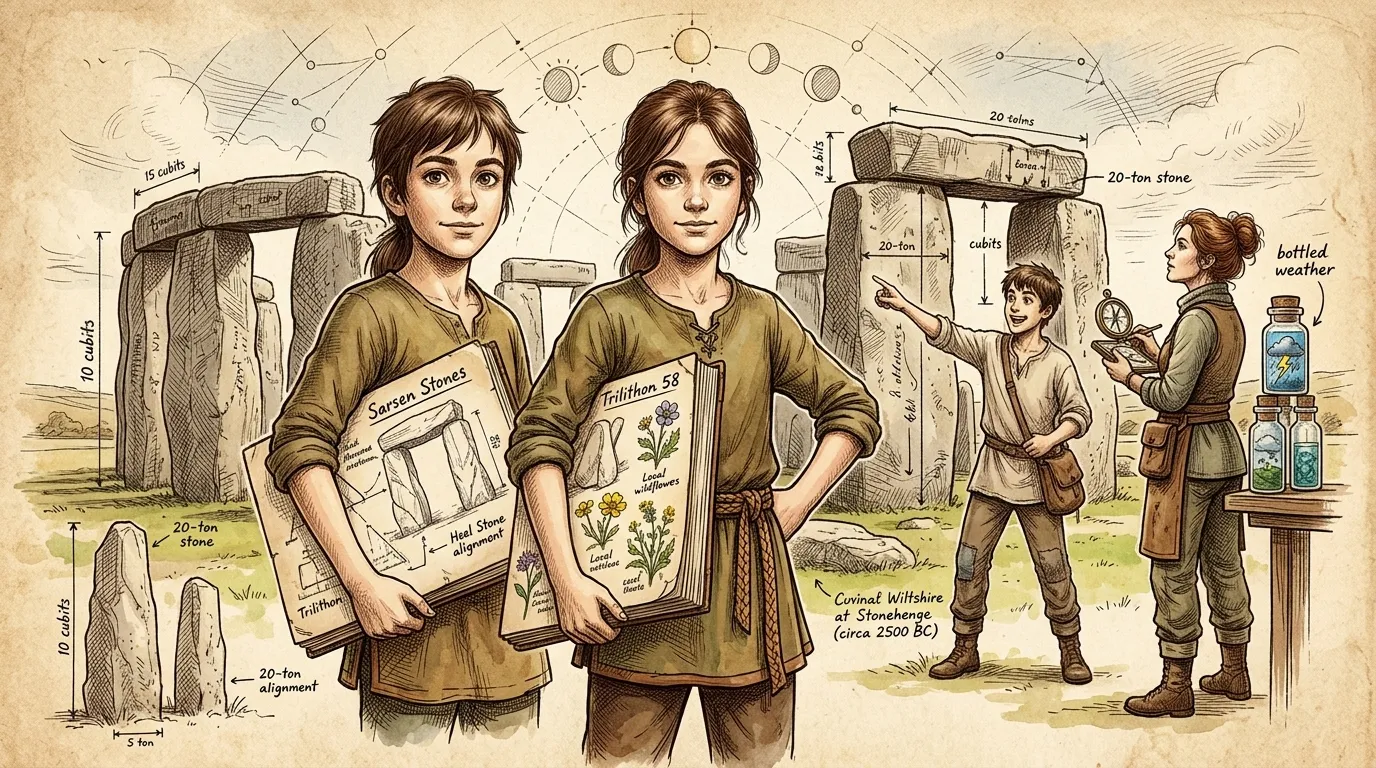
Stonehenge, on Salisbury Plain in southern England, was not built in a single effort. Construction and rebuilding stretched across roughly 1,500 years, with the massive sarsen stones that form its most recognizable circle raised around 2500 BC. Some of its smaller bluestones were transported from as far as Wales, and a 2024 study traced its central Altar Stone to an origin in Scotland — a haul of well over 400 miles for a single block of rock, using nothing but Neolithic technology. Moving stones that size that far was not an accident of convenience; it required deliberate, sustained effort from a large number of people.
For centuries, folklore filled the gap left by missing evidence — 17th- and 18th-century writers credited the monument to Druid priests, and older legend attributed it to the wizard Merlin, said to have magically transported the stones from Ireland. Modern archaeology has ruled out both: Stonehenge predates the historical Druids by roughly 2,000 years, and its actual purpose has to be pieced together from the physical evidence left on and around the site.
The Clue Everyone Notices First
The most visible pattern is astronomical. Stonehenge's entrance and its Heel Stone align with the sunrise on the summer solstice — stand at the monument's center on that day and the sun rises just beside the Heel Stone, a detail first noted by scholars in the 18th century. Archaeologists have since found evidence of a stone hole that may once have held a partner stone framing that same sunrise, reinforcing the idea that the site functioned, at least in part, as a way of tracking the solar calendar and marking the turn of the seasons.
The Evidence Nobody Expected: A Graveyard
Excavations have also turned up something the solstice theory alone does not explain: hundreds of human bones, buried across roughly 500 years during the monument's earliest phases, many showing signs of cremation. That has led archaeologists to treat Stonehenge as, among other things, a burial ground and a monument to the dead — not incompatible with the solar-calendar theory, but a reminder that the site likely served more than one purpose across its long history rather than a single, fixed function.
A Newer Theory: A Monument Built to Unite Britain
The 2024 discovery that the Altar Stone came from Scotland — not Wales, as long assumed — reframed the debate again. Researchers at UCL and Aberystwyth University have proposed that stones gathered from such distant corners of Britain suggest Stonehenge was built, or substantially rebuilt, as a unifying project — a shared undertaking meant to draw together communities from across the island, possibly following a period of conflict between eastern and western Britain. Most archaeologists today favor some version of a multi-purpose explanation: astronomical calendar, burial ground, and unifying monument all at once, with the balance between them shifting as the site was used and reused over its roughly 1,500-year construction history.
Told as an illustrated story
Frequently Asked Questions
Was Stonehenge built by the Druids?
No. Stonehenge was built roughly 2,000 years before the historical Druids existed. The Druid connection comes from 17th- and 18th-century writers who assumed the monument must be linked to ancient British religion and simply attached the best-known name they had to it.
Is Stonehenge actually aligned with the sun?
Yes. Its entrance and the nearby Heel Stone line up with the sunrise on the summer solstice, a pattern first documented by 18th-century scholars and confirmed by later archaeological work, including a stone hole that may have held a second stone framing that same sunrise.
So what was Stonehenge actually for?
There is no single confirmed answer. The physical evidence supports several functions at once — human remains suggest it served as a burial site for around 500 years, its alignment suggests use as a solar calendar, and stones gathered from across Britain, including one traced to Scotland in 2024, suggest it may also have served as a unifying monument. Most archaeologists today accept it likely served more than one of these purposes over its long history.