Barberini Faun by Greek artist (Munich, Germany — c. 220 BC)
Barberini Faun by Greek artist (Munich, Germany — c. 220 BC) — an illustrated arts story, set in Germany. 10 illustrated pages, free to read on Wonder Arts.
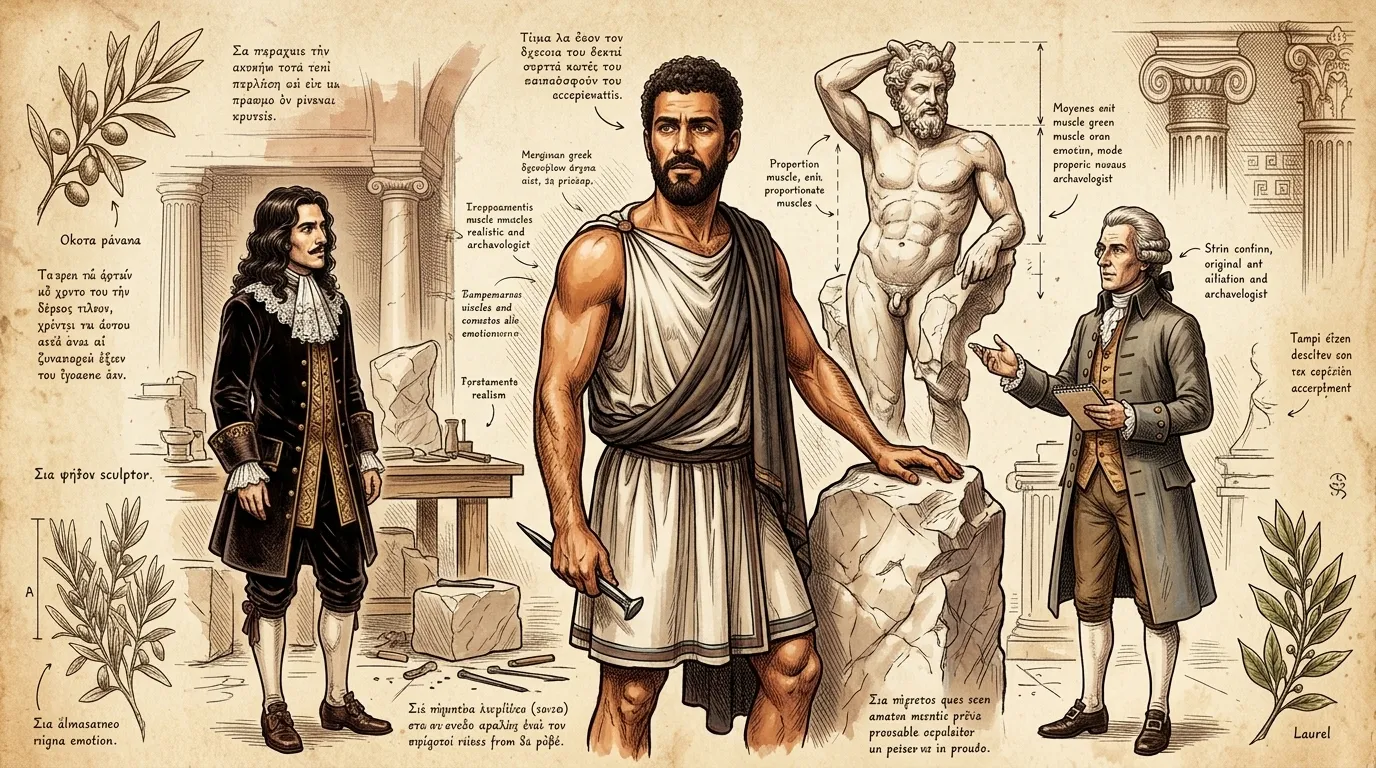
Page 1

A Greek artist stands proudly before his creation: the Barberini Faun, a marble sculpture pulsating with raw, Dionysian energy. Carved around 220 BC, this masterpiece captures a moment of drunken slumber, a celebration of the wild. Currently housed in the Glyptothek in Munich, its turbulent history includes rediscovery in Rome and a controversial 'restoration' by Bernini. Its dimensions are imposing: over 2 meters in length, a testament to the sculptor's ambition.
""This piece...it breathes," the artist murmurs, his fingers tracing the Faun's muscular arm. "A god caught in a moment of vulnerability.""
Art Fact: The Barberini Faun, named after its first known owners, is a Hellenistic marble sculpture believed to be inspired by Pergamon school around 220 BC.
Page 2

The sculptor's journey began in Pergamon, a city renowned for its artistic innovation. He recalls the vibrant energy of the Pergamene workshops, the air thick with the scent of marble and the rhythmic clang of chisels. It was there, amidst the bustling activity, that he first encountered the concept of depicting gods and mythical creatures with unflinching realism, a hallmark of the Hellenistic style.
""Remember, young one," his mentor had said, his voice gravelly from years of inhaling marble dust, "a god is not merely an ideal, but a being of flesh and blood. Show their passions, their flaws.""
Art Fact: Pergamon, an ancient Greek city, was a major center for Hellenistic art and sculpture, known for its dramatic and realistic style.
Page 3

In a dream, the sculptor saw Dionysus, the god of wine and revelry, not as a figure of divine authority, but as a being lost in intoxicated slumber. This vision sparked a revolutionary idea: to capture the raw, untamed essence of the god. He remembers reading Euripides and being struck by the god's ecstatic power. It was then he understood that to truly represent the god of wine was to show his humanity.
""He would want to capture the god's vulnerability", he thought, remembering a line from Euripides' The Bacchae: "'Reason is a poor guide in the face of Dionysus.' It's not about control, it's about losing yourself.""
Art Fact: Dionysus, also known as Bacchus, was the Greek god of wine, fertility, theatre, and religious ecstasy.
Page 4

Selecting the perfect marble was crucial. He traveled to the quarries of Paros, seeking a block of exceptional purity and texture. Hours were spent examining each vein, each subtle variation in color. Finally, he found it: a block that seemed to resonate with the very spirit of Dionysus, waiting to be unleashed.
""This marble...it sings," the sculptor said softly, his hand caressing the cool, smooth surface. "It holds the god within.""
Art Fact: Parian marble, from the island of Paros, was highly prized by ancient sculptors for its purity and fine texture.
Page 5

The first strike of the chisel was a moment of profound commitment. With each blow, the sculptor sought to liberate the Faun from the confines of the stone. Days turned into weeks, weeks into months, as the form gradually emerged, guided by the vision of Dionysus in slumber.
""Each strike is a prayer," the sculptor muttered, sweat dripping from his brow. "To unveil the god within.""
Art Fact: Sculptors in ancient Greece used a variety of tools, including chisels, hammers, and rasps, to shape marble.
Page 6

Centuries later, the Faun resurfaced, damaged and incomplete. Gian Lorenzo Bernini, the master of Baroque sculpture, was commissioned to restore it. His additions, while controversial, imbued the sculpture with a new dynamism, a heightened sense of drama and movement. Bernini, known for his dramatic flair, found the statue fragmented and added parts he felt were missing.
""I see potential here, a raw power waiting to be unleashed," Bernini declared, examining the damaged Faun, "but much is damaged." He believed that his 'restoration' was in keeping with the work's original spirit."
Art Fact: Gian Lorenzo Bernini, a leading sculptor of the Baroque period, was known for his dramatic and expressive style.
Page 7

The sculpture eventually found its way to Munich, where it became a centerpiece of the Glyptothek, a museum dedicated to ancient sculpture. Here, amidst other masterpieces of antiquity, the Barberini Faun continues to captivate visitors with its blend of realism and raw emotion. The museum curators knew they had to find a space befitting his magnitude.
""The Faun has found its rightful home," the museum director proclaimed. "Here, it will inspire generations to come.""
Art Fact: The Glyptothek in Munich is a museum dedicated to ancient Greek and Roman sculpture.
Page 8

Over the centuries, the Barberini Faun has become an emblem of Dionysian ecstasy, a reminder of the power of art to capture the raw, untamed aspects of human experience. It stands as a symbol of vulnerability and untamed power. Art critics from Winckelmann to modern day scholars note the statue's controversial nature.
"As Johann Winckelmann, the father of art history, once noted: "The noblest aim of Greek art is beauty, but even in beauty, there is always a touch of something untamed.""
Art Fact: Johann Winckelmann was a German art historian and archaeologist, considered one of the founders of modern art history.
Page 9

The question of the sculpture's original form continues to fascinate scholars. Did Bernini truly capture the sculptor's original intentions, or did he impose his own Baroque sensibility? The debate rages on, a testament to the enduring power of art to provoke and inspire.
""We will never truly know what the original artist intended," says a scholar, adjusting his spectacles. "But that is the beauty of it. The mystery endures.""
Art Fact: The 'restoration' of the Barberini Faun by Bernini has been a subject of debate among art historians for centuries.
Page 10

The Barberini Faun endures as a testament to the artist's vision, Bernini's touch, and the enduring power of classical art. Its message of raw emotion and unfiltered expression continues to resonate across the ages. As Michelangelo said, 'Every block of stone has a statue inside it and it is the task of the sculptor to discover it.' This piece is more than a sculpture; it is a fragment of the ancient world, resurrected in stone, forever whispering the secrets of Dionysus.
"The artist's shadow stands beside the Faun, a silent witness to the sculpture's enduring power. From the past to the present, its message remains vibrant: "The gods are human, and humanity can be divine.""
Art Fact: The Barberini Faun remains one of the most celebrated sculptures of antiquity, housed in the Glyptothek in Munich.
About this story
- Location: Germany
- Audience: general readers
Questions and answers
Questions and answers about Barberini Faun by Greek artist (Munich, Germany — c. 220 BC)
Read Wonder Arts on your phone
Wonder Arts is available on Android. Get Wonder Arts on Google Play.