Barbizon School by Rousseau (France — c. 1830)
Barbizon School by Rousseau (France — c. 1830) — an illustrated arts story, set in France. 10 illustrated pages, free to read on Wonder Arts.
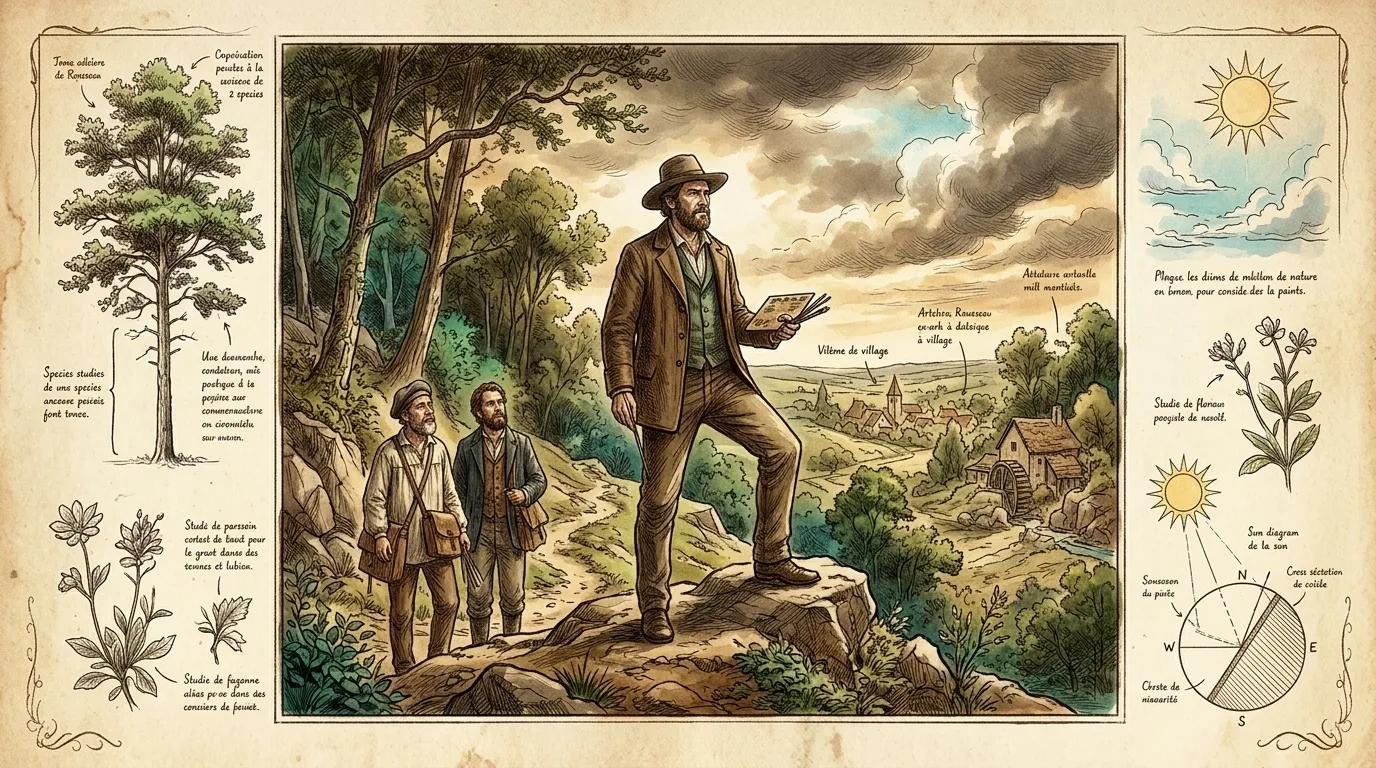
Page 1

Théodore Rousseau stands before his monumental work, 'The Edge of the Forest at Sunset,' completed around 1850. This masterpiece, measuring approximately 140 x 180 cm, showcases Rousseau's dedication to capturing the wild essence of the Barbizon landscape. Its estimated value has grown exponentially over the decades, and it now resides in the permanent collection of the Louvre Museum in Paris. Legend has it that Rousseau spent months observing this very spot in the forest, sketching the light at different times of day.
""At last," Rousseau murmurs to himself, his eyes reflecting the fiery sunset in his painting, "I have captured the soul of the forest.""
Art Fact: Rousseau's meticulous attention to detail and his deep connection to the natural world are evident in every brushstroke of this iconic landscape.
Page 2

Young Théodore, barely a teenager, accompanied his family on a business trip to Montmartre. While his father finalized deals, Théodore wandered the bustling streets, sketchbook in hand. He saw not just the city, but the play of light on the cobbled roads, the vibrant energy of the market, and the expressive faces of the working class. It was here he had a conversation with a seasoned artist, an event that would later change his life. "That day changed everything," he'd later write in his journal.
""Look closely, young man," the older artist, a man named Monsieur Dubois, chuckled, pointing to the shadows dancing on a building. "It's not enough to simply see. You must feel the light, the life, the story!""
Art Fact: Montmartre's vibrant atmosphere and the words of Monsieur Dubois ignited Rousseau's passion for capturing the essence of everyday life.
Page 3

Rousseau faced harsh criticism and rejection from the Salon early in his career. His unconventional style, focusing on the raw, untamed beauty of nature, clashed with the prevailing academic tastes. This setback could have deterred a lesser artist, but for Rousseau, it was a catalyst. He embraced his unique vision even more fiercely. He remembered a quote from the Roman philosopher Seneca, the Younger: 'Every new beginning comes from some other beginning's end.' These words became a personal mantra.
""They call it unfinished, unrefined!" Rousseau exclaimed to his friend, Jules Dupré, pacing his small studio. "But I see the truth in the forest, Jules, a truth they refuse to acknowledge!""
Art Fact: Rejection fueled Rousseau's determination to challenge artistic conventions and capture the true spirit of nature.
Page 4

Driven by his desire to paint directly from nature, Rousseau ventured to the village of Barbizon in the Forest of Fontainebleau. Here, he found the landscapes that would define his artistic career. The ancient trees, the rugged terrain, the ever-changing light—Barbizon offered an inexhaustible source of inspiration. It became his refuge, his studio, and his muse. This was when he finally found a place to belong.
""Look at this light, Jules!" Rousseau exclaimed, gesturing towards the forest. "It's unlike anything I've ever seen! The shadows, the textures...it's a painter's paradise!""
Art Fact: The Forest of Fontainebleau at Barbizon ignited Rousseau's passion for capturing the untamed beauty of nature.
Page 5

Rousseau dedicated himself to meticulous observation of nature. He spent hours studying the play of light on leaves, the patterns of clouds, and the changing colors of the forest at different times of day. He wanted to understand the forest's visual language. This involved learning to capture the fleeting moments of light and shadow with accuracy and sensitivity. This practice would later come to define his style.
""The secret is not just to see, but to understand," Rousseau muttered to himself, squinting at the leaves overhead. "Each leaf, each branch, tells a story of light and shadow. I must learn to translate this into paint.""
Art Fact: Rousseau's dedication to direct observation allowed him to capture the subtle nuances of light and shadow in his paintings.
Page 6

Rousseau became a central figure in the Barbizon School, a group of artists who shared a commitment to painting directly from nature. They gathered in the village of Barbizon, exchanging ideas, critiquing each other's work, and fostering a spirit of camaraderie. Together, they would revolutionize landscape painting, paving the way for Impressionism. They valued nature's influence above all else.
""We must break free from the confines of the studio!" Rousseau declared to his fellow artists during a gathering. "Let us paint the forest as it truly is, with all its imperfections and its sublime beauty!""
Art Fact: The Barbizon School's collective dedication to plein air painting transformed landscape art.
Page 7

A cholera outbreak struck France, casting a dark shadow over the Barbizon community. Rousseau, deeply affected by the suffering around him, sought solace in nature. He painted with renewed intensity, finding a sense of peace and hope in the enduring beauty of the forest. During this time, he created some of his most emotionally resonant works. He considered this the worst of times.
""Even in the face of death," Rousseau confided to his friend, Jean-François Millet, "the forest offers a promise of renewal. It is a reminder that life continues, even amidst despair.""
Art Fact: Adversity and suffering deepened Rousseau's artistic expression and his connection to the natural world.
Page 8

The advent of photography had a profound impact on the art world. Rousseau, fascinated by the new medium, studied photographs of landscapes, observing how they captured details that were often overlooked by the human eye. This exposure influenced his own painting style, leading him to incorporate a greater level of realism and precision in his work. He would often study pictures to enhance his own paintings.
""Look at the detail, Millet!" Rousseau exclaimed, holding up a photograph of a forest scene. "Photography sees what the eye often misses. It is a new way of understanding the world around us!""
Art Fact: Photography broadened Rousseau's artistic vision, inspiring him to strive for greater accuracy and detail in his paintings.
Page 9

Rousseau's work continues to inspire artists and nature lovers today. His paintings remind us of the importance of preserving the natural world and appreciating its inherent beauty. His dedication to capturing the soul of the forest ensures that his vision will endure for generations to come. 'To create, one must first question everything', Rousseau once said.
"The art critic Théophile Thoré-Burger once said of Rousseau, 'He is not just a painter of landscapes, but a poet of nature.'"
Art Fact: Rousseau's paintings serve as a testament to the enduring power of nature and the transformative potential of art.
Page 10

Rousseau's vision lives on, reminding us of the profound connection between art and nature. His paintings capture the enduring spirit of the forest, inspiring generations to appreciate the beauty and fragility of our natural world. His work remains as relevant today as it was in the 19th century. The forest is still here, but it took someone like Rousseau to truly see it. Théophile Thoré-Burger wrote, "He does not paint trees, he paints their souls."
Art Fact: Why does Rousseau's work survive forever? Because it reveals the timeless soul of nature.
About this story
- Location: France
- Audience: general readers
Questions and answers
Questions and answers about Barbizon School by Rousseau (France — c. 1830)
Read Wonder Arts on your phone
Wonder Arts is available on Android. Get Wonder Arts on Google Play.