Amenhotep III
Amenhotep III — an illustrated history story. 10 illustrated pages, free to read on Wonder Egypt.
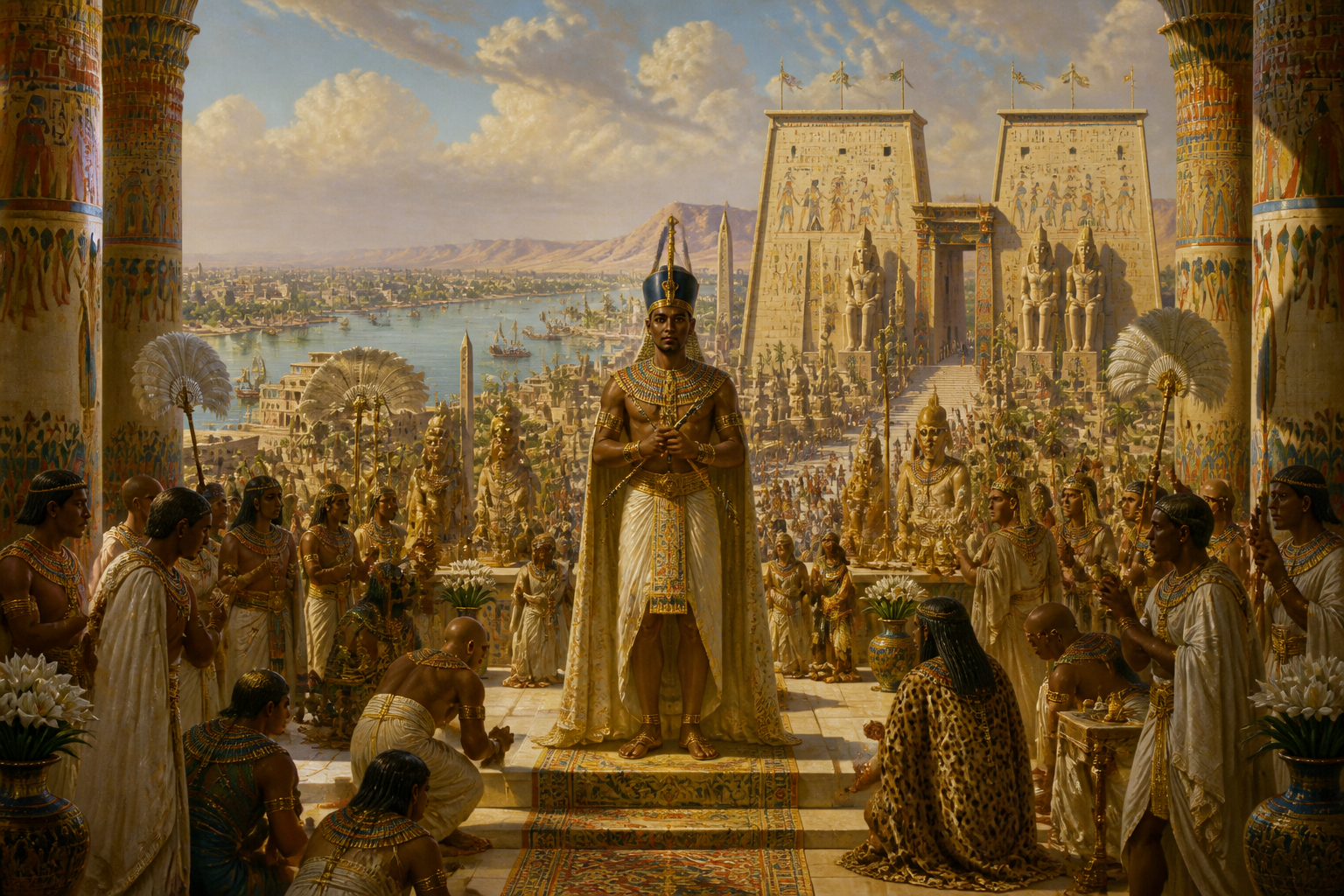
Page 1 — The Majesty of Amenhotep III
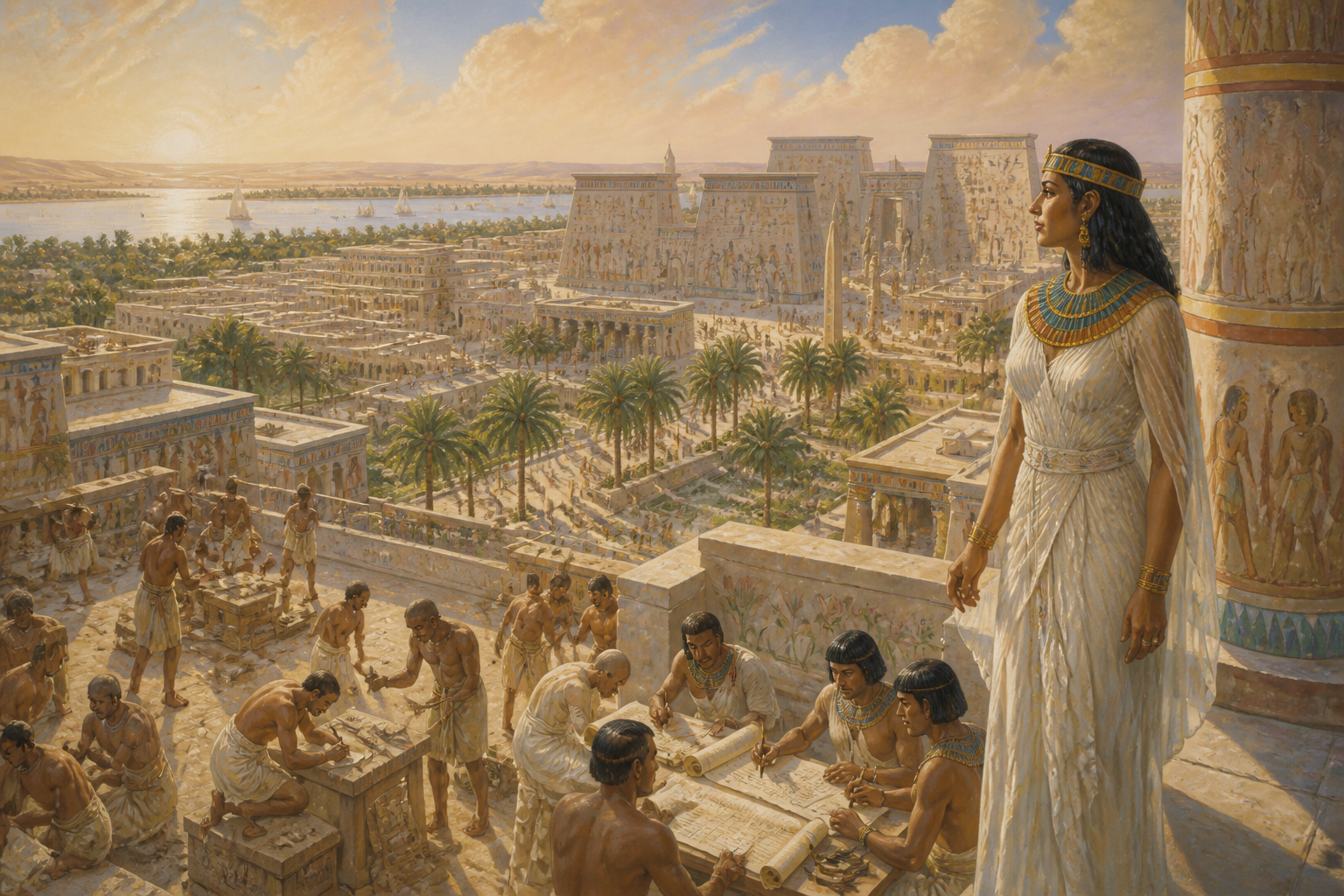
In the ancient land of Thebes, Amenhotep III ascended the throne of Egypt around 1386 BC, marking a reign that would come to symbolize unrivaled prosperity and grandeur. Inheriting an empire already at the zenith of its power, Amenhotep III maintained peace through skilled diplomacy, relying on marriage alliances and correspondences. His queen, Tiye, was not only his partner but a powerful influence in her own right, known for her wisdom and administrative skill. His chief architect, Amenhotep son of Hapu, was tasked with creating architectural wonders that would awe his subjects and the gods alike. In this time, young Akhenaten, his son, observed a kingdom rich and serene, unaware of the revolutionary path he would one day tread. Royal daughters like Sitamun played roles in these diplomatic maneuvers, often being married to foreign dignitaries to secure alliances. Amenhotep III’s reign represents a golden age of cultural and economic prosperity, setting standards that successors would admire yet challenge. His monumental building projects, from the grand temples of Karnak to the serene palace at Malkata, ensured his legacy endured in stone long after his reign concluded.
Amenhotep III: "Let peace be our legacy, not war."
Tiye: "With wisdom and alliances, we secure our realm's future."
Page 2 — The Testament of Stone
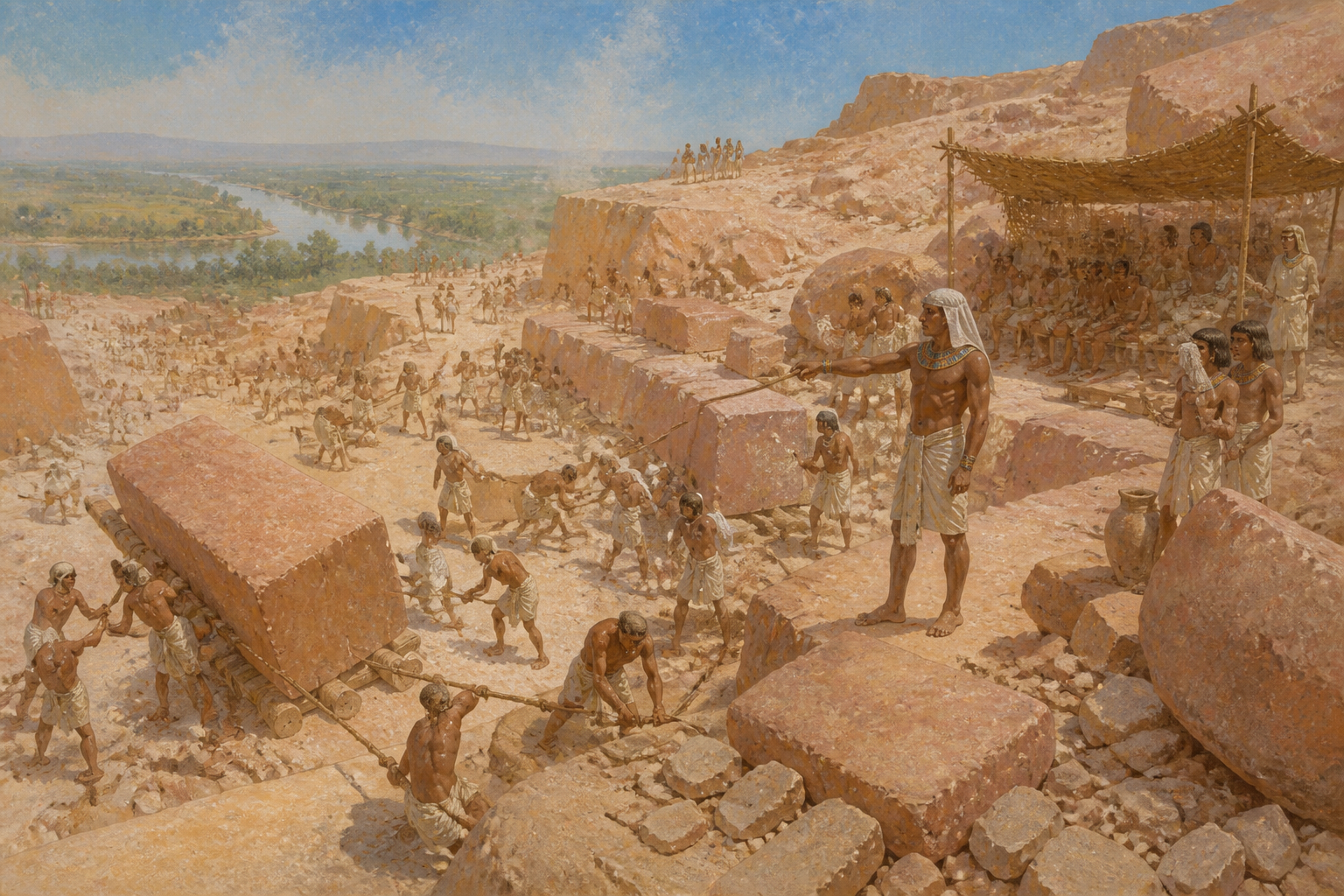
In the bustling quarry at Aswan, blocks of red granite are hewn by hundreds of workers, the sound of chisels and hammers echoing across the landscape. Under the watchful eye of Amenhotep son of Hapu, these stones are destined to become the grand monuments honoring their king. Stones are cut meticulously, each marked with the seal of the royal cartouche. Among the overseers, the chief architect stands tall, his presence commanding respect as he orchestrates the labor. The sun blazes overhead, casting stark shadows on the workers, all dressed in simple loincloths, their skin gleaming with sweat. Each stone is an investment in the legacy of Amenhotep III, a testament to the pharaoh’s vision and ambition. As the day draws long, carts laden with stone begin their journey down the Nile, heading to Thebes where they will be assembled into colossal statues and temples. The air is thick with dust and purpose, a testament to the pharaoh’s grand architectural dreams.
Amenhotep son of Hapu: "Every block here is a piece of eternity. Treat it as such."
Page 3 — The Diplomats' Correspondence
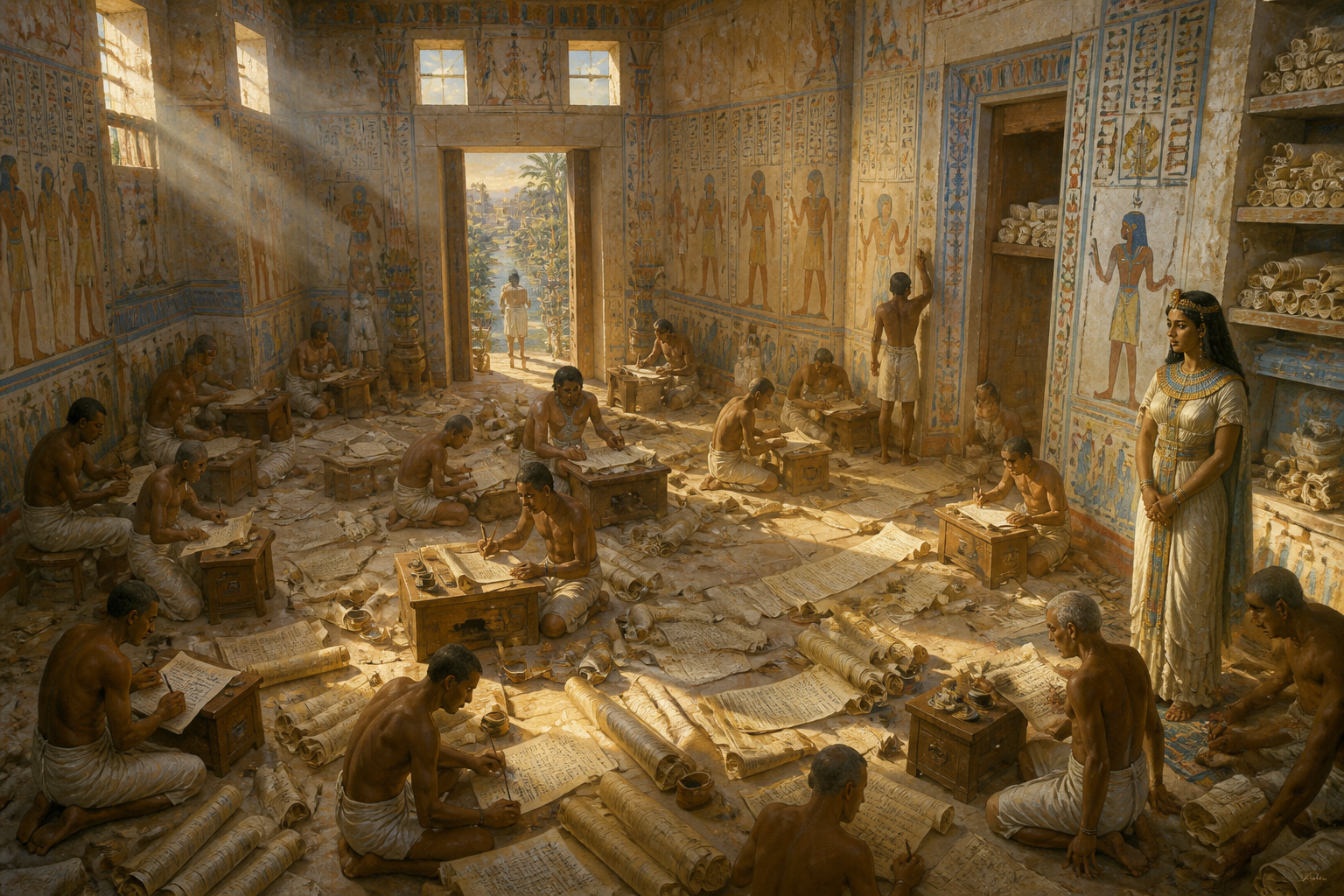
In the quiet confines of the royal scribes' chamber at Malkata, the air is filled with the soft whisper of papyrus scrolls and the scratching of reed pens. Scribes, clad in simple white linen, sit cross-legged, meticulously copying the pharaoh's words onto sheets that will be sent to foreign courts. Amenhotep III’s diplomatic network is vast, with correspondence reaching as far as Babylon and Mitanni. This peaceful exchange of messages is part of the pharaoh's grand strategy, preferring ink and parchment to the clamor of war. Gilukhipa, the Mitannian princess, recently joined Amenhotep's court, reinforcing the bonds between nations. The scribes labor tirelessly, aware that their words carry the weight of a kingdom’s intentions. As the sun sets, casting long shadows across the papyrus-strewn floor, these missives of peace are sealed with the royal seal, each a quiet promise of continued prosperity.
Scribe: "Every word here is a bridge to far-off lands, a testament to our king's wisdom."
Page 4 — The Queen's Influence
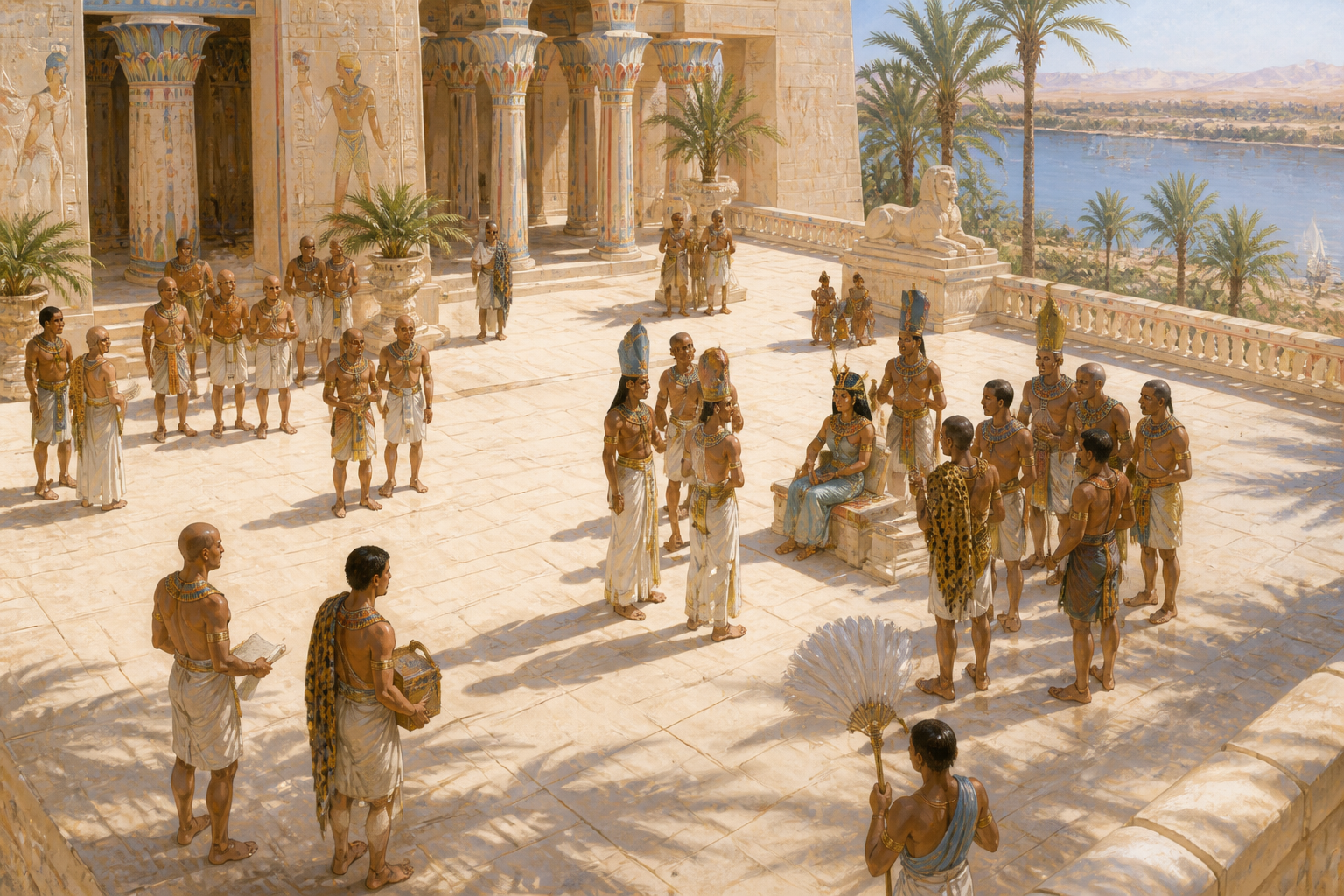
In the sun-drenched courtyard of Malkata Palace, Queen Tiye holds court with the dignified presence of a ruler. Her influence, both domestic and foreign, is as pivotal as Amenhotep III’s own. The courtyard bustles with activity; courtiers and officials seek her counsel on matters ranging from governance to diplomacy. She is draped in a linen sheath, the deep blue of lapis lazuli contrasting the brightness of her surroundings. A hawk circles overhead, casting a fleeting shadow across the ground. Tiye’s words are measured and wise, her suggestions implemented with the weight of authority. As the Nile wind flows through the courtyard, bearing the scent of distant waters, Tiye discusses trade routes with a Nubian envoy. Her role is indispensable and her relationship with Amenhotep built on mutual trust and respect. Her decisions reverberate through the kingdom, ensuring stability and continuity in a time of unprecedented peace.
Tiye: "Our strength lies not just in stone, but in the alliances we forge."
Page 5 — The Temple of Karnak
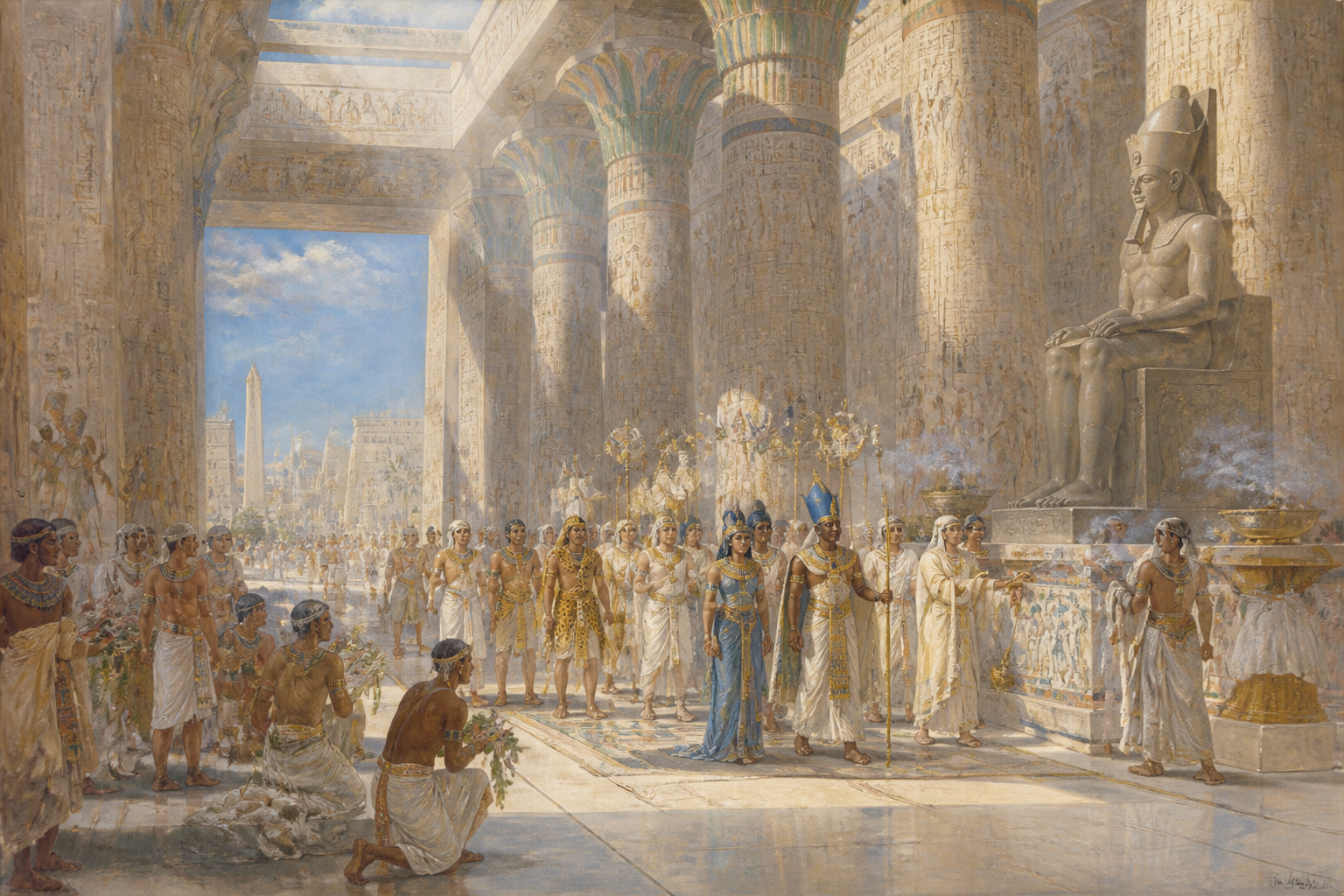
The colonnaded hall of the Temple of Karnak stands as a testament to Amenhotep III’s devotion to the gods and the grandeur of his reign. Each pillar is carved with hieroglyphs that tell of victories and divine favor. Amenhotep son of Hapu is present, ensuring every detail reflects the pharaoh's vision. A procession of priests, clad in leopard skins and white kilts, moves serenely between the columns, chanting hymns that resonate in the vastness of the hall. Incense wafts through the air, a fragrant offering that mingles with the sunlight streaming through high clerestory windows. The pharaoh's statue, recently completed, towers over the worshippers, a reminder of his divine right to rule. Stone underfoot reverberates with each step of the procession, and beyond the temple walls, the city of Thebes hums with the everyday life of a prosperous kingdom.
Priest: "These walls echo the glory of our king and the favor of the gods."
Page 6 — Tales of the Colossi
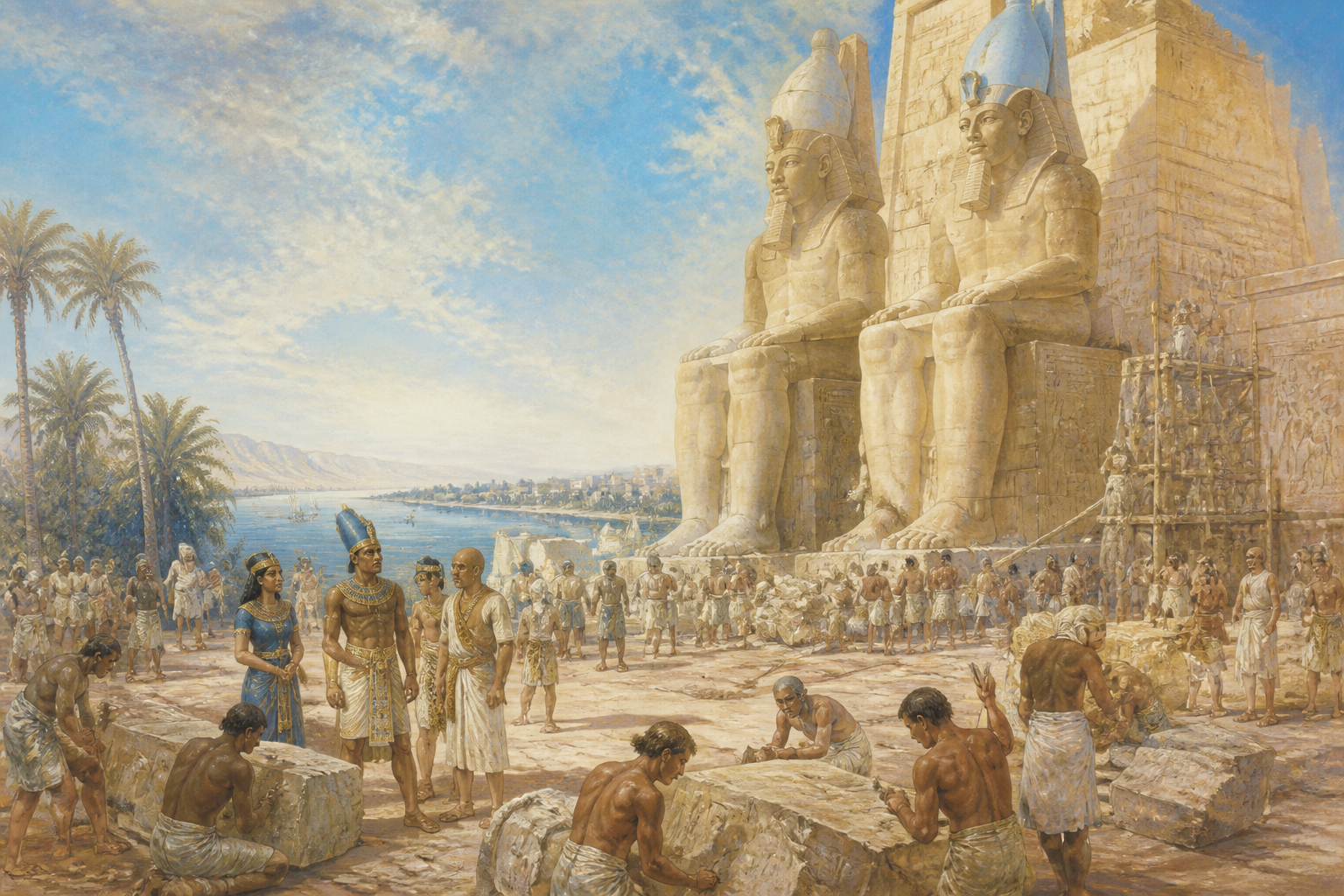
On the west bank of the Nile, the colossal statues of Amenhotep III stand sentinel, gazing out across the landscape. Known as the Colossi of Memnon, these twin giants were erected at the entrance of what was once his mortuary temple. Workers continue to labor amidst the ruins, their voices mingling with the sounds of chisels striking stone. Dressed in linen kilts, their skin bronzed by the sun, they toil to preserve the legacy of a king whose reign was marked by peace and prosperity. A cool breeze rustles the reeds by the river, carrying stories of past glories. The statues, each a monolith of quartzite, bear the regal likeness of Amenhotep, their faces etched with the wisdom and authority of a ruler. Nearly seventy feet high, they dwarf all who approach, watching over the land that flourished under the pharaoh's guidance.
Overseer: "Each stone stands for his wisdom, his reign eternalized in might."
Page 7 — The Crown Prince's Lessons
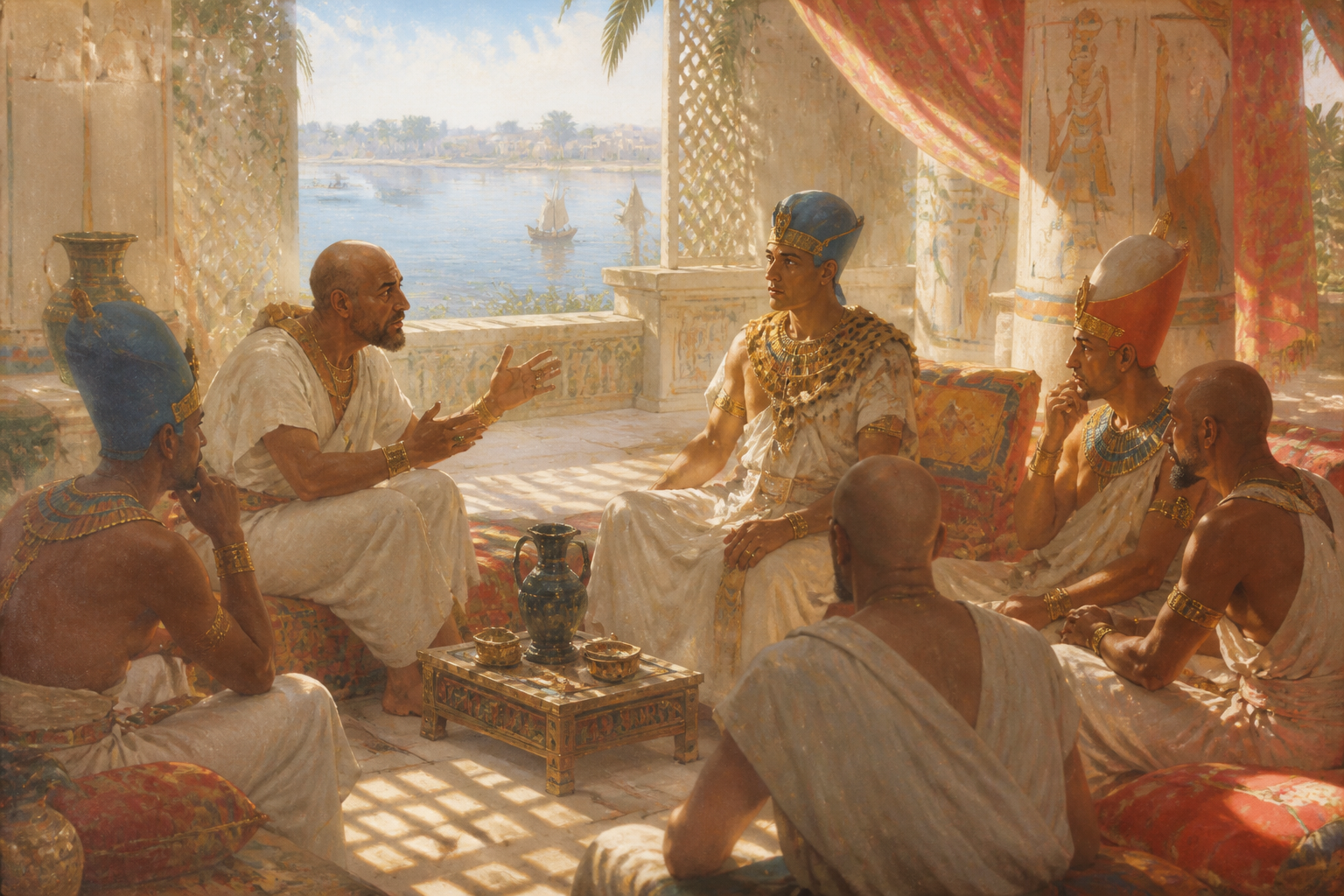
In a shaded alcove of the palace at Malkata, young Akhenaten listens intently to the councils of his father, Amenhotep III. The future pharaoh, dressed in fine linen, is surrounded by the luxuries of his father's prosperous reign. His education is as much about diplomacy and governance as it is about the rituals of the gods. Today, he watches as his father discusses matters of state with his closest advisors. They sit on cushions, the scent of lotus flowers wafting through the air. A scribe nearby records every word, ensuring no wisdom is lost to time. Akhenaten, contemplative and curious, absorbs the lessons of peace, prosperity, and the divine right to rule. His father's shadow looms large, both as a guide and as a challenge he will soon need to meet. The soft echo of the Nile beyond the palace fills the air with a gentle, rhythmic lull, ever present in the life of the court.
Amenhotep III: "Learn, my son, for a king's burden is heavy, but his legacy can be eternal."
Page 8 — The Festival of Opet
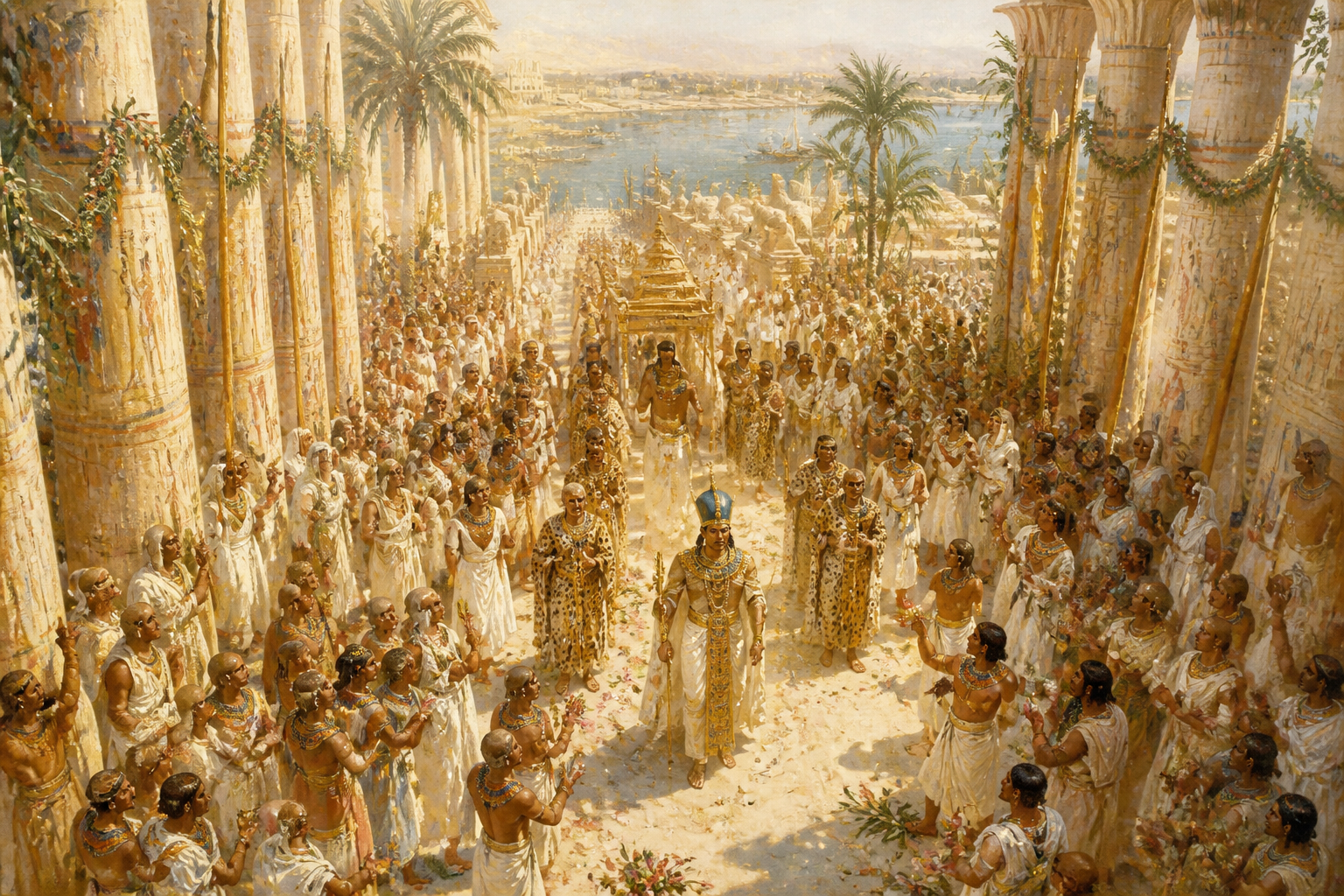
The city of Thebes is alive with celebration as the Festival of Opet begins, a grand event that reaffirms the divine connection between the pharaoh and the gods. Amenhotep III, adorned in the khepresh, a tall blue leather crown with a gold cobra at the brow, leads the procession. The streets are lined with cheering citizens, their colorful garments a sea of vibrant hues. Priests carrying sacred barques on their shoulders chant hymns, the air rich with the scent of myrrh. The procession moves through Karnak and onto Luxor, where offerings are made to Amun, the king's divine patron. The joy is palpable, the city united in reverence and festivity. Chariots, gilded and gleaming, pass by, stirring dust that glitters in the sunlight. Musicians play on lutes and drums, their melodies weaving through the jubilant cries of the people. It's a spectacle that encapsulates the wealth and faith of Amenhotep's reign.
Priest: "Behold, the pharaoh, beloved of Amun, walks among us!"
Page 9 — The Palace at Malkata
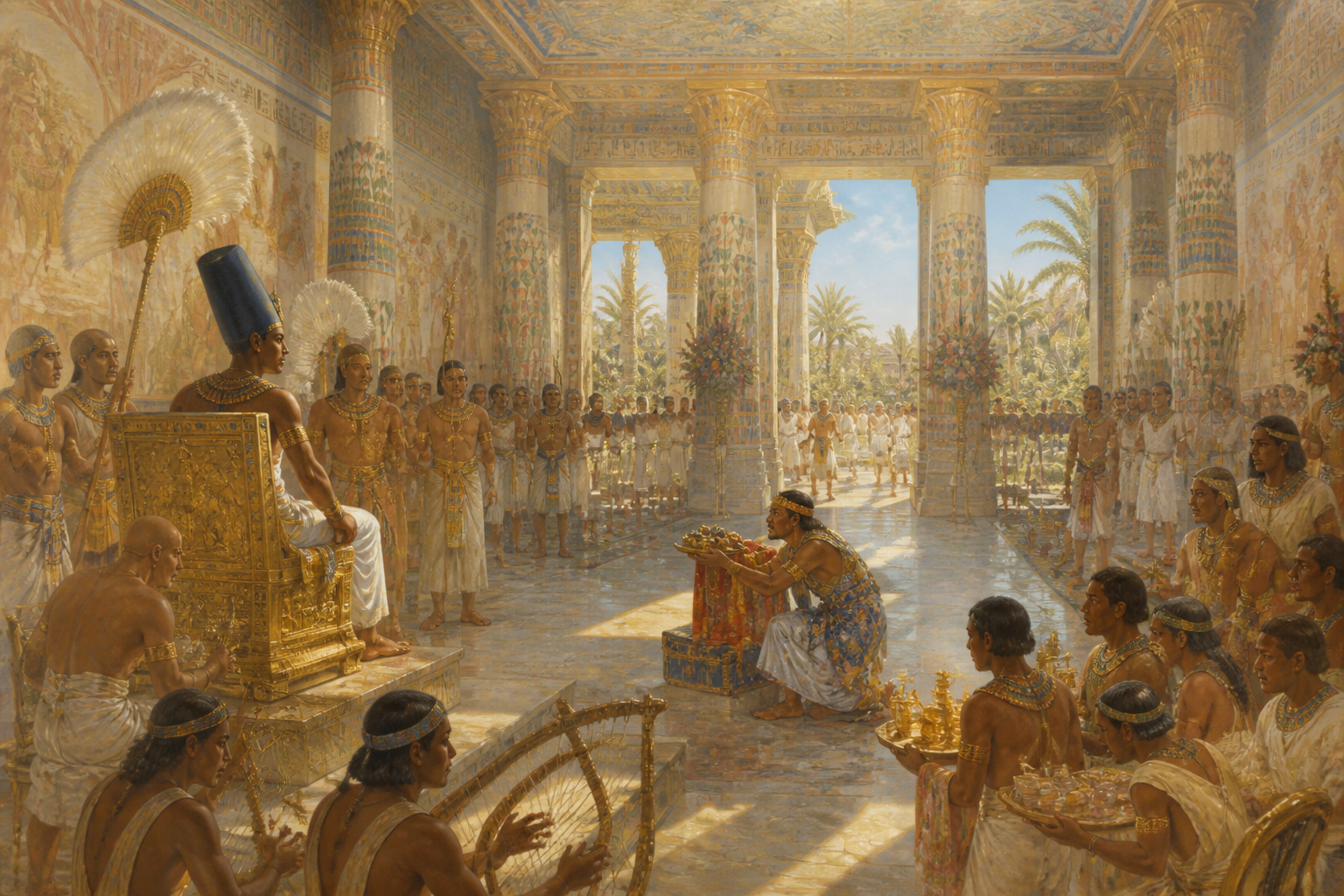
At the heart of his realm, Amenhotep III’s palace at Malkata stands as a symbol of opulence and power. The vast complex is alive with activity; servants hurry along colonnaded corridors, their arms piled high with luxuries destined for the royal feast. The walls are adorned with frescoes depicting the exploits of the king, their vibrant pigments still fresh and vivid. The pharaoh, seated on a cushioned throne in a grand reception hall, receives envoys bearing gifts from distant lands. Their offerings—exotic animals, gold, and precious stones—are testament to his reach and influence. His queen, Tiye, sits beside him, her presence formidable yet warm. Musicians play in a corner, their melodies soft and soothing. The floor is a cool alabaster, and overhead, painted beams depict celestial scenes. The palace is a microcosm of the kingdom: prosperous, cosmopolitan, and steeped in tradition.
Amenhotep III: "Let these gifts remind us of our place among the nations, prosperous and revered."
Page 10 — The Sunset of a Golden Age
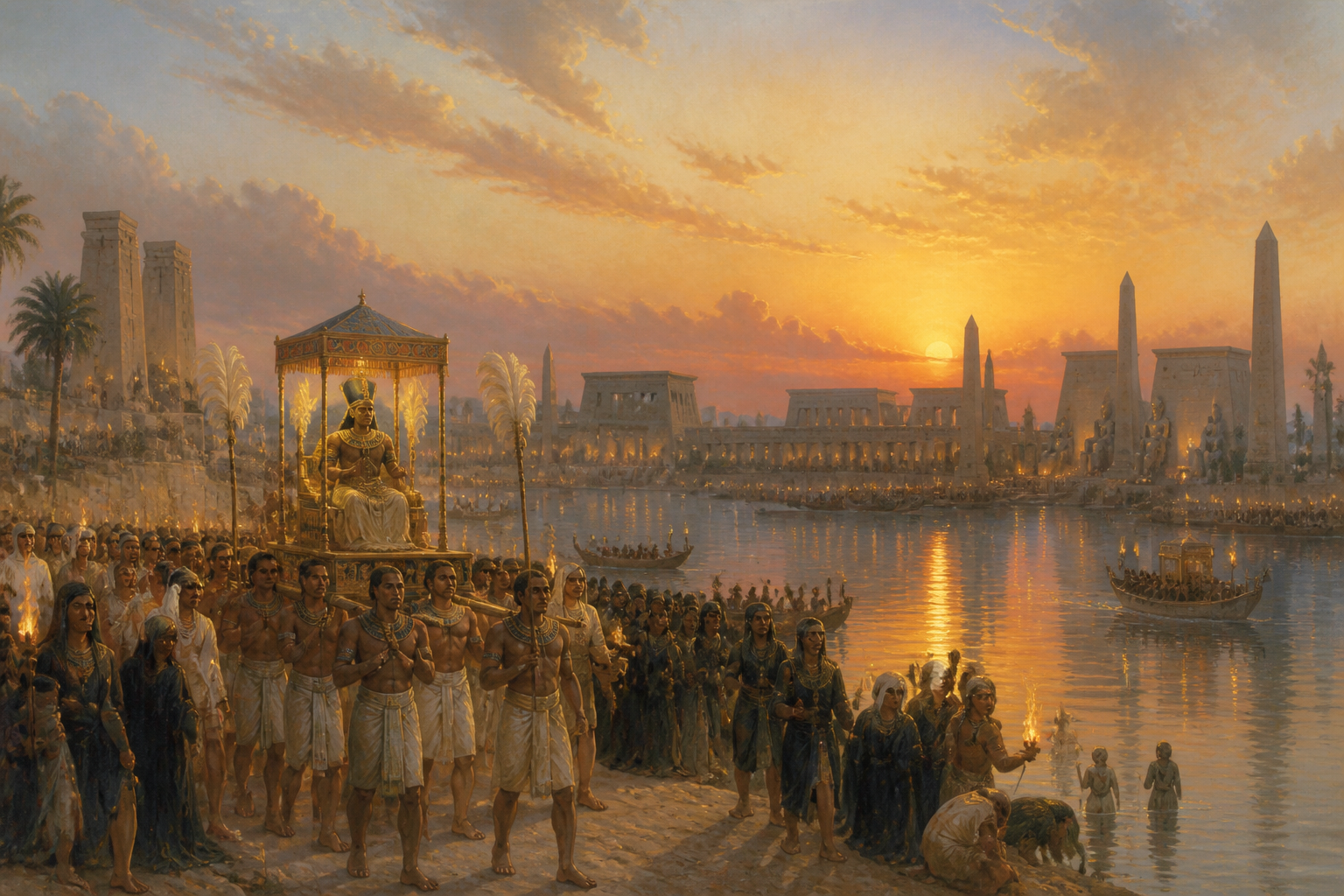
The sun sets on Amenhotep III’s reign, casting long shadows across the monuments and temples that mark his legacy. By the river’s edge in Thebes, courtiers gather to pay their final respects as the noble king prepares to join the gods. The air is solemn yet reverent, filled with the perfumed smoke of incense. Amenhotep, now aged but regal in his last days, is carried upon a golden litter, adorned in a flowing white shendyt and the double crown of Upper and Lower Egypt. His life, a tapestry of peace and wealth, is celebrated with hymns and offerings. Among the assembled, his son Akhenaten stands ready to inherit a kingdom thriving yet on the cusp of change. As the torches flicker in the dusk and the water flows tirelessly, the court reflects on a reign that set the pinnacle of Egyptian grandeur, a memory etched in the sands of time.
Courtier: "A golden age comes to rest, leaving behind the stone that speaks forever."
About this story
- Audience: general readers
Read Wonder Egypt on your phone
Wonder Egypt is available on Android. Get Wonder Egypt on Google Play.