The War of the Sea Peoples
The War of the Sea Peoples — an illustrated history story. 10 illustrated pages, free to read on Wonder Egypt.
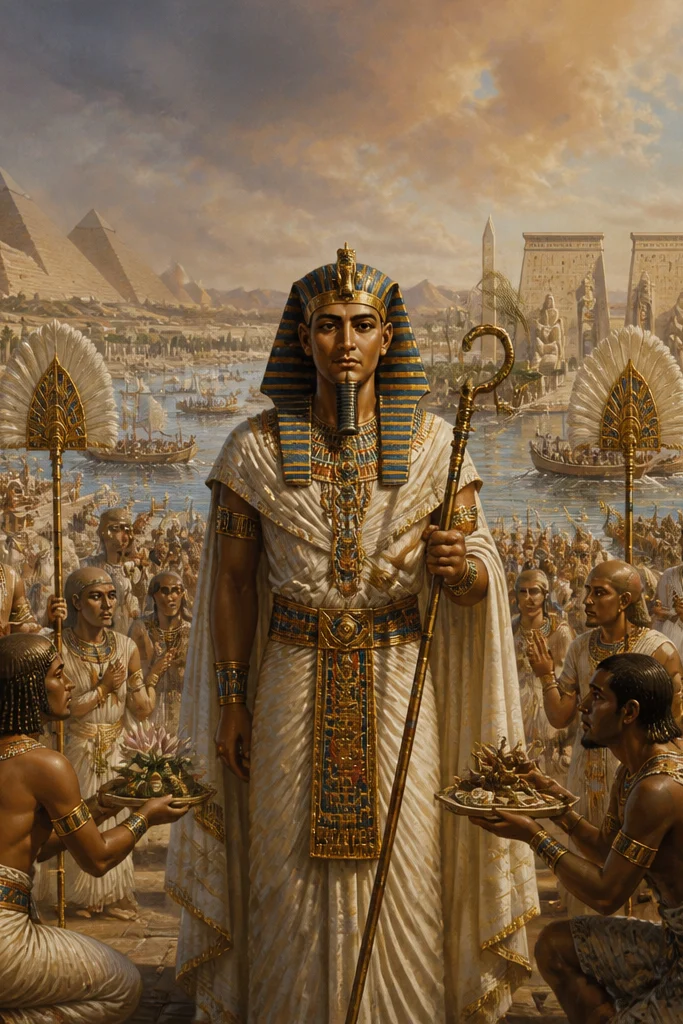
Page 1 — The Clash at the Delta
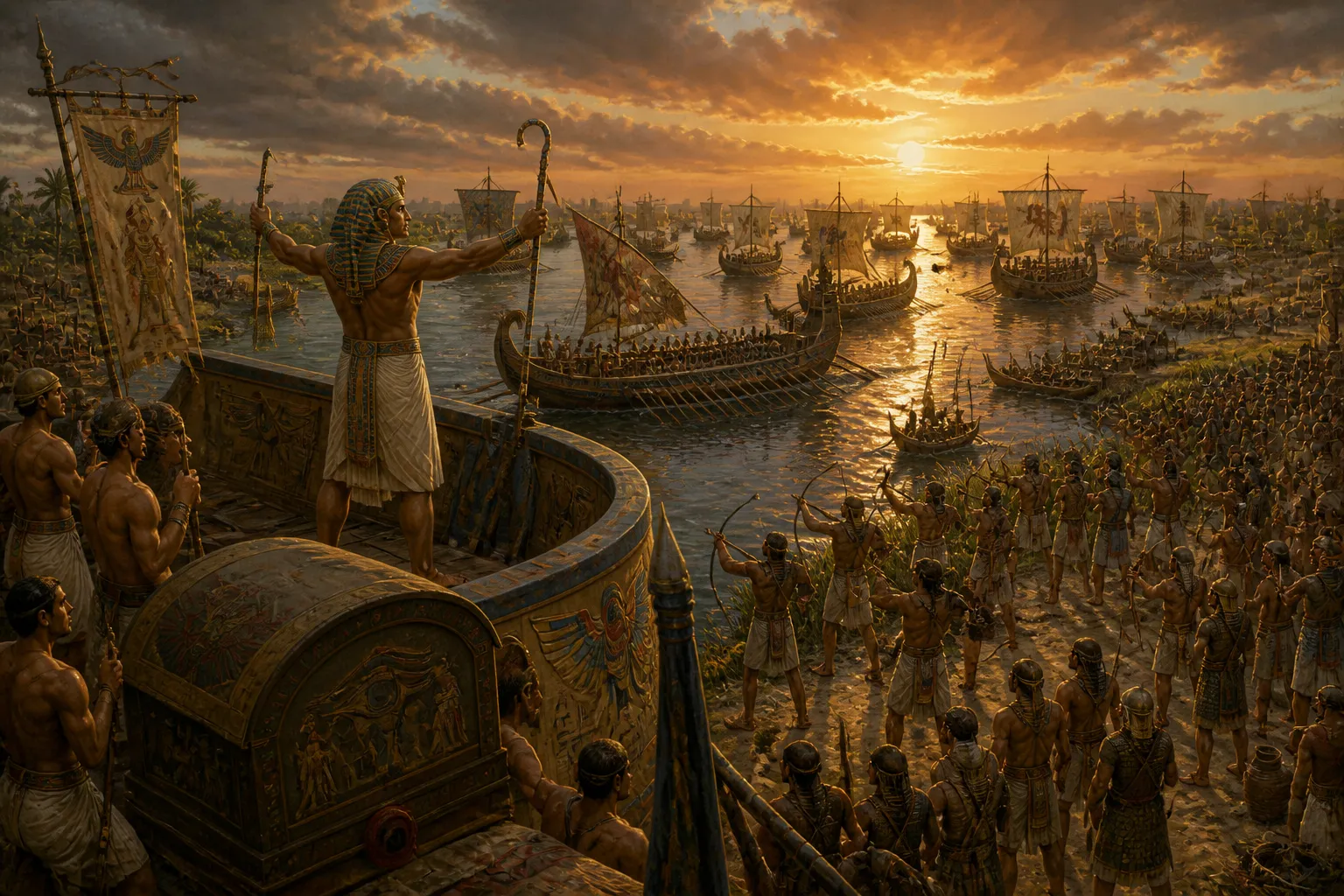
The sun hangs low over the Delta coast, casting long shadows over the amassed forces. The landscape is a rich tapestry of reeds and rolling waters that create a natural labyrinth, a kingdom of silt and sand embracing the great river. The air is thick with tension as the Sea Peoples, a formidable coalition including the Peleset, the Sherden, and the Tjeker, press forward. Ramesses III, standing resolute on the prow of his flagship, surveys the scene with determined eyes. His royal attire, adorned with symbols of power and protection, gleams in the fading light. His chariot fleet, poised like coiled serpents at the river’s edge, reflects the golden sun, a radiant testament to Egyptian craftsmanship. Archers, clad in linen kilts, line the banks, their bows taut and ready. The invaders' ships close in with their distinct sails and carved prows signaling the diversity of the coalition. This battle represents a fulcrum in history; the survival of Egypt hangs in the balance. As the first wave crashes against the fleet, shouts of command and the twang of bowstrings fill the air, creating a symphony of survival against annihilation.
"By Amun's will, we hold the line!" Ramesses III declares.
Page 2 — Council of War
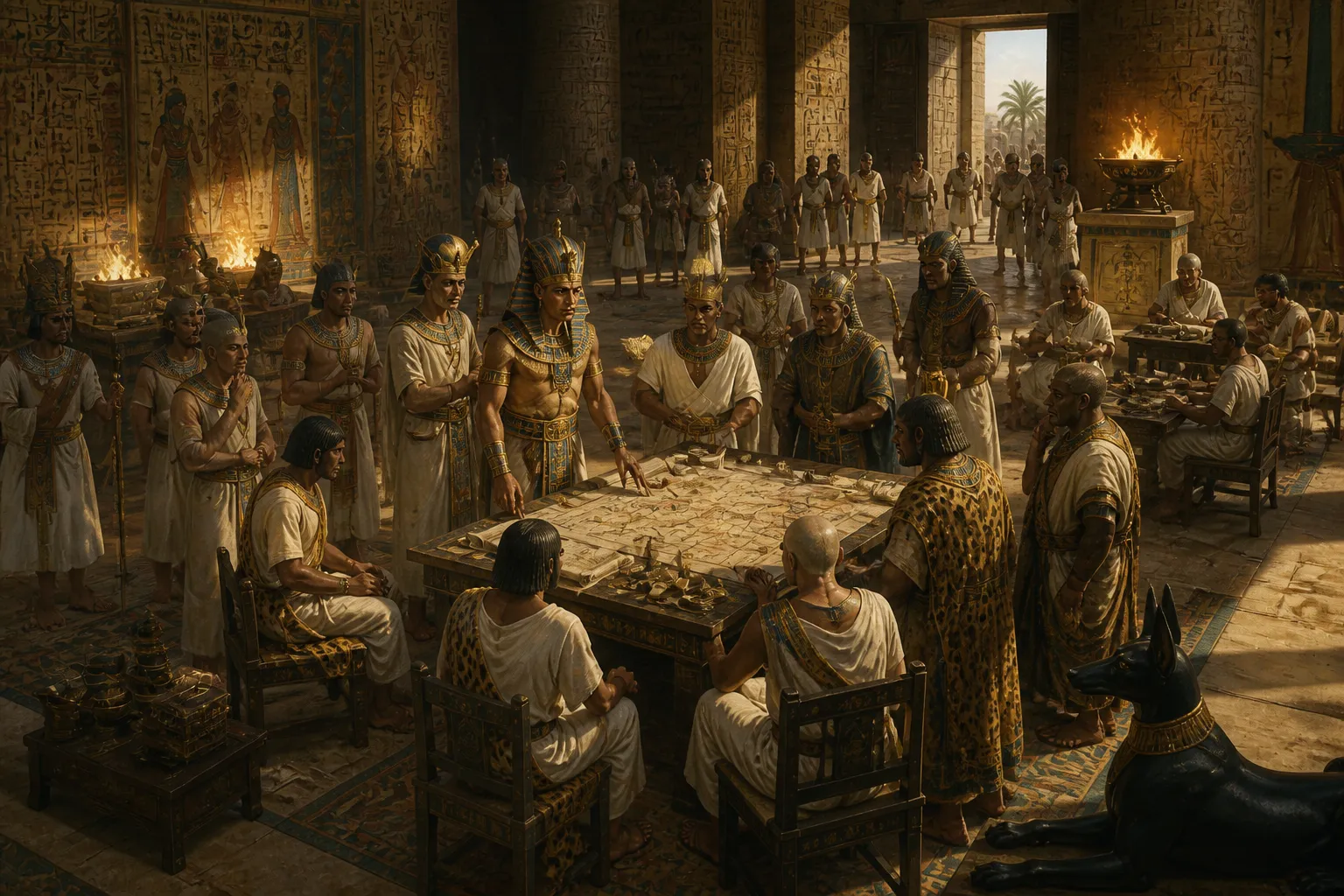
In the vast audience hall of Pi-Ramesses, the atmosphere is thick with urgency, an echo chamber of ancient stone and political maneuvering. The chamber, grand in its proportions, is lined with pillars etched with the hieroglyphs of past triumphs and tribulations. Ramesses III stands at the center, his average build underscored by a strong jawline, the embodiment of Egyptian authority. Around him are his most trusted advisors: Chancellor Bay with his keen eyes and elaborate robe, Vizier To wearing the mantle of his office, and High Priest Ramessesnakht, enigmatic in his priestly garb. Maps and scrolls, detailing the movements of the relentless Sea Peoples, lie strewn across the alabaster table. Generals, dressed in varied Egyptian military attire, argue over strategies, their voices a cacophony bouncing off the stone walls. Ramesses listens intently, the weight of the crown - a symbol of his people's hopes - resting heavily on his head. He knows that this decision will shape the history of Egypt, the last bastion against the tide of chaos sweeping through the ancient world.
"We must meet them at the Delta, where the river narrows their advance," Vizier To suggests.
Page 3 — Muster at Medinet Habu
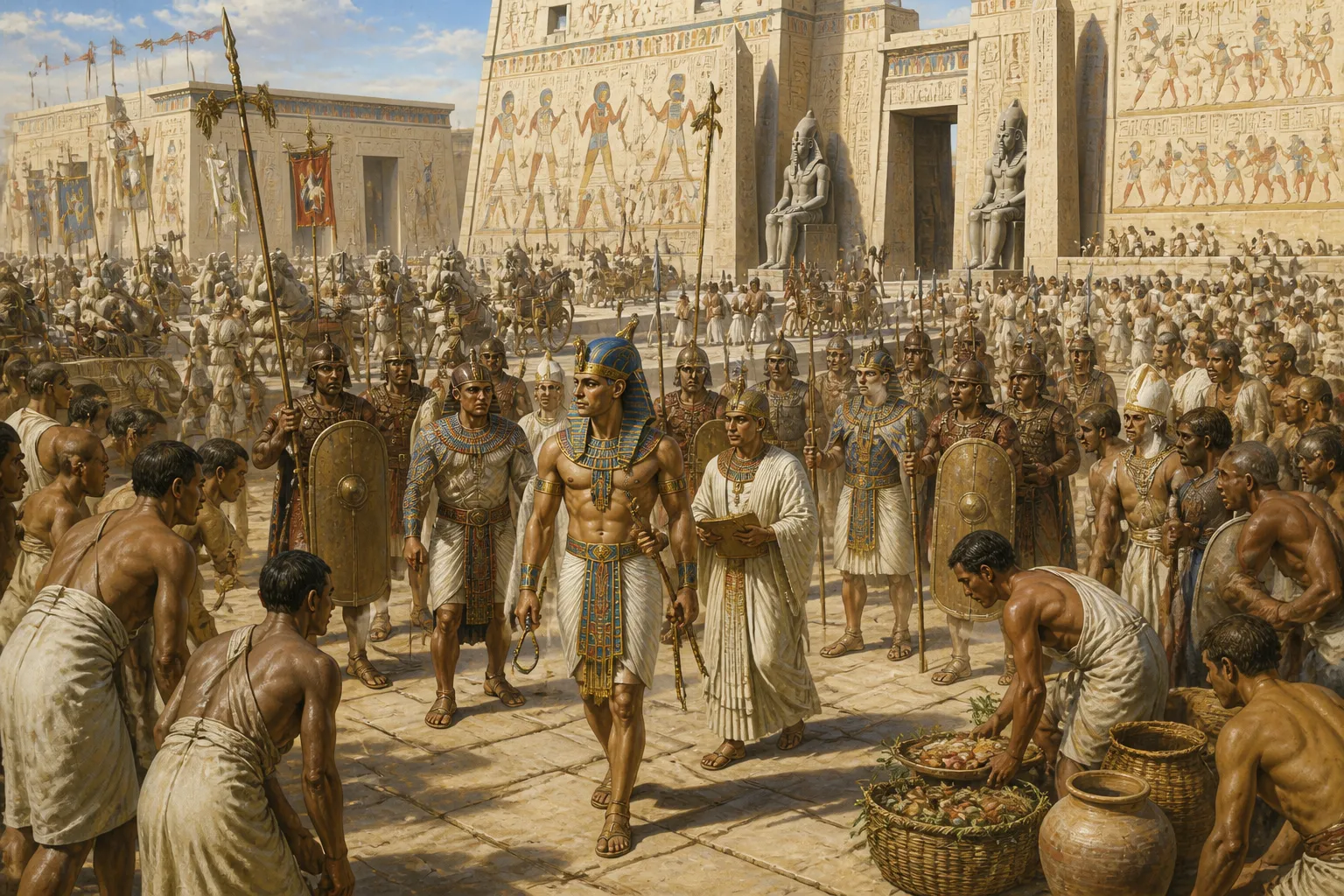
The grand temple complex of Medinet Habu breathes with the rhythm of preparation, a symphony of human and divine endeavor. Stone carvings depict the gods, their serene expressions a contrast to the urgency below. Warriors, bronze spears in hand, secure their pleated kilts and leather sandals for the coming conflict. Their armor, polished to a mirror finish, reflects the morning light in dazzling arrays. Craftsmen and laborers, clad in simple linen garments, labor tirelessly to fortify the temple walls, a testament to their dedication and skill. Supplies are meticulously gathered, every bundle and amphora a piece of the grand strategy. Ramesses III strides through the bustling throng, commanding respect with the mere presence of his regalia - the crown and crook symbols of his divine right to rule. The temple murals, vivid with depictions of past glories and battles, loom as silent witnesses to the preparations, their scenes a reminder of past triumphs. Priests, garbed in white linens, chant invocations to Amun, their deep voices resonating through the incense-laden air, heavy with anticipation. Each man and woman knows their role, their unity a testament to the unyielding resolve and communal spirit of what remains the last surviving great kingdom of the ancient world.
"The gods favor us with strength and wisdom," a priest declares to the gathered soldiers.
Page 4 — The Sea Peoples Approach
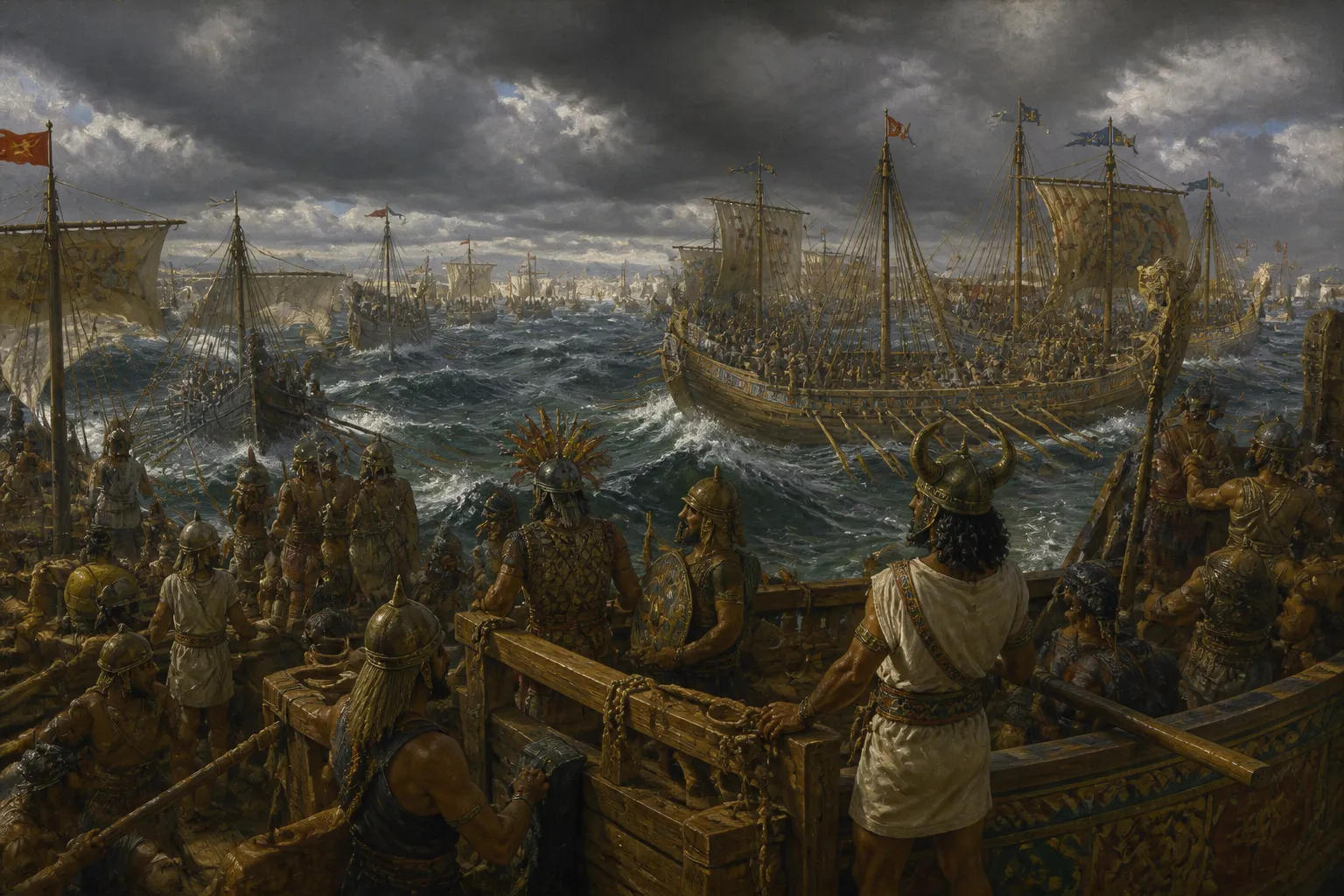
Beyond the churning waters of the Mediterranean, the sight of the Sea Peoples emerges like a storm on the horizon. Their ships, an armada crafted for war and driven by desperation, cut through the water under a sky burdened with the promise of rain. Each vessel carries men from lands ravaged by calamity, their faces, etched by hardship, peer from the decks with a determination born of necessity. The Peleset, their feathered helms distinctive among the throng, stand ready beside the Sherden, who are easily recognized by their horned helmets and fierce countenances. The Tjeker, masters of the sea, steer their vessels with expert precision, using every advantage of wind and wave. These seafaring peoples, survivors from a world undone, sail not for conquest but survival, seeking new lands to call their own. Their approach remains relentless, the foaming sea conspiring as their ally, edging them ever nearer to the Egyptian stronghold. The air is charged with the portent of impending conflict, where the future of kingdoms is suspended in the balance of intent and chance.
"We sail for survival, not conquest," a Sherden captain states to his crew.
Page 5 — Rallying the Troops
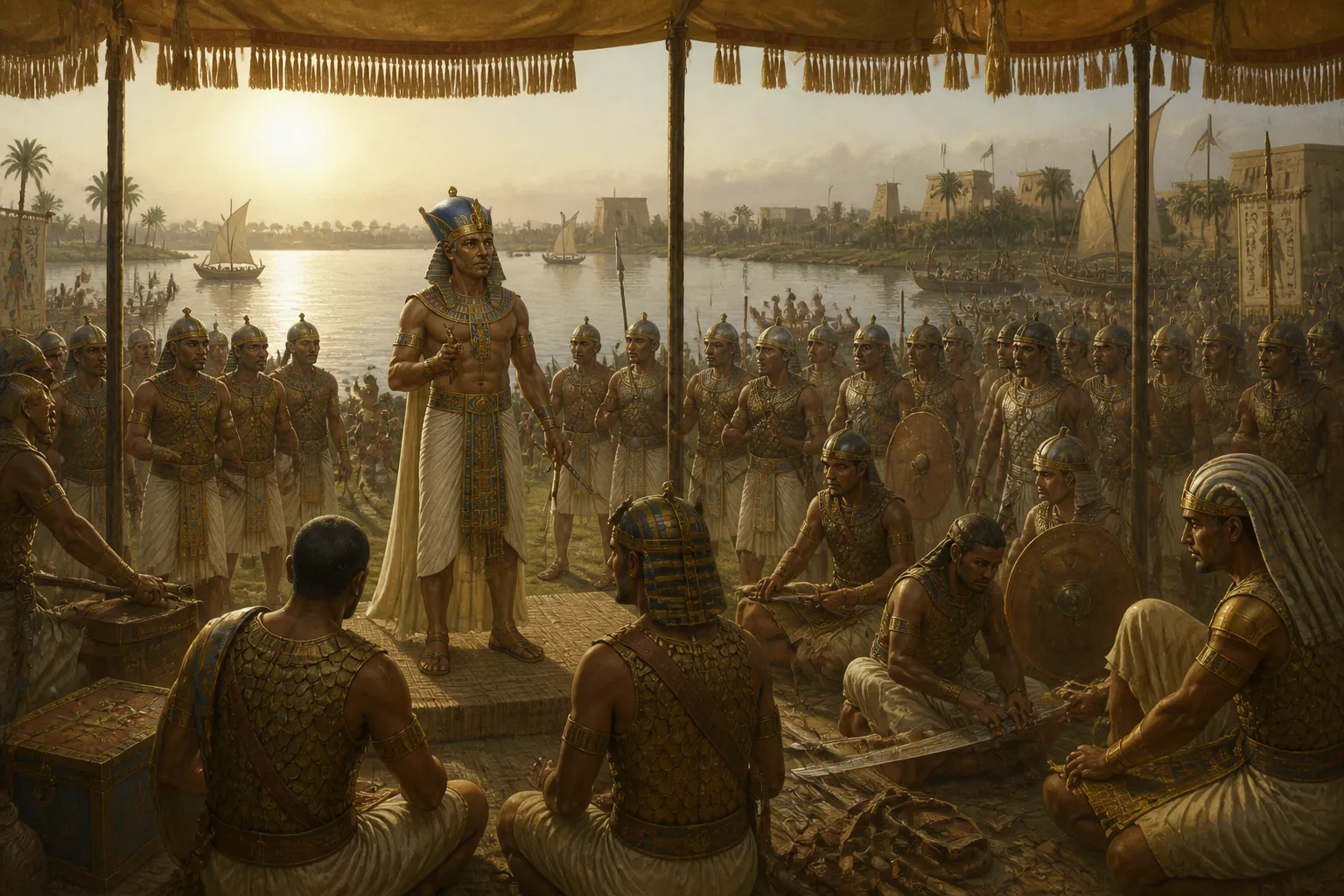
The barracks near the Nile River vibrate with the sound of preparation, a testament to the discipline and endurance of Egyptian soldiers. Each warrior, a veteran of past conflicts, meticulously sharpens his blade, the metallic scrape echoing the determination in their hearts. Shields, burnished to brilliance, are checked for defensive strength. Ramesses III, now a venerable figure with the weight of years apparent in the lines of his face, stands before his assembled troops, each word a promise of glory and survival. The river flows steadily beside them, a lifeline of this ancient civilization, its waters mirroring the resilience and solidarity in each soldier's eyes. As the sun rises, its golden rays cast long, majestic shadows, illuminating the faces of warriors ready to defend the lands of their ancestors. The gravity of the moment, a confluence of destiny and duty, binds them as a united force against an uncertain future. They stand as one, ready to fight for the preservation of their culture and heritage.
"Today, we fight for the land of our ancestors," Ramesses III proclaims.
Page 6 — In the Cunning Embrace of the Delta
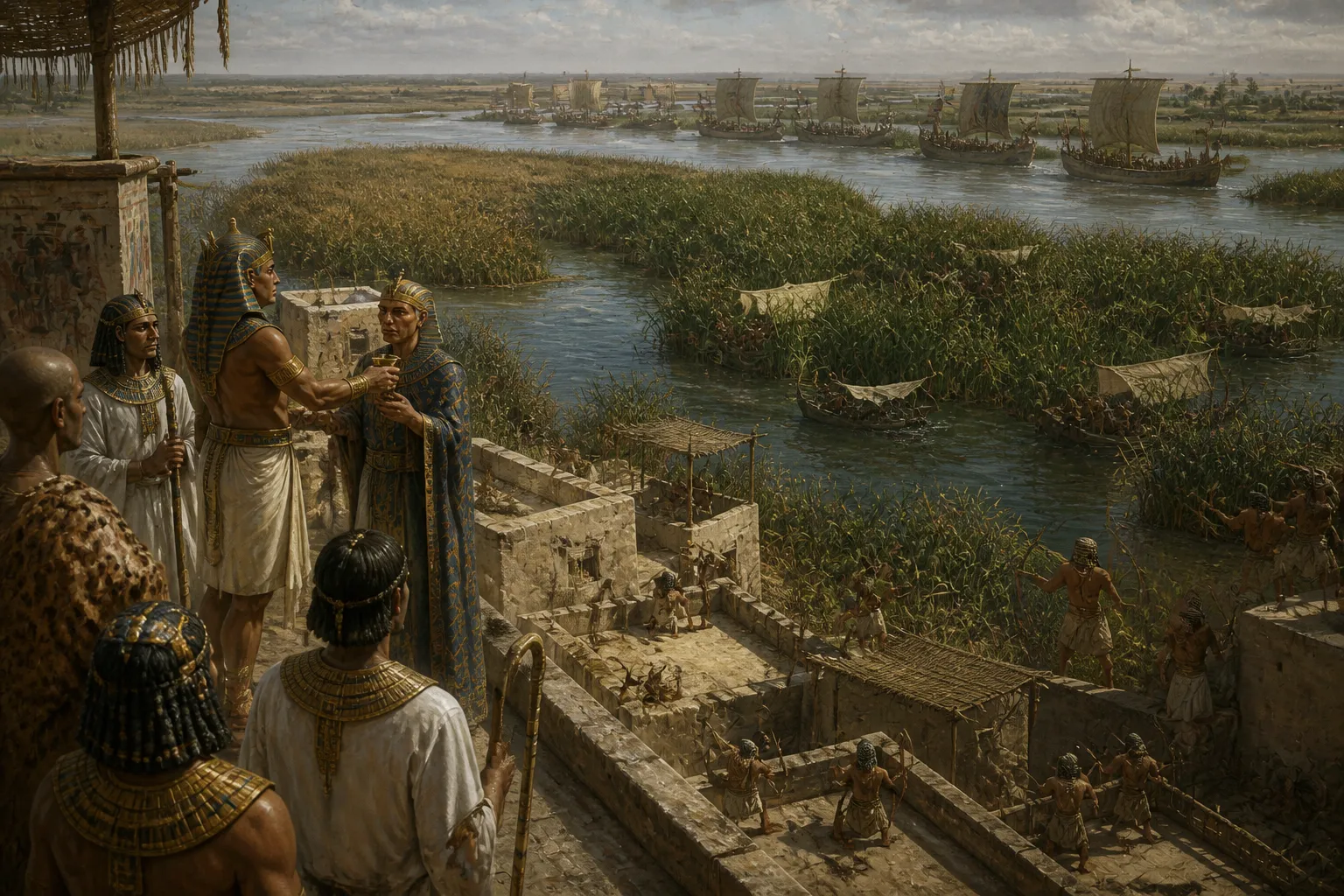
The Sea Peoples' armada sails into the labyrinthine waters of the Nile Delta, their confidence unshaken by the calm of the river's embrace. Unaware, they drift deeper into the strategic quagmire that is the delta - a natural maze of channels and reeds, deceptive in its tranquility. Ramesses III’s fleet, biding its time, lurks within these watery corridors, ready to spring forth with lethal intent. Concealed along the banks, Egyptian archers, masters of marksmanship, prepare their bows with unwavering precision. The Sea Peoples advance, their ships slicing through the narrow channels, oblivious to the Egyptian forces poised to unleash devastation. The air crackles with an electric tension, a charged stillness preceding the orchestrated storm. Every rustle of the reeds, every whisper of the wind carries the weight of the impending clash, as nature itself seems to hold its breath.
"Let them come deeper; we have the river's guard," Ramesses III commands.
Page 7 — The Battle Unleashed
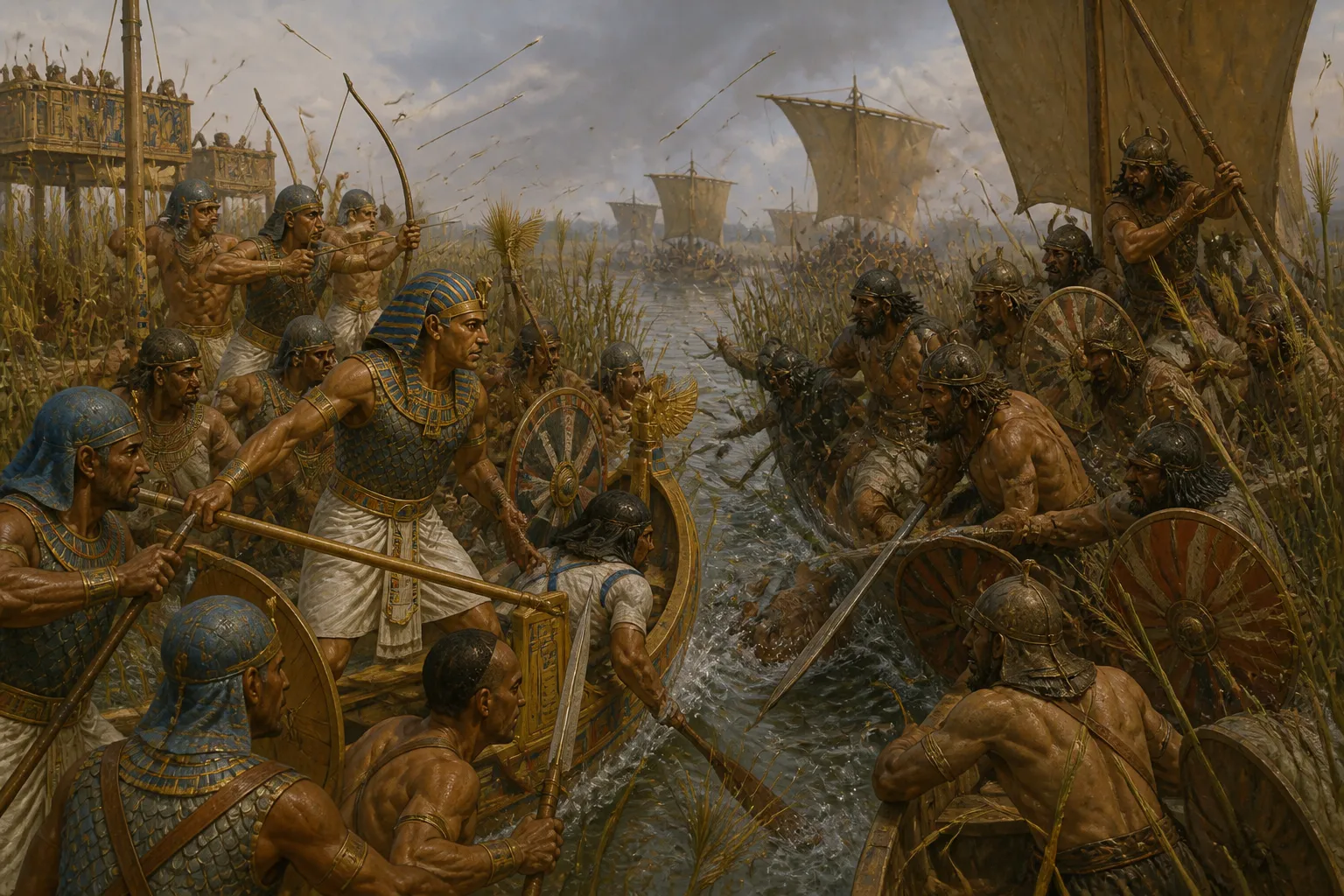
The moment erupts in chaotic fervor as Egyptian forces spring their trap with coordinated precision. Arrows rain from the banks, a darkening storm of projectiles against the twilight sky, while Ramesses III's fleet surges forward from hidden inlets, their vessels cutting through the water with lethal grace. The Sea Peoples, taken by surprise, scramble to respond as panic grips their ranks. Ships collide in the narrow channels, wooden hulls splintering under the sudden assault. The clash of bronze and cries of battle echo across the delta, a cacophony of human conflict and clashing steel. Ramesses III’s tactics unfold with methodical precision, his command of the battlefield a testament to his strategic mastery and experience in warfare. The waters, churned by the struggle, become a theater of grit and resolve, where the fate of civilizations hangs by a slender thread.
"Loose the arrows! Strike with the river's force!" Ramesses III commands.
Page 8 — Tide Turned by Deception
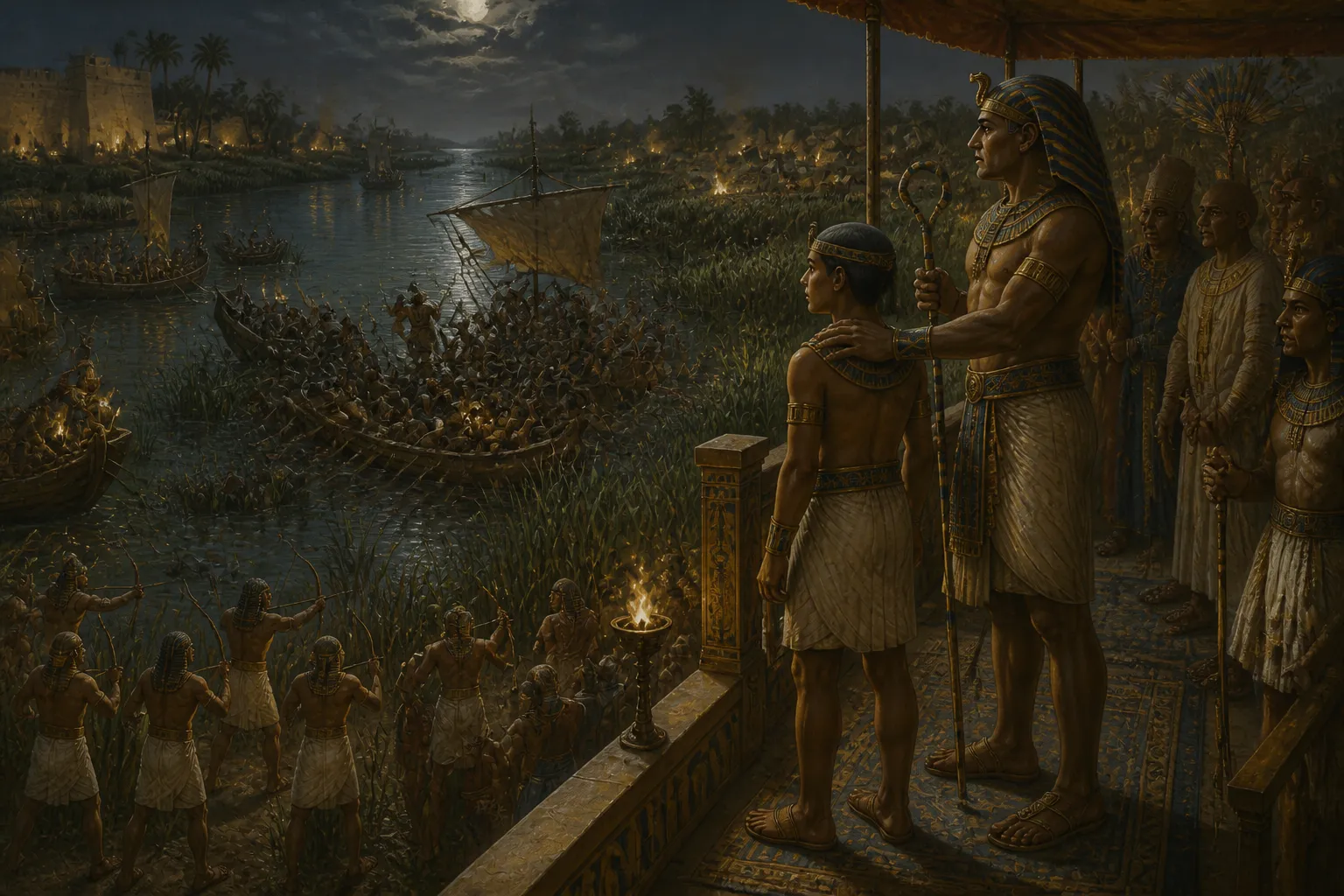
As the battle rages, a tactical shift occurs, a masterstroke of Egyptian cunning. The forces of Ramesses III feign a retreat, drawing the Sea Peoples further into the ensnaring network of channels. Deceived by the apparent withdrawal, the invaders pursue aggressively, their ships becoming tangled among the reeds and shallows. At the decisive moment, Ramesses III gives the signal, and the trap closes with sudden, deadly finality. Egyptian reserves, hidden with meticulous foresight, emerge from concealed positions, launching a decisive strike. The tides of battle turn, with the Sea Peoples caught in the vise of Egyptian strategy. Confusion and cries of the disoriented invaders reverberate along the riverbanks, a testament to their fatal error in judgment and the brilliance of their opponents.
"Draw them in, and let the river ensnare them," Ramesses III instructs.
Page 9 — The Aftermath of Victory
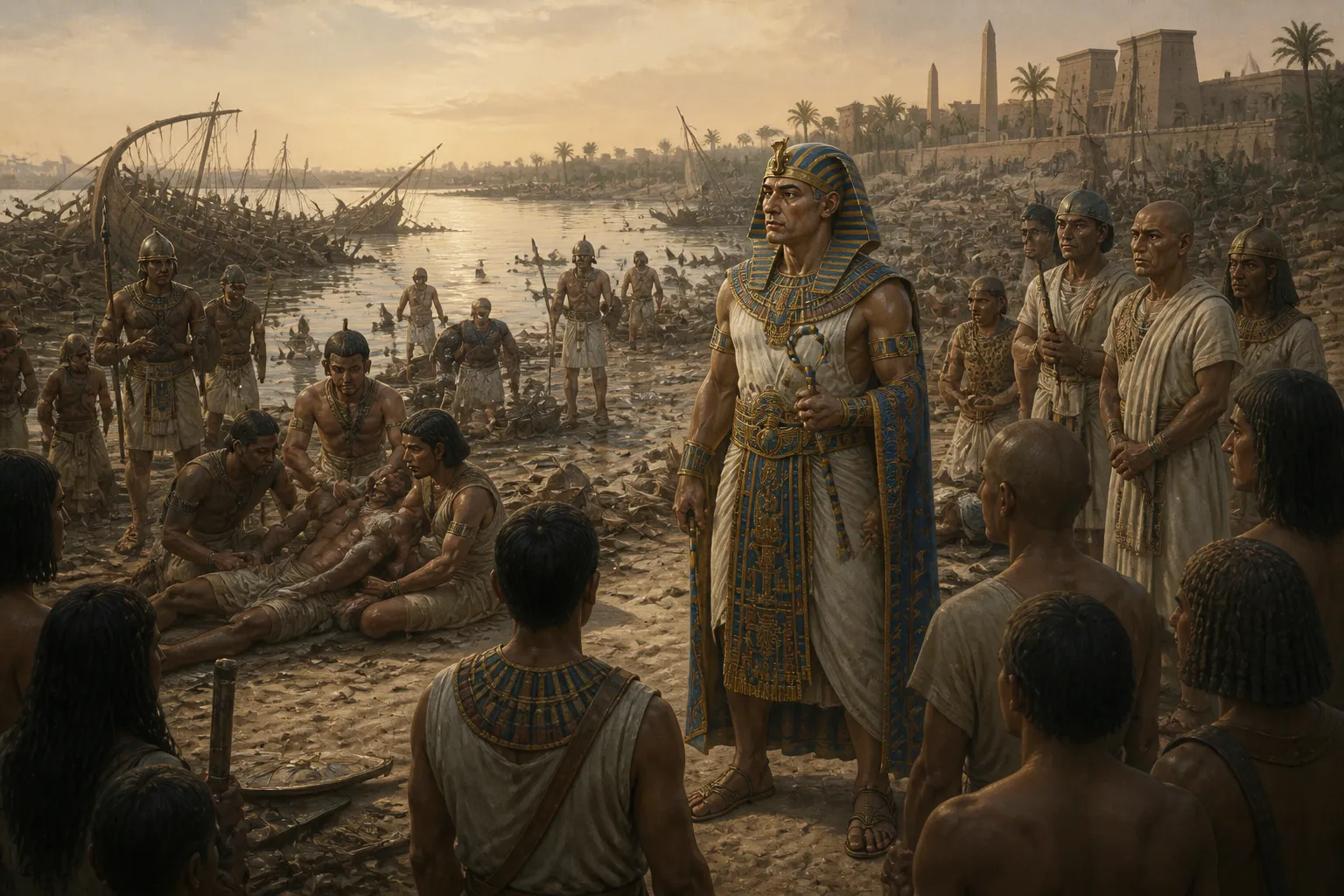
With the battle won, a tranquil calm descends upon the Nile Delta, a stark contrast to the earlier chaos. Ramesses III stands amidst the remnants of the Sea Peoples' fleet, now reduced to splintered wrecks scattered across the river's expanse. Captives are gathered, their fate sealed by Egyptian decree and the laws of victory. The air, once filled with war's fury, hangs heavy with the somber weight of reflection. Along the banks, soldiers tend to the wounded, their spirits buoyed by the hard-earned triumph. In the distance, the spires of temples rise against the horizon, a testament to the enduring strength and resilience of Egypt, the lone survivor among fallen empires. The river flows on, a silent witness bearing the stories of that day towards eternity, a living thread in the tapestry of history.
"Today, Egypt stands unbroken," Ramesses III solemnly proclaims.
Page 10 — Legacy of the Delta
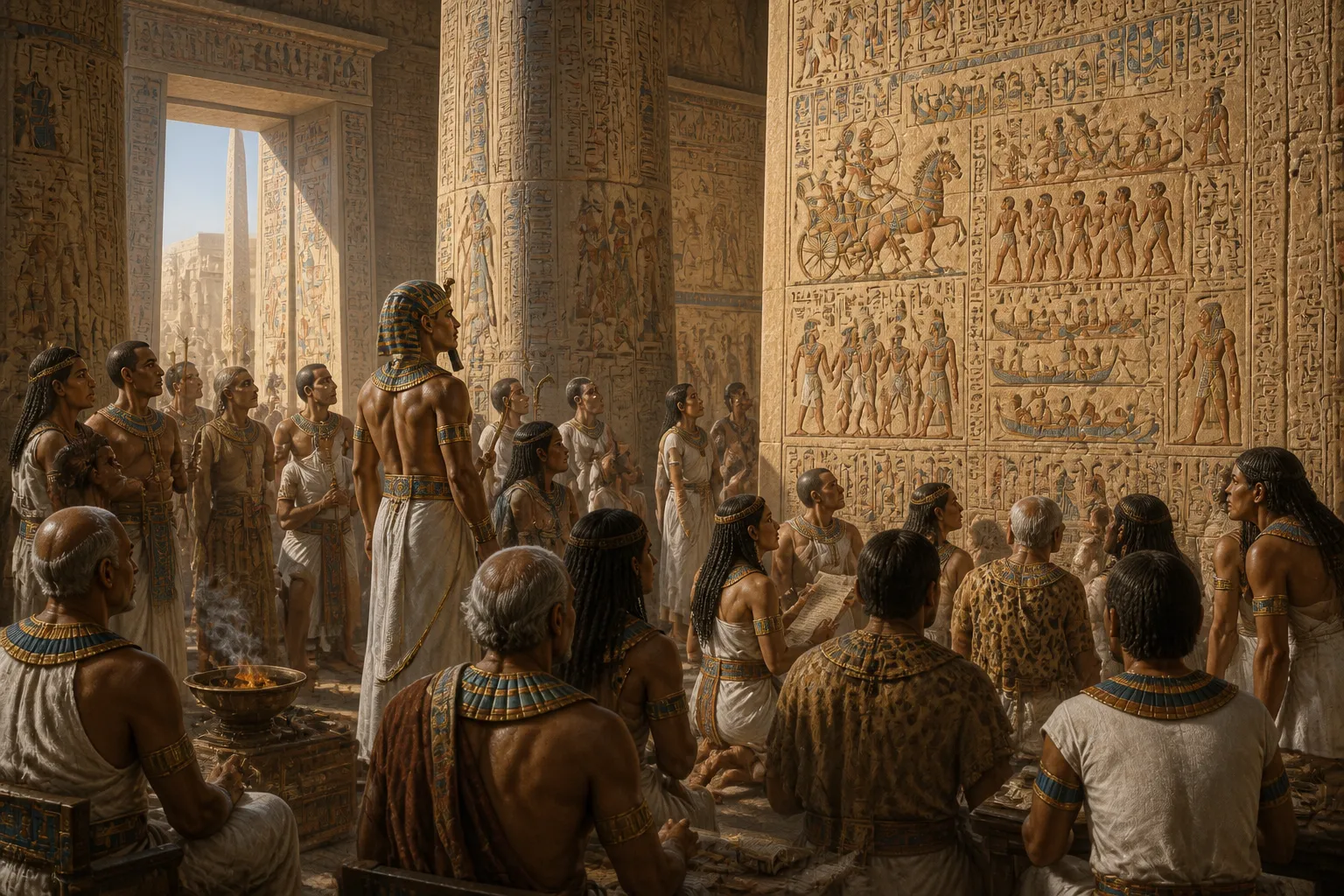
Years after the battle, the legacy of the victory at the Nile Delta endures in the collective memory of Egypt. Within the hallowed halls of Medinet Habu, the temple's walls tell the tale of triumph through intricate carvings, eternalizing the vanquishing of the Sea Peoples. Ramesses III, now aged and bearing the marks of time, is remembered as a Pharaoh who valiantly preserved his great civilization. His successors, including Ramses IV, stand inheritors of a realm stabilized by his strategic prowess and unwavering leadership. Egypt, like a stalwart beacon of resilience, stands firm amidst the ruins of once-mighty kingdoms, a solitary pillar of enduring strength. The echoes of this battle linger in the collective consciousness, a powerful reminder of the strategic brilliance and determination that defined an era.
"Our future is secured by the deeds of our past," a scribe recounts.
About this story
- Audience: general readers
Read Wonder Egypt on your phone
Wonder Egypt is available on Android. Get Wonder Egypt on Google Play.