The Glorious Revolution (1688, United Kingdom)
The Glorious Revolution (1688, United Kingdom) — an illustrated history story, featuring William of Orange, Queen Mary II, King James II, set in United Kingdom. 10 illustrated pages, free to read on Wonder History.

Page 1

On November 5th, 1688, the fate of England hung in the balance. William of Orange, the Dutch prince with ambitions for the English throne, Queen Mary II, the English princess aligned with William, James II, the beleaguered king facing widespread discontent, Henry Compton, the influential Bishop of London, and Patrick Sarsfield, the steadfast Irish general, all stood at the precipice of a conflict that would reshape the nation. William's invasion fleet, a sea of masts and sails, approached the English coast as described by his declaration which reads, 'The Crown is Elective, not solely based on birthright.' But who were these players, and what events led to this moment?
Page 2

"Our King has been very tolerant of Catholics; far too tolerant for many," Compton noted, adjusting his spectacles. Sarsfield, his brow furrowed, responded, "Loyalty to the Crown demands respect for James, despite his choices. But the people fear tyranny; arbitrary decisions, and a standing army are not the way to keep order," Compton said. James II, isolated and increasingly distrusted, unintentionally paved the way for his own downfall.
Page 3

Compton, his voice low, explained to Mary, "We must seek assistance from your husband, William. His Protestant faith and claim to the throne through you offer England a solution." Mary replied softly, looking at the invitation, "But to invite a foreign army onto English soil? The risks are immense!" She recalled something William had said, quoting Cicero: "'The safety of the people shall be the highest law.' I believe he will do what is best for England."
Page 4

William, pointing at a large nautical map spread across a table, addressed his advisors. "Our fleet must be ready by autumn. The winds favor a November crossing. We will land in Torbay, a strategic port." He paused, tapping the map with his finger. "England awaits a change," William said to his high commanders.
Page 5

As the Dutch troops disembarked, Sarsfield watched from a nearby hill, a look of grim acceptance on his face. He muttered to his fellow officers, "A king deposed by foreign arms is a tragedy for any nation." The people of Torbay, cautiously optimistic, observed the orderly procession of soldiers, their muskets gleaming, as William stepped onto the beach, his orange standard held high.
Page 6

James, pacing anxiously in his palace, received grim news. "Lord Churchill has defected, Your Majesty!" his messenger exclaimed. "And many others have followed. Our army is dissolving like snow!" James slumped into his chair, despair evident in his eyes, realizing the tide had turned against him.
Page 7
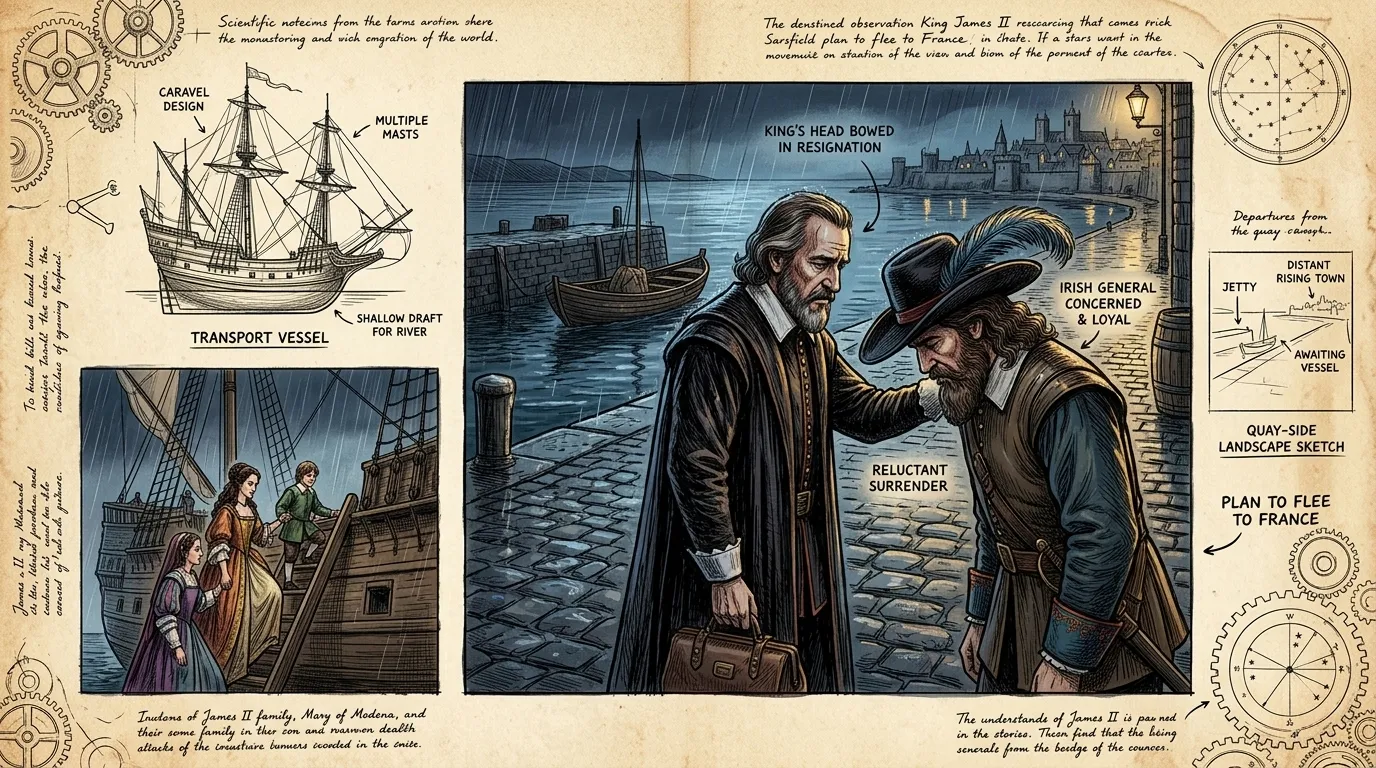
"We cannot win this," James declared to Sarsfield. "The people have turned. I must flee to France and seek refuge with my cousin, King Louis." Sarsfield, though loyal, bowed his head. "Your Majesty's safety is paramount," he responded, "though I fear for what this means for England!" This decision marked the effective end of James' reign, his abdication, not through bloodshed, but through political pressure and desertion.
Page 8

William and Mary entered London triumphantly, greeted by cheering crowds. Compton, witnessing the scene, remarked, "This is not a conquest, but a liberation!" People lined the streets, waving orange ribbons and shouting their support. The peaceful transfer of power was nearly complete, fulfilling the promise of a new era.
Page 9

Mary, holding the newly drafted Bill of Rights, confided in William. "This document will ensure the rights of the people and limit the power of the crown. It is a testament to the principles for which we stand." William, placing his hand on hers, replied, "Indeed, my Queen. We must ensure, as Edmund Burke said, that 'All that is necessary for the triumph of evil is that good men do nothing.'"
Page 10

Generations later, England continued to prosper under a constitutional monarchy, its citizens enjoying greater freedoms and protections. The Glorious Revolution, a bloodless transfer of power, left a lasting legacy. It demonstrated the power of diplomacy and the enduring importance of upholding individual rights.
About this story
- Historical figures: William of Orange, Queen Mary II, King James II
- Location: United Kingdom
- Period: Early Modern
- Audience: general readers
Questions and answers
Questions and answers about The Glorious Revolution (1688, United Kingdom)
Read Wonder History on your phone
Wonder History is available on Android. Get Wonder History on Google Play.
More Wonder History stories
- The Greco-Persian Wars — Greece & Persia (490 BC, Greece & Persia)
- The Haitian Declaration of Independence (1804, Haiti)
- The Haitian Revolution (1791–1804, Haiti)
- The Halifax Explosion (1917, Canada)
- The Helsinki Accords (1975, United States)
- The Industrial Revolution (18th–19th Century, United Kingdom & Europe)