Artificial Intelligence
Artificial Intelligence — an illustrated inventions story, set in Global. 10 illustrated pages, free to read on Wonder Inventions.
Page 1
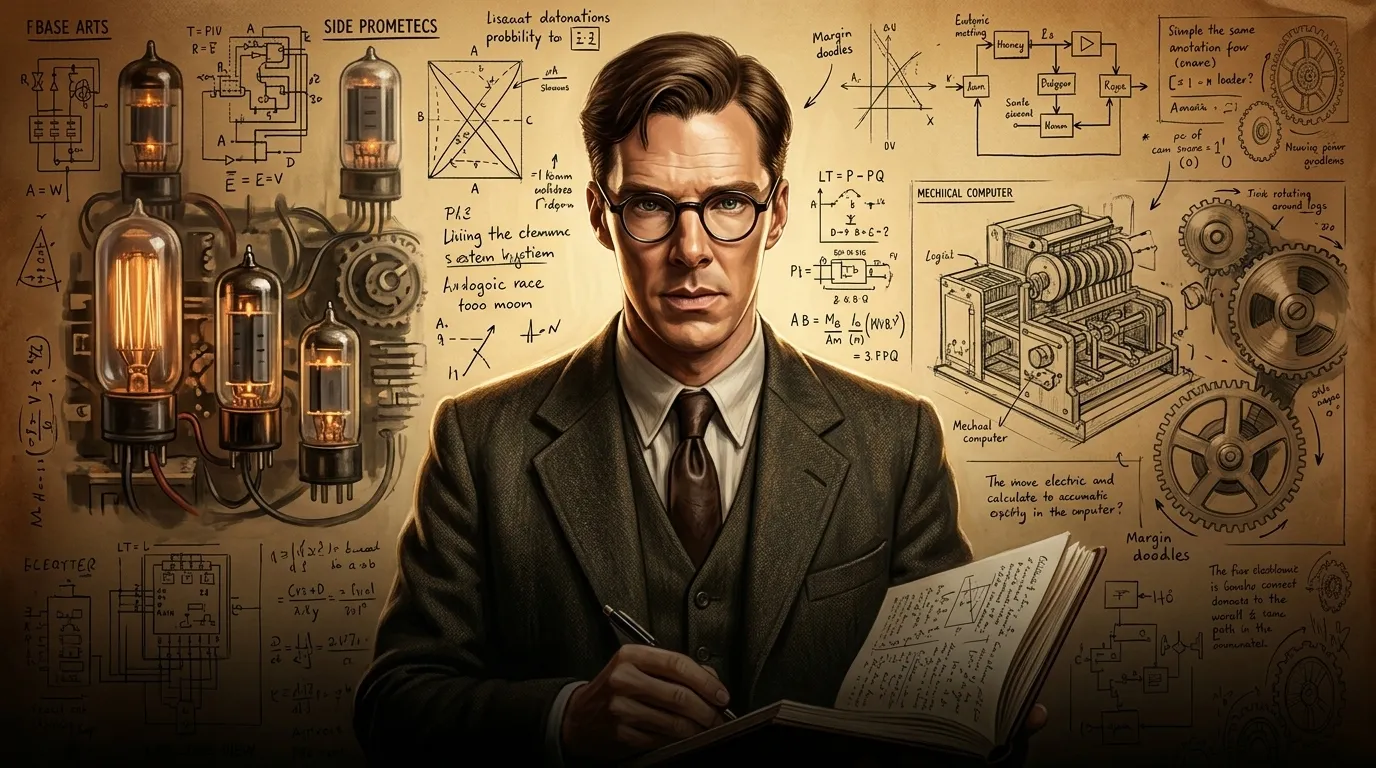
For millennia, the very concept of 'thought' remained exclusively human, a unique spark distinguishing us from all other life. Yet, as the industrial age matured into the electronic era, a profound question emerged: Could humanity engineer intelligence itself? This inquiry laid the foundation for one of the 20th century's most ambitious intellectual pursuits, seeking to replicate, augment, and eventually surpass human cognitive capabilities.
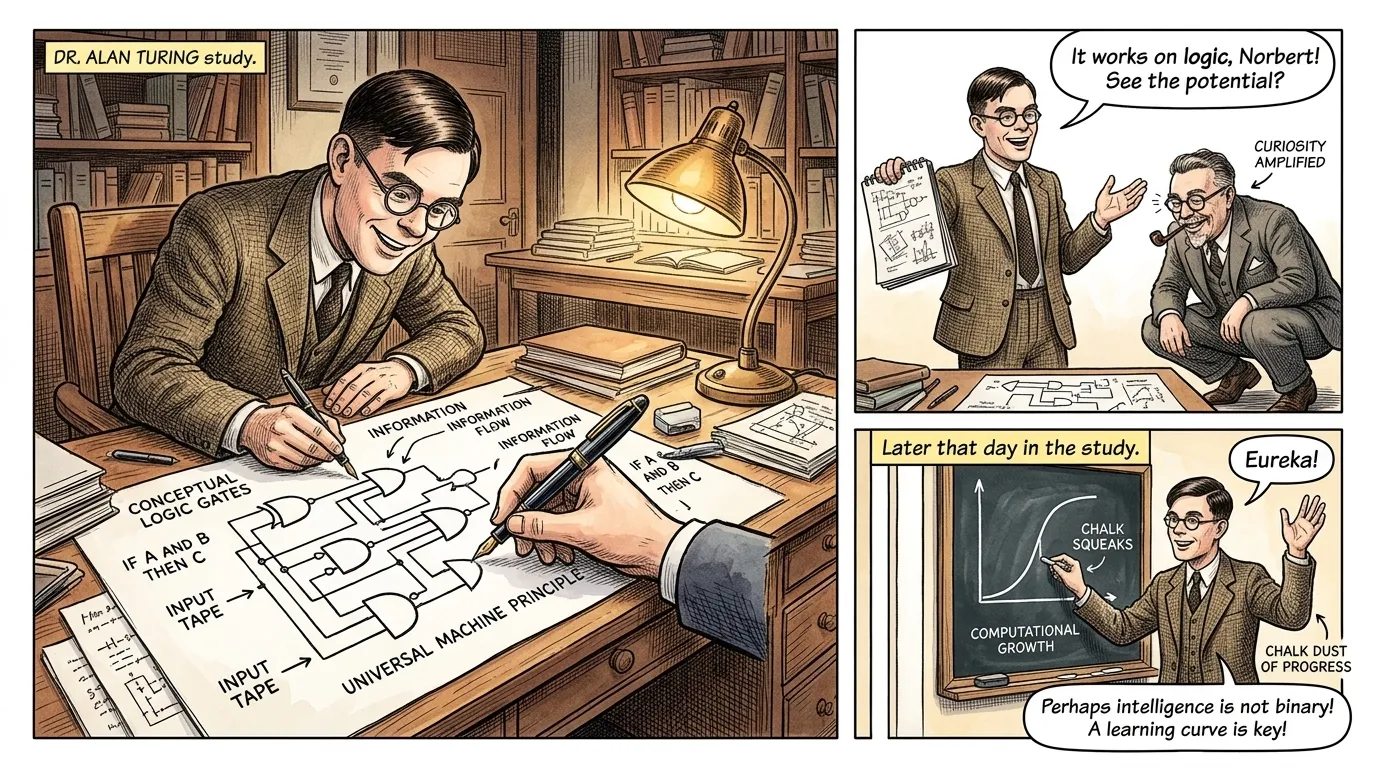
"Dr. Alan Turing, a brilliant British mathematician, laid crucial groundwork in the 1940s, envisioning machines that could simulate intelligent conversation. "We can only see a short distance ahead, but we can see plenty there that needs to be done," he once remarked, acknowledging the vast, unexplored territory of machine cognition. His visionary work paved the way for a new field, striving to create systems that could reason, learn, and adapt."
Page 2
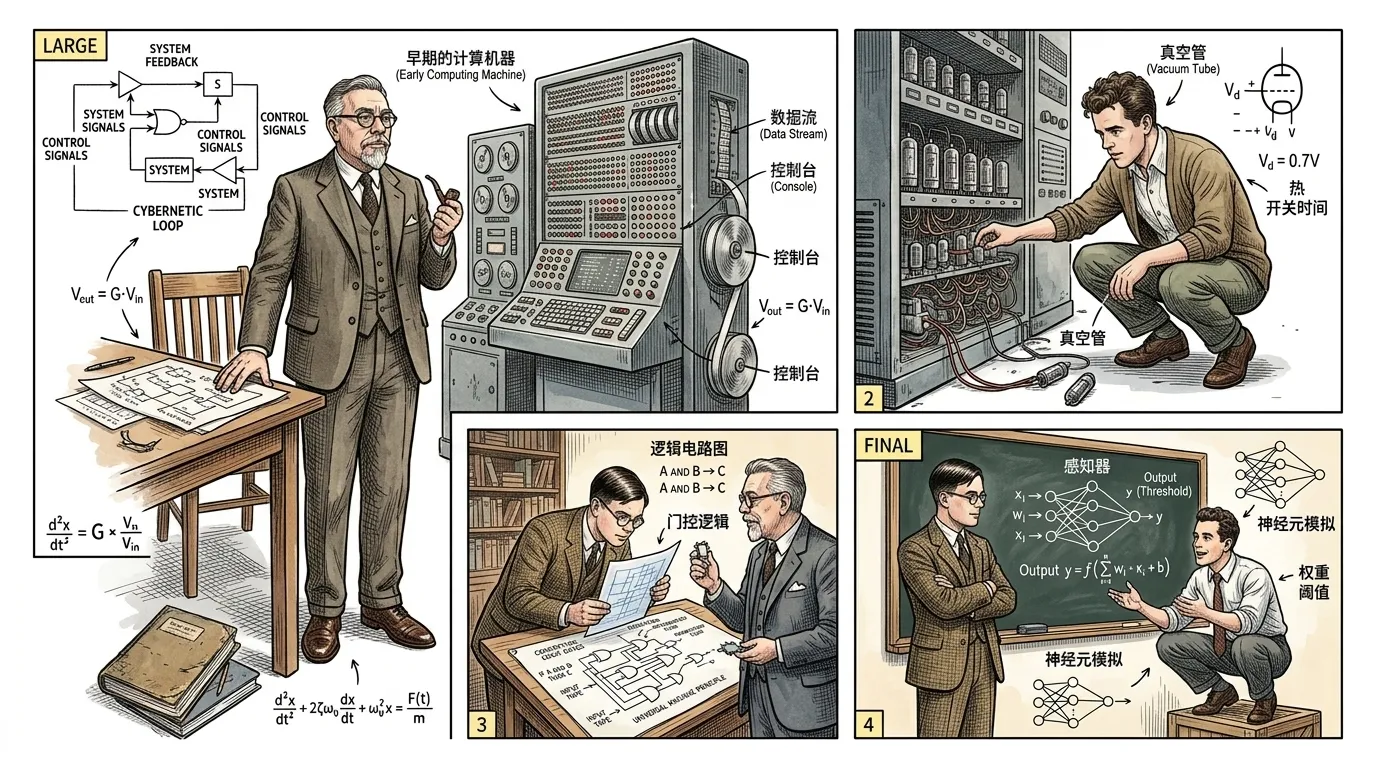
Before the advent of Artificial Intelligence, complex tasks requiring logical deduction or pattern recognition were entirely the domain of human experts. Fields from mathematics to military strategy relied on intensive, often slow, human computation and judgment. The limitations were evident: human processing was prone to error, exhaustive, and could not scale to the growing complexity of emerging scientific and logistical challenges.
"Pioneers like Norbert Wiener observed the burgeoning capabilities of computing machines, realizing their potential far beyond mere arithmetic. "The automatic control of vast new power sources," he mused, "can lead to both good and evil, and it is the part of the scientist to be aware of the moral implications of this fact." This foresight underscored the profound implications of machines that could process information and make decisions, initiating the urgent need for a new scientific discipline."
Page 3
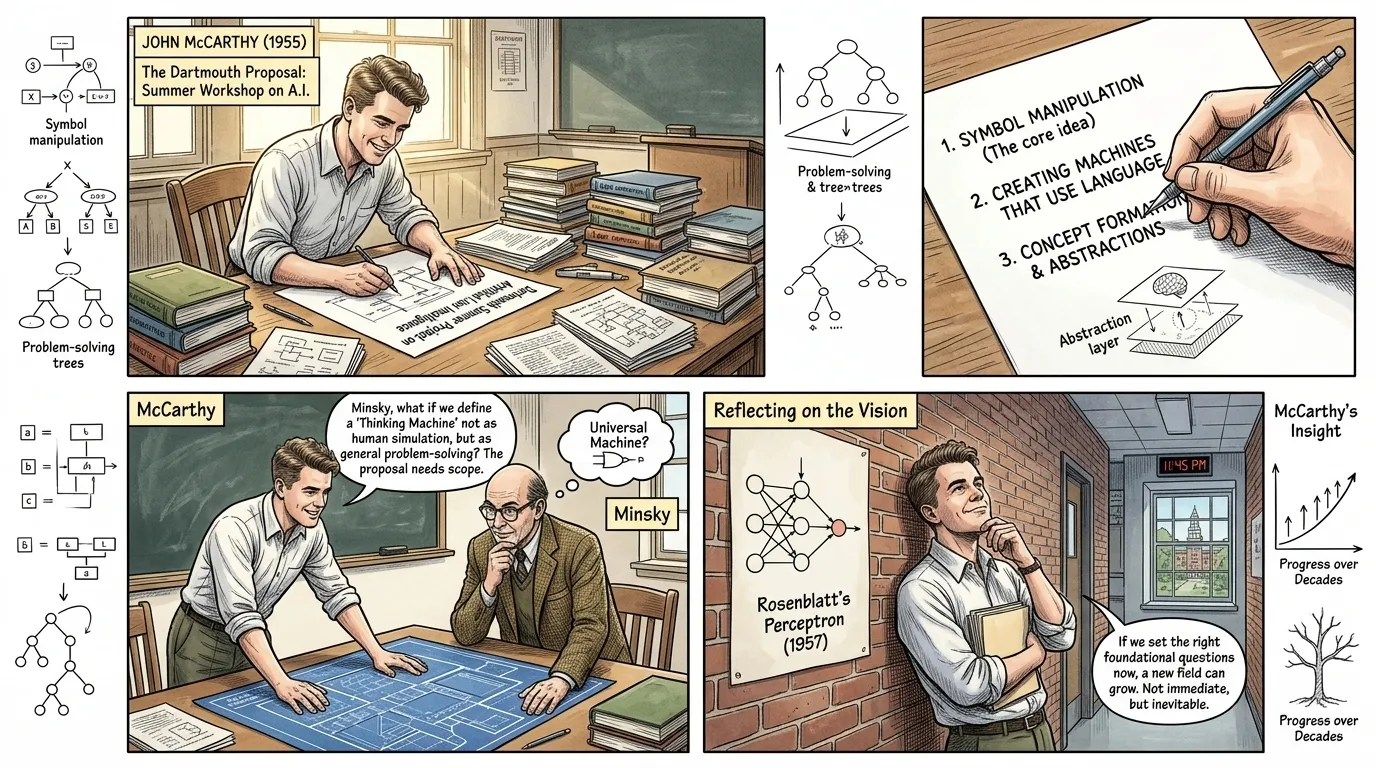
The mid-1950s marked a pivotal moment. A small group of visionary scientists, frustrated by the limitations of conventional computing, sought to formalize a new field. They believed that machines could be programmed to simulate higher-level cognitive functions, moving beyond simple calculation to genuine problem-solving and learning. This ambitious proposal aimed to gather leading minds to define the scope and methods of this nascent discipline.
"In 1955, John McCarthy, then a young assistant professor at Dartmouth, drafted a proposal for a summer research project, famously stating its objective: "to find how to make machines use language, form abstractions and concepts, solve kinds of problems now reserved for humans, and improve themselves." This foundational 'knowledge' established the guiding principles and grand ambition for what would soon be officially named Artificial Intelligence, setting a bold agenda for decades of research."
Page 4
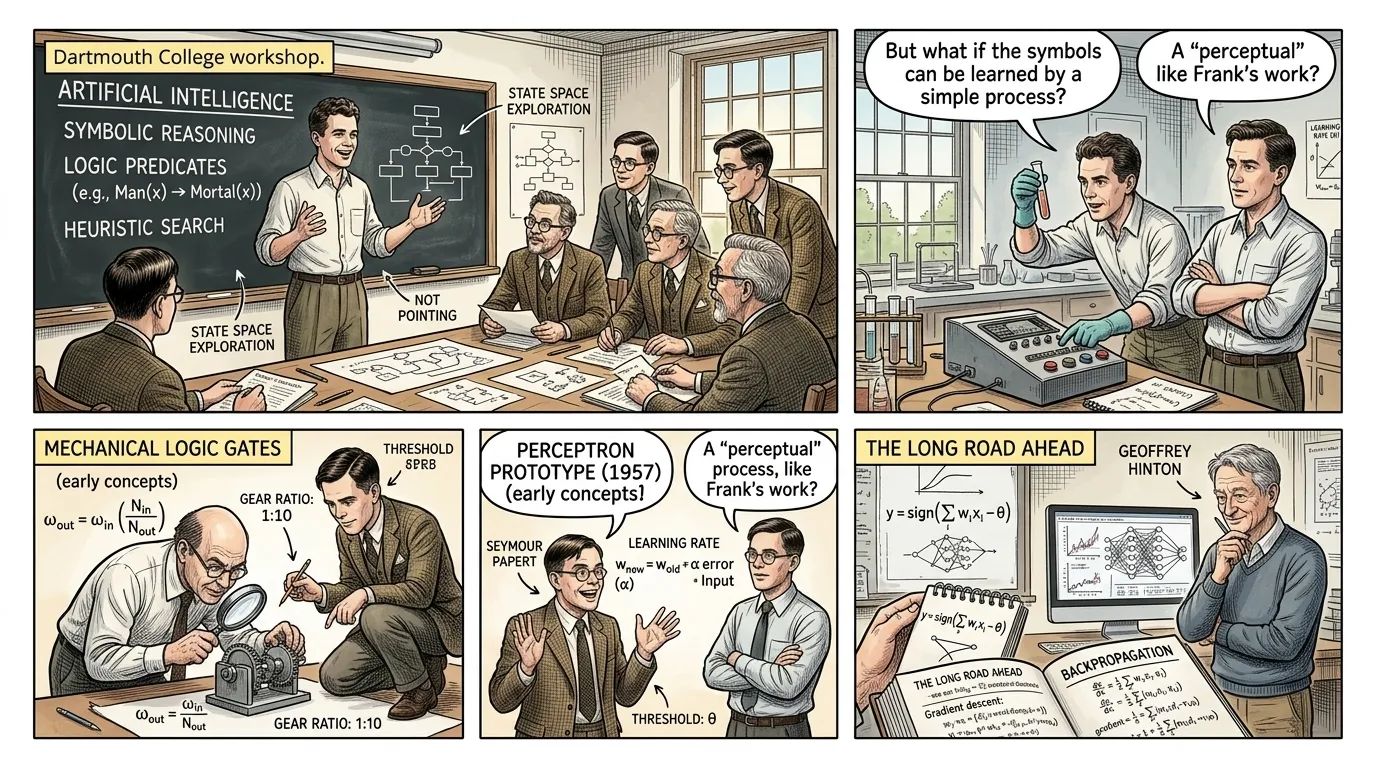
The summer of 1956 saw the historic Dartmouth Summer Research Project on Artificial Intelligence. This two-month workshop brought together the brightest minds to discuss computation, automata theory, and the nervous system. It was here, during intensive discussions, that the term 'Artificial Intelligence' was officially coined by John McCarthy, giving a name to the ambitious endeavor of creating machines that think.
"McCarthy, seeking a neutral, descriptive term, chose 'Artificial Intelligence' to distinguish it from cybernetics. He articulated the core ambition: to build systems capable of 'symbolic reasoning.' "The ultimate goal," he might have explained to his colleagues, "is to create machines that can manipulate symbols representing concepts, allowing them to perform logical deductions and problem-solving at an abstract level, much like humans do with language and ideas." This marked the formal genesis of AI as a distinct academic discipline."
Page 5
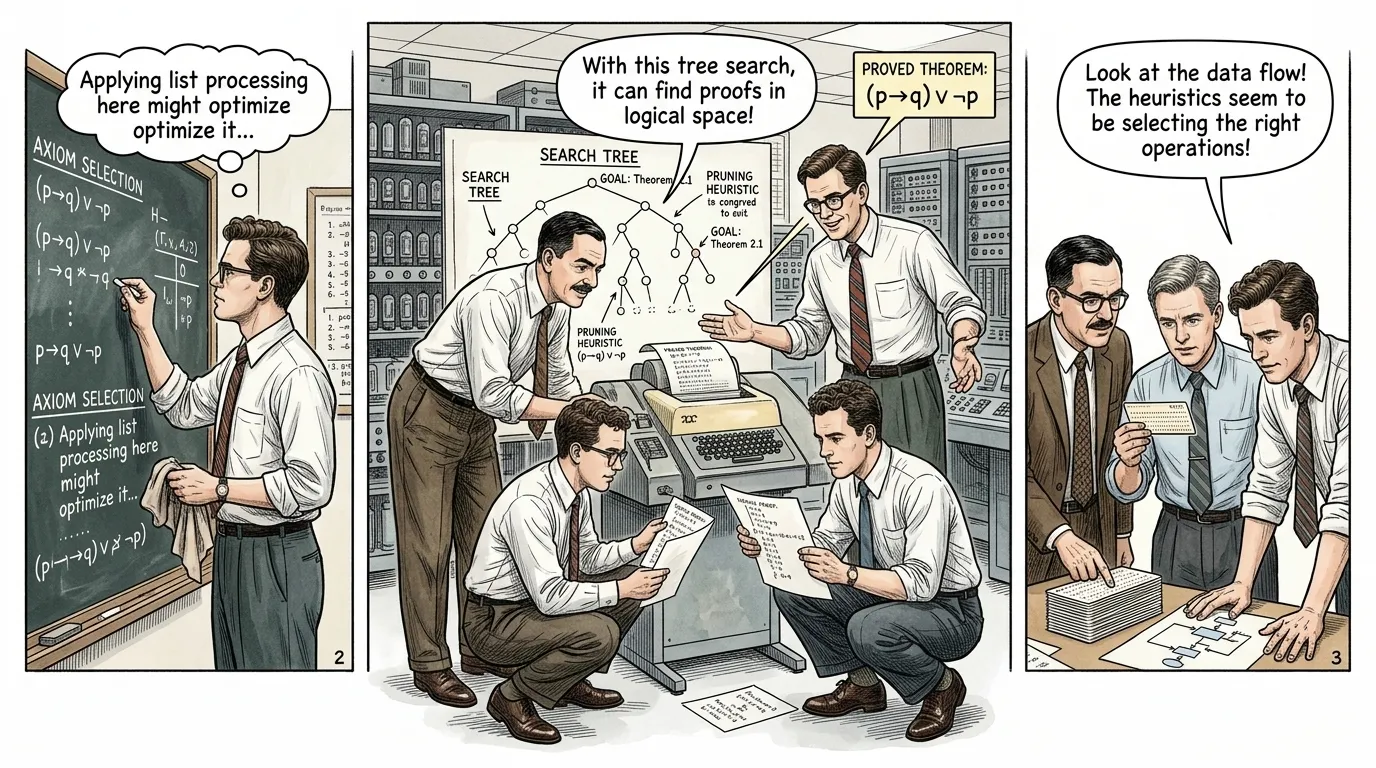
The Dartmouth Workshop participants swiftly translated their theoretical ambitions into practical systems. One of the earliest and most significant successes was the 'Logic Theorist,' developed by Allen Newell, Herbert A. Simon, and J. C. Shaw. This program, considered the first AI program, demonstrated machines' ability to perform non-numerical reasoning.
"Newell and Simon proudly stated, perhaps upon demonstrating their program: "The Logic Theorist was designed to mimic human problem-solving, not merely to calculate. It uses heuristics, rules of thumb, to search for solutions, much as a mathematician would." The program successfully proved 38 of the 52 theorems in Chapter 2 of Russell and Whitehead's Principia Mathematica, selecting axioms and applying inference rules to derive conclusions. This demonstrated the power of 'symbolic AI,' where abstract symbols represented concepts, and rules dictated their manipulation, a profound leap in machine capability."
Page 6
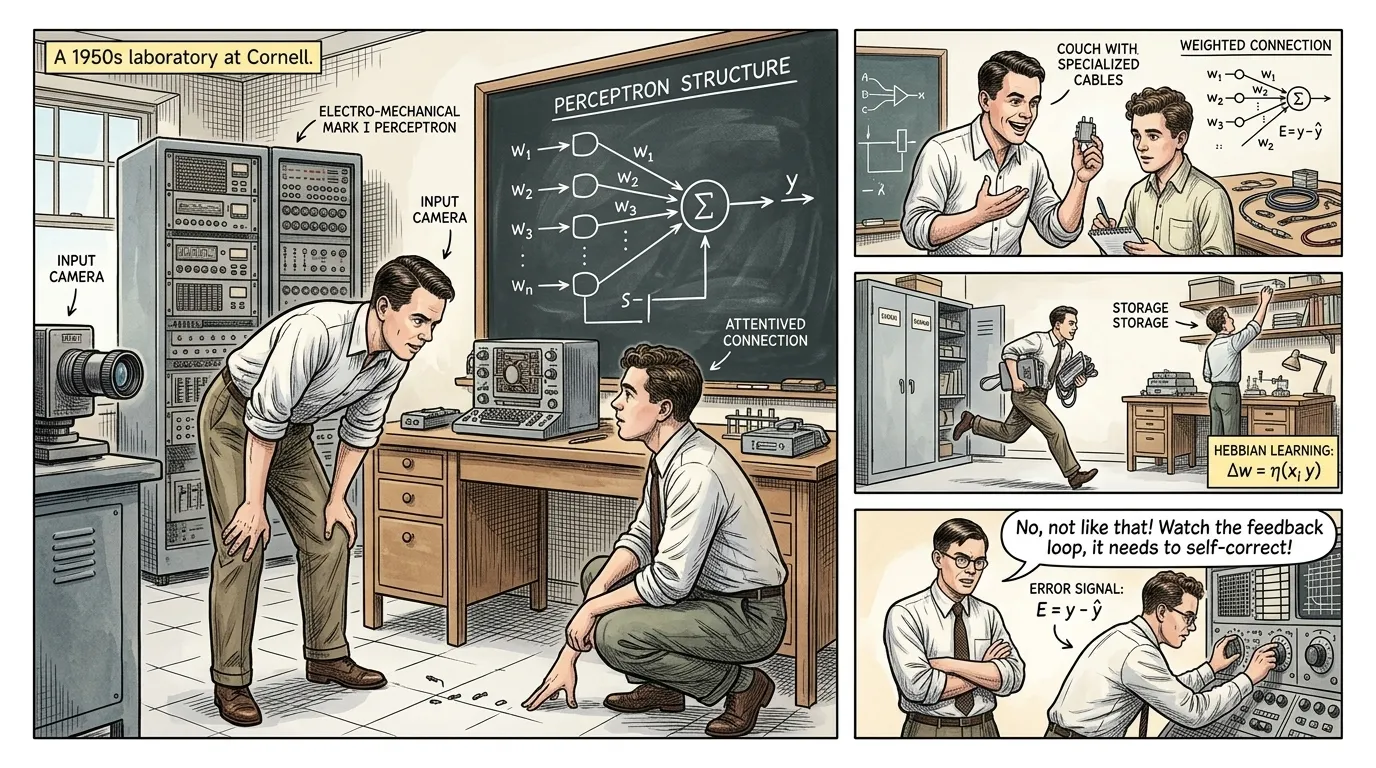
While symbolic AI pursued logic and explicit rules, another avenue emerged, inspired by the structure of the human brain. Frank Rosenblatt introduced the 'Perceptron' in 1957, a novel approach that sought to simulate how biological neurons learn. This marked the birth of artificial neural networks, moving beyond predefined rules towards systems that could learn from data.
"Rosenblatt, observing the potential, might have explained to a fellow researcher: "The Perceptron isn't programmed with rules; it learns them. It takes inputs, assigns them weights, and if the weighted sum crosses a threshold, it 'fires' an output." He emphasized that through trial and error, adjusting the weights based on correct or incorrect classifications, the Perceptron could 'learn' to recognize patterns. This mechanism, though simple, introduced the revolutionary concept of machines adapting and improving their performance without explicit reprogramming, a crucial step towards the 'self-improvement' envisioned at Dartmouth."
Page 7
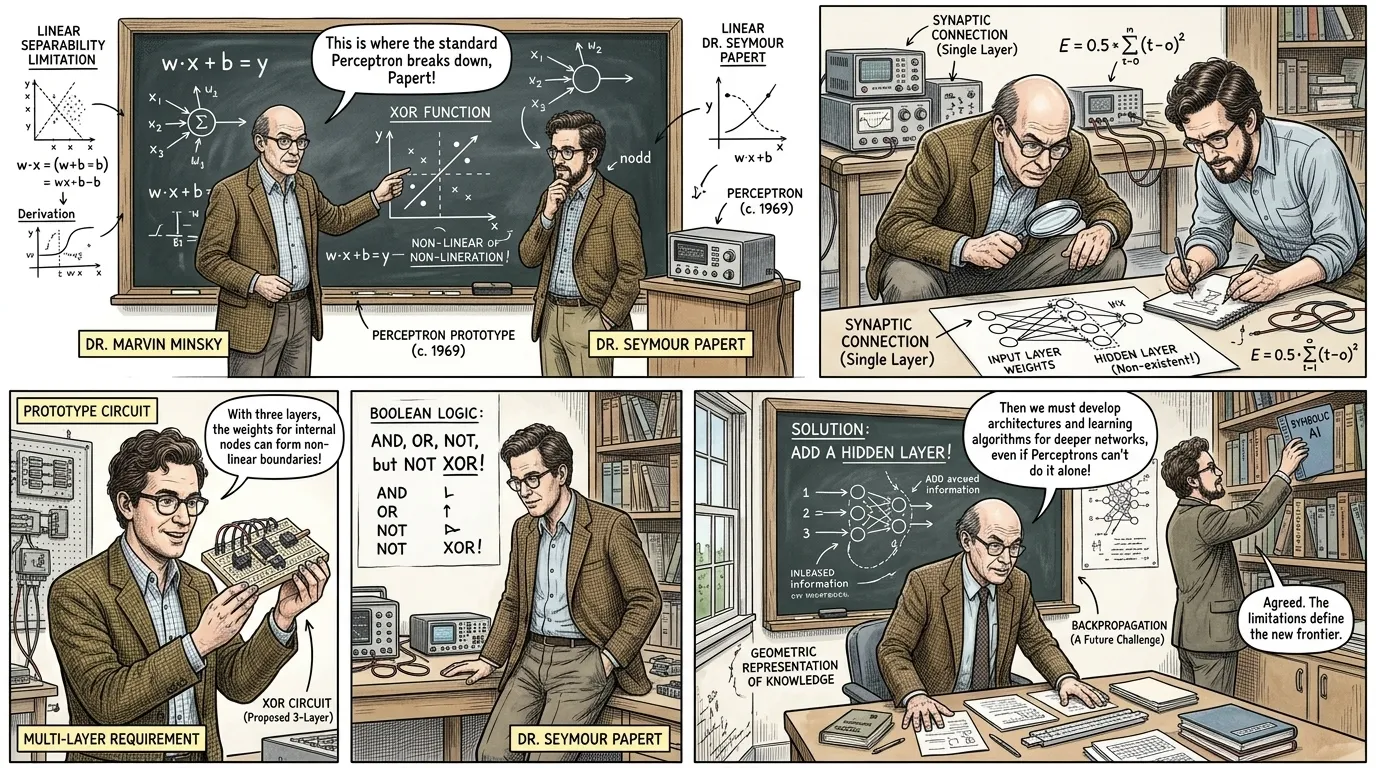
Despite initial excitement, the limitations of early AI soon became apparent. The 'AI winter' of the late 1960s and 70s saw a dramatic reduction in funding and research, largely due to unfulfilled promises and the practical difficulties of scaling early models. Perceptrons, for instance, were found to be incapable of solving simple non-linear problems, a critical flaw highlighted by Marvin Minsky and Seymour Papert in their influential 1969 book, 'Perceptrons'.
"Minsky, a pragmatist, might have articulated the critique: "While a Perceptron can learn linear patterns, it utterly fails at problems requiring non-linear separation, like the XOR function. We had oversold the simplicity of the approach." This revelation revealed a fundamental mathematical constraint, dampening enthusiasm for neural networks for nearly two decades. The field pivoted, seeking more robust, rule-based approaches, but the 'knowledge' of these limitations forced a crucial re-evaluation of AI's core paradigms."
Page 8
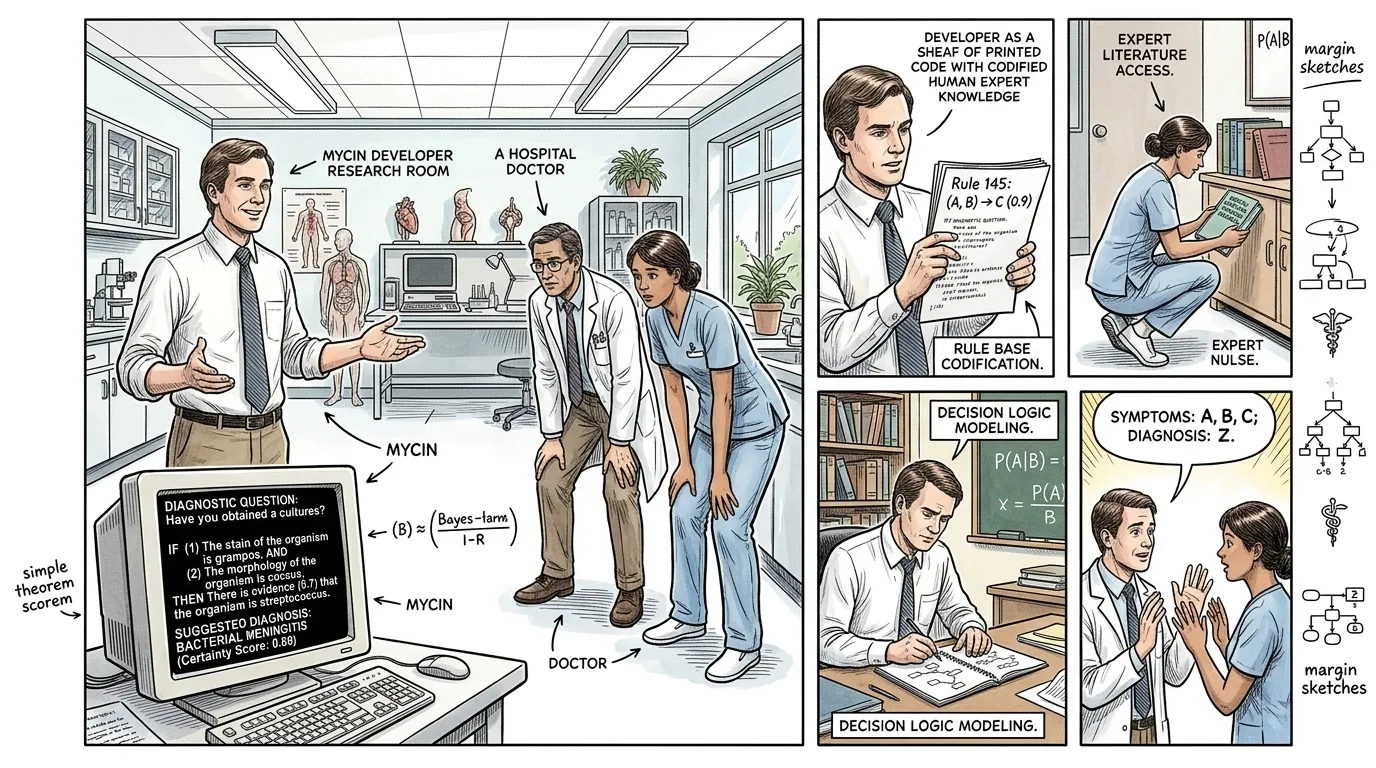
Following the 'AI winter,' the field rebounded with a focus on 'expert systems' in the 1980s. These systems codified human expert knowledge into vast databases of 'if-then' rules, allowing computers to mimic the decision-making of specialists in specific domains. Projects like DENDRAL (for chemical analysis) and MYCIN (for medical diagnosis) demonstrated practical applications.
"A developer of MYCIN might explain to medical professionals: "This system works by capturing a physician's diagnostic logic. It asks questions, applies rules based on symptom inputs, and then proposes a diagnosis and treatment plan, complete with confidence scores." This 'knowledge engineering' approach proved successful in narrow, well-defined problems, offering a significant leap in machine utility and showing that AI could deliver tangible value. It was a crucial step in fulfilling the initial Dartmouth vision of machines solving 'problems now reserved for humans'."
Page 9
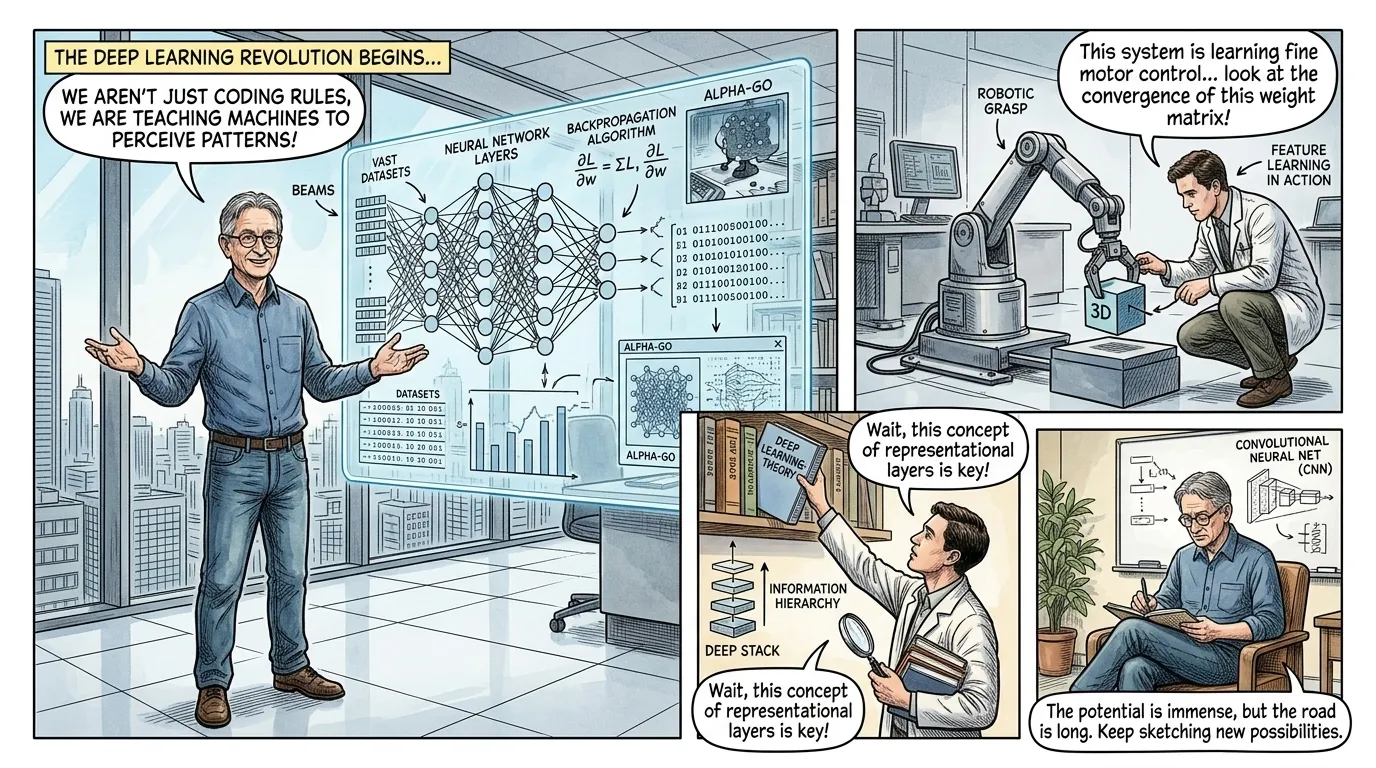
The late 20th and early 21st centuries saw a dramatic resurgence of neural networks, fueled by increased computational power, vast datasets, and theoretical breakthroughs like the backpropagation algorithm. This era, often termed the 'Deep Learning Revolution,' allowed multi-layered networks to learn incredibly complex patterns, fulfilling more aspects of the original Dartmouth vision.
"Geoffrey Hinton, a pioneer in deep learning, reflected on this period: "The ability to train deep networks efficiently, combined with the sheer volume of data now available, has transformed AI. We are seeing machines that can learn features automatically, rather than having them hand-engineered." This 'payoff' from the earlier setup was monumental. DeepMind's AlphaGo, for example, learned the intricate game of Go to defeat human champions, demonstrating a profound capacity for abstract strategic learning and self-improvement far beyond initial expectations."
Page 10
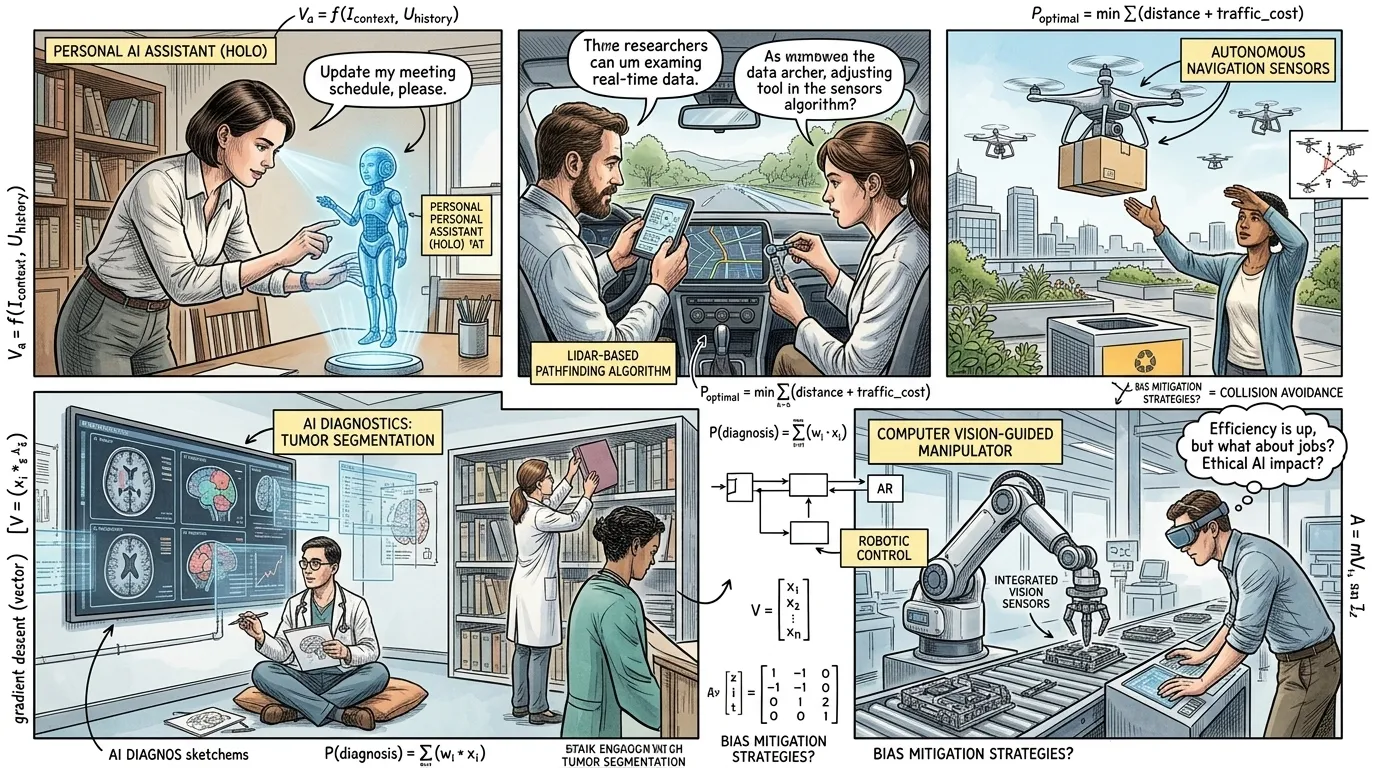
Today, Artificial Intelligence is woven into the fabric of modern life, transforming industries and challenging our understanding of intelligence itself. From powering search engines and personal assistants to revolutionizing healthcare and transportation, AI's capabilities continue to expand, reshaping human interaction with technology and the world.
"The impact extends far beyond computation; it's about augmentation, discovery, and new frontiers. Researchers and ethicists continually ask, 'How can we ensure these powerful systems serve humanity's best interests?' The ongoing dialogue reflects the profound and far-reaching consequences of systems that can learn, predict, and create. AI is not merely an invention but an evolving field, continuously pushing the boundaries of what machines can achieve."
About this story
- Location: Global
- Audience: general readers
Questions and answers
Read Wonder Inventions on your phone
Wonder Inventions is available on Android. Get Wonder Inventions on Google Play.