Astrolabe
Astrolabe — an illustrated inventions story, set in Global. 10 illustrated pages, free to read on Wonder Inventions.
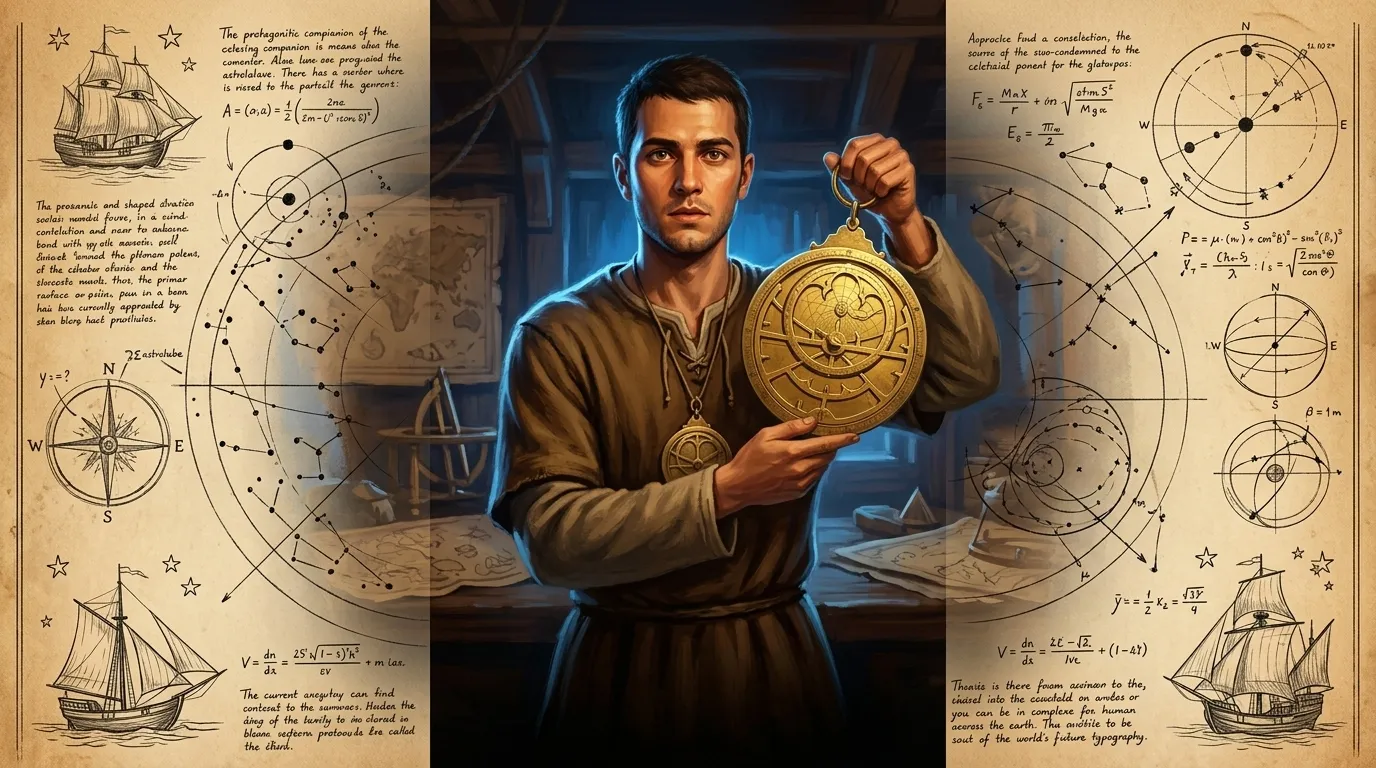
Page 1
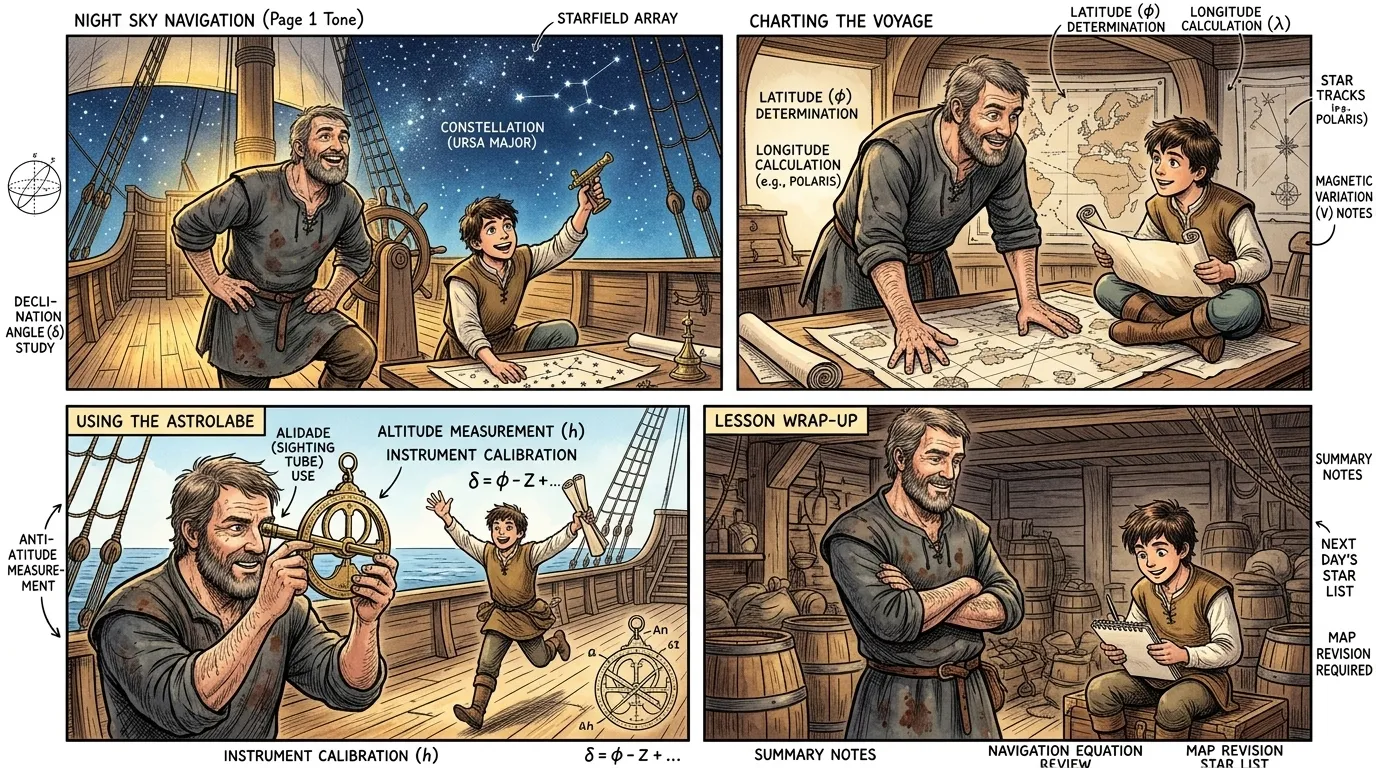
Before the advent of precise navigational instruments, humanity struggled against the vastness of the unknown. Ancient mariners, scholars, and travelers alike wrestled with fundamental questions: What time is it? Where am I? What direction lies ahead?
"A grizzled mariner in a simple tunic, his gaze fixed on the bewildering night sky, turns to his younger companion. "The stars are a compass, young Basim, a clock, and a map all at once. But to truly read them, we need more than just keen eyes.""
Page 2
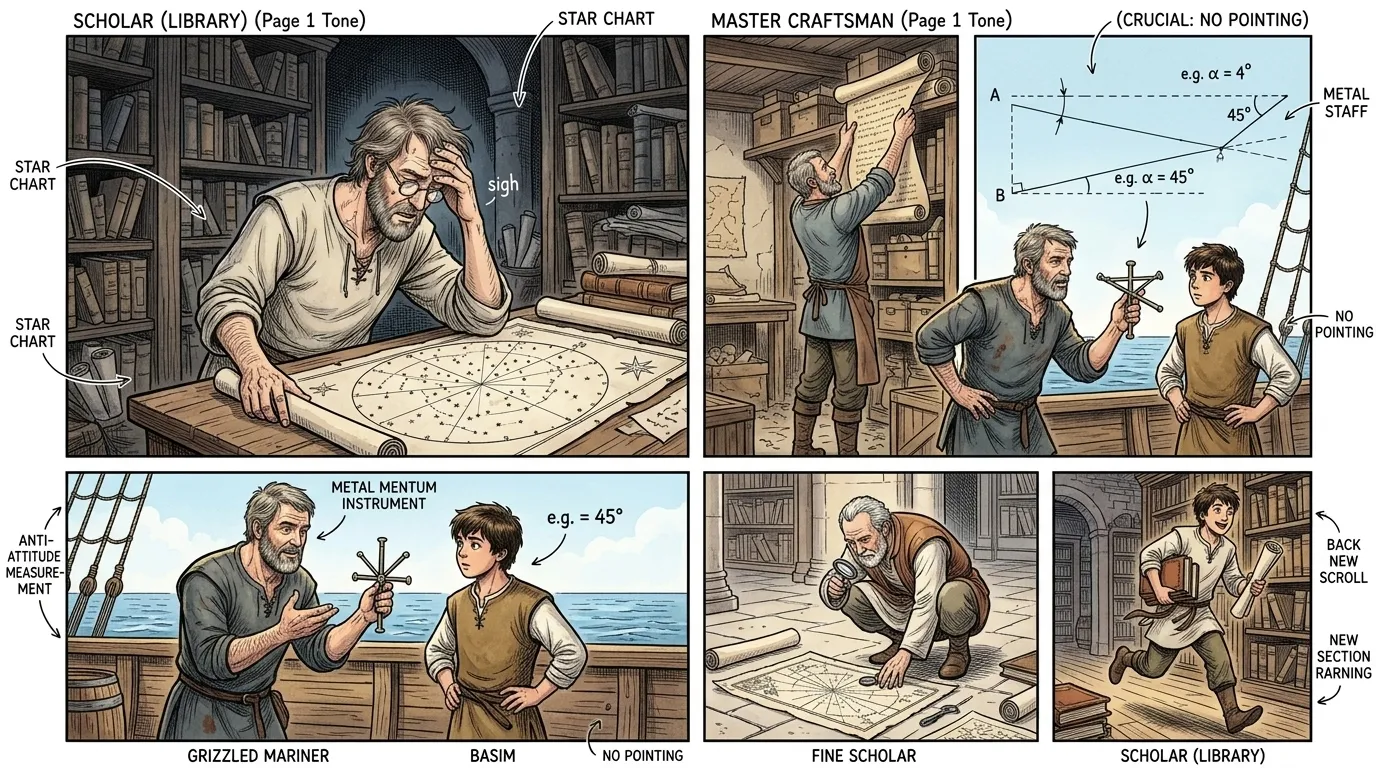
Across continents and centuries, the absence of reliable instruments made long-distance travel and accurate astronomical observation a monumental challenge. Navigators relied on dead reckoning, coastal landmarks, or rudimentary celestial estimations, often leading to tragic miscalculations.
"A scholar, poring over complex, incomplete star charts in a dimly lit library, sighs. "How can we chart the heavens, let alone the seas, with such imprecise tools? The movement of the stars holds all the answers, but they whisper, rather than shout.""
Page 3
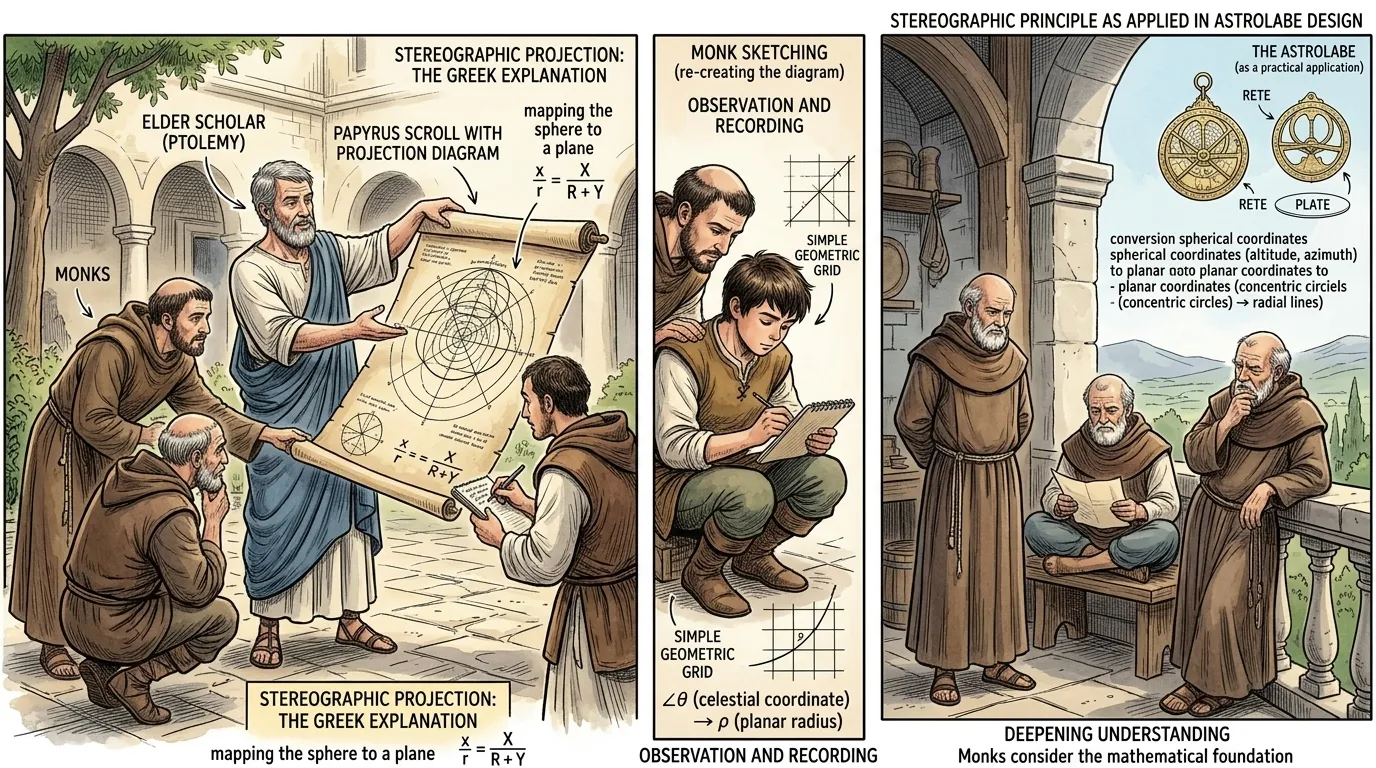
The intellectual seeds for instruments like the Astrolabe were sown much earlier. In the 2nd century CE, the Greco-Egyptian astronomer Claudius Ptolemy, in his monumental work the Almagest, laid down the mathematical principles of stereographic projection, crucial for mapping the three-dimensional celestial sphere onto a two-dimensional plane.
"An elder scholar points to a diagram on a large papyrus scroll, addressing his students. "Ptolemy taught us that by projecting the celestial sphere onto a plane, we could represent the heavens. This insight, he once mused, 'is the only thing we have to guide us through the darkness of ignorance.' He knew the theoretical path to understanding, even if the tools lagged behind.""
Page 4
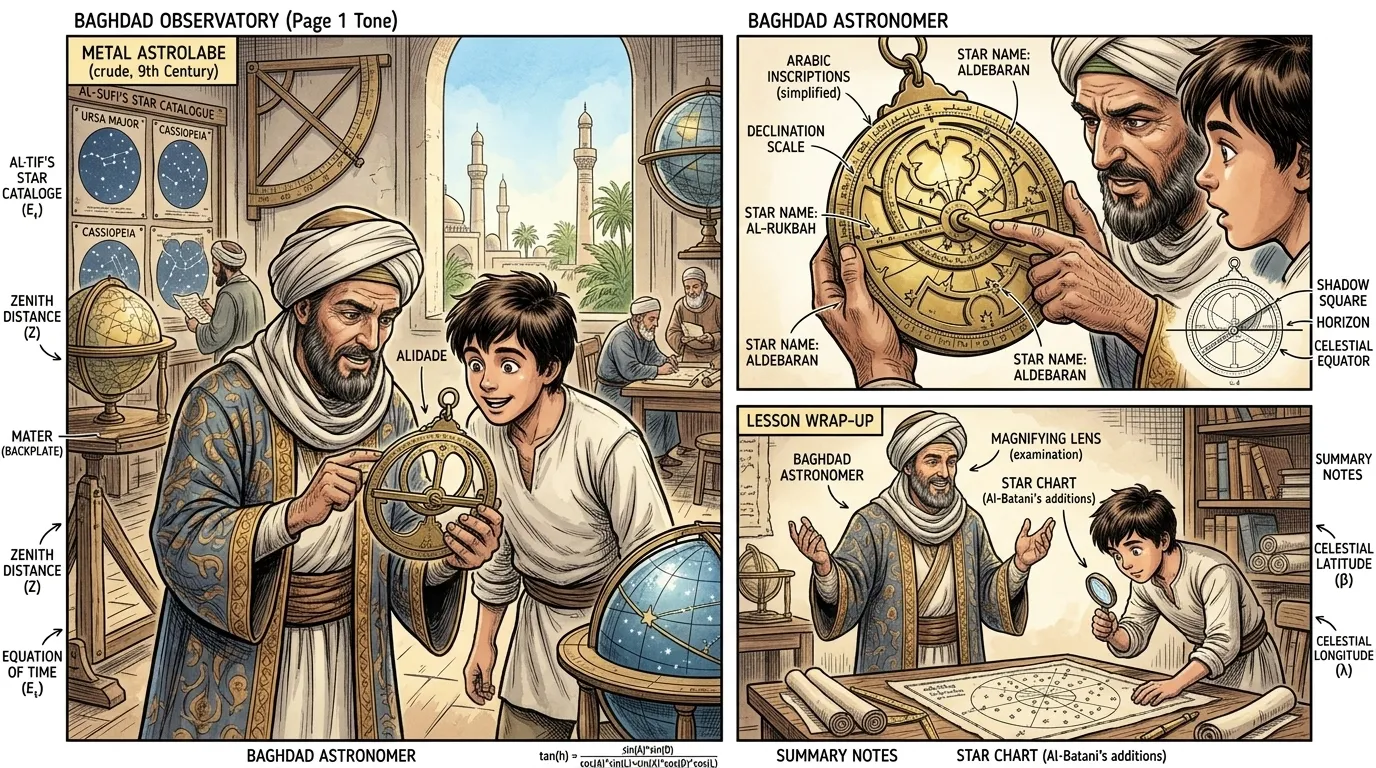
While Ptolemy provided the theoretical framework, it was during the Islamic Golden Age, from the 8th to the 13th centuries, that the astrolabe truly flourished. Scholars across the Abbasid Caliphate, driven by the needs of religious practice and scientific inquiry, transformed the theoretical concept into a sophisticated, practical instrument.
"An astronomer in a bustling Baghdad observatory, holding an early, slightly crude metal disc, explains to an apprentice. "Our predecessors took Ptolemy's math and dared to forge it into metal. This isn't merely an observation tool; it is a portable universe. It demands precision, a true mastery of both numbers and craft.""
Page 5
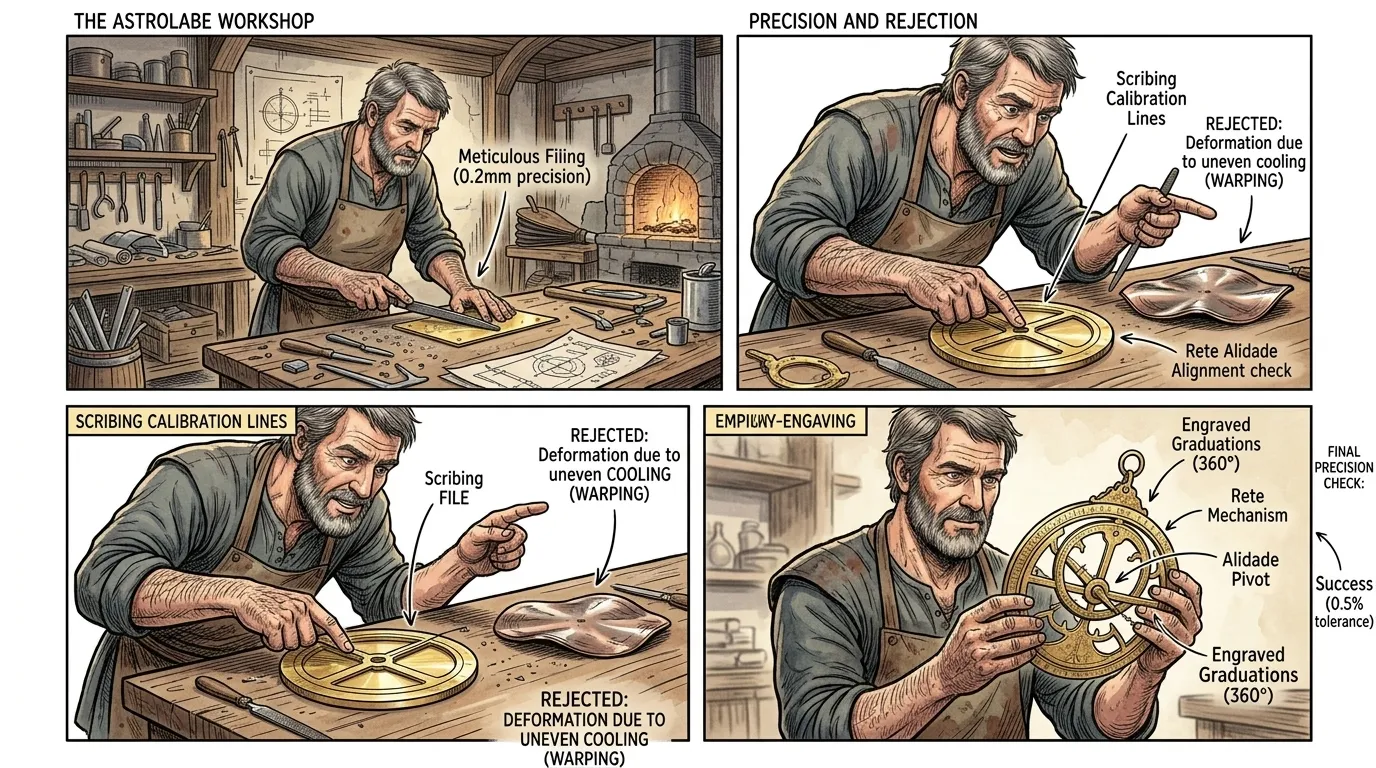
The core technical challenge lay in precisely rendering the dynamic, curved celestial sphere onto a flat plate. Early attempts struggled with accuracy, leading to instruments that were complex but often unreliable. The genius of the planispheric astrolabe was its elegant solution to this very problem.
"A master craftsman, meticulously filing a brass plate in his workshop, points to a rejected, warped metal disc lying on his bench. "See this? An earlier attempt. The projection was flawed, the divisions inaccurate. A slight error here," he traces a line with his finger, "and your prayers are misdirected, your ship off course. Perfection is not merely an aesthetic choice; it is a necessity.""
Page 6
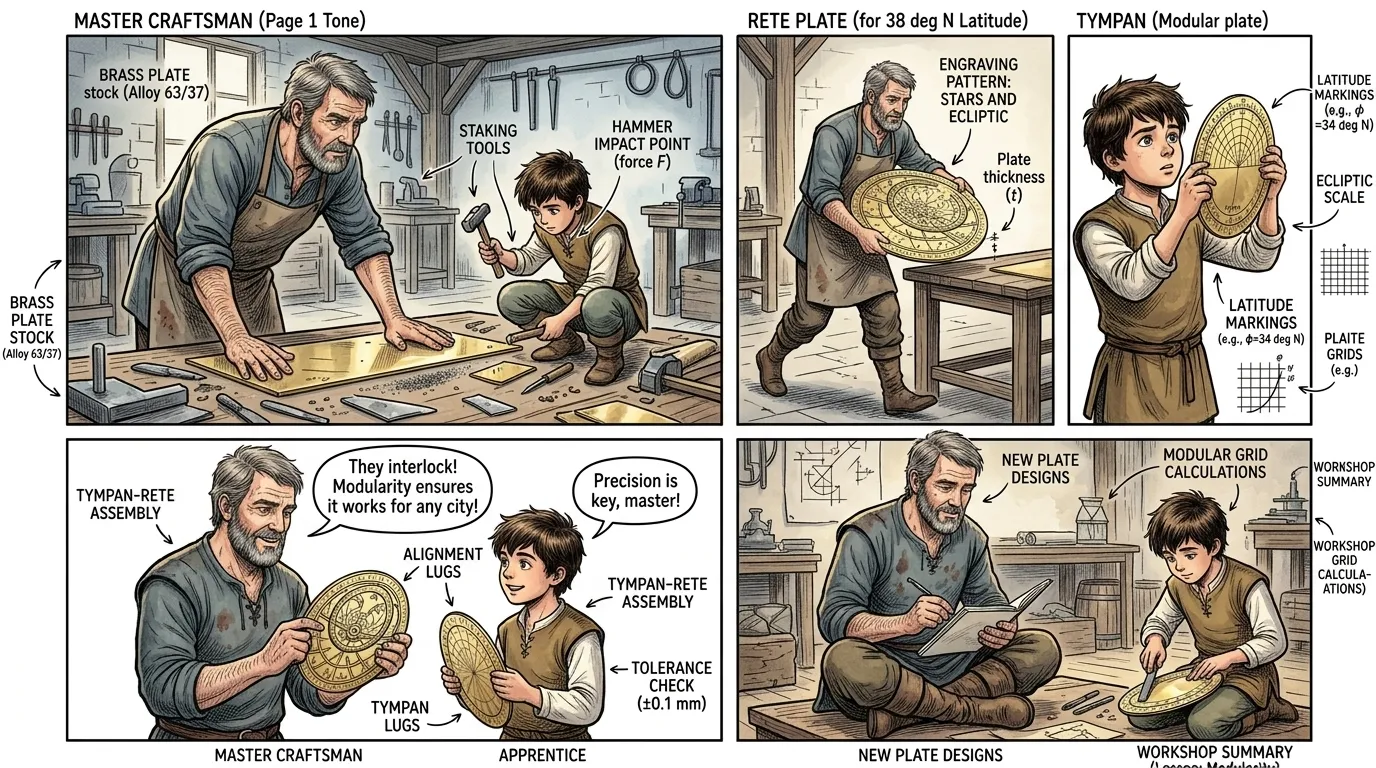
The breakthrough in the astrolabe's design centered on its modularity. The 'mater,' or mother, served as the instrument's sturdy base, engraved with fixed altitude and azimuth scales. Crucially, a 'tympan' – a thin, interchangeable plate specifically engraved for a particular latitude – slotted into the mater, representing the static sky as seen from that specific location.
"The master craftsman holds up a finely etched tympan plate. "This," he explains, "is the fixed heaven for a specific latitude. When you travel, you swap this out, rather than needing an entirely new instrument. It's like carrying different maps for different lands, all within the same frame.""
Page 7
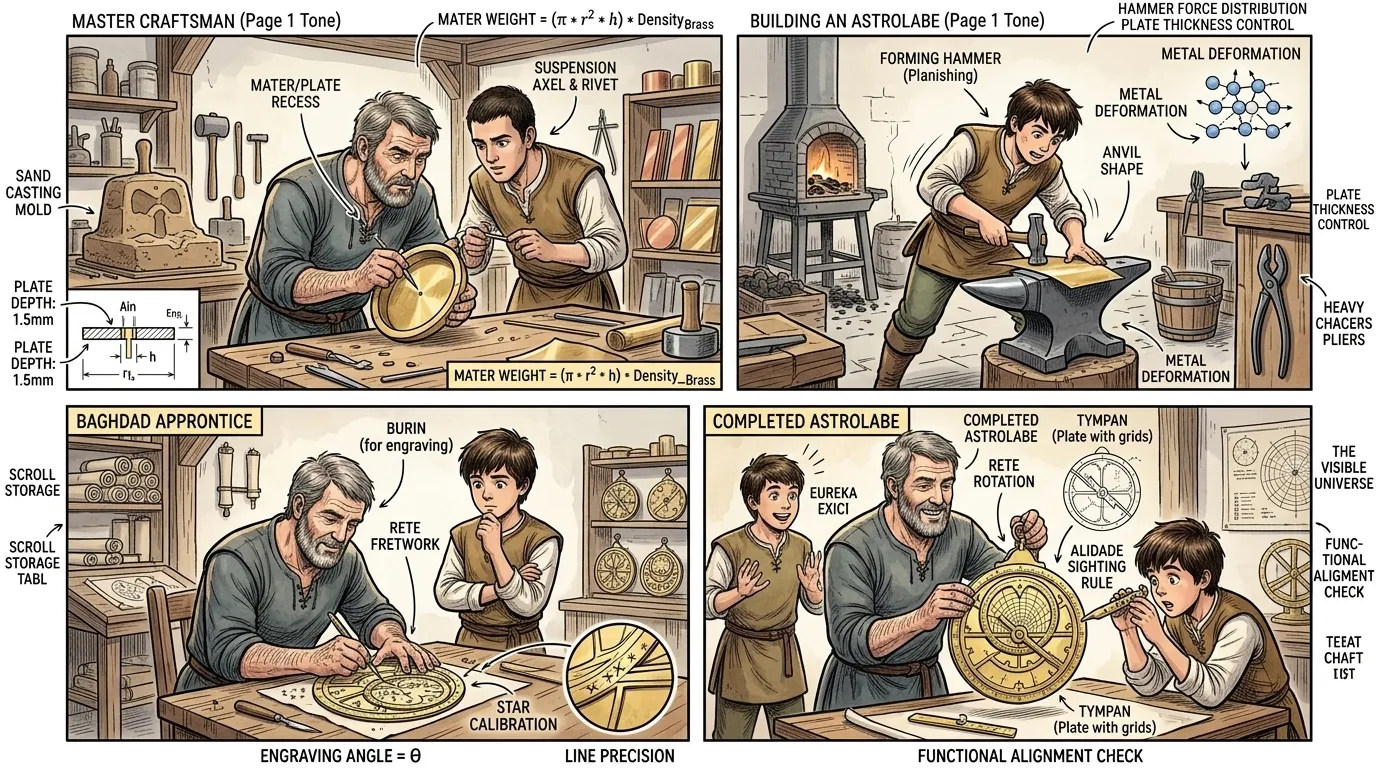
Above the static tympan rotated the 'rete,' an open-cut fretwork disk representing the stars and ecliptic path. It was the dynamic interplay between the rete and tympan, combined with the 'alidade' – a sighting rule on the back – that allowed users to simulate the celestial sphere's rotation and take precise measurements.
"The craftsman gestures to the rotating components. "The rete spins, mimicking the daily rotation of the stars. Align it with the alidade, measure a star's height, and suddenly you know the time, your latitude, even the very positions of the planets. It makes the invisible visible, the intangible tangible.""
Page 8
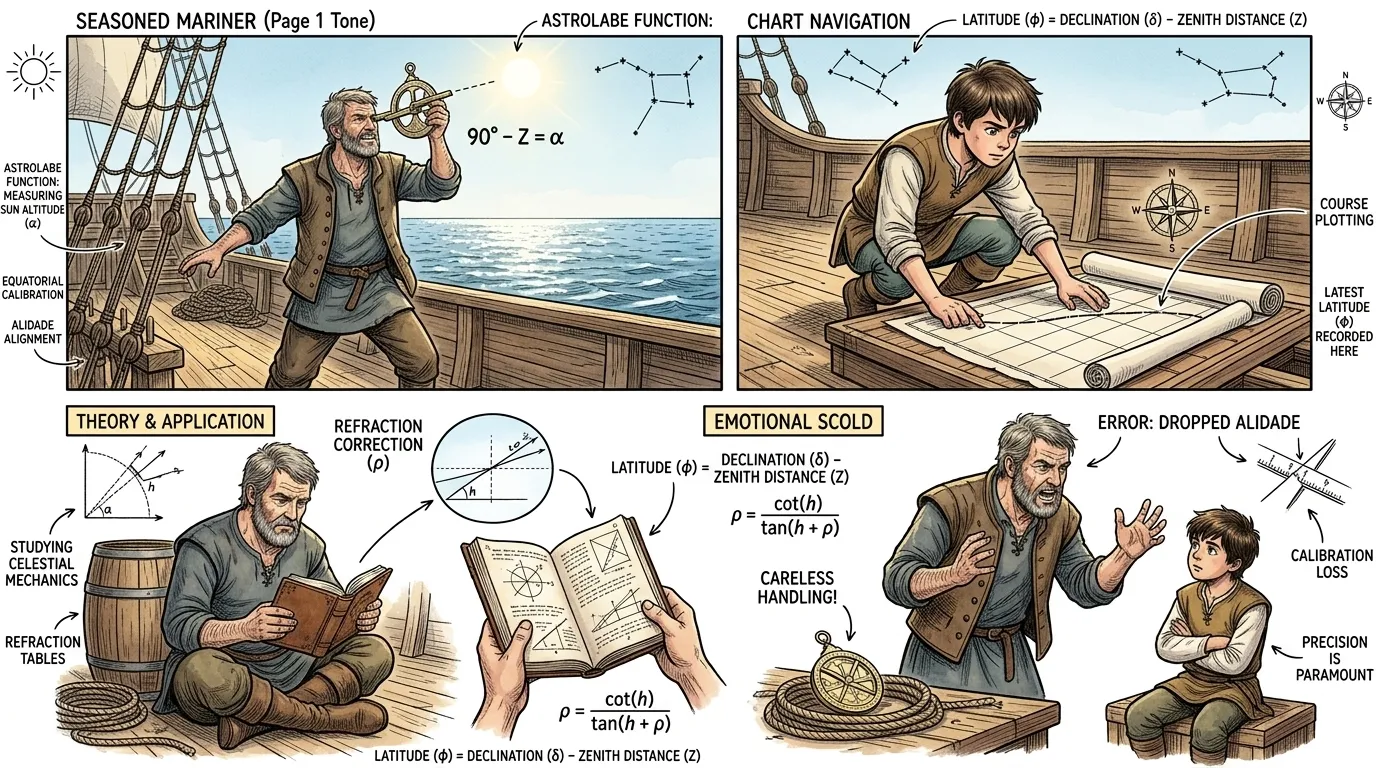
With the Astrolabe, a single sighting of a celestial body—a star at night or the sun by day—could unlock a wealth of information. Sailors could determine their latitude, scholars could accurately tell time, and astronomers could predict planetary movements. This instrument became indispensable for both practical navigation and theoretical astronomy.
"A seasoned mariner, standing on the deck of a carrack, holds an astrolabe steady, squinting through the alidade at the sun. "By God, the altitude is consistent! This confirms our latitude. Every degree this instrument measures is a mile less guesswork, a life more saved. It truly is a 'mathematician's jewel,' as the poet Chaucer called it generations later, a testament to human ingenuity against the vast ocean.""
Page 9
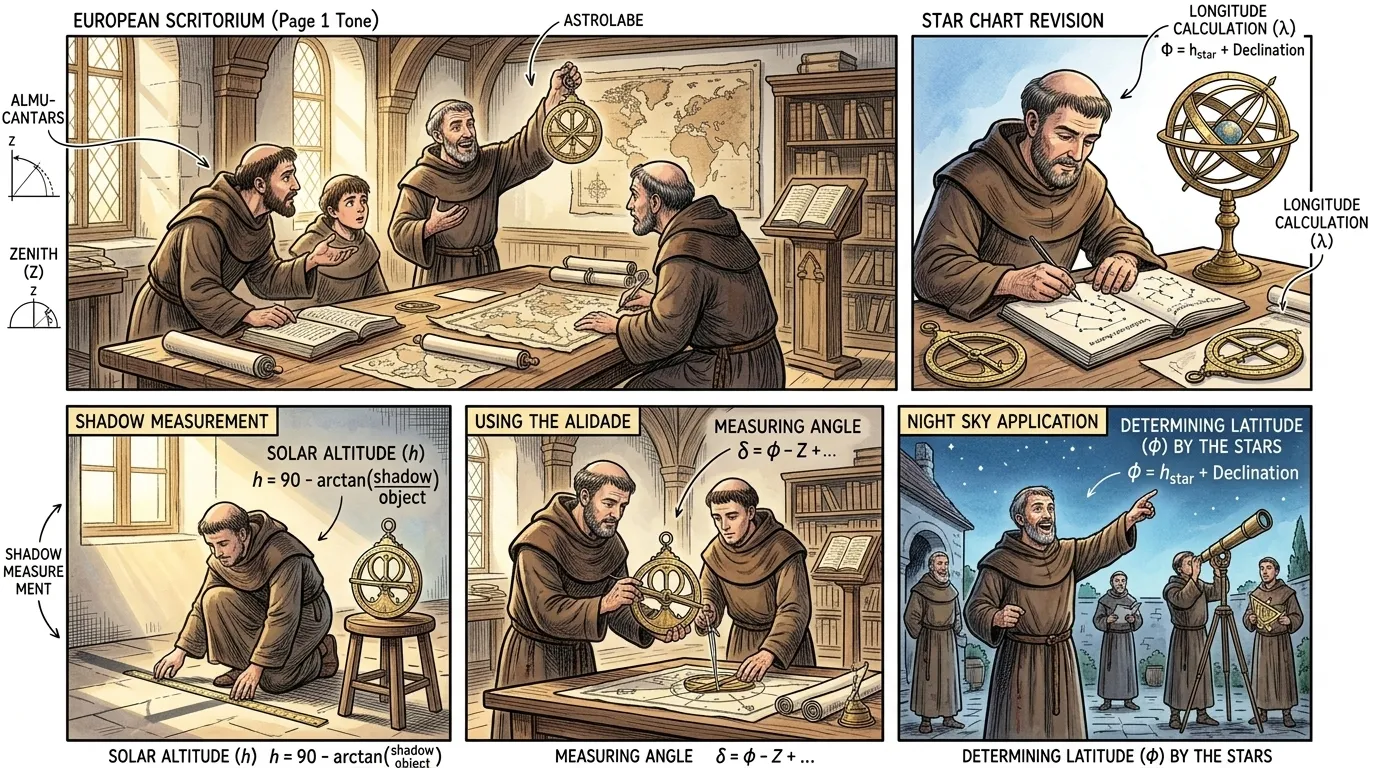
The Astrolabe's journey was a testament to the exchange of knowledge. From its refined development in the Islamic world, it traveled through Spain and into medieval Europe. Figures like Gerbert of Aurillac (later Pope Sylvester II) and Geoffrey Chaucer introduced and popularized the instrument, making it a cornerstone of European scientific and navigational pursuits during the Age of Exploration.
"A European scholar in a scriptorium, demonstrating an astrolabe to a group of monks, says with fervor, "This instrument, a gift from the East, allows us to grasp the order of the cosmos. It bridges the gap between our humble Earth and the grand celestial mechanics. We are no longer bound by mere faith, but empowered by observation.""
Page 10
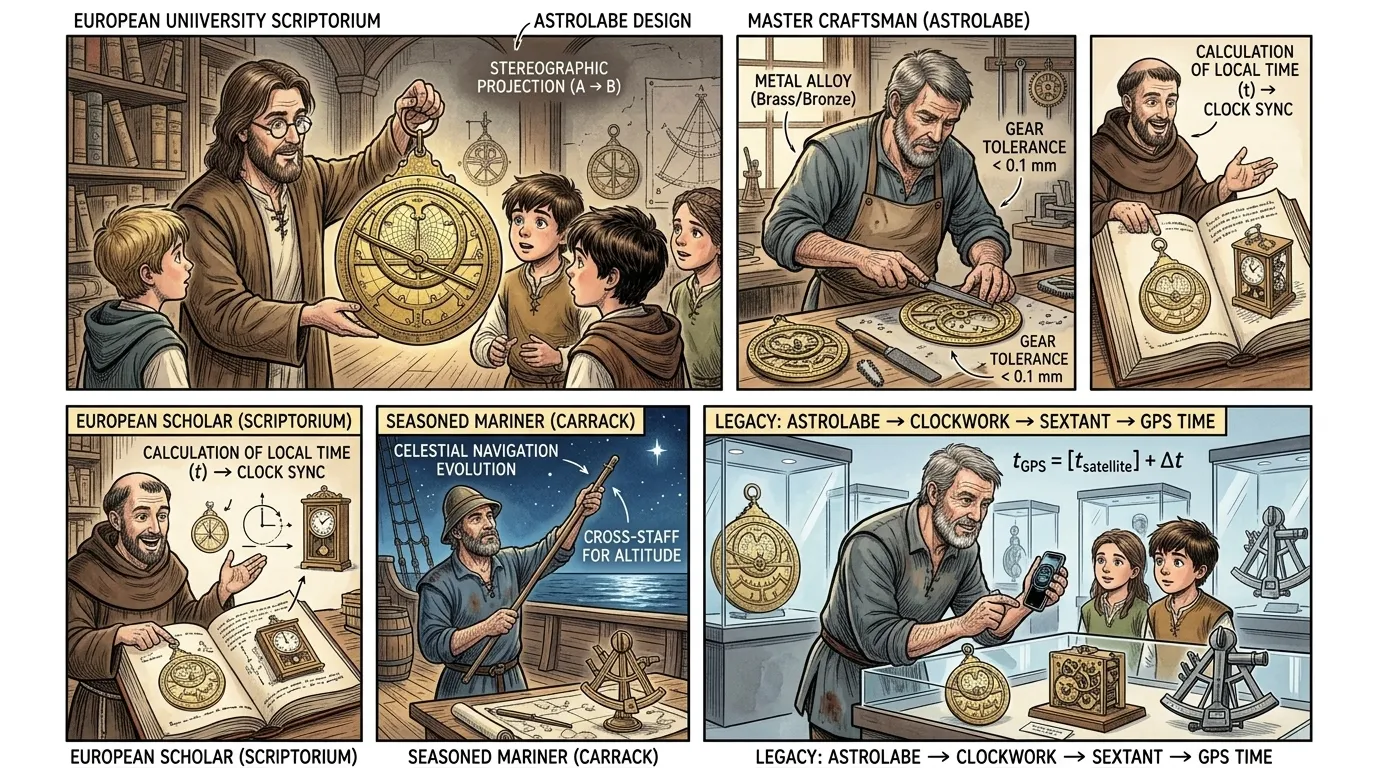
Though eventually superseded by more specialized instruments like the sextant, the astrolabe's impact was profound and enduring. It not only guided explorers across oceans but also laid intellectual foundations for understanding celestial mechanics, influenced the design of early mechanical clocks, and represented a pivotal leap in humanity's quest to measure and comprehend its place in the universe.
"No direct dialogue, but descriptive labels and the visual narrative convey the message."
About this story
- Location: Global
- Audience: general readers
Read Wonder Inventions on your phone
Wonder Inventions is available on Android. Get Wonder Inventions on Google Play.