Audio Recording
Audio Recording — an illustrated inventions story, set in Global. 10 illustrated pages, free to read on Wonder Inventions.
Page 1
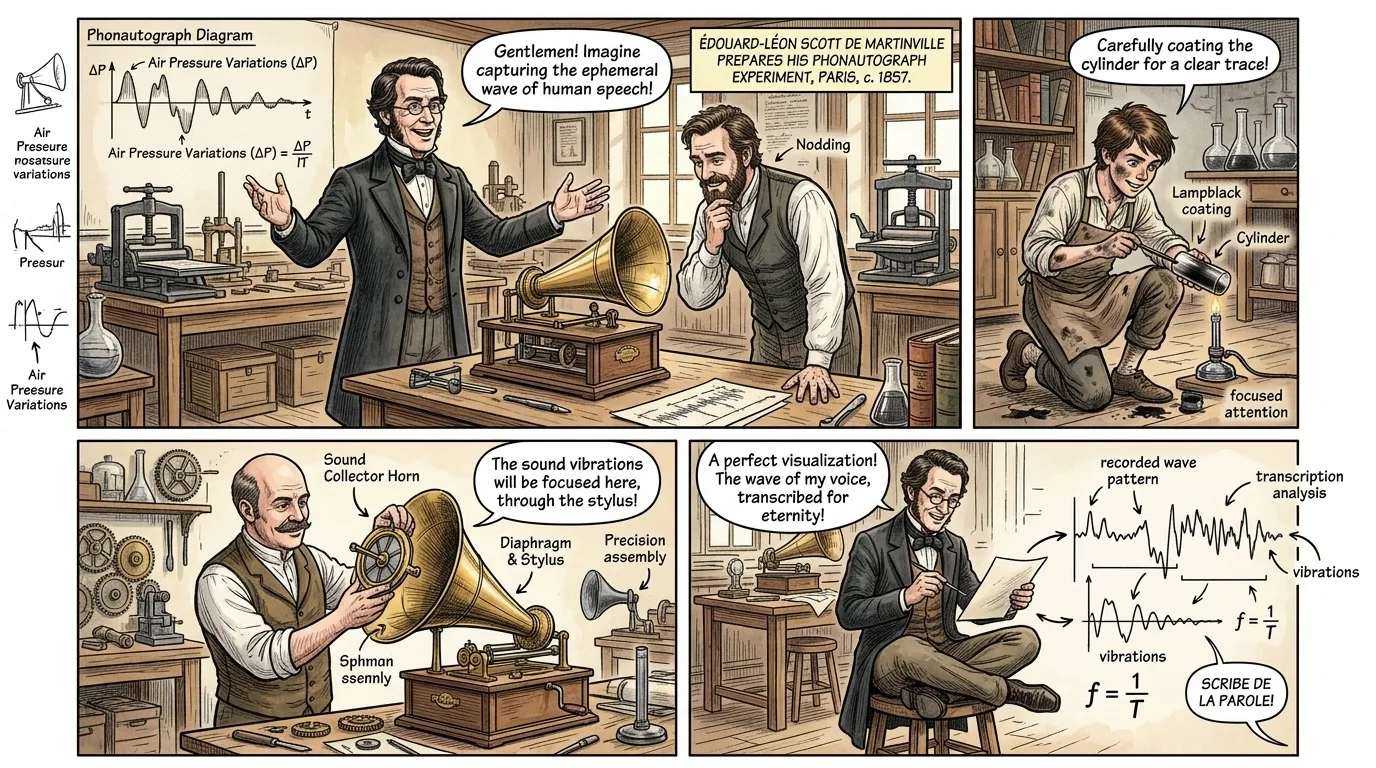
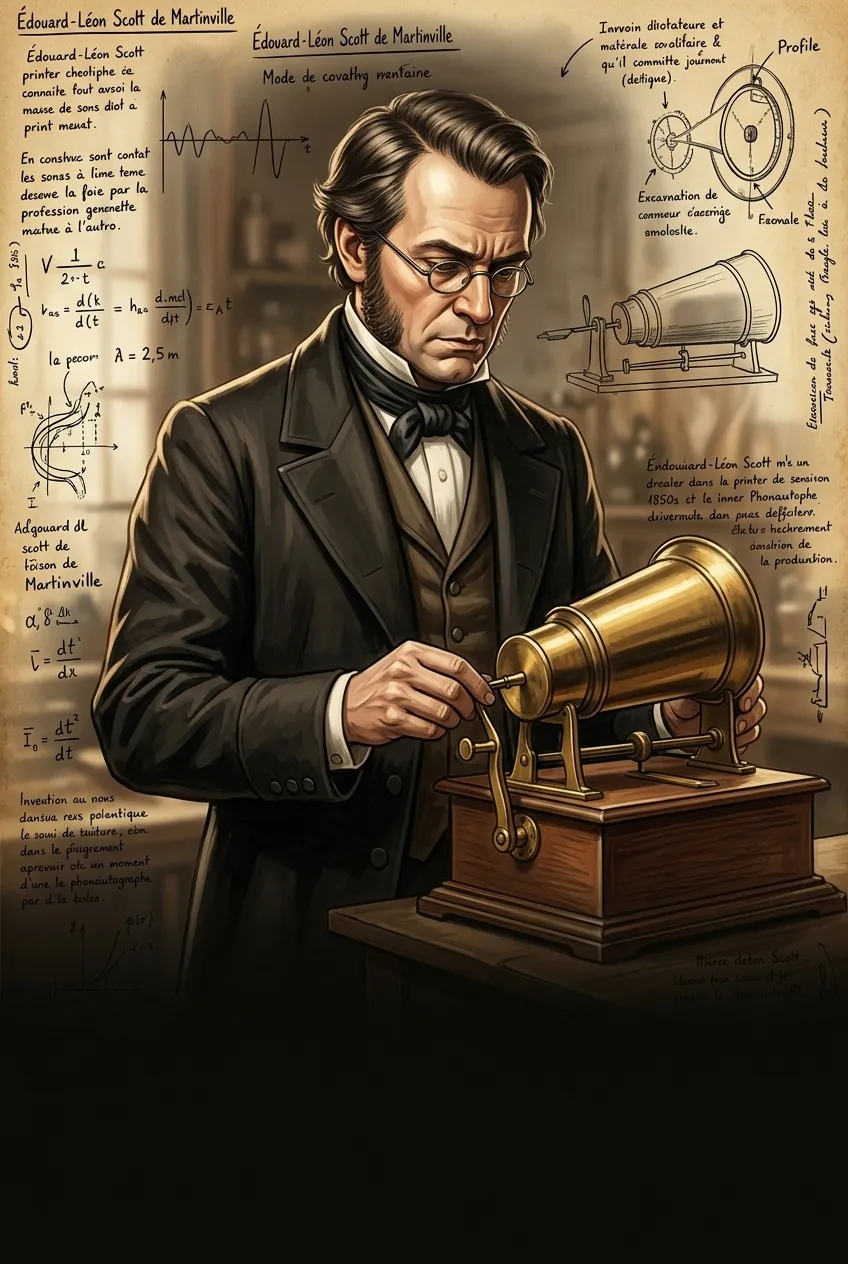
Before the advent of audio recording, sound was a transient phenomenon, its very nature defined by its immediate dissipation. Music, speech, and the cacophony of daily life existed only in the moment of their creation, forever lost to the past. This inherent impermanence presented a profound limitation to human archiving and communication. Scientists and inventors yearned for a mechanism to capture these fleeting vibrations.
""Imagine, Monsieur, a world where the spoken word could echo beyond the grave," Édouard-Léon Scott de Martinville mused, gesturing towards his complex apparatus. "As the Roman philosopher Cicero once wisely observed, 'What greater gift than to have the right to speak what you think?' But what if those thoughts, once spoken, could also be held, revisited, studied?" His colleague nodded slowly, contemplating the radical implications."
Page 2
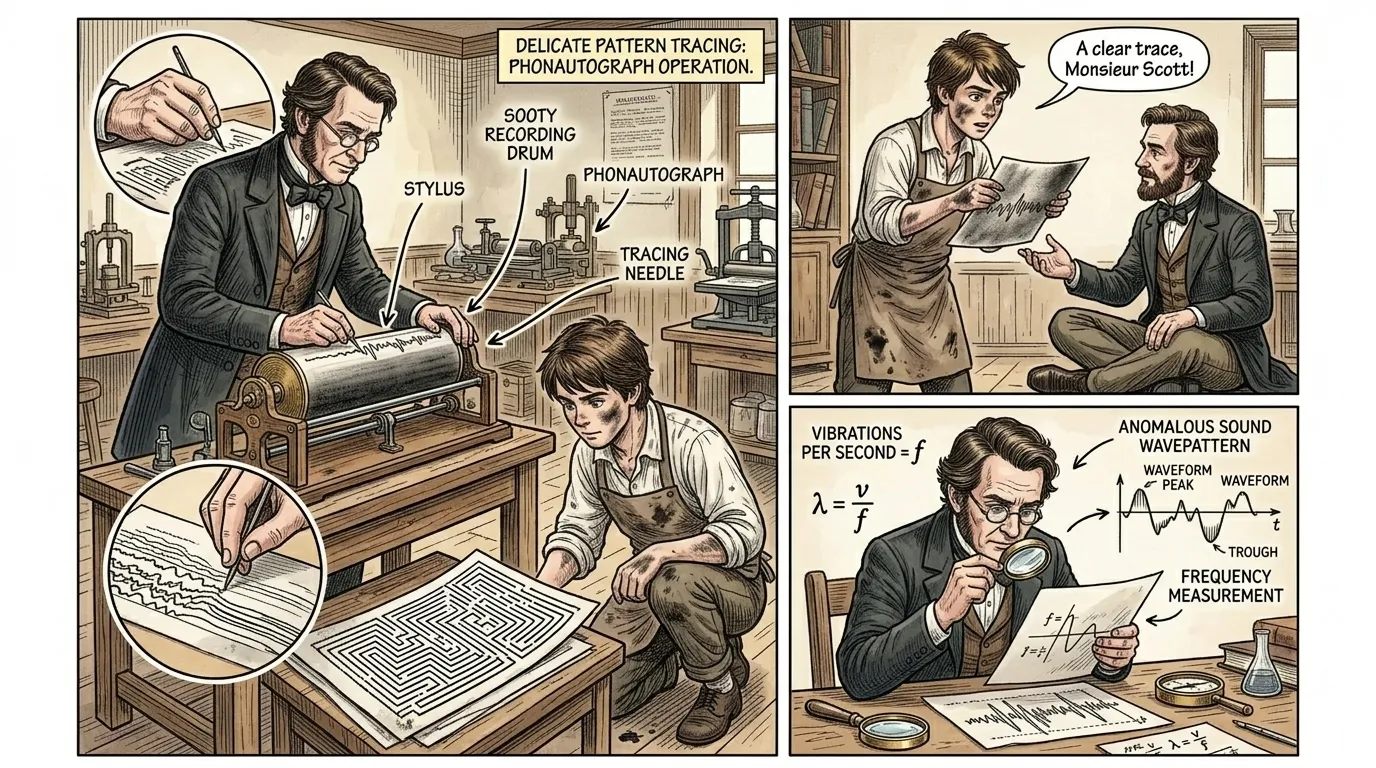
Before the ability to record, every lecture, every piece of music, every important declaration was ephemeral, leaving no audible trace. The challenges were immense: how to convert airborne pressure waves into a stable, retrievable physical form, and then, crucially, how to reverse that process? Scott de Martinville's device, the Phonautograph, made a crucial first step by visually inscribing sound waves onto paper. Yet, it offered no path to playback, leaving the captured patterns as silent enigmas.
""We see the sound, a fascinating labyrinth of lines," Scott de Martinville explained to his apprentices, tracing a pattern on the soot-covered paper. "Each groove, a precise mirror of the air's vibration. But what do these patterns mean to the ear? Without a method to re-animate them, they remain a mere shadow of the original sound." An apprentice, a young man with a studious expression, peered closer. "So, we have captured its form, but not its voice, Master?" Scott de Martinville sighed, "Precisely. The greatest challenge remains: how do we make the machine speak what it has seen?""
Page 3
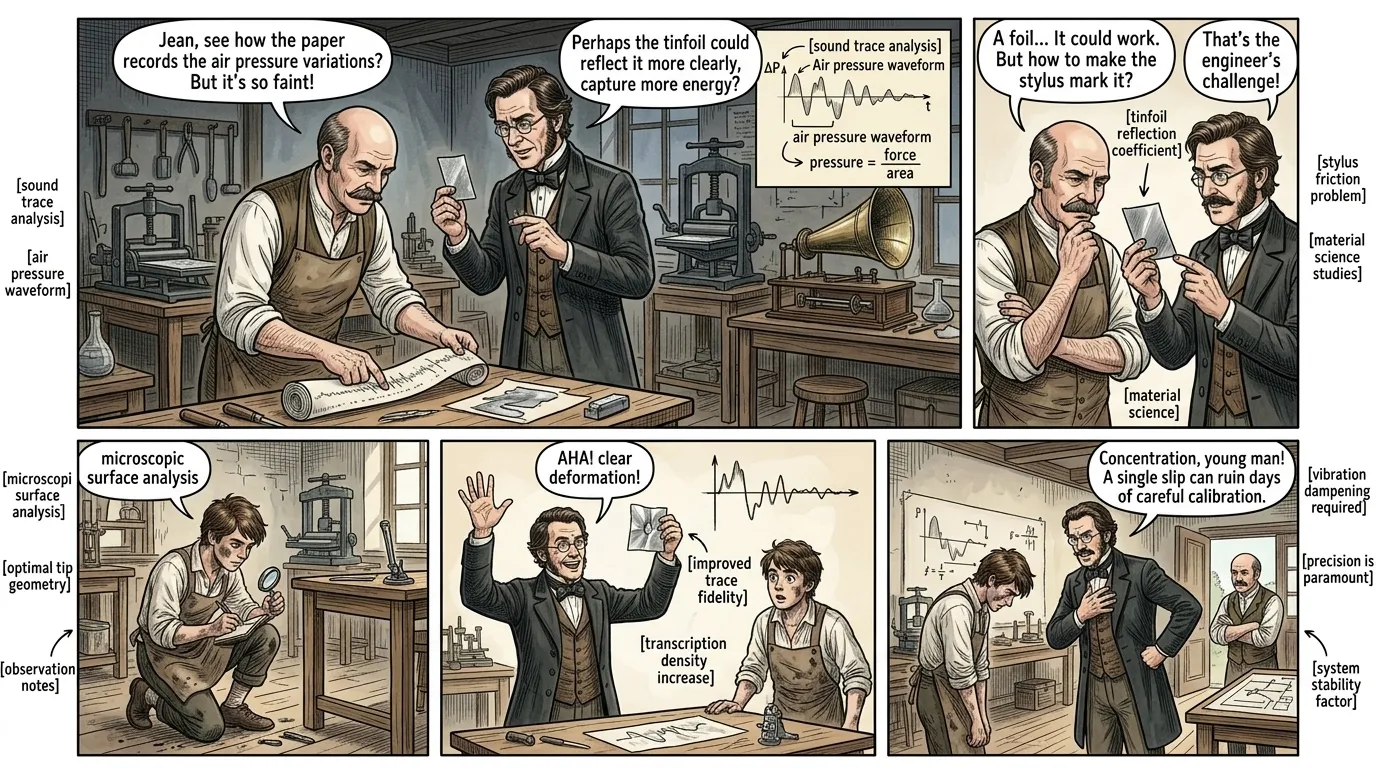
The core problem of audio recording wasn't merely the inscription of sound, but its faithful reproduction. Early attempts, like Scott de Martinville's, could chart the oscillations of air, visualizing speech or song as complex wave patterns. However, translating these static lines back into audible vibrations proved a monumental task. The physical medium itself needed to possess qualities that allowed for both precise inscription and robust re-vibration, a duality that eluded inventors for decades.
""The stylus leaves its mark, yes, but the paper offers no resistance, no spring to push back," one of Scott de Martinville's engineers, a balding man named Jean with a thick, practical mustache, observed, gesturing at a roll of phonautograph paper. "It absorbs, it holds, but it cannot return the energy. We need a surface that remembers not just the shape, but the force required to create that shape." Scott de Martinville nodded, "Indeed. The material itself must contain the potential for rebirth. This is our fundamental impasse: how to make an inert substance vibrate in resonance with its own inscribed past?" He held up a small, stiff piece of tinfoil. "Perhaps a material with more... memory.""
Page 4
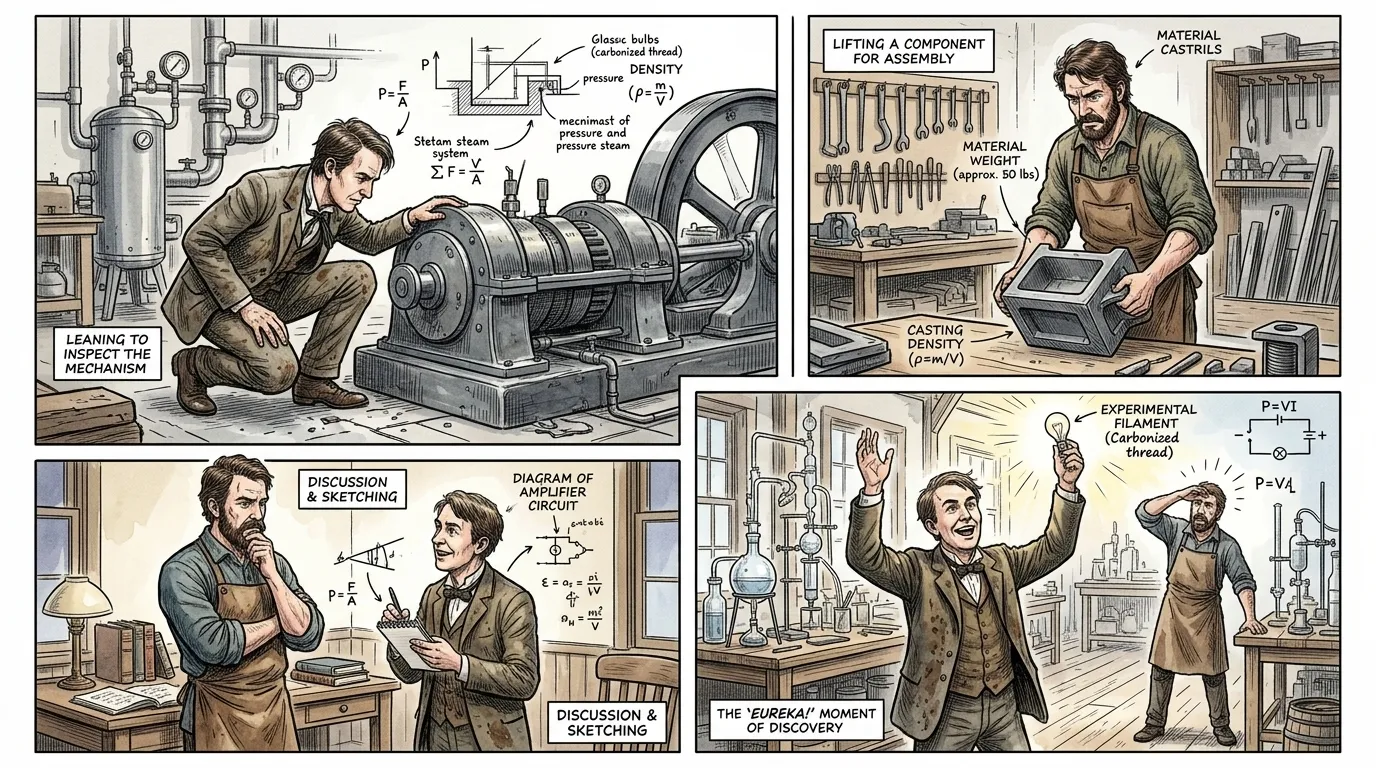
Across the Atlantic, in Menlo Park, New Jersey, Thomas Edison, already a celebrated inventor for his work on telegraphy and the electric light, was unknowingly on a convergent path. His initial focus was on improving the telegraph, developing a system to record telegraphic messages automatically, allowing them to be sent and received at high speeds, and then replayed. This work with automated transcription sparked an audacious idea: what if, instead of dots and dashes, one could record the human voice itself?
""If we can impress a Morse code signal onto a wax-coated paper disk and then use that impression to re-trigger a telegraph key," Edison pondered aloud to his lead mechanic, John Kruesi, in his bustling workshop, "why could we not do the same for the infinitely more complex vibrations of human speech? The principle should be analogous." Kruesi, a skilled craftsman with strong, capable hands, scratched his beard. "It's a grand leap, Mr. Edison. A simple click versus the nuances of a single word... but you've made grander leaps before. What material do you envision for this 'talking telegraph'?""
Page 5
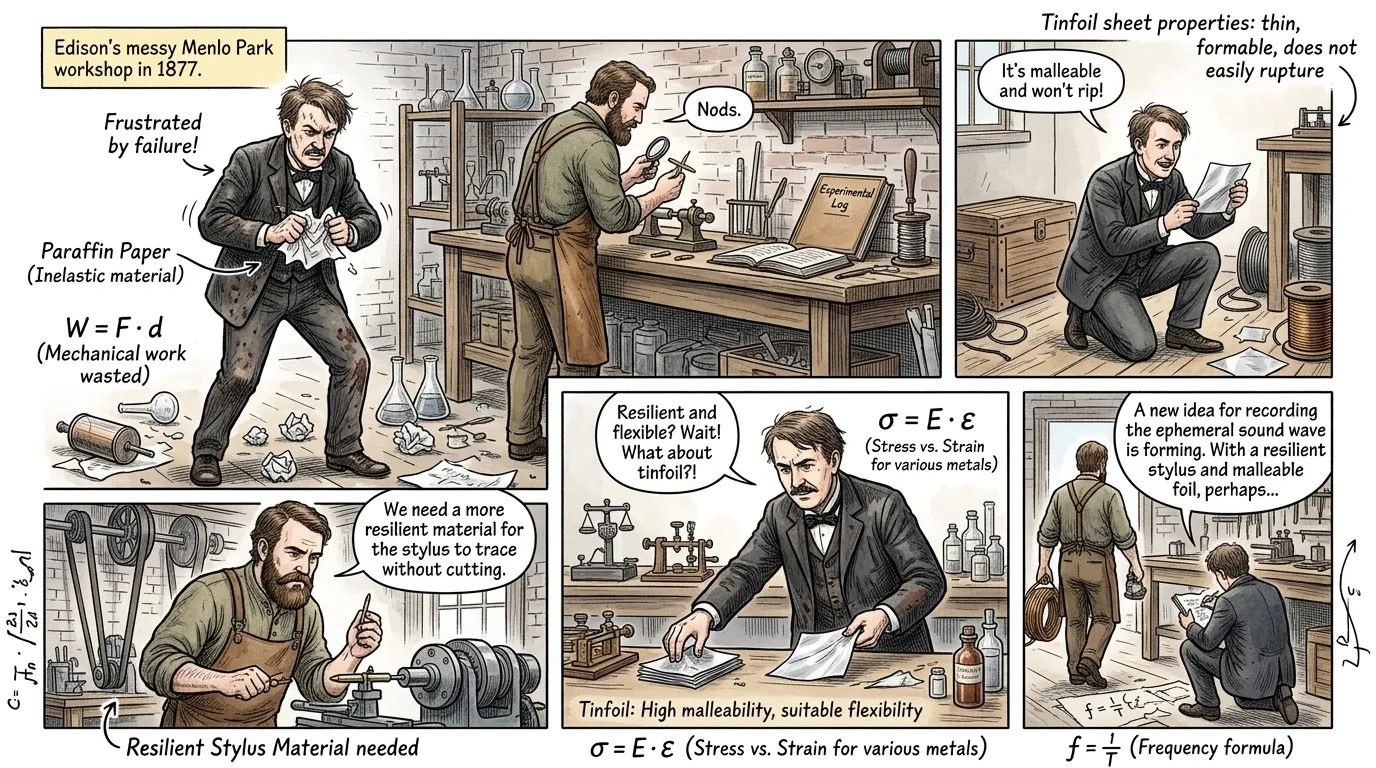
Edison's initial experiments involved a diaphragm, a stylus, and paraffin-coated paper. The idea was to indent the paper with sound vibrations. While this produced a visible record, the quality was poor, and true playback remained elusive. The crucial leap occurred when Edison considered not just impressing the sound, but creating a reversibility in the mechanism. He theorized that if the impressions were deep enough and on a sufficiently resilient surface, the stylus could be used to 'read' them back, causing the diaphragm to vibrate in turn.
""The paper is too flimsy, it tears, it muffles the detail," Edison exclaimed, crumpling a piece of indented paper. "We need something robust, something that holds its form with fidelity. And the stylus must be able to dance in those grooves, not just create them." Kruesi nodded, examining a small, brass stylus. "The problem, as you say, is not just recording the dance, but making the dancer re-perform it. A surface that gives back what it receives, like a resilient spring." Edison picked up a thin sheet of tinfoil. "What if we make the groove itself the spring? A flexible, yet durable, metallic surface, molded by the pressure. Then, the same stylus that pressed it down, could ride its contours, causing the membrane to oscillate once more!""
Page 6
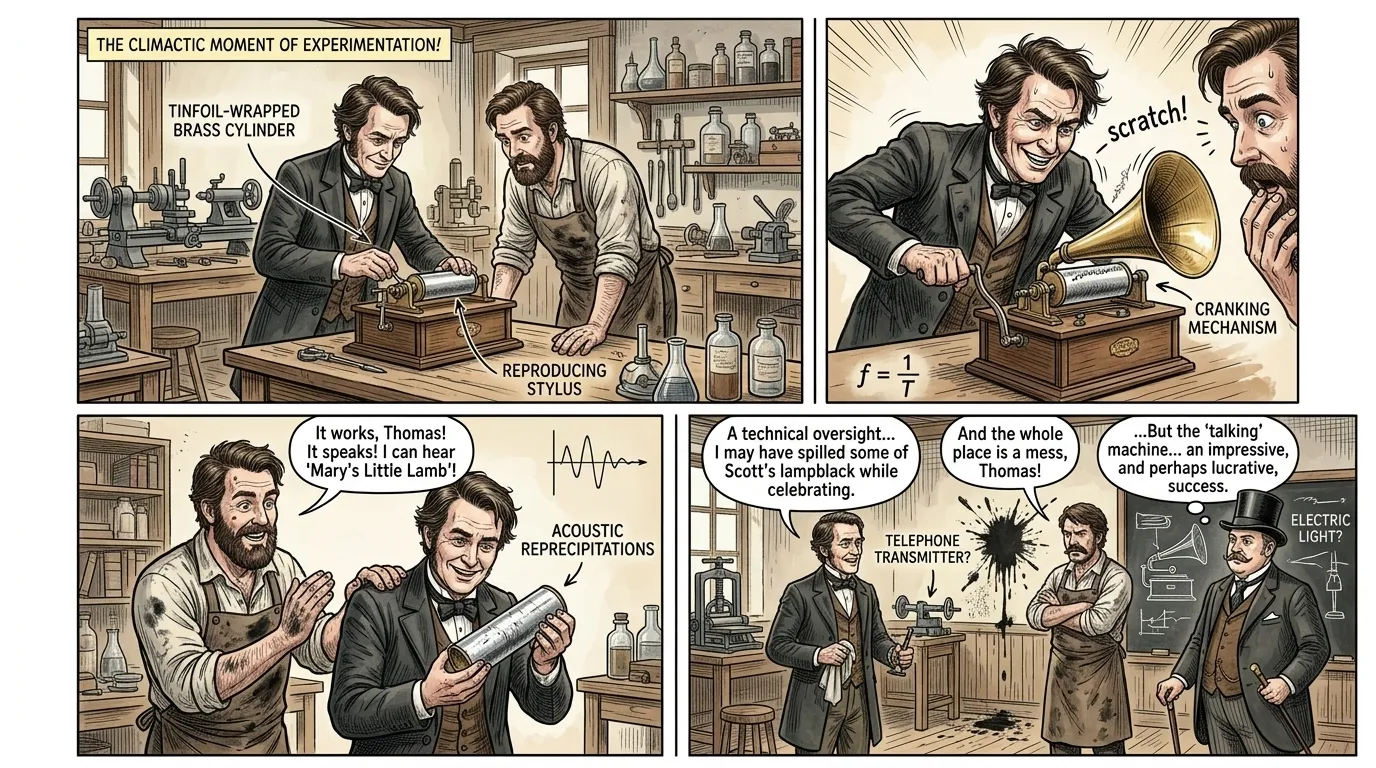
In December 1877, Edison sketched his design: a rotating brass cylinder, a hand-crank to turn it, and two diaphragms with styli – one for recording, one for playback. The cylinder was wrapped in a sheet of tinfoil. When sound waves hit the recording diaphragm, its attached stylus vibrated, making indentations of varying depth into the pliable tinfoil as the cylinder rotated. For playback, the second stylus was lowered into these indentations. As it traced the grooves, it vibrated, transferring those vibrations back to its diaphragm, which in turn moved the air, recreating the original sound.
""The moment of truth, John!" Edison declared, his eyes gleaming, as he carefully positioned the playback stylus onto the tinfoil-wrapped cylinder. "Every impression made by my voice, now a minute valley, ready to guide this needle." Kruesi leaned in, his breath held. "And the valley, in turn, shall awaken the diaphragm, giving breath back to the sound." Edison cranked the handle. A scratchy, reedy voice emerged: "Mary had a little lamb..." Both men stared, astonished. "It speaks! My words... returned to me!" Edison exclaimed, a triumphant grin spreading across his face. "We have captured the whisper of time itself!""
Page 7
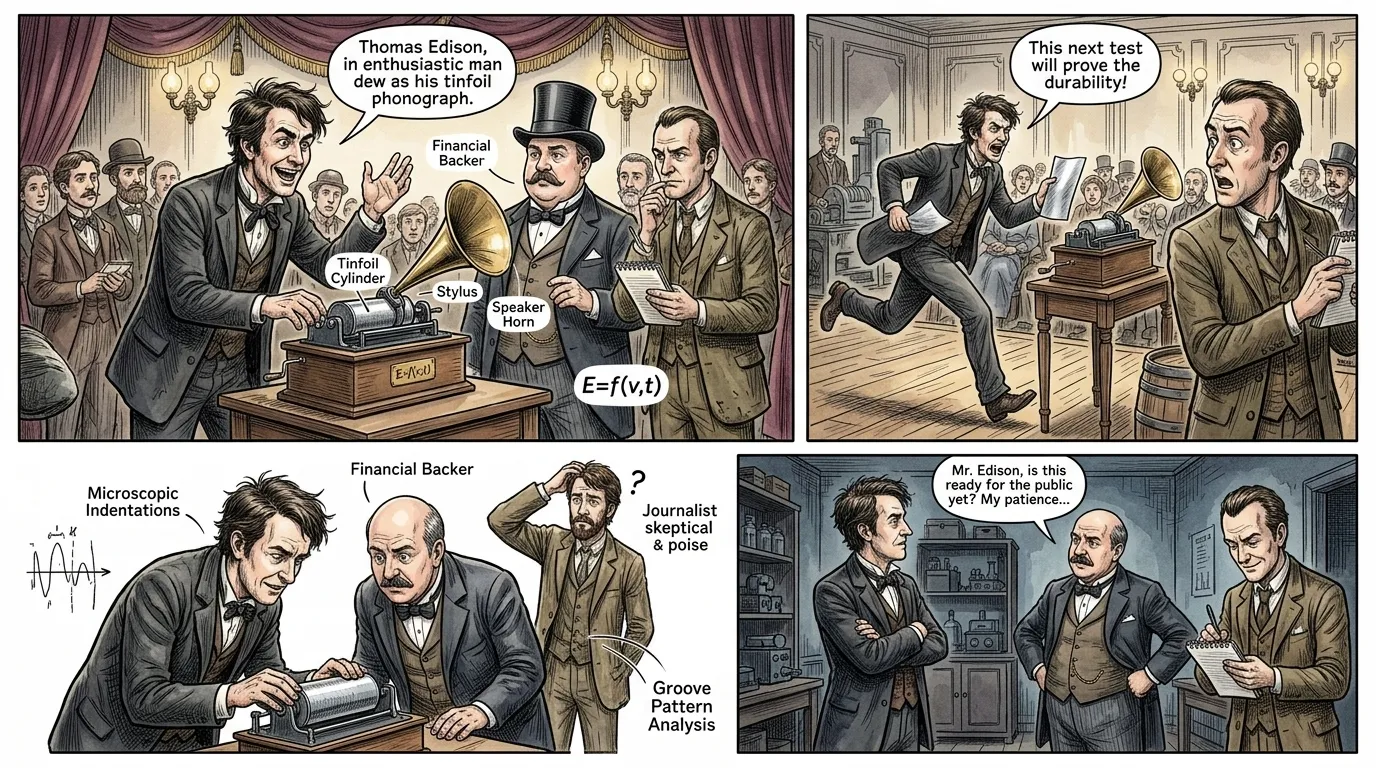
The initial recording of 'Mary Had a Little Lamb' was a moment of profound revelation. Edison and his team had not merely inscribed sound; they had resurrected it. The tinfoil phonograph, though crude and fragile, demonstrated the fundamental principle: converting sound waves into physical indentations, and then reversing the process to recreate the sound. This invention, patented in 1878, ignited a global sensation, ushering in an entirely new era of auditory preservation.
""The phonograph promises to be of great value for dictation, for capturing the last words of the dying, and even for teaching elocution," Edison announced to a small gathering of journalists and investors, his voice brimming with enthusiasm. "But imagine the archives, gentlemen! The voices of history, held forever!" A journalist, a skeptical man with a notebook, raised an eyebrow. "And music, Mr. Edison? Could this machine sing?" Edison smiled broadly. "Given time, sir, it will sing, it will speak, it will inform, and it will entertain. We have only just begun to understand its potential.""
Page 8

The tinfoil phonograph captured public imagination but quickly revealed its limitations: poor sound quality and extreme fragility of the tinfoil. It was truly a novelty. Yet, its potential was undeniable. Other inventors soon entered the fray, seeking to improve upon Edison's groundbreaking concept. Alexander Graham Bell, his cousin Chichester Bell, and Charles Tainter developed the 'Graphophone,' using wax-coated cardboard cylinders, offering superior fidelity and durability. This innovation paved the way for commercially viable audio recording, moving beyond mere demonstration.
""The tinfoil, while ingenious, simply doesn't capture the subtle harmonics of the human voice," Alexander Graham Bell stated to his team in their Washington D.C. laboratory, holding a fragile piece of creased tinfoil. "We need a medium that can accept finer impressions and withstand repeated playbacks. A more durable 'memory'." Charles Tainter, a meticulous mechanic with a handlebar mustache, presented a prototype. "Our wax-coated cardboard cylinder, sir. It allows for a far smoother, more precise groove, and crucially, it can be shaved down and re-recorded. A true 'blank slate' for sound." Bell nodded, examining the wax. "Excellent. This, gentlemen, is the next crucial step toward making sound truly permanent and accessible.""
Page 9
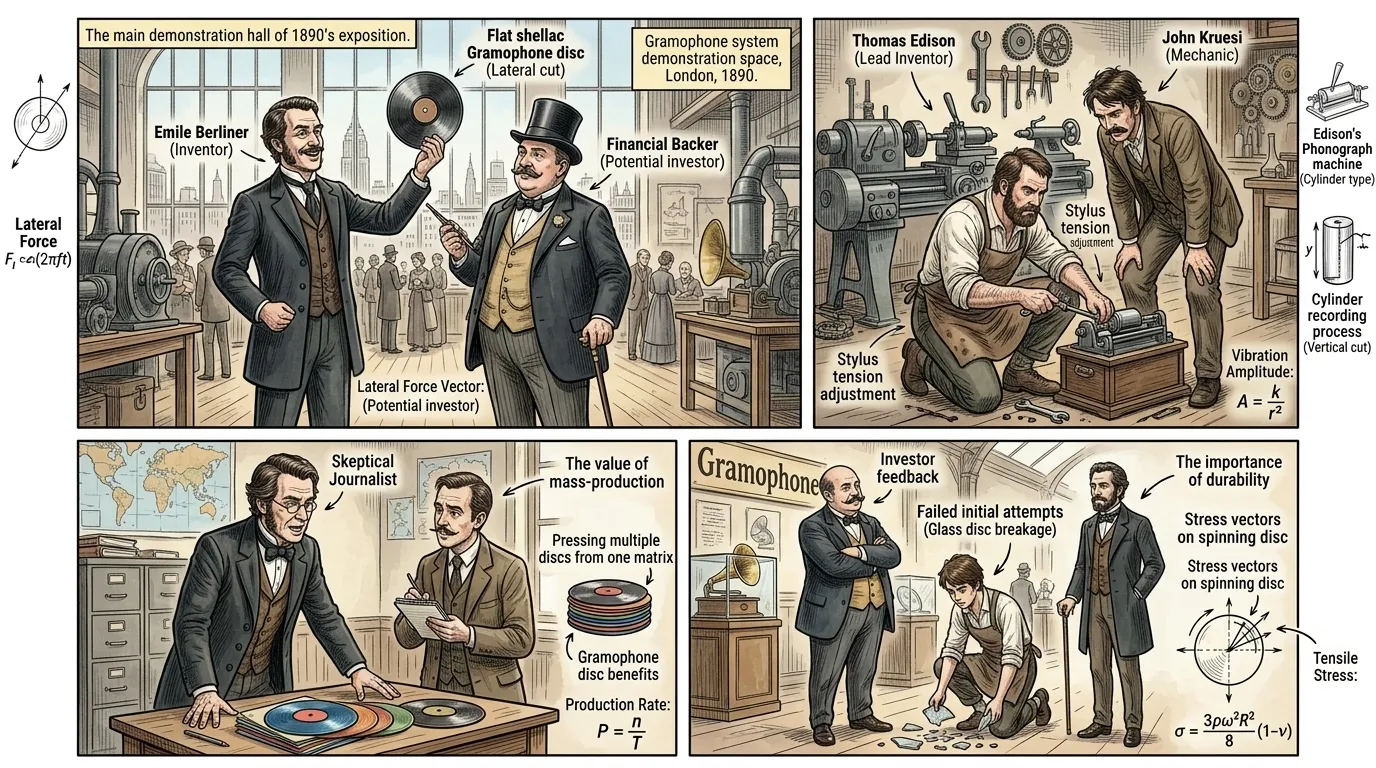
While wax cylinders improved fidelity, they remained limited in playing time and difficult to duplicate en masse. The true revolution in mass audio production came with Emile Berliner's Gramophone, patented in 1887. Berliner's innovation was the flat disc record, recorded laterally (side-to-side) instead of vertically (hill-and-dale). This allowed for easier pressing of multiple copies from a single master, making recorded music affordable and widely available. The disc became the dominant format, transforming the music industry and shaping popular culture.
""These cylinders, while good, are simply not practical for mass reproduction," Emile Berliner declared, holding a flat shellac disc triumphantly. "Imagine trying to copy thousands of these fragile tubes! My flat disc, however, can be pressed from a master mold, like printing a book. This changes everything!" His financial backer, a portly gentleman with a top hat, looked at the disc with keen interest. "So, instead of individual artisans, we have a factory. This truly democratizes music, Berliner. What will the public call these wonderful, flat sound machines?" Berliner smiled. "We shall call it the 'Gramophone,' and these, sir, are 'records.' The world is about to hear itself as never before.""
Page 10
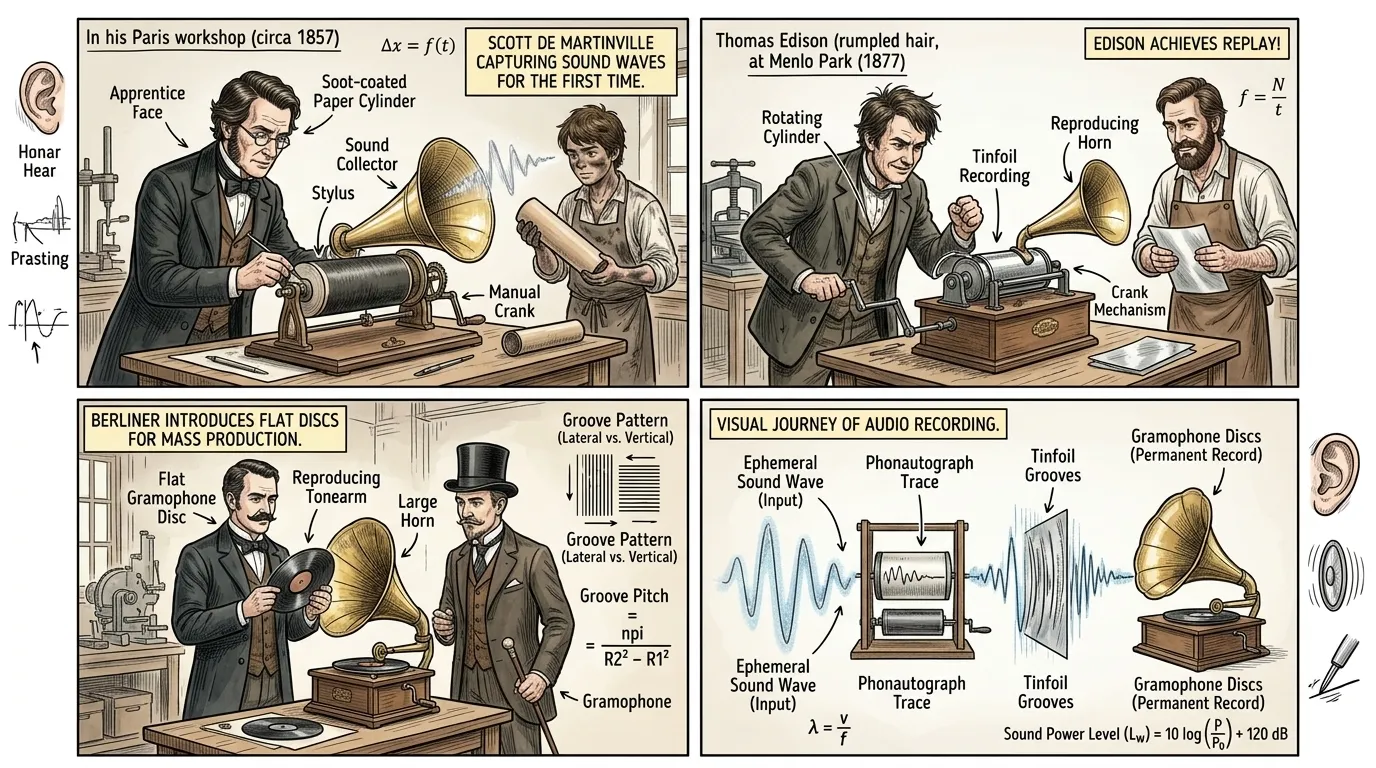
From its humble beginnings as a curiosity, audio recording evolved into a ubiquitous technology, fundamentally reshaping human communication, culture, and information. It transformed music from live performance into a mass-produced, shareable art form. It gave voices to the past, preserving historical speeches, interviews, and oral traditions. It became indispensable in scientific research, broadcasting, and personal communication. The journey from Édouard-Léon Scott de Martinville's visual trace to Thomas Edison's tinfoil wonder, and finally to Berliner's disc and beyond, forged an entirely new sensory dimension for humanity, allowing us to conquer the ephemerality of sound itself.
About this story
- Location: Global
- Audience: general readers
Questions and answers
Read Wonder Inventions on your phone
Wonder Inventions is available on Android. Get Wonder Inventions on Google Play.