Battery
Battery — an illustrated inventions story, set in Global. 10 illustrated pages, free to read on Wonder Inventions.
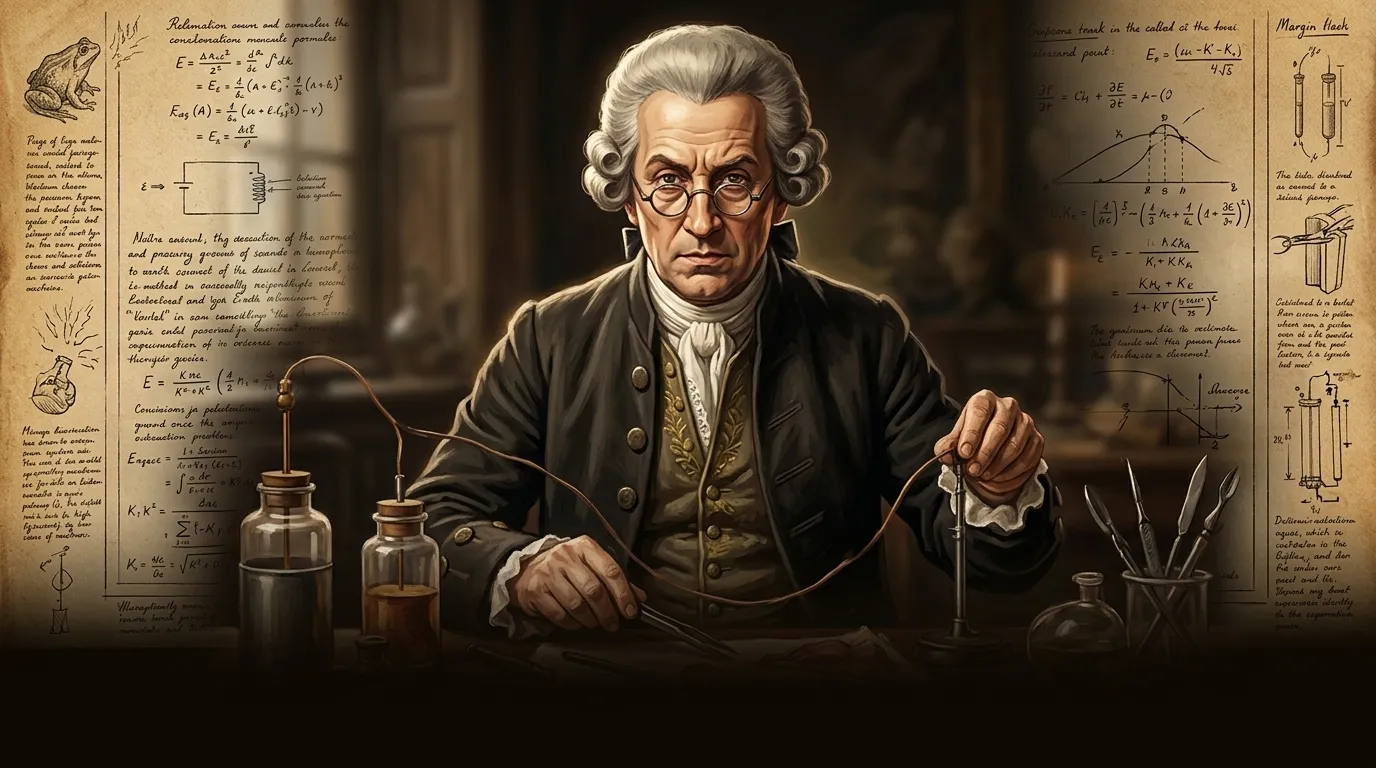
Page 1
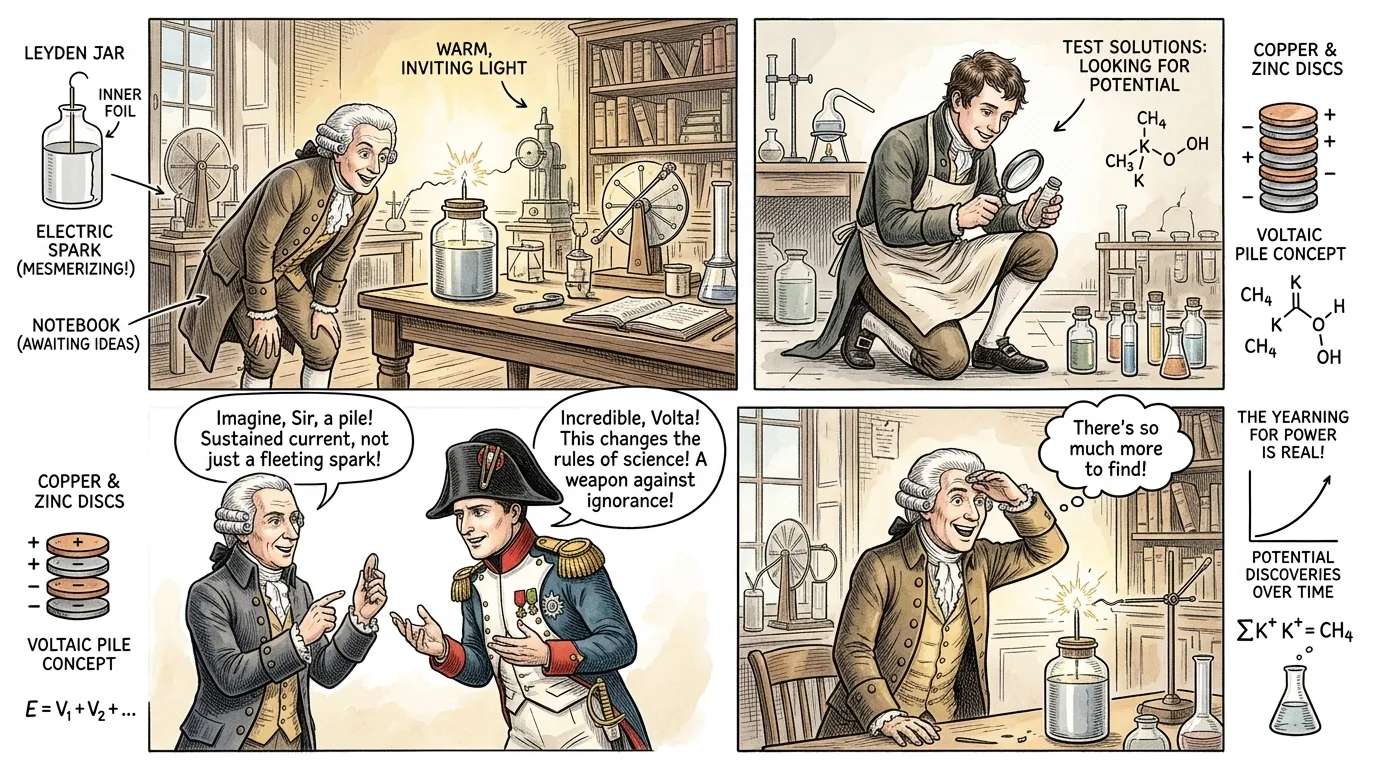
For centuries, humanity harnessed electricity in fleeting sparks, grand but uncontrollable discharges from static machines and Leyden jars. These bursts, while awe-inspiring, lacked the sustained power needed to drive continuous scientific inquiry or practical application. The world yearned for a steady, reliable flow of electric current, a silent river of energy that could be channeled and controlled, rather than a volatile lightning bolt. In the late 18th century, amidst fervent scientific curiosity, one man in Italy would finally unlock this elusive secret, fundamentally reshaping our understanding and utilization of electrical phenomena. His invention would become the cornerstone of modern electrical engineering.
Page 2
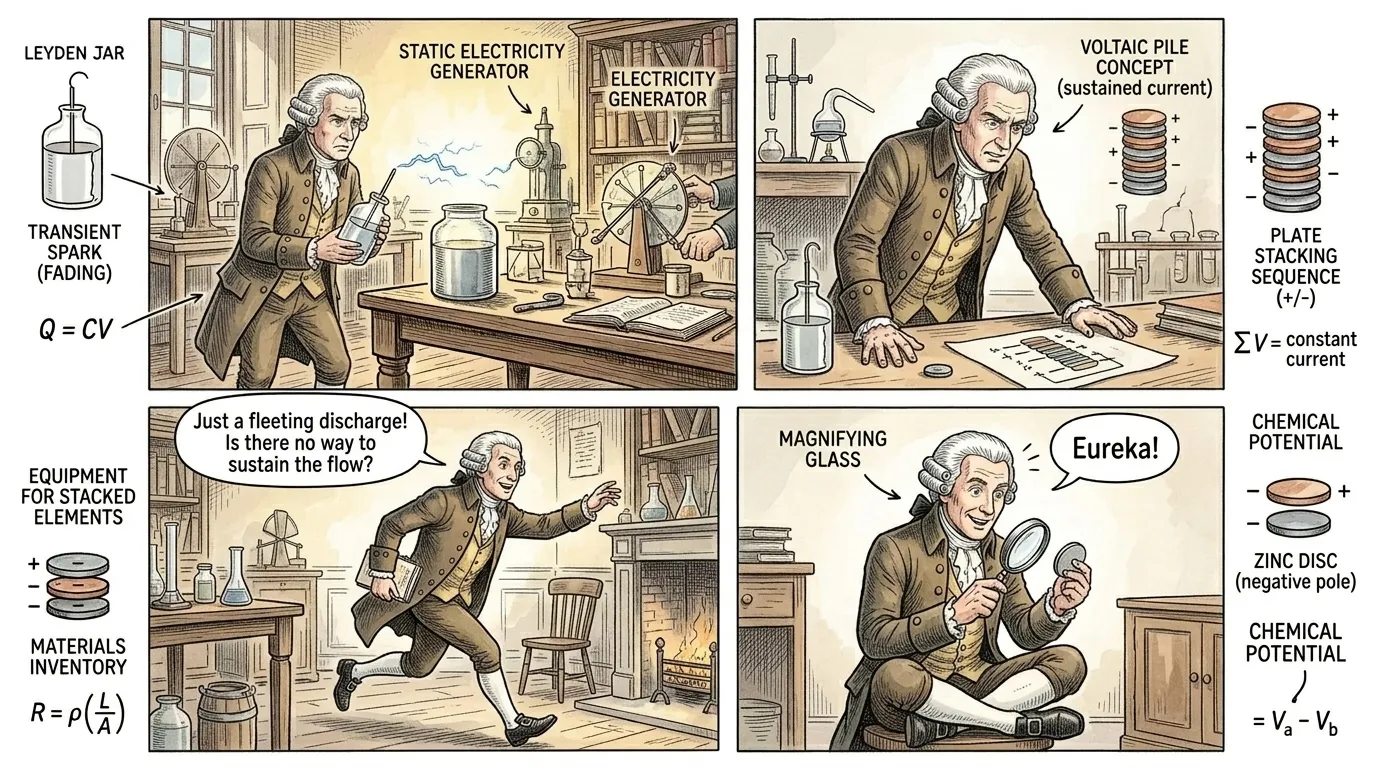
Before Volta's breakthrough, electrical experimentation was largely confined to demonstrations of static electricity. Machines with rotating glass plates or sulfur globes could generate impressive charges, easily stored in Leyden jars – glass condensers lined with metal foil. These devices could deliver a powerful, instantaneous shock, illuminate a vacuum tube for a moment, or ignite flammable gases. However, their utility was severely limited by their transient nature; the charge was quickly depleted, offering no sustained flow of current. Scientists found themselves constantly recharging their apparatus, interrupting their work and preventing the development of any processes requiring prolonged electrical energy. The quest for a truly 'dynamic' electricity remained an urgent scientific pursuit, a barrier to deeper understanding.
Page 3
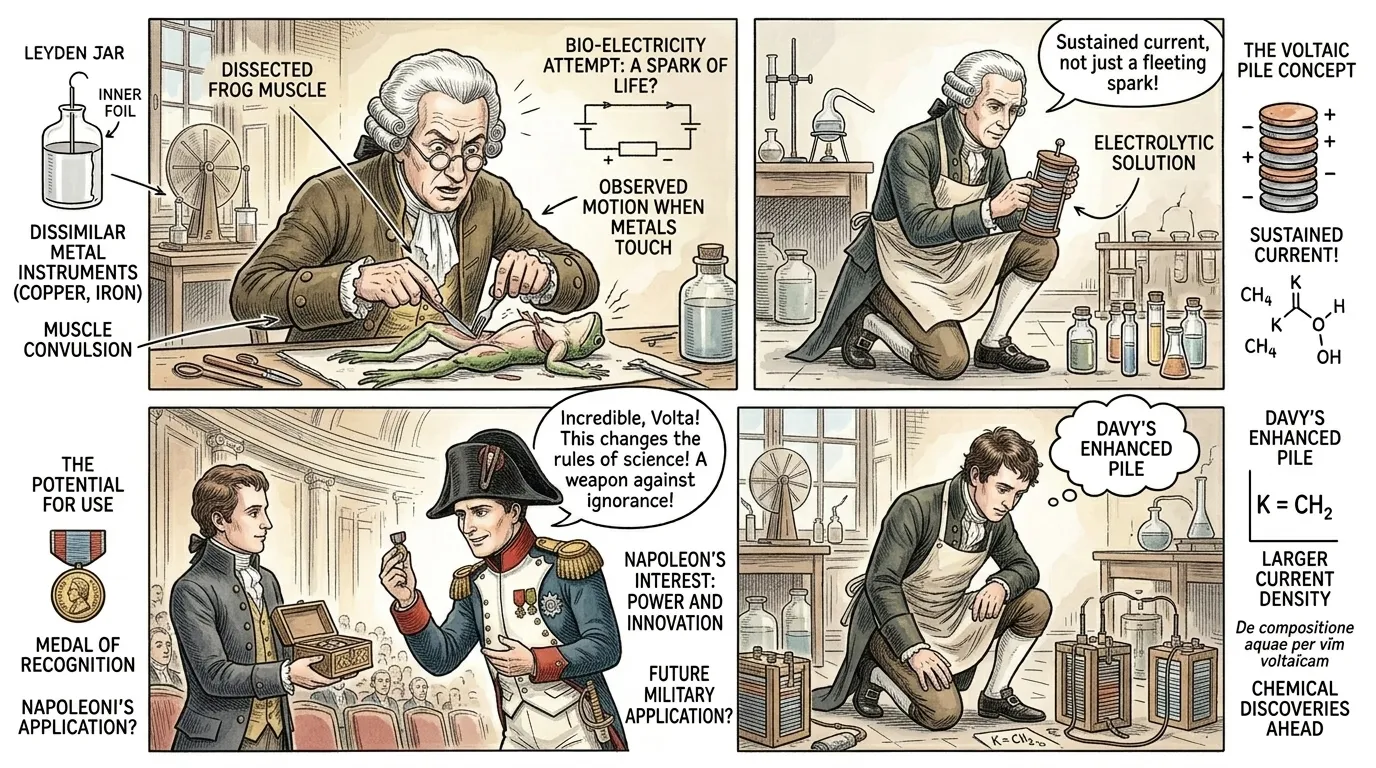
The path to continuous electricity was unexpectedly illuminated by an Italian physician, Luigi Galvani. In the late 1780s, while dissecting frogs near a static electricity machine, Galvani observed a remarkable phenomenon: the muscles of a dead frog's legs would convulse when touched by dissimilar metals, or even during a lightning storm. He theorized that the phenomenon was due to 'animal electricity,' an intrinsic fluid within the animal's body that flowed through the nerves, much like a static charge. His dramatic public demonstrations captivated the scientific community, sparking intense debate and igniting new avenues of research into the very nature of electricity and life itself. Galvani's findings were groundbreaking, yet his interpretation would soon be challenged.
Page 4
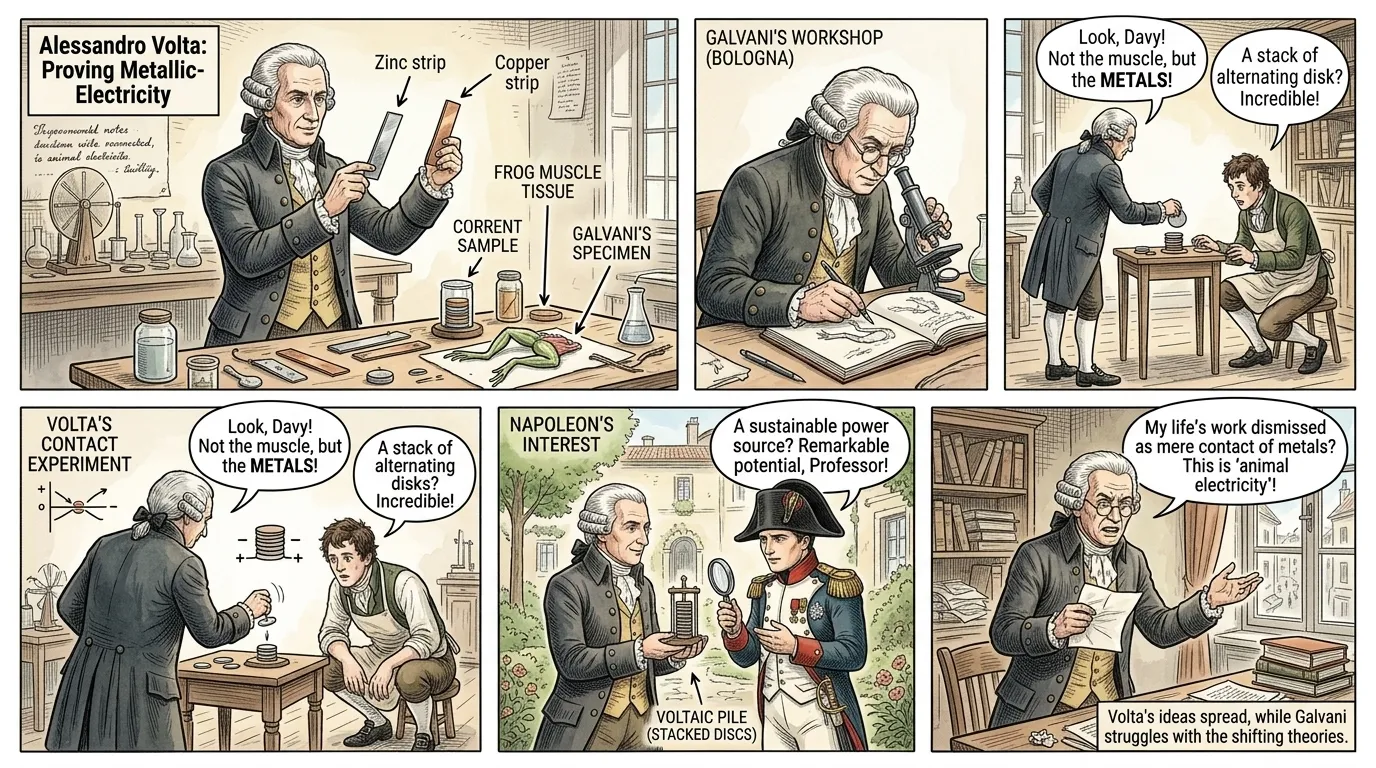
Among those intrigued by Galvani's work was Alessandro Volta, a professor of experimental physics in Pavia. While acknowledging the observed twitching, Volta remained skeptical of the 'animal electricity' hypothesis. He proposed an alternative theory: the electricity was not generated by the frog's muscles, but rather by the contact of the two dissimilar metals, which Galvani had used to touch the frog's leg. Volta believed the animal tissue merely acted as a sensitive detector or conductor. This fundamental disagreement spurred Volta to conduct his own meticulous experiments, systematically investigating the electrical properties of various metal pairs. He was determined to prove that inanimate materials could generate a sustained electric current, a radical departure from prevailing thought.
"Volta, adjusting a copper and zinc strip: "This phenomenon, Professor Galvani, arises not from 'animal fluid,' but from the inherent tension between these dissimilar metals.""
Page 5
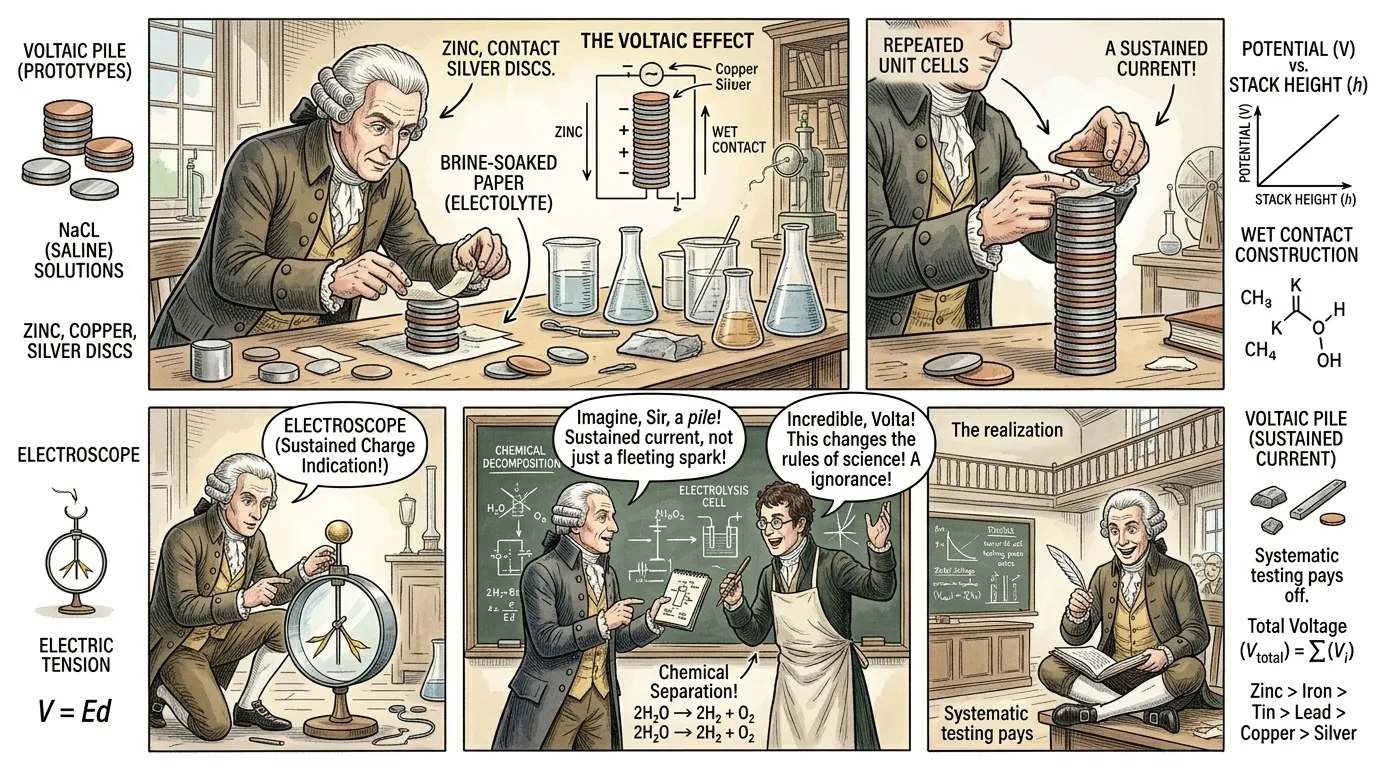
Volta's early experiments focused on proving the 'contact electricity' theory. He demonstrated that merely bringing two different metals into contact, then separating them, could generate a small electric charge detectable by an electroscope. Crucially, he discovered that inserting a moist substance, an electrolyte, between the metals dramatically enhanced and sustained this effect. This 'wet contact' was key. He systematically tested various combinations: zinc and silver, copper and iron, each paired with different saline solutions. These meticulous trials revealed that certain pairs of metals, particularly zinc and silver (or copper), produced the strongest and most consistent electrical tension, laying the groundwork for a truly revolutionary device. He began to envision a way to amplify this effect.
Page 6
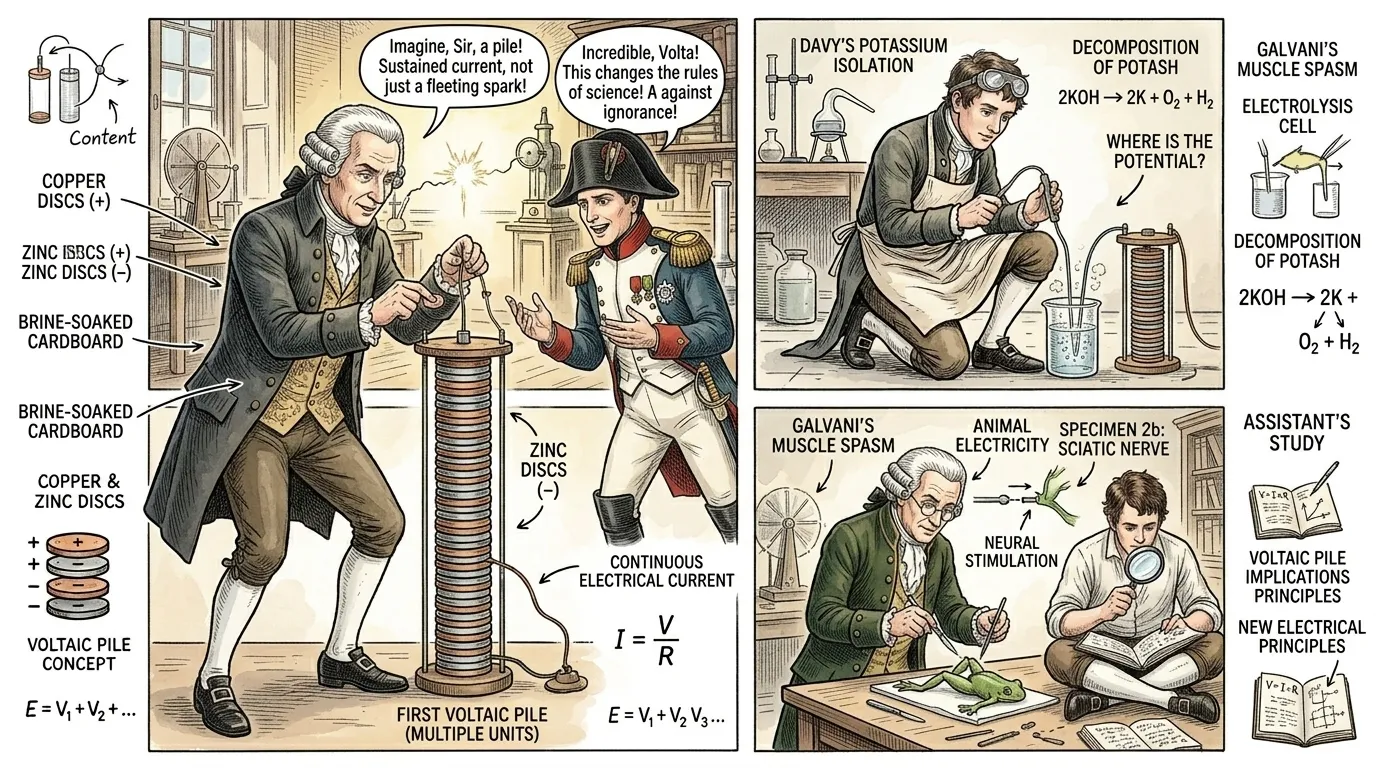
The breakthrough came with Volta's ingenious idea to stack these basic units of dissimilar metals and electrolyte. If one pair produced a small electrical effect, surely many pairs stacked together would amplify it. He arranged alternating discs of copper (or silver) and zinc, separated by pieces of cardboard or flannel soaked in saltwater or acid. This multi-layered column, known as the Voltaic Pile, effectively connected multiple small electrical 'cells' in series, multiplying their individual voltages. The top and bottom plates of this pile, when connected by a wire, produced a continuous and steady flow of electric current – the first true battery. It was a monumental achievement, capable of sustaining chemical reactions, generating heat, and even causing strong physiological effects.
Page 7
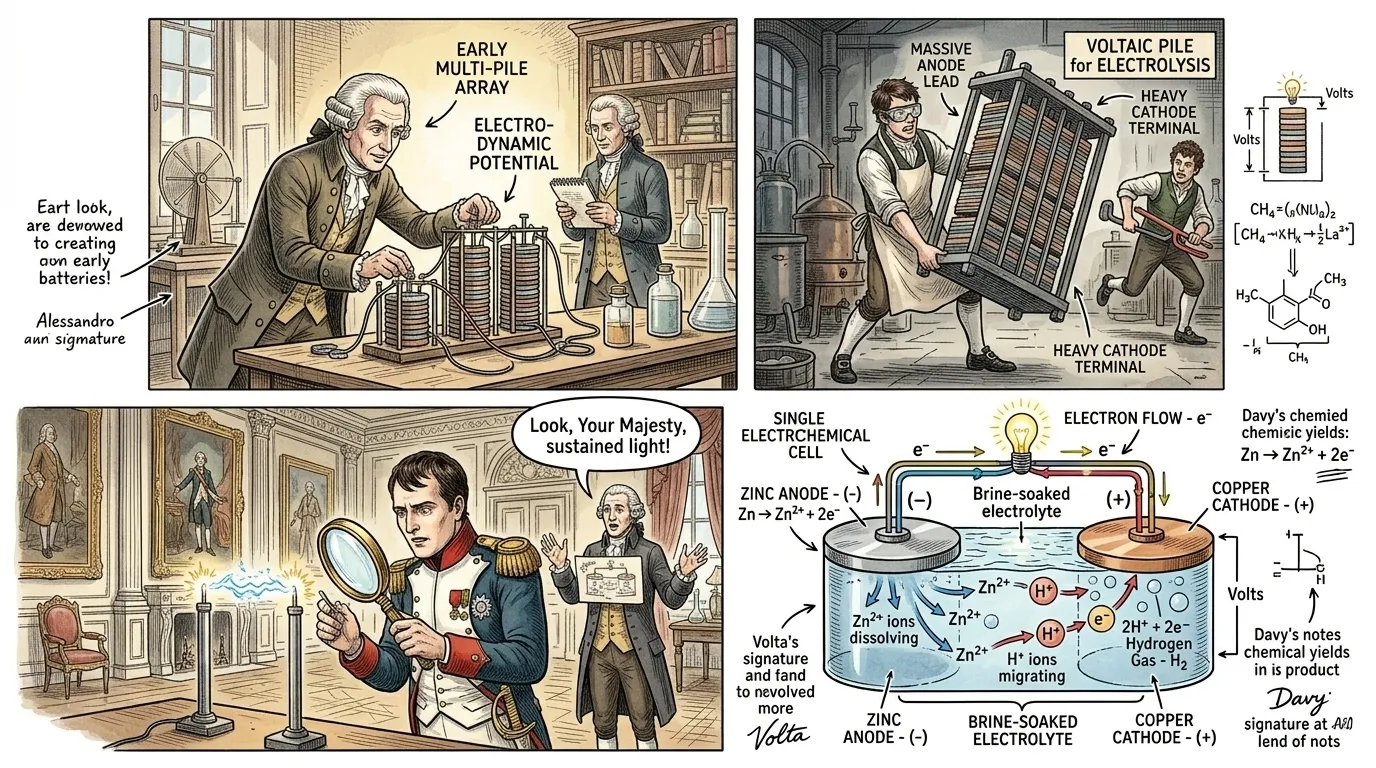
The Voltaic Pile's operation relies on a fundamental electrochemical process. At the zinc electrode (anode), zinc metal oxidizes, releasing electrons and forming zinc ions that dissolve into the electrolyte. These electrons travel through the external circuit to the copper electrode (cathode). At the copper electrode, positive hydrogen ions (from the water in the electrolyte) gain these electrons and become hydrogen gas. This transfer of electrons through the external circuit constitutes the electric current. Crucially, the electrolyte – the brine-soaked paper – allows ions to migrate, completing the internal circuit and maintaining electrical neutrality within each cell. This sustained chemical reaction at the metal-electrolyte interfaces drives the continuous flow of charge, creating a constant voltage difference.
Page 8
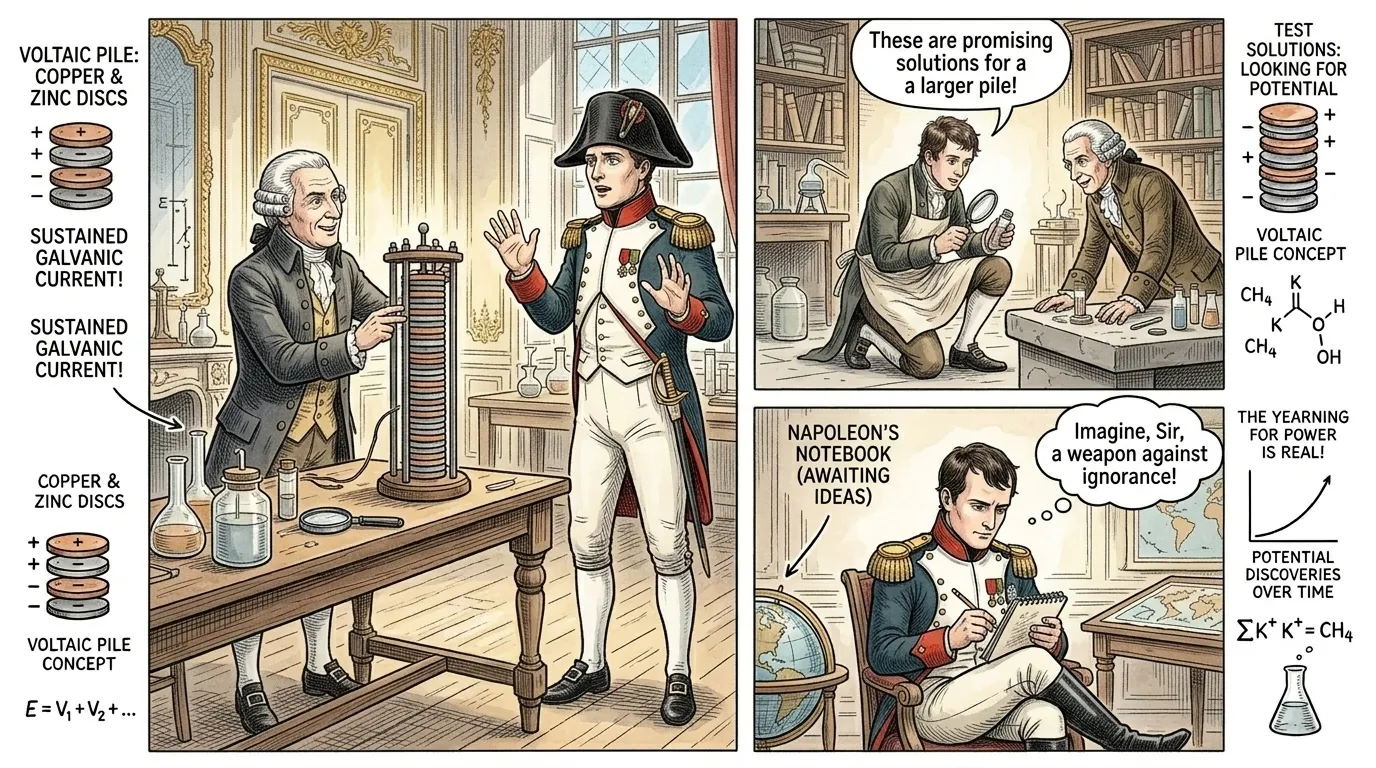
Volta's invention caused an immediate sensation. In 1800, he formally announced his discovery to the Royal Society of London and, shortly thereafter, personally demonstrated the Voltaic Pile to Napoleon Bonaparte in Paris. Napoleon, fascinated by the device's power, immediately recognized its significance and became a staunch patron of Volta's work, even awarding him a medal and a pension. The simplicity and effectiveness of the pile meant it could be easily replicated. Scientists across Europe rapidly constructed their own piles, embarking on a new era of experimentation with sustained electrical currents. Suddenly, the ability to generate a powerful, controllable flow of electricity was within reach of any serious researcher, transforming laboratories overnight.
"Napoleon, gesturing towards the Voltaic Pile with a look of awe: "This is indeed a marvel, Professor Volta! A power that will revolutionize the age!""
Page 9
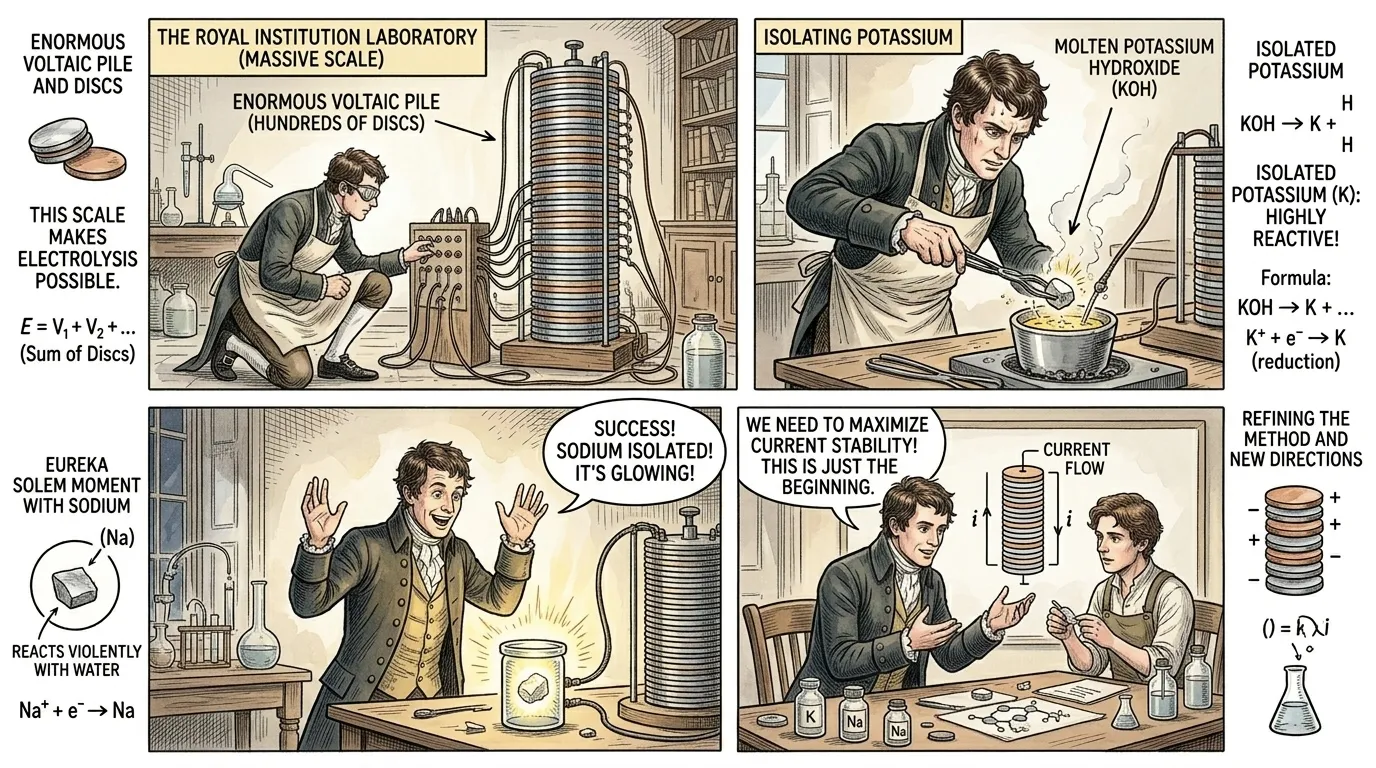
The availability of continuous electric current from the Voltaic Pile rapidly catalyzed a cascade of new scientific discoveries and technological applications. Humphrey Davy famously used a massive Voltaic Pile at the Royal Institution in London to perform electrolysis on molten salts, leading to the isolation of elemental sodium and potassium – substances previously unknown. Other chemists soon isolated magnesium, calcium, and boron, fundamentally expanding the periodic table. The steady current also allowed for more precise measurements and a deeper understanding of electricity's relationship with magnetism. Early attempts at telegraphy and electroplating also emerged, laying crucial groundwork for future innovations. The battery had not just provided power; it had opened a new universe of scientific exploration.
Page 10
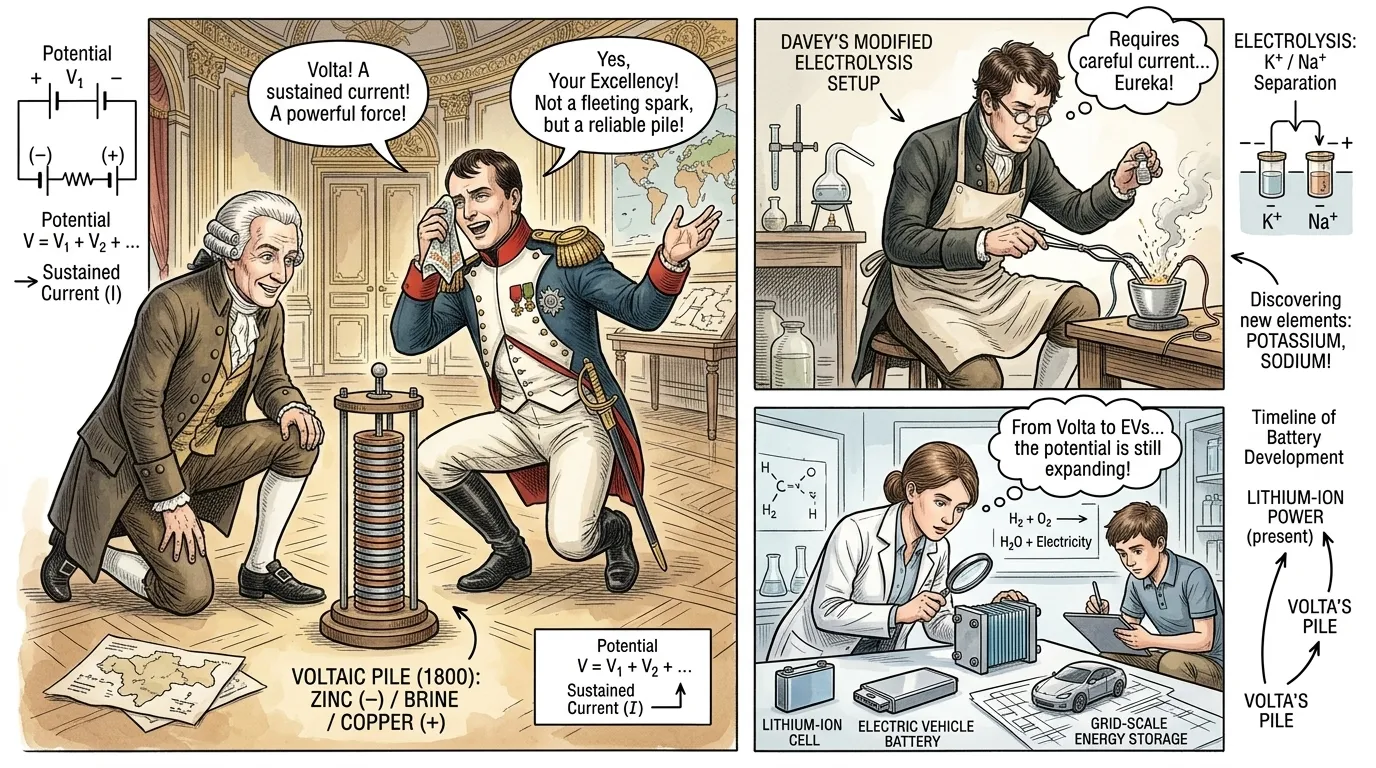
Alessandro Volta's invention, the Voltaic Pile, stands as one of the most transformative breakthroughs in human history. While its original form was cumbersome and limited, it ignited the relentless pursuit of improved battery technologies. From the Daniell cell to the Leclanché cell, the lead-acid battery for automobiles, and the ubiquitous lithium-ion batteries powering our modern world, the fundamental principle of converting chemical energy into electrical energy has endured. Today, batteries are indispensable: enabling portable computing and communication, driving electric vehicles, storing renewable energy on power grids, and powering countless medical devices and industrial systems. Volta's initial stack of metal and brine was far more than a scientific curiosity; it was the birth of portable power, a cornerstone of the digital age, and a testament to sustained scientific inquiry.
About this story
- Location: Global
- Audience: general readers
Questions and answers
Read Wonder Inventions on your phone
Wonder Inventions is available on Android. Get Wonder Inventions on Google Play.