Barcode
Barcode — an illustrated inventions story, set in Global. 10 illustrated pages, free to read on Wonder Inventions.
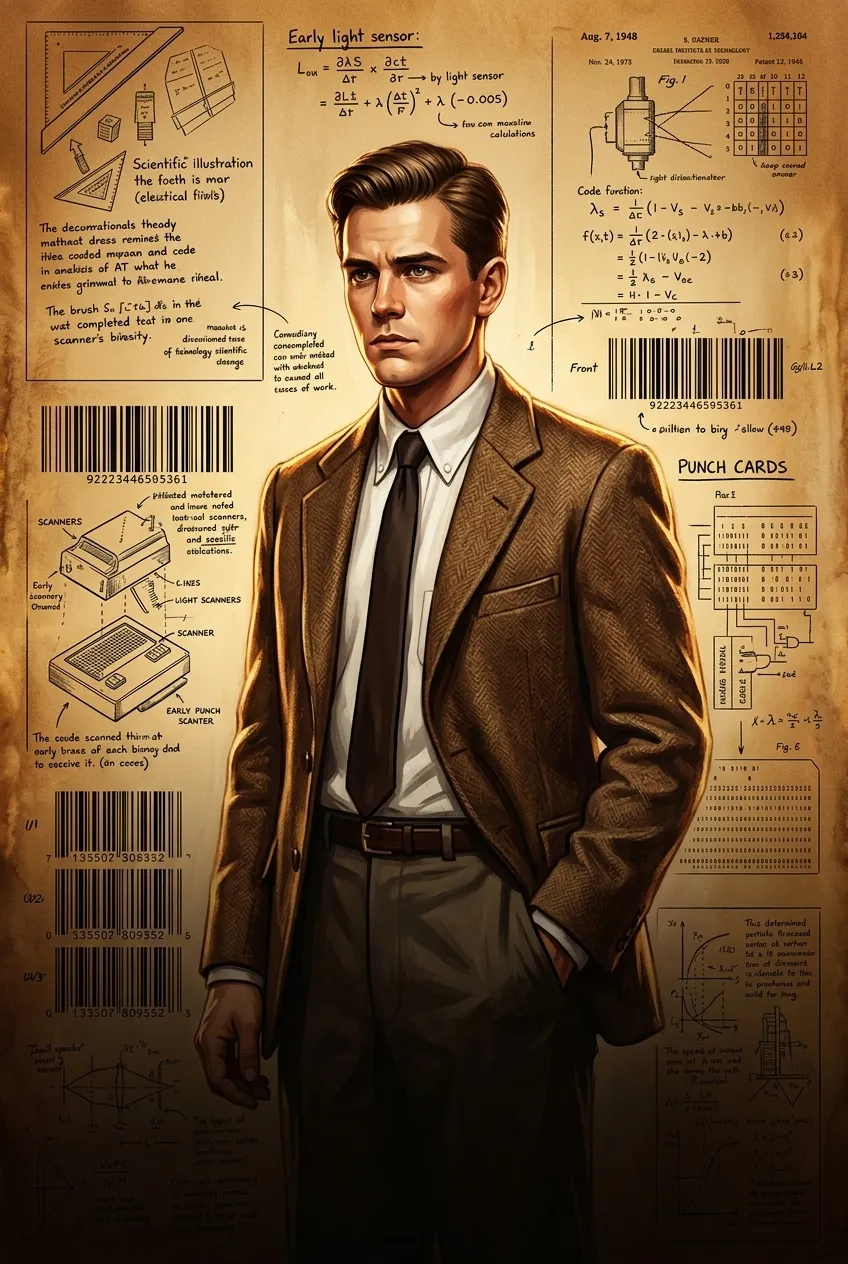
Page 1
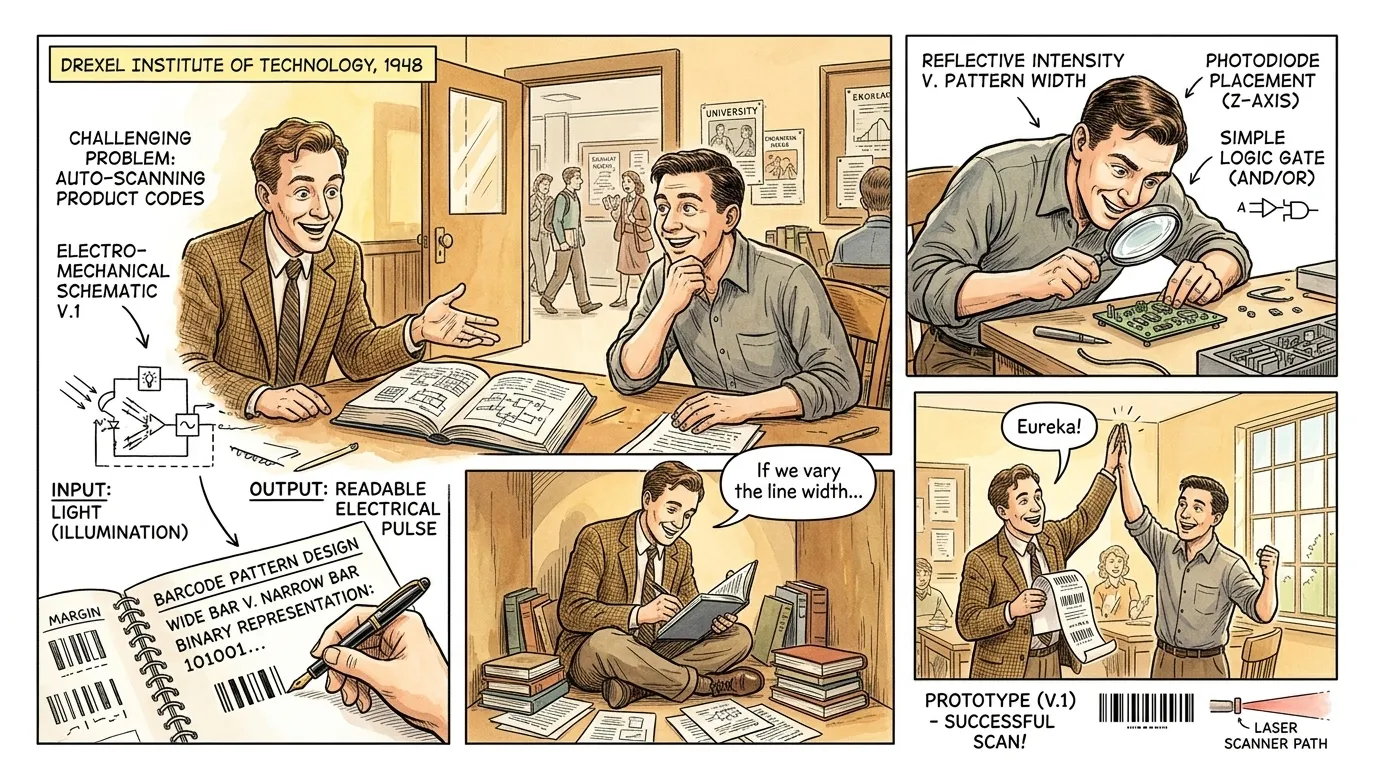
Before the Barcode, the retail world was a realm of manual inefficiency. Every item, from a loaf of bread to a can of soup, required human intervention at the point of sale, a bottleneck of remarkable scale. This fundamental challenge, the rapid and accurate identification of products, spurred two visionary minds to seek a revolutionary solution.
"At the Drexel Institute of Technology in Philadelphia, 1948, graduate student Bernard Silver overheard a crucial conversation. "The president of a major food chain," Silver explained to his friend Norman Joseph Woodland, "asked our dean if the institute could develop a method to automatically read product data during checkout." Woodland listened intently, understanding the immense scope of such a problem."
Page 2
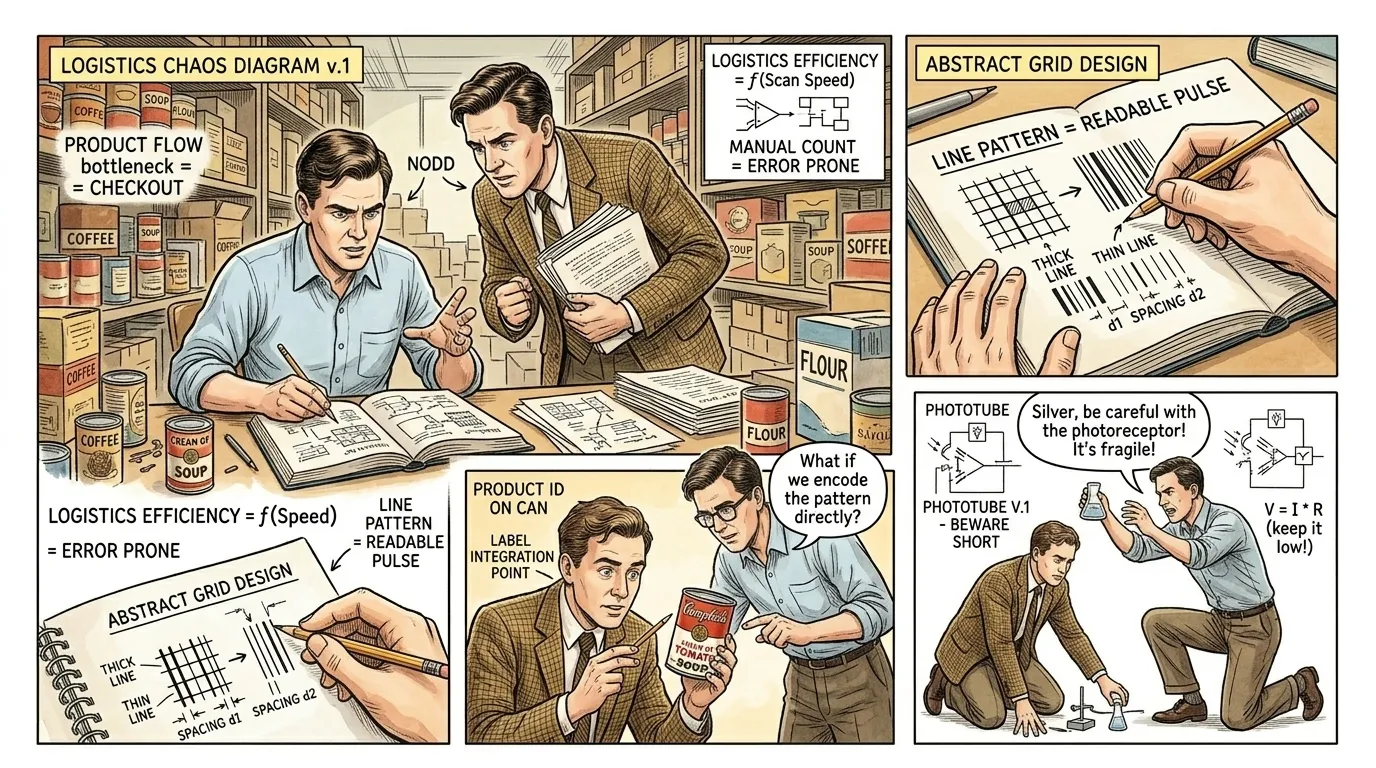
Beyond the slow checkout, a more insidious inefficiency plagued the burgeoning post-war consumer economy: inventory management. Manufacturers struggled to track stock, while retailers grappled with inconsistent pricing and labor-intensive restocking. Each item required manual counting, manual reordering, and manual repricing during sales, leading to substantial waste and lost revenue.
""Imagine the sheer volume," Woodland remarked, sketching diagrams in his notebook, "tens of thousands of unique items in a single store, each needing individual attention. Manual systems are simply unsustainable as commerce scales." Silver nodded, "The current approach is a constant battle against human error and sheer physical effort. We need a system that speaks directly to machines.""
Page 3
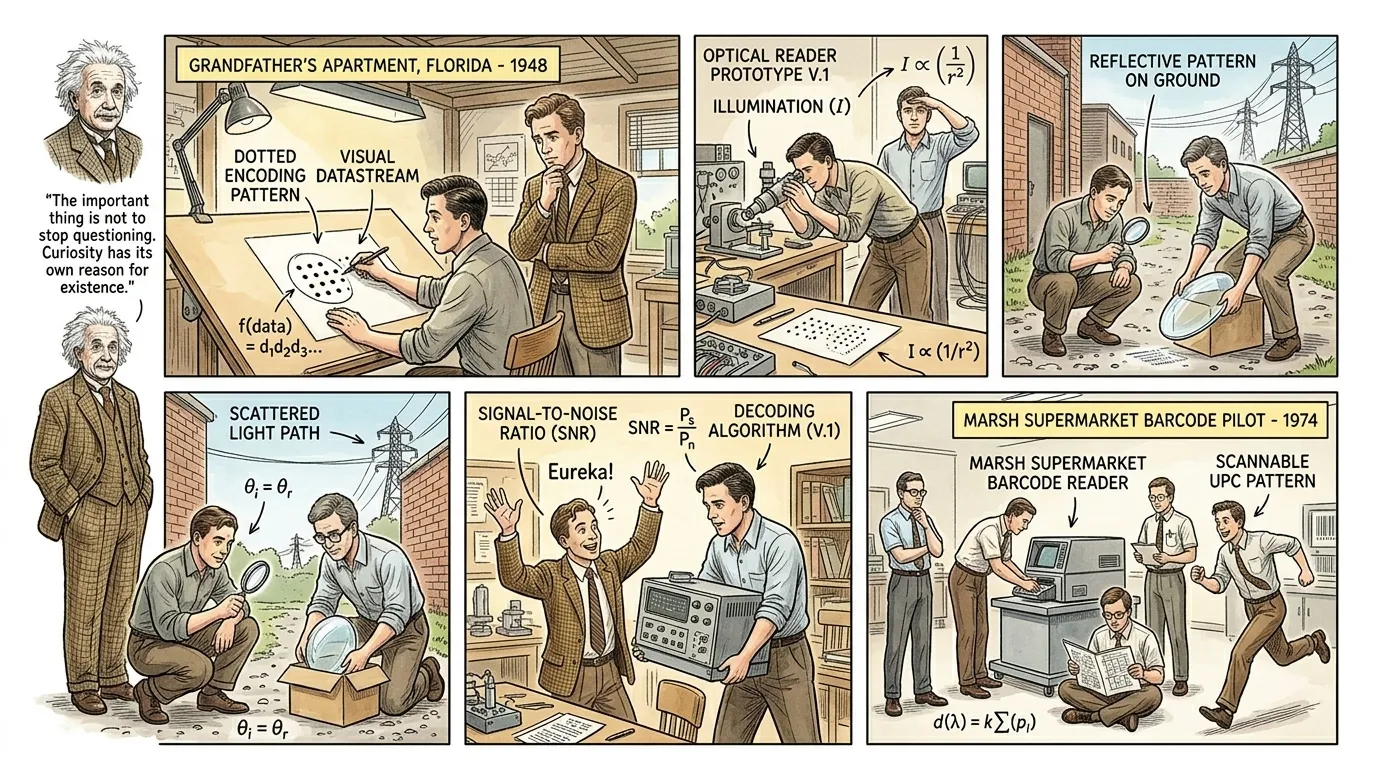
The challenge was multifaceted: how to encode data onto a product in a machine-readable format that was robust, inexpensive, and easily manufactured. Early attempts at optical character recognition (OCR) were slow, prone to error, and lacked the density for complex product identification. The solution needed an entirely new approach to visual data encoding.
"Woodland stared at the paper. "We considered fluorescent inks, even magnetic patterns, but the cost and complexity were prohibitive for mass adoption," he explained, circling a simple drawing of a dotted pattern. "The core problem, Bernard, is creating a visually distinct pattern that a simple scanner can interpret reliably, even with smudges or imperfect printing." Silver pondered, "We need a code that is as resilient as the information it carries. As Albert Einstein once noted, 'The important thing is not to stop questioning. Curiosity has its own reason for existence.'""
Page 4
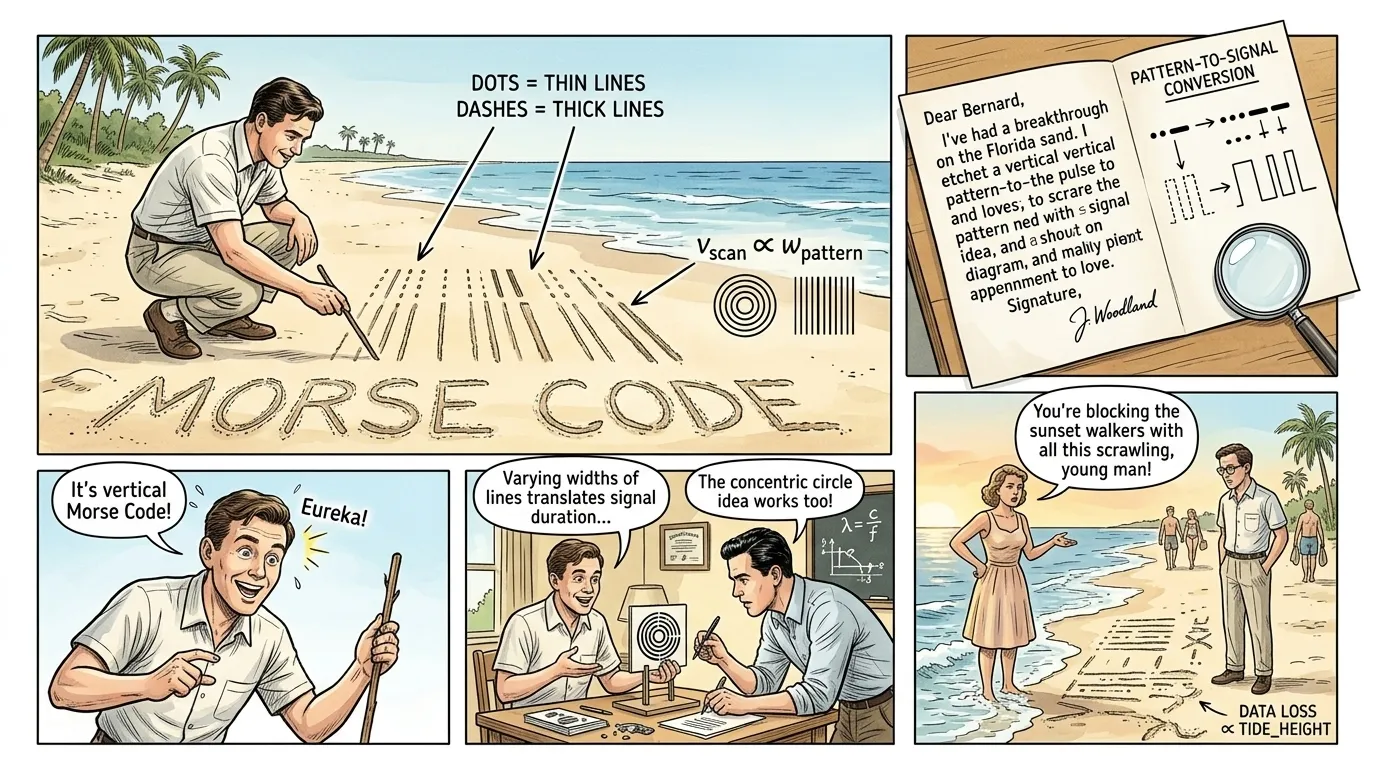
The breakthrough began with Norman Joseph Woodland's unique background. A former Boy Scout who knew Morse code and possessed a profound understanding of electrical engineering, he was uniquely positioned to bridge the gap between abstract information and physical patterns. Dissatisfied with conventional solutions, Woodland left Drexel and moved to his grandfather's apartment in Florida, seeking an undisturbed environment for reflection.
""I needed to step away from the noise, to truly think," Woodland recounted to Bernard Silver in a letter, a copy visible on a table. "I found myself on the beach, drawing patterns in the sand. It suddenly clicked: Morse code, but extended vertically. Dots and dashes become thin and thick lines." He continued, "What if the information isn't just about presence or absence, but about width ratios?""
Page 5
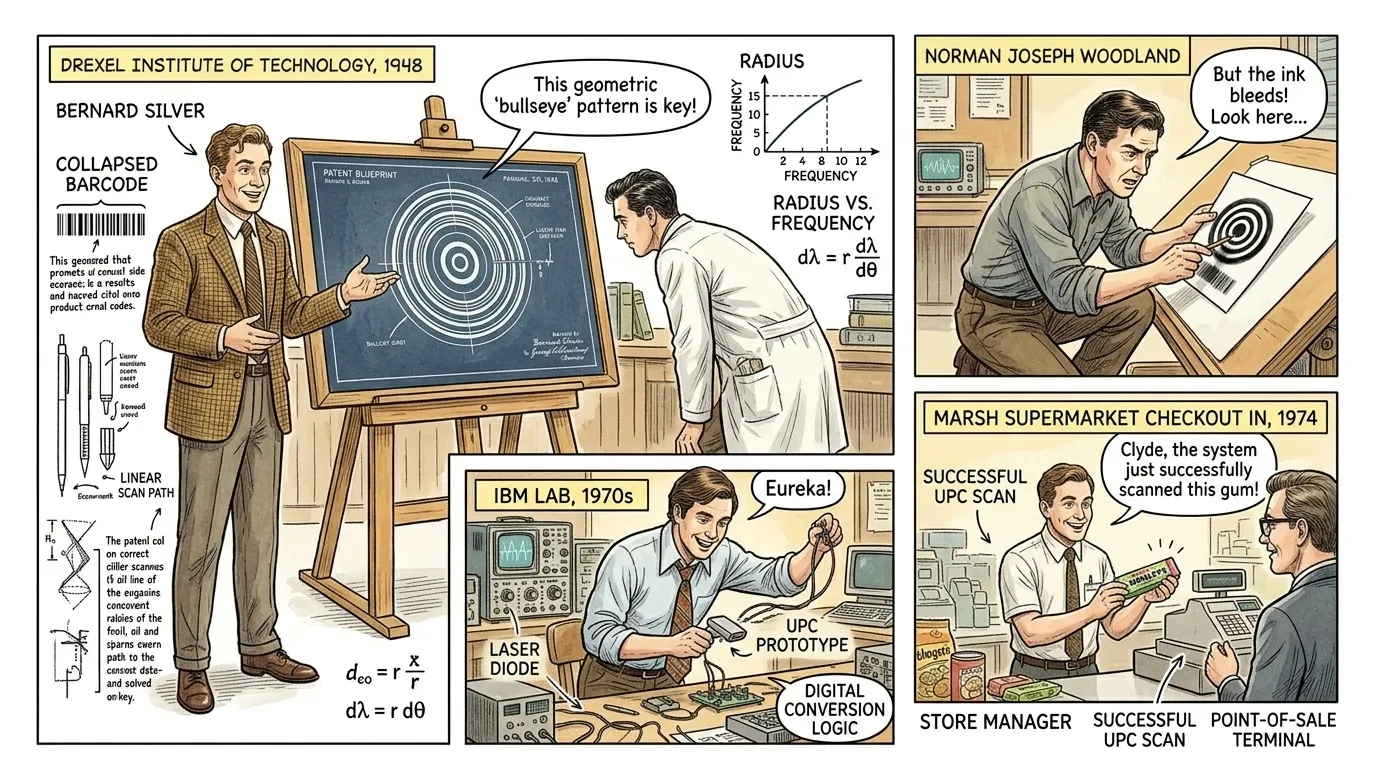
Woodland's initial design, patented with Bernard Silver in 1952, was a 'bullseye' pattern of concentric circles. This radial approach was ingenious, allowing omnidirectional scanning regardless of orientation. However, printing technology of the era struggled to consistently produce dense, clean circles, and ink bleed proved a significant hurdle, compromising data integrity.
""The concentric circles were elegant, mathematically sound," Silver explained to a colleague, gesturing to a patent drawing. "A photoelectric cell could sweep through it, distinguishing the dark rings from the light spaces, but manufacturing proved difficult. Ink tends to feather outwards, especially with high-speed printing." Woodland, now back in Philadelphia, added, "We needed something more robust, something that could withstand imperfect reproduction and still be read accurately.""
Page 6
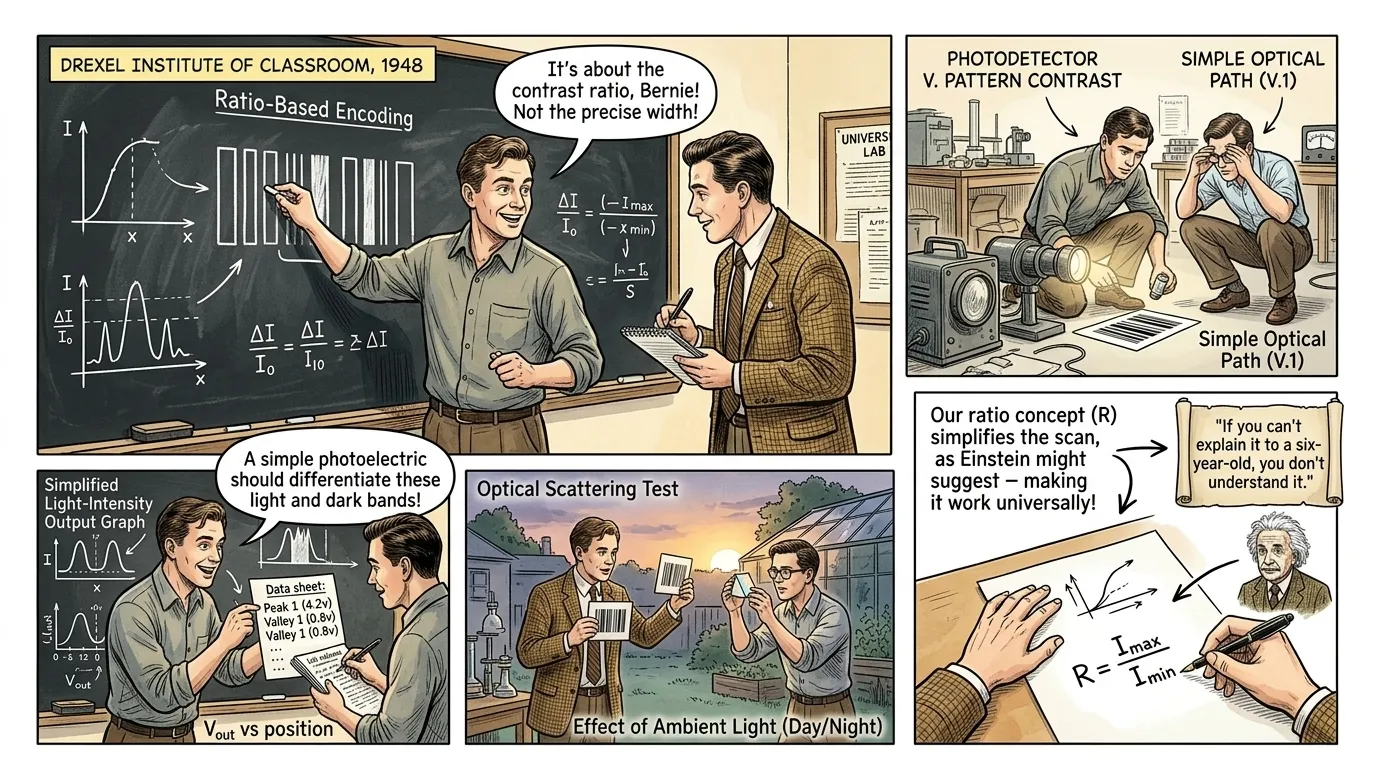
The limitations of the bullseye design led Woodland back to his original linear inspiration. He realized that if the code's 'dots and dashes' were simply elongated vertically, a scanner could still interpret them even if the item was slightly rotated. The true innovation lay in encoding information not by the absolute width of a line, but by the ratio of the widths of adjacent lines and spaces. This relative measurement was far more tolerant of printing imperfections.
""It's about the contrast, not the absolute size," Woodland clarified, gesturing with a chalk stick on a blackboard. "A wide bar followed by a narrow space, or vice-versa. That ratio is the data. It's stable, even if the ink spreads slightly." Silver added, "This relative measurement makes the system resilient. A scanner, equipped with a simple photoelectric tube, could differentiate these patterns by measuring reflected light intensities.""
Page 7
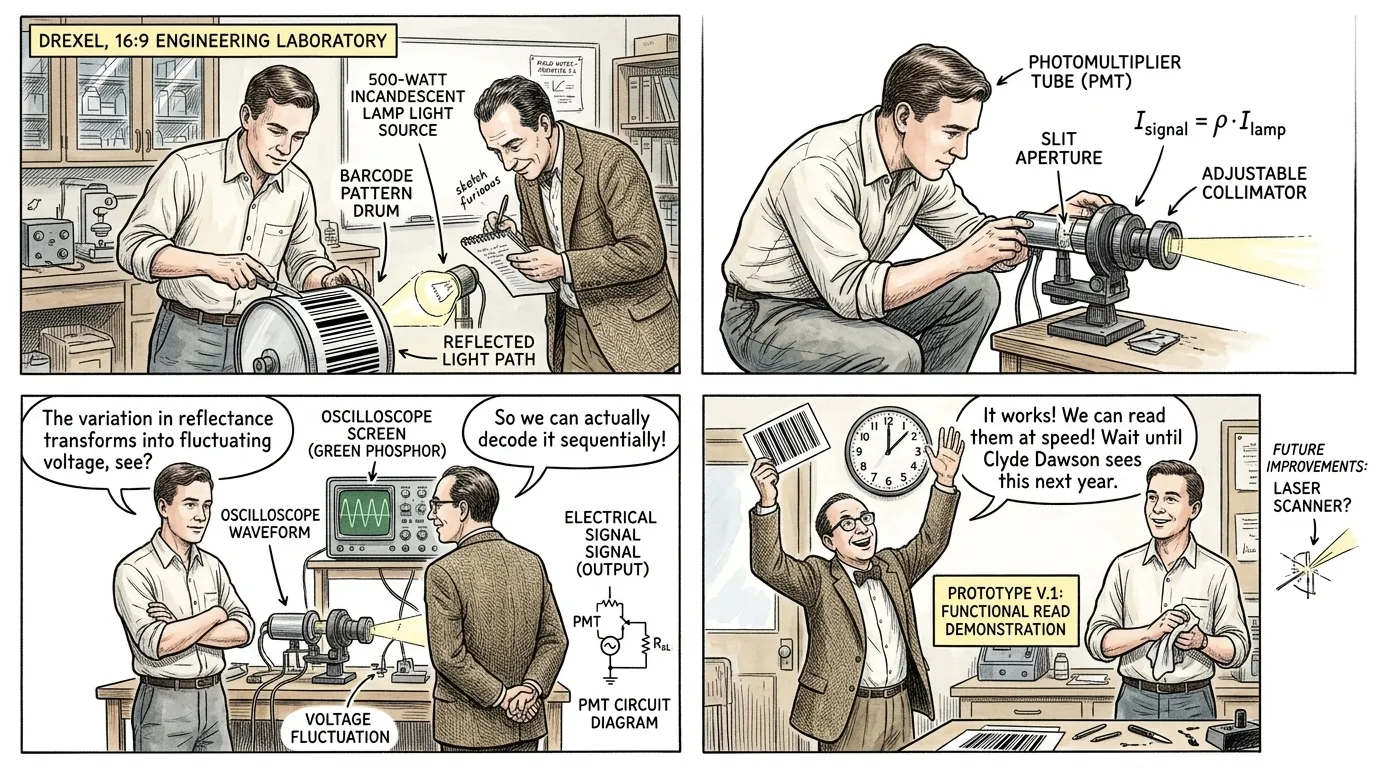
With the linear code concept refined, Woodland and Silver constructed a rudimentary prototype. It involved a 500-watt incandescent lamp as a light source, shining through a printed barcode onto a photomultiplier tube. As the barcode was moved under the light, the tube registered changes in reflected light, converting the black and white patterns into electrical signals. These signals, representing the encoded ratios, could then be translated back into numerical data.
""The light source hits the pattern," Woodland described, demonstrating with the device, "and the photomultiplier tube captures the variations in reflected light, converting them into a fluctuating current." Silver watched the oscilloscope connected to the prototype. "Each change from dark to light, and the duration of each phase, creates a unique electrical signature. It's rudimentary, but it works – it's a direct translation from visual pattern to digital information.""
Page 8
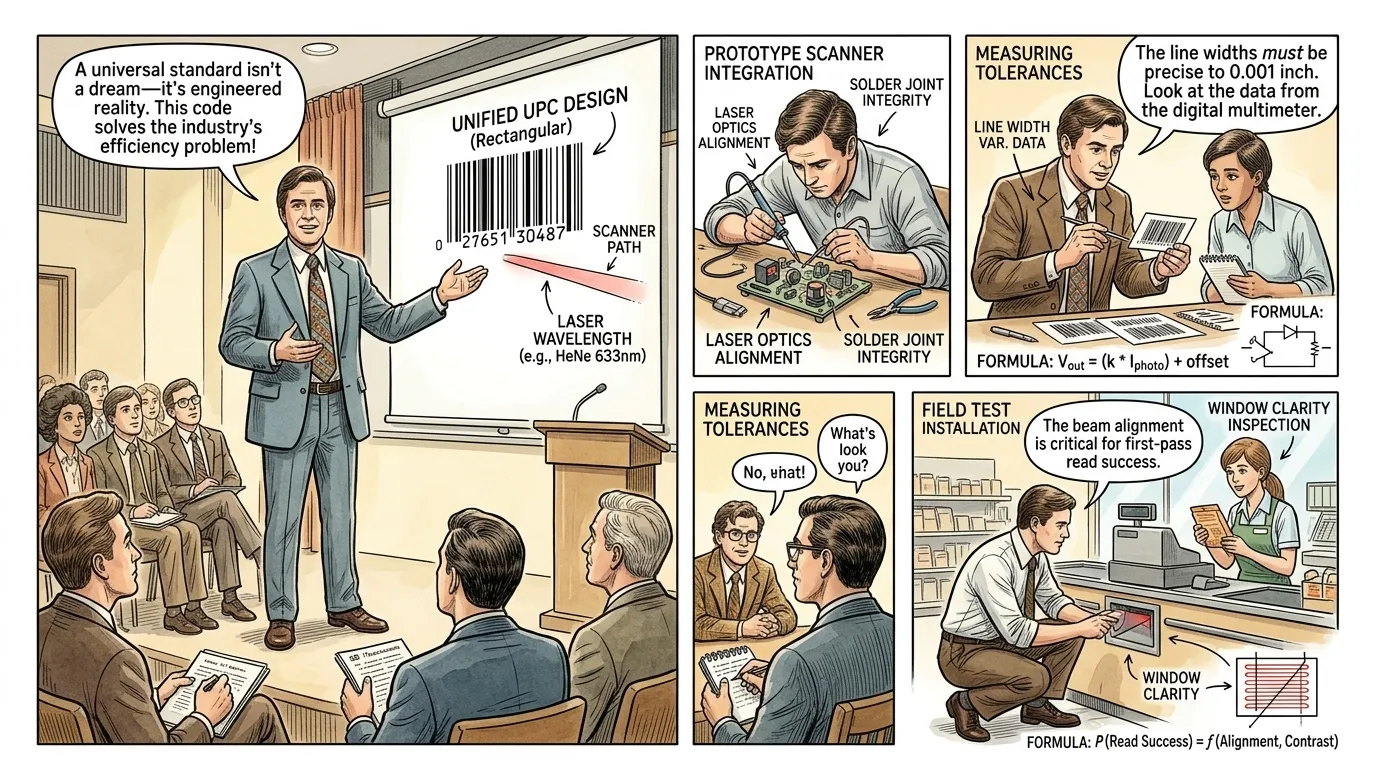
Despite the 1952 patent, the barcode remained largely dormant for two decades. The technology was ahead of its time; scanners were expensive, and a universal standard was desperately needed. The grocery industry, facing immense pressure to automate, formed a committee in 1970 to find a unified solution. This led to IBM engineer George Laurer's pivotal involvement.
""The lack of a standardized code was the major impediment," George Laurer stated during a 1973 presentation, gesturing to an early UPC symbol. "Manufacturers needed assurance that their product could be read everywhere, and retailers needed common equipment. My team at IBM realized that a fixed-ratio, self-checking linear code, printed cheaply, was the answer." He continued, "We took Woodland's fundamental idea and engineered it for mass production and universal adoption, specifically for the grocery industry.""
Page 9
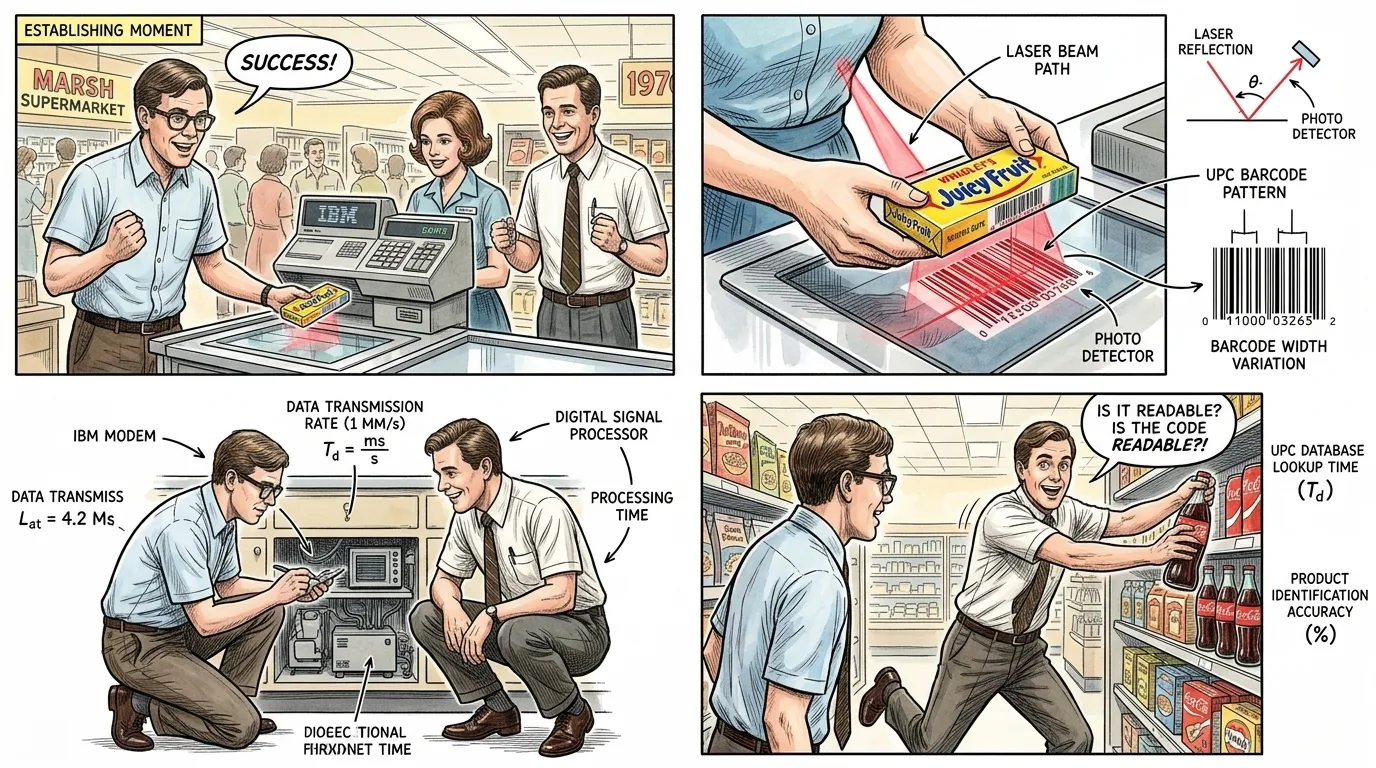
On June 26, 1974, at Marsh Supermarket in Troy, Ohio, a pack of Wrigley's Juicy Fruit chewing gum became the first item ever scanned by a UPC barcode in a commercial transaction. This seemingly mundane event marked a seismic shift in retail, initiating an era of unprecedented efficiency, accuracy, and data collection. The vision of Woodland and Silver, refined by Laurer, was finally realized.
""This is it," Clyde Dawson, director of R&D at Marsh, exclaimed as the gum pack registered instantly on the IBM scanner. "The years of planning, the standardization efforts—it's all paid off. No more manual entry, no more price-sticker errors." A store manager, beaming, added, "Think of the time saved, the inventory accuracy! This will fundamentally change how we operate, how we understand our sales data.""
Page 10
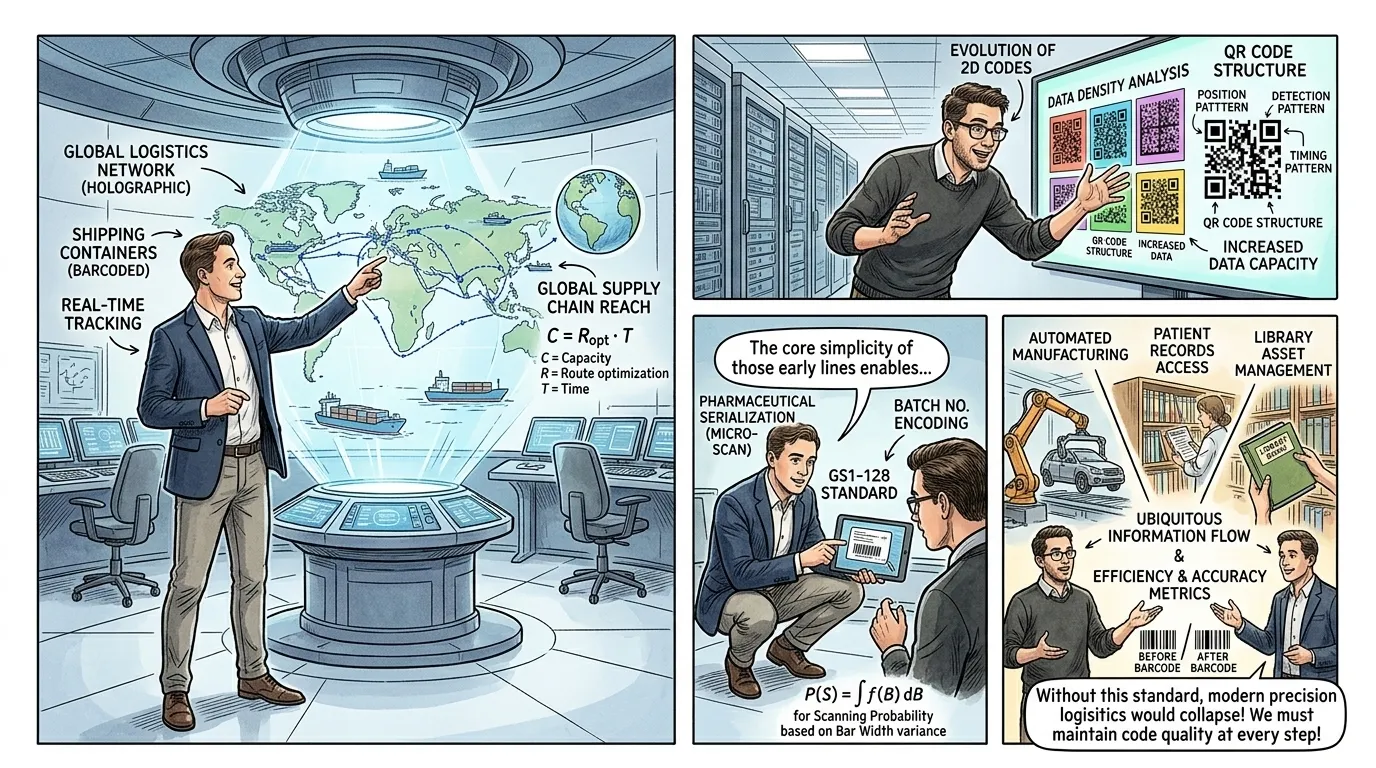
The barcode's impact extends far beyond the grocery store. It transformed global logistics, manufacturing, healthcare, and countless other sectors. From tracking parcels across continents to managing patient records, the simple pattern of lines became the backbone of modern information flow. Its evolution into two-dimensional codes like QR codes further expanded its capabilities, continuing its silent revolution in data management.
""The barcode democratized data," a supply chain expert observed in a recent interview, pointing to a diagram of global shipping routes. "It gave every single product a unique, machine-readable identity, enabling granular tracking and unprecedented efficiency." Another data scientist added, "From its humble beginnings, inspired by Morse code in the sand, it became the ubiquitous language that underpins our global economy, a testament to the power of simple, elegant solutions to complex problems.""
About this story
- Location: Global
- Audience: general readers
Questions and answers
Read Wonder Inventions on your phone
Wonder Inventions is available on Android. Get Wonder Inventions on Google Play.