Broadcast Radio
Broadcast Radio — an illustrated inventions story, set in Global. 10 illustrated pages, free to read on Wonder Inventions.
Page 1
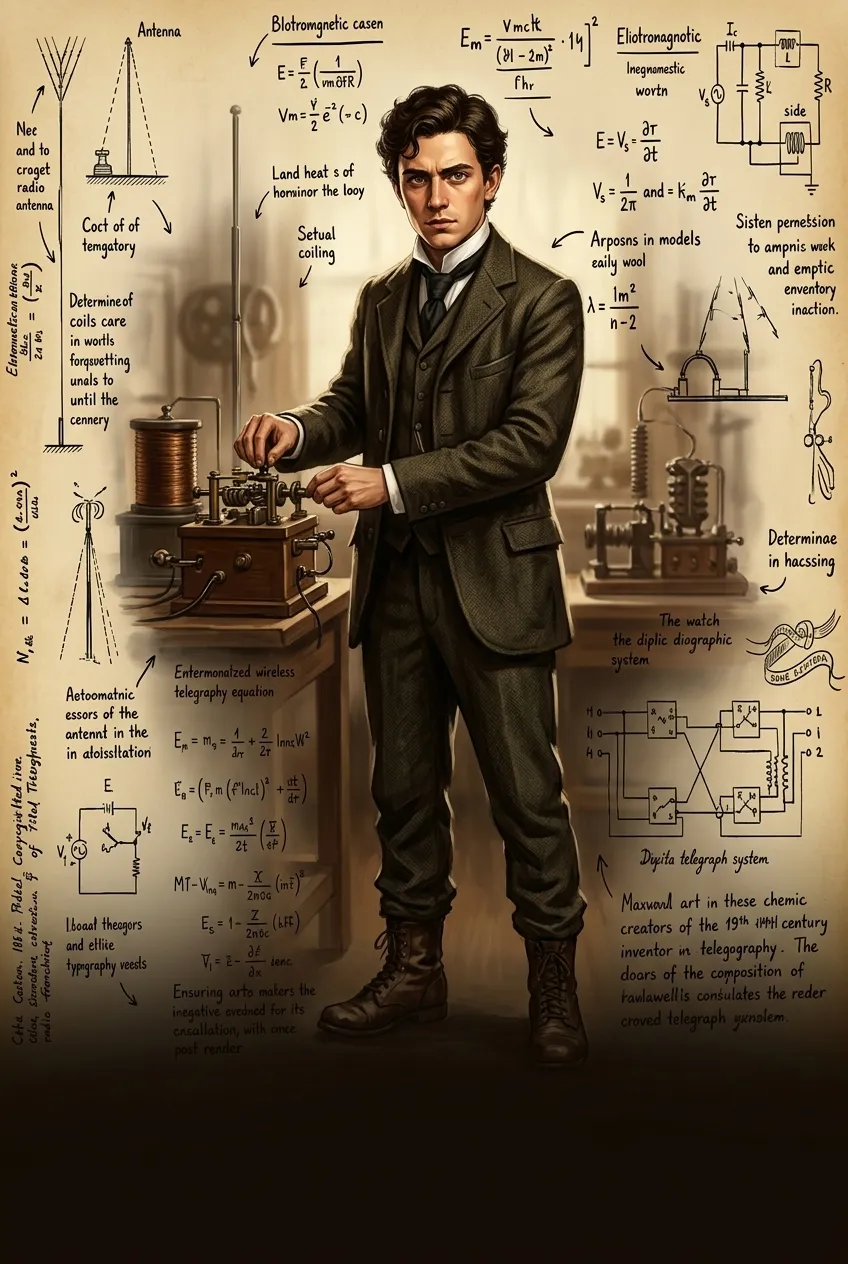
Before the advent of broadcast radio, humanity faced an immense barrier: how to communicate instantaneously across vast, unbridged distances without physical wires. Messages were bound by geography, limited to the speed of couriers, ships, or the finite reach of telegraph cables. The oceans, in particular, remained silent voids, isolating vessels and leaving coastal communities uninformed of distant events.
"'The very essence of electrical science lies in its ability to transmit intelligence through space, and not merely by wires,' Guglielmo Marconi often remarked, reflecting on the audacious challenge he pursued in his early experiments. 'Imagine a world where thoughts travel unseen, faster than any messenger.'"
Page 2
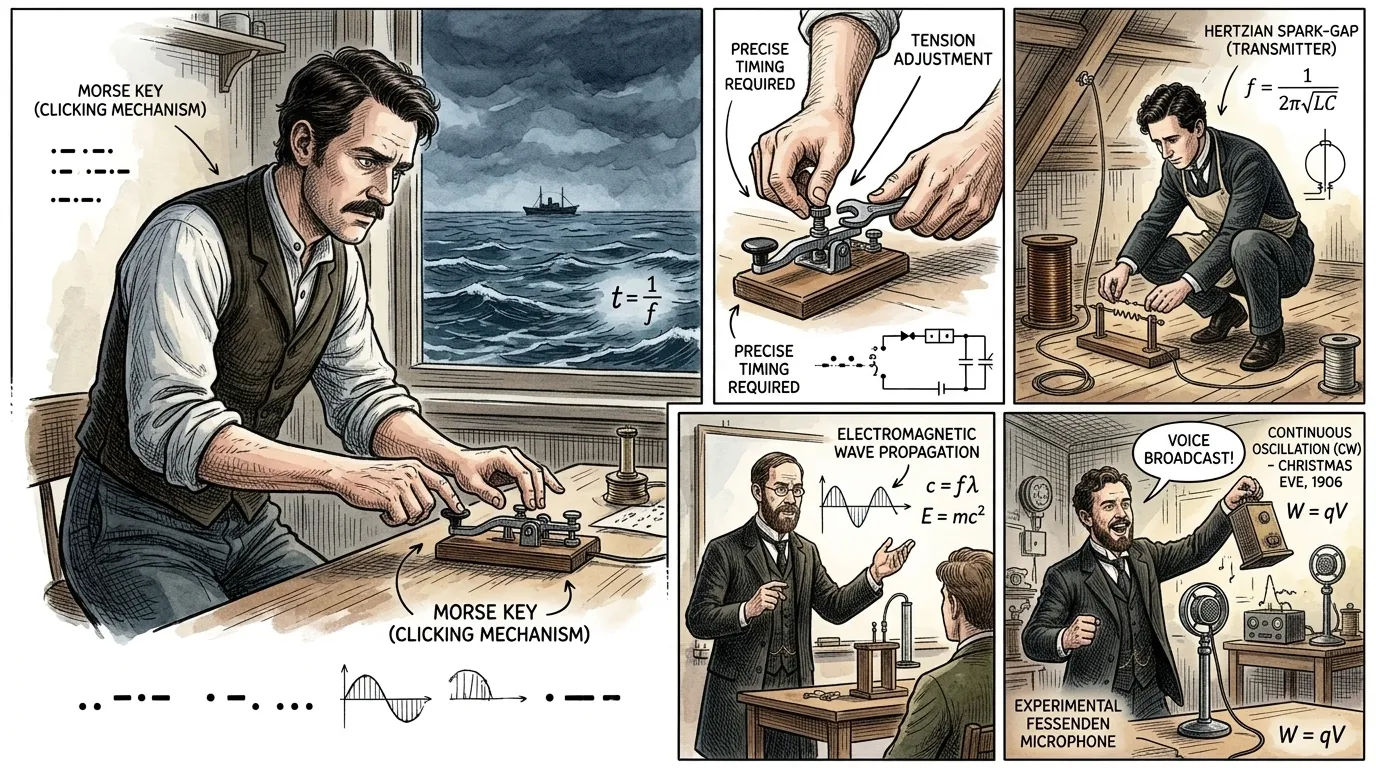
In the late 19th century, the telegraph reigned supreme for rapid communication. Submarine cables stretched across oceans, connecting continents, but these colossal undertakings were immensely expensive, vulnerable to damage, and required immense infrastructure. Remote islands, mountainous regions, and, crucially, ships at sea remained cut off, their isolation a stark reminder of communication's physical limits.
"A seasoned telegraph operator, his fingers dancing across the Morse key, once lamented, 'We send our dots and dashes faster than thought, yet the moment a cable snaps, or a storm rages too far from shore, silence descends. 'What good is instantaneous news,' he asked, 'if half the world cannot receive it?'"
Page 3
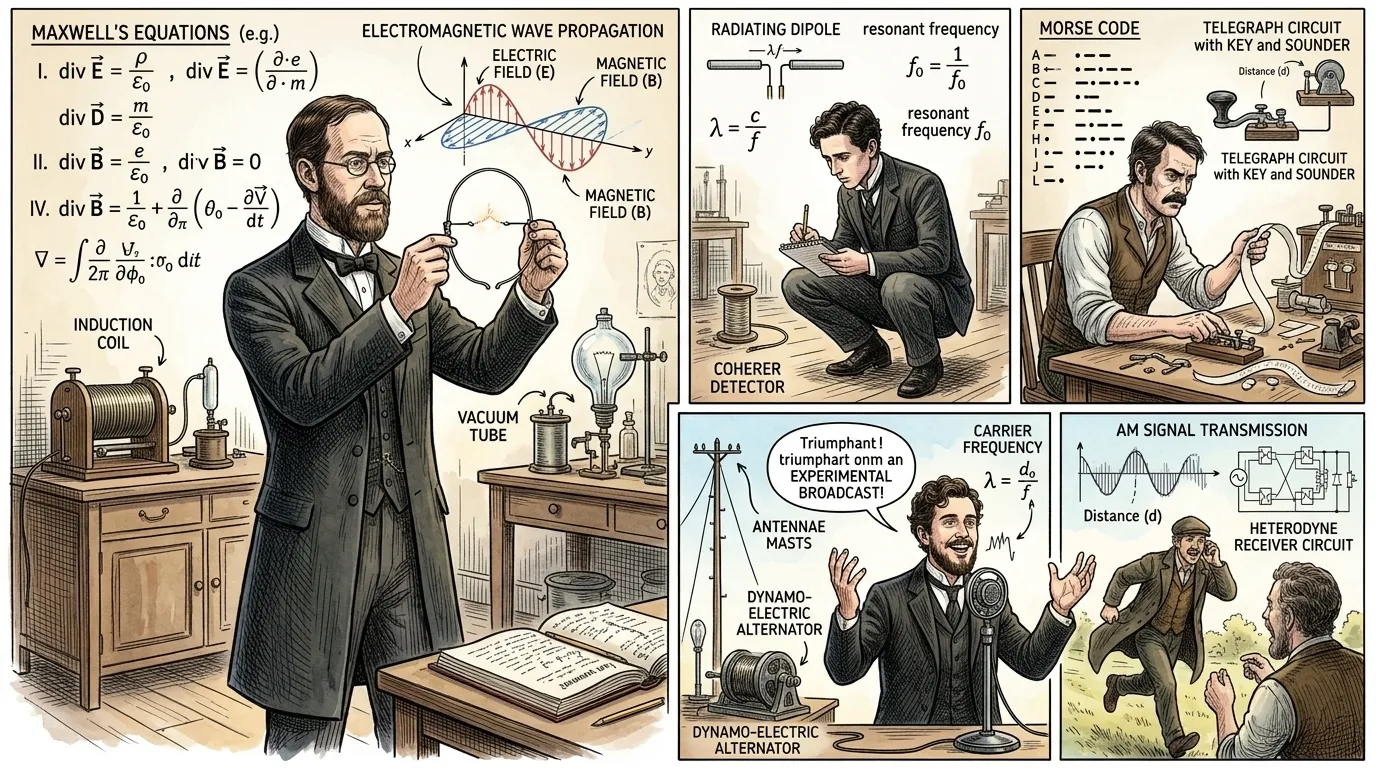
The invisible realm of electromagnetic waves was not entirely unknown. Decades before Marconi, Scottish physicist James Clerk Maxwell published his groundbreaking equations in the 1860s, mathematically predicting the existence of such waves, theorizing they traveled at the speed of light. Yet, these remained abstract concepts until experimental proof emerged.
"Heinrich Hertz, a German physicist, reflecting on his 1887 experiments, declared, 'It is indeed a strange feeling to realize that these predicted waves, which I now demonstrate in my laboratory, are of the same nature as light itself, only differing in wavelength.' He carefully explained to his colleagues, 'By creating an oscillating electric spark, we generate these electromagnetic disturbances, which then propagate through space. We detect them with a simple loop and spark gap, showing the principles of resonance at work.'"
Page 4
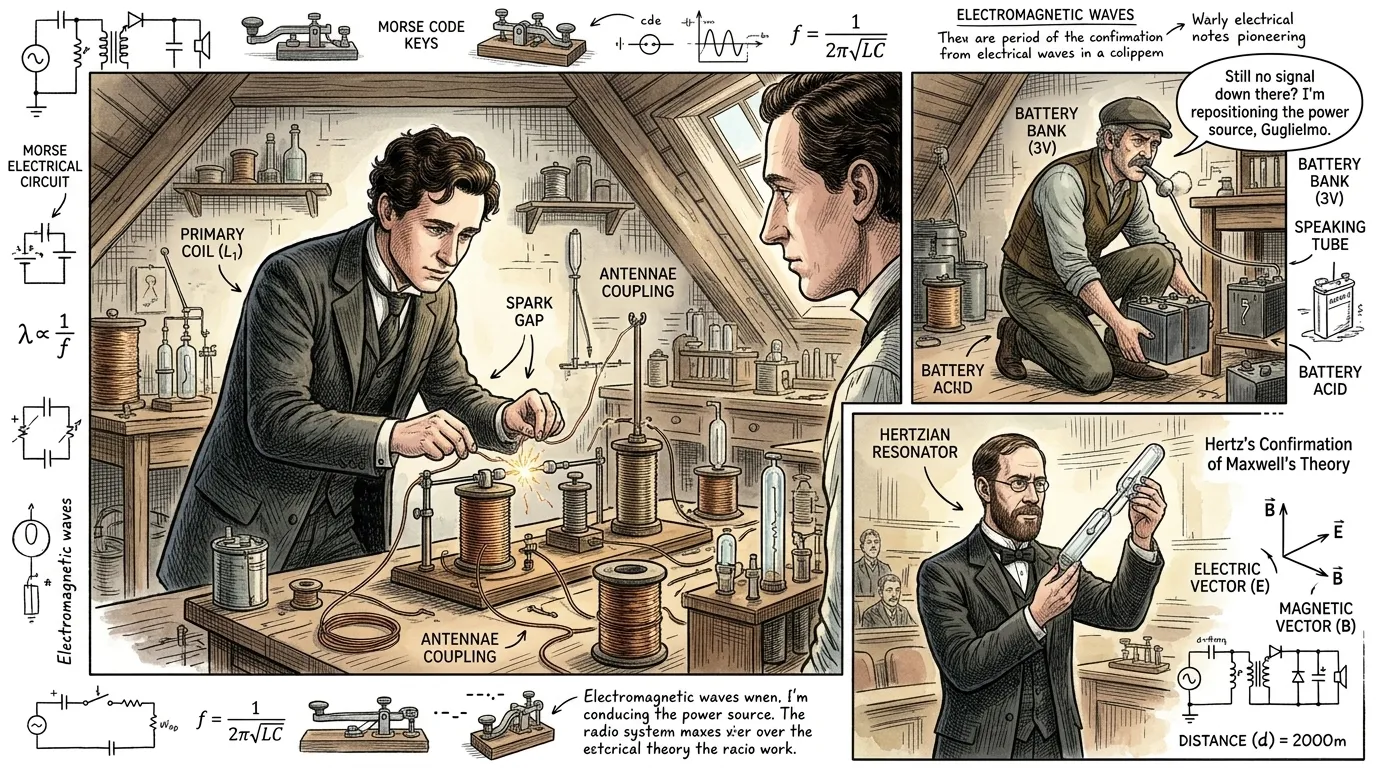
Inspired by Hertz's findings, the young Guglielmo Marconi, armed with an innate practicality and relentless drive, saw beyond the laboratory curiosities. His vision was not merely to demonstrate waves but to use them for practical communication. In his family's attic and later on the estate, he began his audacious experiments, transforming theoretical physics into tangible technology.
"Marconi, often working alone in his attic, meticulously adjusted his apparatus. 'The challenge isn't merely to produce a spark,' he murmured to himself, 'but to make the energy radiate efficiently and detect it reliably over increasing distances.' He struggled with early, weak signals. 'Many doubted the practicality of 'wireless telegraphy.' They thought the waves would simply diffuse into nothingness, but I held to the conviction that they could be directed and received.'"
Page 5
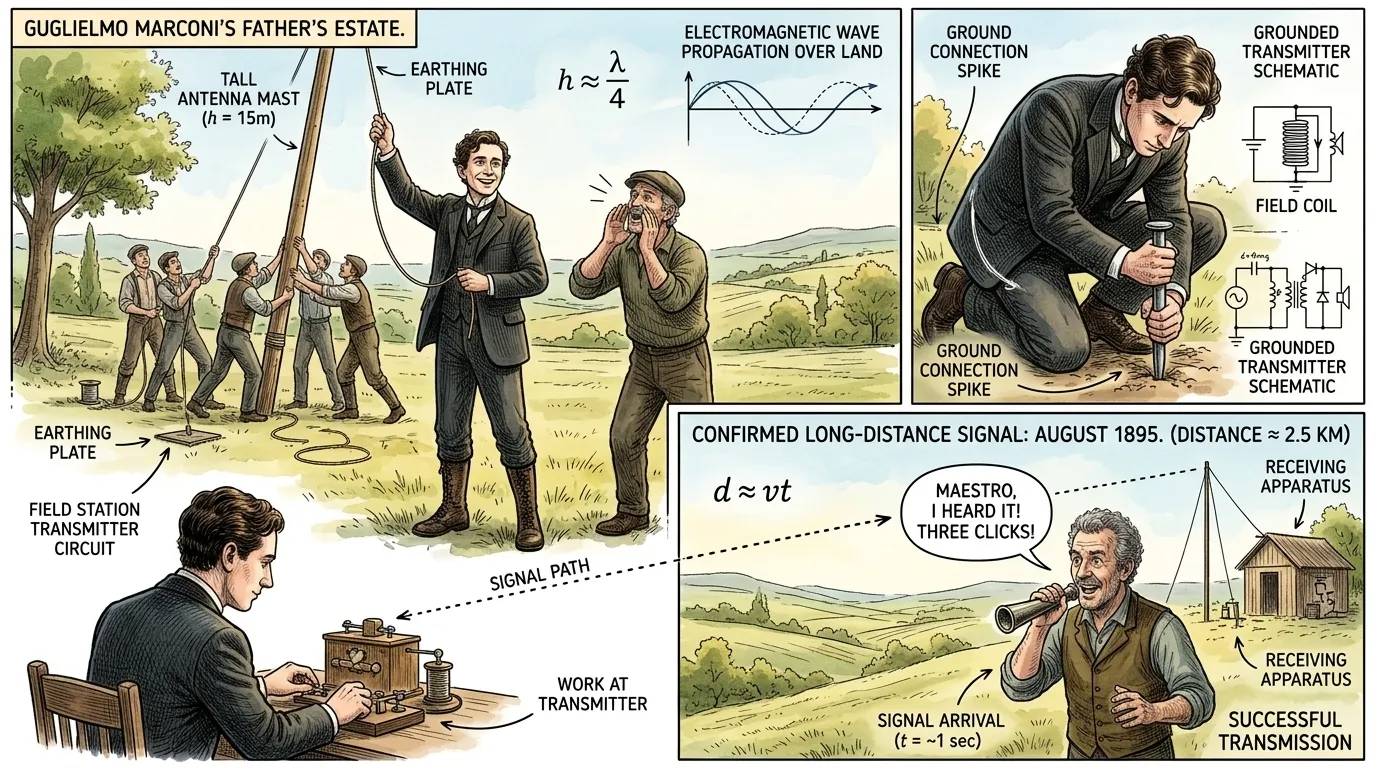
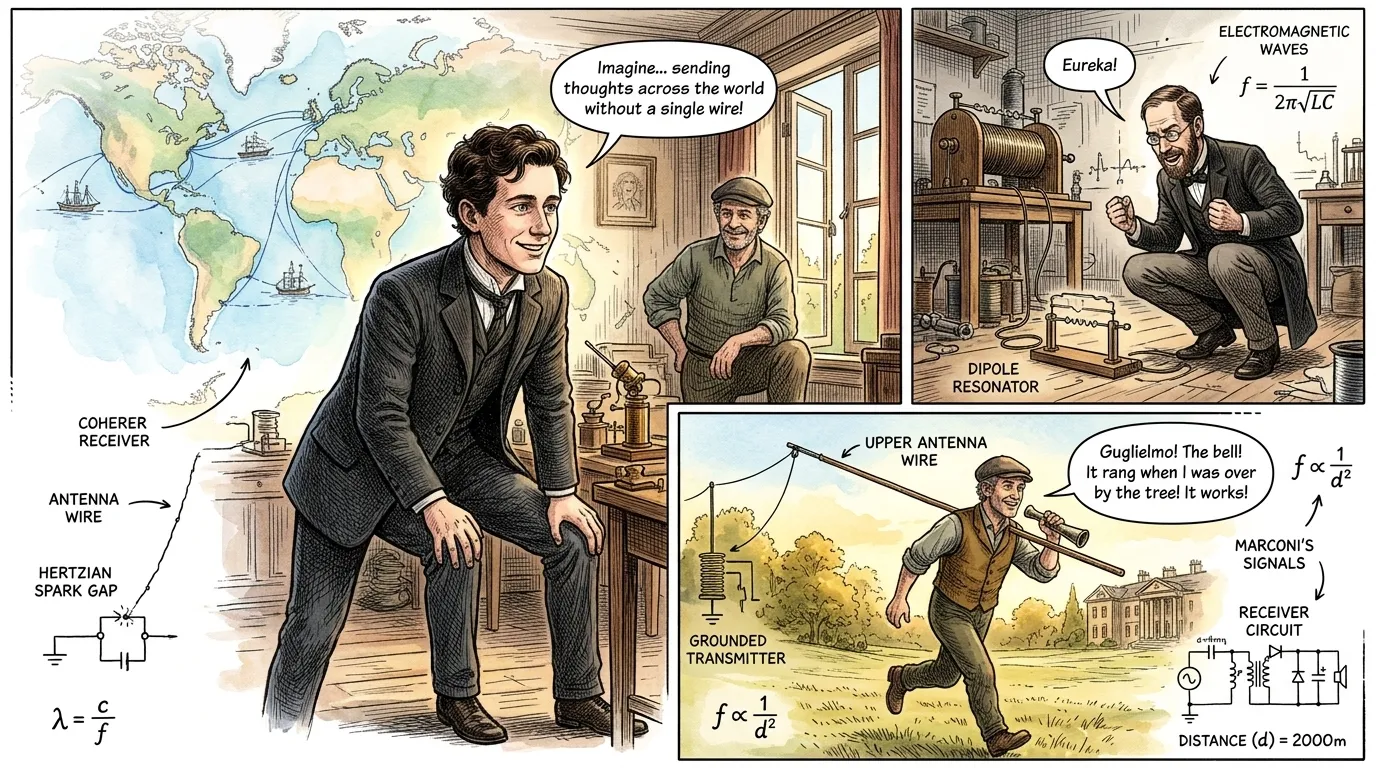
Marconi's initial successes were modest, limited to a few meters. But his ingenious addition of an elevated antenna and a grounded connection dramatically increased range. He moved his experiments outdoors, testing progressively longer distances across his father's estate in Italy, often with his skeptical but eventually convinced estate manager, Mignani, acting as a signal observer.
"As he positioned a new, taller antenna pole in an open field, Marconi explained to Mignani, 'By raising the antenna and connecting the other side of the spark gap to the earth, we are essentially making the entire planet part of our circuit. It's like a giant mirror for the waves.' Mignani, holding a simple receiver several kilometers away, exclaimed into a speaking tube, 'Maestro, I heard it! Three clicks! The signal is clear today!' Marconi grinned, 'Excellent! Each successful transmission proves that our 'wireless' is not just a parlor trick, but a viable future.'"
Page 6
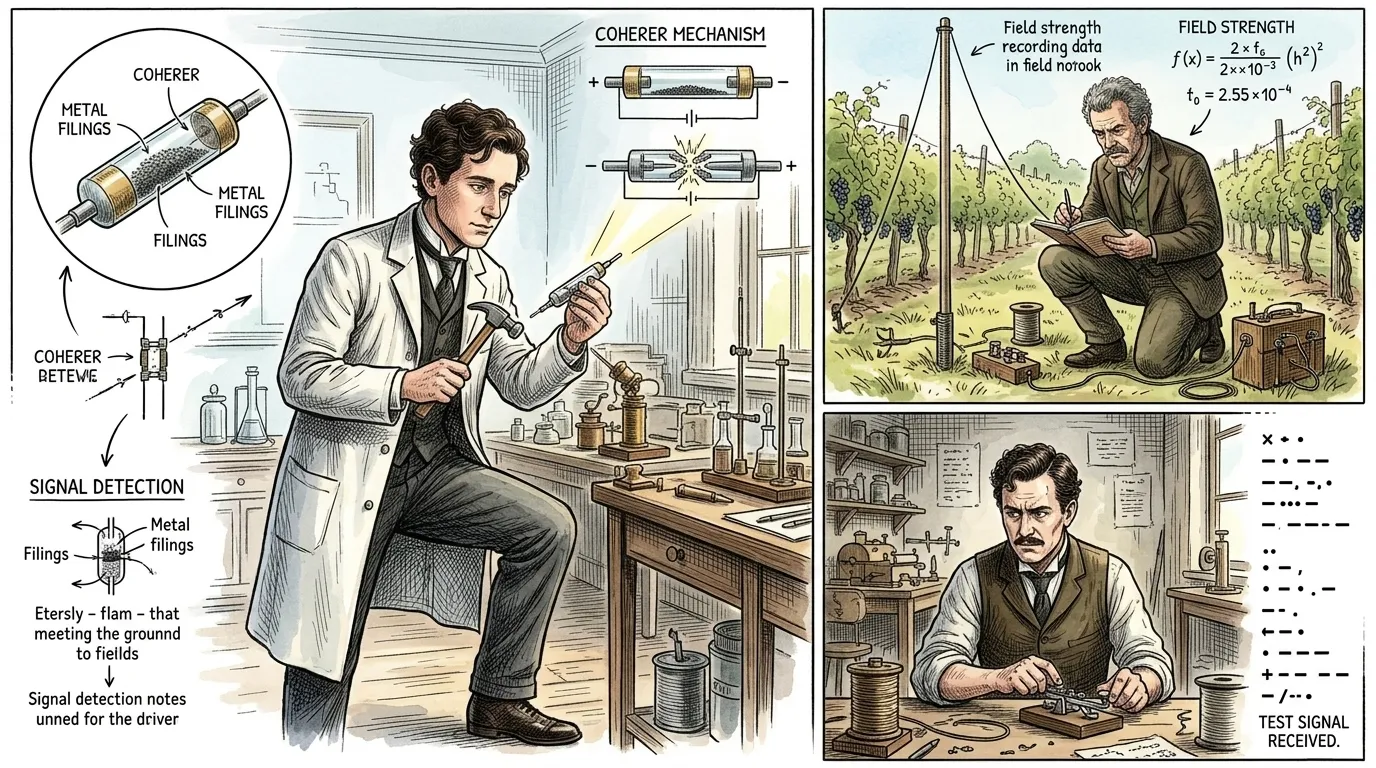
Marconi's system relied on a few key components. At the transmitting end, a powerful spark-gap created rapid oscillations of electricity, launching electromagnetic waves into the air via an antenna. These waves traveled at light speed, carrying encoded information. At the receiving end, another antenna captured the minuscule energy, feeding it into a device called a coherer.
"Marconi meticulously demonstrated the system's operation. 'When the spark fires,' he stated, pointing to the transmitter, 'it generates a burst of high-frequency energy. These waves, once picked up by the receiving antenna, induce a tiny current.' He then held up a glass tube filled with metal filings. 'This,' he explained, 'is the coherer. Normally, these iron filings are disordered and resist current. But the incoming radio wave causes them to cohere, or clump together, dramatically reducing their resistance and allowing a current to flow through them, thus signaling the presence of a wave.'"
Page 7
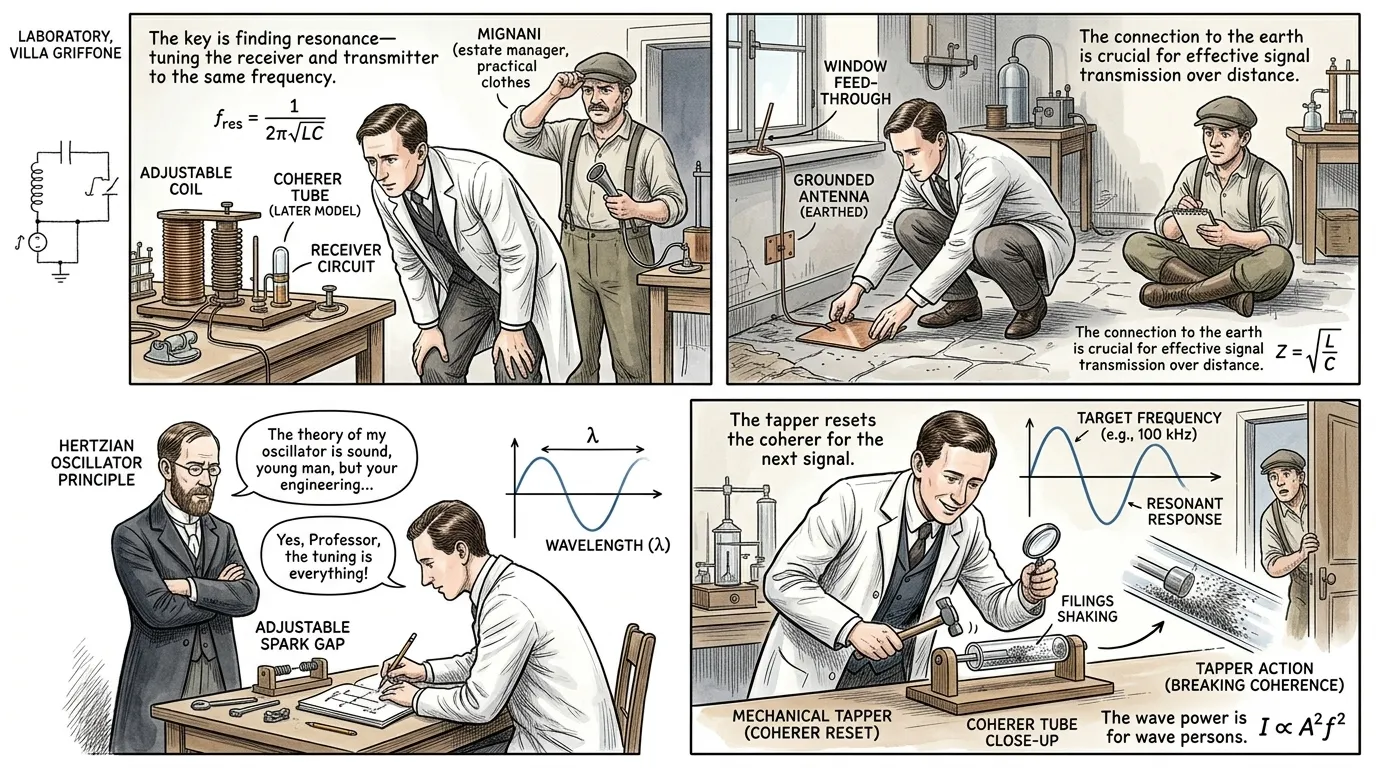
While the coherer detected the wave, it also 'latched' into its low-resistance state after receiving a signal. To prepare it for the next incoming pulse, a 'tapper' mechanism was essential. This small hammer would gently strike the coherer, shaking the filings apart and restoring its high-resistance state, ready to detect the next part of the Morse code signal. The advent of 'tuning' further revolutionized the system.
"'The coherer itself was brilliant, but without a tapper to decohere it, we could only detect the first signal,' Marconi elaborated during a public demonstration. 'This small device,' he gestured to a miniature hammer, 'resets the filings for continuous reception.' He continued, 'But the real breakthrough for distinguishing signals came with resonance and tuning. As Sir Oliver Lodge said, 'It is useless to multiply wireless stations if they all interfere with each other.' By adjusting the coils and capacitors, we can ensure our receiver only 'listens' to a specific frequency, just as a musical instrument resonates with a particular pitch.'"
Page 8
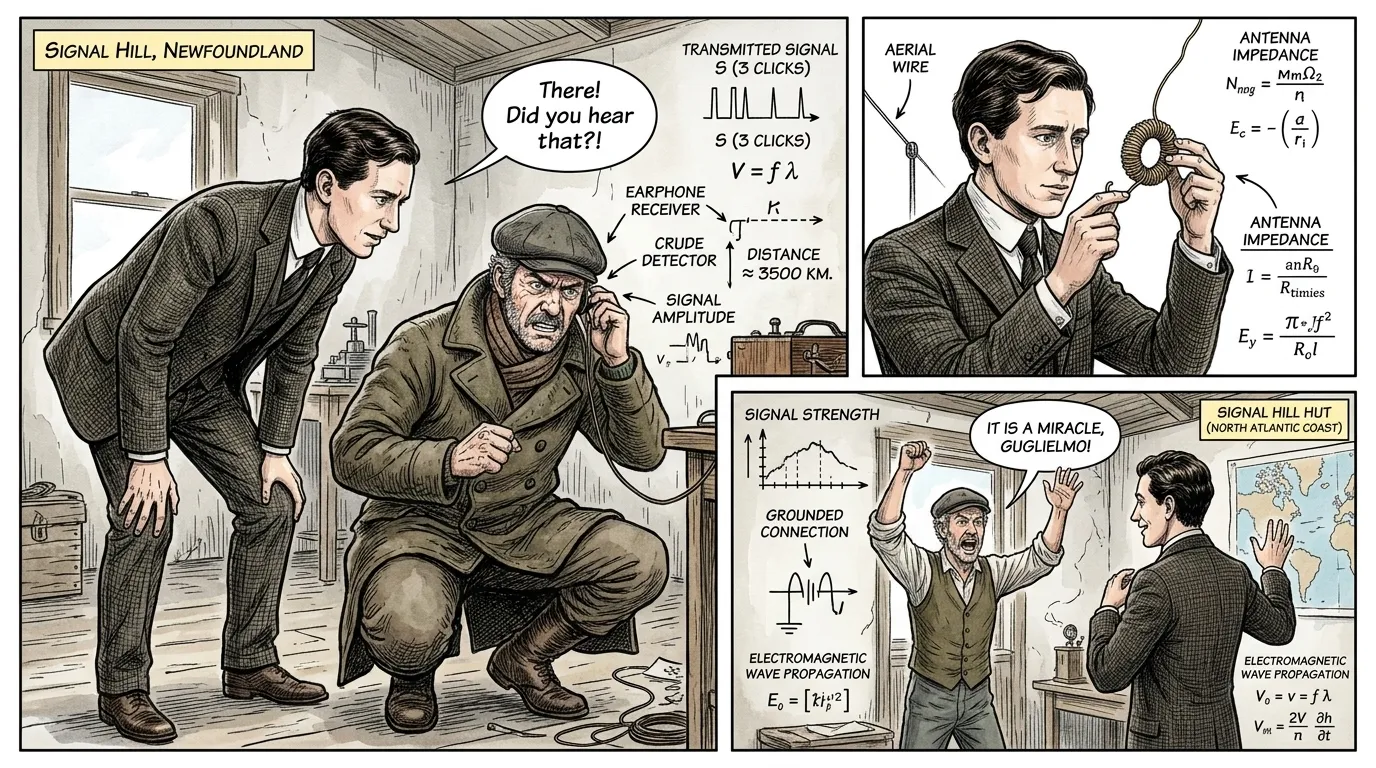
By 1901, Marconi was confident enough to attempt the ultimate test: a transatlantic transmission. From Poldhu, Cornwall, a colossal spark-gap transmitter sent signals towards Signal Hill, Newfoundland, over 3,500 kilometers away. Against all scientific skepticism that the Earth's curvature would block such a signal, Marconi believed in the waves' ability to follow the Earth's surface or reflect off the ionosphere.
"At Signal Hill, on December 12, 1901, in a small, windswept hut, Marconi and his assistants waited in tense silence. 'Do you hear anything, Mr. Kemp?' Marconi asked his chief assistant, staring intently at the earphone. Then, a barely audible, faint series of 'S' clicks – three short bursts – reverberated. 'It's the 'S' from Poldhu!' Kemp exclaimed, his voice trembling with emotion. Marconi nodded slowly, a profound sense of triumph dawning. 'It proves,' he stated, 'that the curvature of the Earth is no barrier. The invisible waves have transcended physical limits, uniting distant shores.' This success was built on years of refining the very principles of resonance and efficient signal generation they had explored."
Page 9
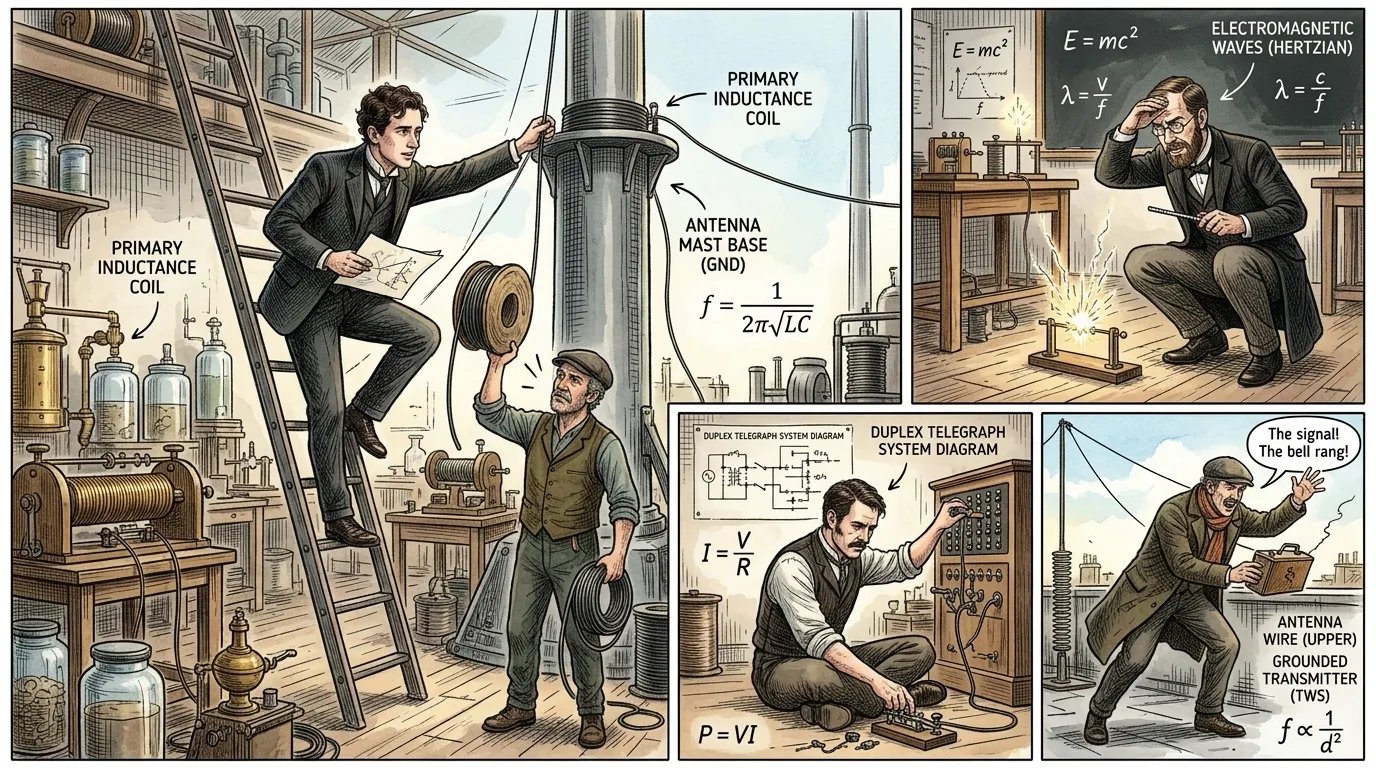
Marconi's transatlantic success ignited a revolution. Initially, 'wireless telegraphy' was primarily used for point-to-point communication, especially for maritime safety, allowing ships to send and receive distress calls. But the potential for transmitting not just coded pulses but continuous sound – voice and music – soon became the next frontier. Inventors like Reginald Fessenden and Lee de Forest made critical advances in modulation and vacuum tube technology.
"After successfully transmitting speech and music on Christmas Eve, 1906, Reginald Fessenden, a Canadian inventor, announced triumphantly over his experimental broadcast, 'With this new apparatus, we are no longer limited to the simple dots and dashes of Morse code! We can transmit the human voice, live music, and indeed, any sound through the air!' He later reflected, 'It allows us to reach many at once, transforming communication from private exchange to public address. The world, once isolated, can now share a common auditory experience.'"
Page 10
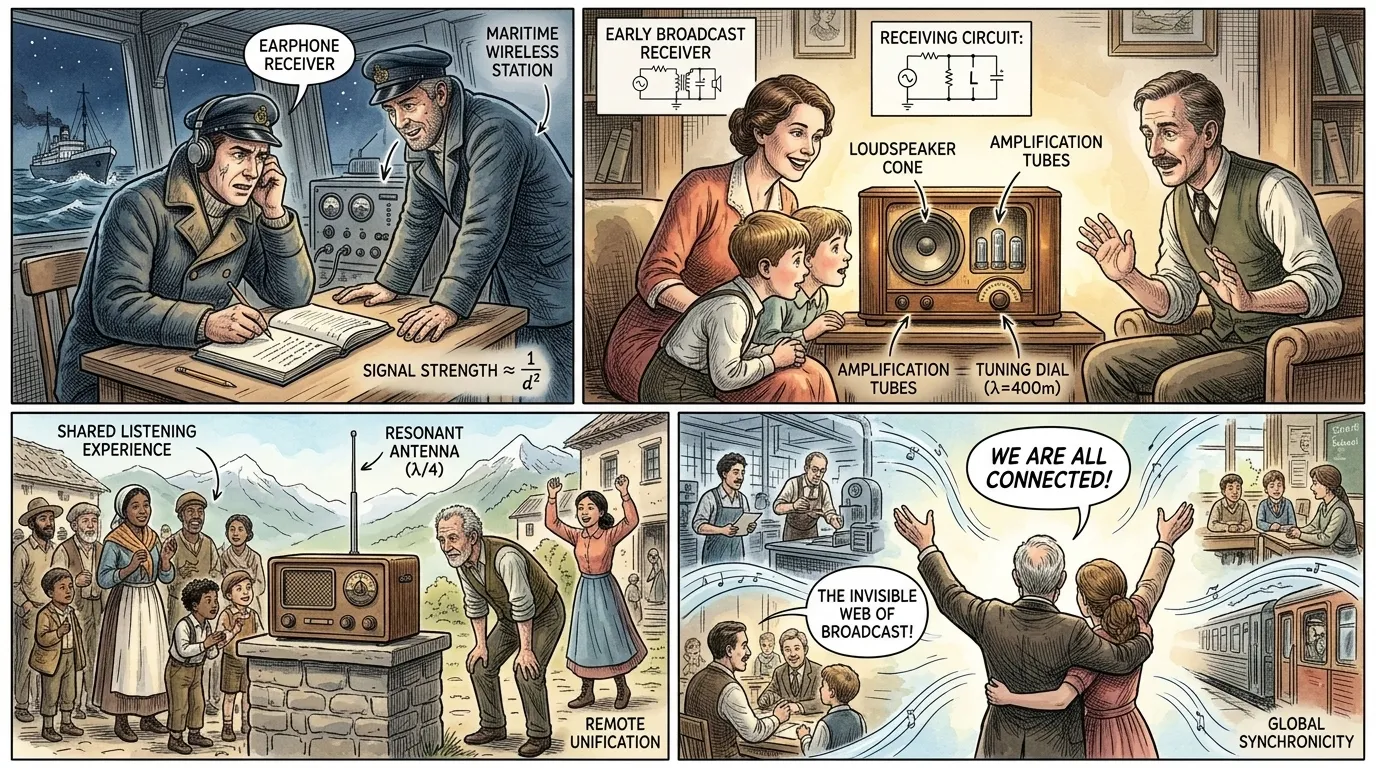
Broadcast radio profoundly reshaped the 20th century, becoming an indispensable medium for news, entertainment, and public discourse. It dissolved geographical barriers to information, uniting diverse populations through shared experiences. From delivering critical wartime messages to families gathering around their sets for nightly dramas, radio became a ubiquitous and transformative force.
"Reflecting on radio's unparalleled impact, a historian once noted, 'Broadcast radio did more than transmit signals; it transmitted culture, news, and shared identity across vast distances. It brought the world into people's homes, fostering a sense of global community long before television or the internet.' The quiet hum of a receiver became the soundtrack to modernity, a testament to the power of invisible waves."
About this story
- Location: Global
- Audience: general readers
Questions and answers
Read Wonder Inventions on your phone
Wonder Inventions is available on Android. Get Wonder Inventions on Google Play.