Calculator
Calculator — an illustrated inventions story, set in Global. 10 illustrated pages, free to read on Wonder Inventions.
Page 1
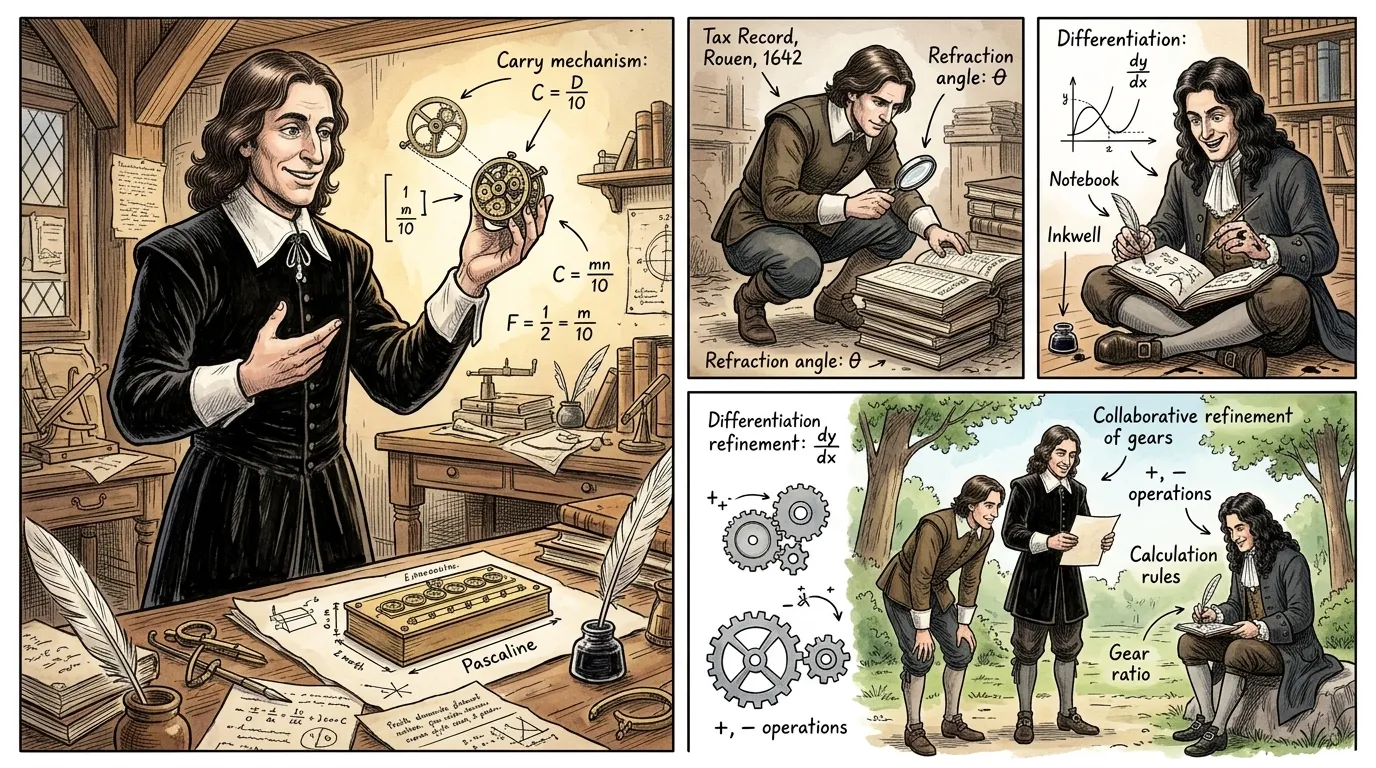
In the mid-17th century, the growing complexities of commerce, astronomy, and state administration created an urgent demand for faster, more accurate calculations. Human error was rampant in manual ledger entries and scientific tables, leading to costly mistakes and delays across Europe. It was in this environment that the brilliant French polymath, Blaise Pascal, conceived of a machine to alleviate this profound intellectual burden. His invention, the Pascaline, debuted in 1642, marking a foundational step towards automated computation.
Page 2
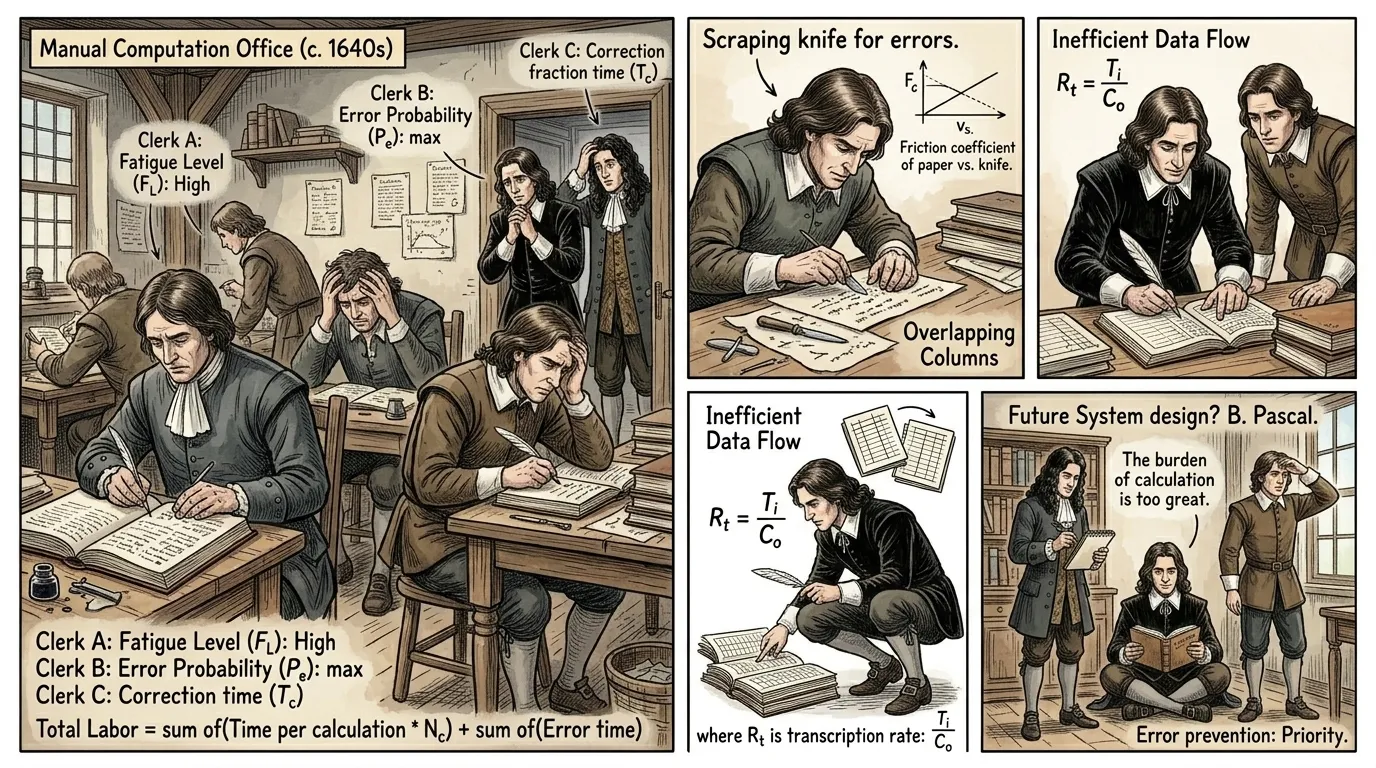
Before the advent of mechanical aids, every calculation, from a merchant's daily accounts to an astronomer's planetary observations, relied solely on painstaking manual effort. Clerks, bookkeepers, and scientists spent countless hours transcribing figures, often prone to fatigue and transposition errors. A single misplaced digit or miscalculated sum could invalidate entire ledgers, jeopardizing financial ventures or derailing scientific research with profound consequences. As the English philosopher Francis Bacon once articulated, 'Knowledge is power,' yet accessing reliable knowledge was severely hampered by the slow, error-prone nature of human arithmetic.
Page 3
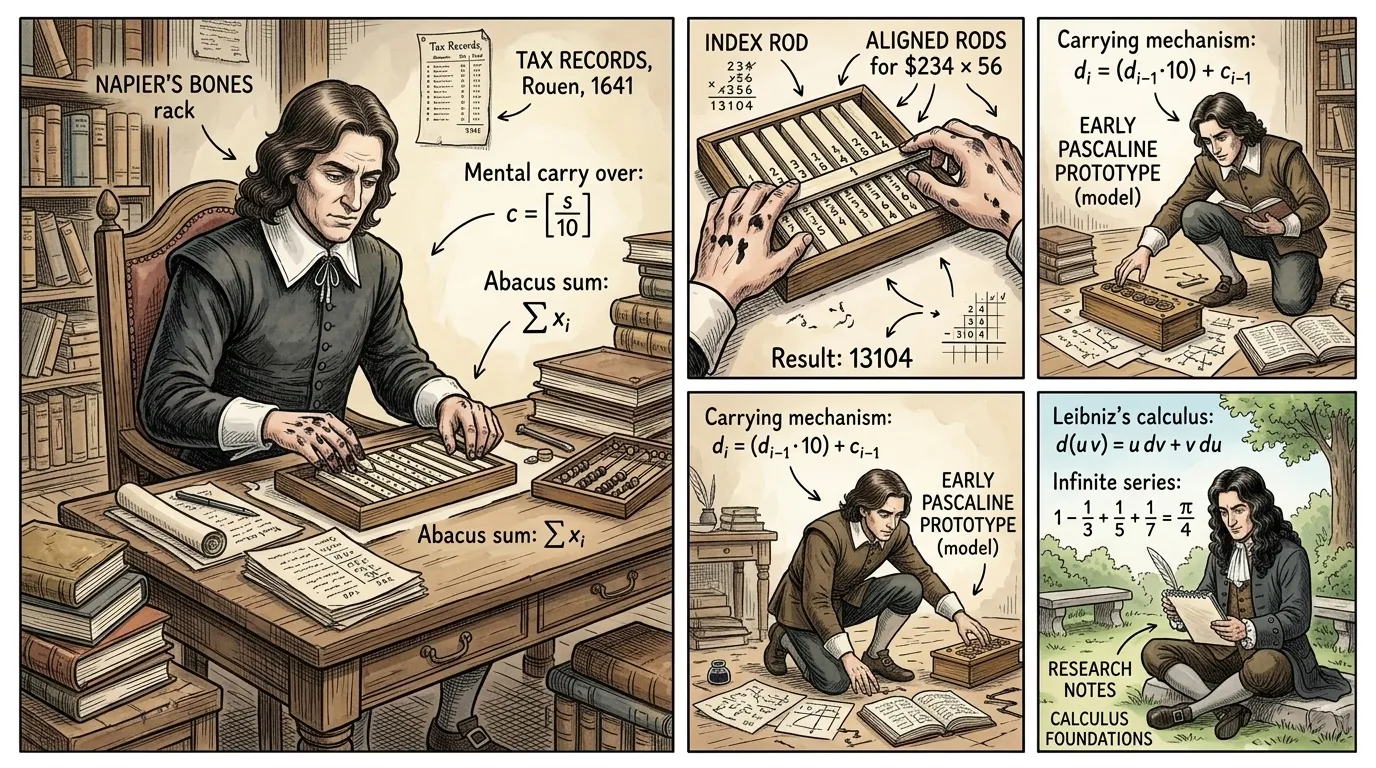
Ancient civilizations utilized simple counting tools like the abacus, and by the 17th century, John Napier's 'bones' offered a system for performing multiplication through movable rods. These devices significantly sped up specific operations but remained aids, not true automatic calculators. They still required manual manipulation and mental computation for carrying over digits, failing to eliminate the potential for human error inherent in mental arithmetic. This persistent challenge fueled the desire for a machine that could not only count but also automatically handle the complex 'carrying' of tens, a fundamental barrier to fully automated calculation.
Page 4
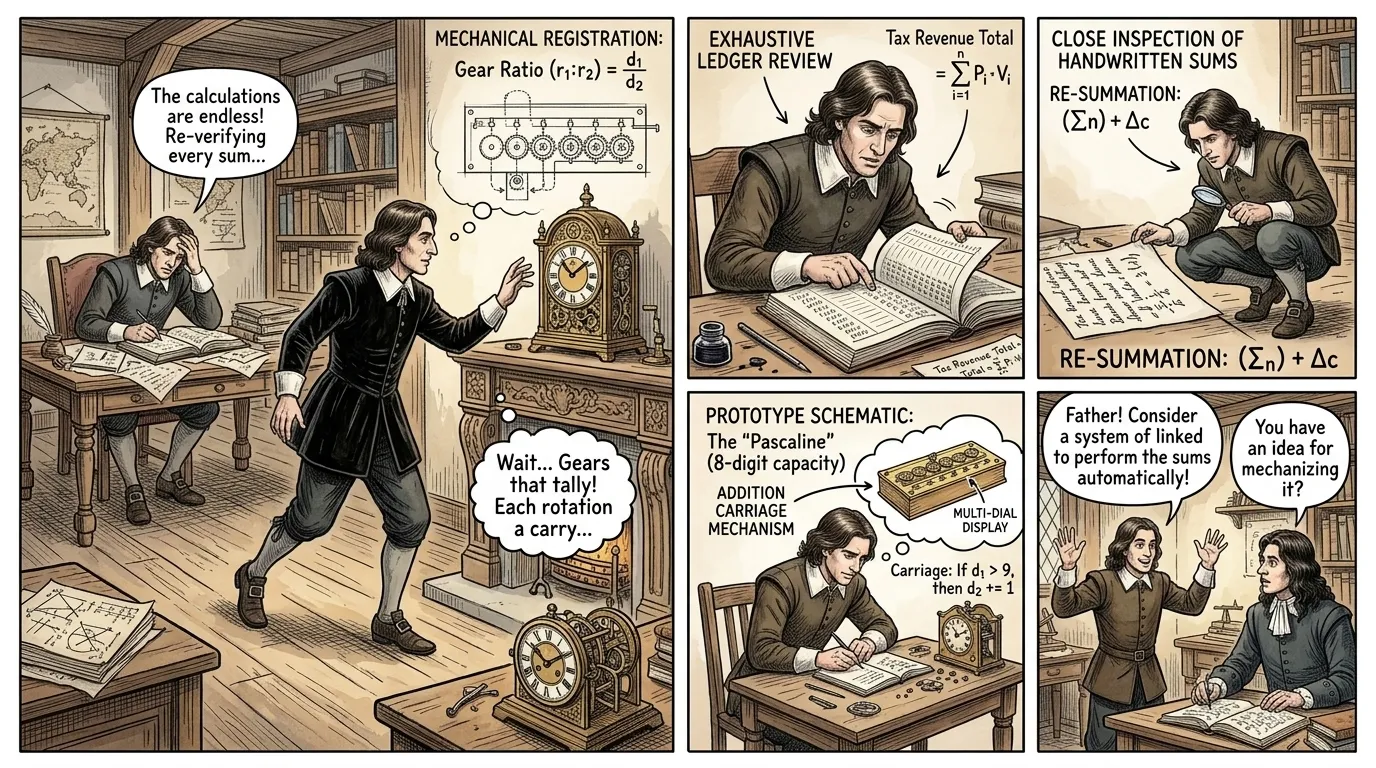
Blaise Pascal's personal motivation for inventing a calculating machine was deeply rooted in a desire to assist his father, Étienne Pascal, who worked as a tax superintendent in Rouen. Faced with the daunting task of constantly calculating vast sums of money for tax revenues, Étienne struggled with repetitive and error-prone arithmetic. Witnessing his father's exhaustion and the administrative inefficiency, the young Pascal resolved to create a device that could perform additions and subtractions reliably. His initial inspiration stemmed from observing the mechanisms of clockwork, particularly how gear trains could transmit motion and effect changes in position, a principle he began adapting for numerical operations.
Page 5
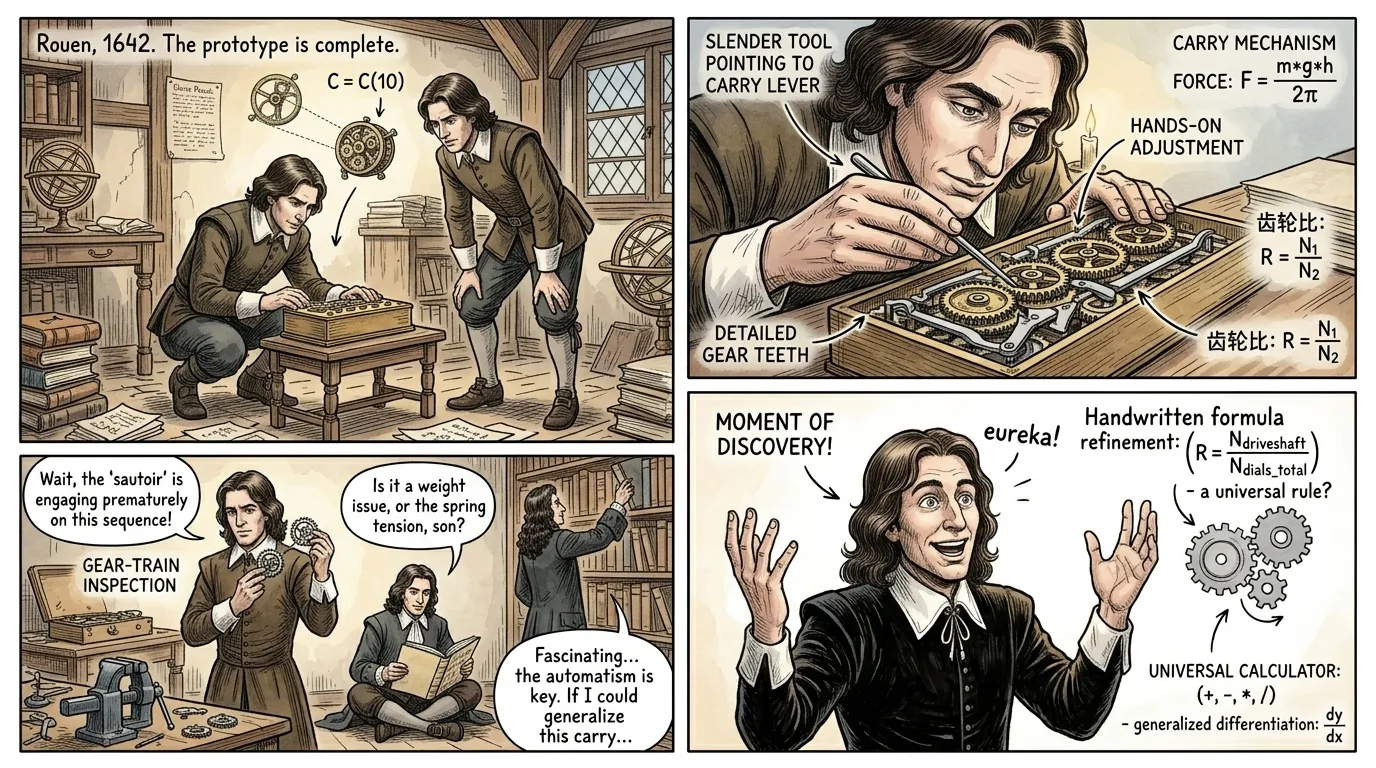
Pascal's breakthrough lay in devising a mechanism that could automate the 'carrying' of tens, a process known as 'pascaline's sautoir' or 'gravity-assisted carry.' When a dial spun past nine, a small, weighted lever would be lifted. Upon reaching zero, this lever would fall, using its kinetic energy to advance the next dial by one unit, mimicking how we carry a 'one' to the next column in manual addition. Each digit column had a corresponding toothed wheel, and these wheels were interlinked, allowing the carry-over to propagate from one column to the next. The precision required for these interlocking gears and levers made manufacturing a significant challenge, demanding skilled artisans and iterative refinement.
Page 6
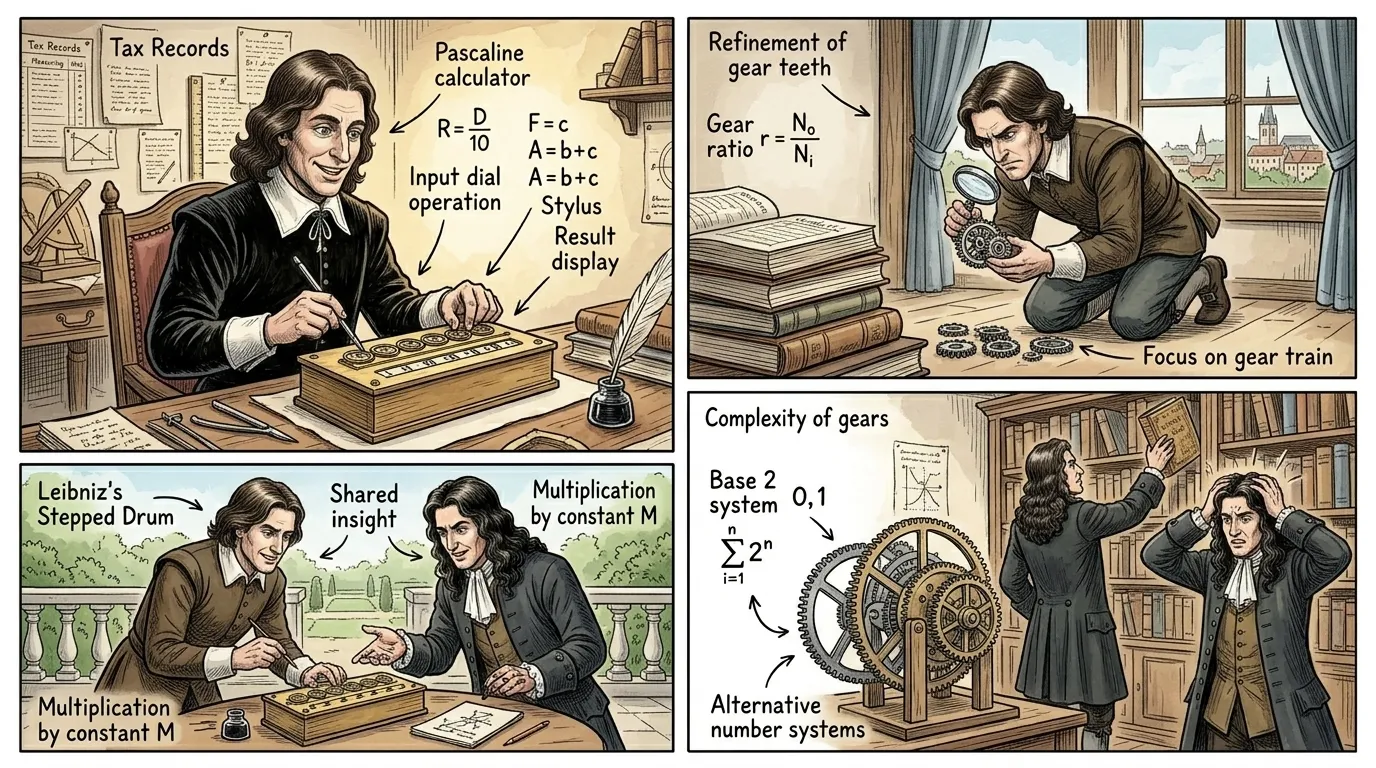
To perform an addition, the user would dial in the first number using a stylus, rotating the input wheels until the desired digit appeared in the display window. Then, the second number would be entered similarly, with the machine automatically performing the addition through its internal gear system and 'sautoir' mechanism. The result would then appear in the row of output windows at the top of the machine. This process, while still manual for input, eliminated the mental effort and errors associated with carrying digits, offering a tangible increase in accuracy and speed for repetitive arithmetic tasks. The Pascaline represented a truly novel approach to computation, transforming abstract numbers into mechanical movements.
Page 7
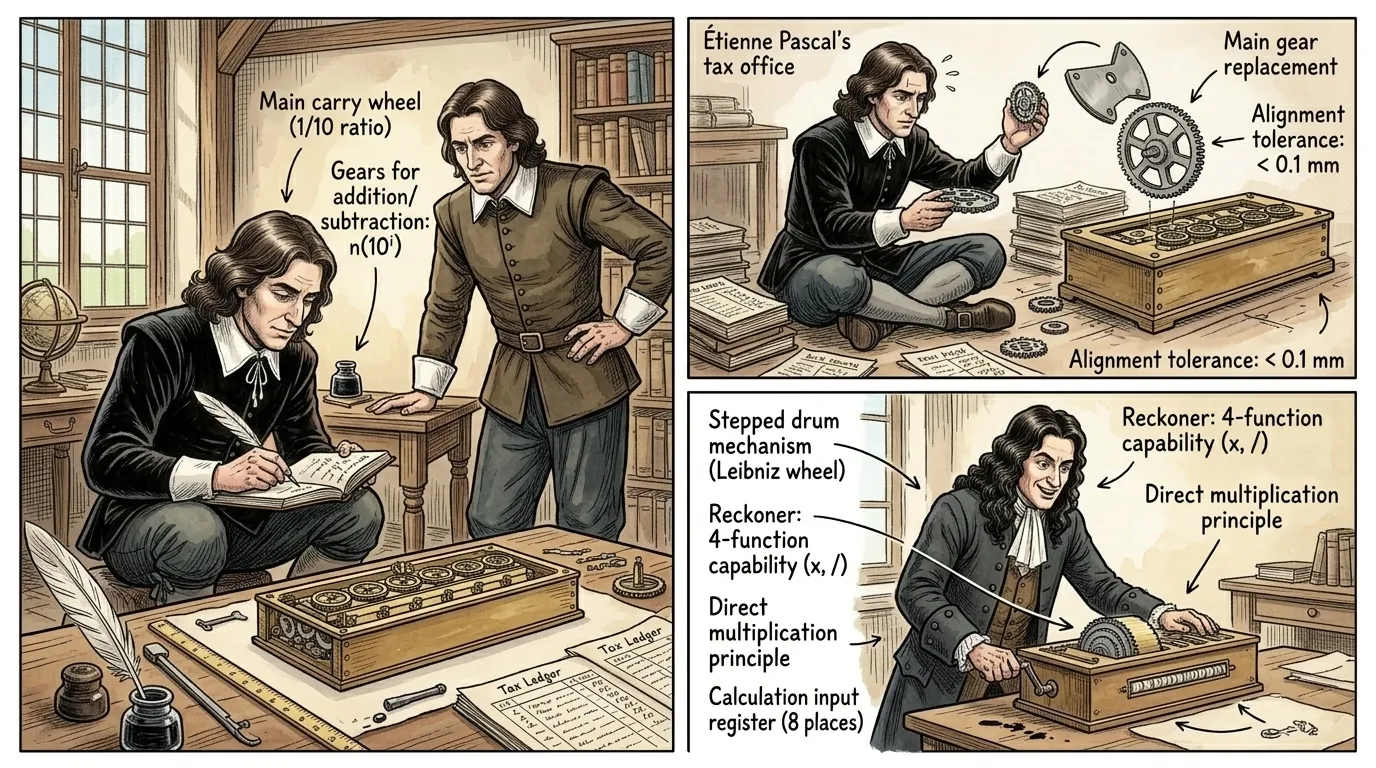
While the Pascaline excelled at addition and subtraction (achieved through a complex method of 'adding complements'), it did not directly perform multiplication or division. These operations still required repeated additions or subtractions, making them laborious. This limitation prompted further innovation, most notably by German mathematician Gottfried Wilhelm Leibniz. In 1673, Leibniz unveiled his 'Stepped Reckoner,' which incorporated a 'stepped drum' (or Leibniz wheel) that allowed direct multiplication and division through a series of shifting gears. Leibniz's design built upon Pascal's principles but introduced a critical advancement, showing that complex arithmetic could indeed be mechanized more comprehensively. As Leibniz himself famously stated, 'The art of discovering the causes of phenomena is to find the principles of things,' a philosophy perfectly embodied in his pursuit of universal computation.
Page 8
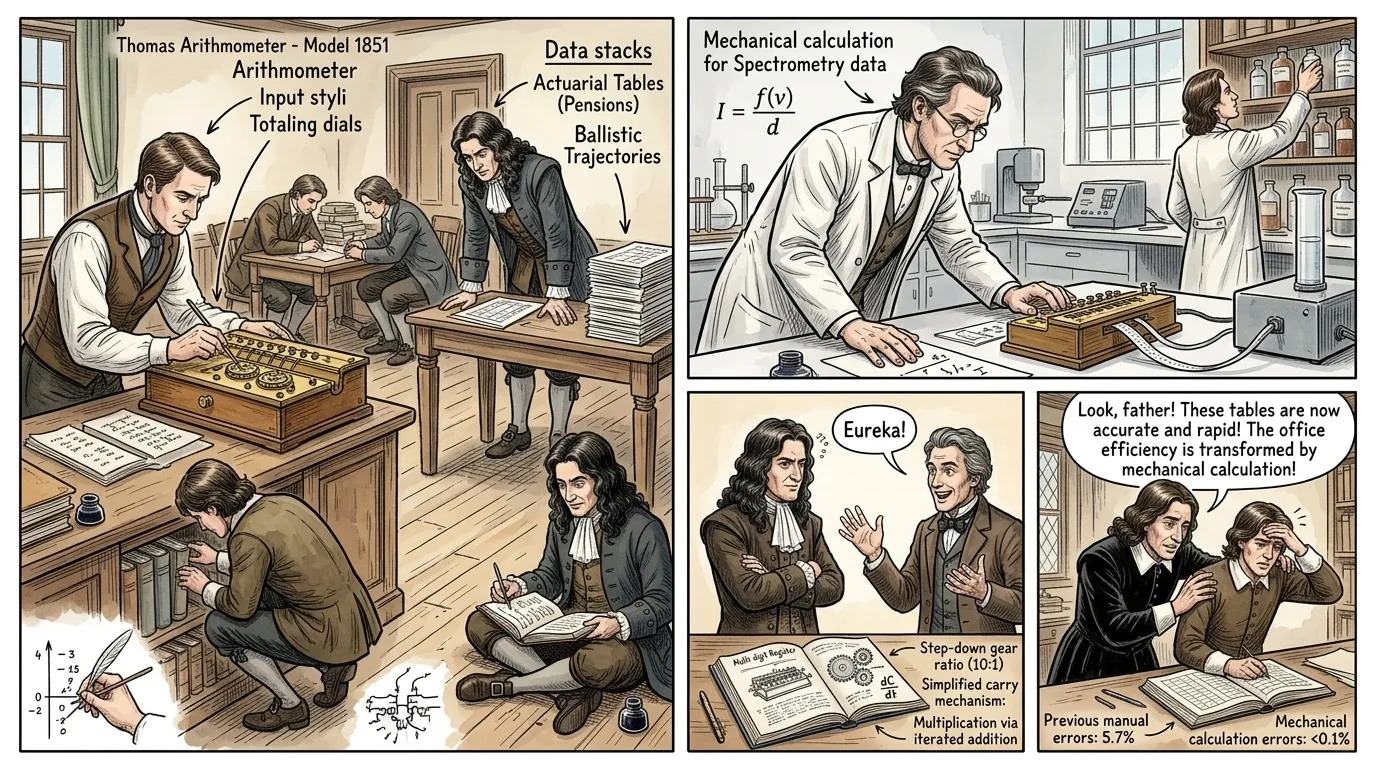
Despite their initial cost and mechanical complexity, mechanical calculators gradually evolved and saw wider adoption throughout the 18th and 19th centuries. Machines like Thomas de Colmar's Arithmometer, patented in 1820, were based on Leibniz's stepped drum and became the first commercially successful mechanical calculator. These robust devices were indispensable for businesses, scientific laboratories, and government agencies, drastically reducing calculation times for tasks like actuarial tables, ballistic trajectories, and engineering specifications. The foundational principles laid by Pascal and Leibniz, particularly the concept of automated carrying and sequential operation, proved endlessly adaptable, paving the way for increasingly sophisticated devices.
Page 9
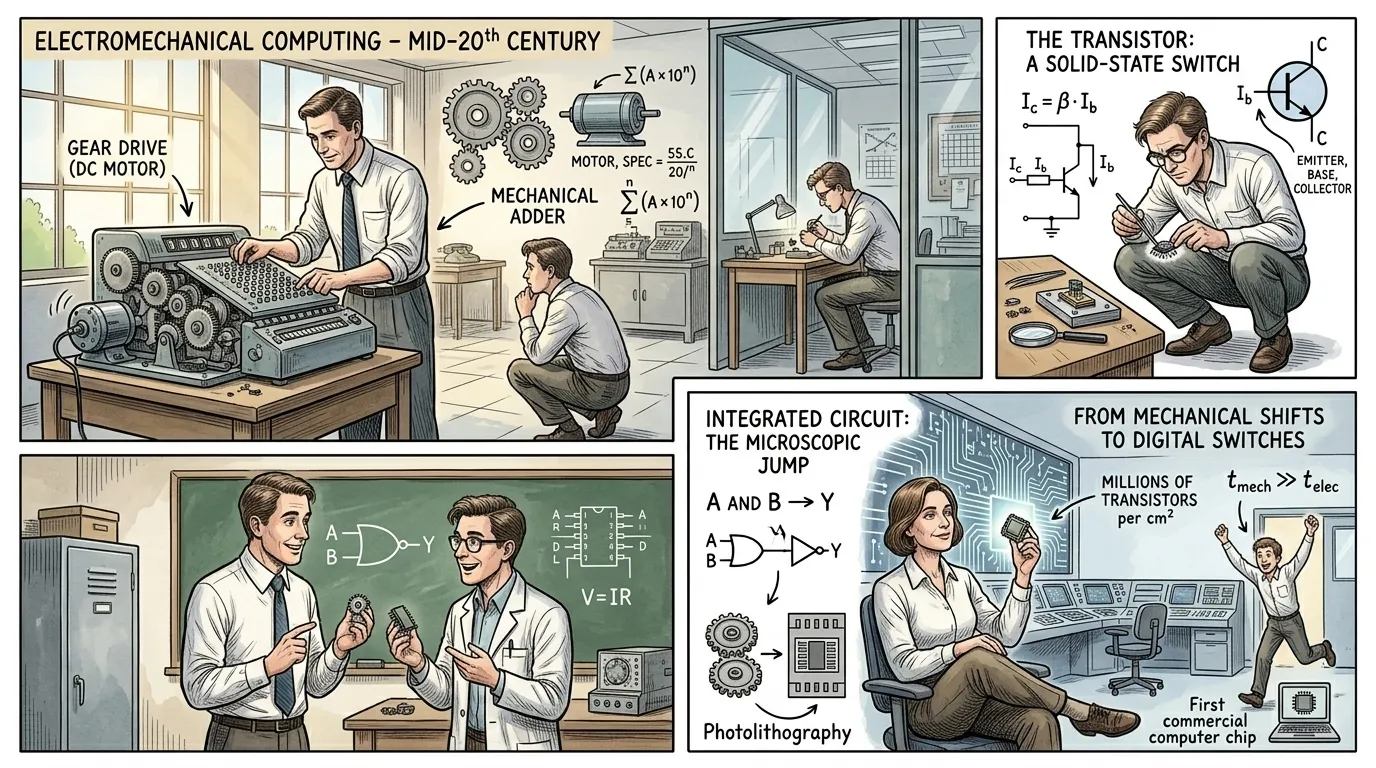
The mechanical calculator dominated for centuries, but the mid-20th century brought a revolutionary shift with the advent of electronics. Initially, electromechanical calculators used electric motors to drive mechanical components, offering greater speed and ease of use. However, the true transformation began with the invention of the transistor and integrated circuits in the 1940s and 50s. These electronic components replaced cumbersome gears and levers with tiny, lightning-fast switches, enabling machines to process numbers at unprecedented speeds. This fundamental change marked the transition from mechanical calculation to electronic computation, laying the groundwork for the modern digital age and miniaturization of devices.
Page 10
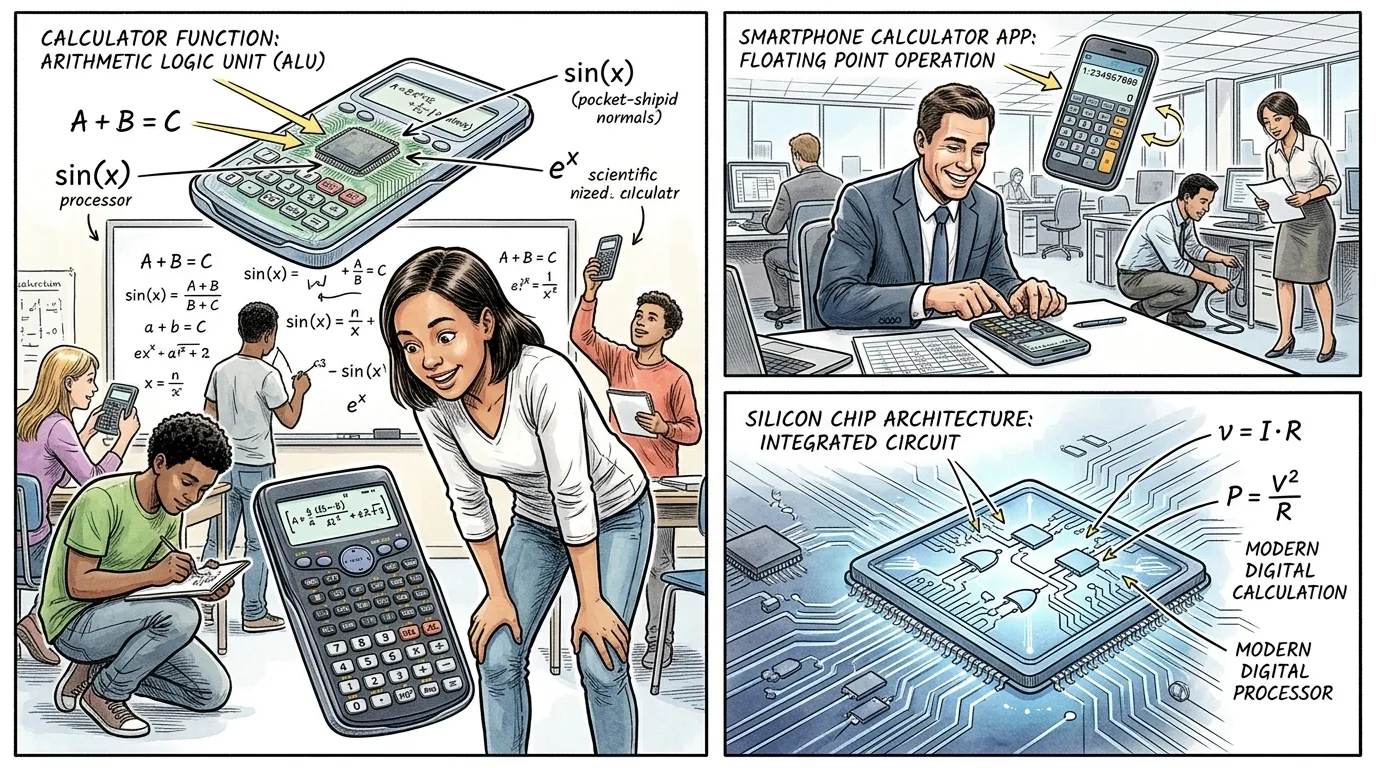
Today, the calculator's legacy is ubiquitous, transforming from a specialized mechanical device into an indispensable electronic tool, often invisible within larger systems. From the pocket-sized scientific calculator aiding students and engineers, to the financial calculator on a smartphone, its core function remains consistent: providing rapid, accurate arithmetic. Modern processors, at the heart of every digital device, still perform calculations in fundamentally similar ways to Pascal's initial vision, albeit at incomprehensible speeds. The calculator's journey underscores humanity's relentless pursuit of efficiency and accuracy, forever shaping how we interact with numbers and the world around us.
About this story
- Location: Global
- Audience: general readers
Questions and answers
Read Wonder Inventions on your phone
Wonder Inventions is available on Android. Get Wonder Inventions on Google Play.