Canal Lock
Canal Lock — an illustrated inventions story, set in Global. 10 illustrated pages, free to read on Wonder Inventions.
Page 1

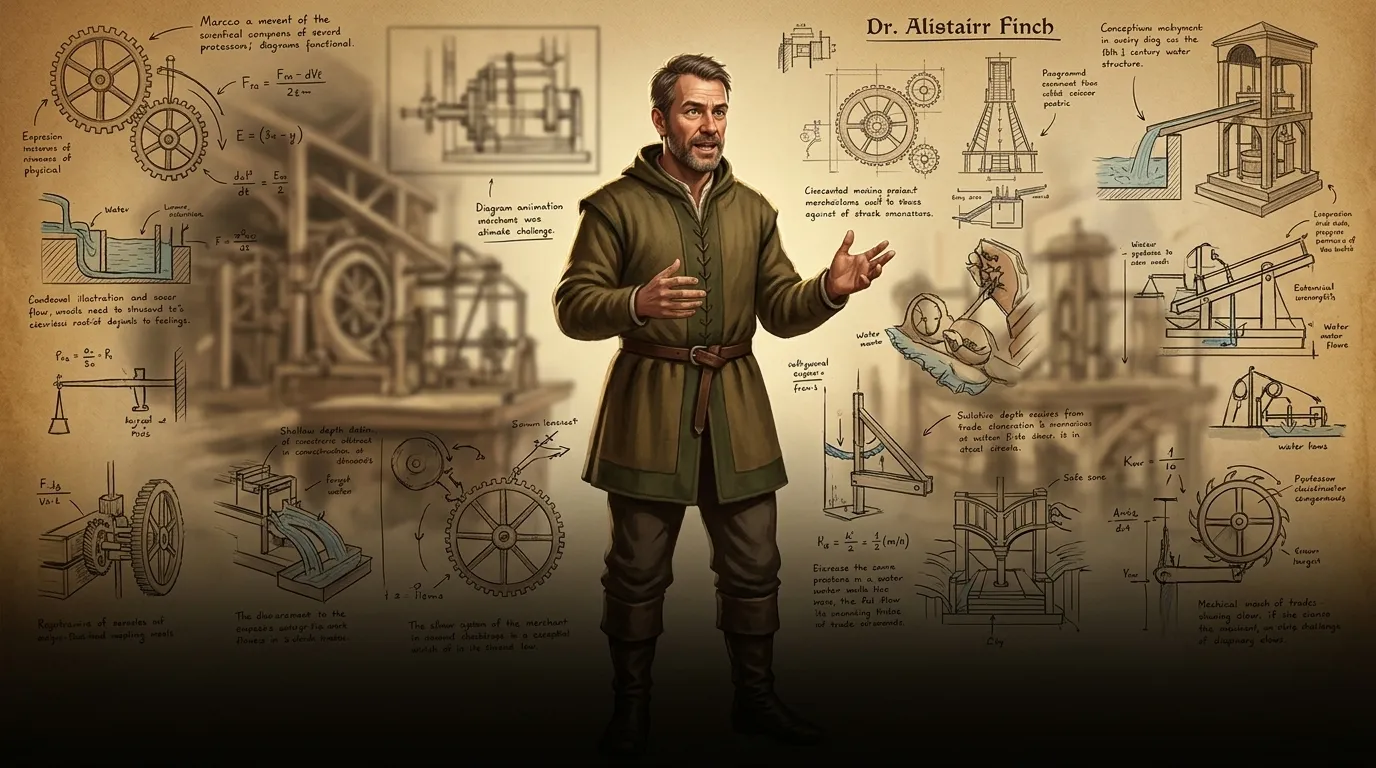
For millennia, the reliable movement of goods and people by water was fundamental to civilization. Yet, nature presented an insurmountable barrier: changes in elevation. Rivers descended in rapids, and landforms created plateaus, rendering continuous navigation impossible.
"A seasoned merchant, Elias, gestures emphatically towards a turbulent river section. "This torrent," he exclaims to a fellow trader, "divides our markets! Goods must be offloaded, carried over land, and reloaded. The costs are immense, the delays crippling.""
Page 2

Before engineered solutions, cargo boats faced insurmountable obstacles at significant drops or rises in water level. The only recourse was portage, a laborious and dangerous process that drastically limited the reach and efficiency of water transport. This method proved slow, risked damage to valuable goods, and required immense manual labor.
"An experienced boatman, Marco, strains against a heavy rope, his muscles bulging as he and several others attempt to pull a wooden barge onto a muddy bank. "Every time, the same struggle!" he grunts, wiping sweat from his brow. "One wrong step, one broken rope, and our entire season's livelihood could be lost to the rocks below.""
Page 3
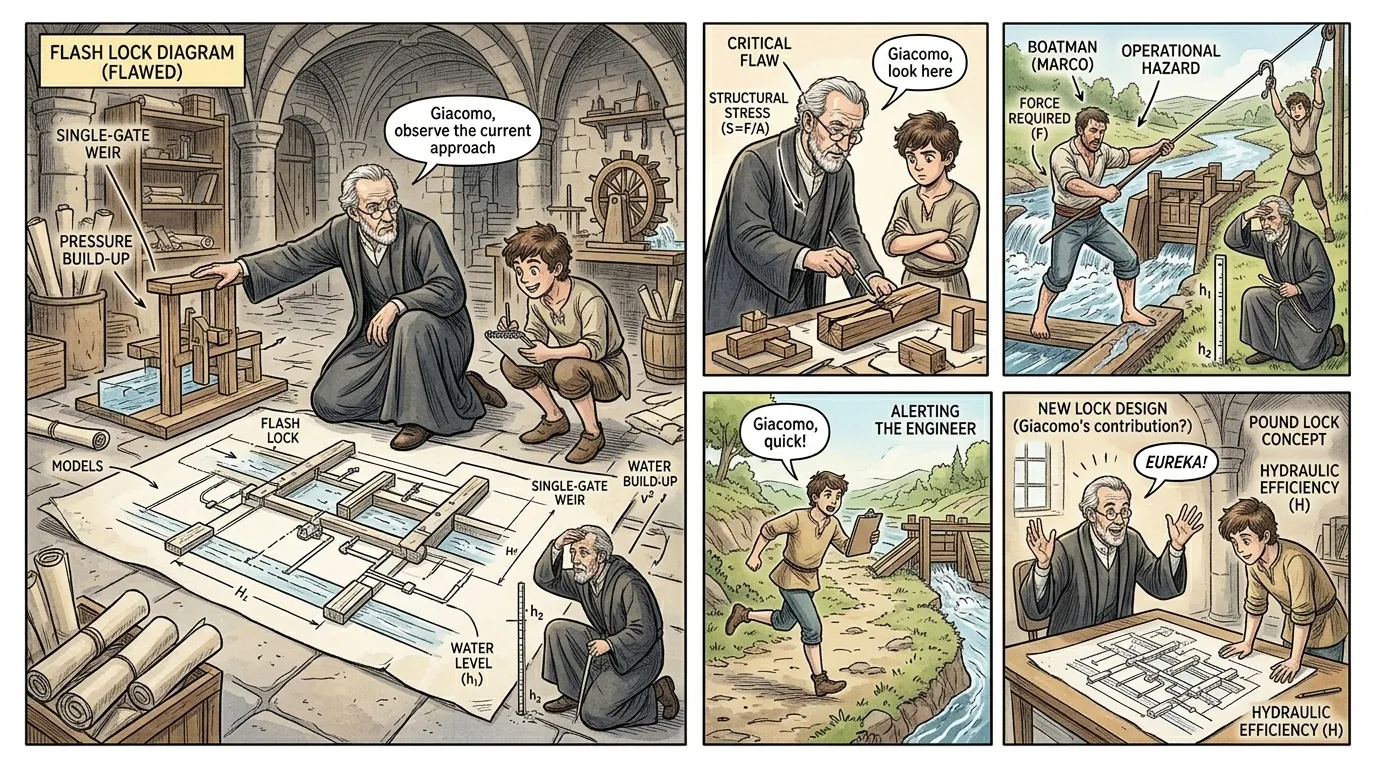
Early attempts at managing water levels involved 'flash locks' or 'stanches' – simple barriers that would hold back water, then release a sudden surge to carry boats over shallow sections. This uncontrolled deluge was unpredictable, hazardous, and wasteful of water, often causing damage downstream. Such methods were hardly a sustainable solution for a growing mercantile economy.
"A scholarly engineer, Dr. Alistair Finch, examines a rudimentary diagram of a flash lock, shaking his head. "Such a method is more akin to a controlled disaster than a reliable system," he explains to a junior apprentice. "We require precise control over water volume and flow, preventing both destructive torrents and severe water loss. The key lies in understanding and manipulating pressure within a confined space.""
Page 4

In 15th-century Lombardy, the burgeoning city of Milan faced logistical challenges in connecting its internal canal network to the broader Ticino River. The terrain's gentle but persistent gradient necessitated a new approach. Here, in the heart of northern Italy, the engineer Bertola da Novate, along with others, began to refine a concept that would revolutionize water transportation.
"Bertola da Novate, a focused engineer in his late 50s, studies detailed parchments with a group of surveyors. "We must harness the water, not simply unleash it," he states with conviction. "The Chinese have shown us the potential of pound locks, but for our European network, a robust, watertight chamber with reliable gates is paramount to ensure consistent navigability across varying elevations.""
Page 5
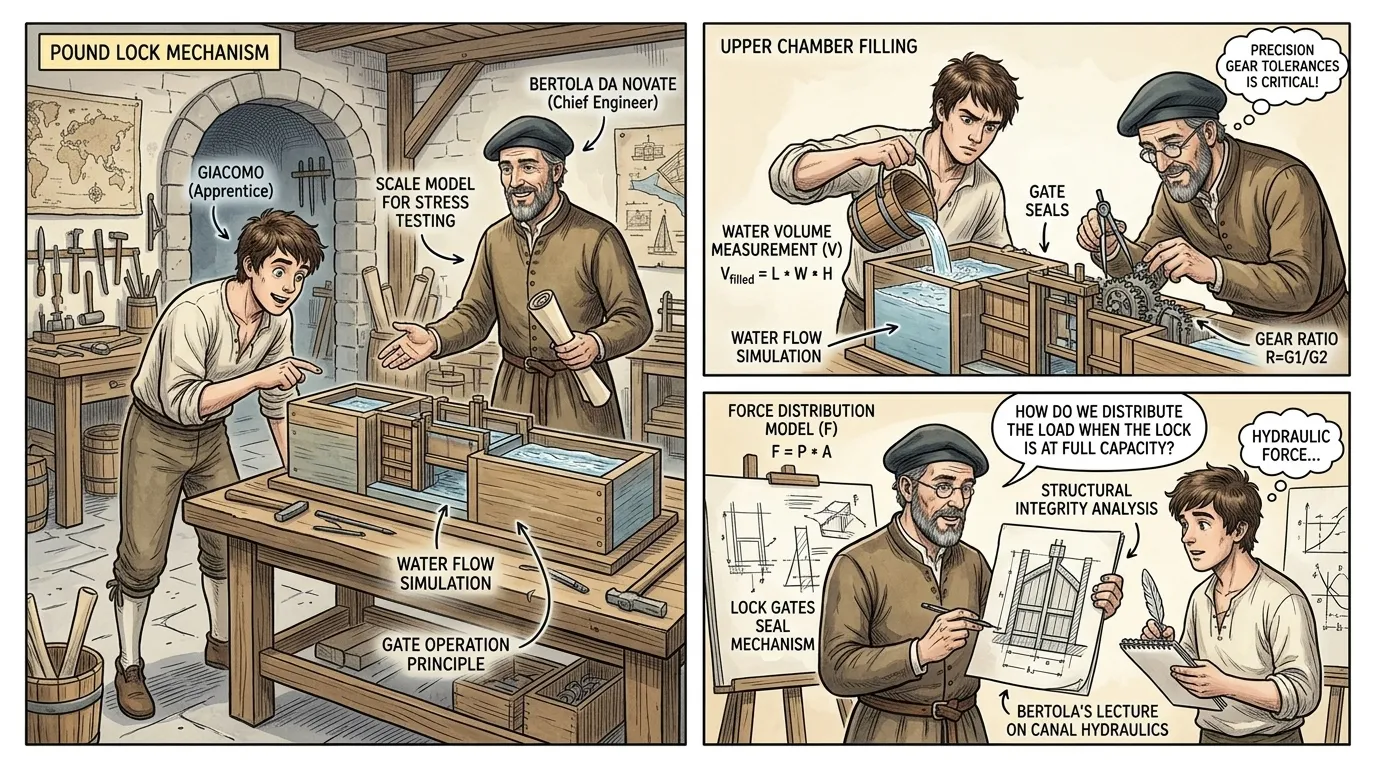
The true breakthrough arrived with the development of the 'pound lock.' Unlike flash locks, this system introduced an enclosed chamber, or 'pound,' situated between two sets of gates, capable of holding a vessel. By carefully controlling the water levels within this chamber, boats could be gently raised or lowered to match the elevation of the adjacent canal sections. This marked a monumental shift from destructive force to precise engineering.
"An eager apprentice, Giacomo, points at a model of a pound lock. "So, the boat enters, the gates close, and then the water level inside the chamber changes?" Bertola da Novate smiles. "Precisely, Giacomo. No more sudden rushes. It's a system of controlled equilibrium, slowly equalizing pressure to achieve a smooth transition. The ingenuity lies in the gate design, ensuring a perfect seal.""
Page 6
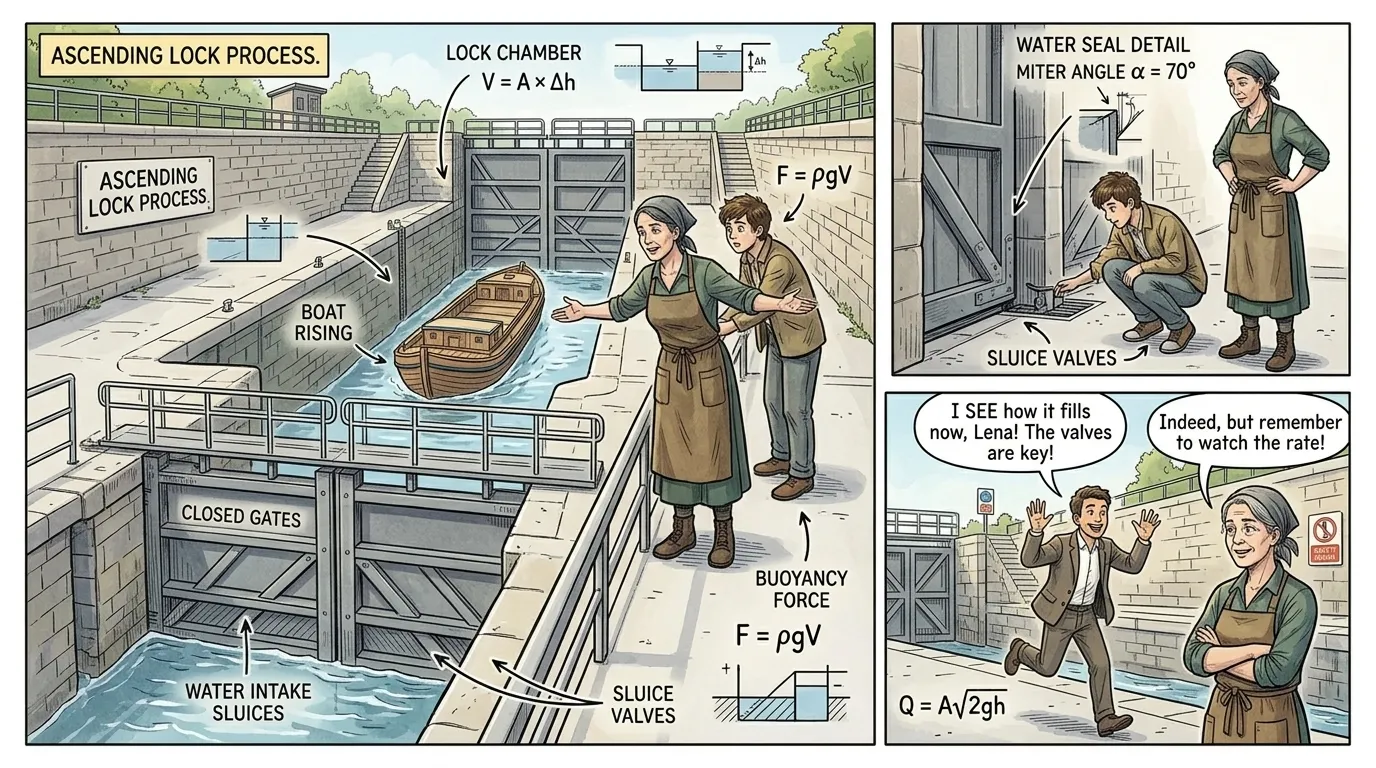
For a boat to ascend, it first enters the lock chamber from the lower water level, with the upper gates securely closed. The lower gates then swing shut, sealing the vessel within the pound. Crucially, small valves, or 'sluices,' are opened in the upper gates or walls, allowing water from the higher canal section to flow slowly and gently into the chamber, raising the boat. This controlled filling prevents turbulence and ensures safety.
"A canal operator, Lena, explains to a new recruit. "First, the lower gates must be closed and sealed. We need a strong, inward-pointing 'miter' angle against the water pressure. Then, open the sluice valves. It's a dance of pressure and patience, allowing the water to do the heavy lifting, steadily raising the boat to the next level.""
Page 7
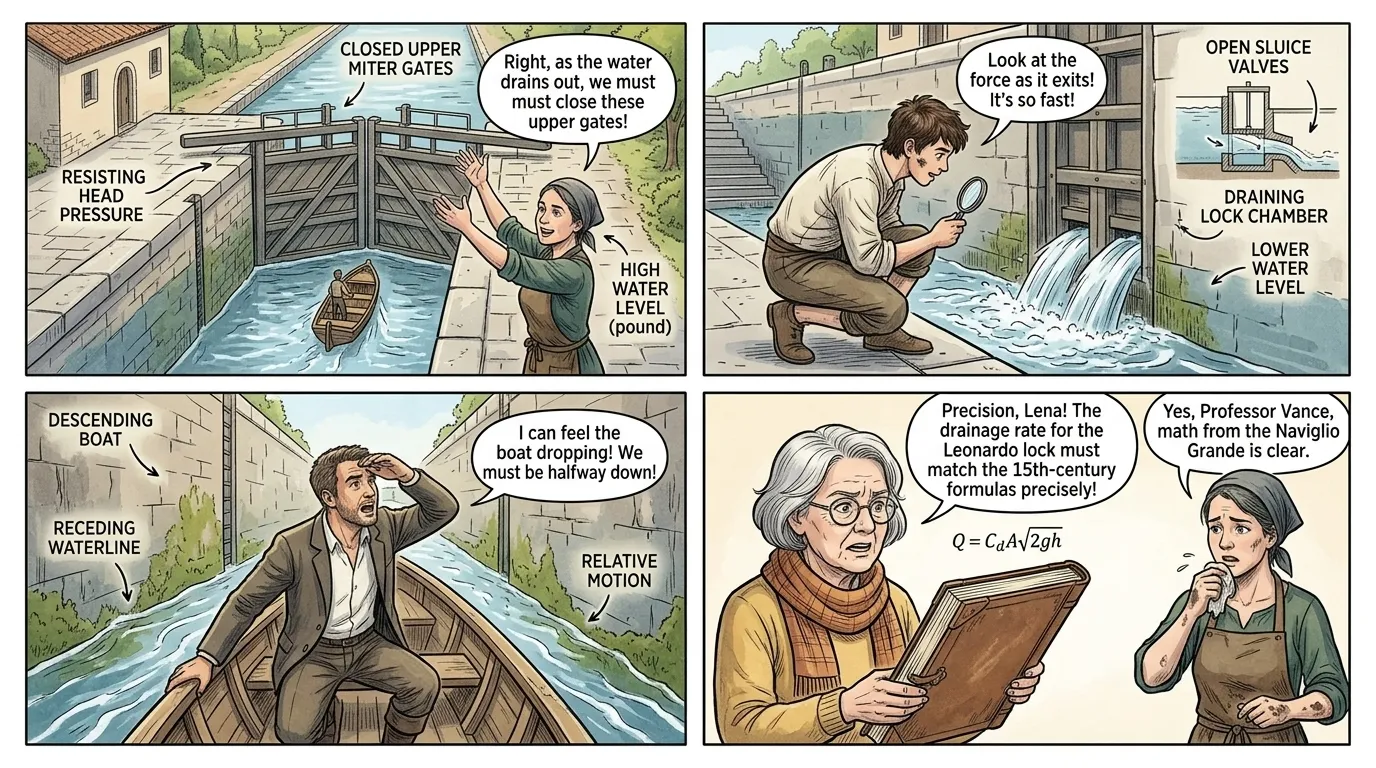
To descend, the process reverses. A boat enters from the upper water level, and the upper gates close behind it. Sluice valves at the lower end of the chamber are then opened, allowing the accumulated water to drain out into the lower canal section. As the water level in the pound drops, the boat is gently lowered. Once the water levels equalize, the lower gates can be safely opened, and the boat proceeds on its journey. The genius of the miter gate lies in its inherent strength against water pressure.
"Lena gestures towards the draining chamber. "Now the lower sluices open. The water drains, and as it does, the pressure from the remaining water in the upper canal holds our miter gates tighter. It's a natural advantage, a testament to clever design. As Daniel J. Boorstin once shared, 'The greatest obstacle to discovery is not ignorance, it is the illusion of knowledge.' We thought we knew how to move goods, but we were only making things harder for ourselves with old, inefficient ways.""
Page 8
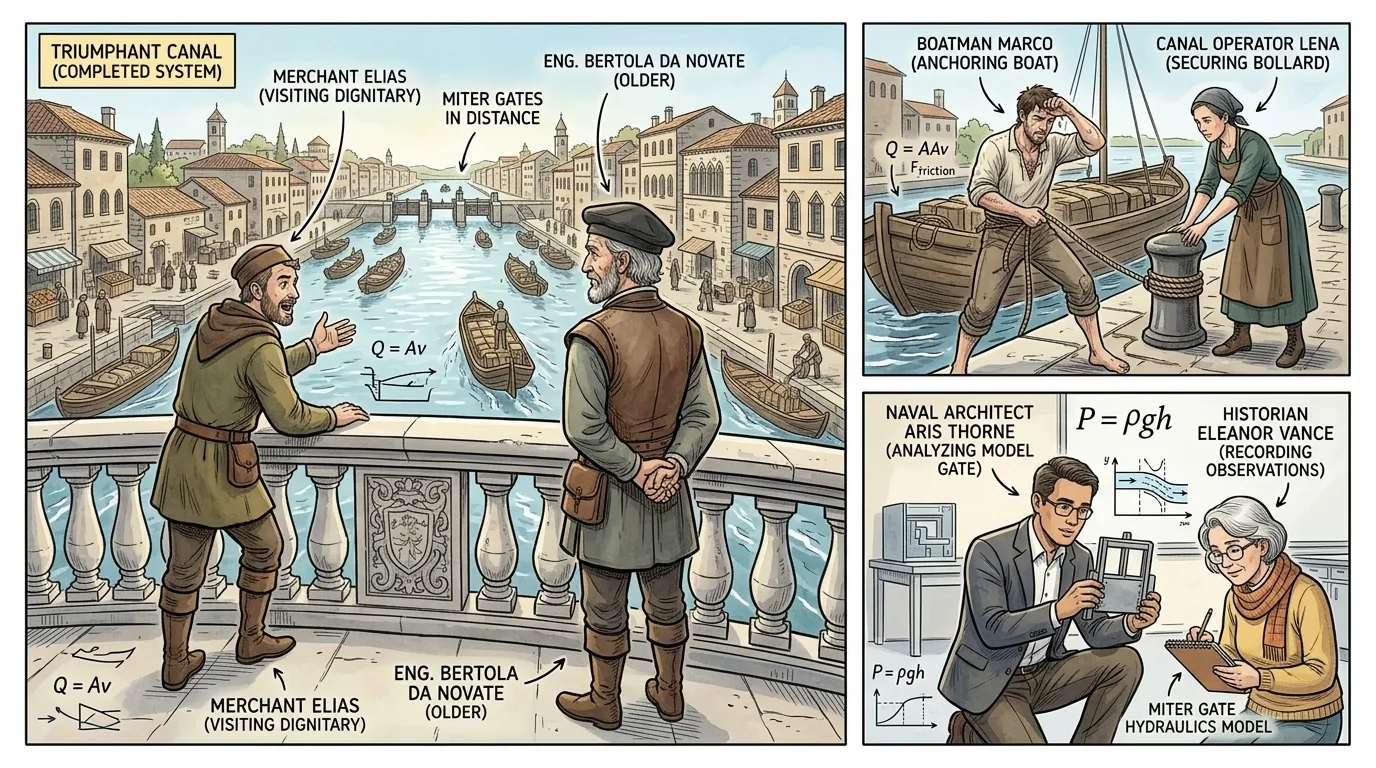
The successful implementation of canal locks, particularly the miter-gated pound lock, rapidly transformed waterborne transport. It allowed vast canal networks to snake across continents, conquering mountainous terrain and connecting distant markets. Rivers previously impassable became arteries of commerce, enabling the swift and reliable movement of raw materials and finished goods, fueling the industrial revolution and global trade.
"A triumphant engineer, now older and with more gray hair, overlooks a busy canal. "From the single chamber in Milan to vast networks like the Canal du Midi or Bridgewater Canal, the principle remains," he muses to a visiting dignitary. "The miter gate, a simple yet powerful design, uses the very force of the water to seal itself more tightly under pressure. It was the crucial insight that made these grand waterways possible.""
Page 9
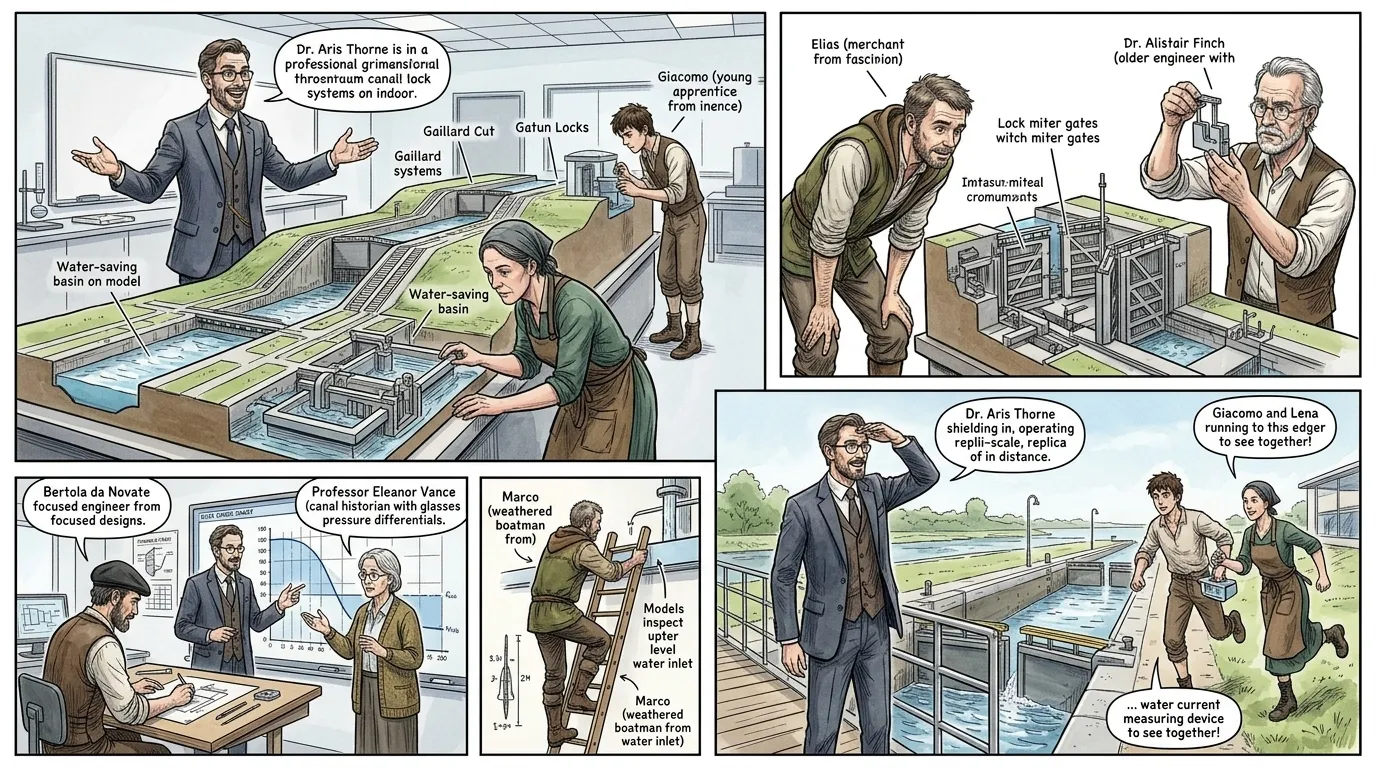
From single locks managing modest elevation changes, the design evolved into spectacular 'flights of locks,' where multiple chambers ascend or descend in sequence, conquering dramatic gradients over short distances. The Panama Canal, a monumental 20th-century feat, utilized immense lock systems to lift ships across the continental divide, demonstrating the enduring power and adaptability of this 15th-century innovation on a truly global scale. This mastery of water pressure and controlled flow enabled unprecedented connectivity.
"A modern-day naval architect, Dr. Aris Thorne, gestures towards a of the Panama Canal. "The underlying principles are still the same," he explains to a group of students. "It's the scale that's breathtaking. Imagine the coordination, the sheer volume of water being moved, all controlled by the descendants of those original miter gates and sluices. It's a testament to incremental innovation building towards monumental achievement.""
Page 10
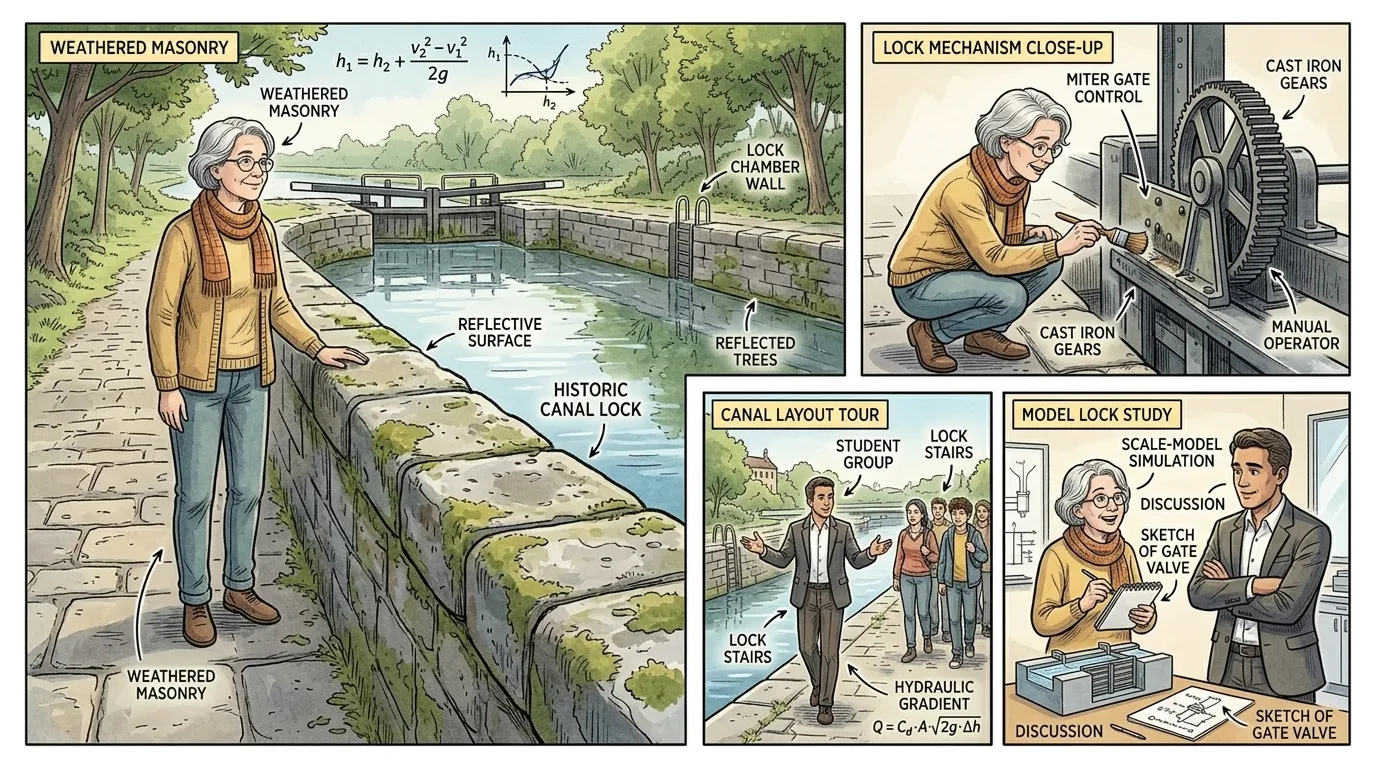
Today, canal locks remain indispensable. From vital commercial routes like the St. Lawrence Seaway to the historic Erie Canal, and even to recreational waterways, they continue to facilitate movement across diverse terrains. Their elegant simplicity and profound effectiveness have shaped economies, connected cultures, and stand as a timeless monument to human ingenuity in overcoming natural barriers. The controlled chamber, a concept refined over centuries, endures as a cornerstone of global logistics and recreation.
"An elderly canal historian, Professor Eleanor Vance, stands beside a quiet, historic lock. "From ancient Chinese designs to Renaissance breakthroughs and modern marvels, the canal lock embodies a fundamental human truth: that with clever engineering, even the most daunting natural obstacles can be overcome," she reflects. "It reshaped our world, proving that with insight and perseverance, we can always find a path forward, no matter how great the challenge.""
About this story
- Location: Global
- Audience: general readers
Questions and answers
Read Wonder Inventions on your phone
Wonder Inventions is available on Android. Get Wonder Inventions on Google Play.