LED Lighting
LED Lighting — an illustrated inventions story, set in Global. 10 illustrated pages, free to read on Wonder Inventions.
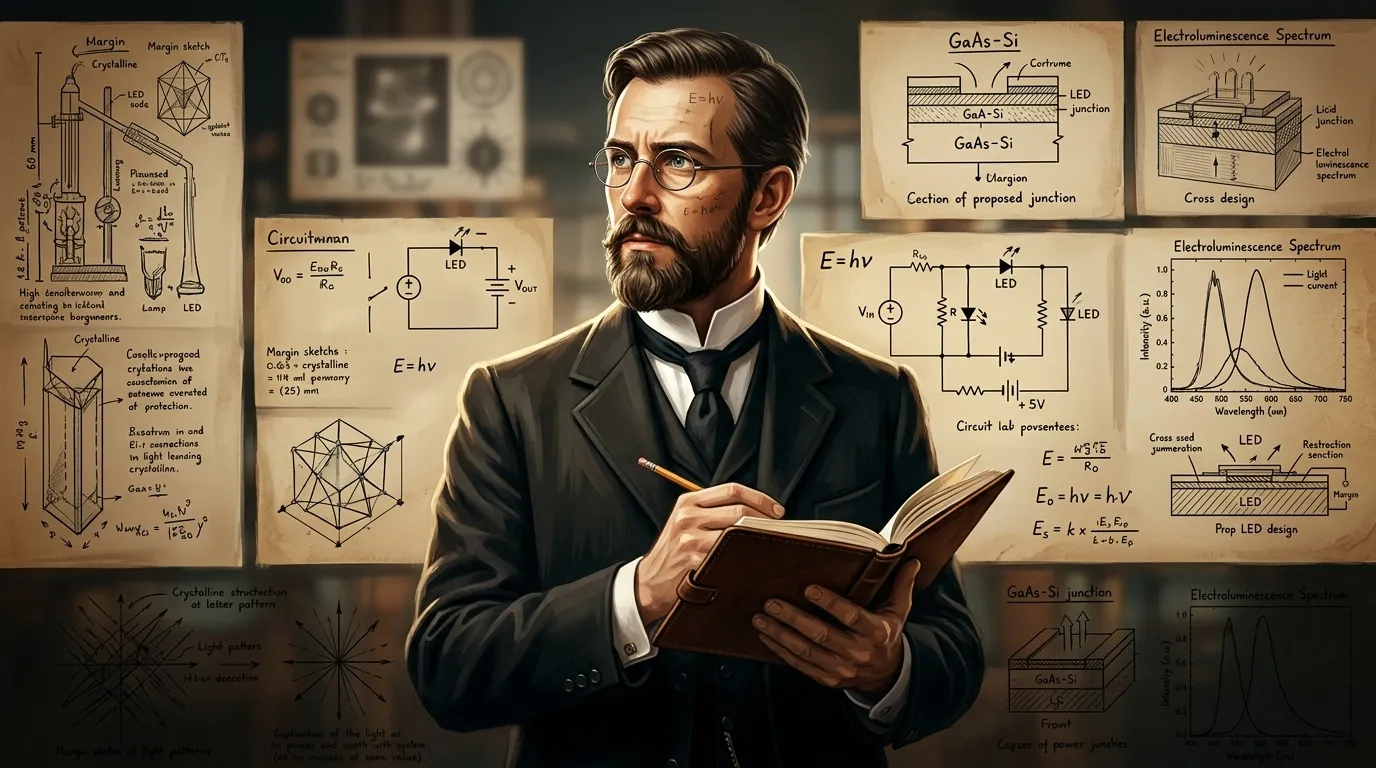
Page 1
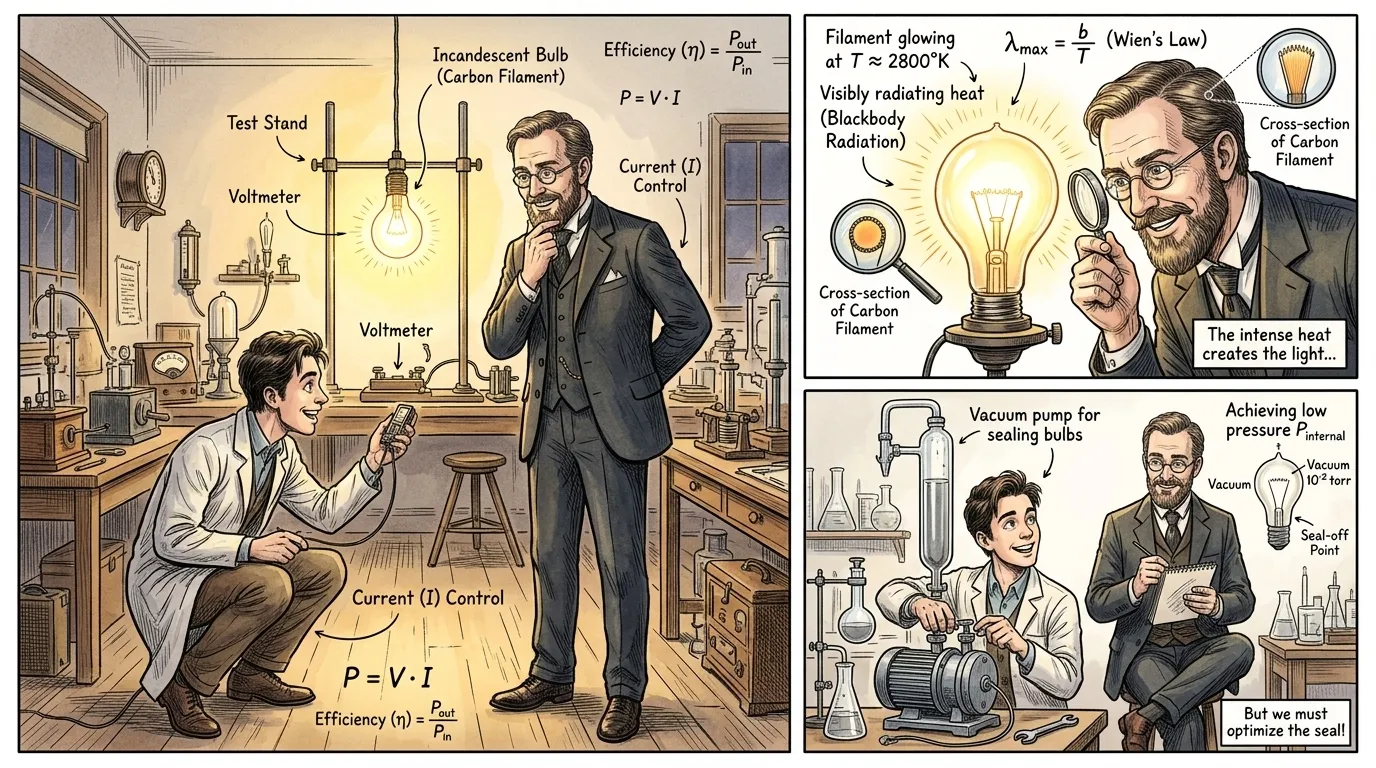
For centuries, humanity relied on combustion for light. By the late 19th century, the incandescent light bulb had revolutionized visibility, but at a tremendous cost: heat. These bulbs converted only a fraction of electrical energy into visible light, radiating most away as wasted thermal energy, demanding constant replacement and consuming vast resources. The challenge was clear: how to achieve 'cold light' – illumination without the inherent inefficiency of heating a filament until it glowed white-hot?
"'This constant heat is an unfortunate necessity, isn't it?' remarked a senior engineer, observing a test bulb in a laboratory. 'We're essentially boiling a wire to get a flicker of light; there must be a more elegant solution for the future.' Another added, 'Indeed, if only we could bypass the incandescence entirely, perhaps harness a different property of electricity to produce light directly.'"
Page 2
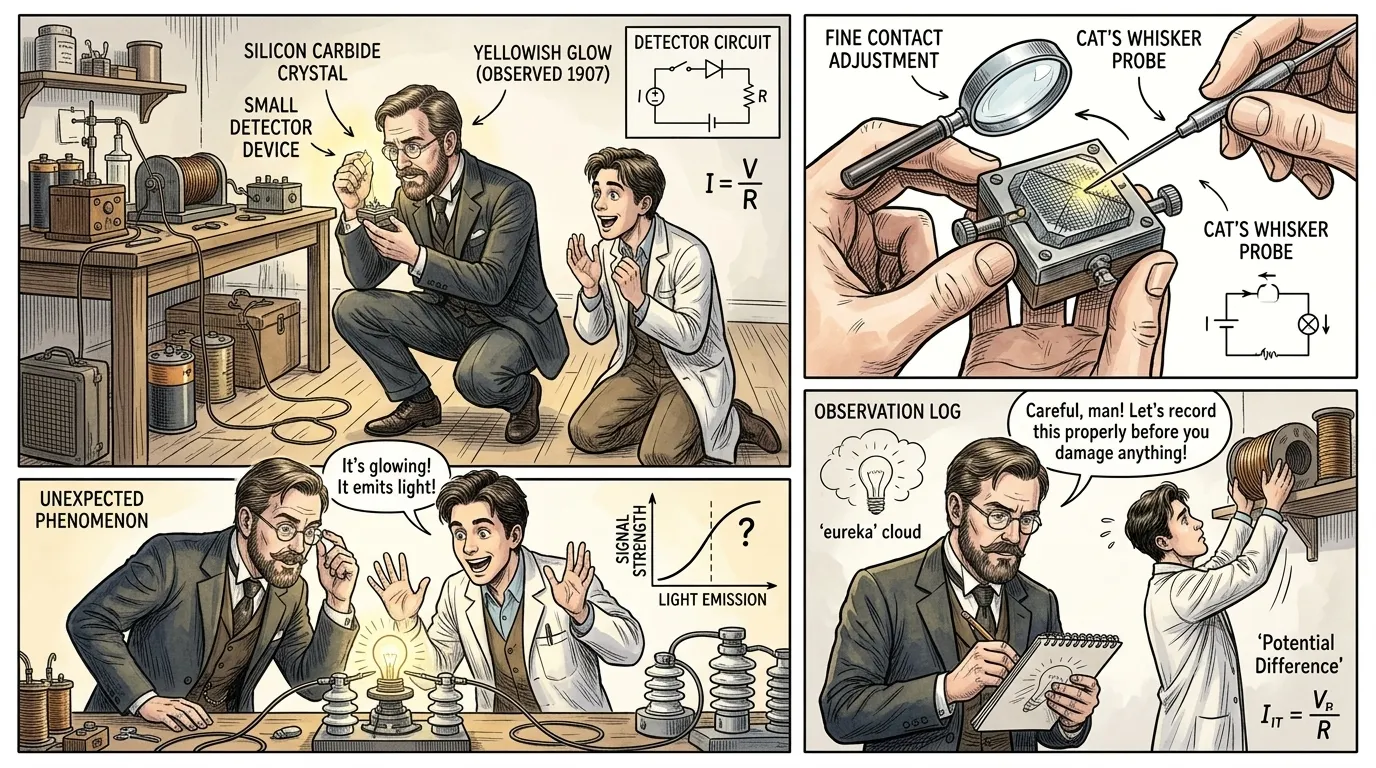
Long before a practical alternative, faint hints of direct light emission from electrical current appeared in scientific observations. In 1907, British radio pioneer Henry Joseph Round, while experimenting with crystal detectors, noted a peculiar yellowish glow emanating from a silicon carbide crystal when a voltage was applied. This phenomenon, later termed electroluminescence, intrigued researchers, suggesting that certain materials could directly convert electrical energy into light, but its unpredictable nature and extreme faintness made it a laboratory curiosity rather than a viable technology. Round's discovery initiated a quiet but persistent scientific inquiry into this enigmatic 'cold light.'
"'Look, Mr. Round, this silicon carbide crystal is emitting a faint glow again!' exclaimed an assistant, leaning over the workbench. Round, a man with a focused gaze and spectacles, replied, 'Indeed, it's barely perceptible, but distinct. This is not heat, it is something else entirely – a direct conversion, perhaps? The potential is immense if we could ever control it.'"
Page 3
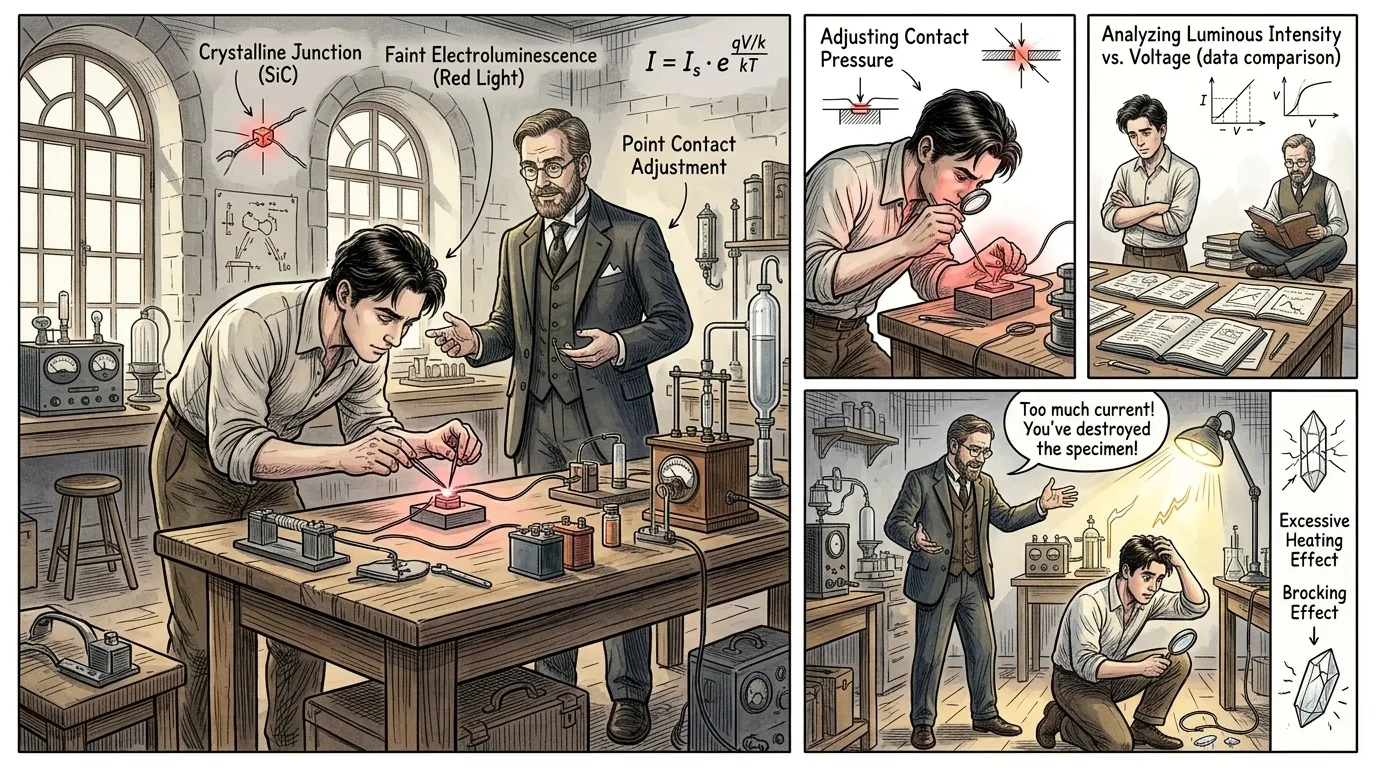
Decades later, in the Soviet Union, Oleg Losev, a brilliant radio technician, systematically investigated this elusive electroluminescence. Working in a Leningrad laboratory in the 1920s, Losev observed consistent light emission from zinc oxide and silicon carbide point-contact junctions, demonstrating a controlled direct conversion of electrical current into light. His 1927 papers detailed what we now recognize as the first light-emitting diode (LED), though it primarily emitted infrared or very faint red light, unsuitable for practical illumination at the time. Losev's work laid the foundational knowledge, identifying the critical role of the 'p-n junction' in this luminescent process.
"Losev, a young, intensely focused man with dark hair, meticulously adjusted a delicate wire on a crystal. He murmured, 'The current flows, and the light persists. This junction, where the materials meet, is where the magic truly happens, isn't it?' A senior scientist, observing, responded, 'Yes, Oleg, the electrons are compelled to recombine here, releasing their energy. This 'p-n junction' is the key. Your findings prove that directly converting electrical energy into light is fundamentally possible, paving the way for something far beyond our present understanding.'"
Page 4
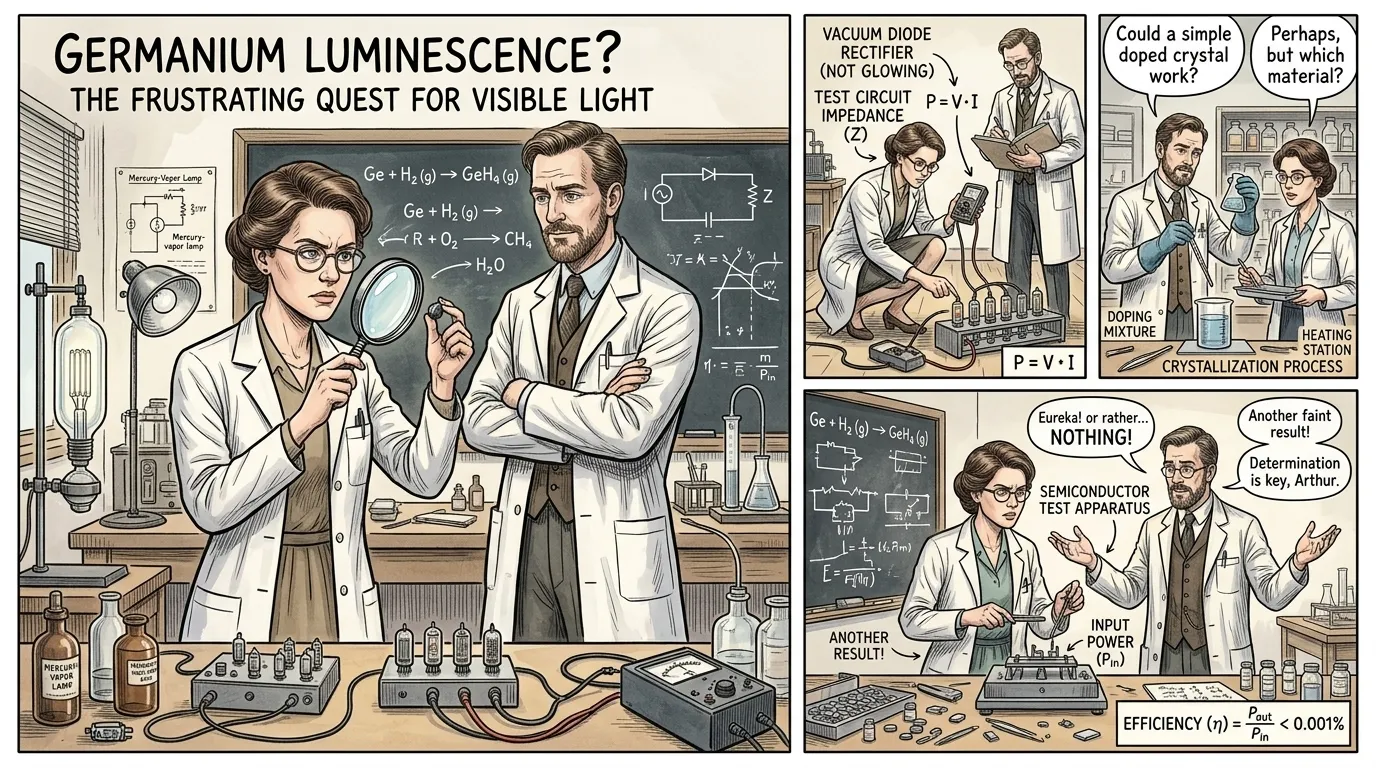
Following Losev's early findings, the path to practical, visible LEDs proved arduous. The scientific community grappled with understanding the intricate quantum mechanics of electroluminescence and, crucially, identifying semiconductor materials that could emit light in the visible spectrum with sufficient brightness. For decades, researchers experimented with numerous compounds, from germanium to various alloys, encountering limitations in crystal purity, doping techniques, and the fundamental band gap properties required to produce different colors. Each attempt underscored the complexity of engineering light at the atomic level.
"'This germanium still yields nothing but heat, barely a whisper of infrared,' lamented Dr. Evelyn Reed, a determined woman in a lab coat, examining a failed experiment in the late 1940s. Her colleague, Dr. Arthur Vance, replied, 'The band gap simply isn't wide enough for visible photons. We need entirely different materials, Evelyn. Materials that force electrons to shed more energy when they recombine across the p-n junction.' 'But finding such compounds, and then synthesizing them with sufficient purity, that is the true mountain we face,' Reed added, gesturing to a shelf filled with untested semiconductor samples."
Page 5
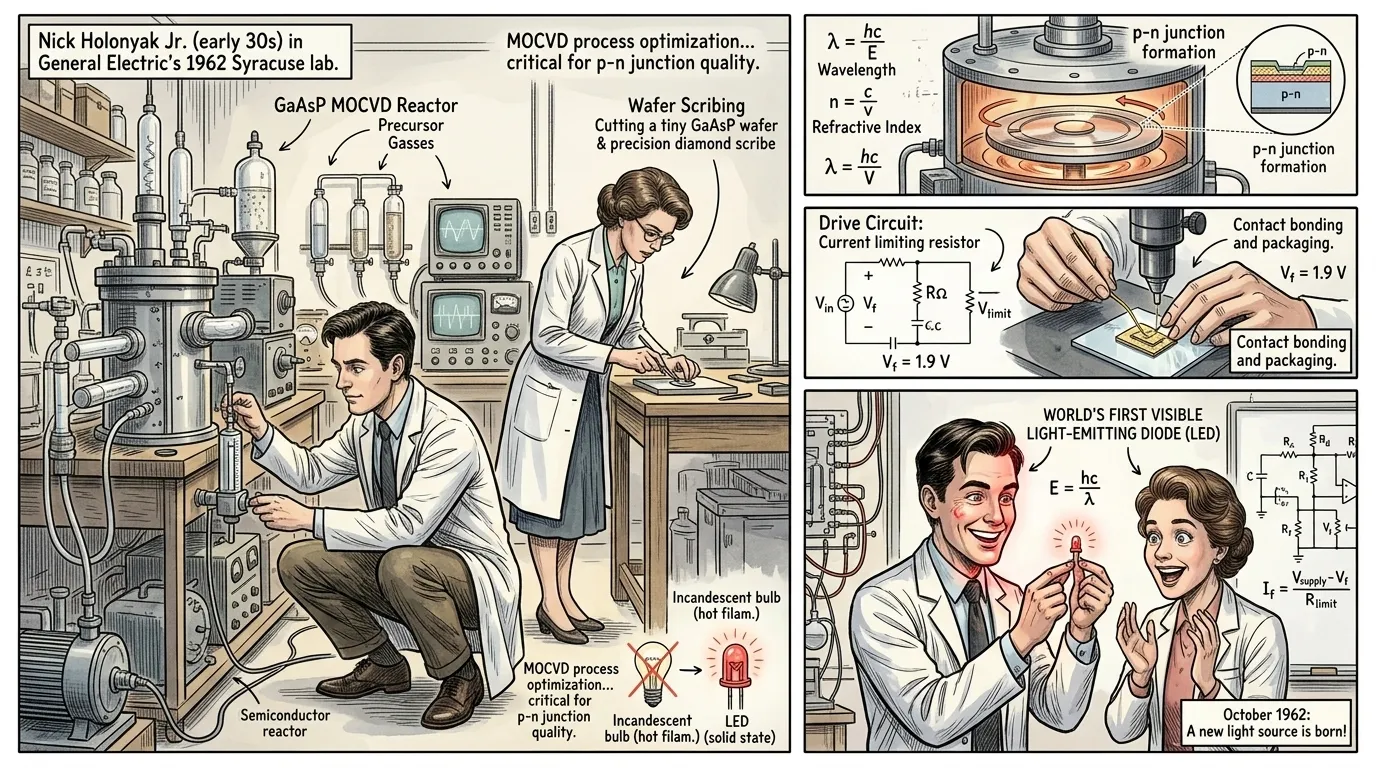
The breakthrough that transformed LEDs from scientific curiosity to technological potential arrived in 1962. Nick Holonyak Jr., working at General Electric's Syracuse lab, engineered a new alloy of gallium arsenide phosphide (GaAsP). This material possessed the precise band gap properties to emit photons in the visible red spectrum when current passed through its p-n junction. Holonyak's diode was the first practical LED, a device that reliably produced visible light, marking a pivotal moment in the development of solid-state lighting and opening the door for its eventual commercialization in indicator lights and digital displays.
"Holonyak, a dynamic man in his early 30s with neatly combed dark hair, held up a tiny, glowing device. He exclaimed, 'It works! A stable, visible red light from gallium arsenide phosphide! This is it!' A beaming colleague, Dr. Martha Jones, replied, 'Nick, this is extraordinary! After so many years, we've finally achieved a controllable, visible emission. This isn't just a flicker; it's a true step forward!' Holonyak nodded, 'Indeed. This 'cold light' finally delivers on its promise, a testament to understanding the p-n junction's potential.'"
Page 6
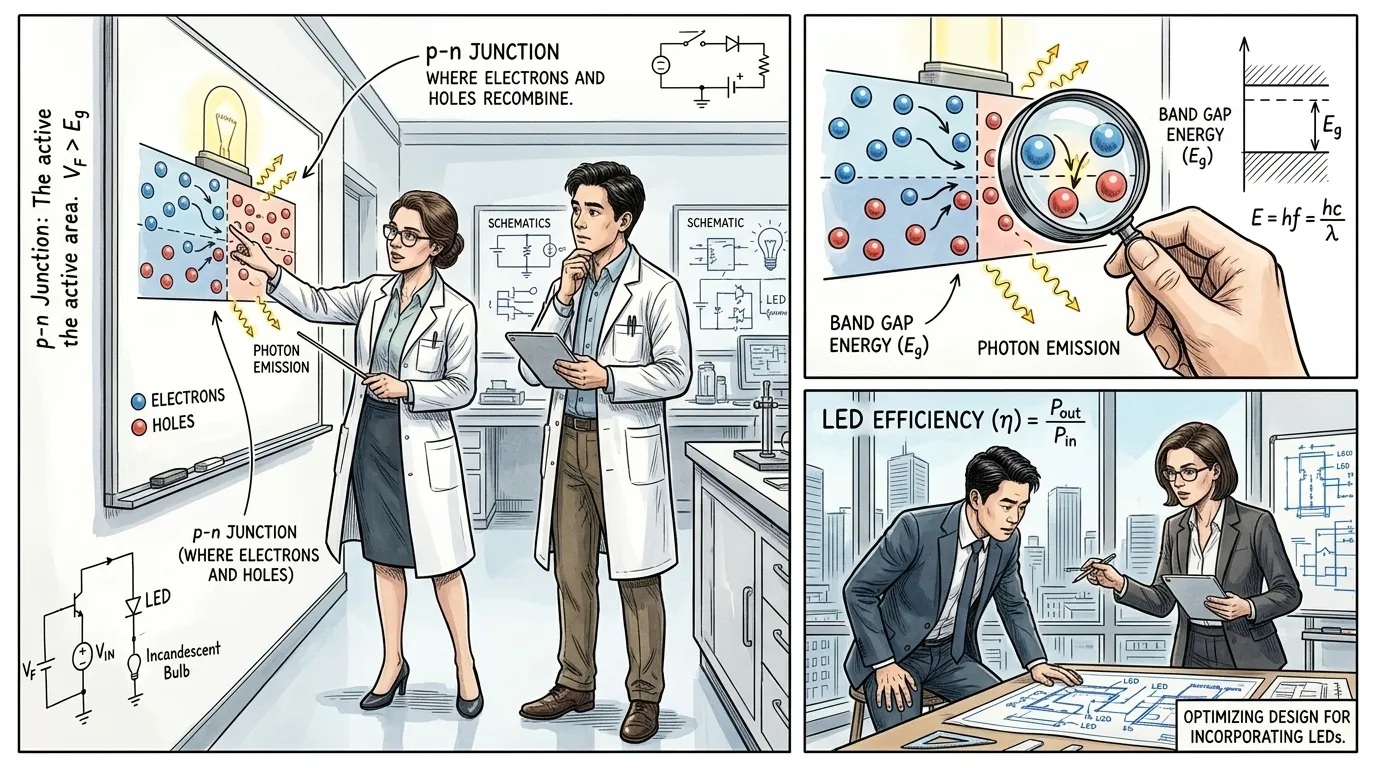
At its core, an LED operates on a principle of quantum mechanics. It is a semiconductor device that features a 'p-n junction.' The 'p-type' material has a surplus of positively charged 'holes,' while the 'n-type' material has an excess of negatively charged 'electrons.' When a voltage is applied, electrons from the n-side are pushed across the junction into the p-side, and holes from the p-side move into the n-side. At the junction, these electrons and holes recombine. This recombination releases energy in the form of photons—packets of light. The specific semiconductor material determines the energy difference (band gap) between the electron and hole, which in turn dictates the energy of the emitted photons, and thus the color of the light.
"'Observe this diagram closely,' explained Dr. Eleanor Vance, a lead engineer, pointing to a cross-section of an LED. 'When we apply voltage, electrons, shown as these blue spheres, are driven from the N-type material across this central junction into the P-type material, where they meet positively charged 'holes.' This is the core of the p-n junction we discussed.' Her junior colleague, Mark Chen, responded, 'And it's at that precise moment of recombination, when an electron fills a hole, that the excess energy is released, not as heat, but directly as a photon of light! The band gap truly dictates the color output, a marvelous manipulation of quantum physics.'"
Page 7
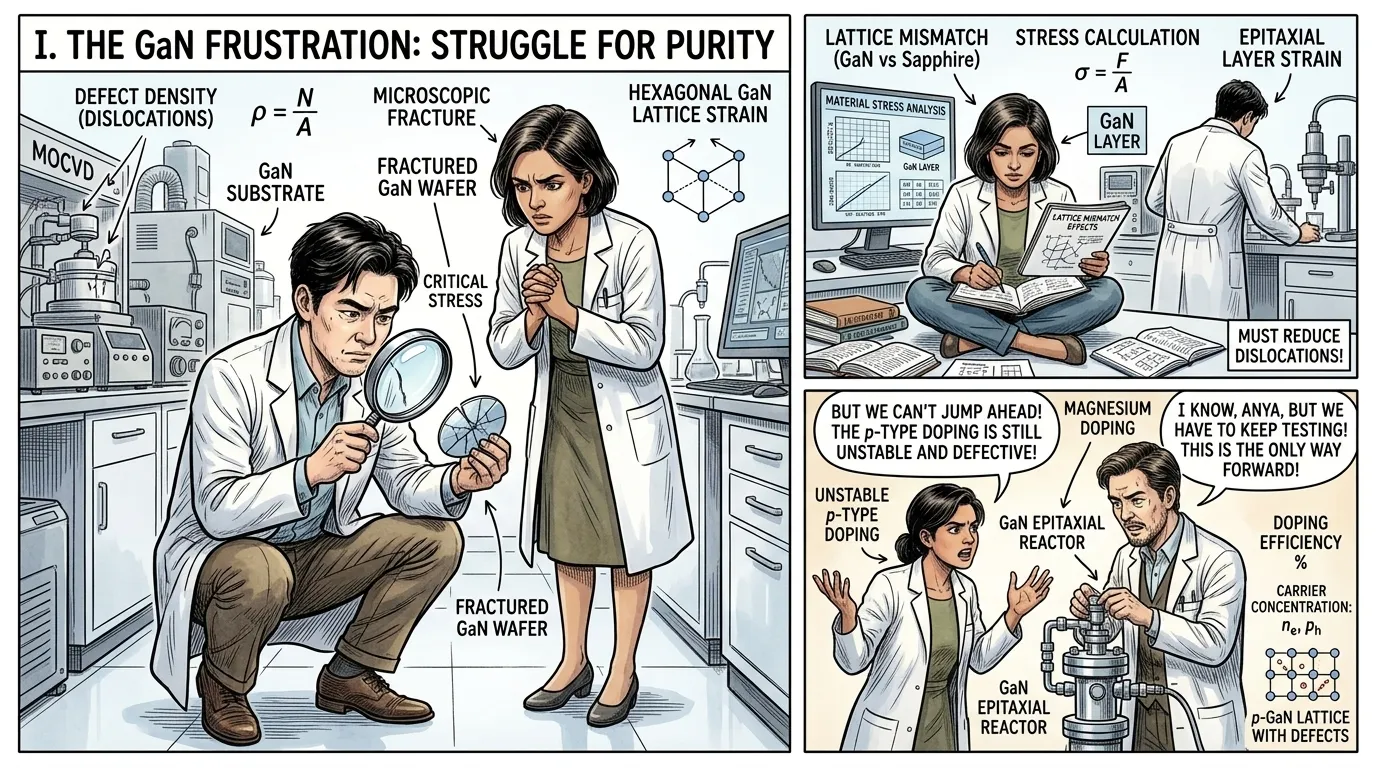
Despite the success of red and later green LEDs, the 'blue problem' remained. Blue light, with its higher energy photons, required a semiconductor material with a significantly wider band gap than GaAsP. Gallium nitride (GaN) was theoretically ideal, but growing high-quality GaN crystals proved incredibly challenging. The material was prone to defects, difficult to dope for p-type conductivity, and incompatible with existing substrate materials. Without an efficient blue LED, white LED lighting and full-color displays were impossible, limiting the technology's widespread adoption and its potential for truly revolutionary impact on global energy consumption.
"'Gallium nitride is the obvious choice, but its crystal growth is a nightmare,' stated Dr. Kenji Tanaka, examining a fractured GaN wafer. 'We need absolute purity, and this material fights us at every turn.' Dr. Anya Sharma, his colleague, added, 'And even if we get the crystal right, creating a stable p-type GaN, the critical half of our p-n junction, feels like chasing a phantom. Without blue, we're stuck in a monochromatic world, unable to unlock the full spectrum of energy-efficient light.'"
Page 8
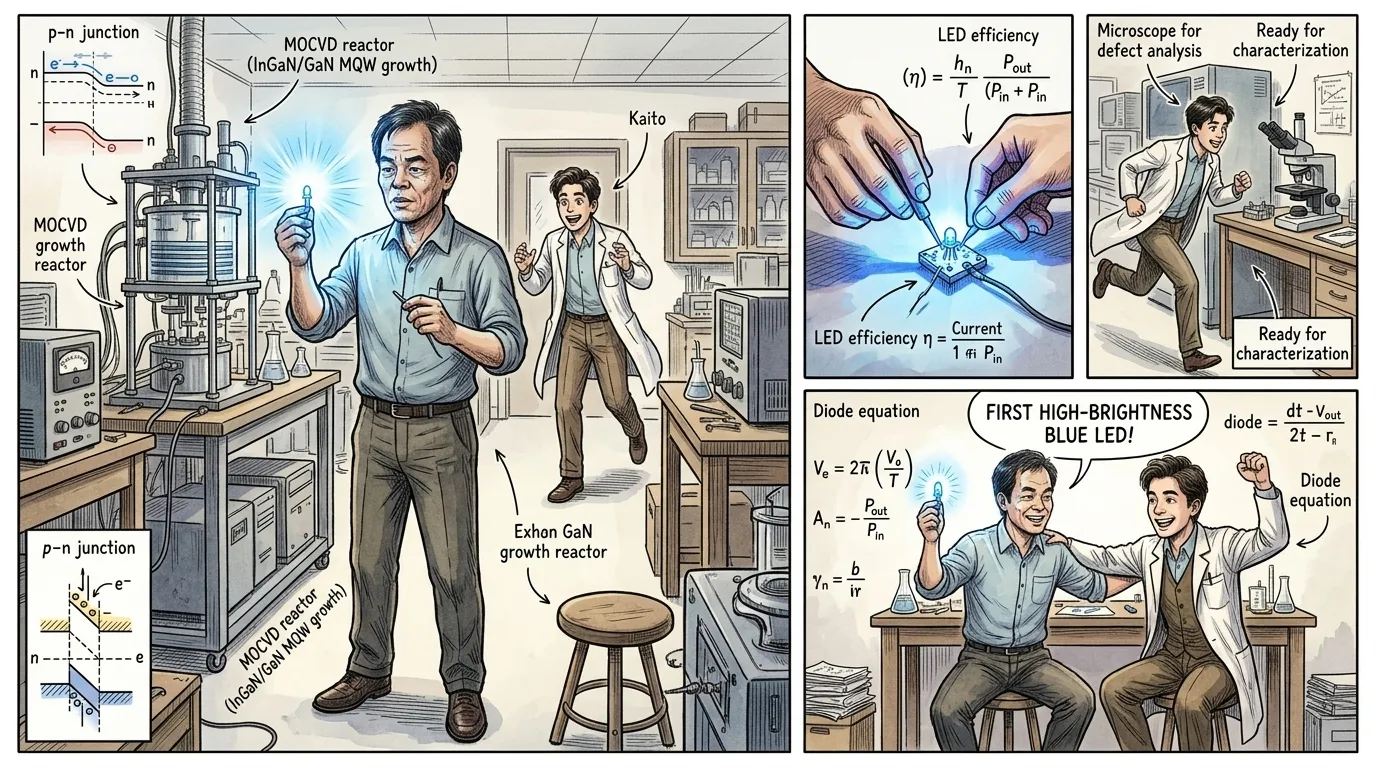
The global quest for blue LED reached its zenith with Shuji Nakamura, a researcher at Nichia Corporation in Japan. Working with relentless determination, often in isolation and against skepticism, Nakamura made a series of critical advancements in gallium nitride crystal growth and p-type doping during the early 1990s. His breakthroughs culminated in the development of the first high-brightness blue LED, a feat that completed the RGB spectrum. This invention, recognized with a Nobel Prize, was the final piece that unlocked white LED lighting and ushered in an era of unprecedented energy efficiency and lighting innovation.
"'After so many failures, so many dismissals, the blue light shines,' Nakamura whispered, his voice tinged with exhaustion and triumph, gazing at the intensely glowing blue LED in his hand. His sole assistant, a young researcher named Kaito, approached, eyes wide. 'Dr. Nakamura, it's truly magnificent. You've defied every expectation.' Nakamura smiled faintly. 'As Marie Curie once said, 'Nothing in life is to be feared, it is only to be understood.' We understood gallium nitride, Kaito. We understood its nature, and now, we have the light.'"
Page 9
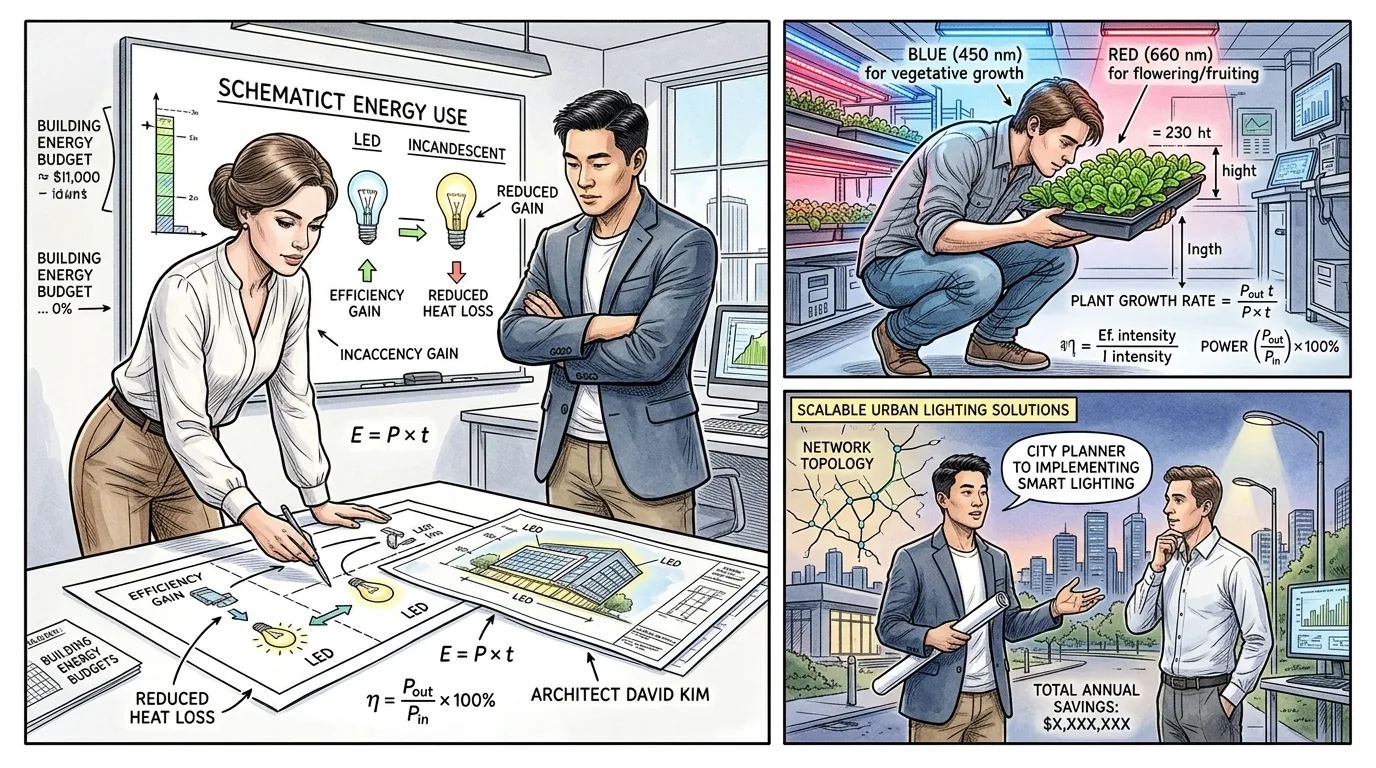
With the advent of the high-brightness blue LED, two primary methods emerged to create white light: combining discrete red, green, and blue LEDs in varying intensities, or, more commonly, coating a blue LED with a yellow phosphor. The phosphor absorbs some of the blue light and re-emits it as yellow, which then mixes with the unabsorbed blue to produce a perception of white light. This innovation, coupled with the inherent energy efficiency of LED technology – converting up to 70% of electricity into light compared to incandescent's 10% – and a lifespan often exceeding 50,000 hours, initiated a global transition away from conventional lighting. The 'cold light' had finally become both practical and profoundly impactful.
"'The energy savings are truly staggering, aren't they?' commented Dr. Lena Petrova, a lighting designer, studying a schematic comparing LED and incandescent energy use. 'Incandescent bulbs were essentially tiny heaters trying to make light. With these LEDs, we're talking about a paradigm shift in efficiency.' Her colleague, Architect David Kim, added, 'And the lifespan! Imagine decades of consistent, reliable illumination from a single fixture. This not only reduces energy waste but also maintenance costs and the environmental burden of manufacturing and disposing of countless conventional bulbs. White light, finally, made sense.'"
Page 10
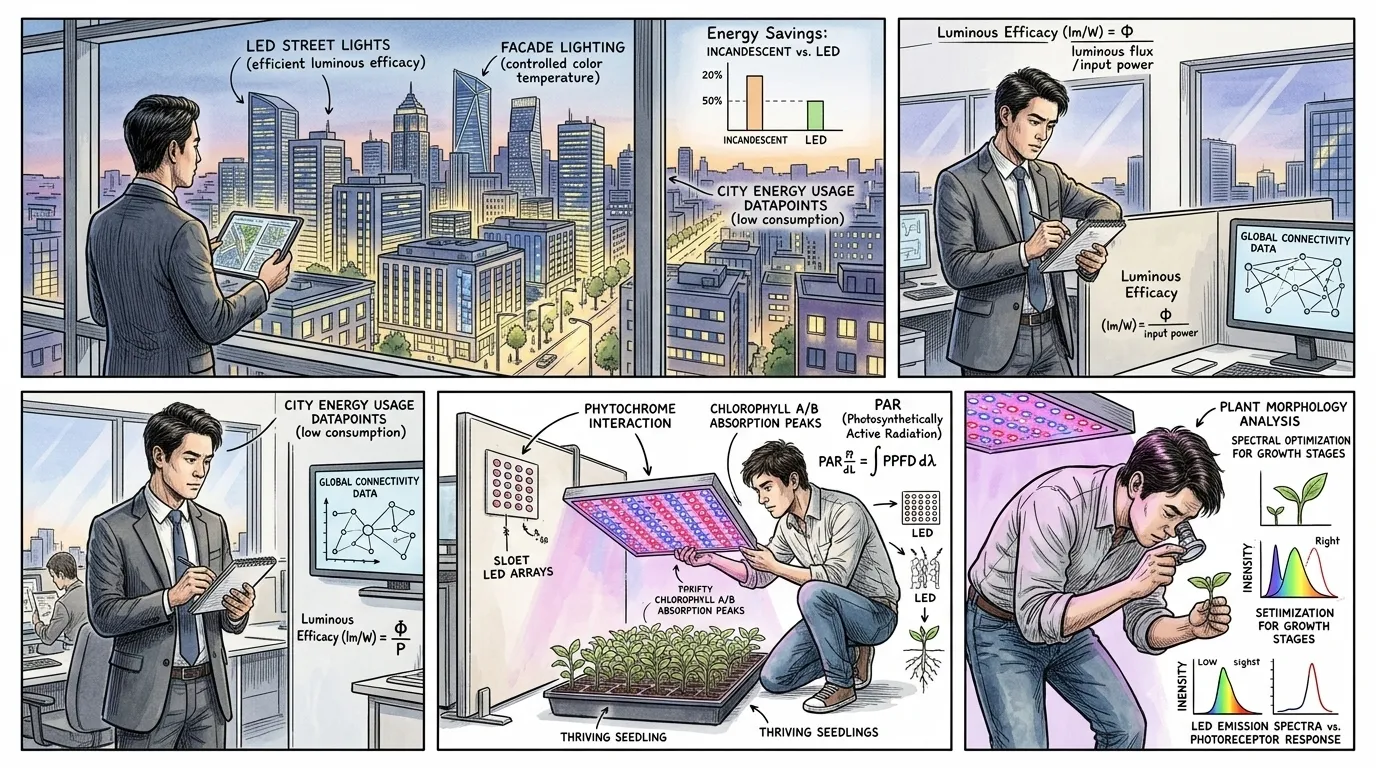
The impact of LED lighting transcends mere illumination; it has reshaped industries, empowered communities, and opened new frontiers. From urban skylines bathed in vibrant, energy-efficient light to off-grid homes in remote regions finally gaining access to reliable evening light, LEDs offer unprecedented flexibility, longevity, and ecological benefits. They drive advanced horticultural systems, enable high-resolution digital displays, underpin innovative Li-Fi communication, and drastically reduce global energy consumption and carbon footprints. The humble diode, once a faint scientific curiosity, now orchestrates a brighter, more sustainable future across the planet, a testament to decades of relentless scientific pursuit.
"'It's incredible to see how a small diode can transform entire cities, making them brighter, safer, and far more sustainable,' reflected a city planner, observing a modern urban landscape. A researcher, working with plant growth, added, 'And beyond cities, LEDs are empowering agriculture, allowing us to precisely tailor light for optimal growth, anywhere, anytime. It's a fundamental shift in how we interact with light.' 'From basic needs to advanced communication,' a third voice chimed in, 'the legacy of LED lighting is a story of profound and ongoing innovation, continuously illuminating new possibilities.'"
About this story
- Location: Global
- Audience: general readers
Questions and answers
Read Wonder Inventions on your phone
Wonder Inventions is available on Android. Get Wonder Inventions on Google Play.