Lithium-ion Battery
Lithium-ion Battery — an illustrated inventions story, set in Global. 10 illustrated pages, free to read on Wonder Inventions.
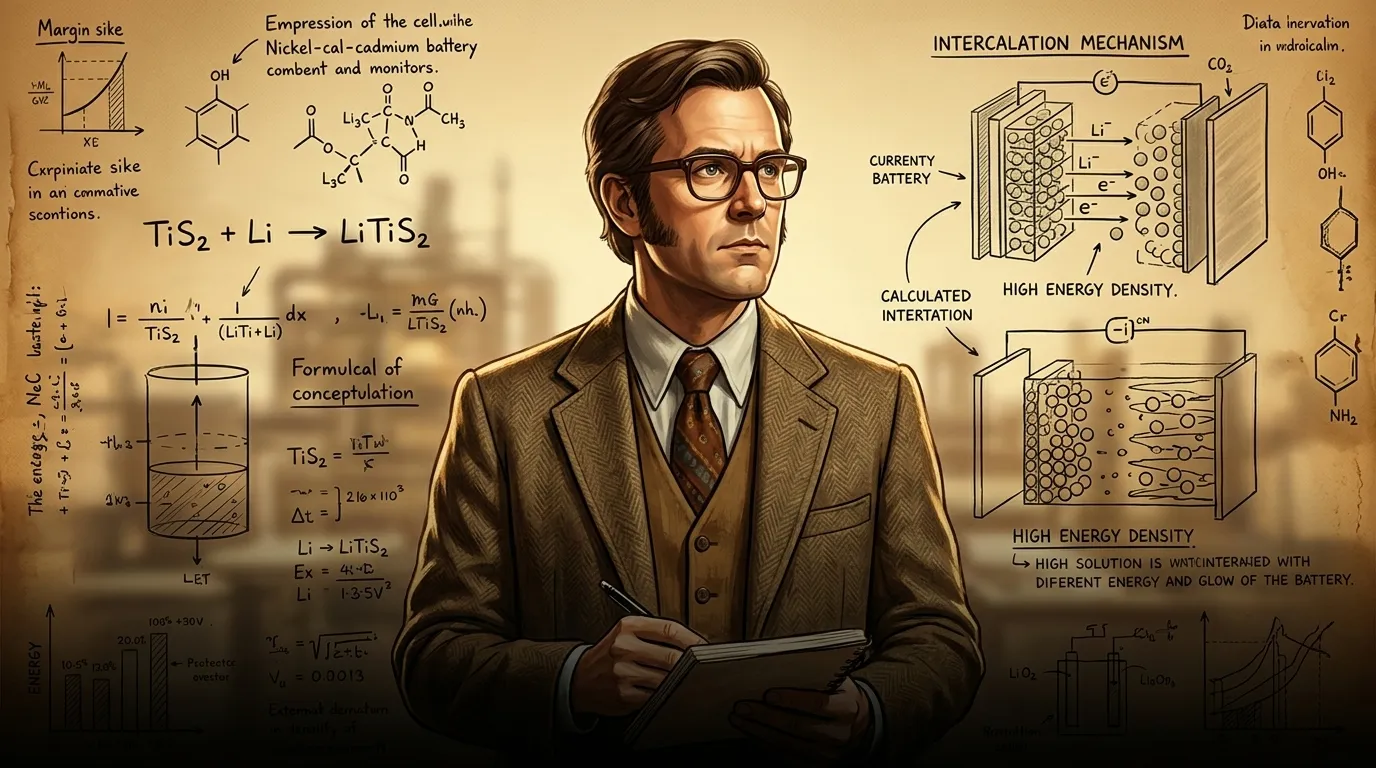
Page 1
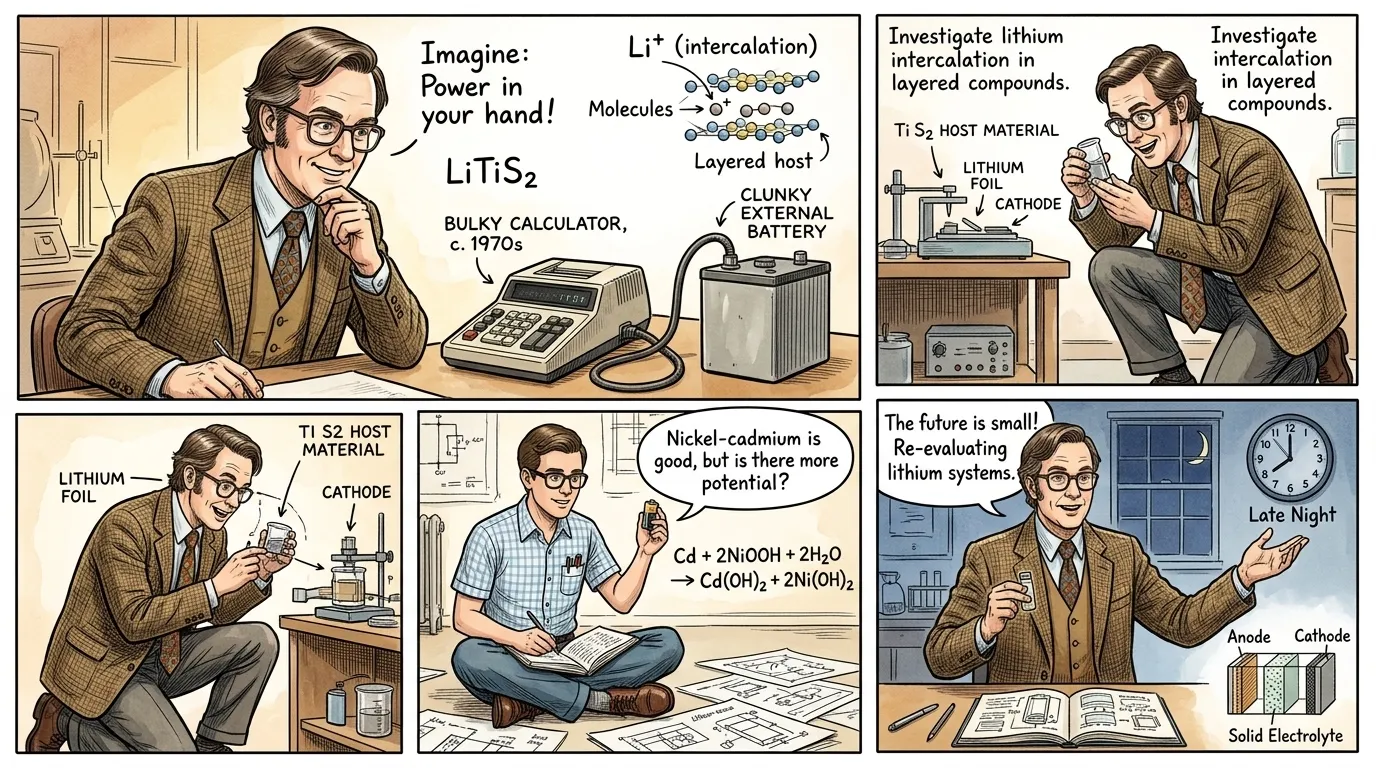
Before the ubiquitous devices of today, power was tethered or fleeting. Early portable electronics were cumbersome, limited by the heavy, inefficient batteries of their era, primarily nickel-cadmium or lead-acid. This fundamental limitation stifled innovation, preventing the widespread adoption of truly mobile computing and communication. The world yearned for a power source that was both lightweight and potent.
"Dr. Whittingham, observing a bulky calculator connected to a large external battery, pondered, "The very concept of 'portable' is hindered by the power source. We need something revolutionary, not merely incremental.""
Page 2
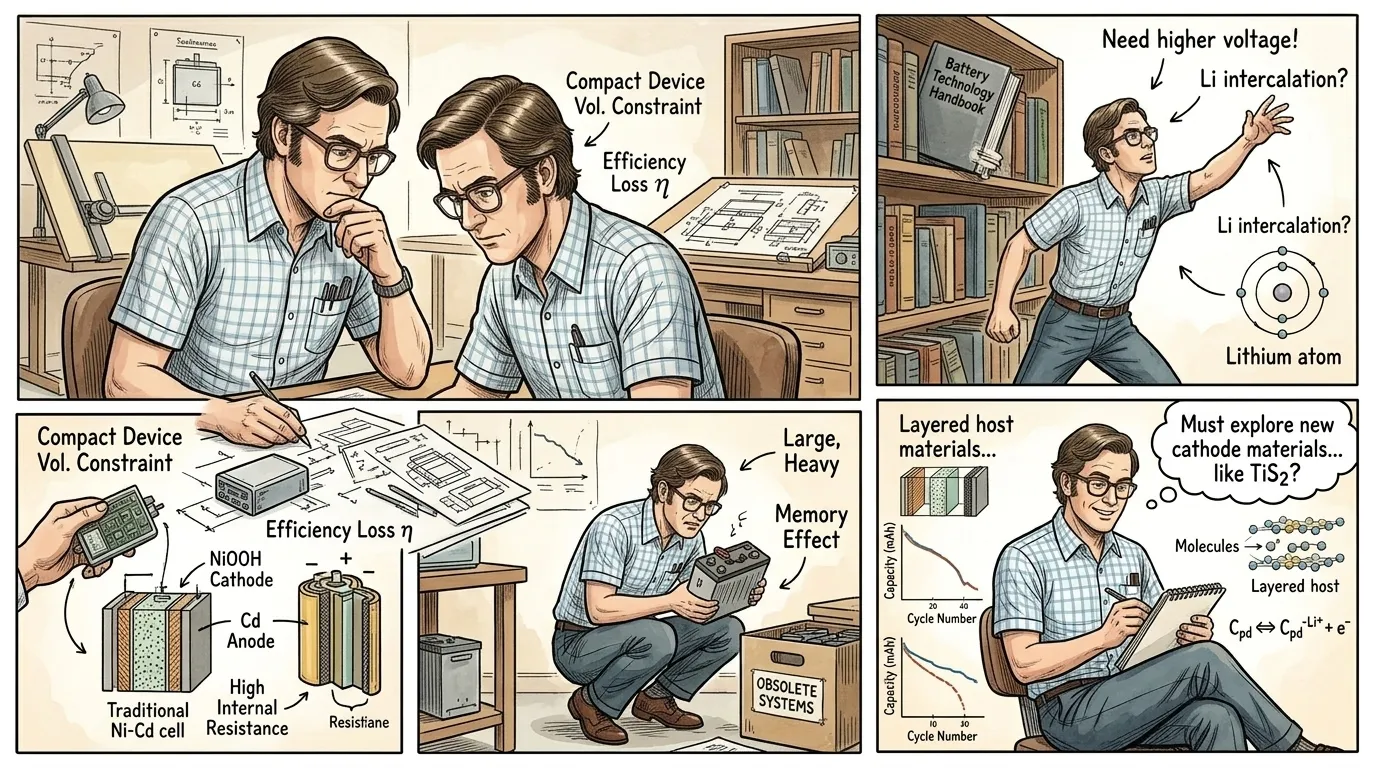
The existing battery technologies presented significant drawbacks. Nickel-cadmium batteries, though rechargeable, suffered from the 'memory effect,' diminishing capacity if not fully discharged. Lead-acid batteries, while robust for automotive starting, were prohibitively heavy and toxic for consumer electronics. Engineers faced a stark choice between energy capacity, weight, and recharge cycles, rarely achieving all three. This dilemma highlighted a critical gap: the world needed a battery that could store substantial energy in a compact, lightweight form, without compromising lifespan.
"An engineer, reviewing schematics of a new device, sighed, "Nickel-cadmium offers some portability, but its energy density just isn't enough for true innovation. And the memory effect? It frustrates users immensely. We need a fundamental shift in chemistry to unlock the next generation of devices.""
Page 3
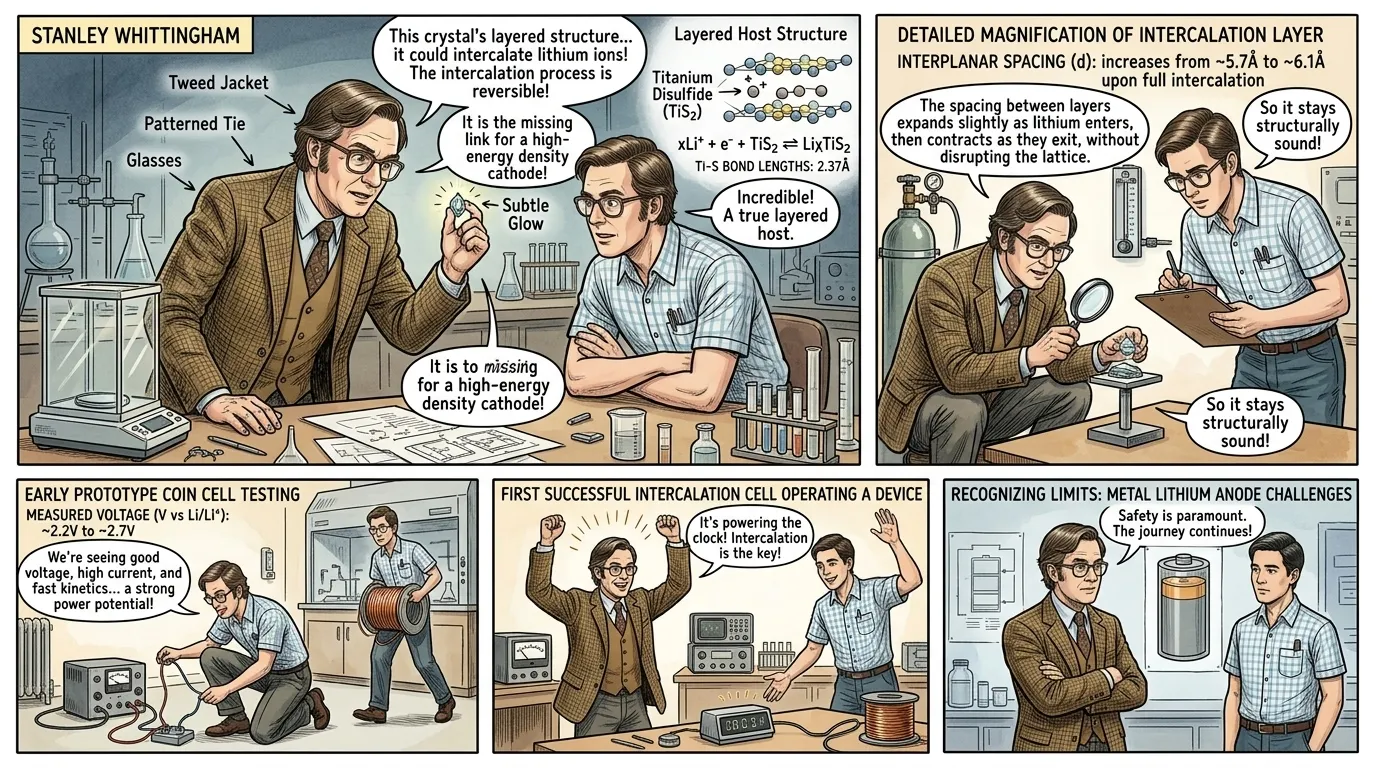
At Exxon, M. Stanley Whittingham pursued a radical idea: instead of depositing metallic lithium, which was highly reactive and prone to dangerous dendrite formation, he envisioned lithium ions 'intercalating' – embedding themselves within – a layered material. His early work utilized titanium disulfide as a cathode, allowing lithium ions to reversibly insert and extract from its crystal lattice. This 'host' material approach promised stability, but the voltage achieved was modest, limiting practical applications. The fundamental challenge lay in finding materials that could safely host more lithium ions at higher voltages.
"Whittingham, holding a small titanium disulfide crystal, explained to a colleague, "The beauty of intercalation is its stability. Lithium ions don't form dangerous metallic deposits; they merely move in and out of the host structure. As the physicist Isaac Newton once famously observed, 'If I have seen further than others, it is by standing upon the shoulders of giants.' We're building on the giants of electrochemistry, but the voltage output with titanium disulfide remains our current giant mountain to climb.""
Page 4
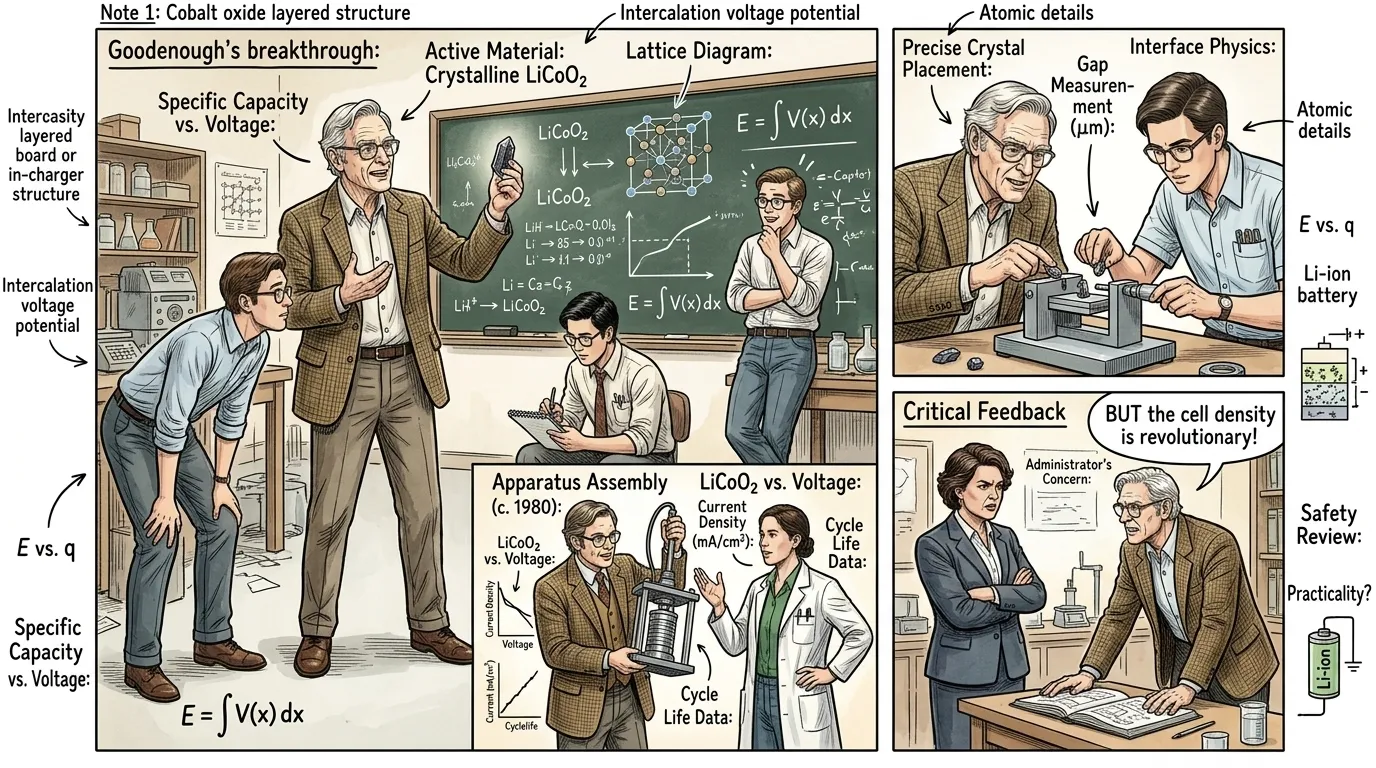
The challenge of achieving higher voltage and greater energy density captivated John B. Goodenough. Working at the University of Oxford in 1980, he theorized that a cathode material containing cobalt oxide (LiCoO2) could offer a significantly higher voltage than titanium disulfide. His insight was groundbreaking: cobalt oxide's atomic structure allowed for more efficient intercalation of lithium ions at a higher electrochemical potential. This critical material innovation unlocked the potential for a truly powerful and lightweight rechargeable battery, dramatically increasing the energy density that Whittingham's initial work had only hinted at.
"John B. Goodenough, a man in his late 50s with a thoughtful expression and receding white hair, presented his findings to a small group of researchers. He stated, "The key lies in the cathode's electronic structure. With lithium cobalt oxide, we can extract lithium ions at almost twice the voltage of Whittingham's titanium disulfide. This isn't merely an improvement; it's a paradigm shift. We're pushing past previous voltage ceilings, opening doors to unprecedented energy storage.""
Page 5
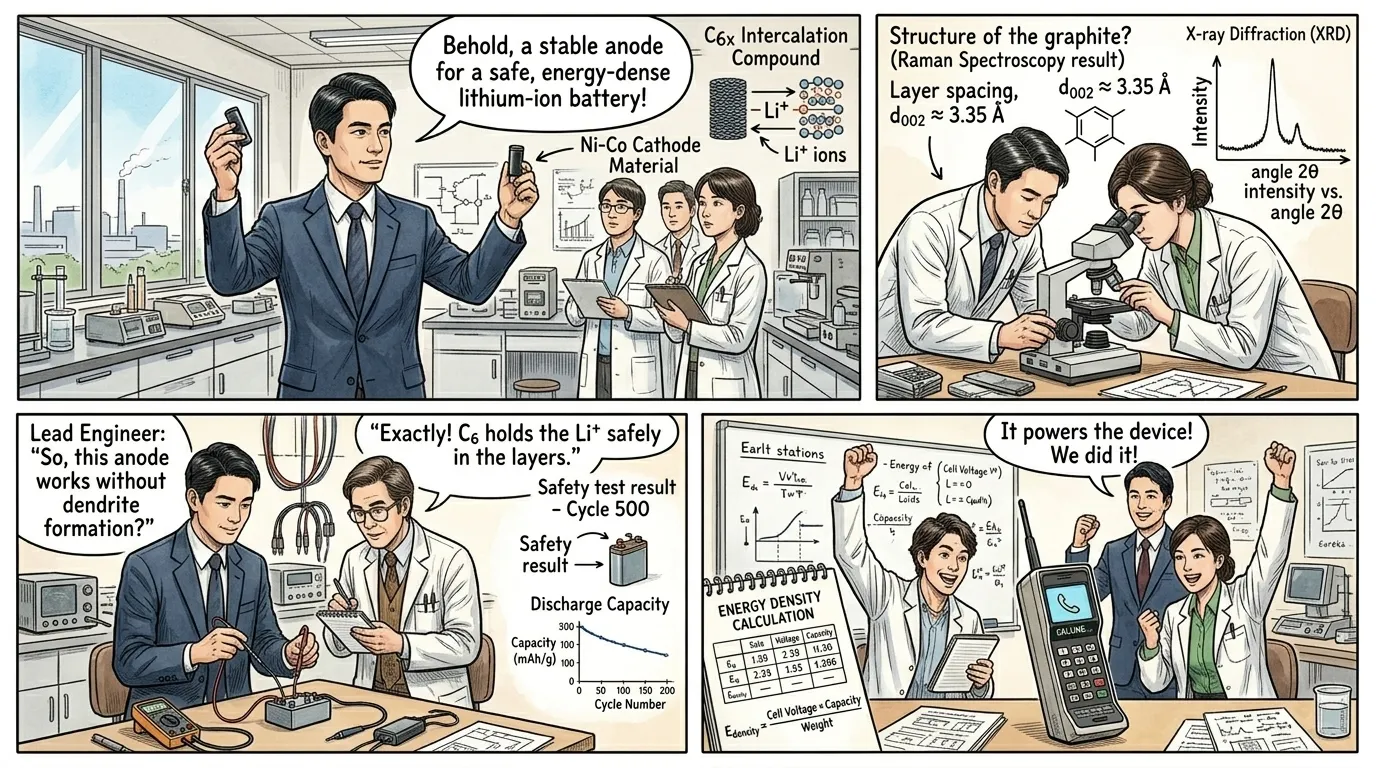
While Goodenough's cathode was a monumental leap, a safe and stable anode remained elusive. Metallic lithium, though energy-rich, posed fire and explosion risks due to dendrite formation. Akira Yoshino, working at Asahi Kasei in Japan in 1985, provided the crucial missing piece. He developed a carbonaceous anode – specifically, petroleum coke – capable of intercalating lithium ions. This innovation allowed for a battery composed entirely of intercalation materials, eliminating hazardous metallic lithium and paving the way for the first commercially viable and safe lithium-ion battery. Yoshino's work transformed a laboratory marvel into a consumer reality.
"Akira Yoshino, a focused man in his late 30s with dark, neatly combed hair, held up a small, dark carbon electrode. He explained to his team, "Our petroleum coke anode is the solution to the safety problem. By allowing lithium ions to intercalate into carbon rather than forming metallic lithium, we've created a battery that is both high-energy and remarkably safe. This unlocks the true commercial potential for portable devices, moving from research curiosity to essential technology.""
Page 6
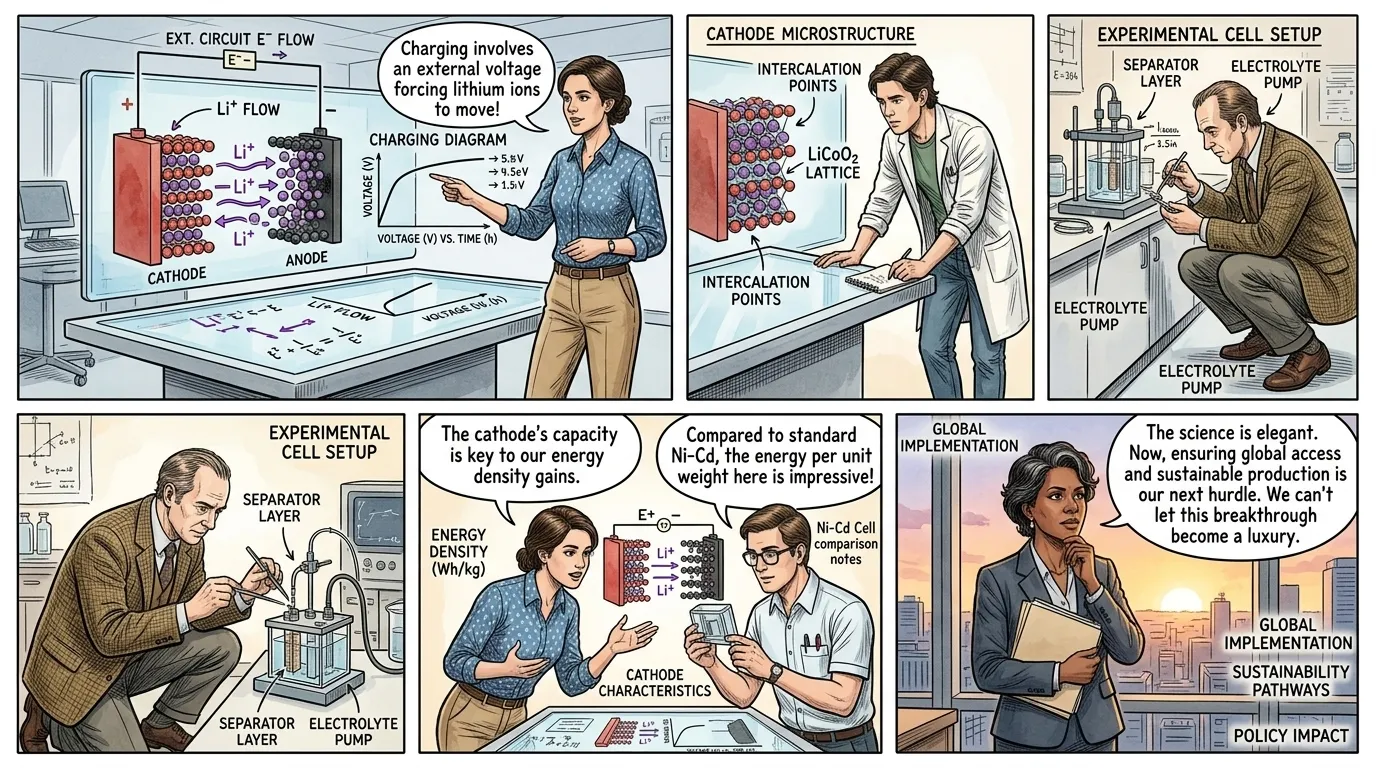
The brilliance of the lithium-ion battery lies in its reversible electrochemical reactions. When charging, an external power source forces lithium ions to move from the cathode (Goodenough's lithium cobalt oxide, for example) through a non-aqueous electrolyte, across a porous separator, and into the layered structure of the anode (Yoshino's carbon material). Simultaneously, electrons are drawn from the cathode, travel through the external circuit, and are stored in the anode. This process stores electrical energy as chemical potential, effectively packing power into the carbon anode.
"A scientist, pointing to an animated diagram of a charging battery, articulated, "Observe the elegant dance. The external power input provides the energy to 'push' the lithium ions into the carbon anode. It's a delicate balance of electrical potential and chemical affinity. The separator is crucial; it prevents direct electron flow, ensuring the ions travel through the electrolyte while the electrons complete the circuit externally, ready to be released upon discharge.""
Page 7
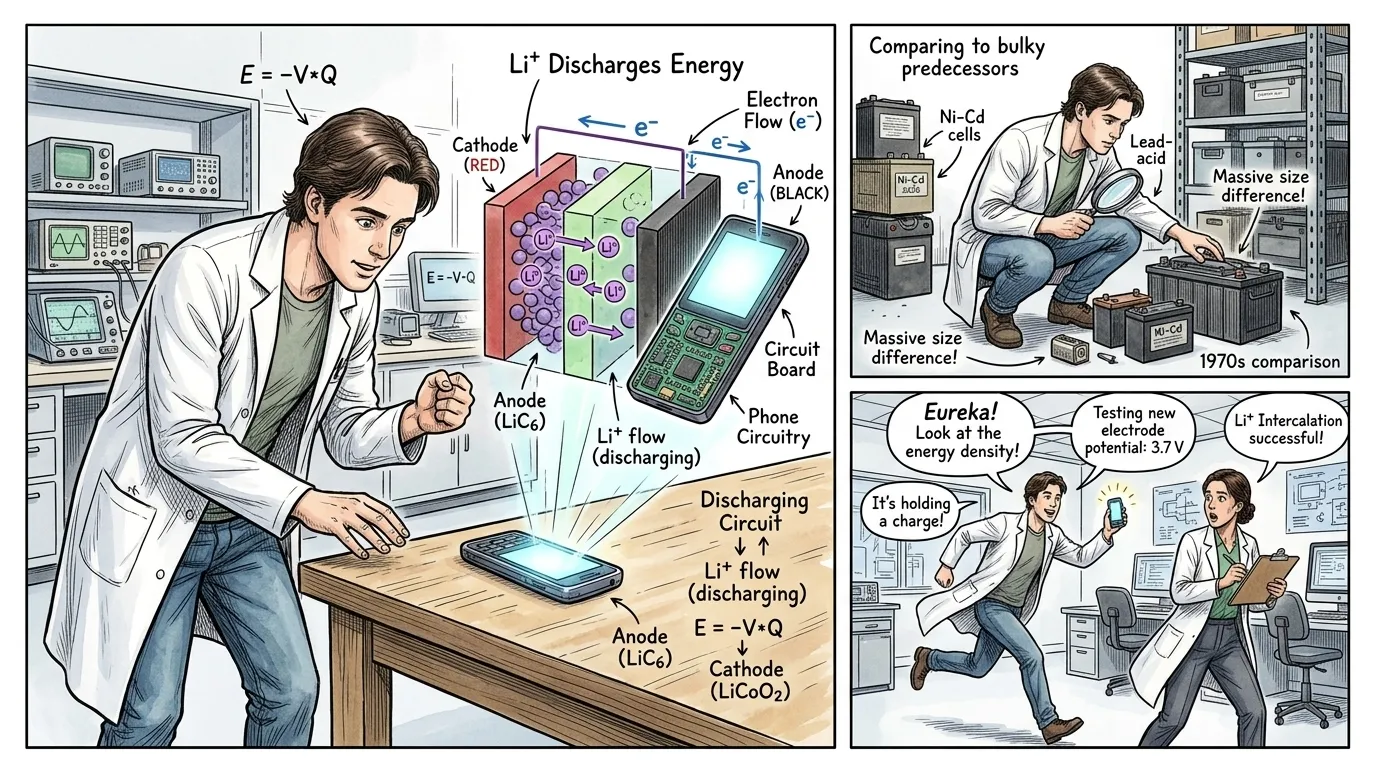
When the battery discharges, the process reverses. The lithium ions, driven by their electrochemical potential, migrate from the anode, through the electrolyte and separator, and back into the cathode. Simultaneously, the stored electrons are released from the anode, flow through the external circuit (powering a device), and return to the cathode to recombine with the lithium ions. This controlled movement of ions and electrons generates a steady electrical current, converting the stored chemical energy back into usable electrical energy. It is a highly efficient and repeatable cycle.
"Another researcher, observing a device being powered, explained, "Now, the stored energy is liberated. The ions move naturally back to the cathode, and in doing so, they compel electrons to flow through our connected device. It's a cascade of potential energy converting to kinetic electrical energy, precisely what we need for everything from a mobile phone to an electric car. This elegant simplicity, combined with high energy density, is its true genius.""
Page 8
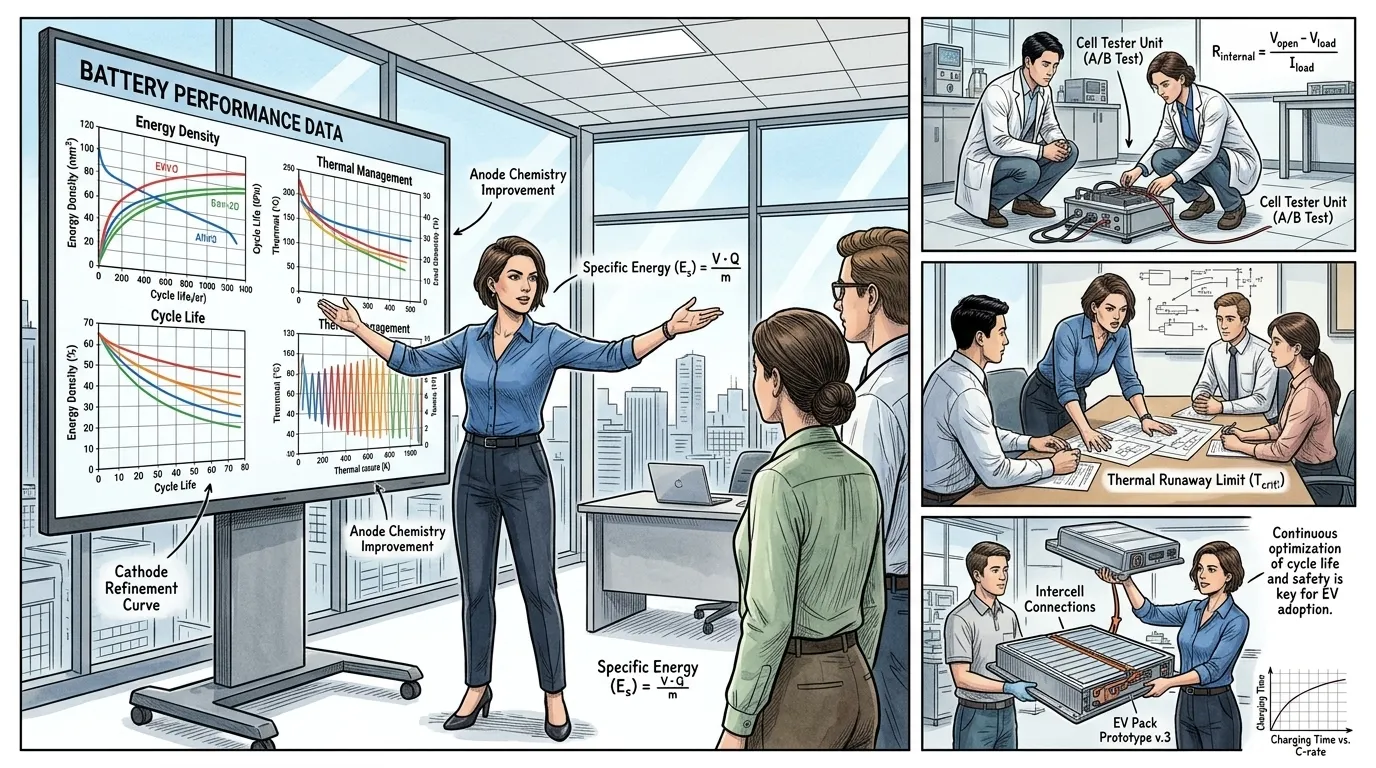
Despite the foundational breakthroughs, the journey of the lithium-ion battery has been one of continuous refinement. Early safety concerns regarding thermal runaway led to improved battery management systems and electrode material innovations. Researchers relentlessly pursue higher energy density, faster charging capabilities, and extended cycle life, exploring various cathode chemistries like nickel-manganese-cobalt (NMC) and lithium iron phosphate (LFP). The goal remains to create even safer, more powerful, and longer-lasting batteries for an increasingly electrified world, demanding constant innovation.
"A lead engineer, gesturing to complex graphs on a computer screen, stated, "We've made immense strides in safety and performance since the initial designs, but the demand for ever-greater energy density and quicker charging cycles never ceases. Each new material, like NMC or LFP, presents its own set of trade-offs and opportunities. We're always pushing the boundaries of what's possible, managing thermal properties and chemical stability, because the next generation of technology depends on it.""
Page 9
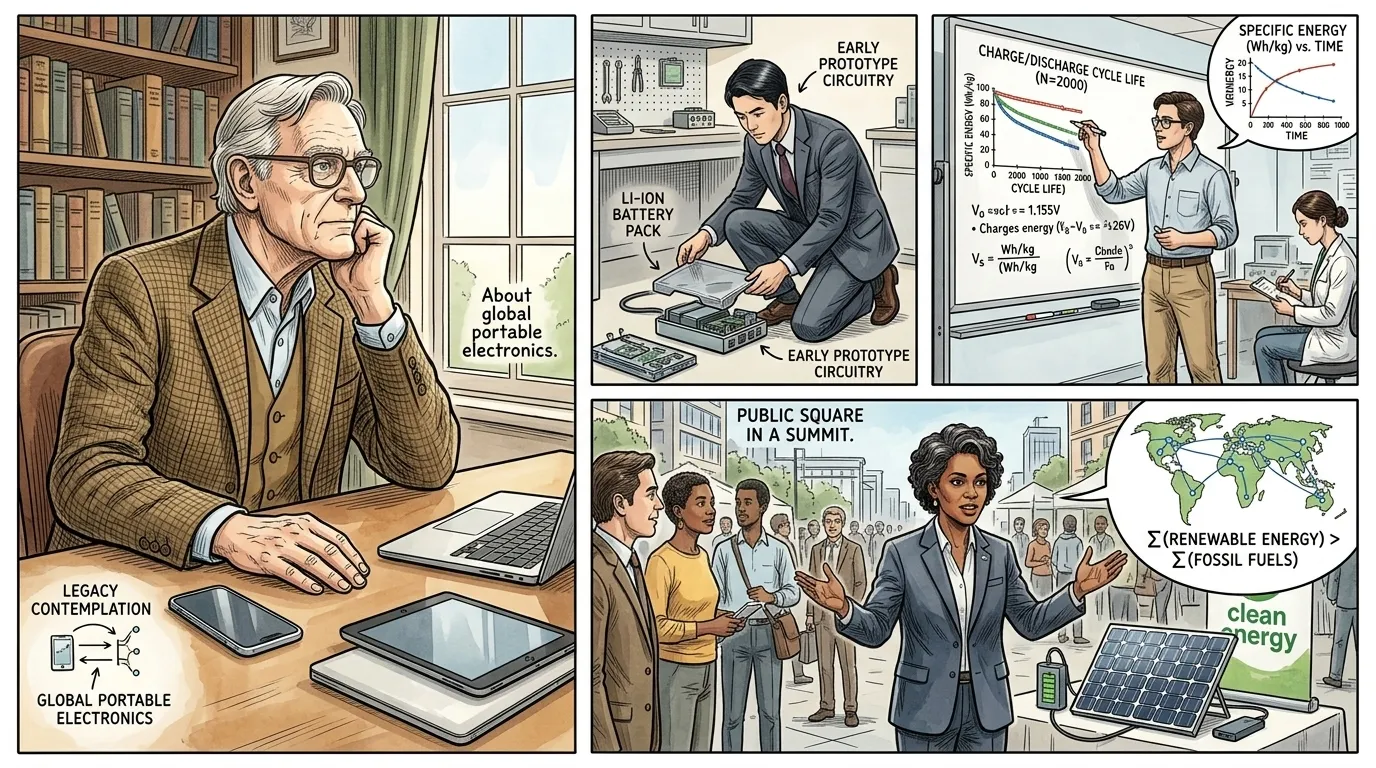
The commercialization of the lithium-ion battery in the early 1990s unleashed an unprecedented revolution in portable electronics. From the clunky mobile phones of the past to the sleek smartphones, laptops, and tablets of today, these batteries became the silent workhorses, providing the compact, high-energy power necessary for widespread adoption. They transformed how people communicate, work, learn, and entertain themselves, enabling true mobility. Without the lithium-ion battery, the digital age, as we know it, would have been severely constrained.
"John B. Goodenough, reflecting in a later interview, mused, "When we began this work, the dream was simply a better battery. To see it power this global transformation, to think that it is in the pocket of nearly everyone on Earth... It truly humbles me. As the Roman philosopher Seneca the Younger wrote, 'Every new beginning comes from some other beginning's end.' Our lithium-ion marked the end of an era of bulky power and the beginning of boundless portable possibility.""
Page 10
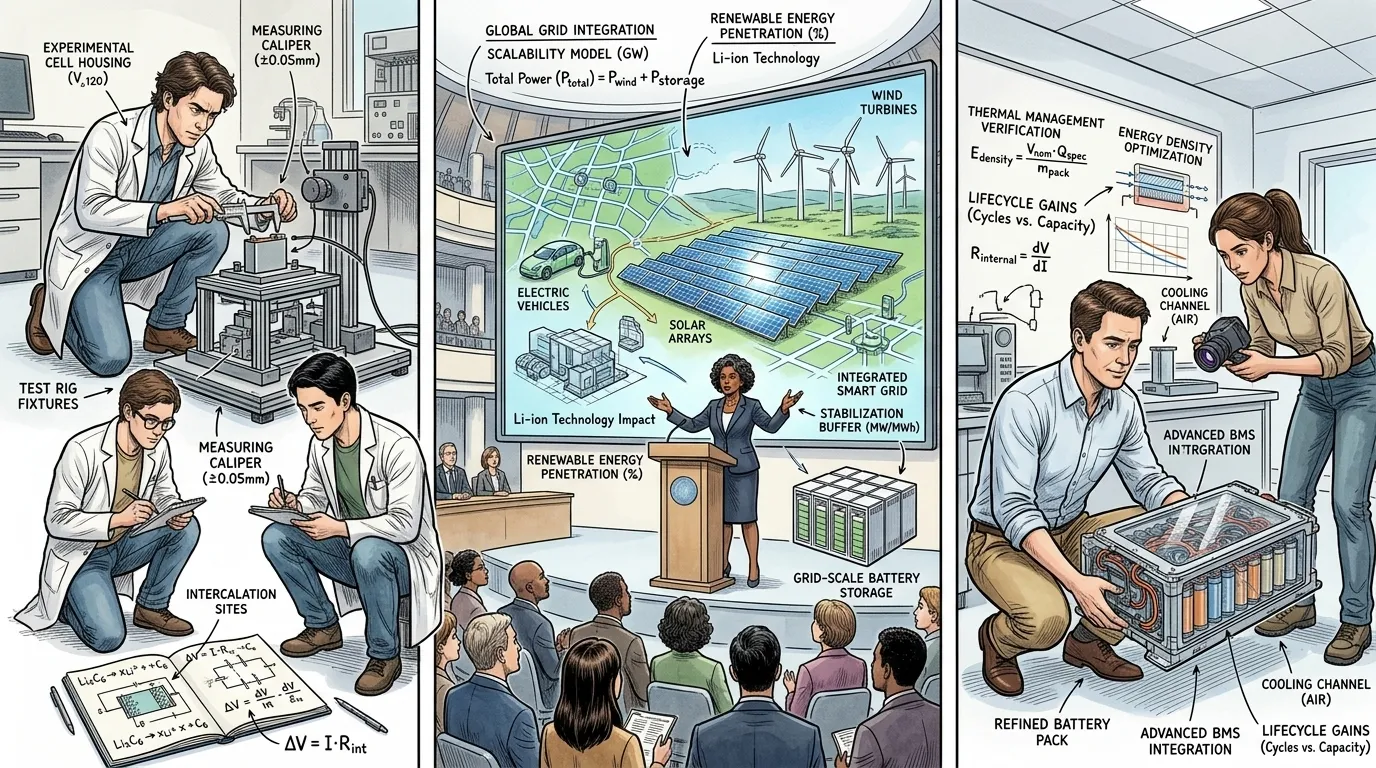
Today, the lithium-ion battery's impact extends far beyond personal electronics. It is the linchpin of the electric vehicle revolution, enabling cleaner transportation and reducing reliance on fossil fuels. It plays a crucial role in grid-scale energy storage, stabilizing renewable energy sources like solar and wind power. As the world moves towards a more sustainable and interconnected future, the demand for advanced energy storage solutions only grows. The lithium-ion battery, a testament to decades of scientific ingenuity, continues to power this transformation, with ongoing research pushing towards next-generation chemistries and applications, shaping our energy landscape for generations to come.
"An energy policy expert, speaking at a global summit, projected, "The true measure of the lithium-ion battery's success is not just what it powers today, but what it enables tomorrow. From our personal devices to our shared energy infrastructure, it's foundational. The future of sustainable energy hinges on continued innovation in storage, building directly upon the remarkable legacy of these pioneers. Our challenge now is to scale this invention to meet global environmental imperatives.""
About this story
- Location: Global
- Audience: general readers
Questions and answers
Read Wonder Inventions on your phone
Wonder Inventions is available on Android. Get Wonder Inventions on Google Play.