Thermometer
Thermometer — an illustrated inventions story, set in Global. 10 illustrated pages, free to read on Wonder Inventions.
Page 1
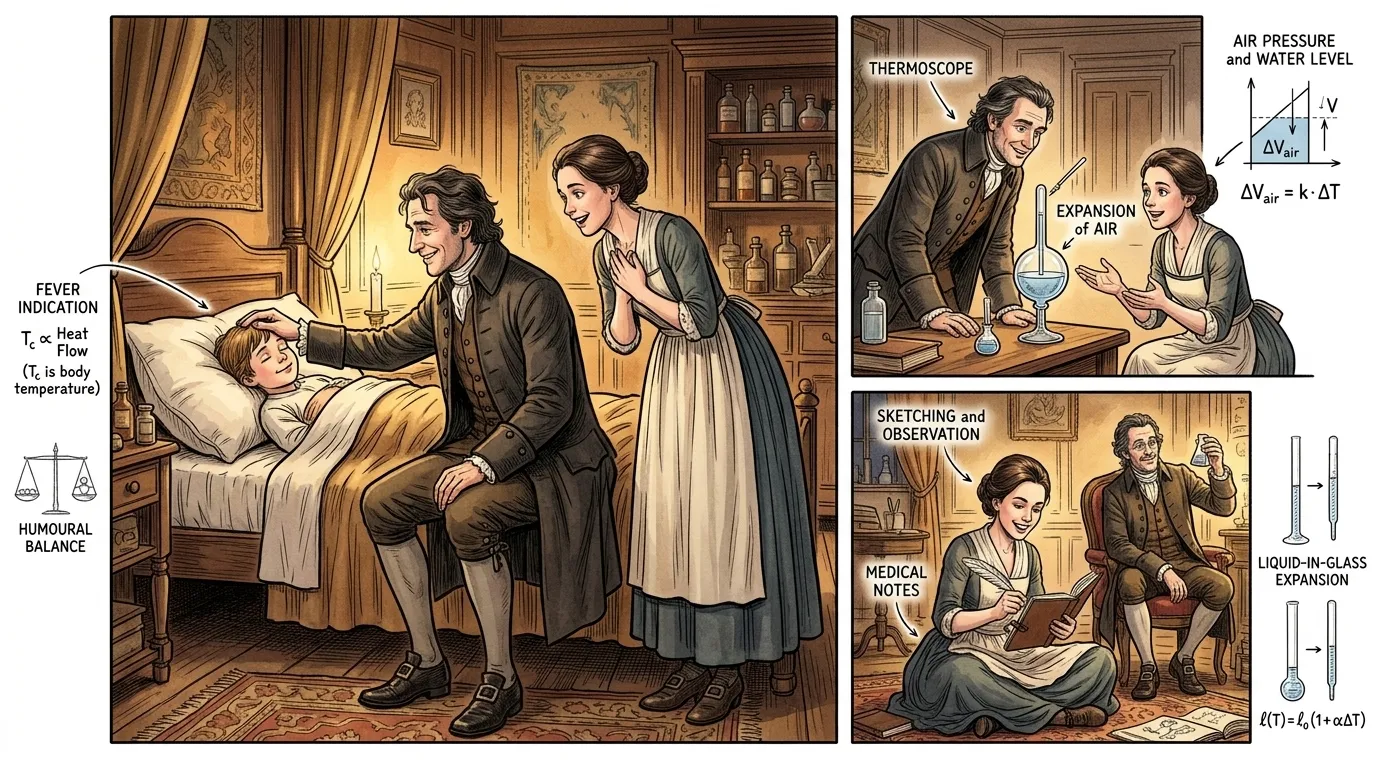
For centuries, the concept of 'heat' within the human body remained an elusive mystery, understood only through subjective touch and vague observation. Early physicians struggled to diagnose fevers with any consistency, relying on imprecise sensations. This profound limitation in objective measurement severely hampered medical understanding and treatment.
""The patient burns with an unseen fire," Dr. Alistair Finch sighed, feeling the brow of his ailing charge. "But how hot, exactly? My hand tells me much, yet reveals so little precise information." Elara Vance, his thoughtful assistant, gestured towards a peculiar glass device. "Perhaps Galileo's 'thermoscope' offers a glimpse, Doctor, though its readings are as temperamental as the winter winds.""
Page 2
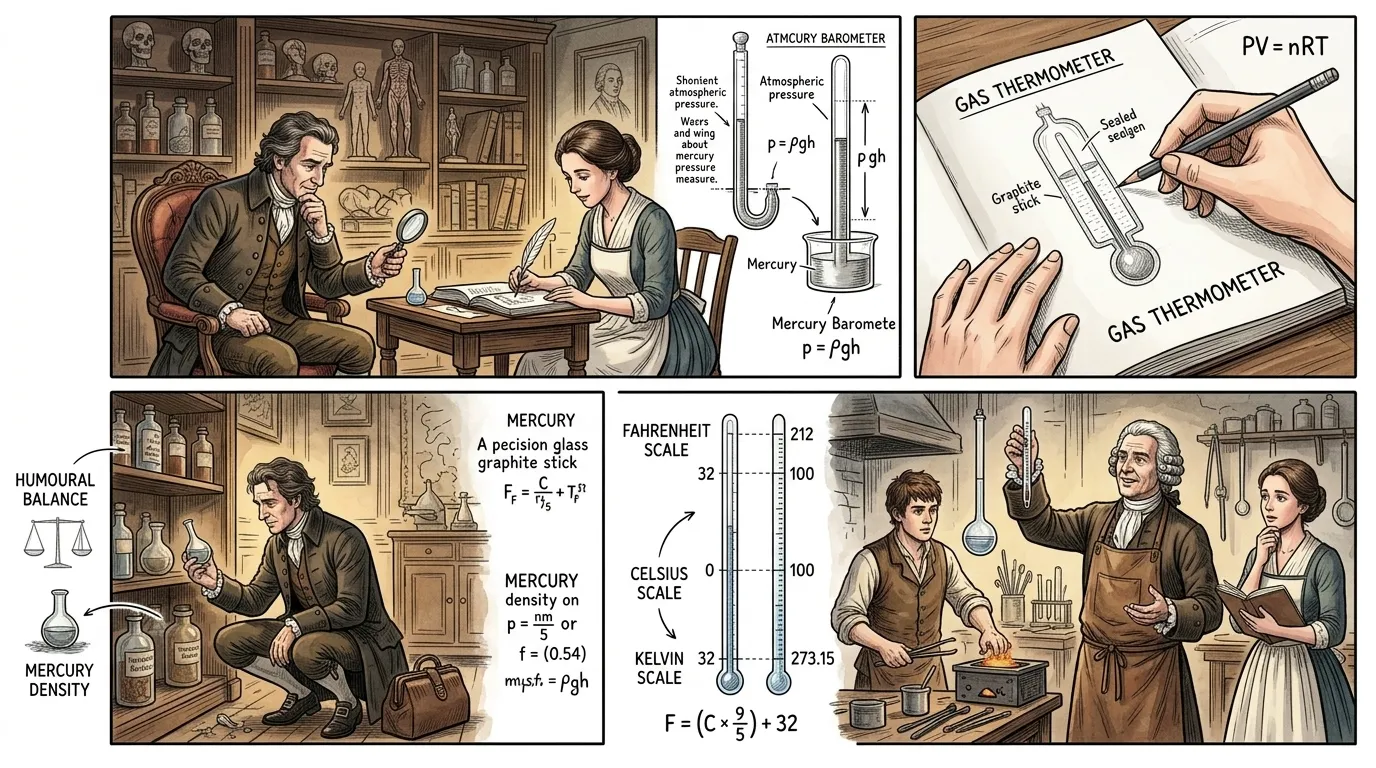
Galileo Galilei's thermoscope, while ingenious, suffered from a fundamental flaw that rendered it unsuitable for precise medical use. Lacking a sealed system, its liquid column responded not only to temperature changes but also to variations in atmospheric pressure, creating unreliable and inconsistent readings. This meant that what appeared as a fever one moment might be mere weather the next.
""See, Doctor?" Elara pointed, observing the fluctuating liquid in the thermoscope. "The level shifts without a discernible change in the patient's warmth. It's impossible to tell what is heat and what is merely the changing air." Dr. Finch nodded gravely. "How can we truly measure internal changes if the instrument itself is swayed by every passing breeze? As the British physicist Lord Kelvin once observed, 'Measurement is the first step that leads to control and eventually to improvement.' Without it, our observations are mere guesses, and our understanding of fever remains in shadow.""
Page 3
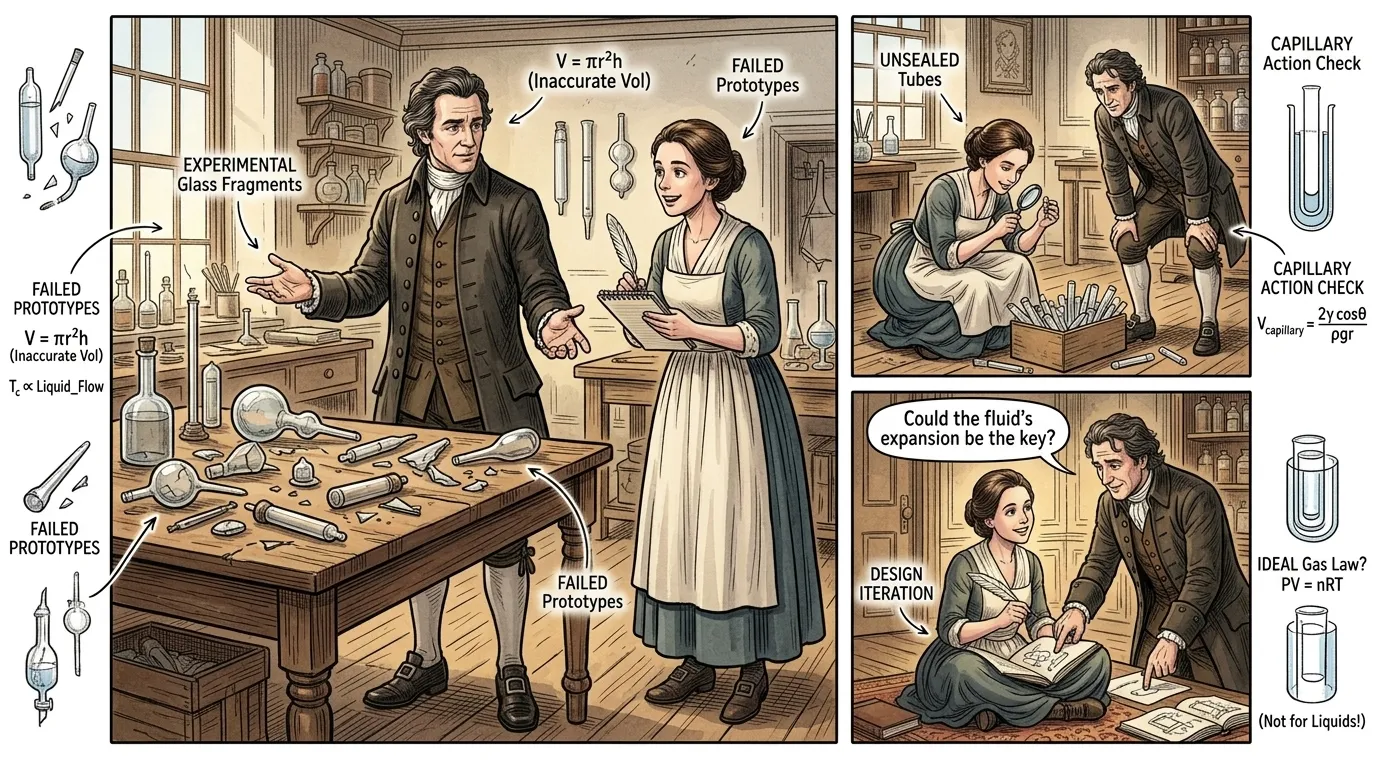
Without a reliable instrument to quantify body temperature, physicians were largely confined to their senses: touch, sight, and intuition. This subjective approach led to inconsistent diagnoses, delayed treatments, and tragically, often fatal errors. The medical world desperately needed an objective standard, a universal language for heat that transcended individual perception.
""Many have attempted instruments using water or air, only to fail at achieving consistency," Dr. Finch explained to Elara, gesturing to discarded components. "Their readings were arbitrary, their scales meaningless from one device to another." He continued, "To truly understand the body's condition, we need an instrument that only responds to heat, and always in the same, verifiable way, everywhere—a genuine breakthrough, not just another fleeting attempt.""
Page 4
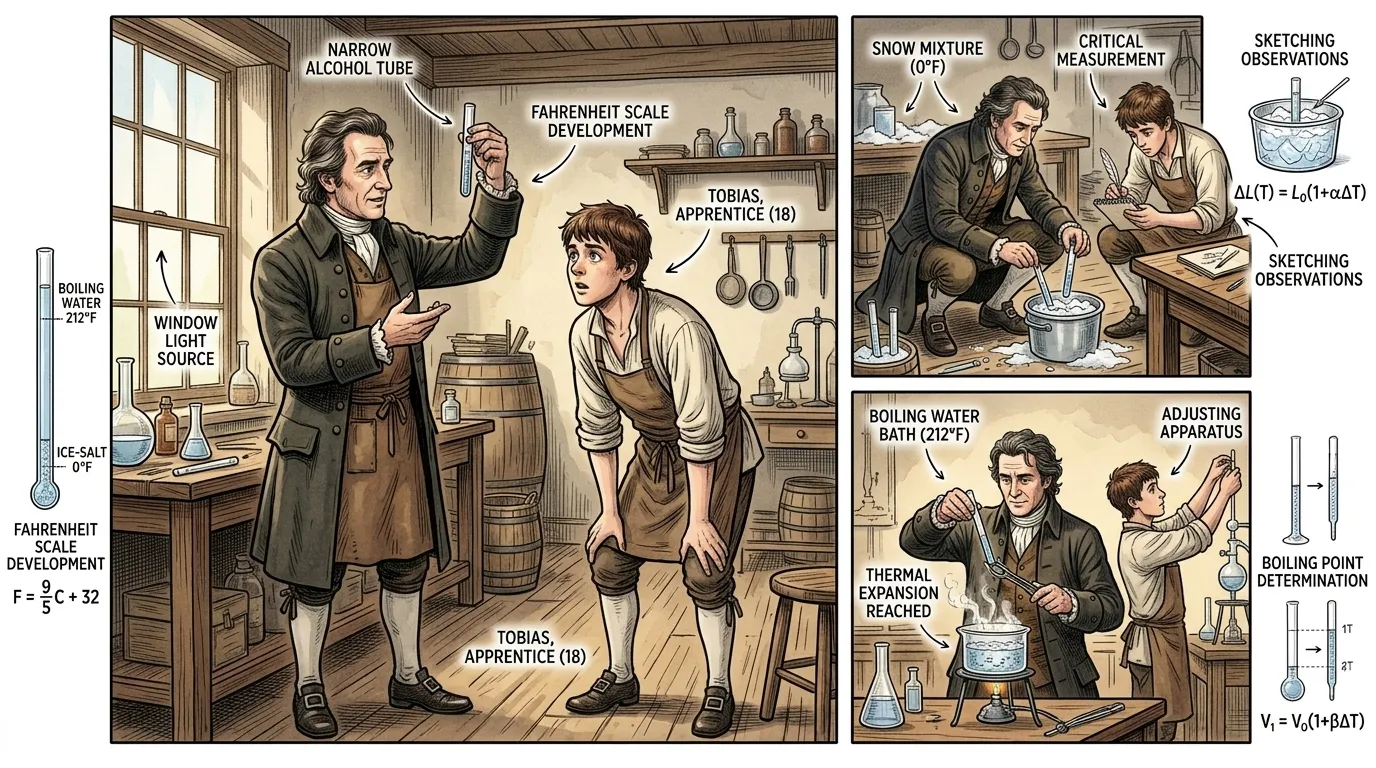
It would take the meticulous hand and scientific mind of Daniel Gabriel Fahrenheit, a Dutch-Polish-German physicist and instrument maker, to forge the path towards true thermometry. Born in Danzig in 1686, Fahrenheit's expertise in glassblowing and his relentless pursuit of precision in barometers laid the groundwork for his revolutionary work with temperature scales.
""The problem, Tobias," Daniel Gabriel Fahrenheit explained to his young apprentice, carefully examining a glass tube filled with alcohol, "is finding a liquid whose expansion is not only predictable but also consistent across a useful range. Alcohol expands, yes, but not always uniformly, and its boiling point is too low for many applications in the wider world." Tobias, an original character, (a young man of 18, eager, short brown hair, wearing a simple linen workshop tunic and leather apron) nodded, observing his master's focused gaze. "So many liquids, so many different behaviors," Tobias murmured."
Page 5
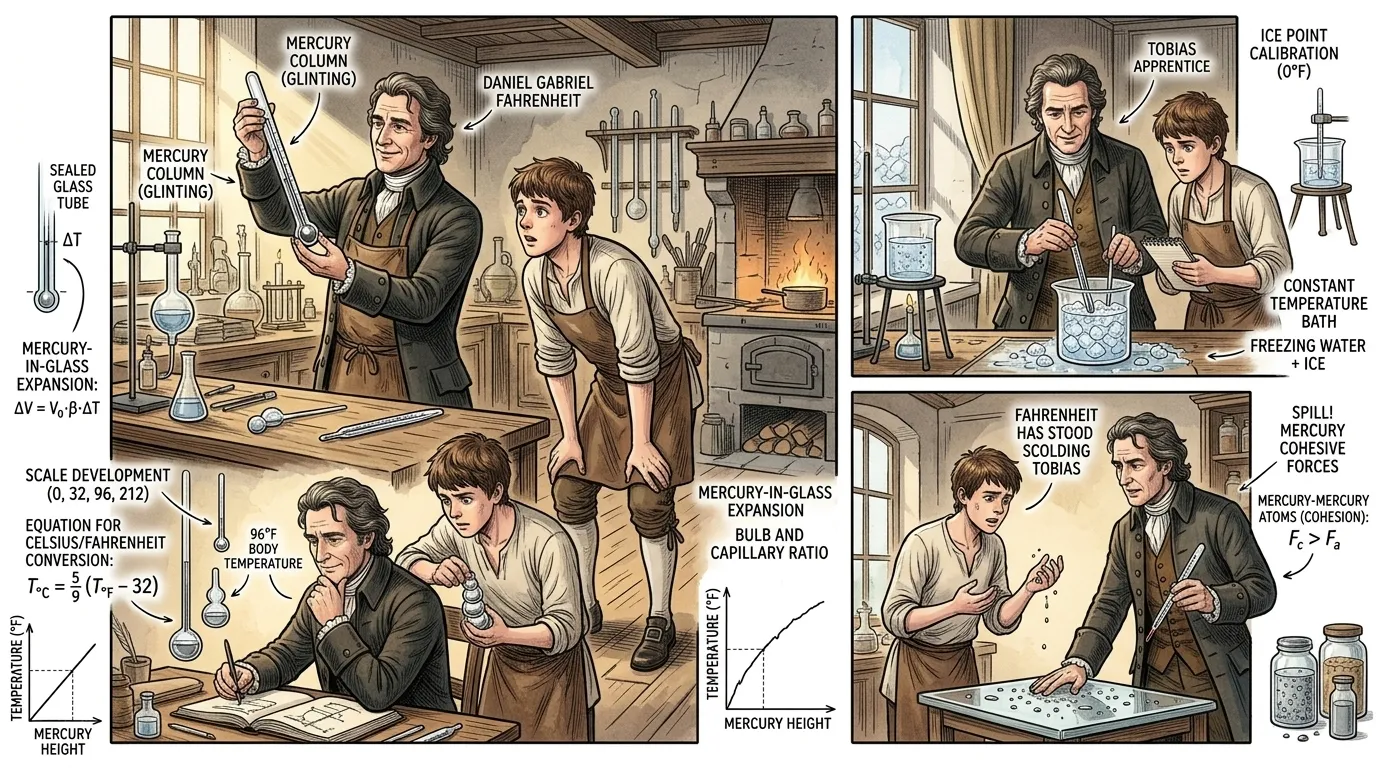
Fahrenheit's crucial insight was to pivot from less reliable substances like alcohol or linseed oil to mercury. This silvery, enigmatic metal possessed a unique combination of physical properties: a high coefficient of thermal expansion that was remarkably linear, a wide liquid range, and an opaque quality that made its column easily visible. These characteristics made mercury the ideal medium for accurate and reproducible temperature measurement.
""Mercury, Tobias, possesses truly remarkable properties," Fahrenheit declared, holding a newly filled mercury tube to the light, its column glinting. "It expands linearly and remains liquid over a vast temperature range, from freezing cold to boiling hot. And its metallic sheen makes the column easy to discern." He demonstrated, gently warming the bulb with his hand. "See how steadily it rises? This consistency is what we require." Tobias's eyes widened with understanding. "Its precision seems unmatched, Master Fahrenheit!""
Page 6
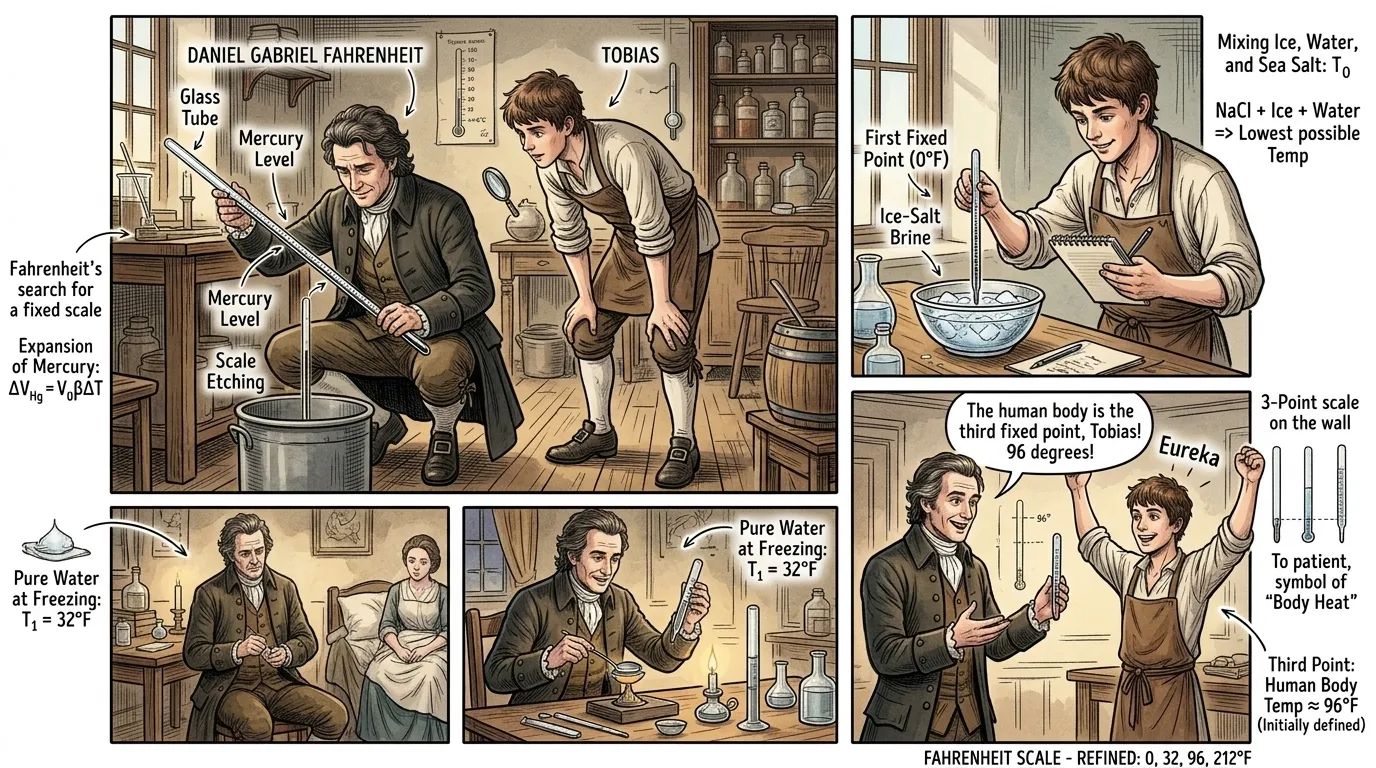
Fahrenheit's genius extended beyond the choice of mercury; his greatest contribution was the creation of a standardized, reproducible temperature scale. He identified three fixed points that could be reliably replicated: the freezing point of a specific brine solution, the freezing point of pure water, and crucially, the average temperature of the human body. These benchmarks allowed for consistent calibration.
""Establishing fixed points is paramount," Fahrenheit explained to Tobias, meticulously marking a new glass tube. "First, the lowest temperature I could achieve: ice, water, and ammonium chloride brine mixed together, which I called zero degrees Fahrenheit. Next, the freezing point of pure water, which I marked as 32 degrees." He gestured to a seated figure. "And most vitally, the stable temperature of a healthy human body, carefully measured and calibrated at 96 degrees. These are our anchors.""
Page 7
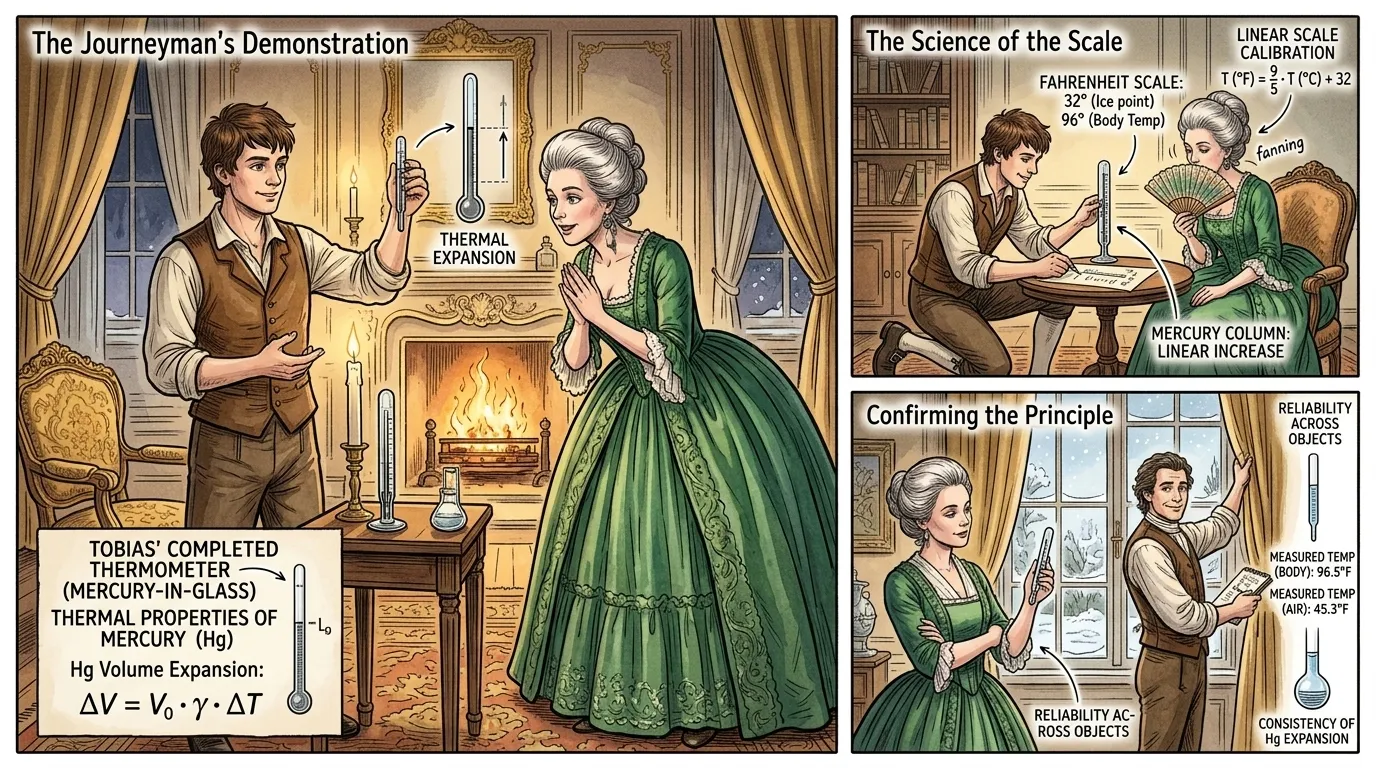
The mercury-in-glass thermometer operates on a simple yet elegant principle of thermal expansion. Within a sealed glass tube, a bulb filled with mercury is connected to a narrow capillary. As the surrounding temperature increases, the mercury inside the bulb expands. With nowhere else to go, the mercury is forced upward into the capillary, its level rising against a precisely calibrated scale.
"Tobias, now a confident journeyman, explained the finished instrument to a visiting dignitary, Madame Dubois, an original character (an elegant woman in her late 30s, adorned in a rich green 18th-century silk dress and a curious expression). "When the bulb warms, Madame, the mercury inside expands. Having nowhere to go, it is forced up this narrow capillary tube. Each etched mark on the glass represents a precise degree." He held it near a candle flame. "See how the column ascends? It is a direct visual representation of heat.""
Page 8
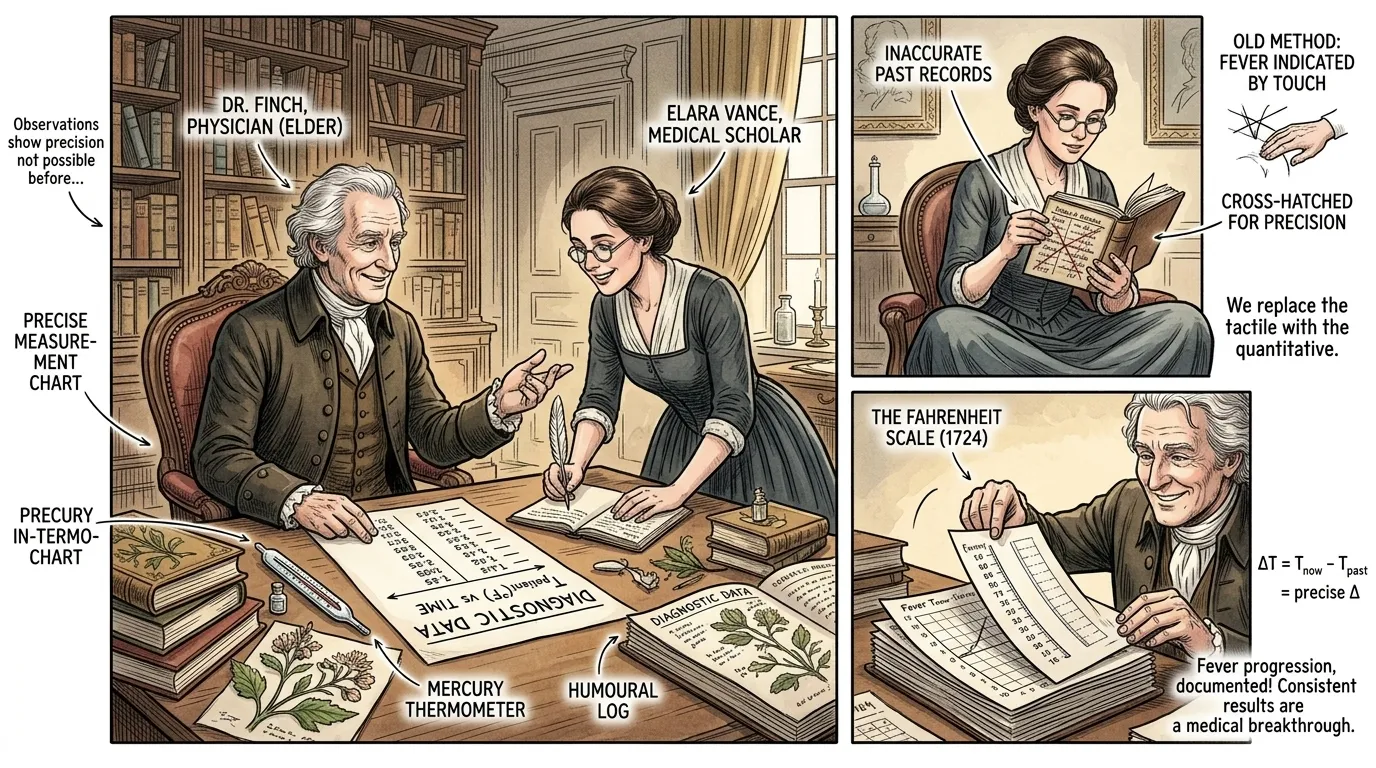
Fahrenheit's thermometer provided physicians with an unprecedented tool, transforming subjective guesswork into objective data. The ability to precisely quantify a patient's temperature allowed for consistent diagnosis of fevers, tracking disease progression, and assessing the efficacy of treatments. This was a monumental leap forward in medical practice, laying foundational groundwork for modern clinical observation.
"Dr. Alistair Finch, now an esteemed elder physician with wisps of white hair and a look of profound satisfaction, reviewed patient charts alongside Elara Vance, now a respected medical scholar. He gestured to a column of precise temperature readings. "Imagine, Elara, how much was mere conjecture before! Now, as William Osler, the great physician, would later observe, 'The good physician treats the disease; the great physician treats the patient who has the disease.' But with the thermometer, we can quantify the disease within the patient, not just guess—a revolution in care!""
Page 9
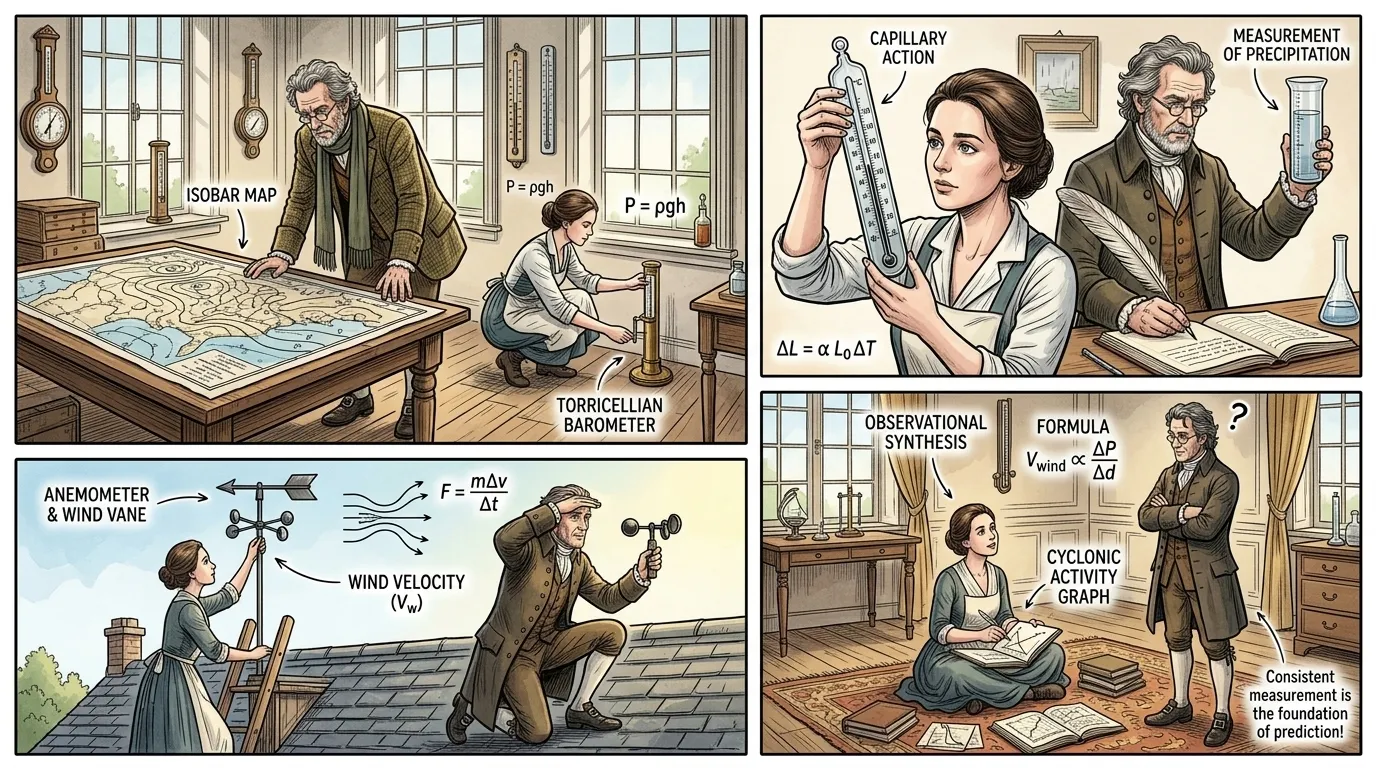
The impact of Fahrenheit's thermometer quickly transcended the medical field, becoming an indispensable instrument across diverse scientific and industrial applications. From meteorology, where it enabled accurate weather forecasting, to brewing and manufacturing, where precise temperature control was critical, the thermometer standardized measurements globally, fostering innovation.
"Professor Aris Thorne, an original character (distinguished meteorologist, 60s, spectacles, tweed jacket, wise expression), pointed to a sprawling weather map in his observatory. "With this instrument, Lena, we can chart weather with unprecedented accuracy, predicting frosts for farmers and tracking climate shifts that once confounded us." Lena Petrova, an original character (junior researcher, 28, analytical, wearing a simple lab coat), meticulously recorded data. "It's remarkable, Professor. From the physician's ward to the brewer's vat, temperature now speaks a universal language.""
Page 10
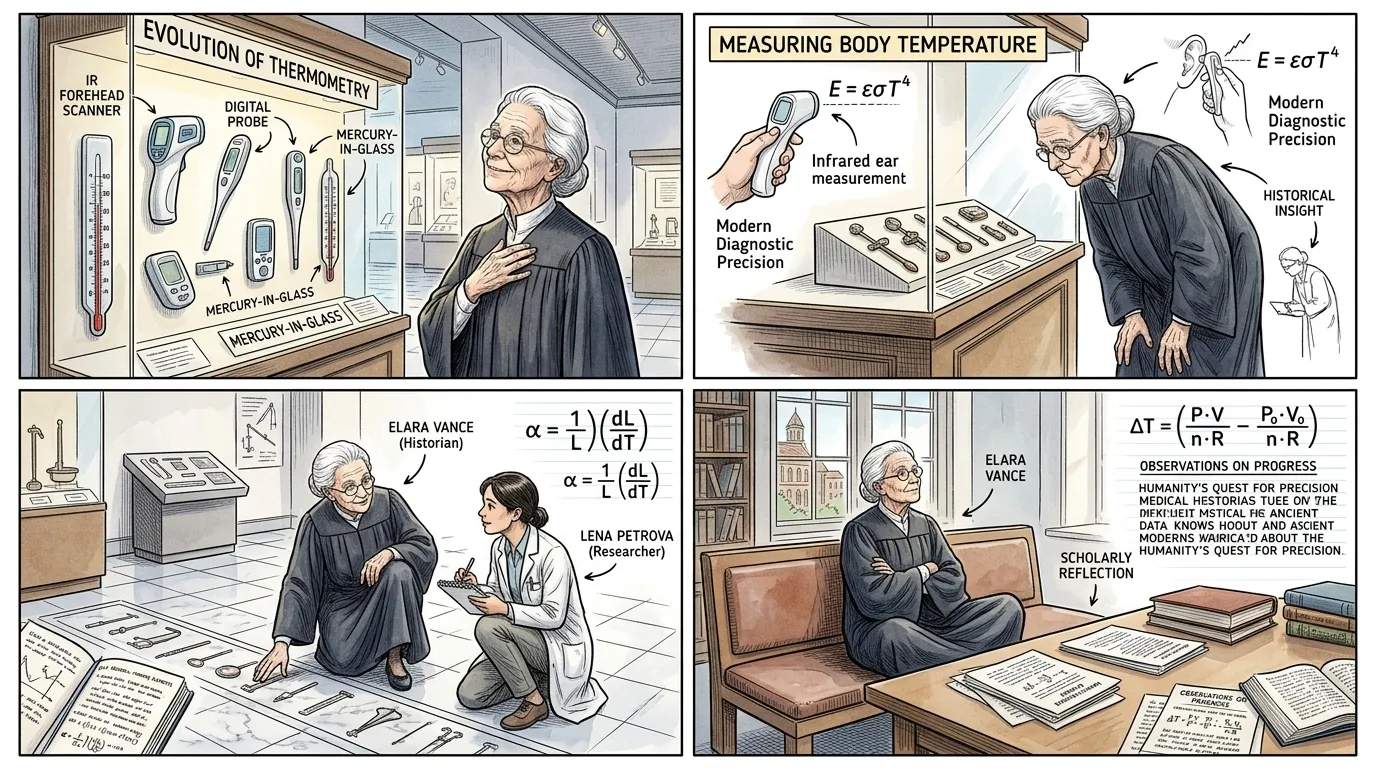
The fundamental principle established by Daniel Gabriel Fahrenheit—that thermal energy can be precisely quantified and standardized—remains a cornerstone of modern life. While the instruments have evolved from mercury-in-glass to sophisticated digital and infrared devices, the thermometer's enduring legacy shapes how we understand health, weather, industry, and our very environment. Its impact is immeasurable.
"Elara Vance, now a very old, esteemed medical historian, gazed at an array of modern temperature-sensing devices in a museum display. Her voice, though aged, resonated with clarity. "While technologies evolve, the fundamental understanding that Daniel Fahrenheit gave us—that heat can be precisely measured and standardized—remains. It transformed human perception of our world and ourselves, ushering in an era of evidence-based insight that continues to shape our future.""
About this story
- Location: Global
- Audience: general readers
Questions and answers
Read Wonder Inventions on your phone
Wonder Inventions is available on Android. Get Wonder Inventions on Google Play.