Touchscreen
Touchscreen — an illustrated inventions story, set in Global. 10 illustrated pages, free to read on Wonder Inventions.
Page 1
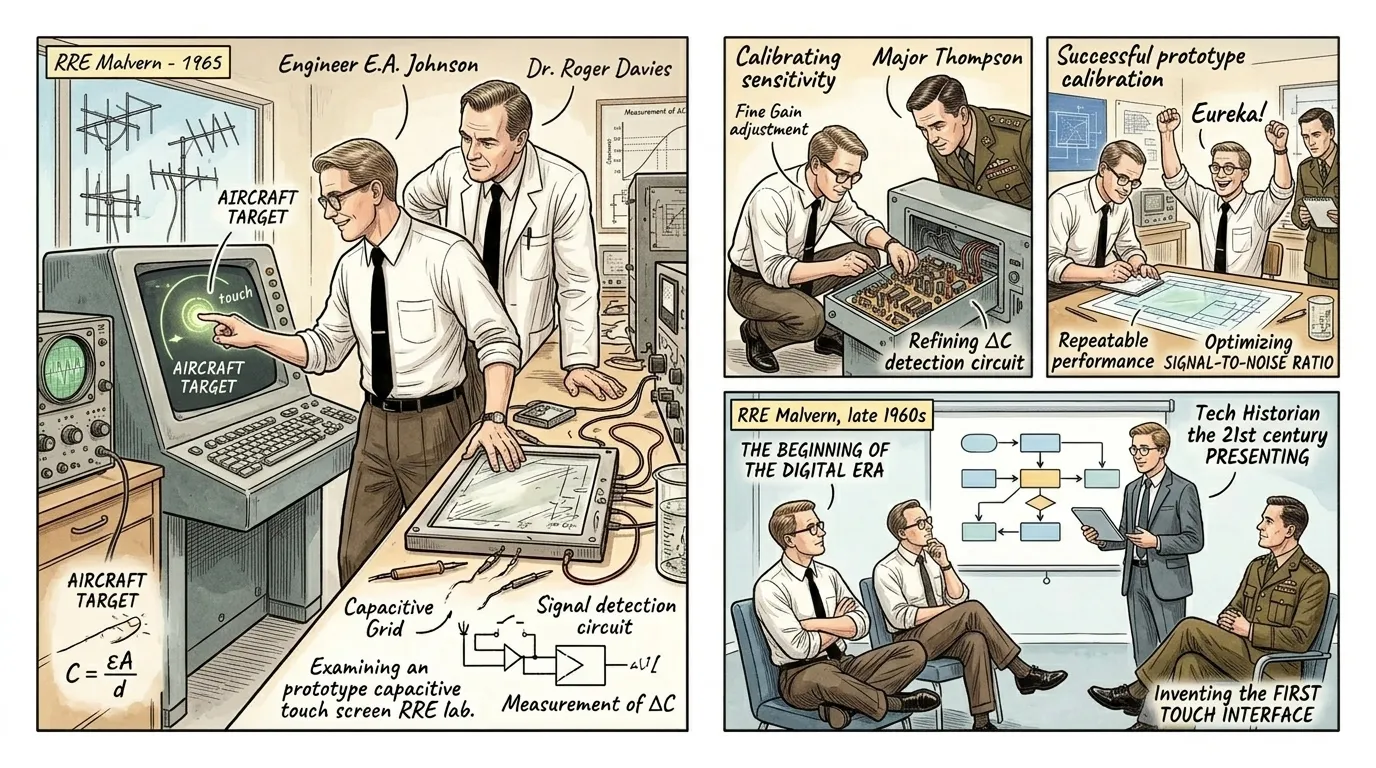
Mid-20th century air traffic control was a system of complex dials, switches, and paper strips, demanding intense focus and physical manipulation from controllers. The challenge was immense: how to make human-computer interaction intuitive and immediate, especially when lives depended on swift decisions. This demanding environment, rife with indirect input methods, was precisely where Engineer E.A. Johnson sought a revolutionary solution.
""This is a game-changer," E.A. Johnson stated, demonstrating his prototype to a small group of senior engineers in 1965. "No more light pens, no more keyboards. Just your finger, directly on the display.""
Page 2
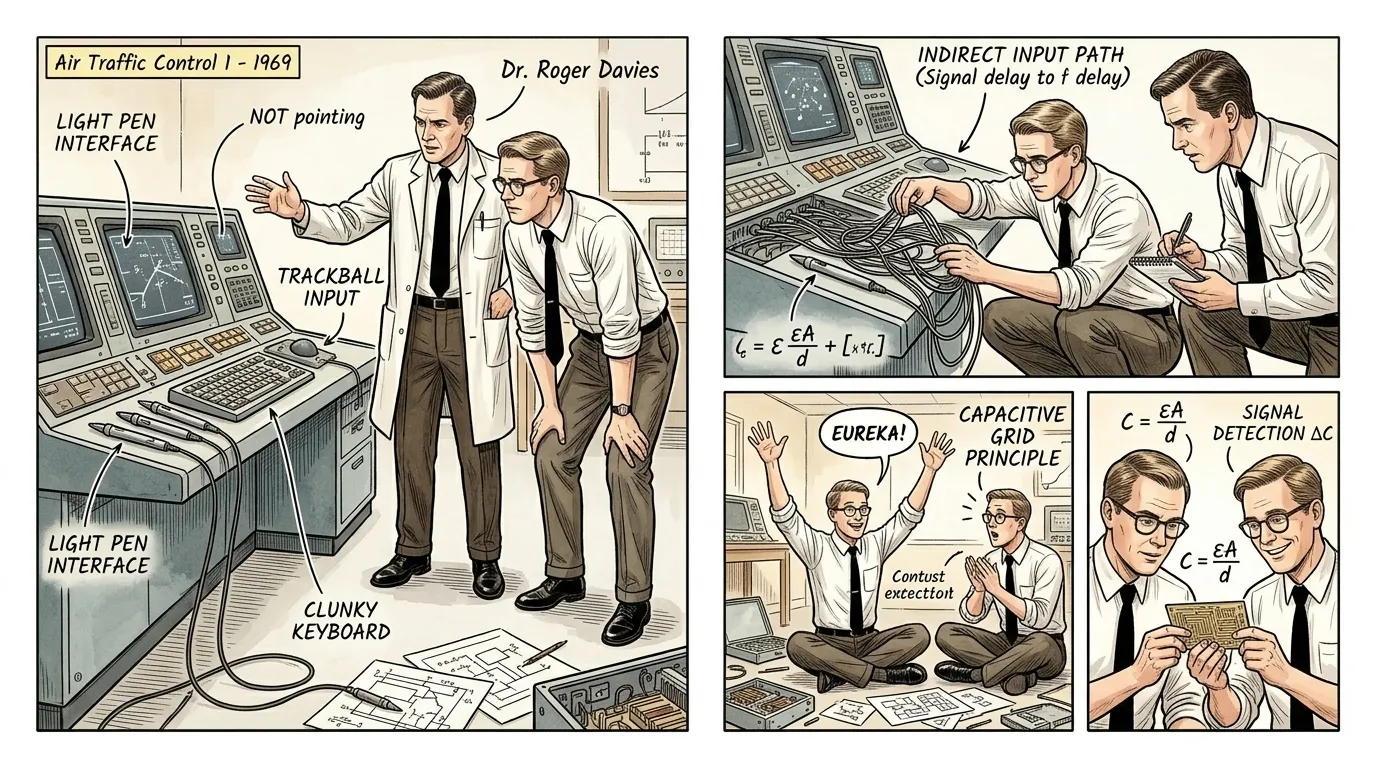
Before direct touch, human interaction with computers was fundamentally indirect. Operators relied on a range of cumbersome devices: clunky keyboards for alphanumeric input, unwieldy trackballs for cursor control, or 'light pens' that required precise aiming at the screen. Each method added a layer of abstraction between the user's intent and the machine's action, slowing down critical tasks and increasing the potential for error.
""Precision is paramount, yet these interfaces introduce delays," observed Dr. Roger Davies, a colleague of Johnson, gesturing at a complex console. "Imagine trying to vector an aircraft in real-time with a stylus, only for a critical command to miss its mark. We need immediate, direct feedback.""
Page 3
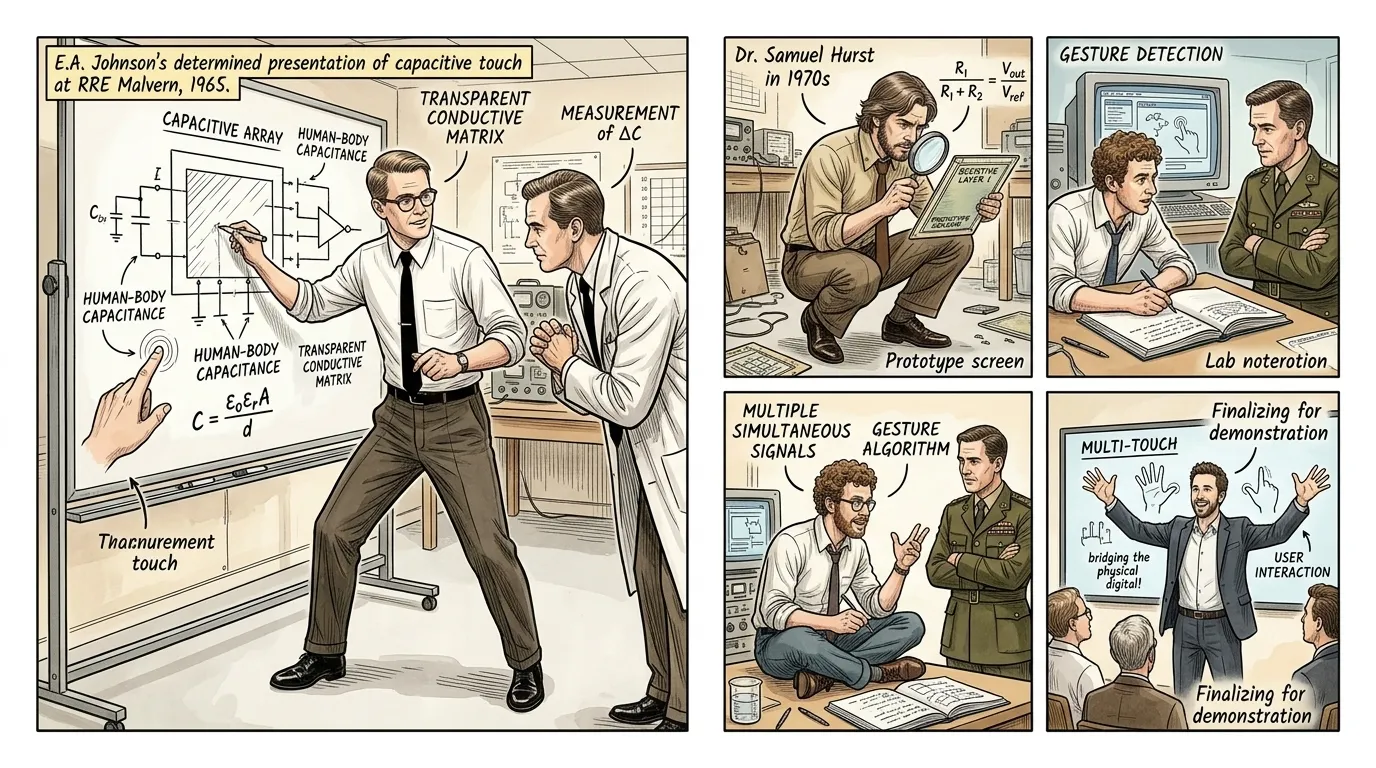
The core challenge was translating a physical touch into a precise digital coordinate without moving parts or external devices. Early solutions struggled with reliability and cost, often requiring specialized hardware or complex calibration. Johnson understood that for touch to be truly revolutionary, it needed to be seamless, robust, and integrate directly with the display technology itself. This led him to consider the subtle electrical properties of the human body and certain transparent materials.
""We need to bridge the physical and digital worlds directly," Johnson explained, sketching diagrams on a whiteboard. "As Leonardo da Vinci famously said, 'Simplicity is the ultimate sophistication.' My goal is to make interaction so simple, it feels natural. This requires harnessing properties like capacitance in a novel way.""
Page 4
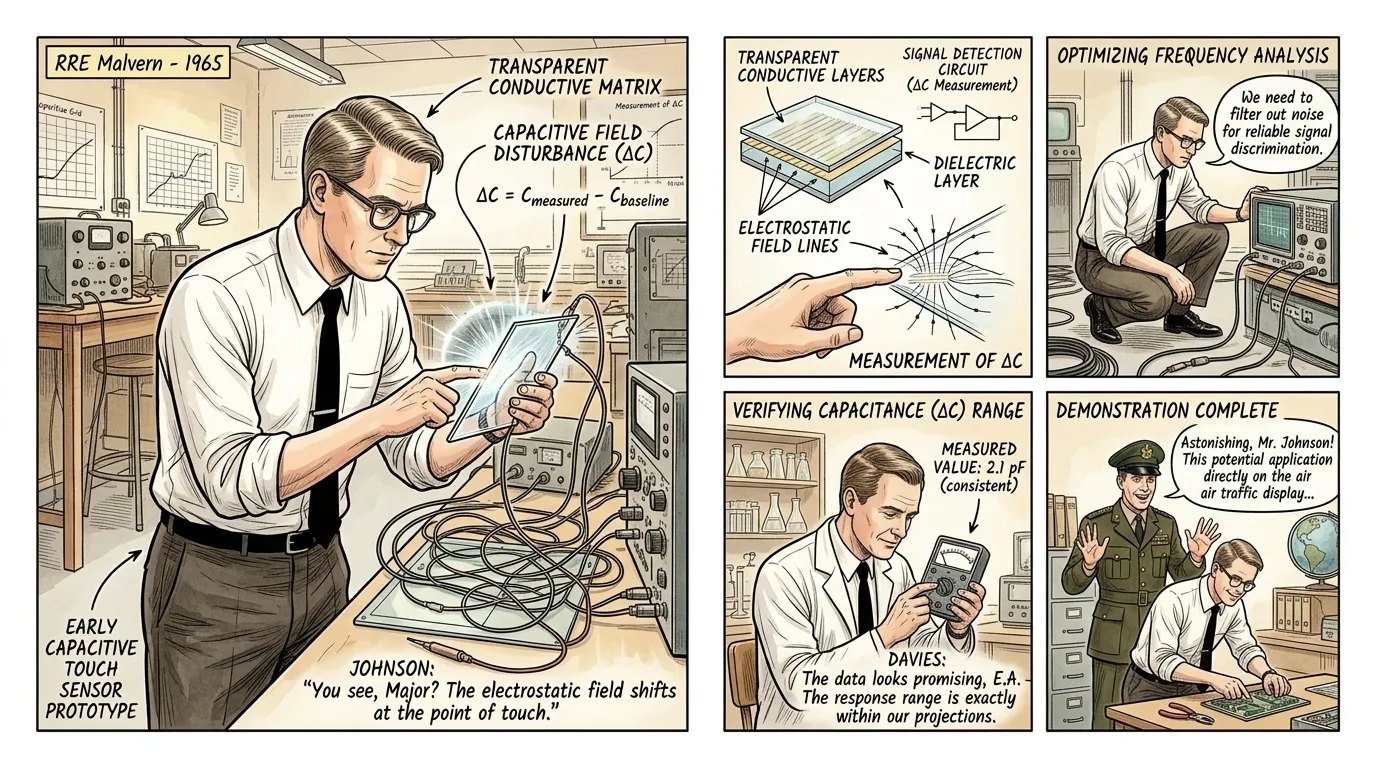
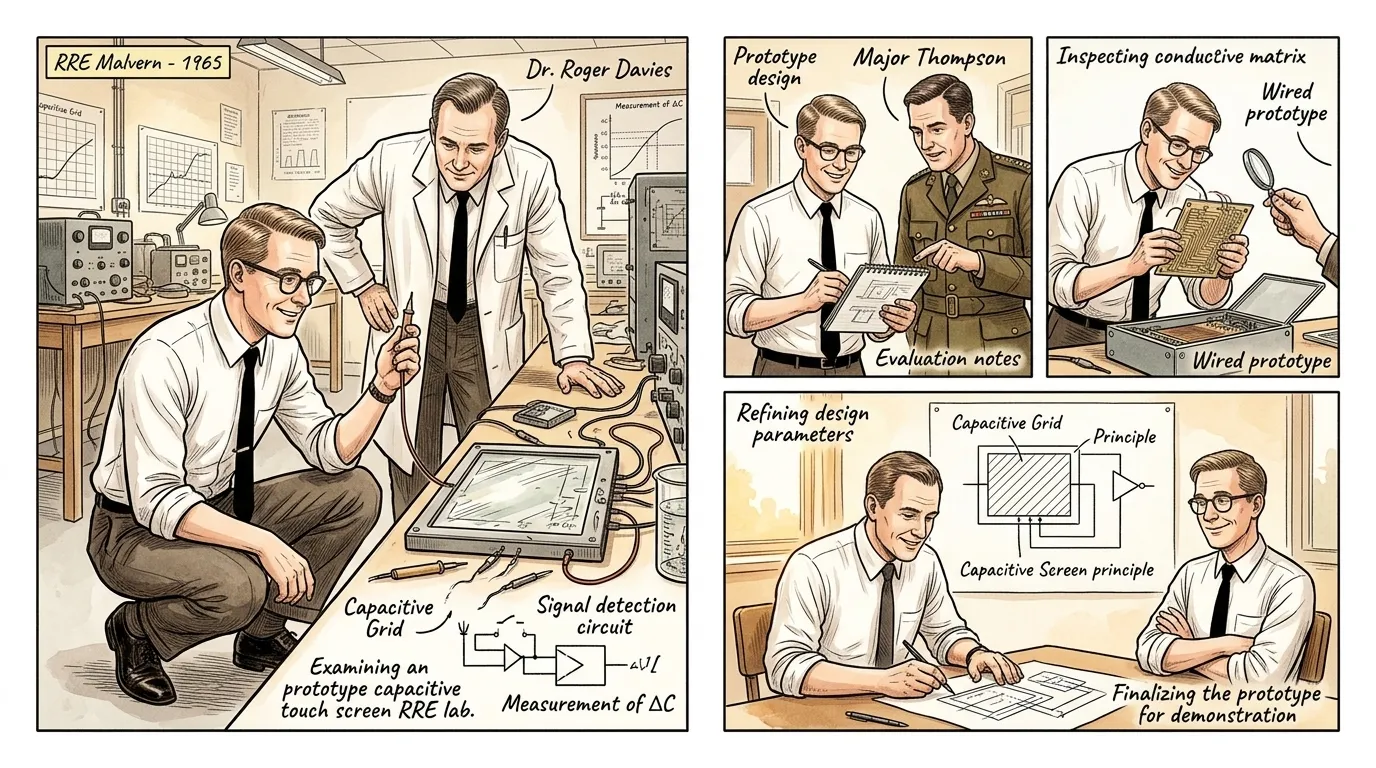
E.A. Johnson's genius lay in his application of capacitance, a fundamental electrical property. His design involved a conductive, transparent layer of indium tin oxide (ITO) coated onto a glass panel. This layer held a uniform electrostatic field. When a finger, being conductive itself, touched the surface, it drew a tiny amount of charge from the screen at that specific point. This minute disturbance in the electrical field was the key.
""The human body is itself a conductor," Johnson articulated, demonstrating with a small, flat panel connected to wires. "By creating a controlled electrostatic field across a transparent surface, we can detect where that field is disturbed. This disturbance isn't a mechanical action, but an electrical signature.""
Page 5
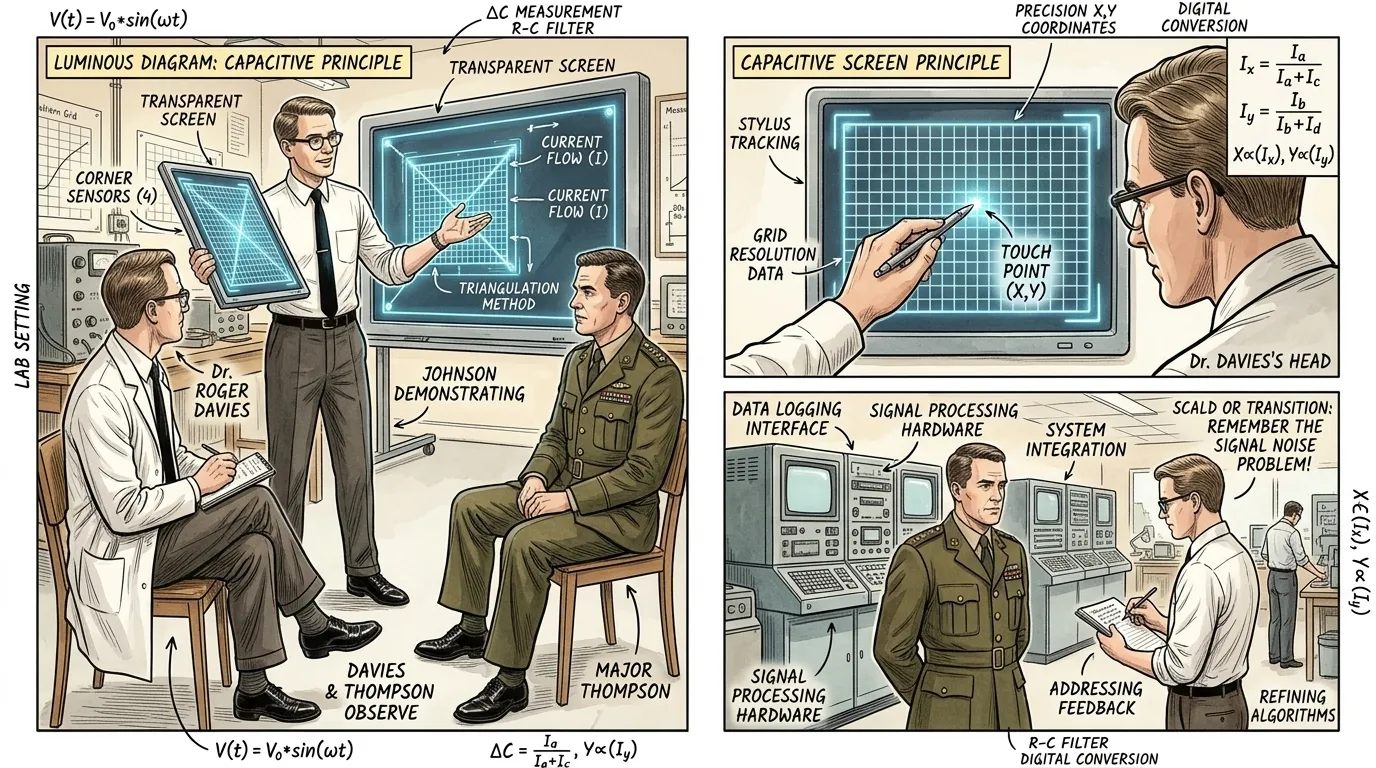
To pinpoint the exact location of a touch, Johnson devised a method to measure the electrical current from four corners of the screen. When a finger drew charge, the current flowing from each corner to the touch point would change proportionally to the distance. Sophisticated circuitry then calculated the X and Y coordinates based on these differential current measurements. This elegant solution bypassed mechanical switches entirely, offering unprecedented precision and durability.
""By measuring the precise current drawn from each corner of the screen," Johnson elaborated, pointing to a diagram of current flow, "our circuitry can triangulate the exact point of contact. This provides the X and Y coordinates with remarkable accuracy. It's a continuous measurement, not just an on/off switch.""
Page 6
By 1965, E.A. Johnson had developed the world's first working capacitive touchscreen, capable of detecting a single touch point. His early prototypes, initially demonstrated for air traffic control, revolutionized the idea of human-machine interface. Instead of cumbersome indirect input, a controller could simply touch a radar blip on the screen to identify an aircraft or issue a command, drastically streamlining complex operations and reducing cognitive load.
""The system is fully operational," Johnson announced, his voice filled with quiet triumph, as he lightly touched a target on the screen. "A direct command, no intermediaries. Imagine the efficiency gains for our air traffic controllers. This is not just a display; it's a window for interaction.""
Page 7
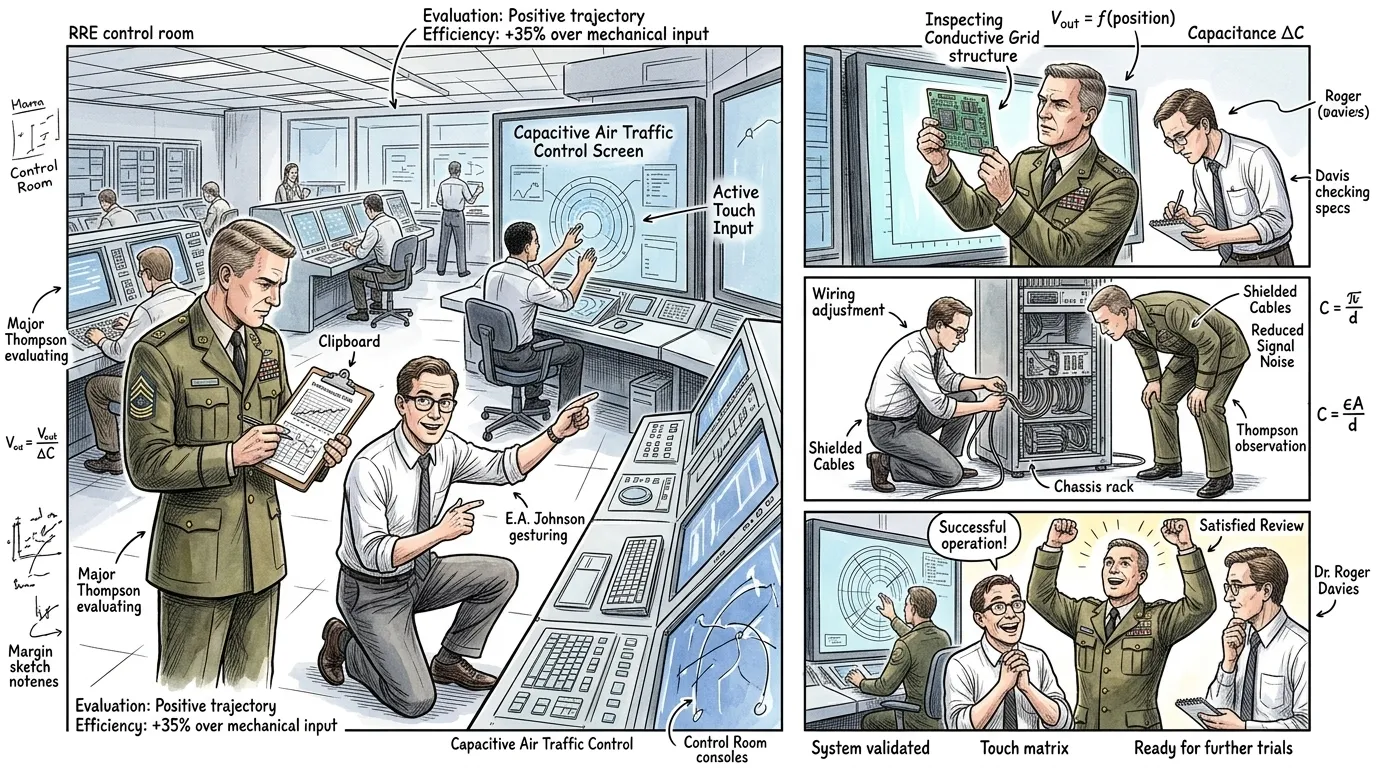
Johnson's capacitive touchscreen was not an immediate commercial product for the masses but a specialized tool. Its initial deployment was in high-stakes environments like the Royal Radar Establishment's air traffic control systems. These early implementations proved the technology's efficacy and reliability under rigorous operational demands. While later resistive touchscreens would offer lower cost and stylus compatibility, Johnson's capacitive design laid the foundational principles for truly direct, multi-user interfaces.
""The feedback from the controllers is overwhelmingly positive," reported Major Thompson, a uniformed officer, reviewing performance data with Johnson. "They're making fewer errors, and decision-making is faster. The directness of interaction is unprecedented. This technology, while specialized now, promises a future of intuitive computing.""
Page 8
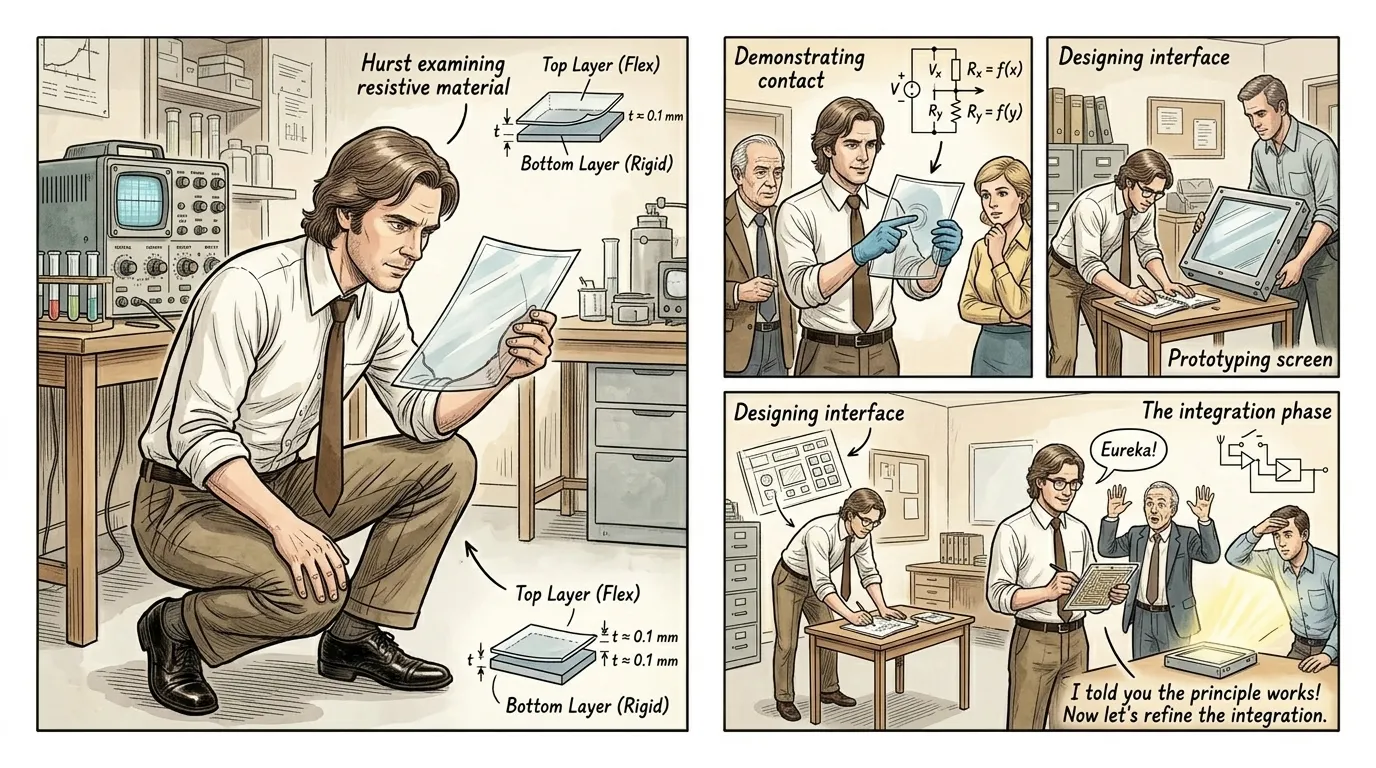
While Johnson's capacitive screens found niche applications, the 1970s saw the emergence of a different approach: the resistive touchscreen, pioneered by Dr. Samuel Hurst. This mechanism used two flexible, electrically resistive layers separated by an air gap. When pressed, these layers would make contact, allowing a controller to detect the pressure point. Resistive screens were simpler to manufacture and could be operated with any object, including gloved hands or styluses, leading to broader initial commercial adoption in point-of-sale systems and industrial applications.
""The resistive principle offers distinct advantages for durability and cost," explained Dr. Samuel Hurst, presenting a new prototype to a room of industrial partners. "By detecting physical pressure, it bypasses the need for bare finger contact, opening up new markets where gloves or styluses are common. It's a different path to the same intuitive goal.""
Page 9
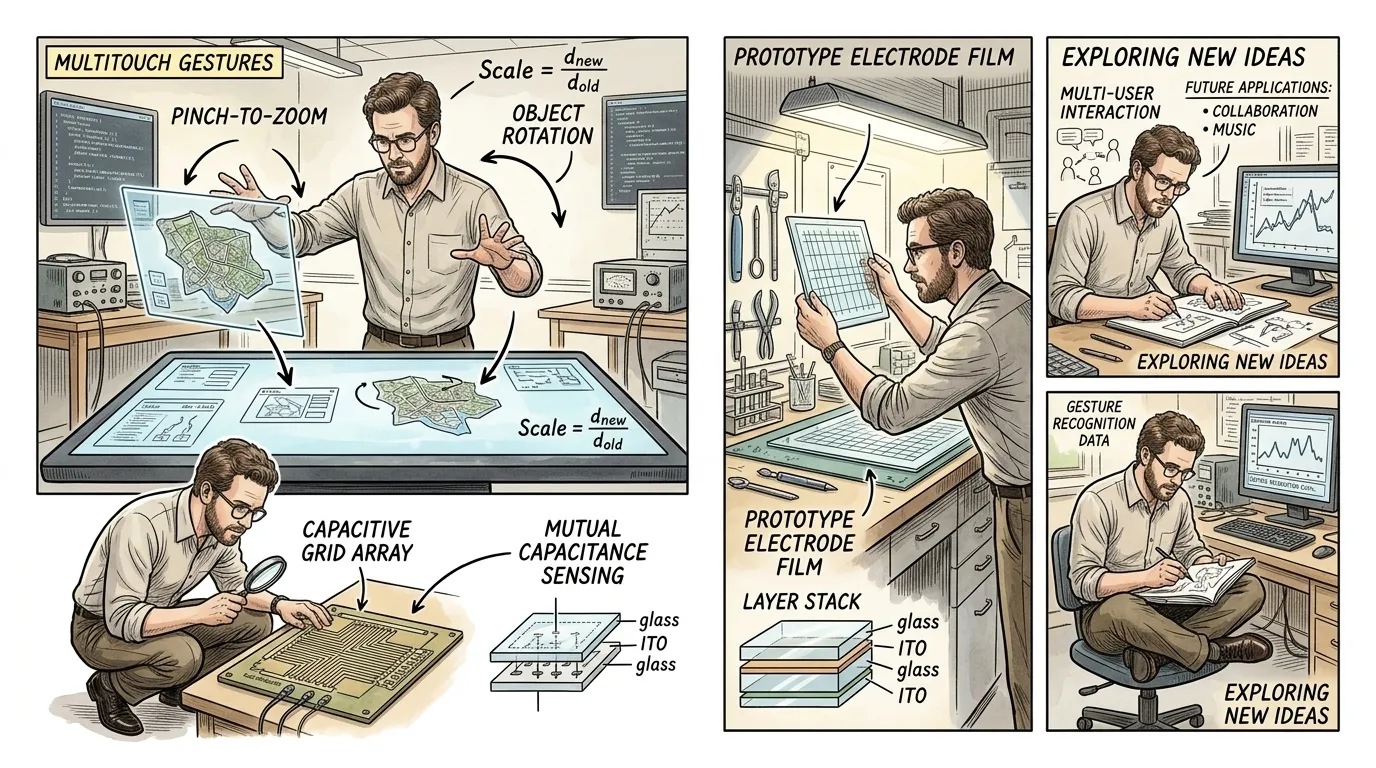
For decades, touchscreens were primarily single-touch, recognizing only one point of contact at a time. The true leap into modern ubiquitous touch came with the development of multi-touch sensing, allowing multiple fingers or gestures simultaneously. Researchers like Bob Boie at Bell Labs (1984) and later Bill Buxton and his team at the University of Toronto, conducted foundational work in this area, envisioning a more fluid, direct interaction. These advancements, combined with powerful processing and refined capacitive technology, paved the way for the smartphone era.
""Imagine manipulating virtual objects with both hands, pinching, zooming, rotating," enthused Bill Buxton, presenting a large multi-touch display. "It's about making interaction congruent with our natural motor skills. This level of direct manipulation, a true extension of our thought, is the future. Every touch point is a command.""
Page 10
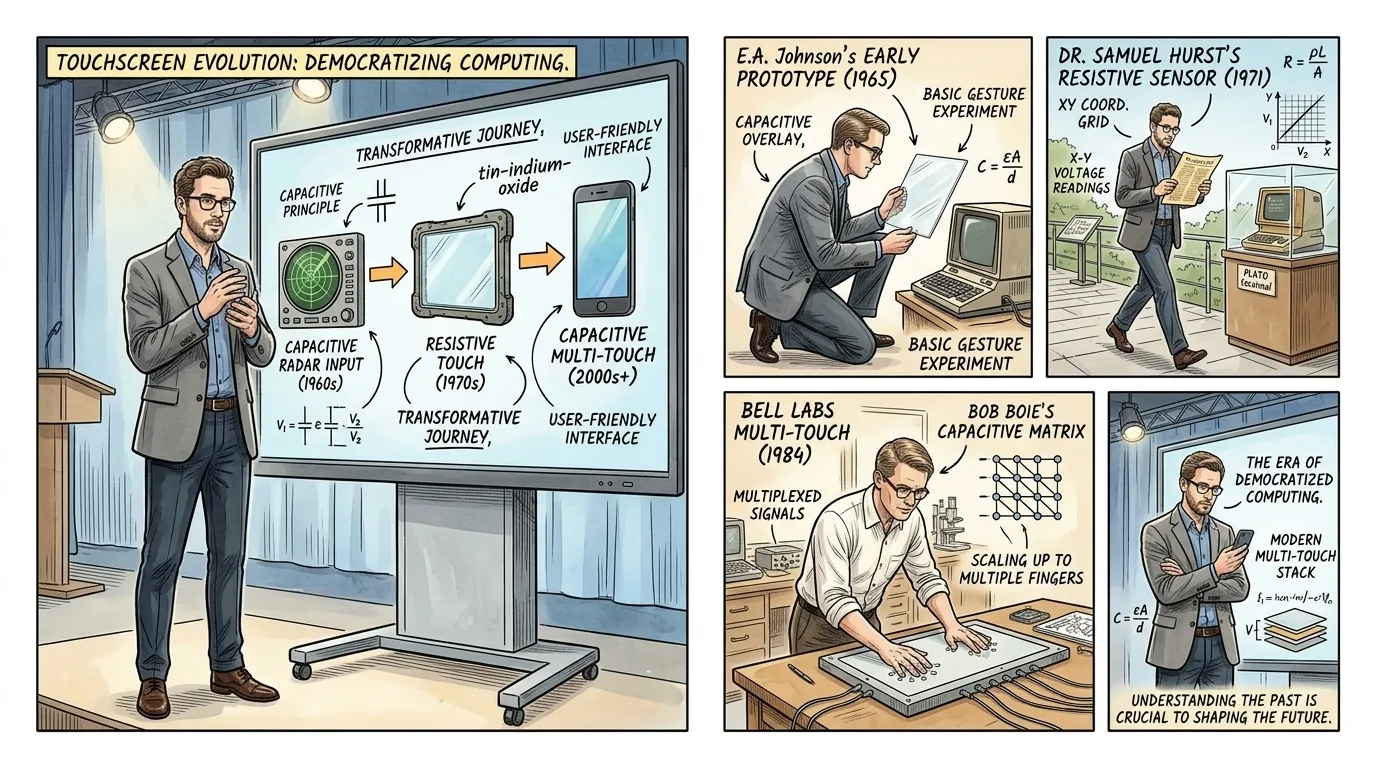
From specialized military applications to the pocket-sized supercomputers we carry today, the touchscreen has fundamentally reshaped human-computer interaction. It eliminated the mouse and keyboard for many everyday tasks, making technology more accessible and intuitive. Its legacy is etched into every swipe, tap, and pinch, transforming public kiosks, automotive systems, medical devices, and global communication.
""The simplicity of touch has democratized computing," reflected a contemporary tech historian at a conference. "It removed the barriers of complex interfaces, truly embodying the principle of directness E.A. Johnson envisioned. We no longer just view information; we physically engage with it, moment by moment.""
About this story
- Location: Global
- Audience: general readers
Questions and answers
Read Wonder Inventions on your phone
Wonder Inventions is available on Android. Get Wonder Inventions on Google Play.