Traffic Light
Traffic Light — an illustrated inventions story, set in Global. 10 illustrated pages, free to read on Wonder Inventions.
Page 1
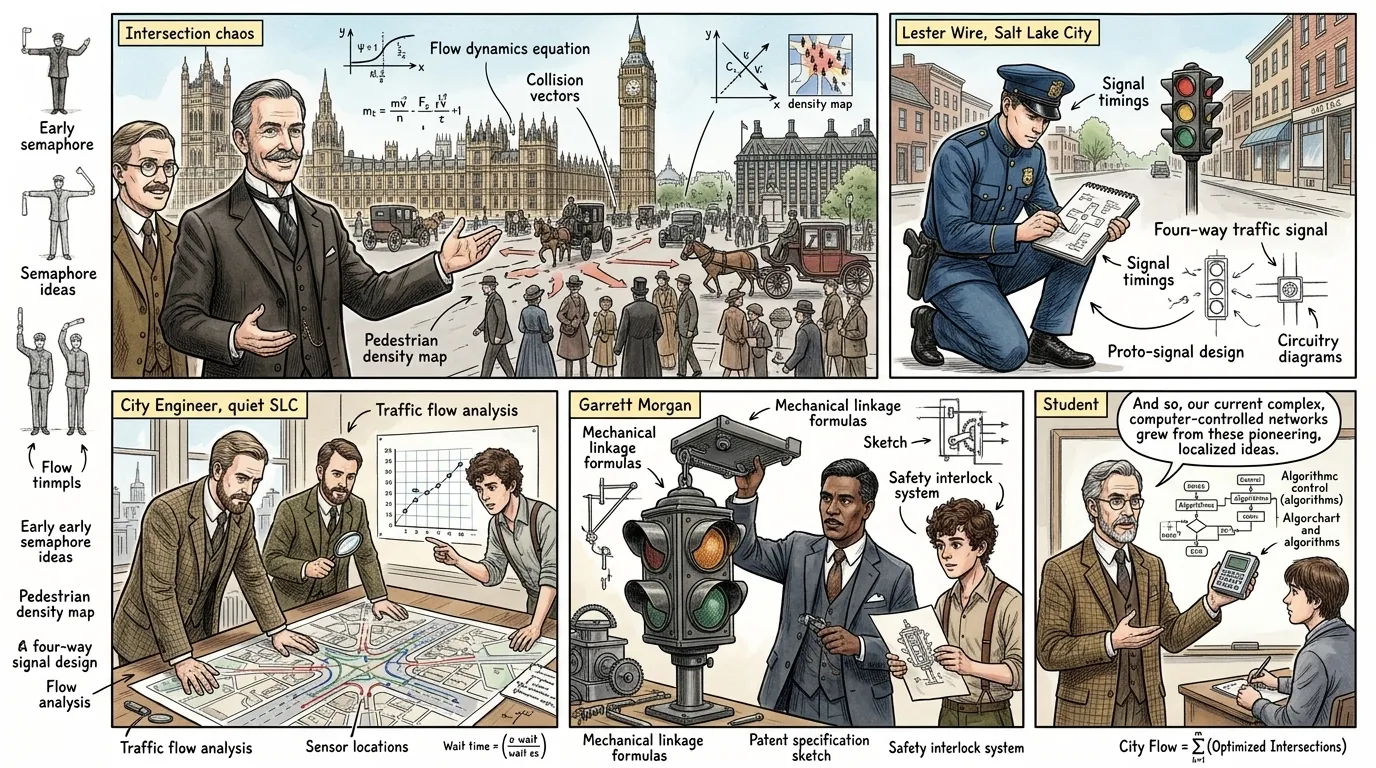
Before the advent of widespread traffic control, urban centers were a maelstrom of conflicting movement. Pedestrians, horse-drawn carriages, and early automobiles vied for space, creating dangerous and inefficient intersections. The need for a systematic solution became paramount as cities expanded and transportation diversified.
"'The sheer anarchy of these thoroughfares is untenable,' remarked Sir John Peake Knight to a colleague, gesturing towards the chaotic intersection. 'We must devise a clear, unmistakable signal, lest these streets claim more lives.' His vision was to bring order to London's notoriously congested passages."
Page 2
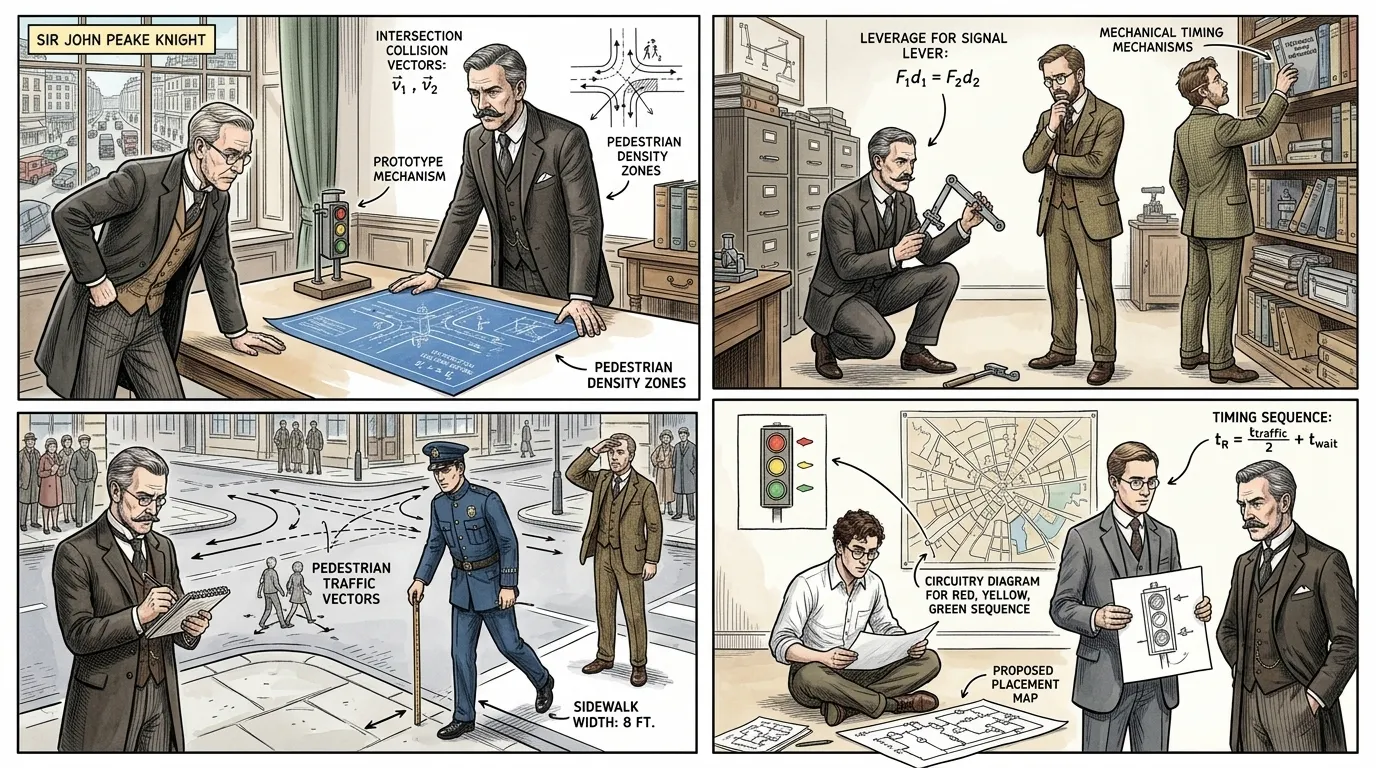
The core problem was the simultaneous claim on shared space, leading to inevitable collisions and delays. Manual control by policemen, though helpful, was insufficient for the growing volume of traffic and placed officers in constant peril. A mechanism was desperately needed that could communicate clear, universal directives.
"'Every day, we witness near misses, and tragically, actual collisions,' stated a London City official, looking gravely at Sir John. 'The safety of the people shall be the highest law, as Cicero once declared. Our current methods are falling short of this fundamental principle.' Another official added, 'We need a system that removes human judgment from the immediate conflict point, replacing it with unambiguous command.'"
Page 3
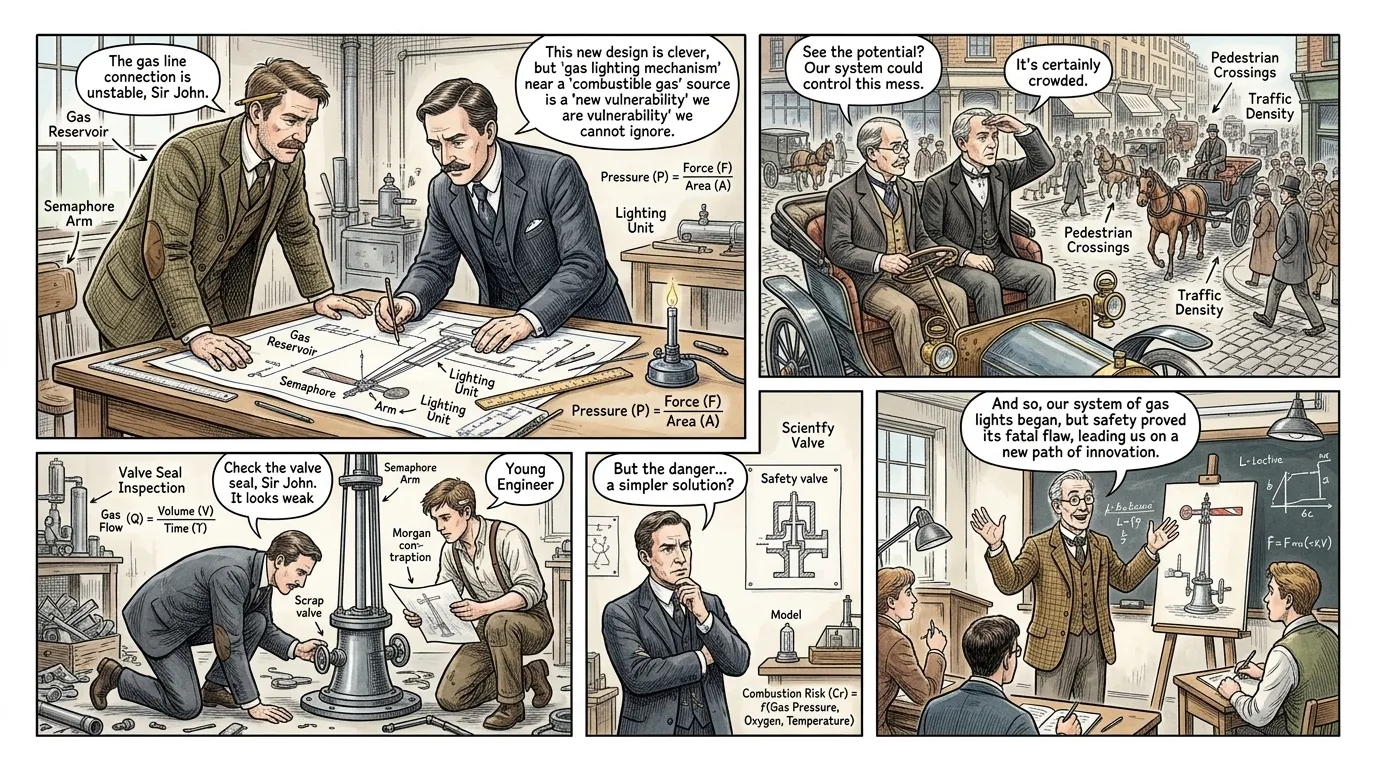
Knight's innovative gas-powered semaphore, installed near the Houses of Parliament, represented a significant step forward. It used semaphore arms during the day and red and green gas lights at night. However, the technology of the era presented unforeseen dangers, proving that early solutions often carried their own risks.
"'While the semaphore arms offered visual clarity, the gas lighting at night presented a new vulnerability,' explained a city engineer, reviewing blueprints with a concerned Sir John Peake Knight. 'The ignition method, using an open flame near combustible gas, is inherently risky.' Knight sighed, 'A tragic lesson learned, indeed. We must seek safer, more reliable power sources for these crucial signals.'"
Page 4
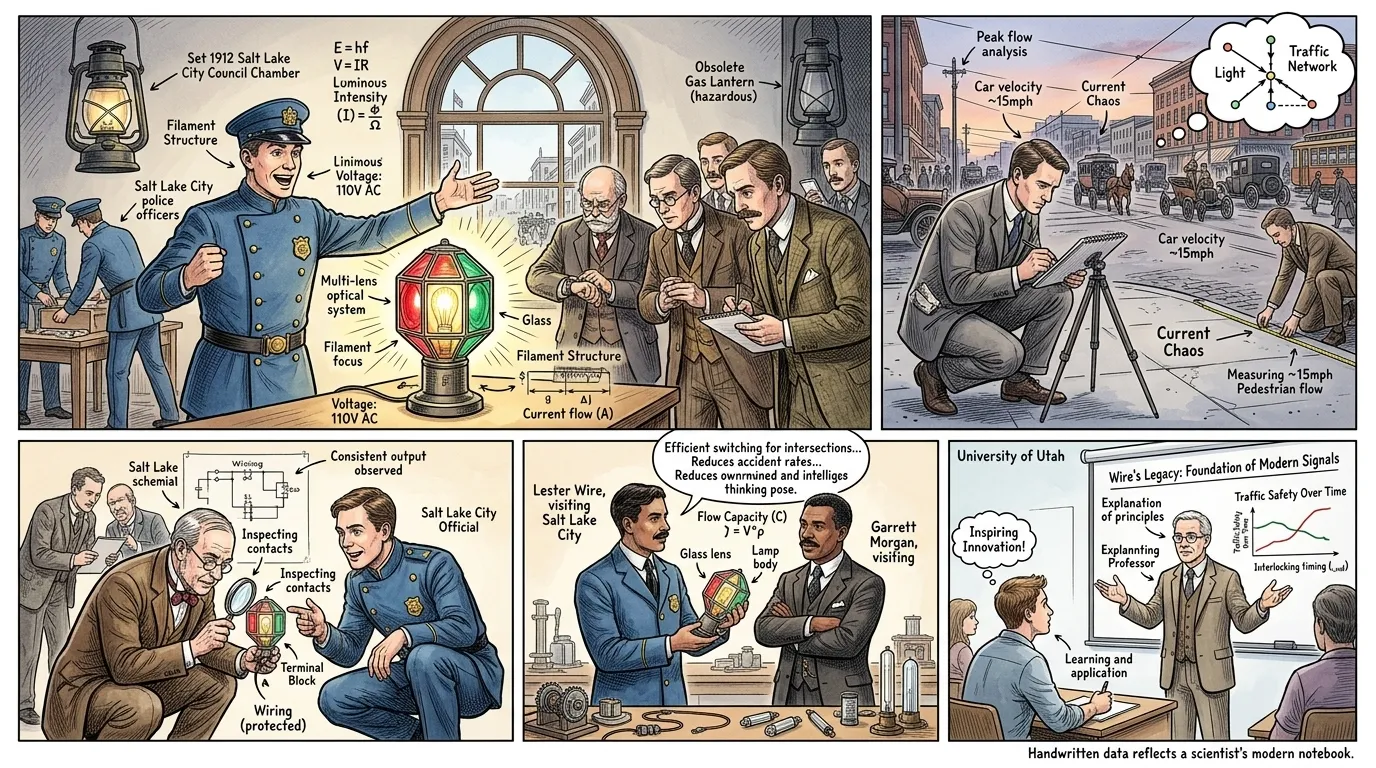
The limitations of gas-powered signals, particularly their safety hazards, underscored the need for a different approach. As electricity became more accessible, engineers turned their attention to electric lamps. This shift marked a critical turning point, paving the way for the modern traffic light.
"'Electricity offers the consistent, bright, and most importantly, safe illumination we've been searching for,' announced Lester Wire, a pioneering police officer and inventor, to a group of Salt Lake City officials. 'Gone are the days of open flames; we can now envision a network of reliable signals.' An official responded, 'This electric signal, though manually operated, is a significant leap toward safer intersections for our burgeoning city.'"
Page 5
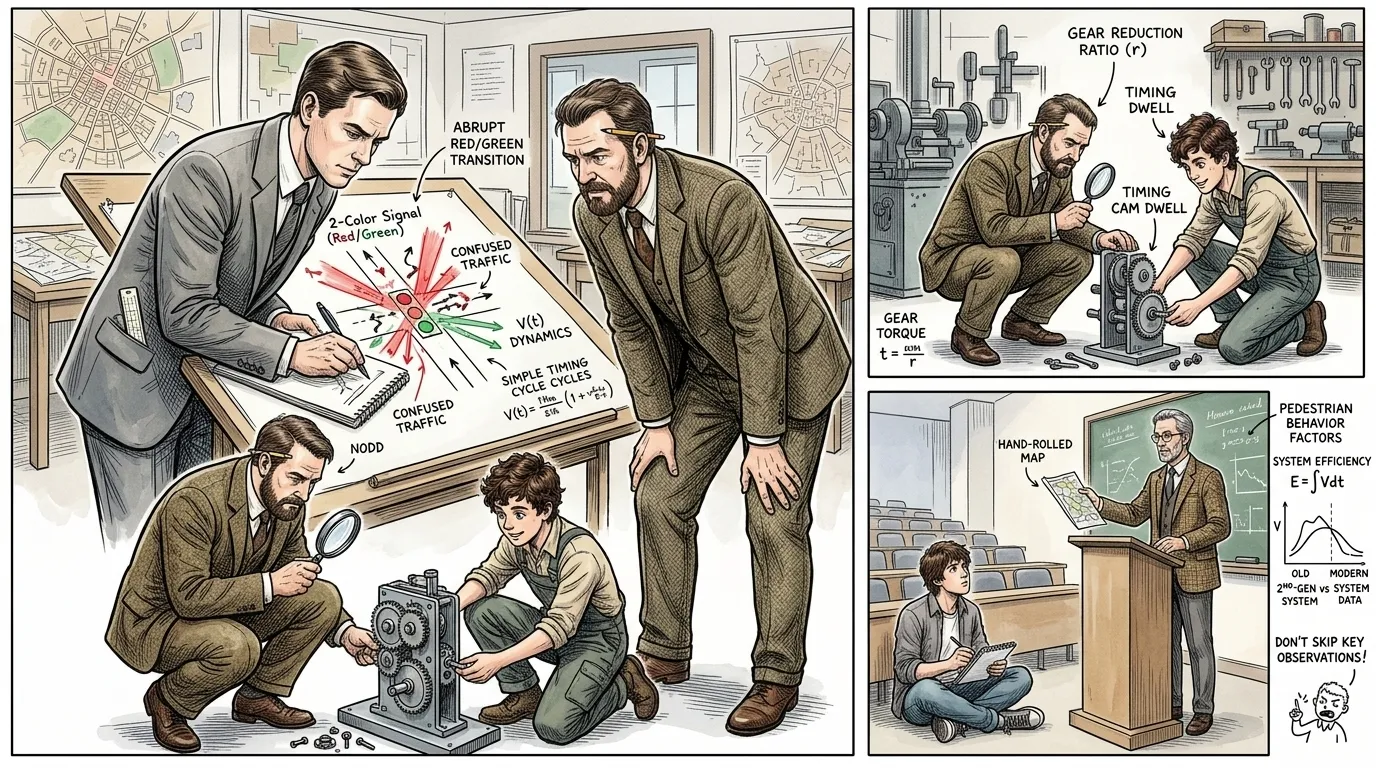
While electric two-color signals were a vast improvement in safety and reliability, they still harbored a critical flaw: the abrupt transition between 'stop' and 'go.' This sudden change created moments of ambiguity, particularly for vehicles approaching at speed, and did not effectively manage the flow for turning traffic or pedestrians.
"'The binary 'stop-go' system, while effective, creates an instantaneous moment of uncertainty,' observed an urban planner, sketching on a notepad. 'As the green light yields to red, drivers in opposing lanes sometimes anticipate prematurely, or those clearing the intersection find themselves caught.' A city engineer nodded, 'We require an interim phase, a universally understood signal of caution, to truly harmonize the flow.'"
Page 6
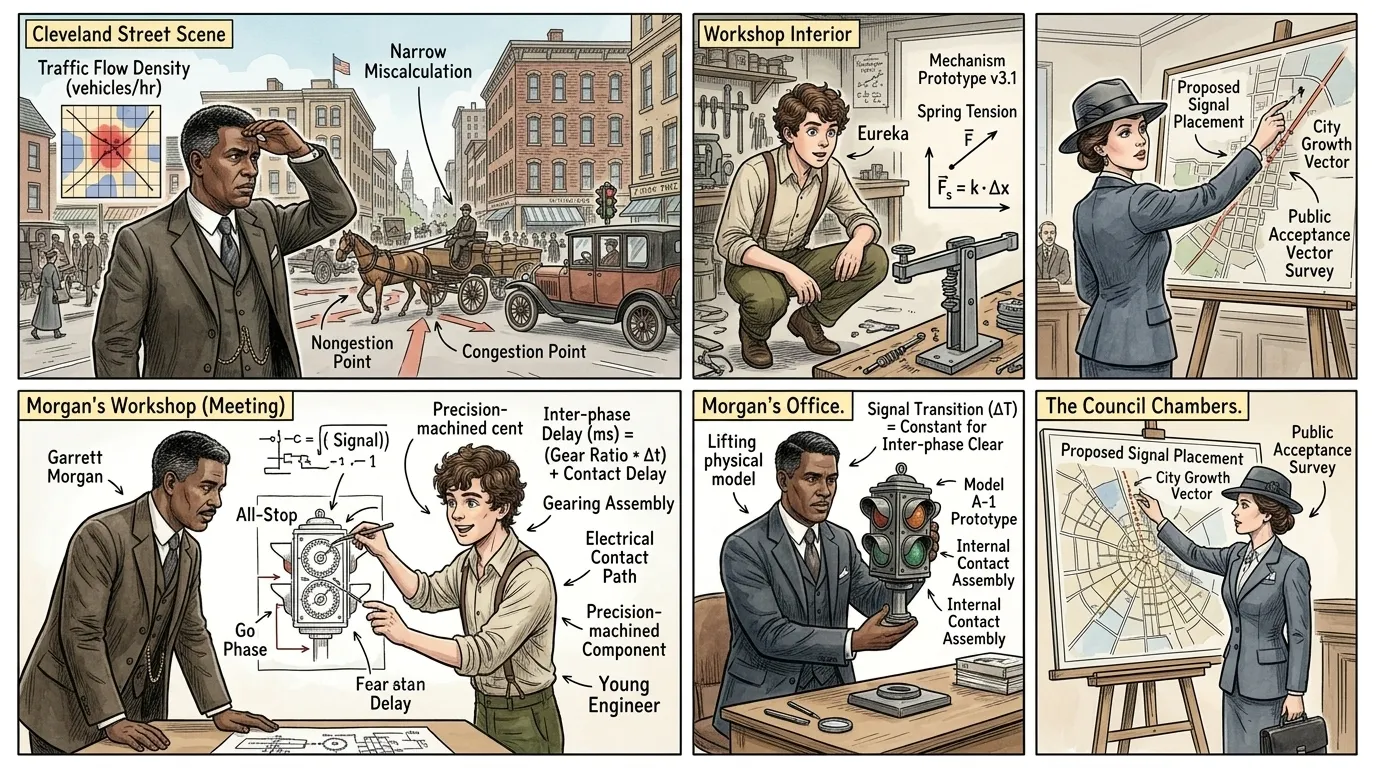
The solution to this ambiguity arrived in 1923, patented by Garrett Morgan in Cleveland, Ohio. His ingenious three-position traffic signal introduced a 'caution' or 'all-stop' phase, a crucial innovation that dramatically enhanced safety and efficiency at busy junctions. Morgan's design, initially a T-shaped pole, resolved the critical flaw of its predecessors.
"'I witnessed the repeated confusion and accidents caused by the sudden shift from green to red,' explained Garrett Morgan, a man in his 40s, broad build, dark skin, neatly parted black hair, well-trimmed mustache, with a determined and intelligent expression, to a group of civic leaders. He wore a smart early 20th-century suit and tie. 'My aim was to provide drivers with an explicit warning, a moment to clear the intersection, before conflicting traffic moved. This third signal, our 'all-stop' position, is key.'"
Page 7
Morgan's T-shaped signal operated through a system of gears and electrical contacts, allowing for a precise and timed sequence of light changes. When activated, typically by a police officer or a timer, the signals would transition from green to an all-directional 'stop' or 'caution' yellow, and then to red for one direction while green for another. This sequence ensured clear communication and mitigated hazards.
"'The internal mechanism, though seemingly simple, guarantees a deliberate transition,' described a young engineer, pointing to a diagram of Morgan's signal. 'A timed cam engages switches, sequentially activating the red, then the yellow, then the green circuits. It's the precision of this interval, this 'all-stop' phase, that prevents collisions.' Morgan nodded, 'Indeed, the very heart of the safety improvement lies in that brief moment of universal caution.'"
Page 8
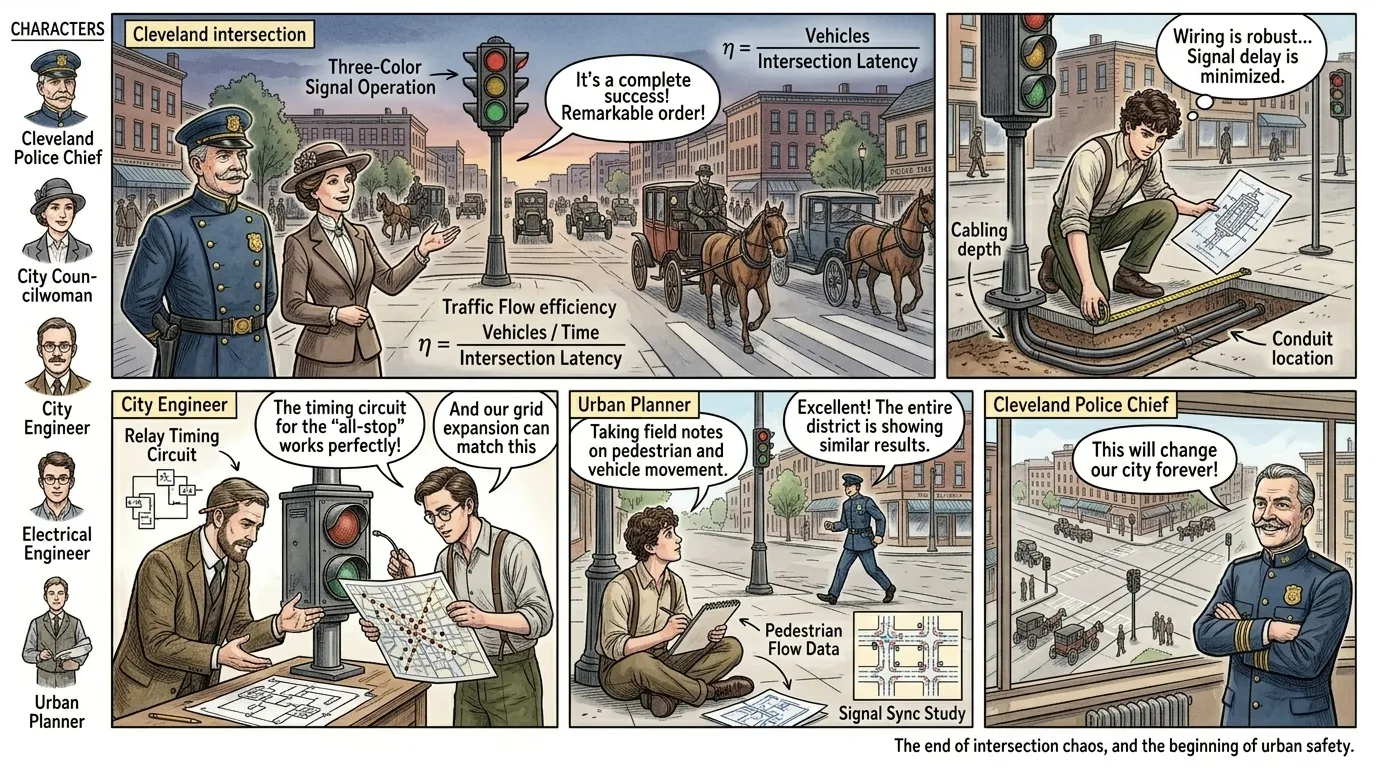
Morgan's design, along with other similar three-color systems developed concurrently, rapidly gained traction. Cities quickly recognized the profound impact on safety and traffic flow. The 'all-stop' or 'caution' phase became the industry standard, transforming chaotic intersections into orderly, predictable crossings and greatly reducing accidents. The initial 'T' shape eventually evolved into the familiar vertical column of red, yellow, and green lights.
"'The transformation has been remarkable,' exclaimed a Cleveland police chief, observing the smooth operation of a new three-color light. 'Accident rates at controlled intersections have plummeted. This clear, sequential instruction prevents the confusion that plagued us for so long.' A city councilwoman added, 'It's more than just lights; it's a new paradigm for urban mobility, making our streets safer and more efficient for everyone.'"
Page 9
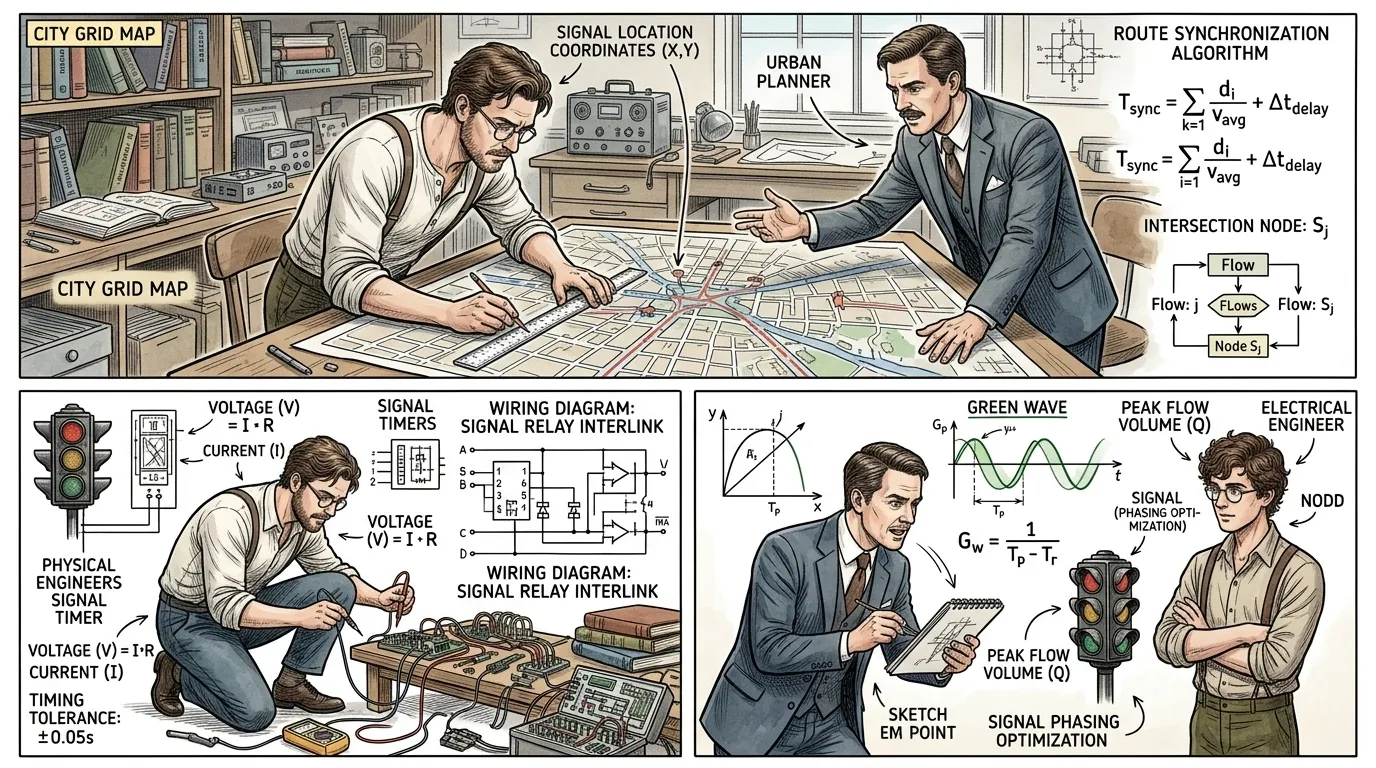
As individual traffic lights proved their worth, the next logical step was coordination. Synchronizing signals across entire urban grids further optimized traffic flow, minimizing delays, and creating 'green waves' where vehicles could travel through multiple intersections without stopping. This required sophisticated timing mechanisms and centralized control, leading to early traffic management systems.
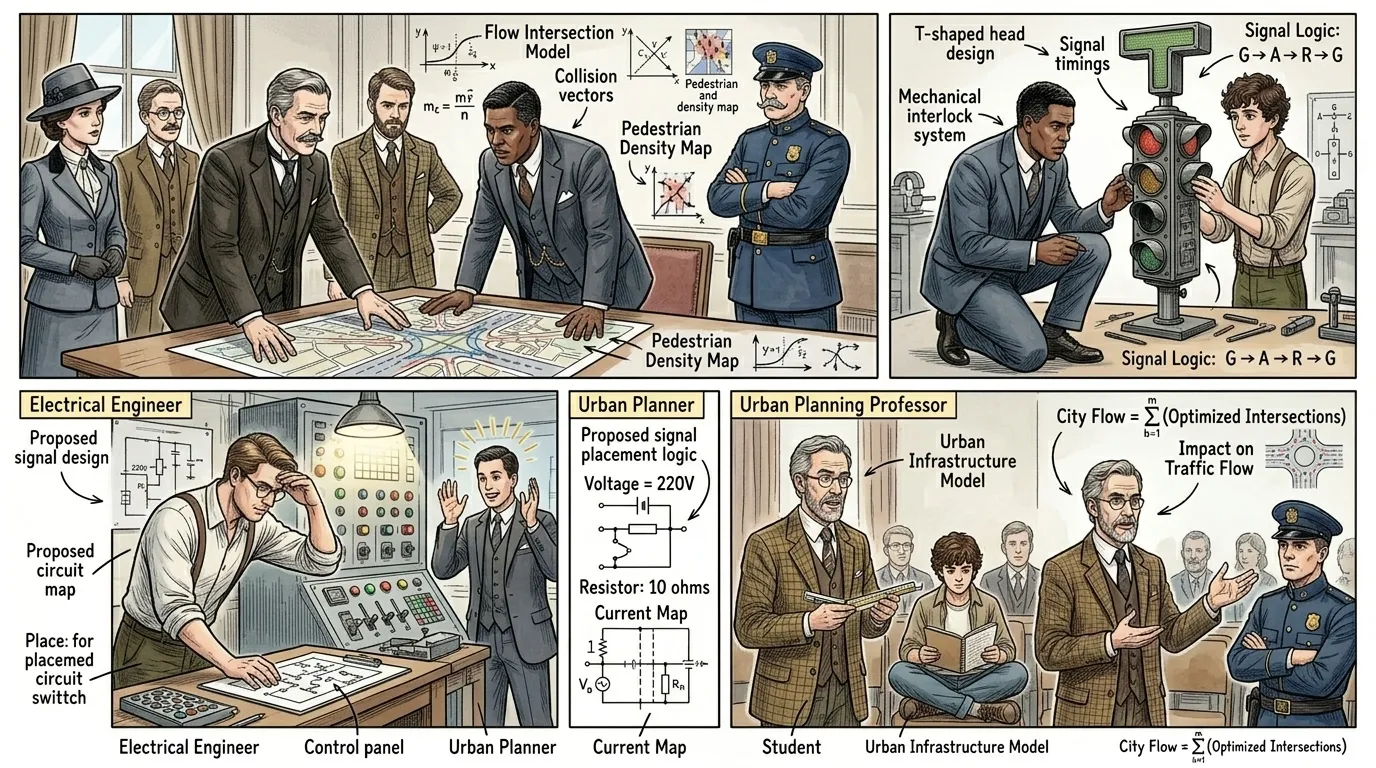
"'Linking these individual signals into a cohesive network presents an exciting, yet complex, engineering challenge,' remarked an early electrical engineer, examining a city map dotted with proposed signal placements. 'We need precise timing, calculating vehicle speeds and intersection distances, to create truly efficient urban arteries.' A city planner responded, 'The goal is a seamless flow, minimizing delays and maximizing the capacity of our road infrastructure.'"
Page 10
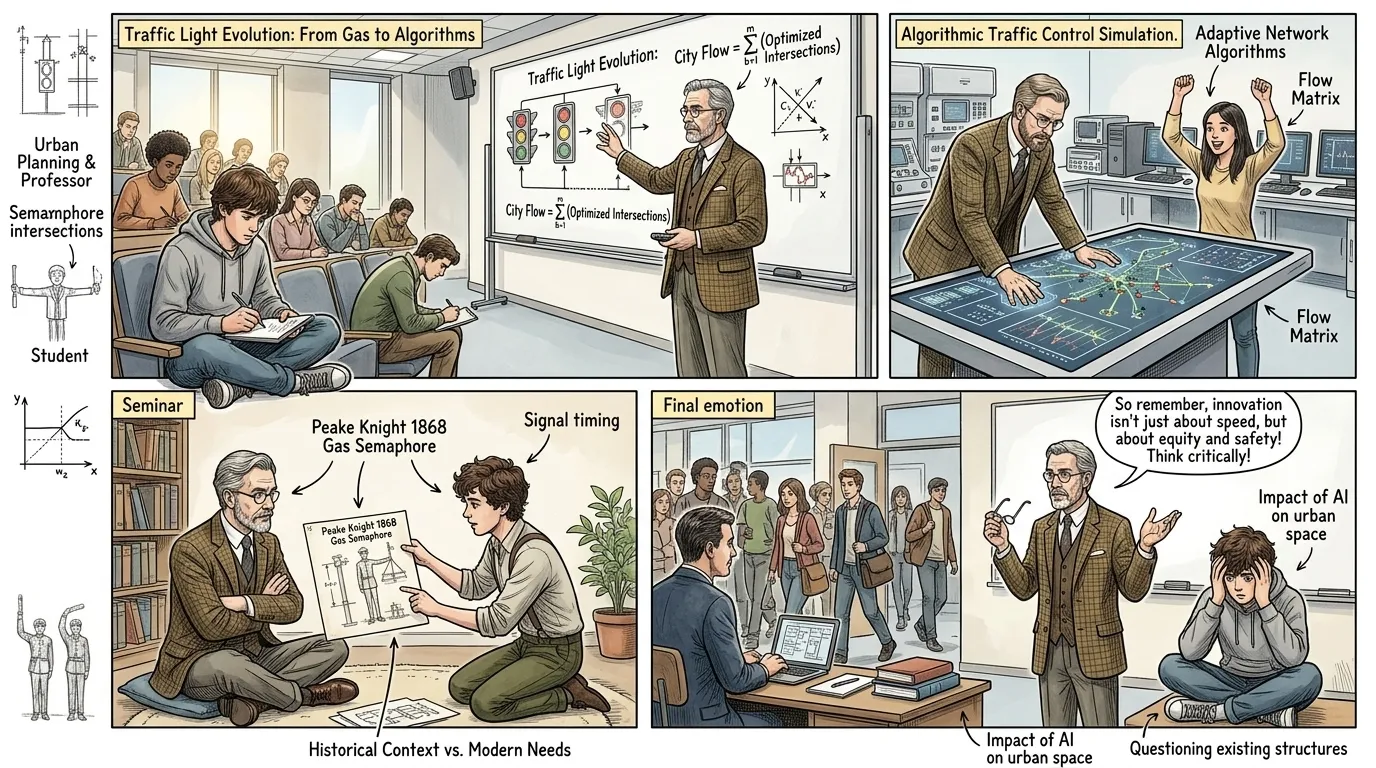
Today, the traffic light is an indispensable element of urban infrastructure worldwide. From bustling metropolises to quiet suburban towns, its consistent signals guide billions of movements daily. Modern systems incorporate advanced sensors, artificial intelligence, and real-time data to dynamically adjust to traffic conditions, ensuring safety and efficiency in an ever-evolving landscape of mobility.
"'The humble traffic light, born from a need for safety, has evolved into a cornerstone of modern society,' mused a contemporary urban planning professor, addressing a group of students in a lecture hall. 'It's a testament to how simple yet profound inventions shape our daily lives, often unseen, yet undeniably critical.' A student asked, 'What challenges remain for future traffic management?' The professor replied, 'Integrating autonomous vehicles and pedestrian priorities will require constant innovation, building on the fundamental principles established a century ago.'"
About this story
- Location: Global
- Audience: general readers
Questions and answers
Read Wonder Inventions on your phone
Wonder Inventions is available on Android. Get Wonder Inventions on Google Play.