Transformer
Transformer — an illustrated inventions story, set in Global. 10 illustrated pages, free to read on Wonder Inventions.
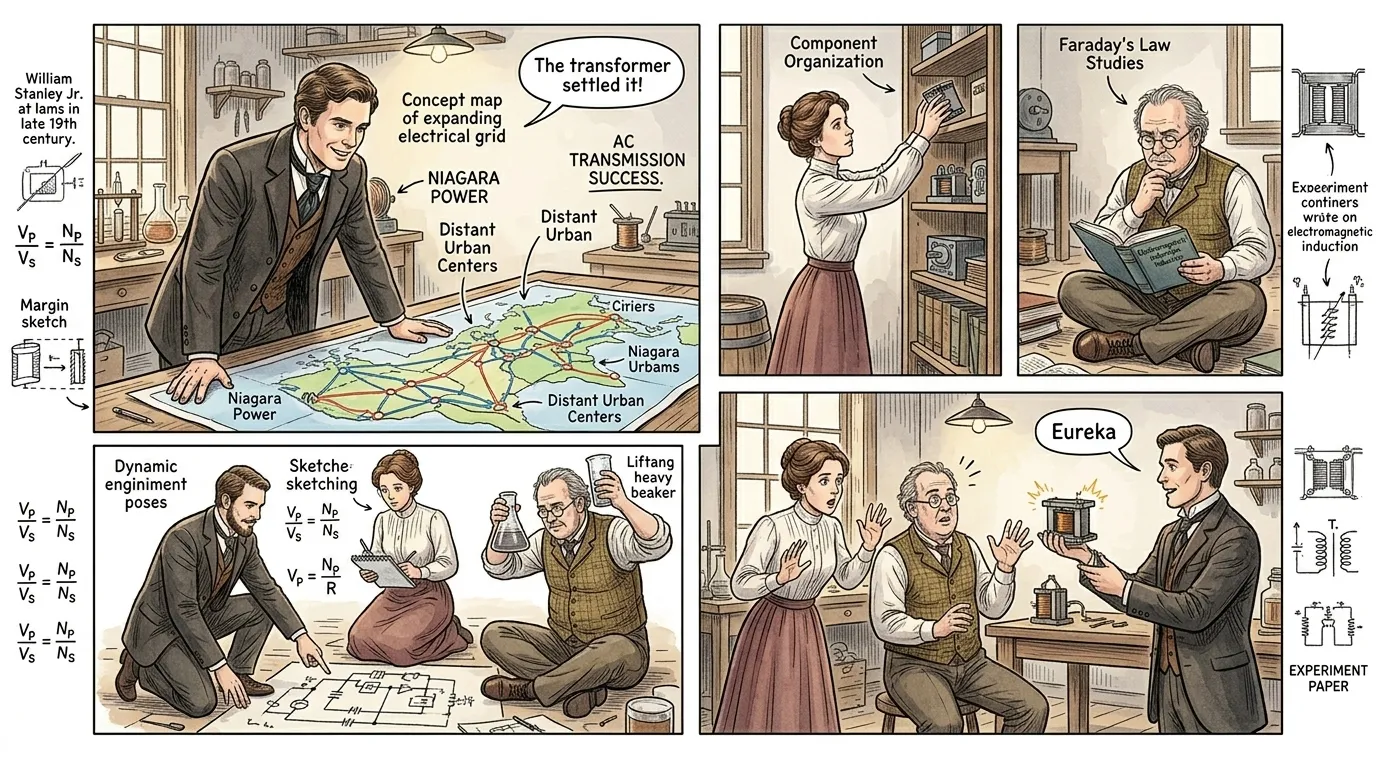
Page 1
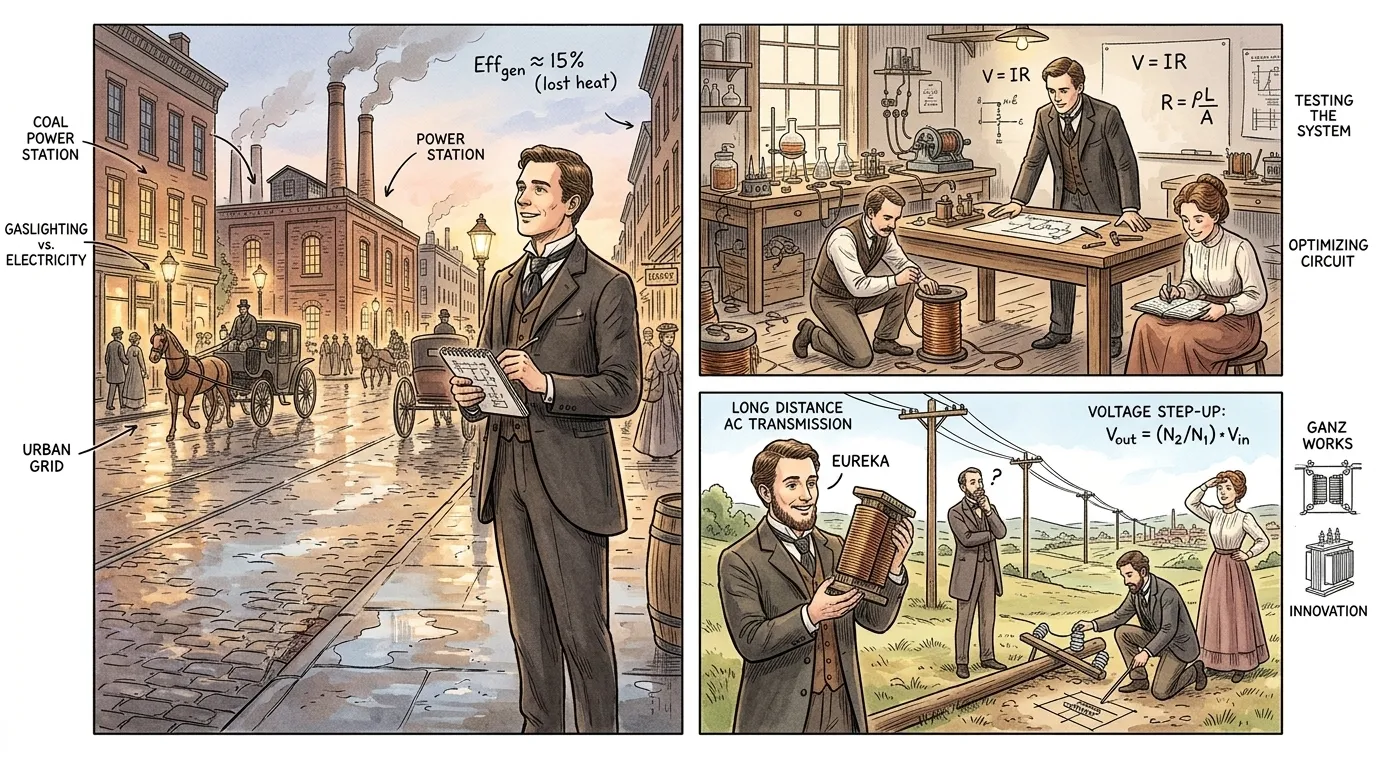
In the burgeoning industrial cities of the late 19th century, the demand for electrical power surged, but its reach was severely limited. Early direct current (DC) systems could only transmit power effectively over a few miles, forcing power stations to be built frequently, often in crowded urban centers. This created an urgent problem: how could electricity, this revolutionary force, be carried across vast distances to illuminate entire nations?
"'This direct current simply cannot travel far enough,' declared William Stanley Jr., a brilliant American electrical engineer. 'We must find a way to step up the voltage for transmission and then step it back down safely for our homes and factories.' His words, though quiet, resonated with the profound challenge of the era, echoing the sentiment that 'necessity is the mother of invention,' a timeless truth often attributed to Plato."
Page 2
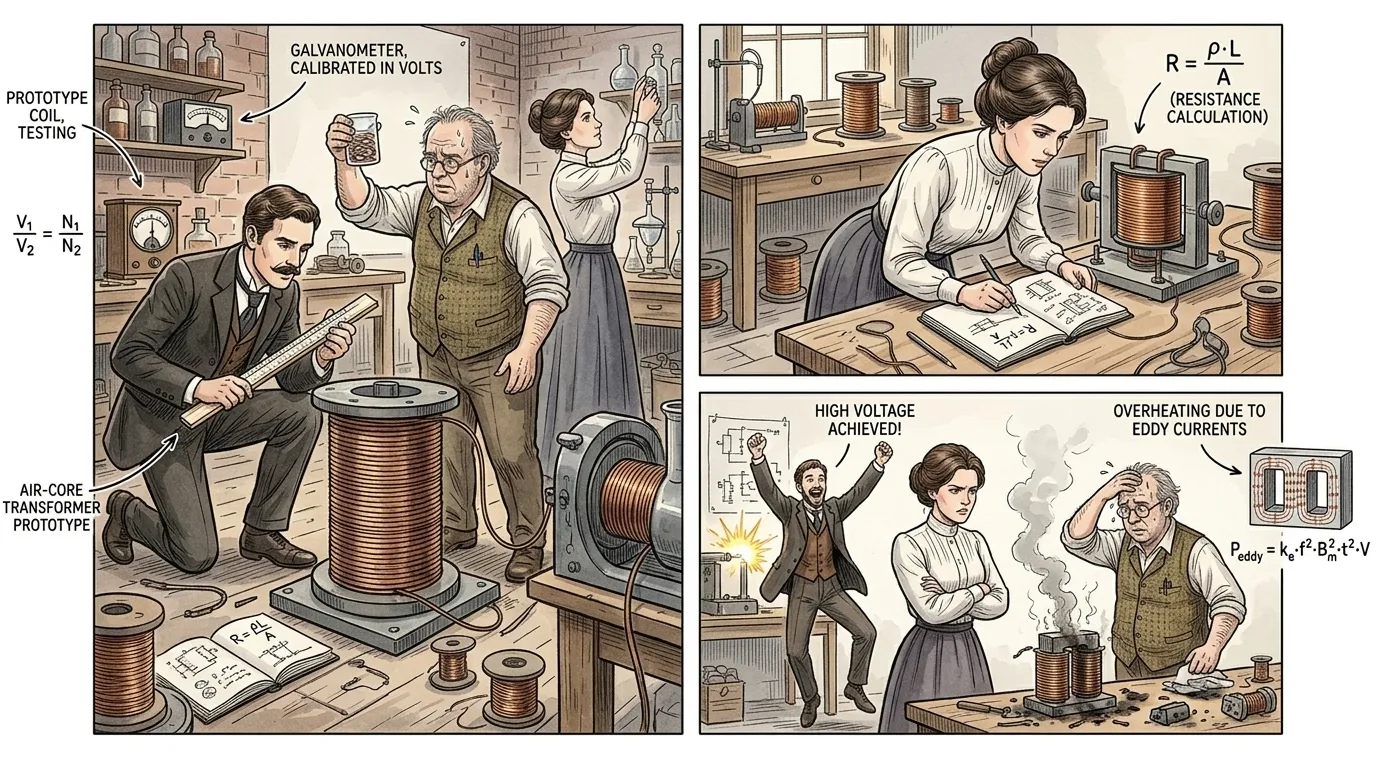
Before the advent of the transformer, electrical distribution relied heavily on direct current, a flow of electrons in a single direction. This meant that voltage, the 'pressure' of electricity, could not be easily altered. To reduce power loss over distance, current needed to be transmitted at high voltage; however, appliances and lights required low voltage. Attempting to transmit low-voltage DC over long distances resulted in massive energy dissipation as heat, rendering it impractical and incredibly expensive.
"'Imagine trying to push water uphill through a leaky pipe,' explained one of Stanley's colleagues, a portly man named Johnson, wiping sweat from his brow. 'That's our DC system for long distances—most of the energy is lost before it reaches its destination.' Another engineer, a younger woman named Eleanor Vance, added, 'And generating high-voltage DC is dangerous, while lowering it safely without huge losses is nearly impossible at the point of use.'"
Page 3
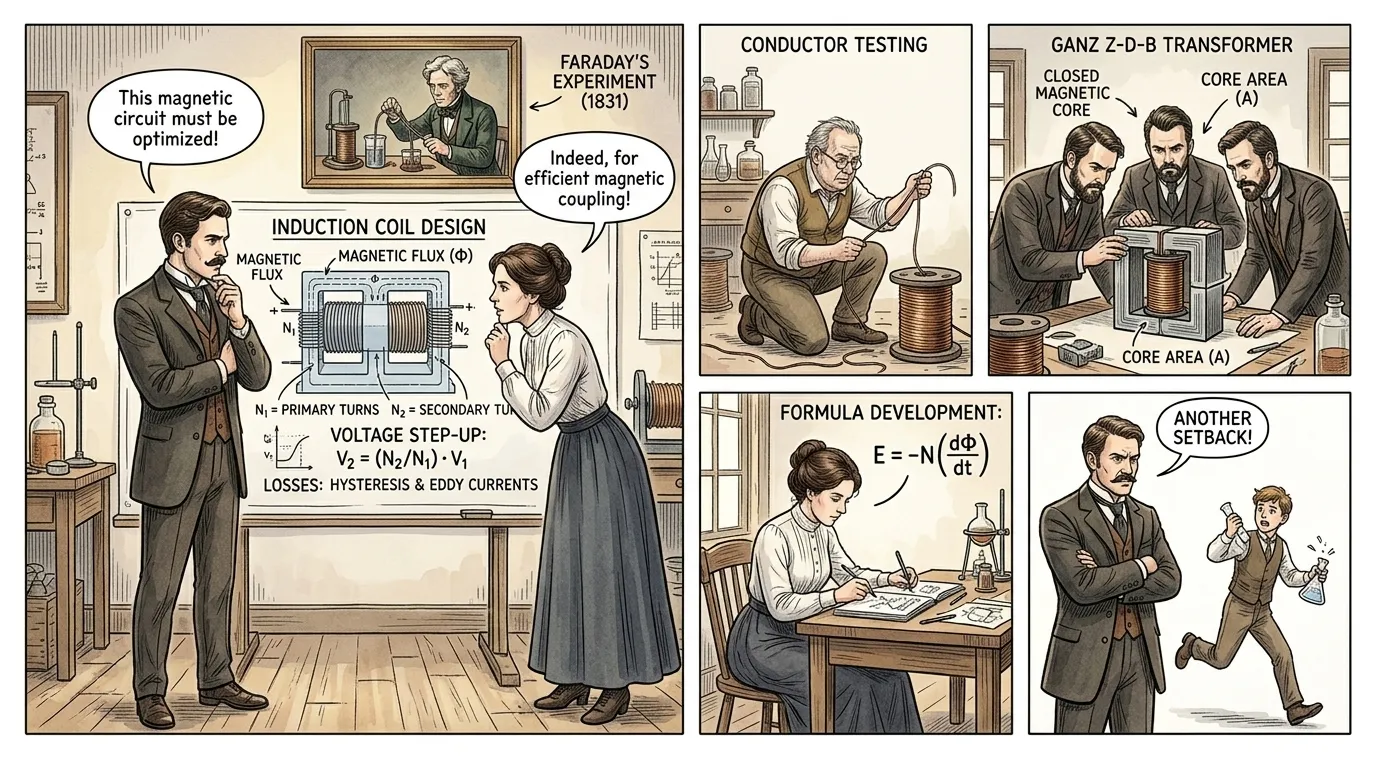
The solution lay with alternating current (AC), where the electrical flow periodically reverses direction. This crucial distinction meant that AC voltage could be changed. Early induction coils, such as those pioneered by Michael Faraday and Joseph Henry, hinted at this possibility, demonstrating how a changing magnetic field could induce a current in a nearby coil. However, these early devices were inefficient and primarily used for intermittent sparks, not continuous power distribution.
"'Faraday's experiments with induction showed us the way forward,' Stanley mused, tapping a finger on a diagram. 'A changing magnetic field in one coil could induce current in another. But our challenge is harnessing that principle for continuous, reliable power.' Vance nodded. 'The critical insight for a practical system, then, isn't just induction, but efficient magnetic coupling—how do we ensure almost all the magnetic field from one coil interacts with the other?'"
Page 4
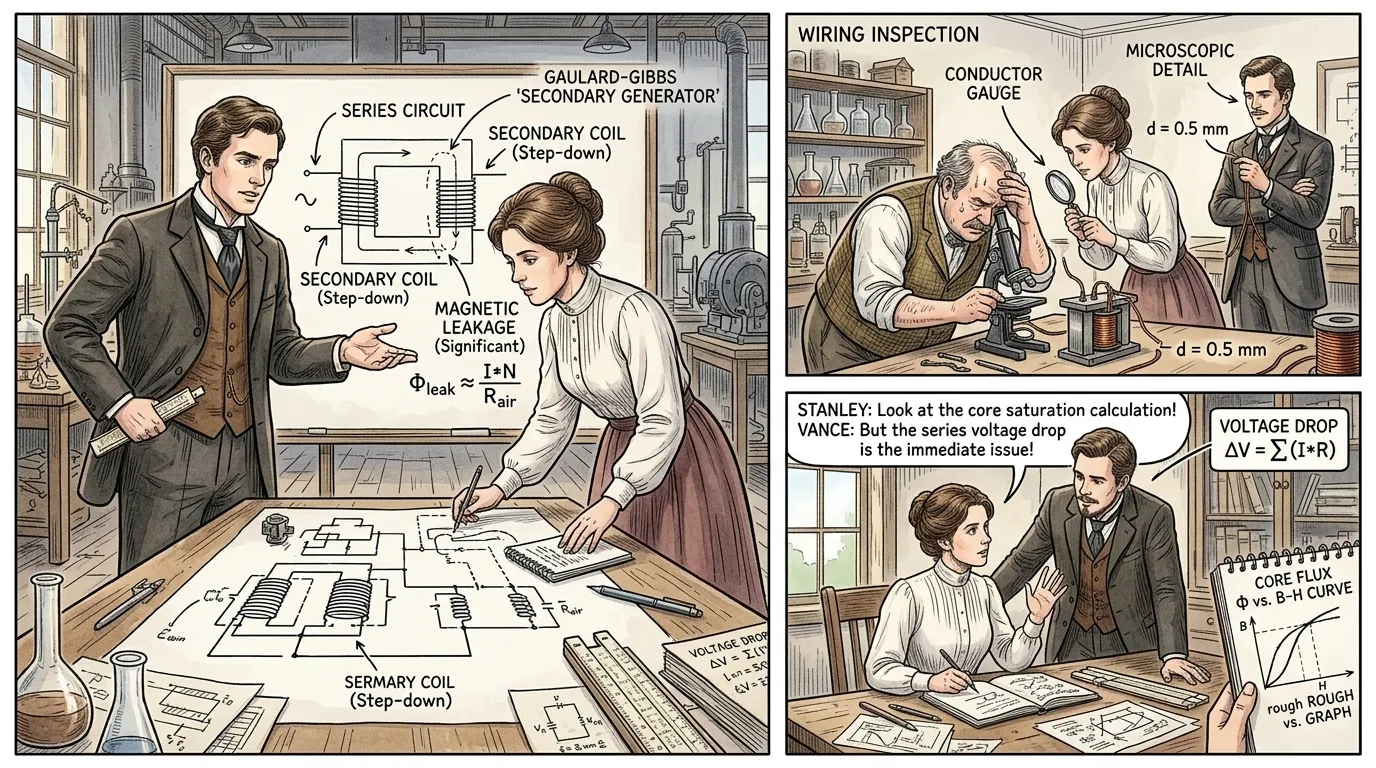
Engineers across Europe and America raced to develop a practical device that could efficiently 'transform' AC voltage. Lucien Gaulard and John Dixon Gibbs developed a 'secondary generator' system in the 1880s, which essentially used open-core induction coils connected in series. While a step towards AC distribution, their design suffered from significant magnetic leakage, making it inefficient, particularly as the load changed, and prone to voltage fluctuations.
"'Gaulard and Gibbs have shown us that individual 'secondary generators' can work, even if imperfectly,' Stanley noted, gesturing to a schematic with a critical eye. 'But connecting them in series means if one fails, the whole system falters. More importantly, the open core loses so much energy.' Vance added, 'The voltage drops significantly as more devices are connected, making it impractical for stable home use. We need a way to ensure voltage remains constant regardless of the load.'"
Page 5
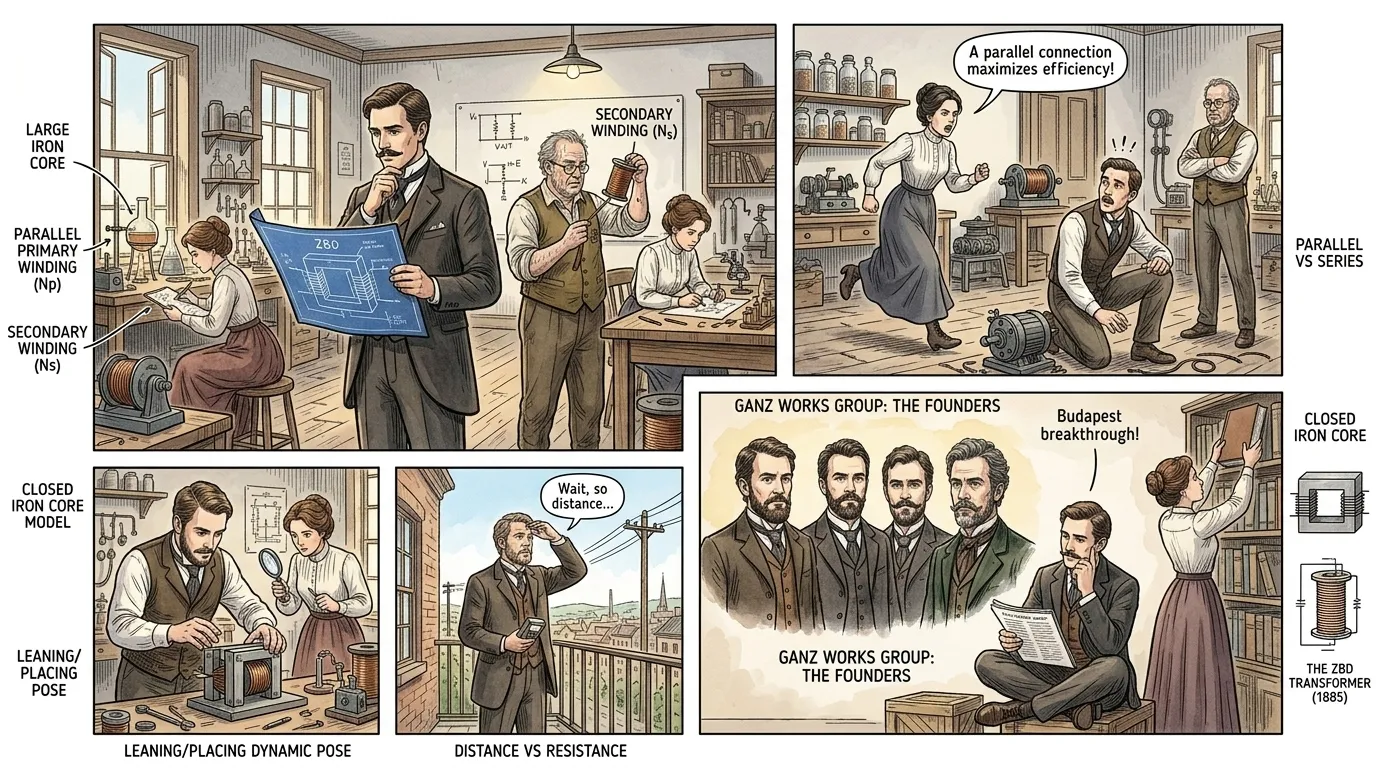
A pivotal breakthrough came in 1885 from three Hungarian engineers at the Ganz Works in Budapest: Ottó Bláthy, Miksa Déri, and Károly Zipernowsky. They independently developed a transformer featuring a fully closed iron core and, crucially, designed it for parallel connection. This 'ZBD' transformer drastically improved efficiency by minimizing magnetic flux leakage and allowed for a stable voltage supply across varying loads, setting the stage for modern AC distribution.
"'The Hungarian team at Ganz has made a truly significant leap,' Stanley said, his expression thoughtful as he reviewed a technical drawing. 'A closed iron core—it's so elegant in its simplicity! This channels the magnetic field almost entirely, reducing losses dramatically.' Vance interjected, 'And connecting them in parallel is critical. It means each consumer can tap into a stable voltage, independent of others. This is the difference between a theoretical curiosity and a viable power grid.'"
Page 6
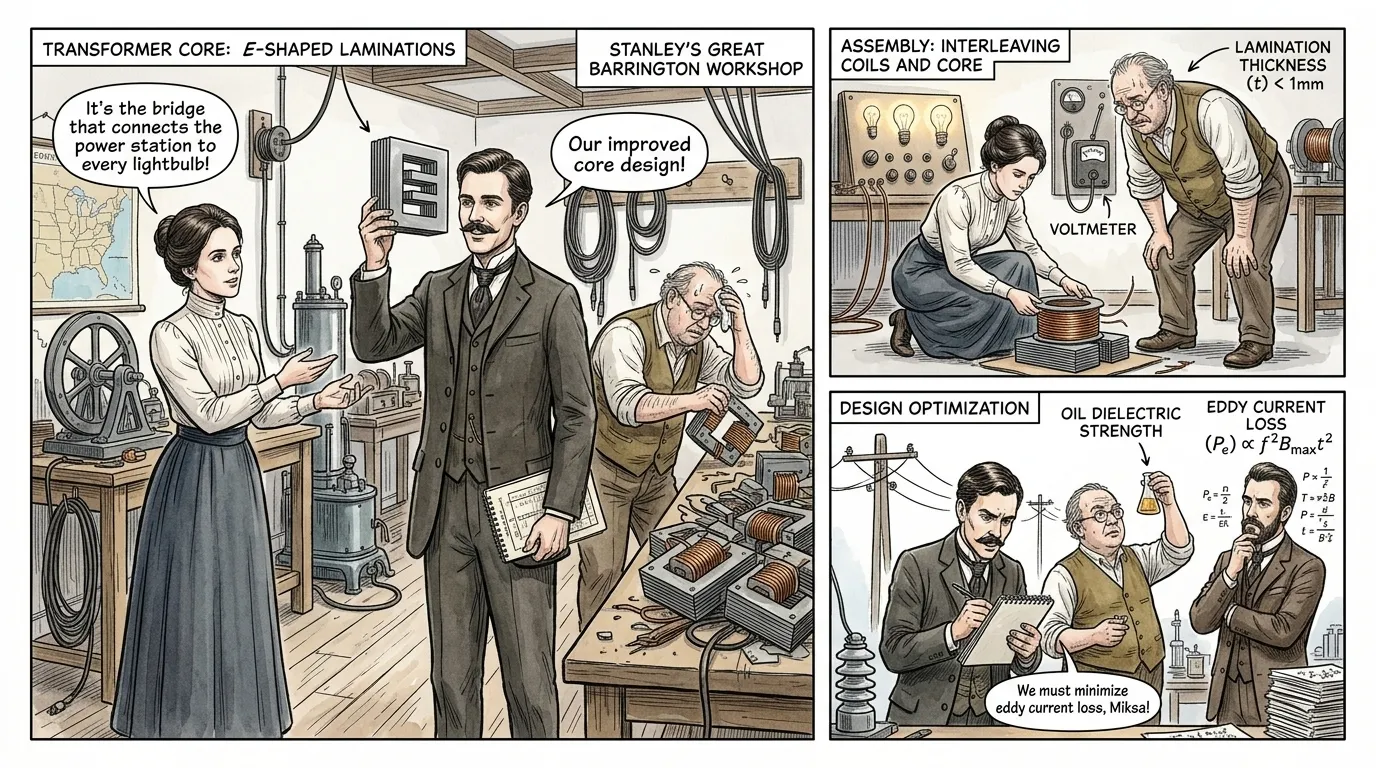
Building upon the principles established by the Ganz engineers and previous patents, William Stanley Jr., working for George Westinghouse in Great Barrington, Massachusetts, designed and built the first practical commercial AC transformer in America in 1886. His design, licensed from Gaulard and Gibbs but greatly improved, also featured a laminated closed iron core, but with a refined construction that made it more manufacturable and reliable. This marked the true dawn of widespread AC power distribution.
"'We've taken these vital principles and refined them,' Stanley announced to a small gathering of engineers in his lab. 'My design for the core, using E-shaped iron sheets, makes it simpler to assemble and much more robust. We can finally build a device that reliably steps voltage up and down.' Vance added, 'This isn't just an improvement; it's the bridge that connects the power station to every lightbulb and motor in every home and factory, making electricity truly accessible.'"
Page 7
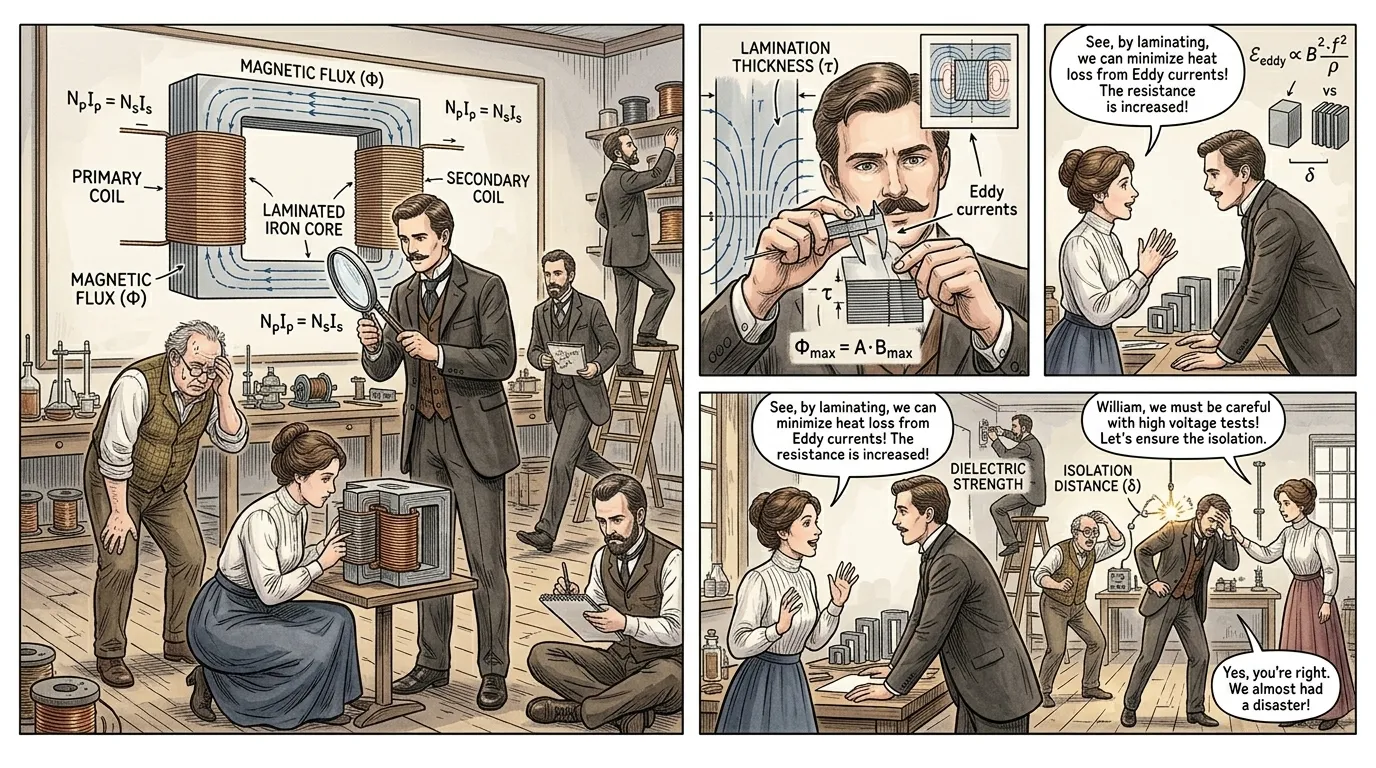
At its heart, the transformer operates on the principle of electromagnetic induction. When alternating current flows through the primary coil, it creates a continuously changing magnetic field. This fluctuating magnetic field is efficiently guided by the laminated iron core through the secondary coil. As the magnetic field changes within the secondary coil, it induces an alternating voltage and current in that coil, transferring electrical energy without direct connection.
"'Consider the primary coil as the voice and the secondary coil as the ear,' Stanley elaborated, pointing to a diagram with two coils around a core. 'The changing magnetic field is the sound wave. If the sound wave is strong enough and the ear is tuned correctly, the message is received clearly.' Vance interjected, 'The laminated iron core is the key. It ensures the magnetic 'sound' travels directly and powerfully from one coil to the other, minimizing any loss or distortion in the 'message'.' This clear path is essential for efficiency."
Page 8
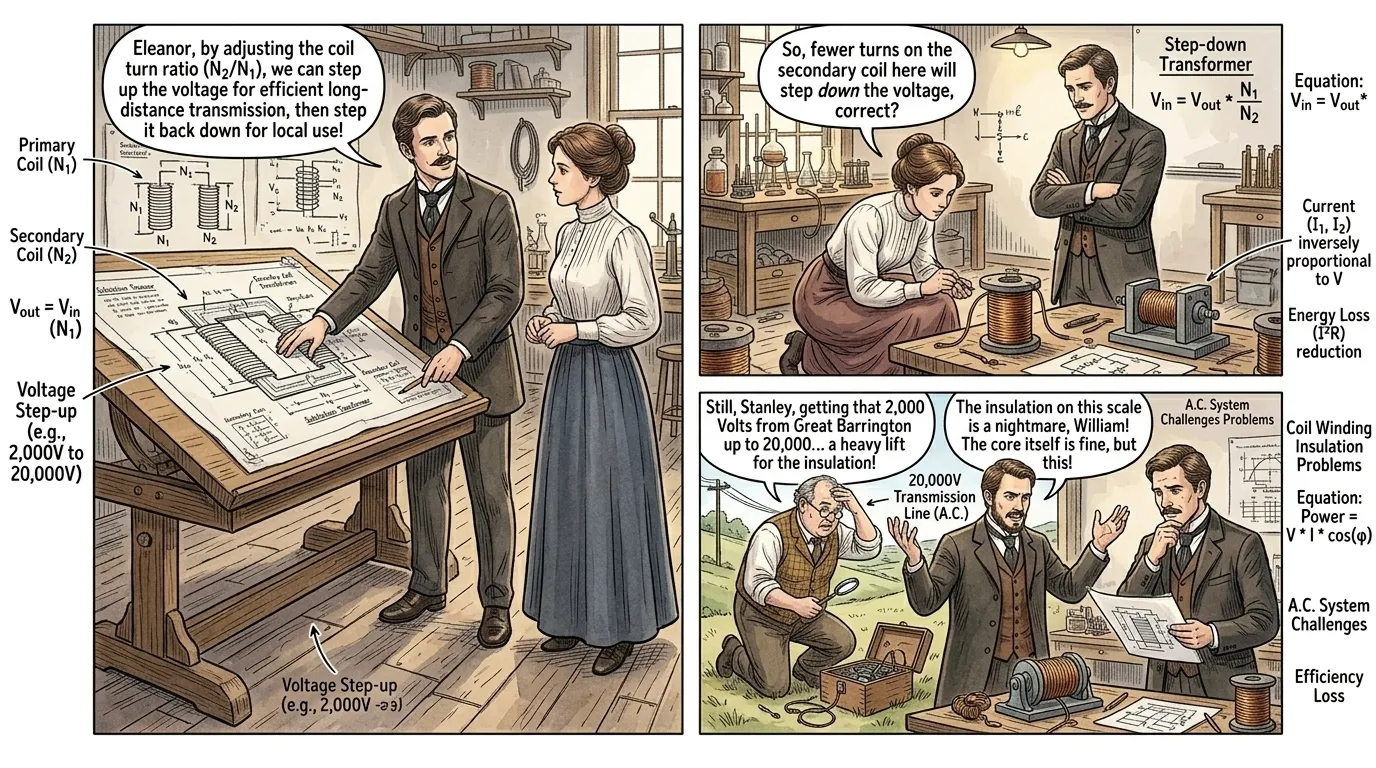
The magic of the transformer lies in its ability to 'step up' or 'step down' voltage. If the secondary coil has more turns of wire than the primary coil, the voltage is increased (stepped up). Conversely, if the secondary coil has fewer turns, the voltage is decreased (stepped down). This simple ratio allows electricity to be efficiently transmitted at very high voltages over long distances, then safely reduced to usable levels for consumers at their destination, fundamentally solving the long-distance power problem.
"'This turn ratio is everything,' Stanley stated firmly, tracing lines on a blueprint for a substation transformer. 'For long-distance lines, we step up from, say, 2,000 volts at the generator to 20,000 volts for transmission. This dramatically reduces current, minimizing energy loss.' Vance added, 'Then, at the city edge, we use another transformer to step it back down to a safe 120 or 240 volts for homes and businesses. This hierarchical voltage control, born from this simple principle, truly unlocks the power grid.'"
Page 9
The practical AC transformer, perfected by Stanley and others, became a cornerstone in the 'War of Currents' against Thomas Edison's DC system. Westinghouse and Nikola Tesla championed AC, demonstrating its superiority for long-distance transmission. The transformer enabled vast power grids to be built, connecting remote power generation sites, like hydroelectric dams, to distant urban centers and industrial complexes. This shift rapidly accelerated global electrification, profoundly reshaping society and industry.
"'This technology settled the 'War of Currents' decisively,' Stanley declared, looking out over a conceptual map of an expanding electrical grid. 'Without the transformer, AC would be little better than DC for distribution. It made large-scale power economically viable.' Vance added, 'Imagine, power from Niagara Falls, reaching Buffalo! This is not just about lights, it's about factories, transportation, and every aspect of modern life. It's truly a global game-changer.'"
Page 10
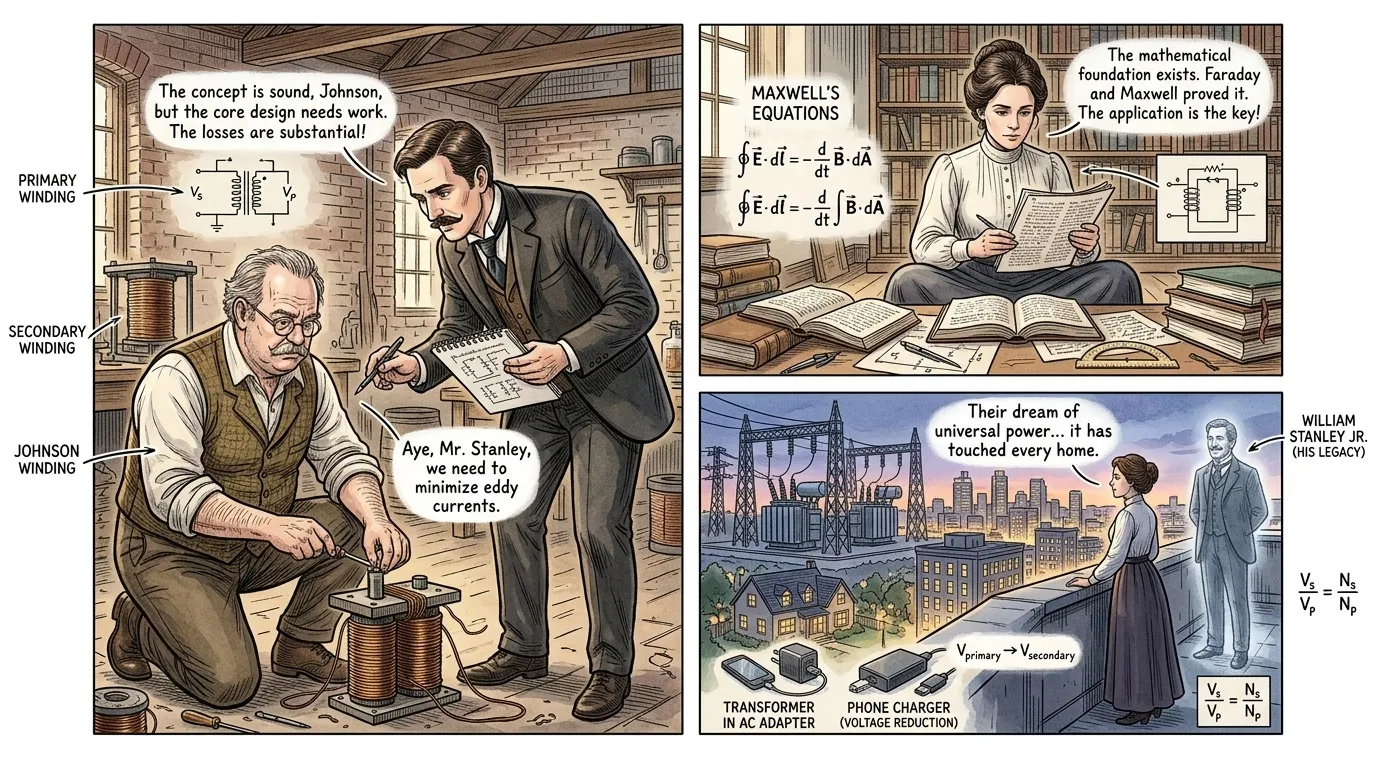
Today, the transformer remains an indispensable component of every electrical grid worldwide, from massive utility substations to the tiny adapters powering our mobile devices. It silently enables the efficient transport of electricity from power plants to every home, business, and factory, facilitating everything from advanced computing to essential infrastructure. This unassuming invention continues to be the unseen pillar that supports our interconnected, power-dependent modern world, a testament to the ingenuity of its pioneers.
"The profound impact of the transformer is evident everywhere. As Vance often remarked, 'It's the silent workhorse that makes the very idea of a modern, interconnected world possible.' Stanley would often agree, adding, 'Its elegance lies in its simplicity, yet its consequence is truly monumental. As Isaac Newton observed, 'If I have seen further than others, it is by standing upon the shoulders of giants.' We built upon the work of many, transforming mere potential into global reality.'"
About this story
- Location: Global
- Audience: general readers
Questions and answers
Read Wonder Inventions on your phone
Wonder Inventions is available on Android. Get Wonder Inventions on Google Play.