A Sportsman's Sketches — Ivan Turgenev
A Sportsman's Sketches — Ivan Turgenev — an illustrated literature story. 10 illustrated pages, free to read on Wonder Novels.
Page 1

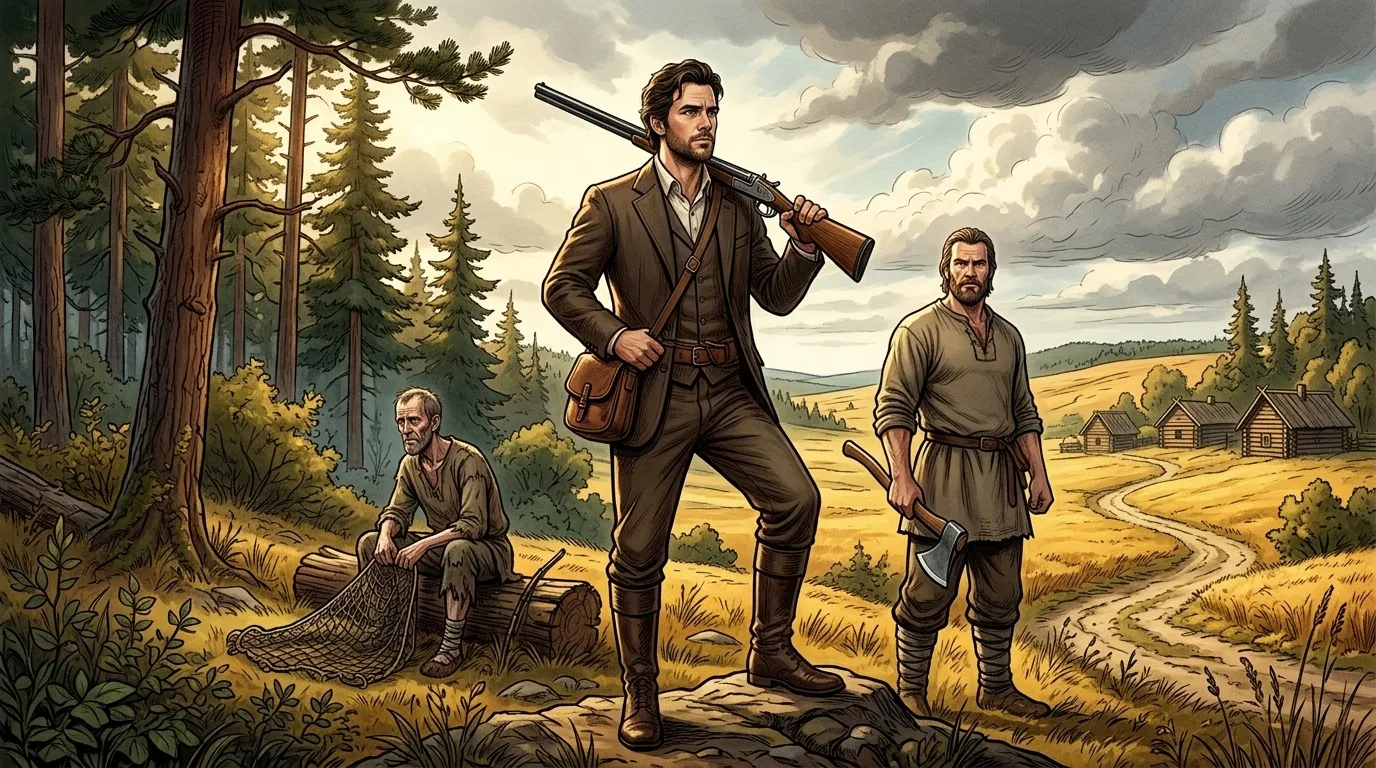
Dimitri Volkov, a sportsman traversing the dense Orel forest, felt the first heavy drops of a sudden, fierce storm upon his face. The wind howled through the ancient trees, twisting their branches, and the sky turned a menacing, bruised purple above him. He knew the peril of being caught unprepared.
""This sudden downpour means I must seek shelter, and quickly, or risk a night exposed to the elements," he muttered, pulling his damp wool cloak tighter around him."
️ Literary Fact: This page introduces Dimitri Volkov, the narrator and observer, caught in the raw, untamed nature of the Russian wilderness. The storm serves as both a literal and metaphorical force, setting the stage for the dramatic human encounter to follow. The 'Orel forest' establishes the authentic Russian setting.
Page 2

As the oppressive light of day faded into a murky twilight, a formidable, silent figure emerged from the dense undergrowth, a heavy axe clutched in his calloused hand. His piercing, dark gaze fixed upon Dimitri, offering a stark contrast to the sportsman's refined bearing as he stepped into the path. Dimitri's horse snorted, unsettled by the stranger's sudden presence.
""Lost, are we, master?" the powerful man grunted, his voice rough but not unkind, his heavy brow furrowed. "Follow me, then. There's a forester's hut nearby, not far from here.""
️ Literary Fact: The introduction of Fyodor, known as Biryuk (the Lone Wolf), immediately establishes his physical presence and stoic nature. The low-angle shot emphasizes his imposing figure and connection to the wild forest, positioning him as a figure of authority in this natural realm.
Page 3

Inside the meager but miraculously dry hut, Dimitri found a sparse comfort from the biting cold, observing the forester's quiet, watchful presence. Fyodor, despite his gruff exterior and the harshness of his life, engaged in a tender act of craftsmanship for his young daughter. The small hut offered a fragile refuge from the storm's fury.
"Dimitri watched as Fyodor carefully whittled a small, intricate wooden bird for Anka, his large, calloused hands surprisingly delicate and precise. "She always liked these," Fyodor murmured, not looking up from his task, a rare, soft note in his tone."
️ Literary Fact: This page reveals a crucial aspect of Fyodor's character: his hidden tenderness as a father. The detail of the carved wooden bird serves as a 'Chekhov's Gun,' a seemingly minor detail that will gain significance later, showcasing his humanity beneath a stoic facade. Anka's presence adds to the warmth and vulnerability.
Page 4
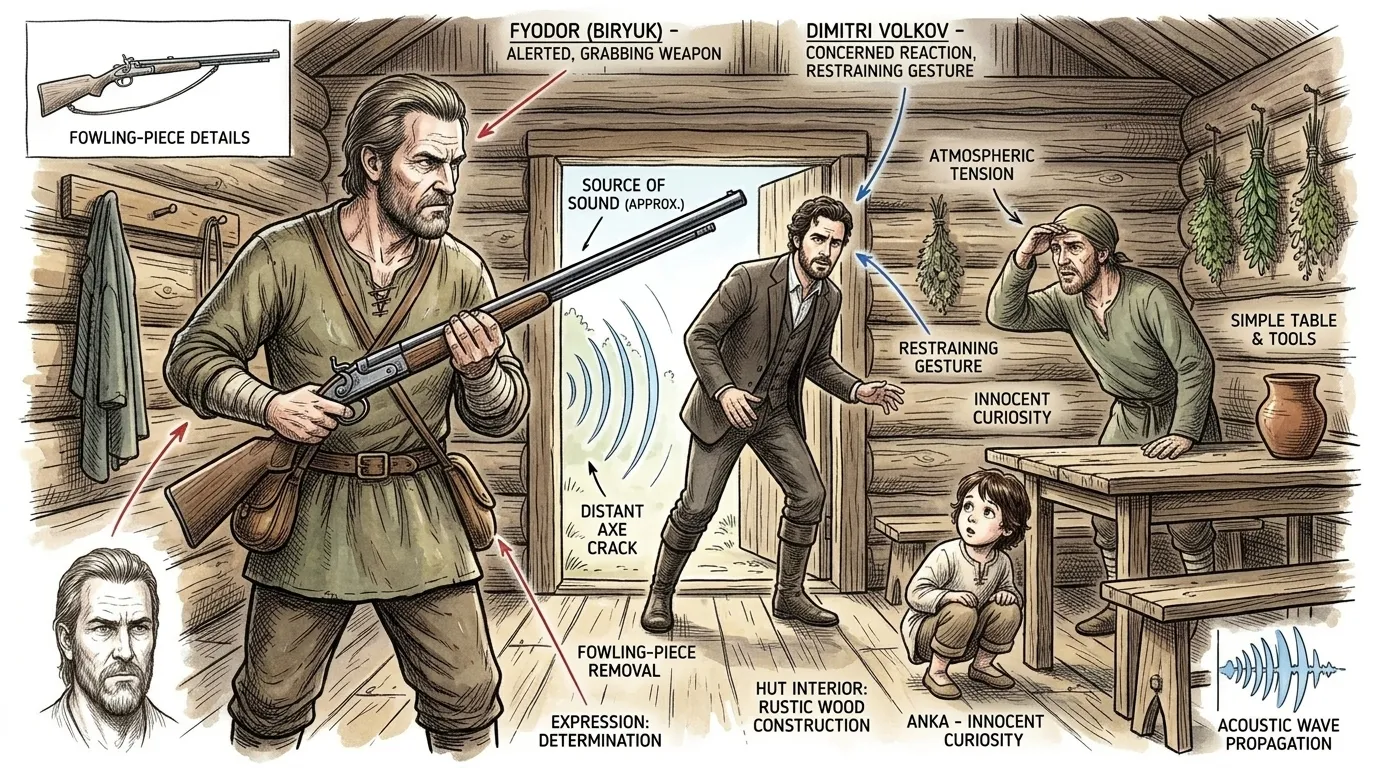
A sharp, distant crack of an axe against wood shattered the hut's newfound quiet, instantly transforming the forester's demeanor from gentle father to vigilant guardian. His deep-set eyes, which had moments before held a flicker of paternal affection, narrowed, hardening with fierce determination. The very air in the small dwelling grew taut with his sudden alertness.
""A poacher," Fyodor declared, his voice like flint as he seized his long fowling-piece from its hook on the wall. "I'll not let them strip these woods bare, not while I breathe and the forest remains under my watch.""
️ Literary Fact: The sound of the axe immediately shifts the narrative, highlighting Fyodor's unwavering commitment to his duty as a forester. This moment marks the transition from domestic quietude to the harsh realities of law and survival in the Russian countryside, introducing the central conflict.
Page 5

With a grim, unwavering resolve, Fyodor plunged back into the deluge, Dimitri following closely behind, struggling to keep pace through the treacherous, rain-slicked forest floor. The forester moved with the stealth and raw power of a true wolf, seemingly oblivious to the lashing rain and deep mud. Each step he took was purposeful, relentless.
""He thinks he can hide in this weather," Fyodor growled, pushing aside a thick tangle of brambles with his heavy forearm, his voice cutting through the storm. "But no creature, man or beast, escapes Biryuk's forest for long, not when I'm on their trail.""
️ Literary Fact: This page emphasizes Fyodor's exceptional skill and dedication to his duty. The relentless pursuit through the storm showcases his prowess as a woodsman and forester, reinforcing his nickname 'Biryuk' (Lone Wolf) and his unyielding nature. Dimitri's struggle to follow highlights Fyodor's strength.
Page 6

After a relentless, breathless pursuit through the sodden woods, Fyodor finally cornered his quarry beside a gnarled, fallen oak tree. The poacher, a gaunt peasant named Mikhail, hung his head in utter defeat, his crude axe lying uselessly on the damp ground beside him. His thin frame shivered not only from the cold but from fear.
"Fyodor gripped Mikhail's arm firmly, his voice low and unwavering. "So, Mikhail, we meet again. You know the rules of these woods, and what happens when they are broken." Mikhail trembled, his voice choked with desperation. "Have mercy, Fyodor," he pleaded, his eyes wide with despair, "my children starve!""
️ Literary Fact: The capture of Mikhail introduces the human element of suffering and necessity into the rigid system of law and duty. Mikhail's desperate plea immediately creates a moral dilemma, forcing Fyodor to confront the reality behind the crime. The scene highlights the harsh economic realities of peasant life.
Page 7

Back in the dim warmth of the hut, Mikhail, hunched and miserable, repeated his tale of destitution, his words echoing the grim reality of peasant life in rural Russia. His gaunt frame shook with the effort of his pleas, and his eyes searched Fyodor's face for any sign of leniency. The air hung thick with his desperation.
""They have nothing, Fyodor!" Mikhail cried, throwing out his hands in a gesture of utter despair, his voice cracking. "No bread, no warmth! A few logs, that's all I sought to keep them from freezing tonight, by God!""
️ Literary Fact: Mikhail's passionate plea humanizes the 'poacher' and brings the theme of suffering to the forefront. His words paint a vivid picture of the extreme poverty driving his actions, directly challenging Fyodor's adherence to the law. The hut, though meager, offers a stark contrast to the despair outside.
Page 8

Dimitri observed the forester, a man visibly torn between his rigid duty to the estate and a nascent empathy for the suffering man before him. The profound choice weighed heavily on Fyodor's stern, unyielding face, etched with a rare flicker of inner turmoil. The silence stretched, heavy with unspoken conflict.
"Dimitri murmured softly, reflecting on the scene, "'No act of kindness, no matter how small, is ever wasted,' as Aesop, the ancient storyteller, once wisely penned. Mikhail's plight, Fyodor, truly cuts deep into the very heart of what it means to be human." "
️ Literary Fact: This page introduces the real-world quote from Aesop, seamlessly woven into Dimitri's internal reflection. It highlights the philosophical core of the story: the conflict between duty, law, and the profound capacity for human kindness. Fyodor's internal struggle is physically manifested, making his decision all the more impactful.
Page 9

After a long, agonizing silence, heavy with the weight of his decision, Fyodor slowly unlatched the heavy wooden door, the sound echoing loudly in the small space. His gaze briefly softened as he met Anka's innocent, searching eyes, before he turned back to Mikhail, his expression now resolute. The small wooden bird, the tender gift from earlier, lay discarded near Anka's feet.
""Go," Fyodor commanded, his voice a low, gravelly rumble, resonating with unexpected mercy, gesturing with a heavy hand towards the open, rain-swept forest. "But do not let me catch you here again, Mikhail. For your children's sake, be gone from my sight!""
️ Literary Fact: This is the climax of the story. Fyodor's act of mercy, driven by compassion rather than strict adherence to the law, is a profound moment of character development. The 'Chekhov's Gun' payoff is subtly shown through Anka and the wooden bird, reminding Fyodor of innocence and vulnerability, influencing his decision.
Page 10

As the first pale light of dawn touched the forest canopy, painting the eastern sky with hues of soft grey and rose, Dimitri rode away from the solitary hut. The image of Fyodor's unexpected compassion and the depths of his internal struggle remained firmly etched in Dimitri's mind. He carried a profound understanding of the human soul's capacity for both stern duty and unexpected mercy.
"He reflected that the formidable forester had, in a single night, revealed the nuanced intersection where rigid law met the profound, undeniable weight of human suffering and quiet redemption. It was a lesson in the complex, contradictory nature of humanity."
️ Literary Fact: The final page serves as a denouement, offering Dimitri's profound reflection on the events and Fyodor's complex character. The return of dawn symbolizes a new understanding and the enduring human spirit amidst hardship, bringing the narrative to a philosophical close, in line with Turgenev's contemplative style.
About this story
- Audience: general readers
Read Wonder Novels on your phone
Wonder Novels is available on Android. Get Wonder Novels on Google Play.