Alexander Graham Bell
Alexander Graham Bell — an illustrated biography story, set in Global. 10 illustrated pages, free to read on Wonder People.
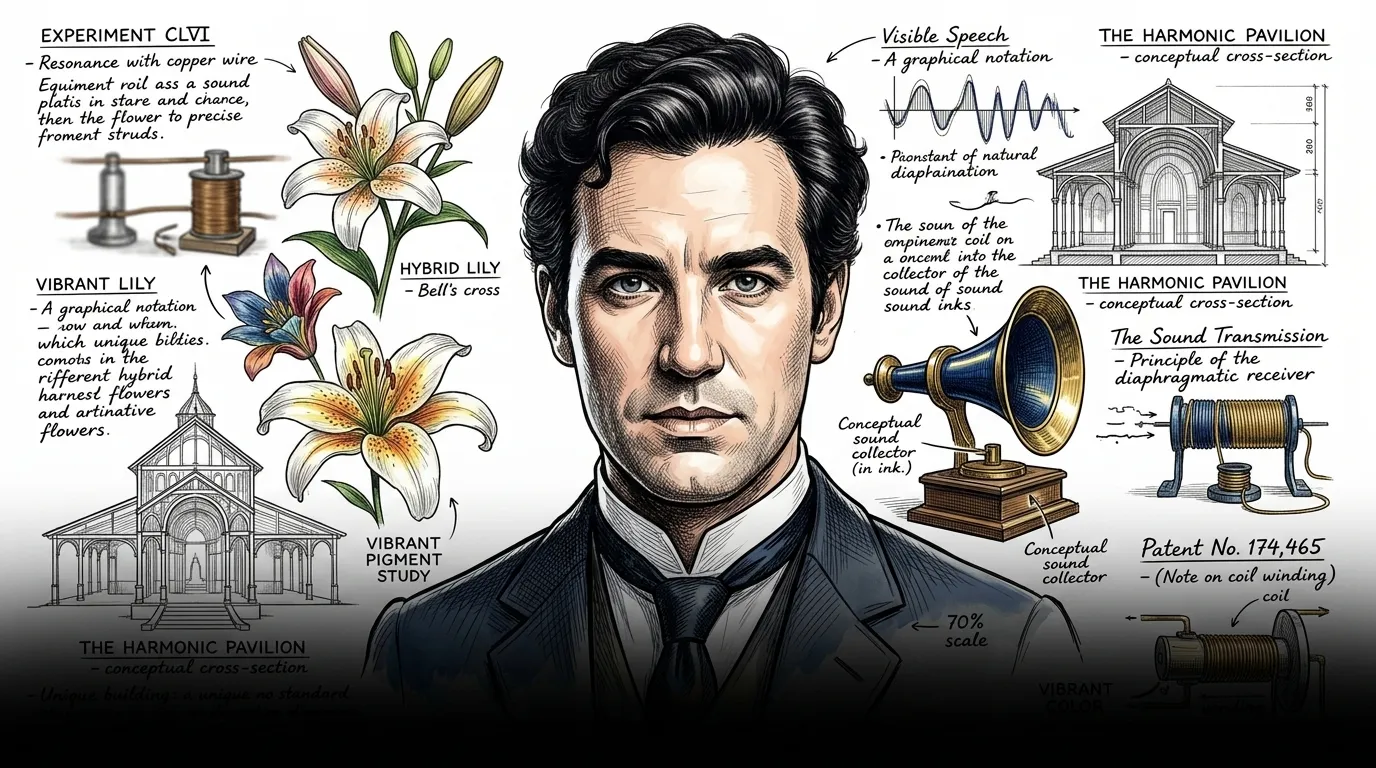
Page 1
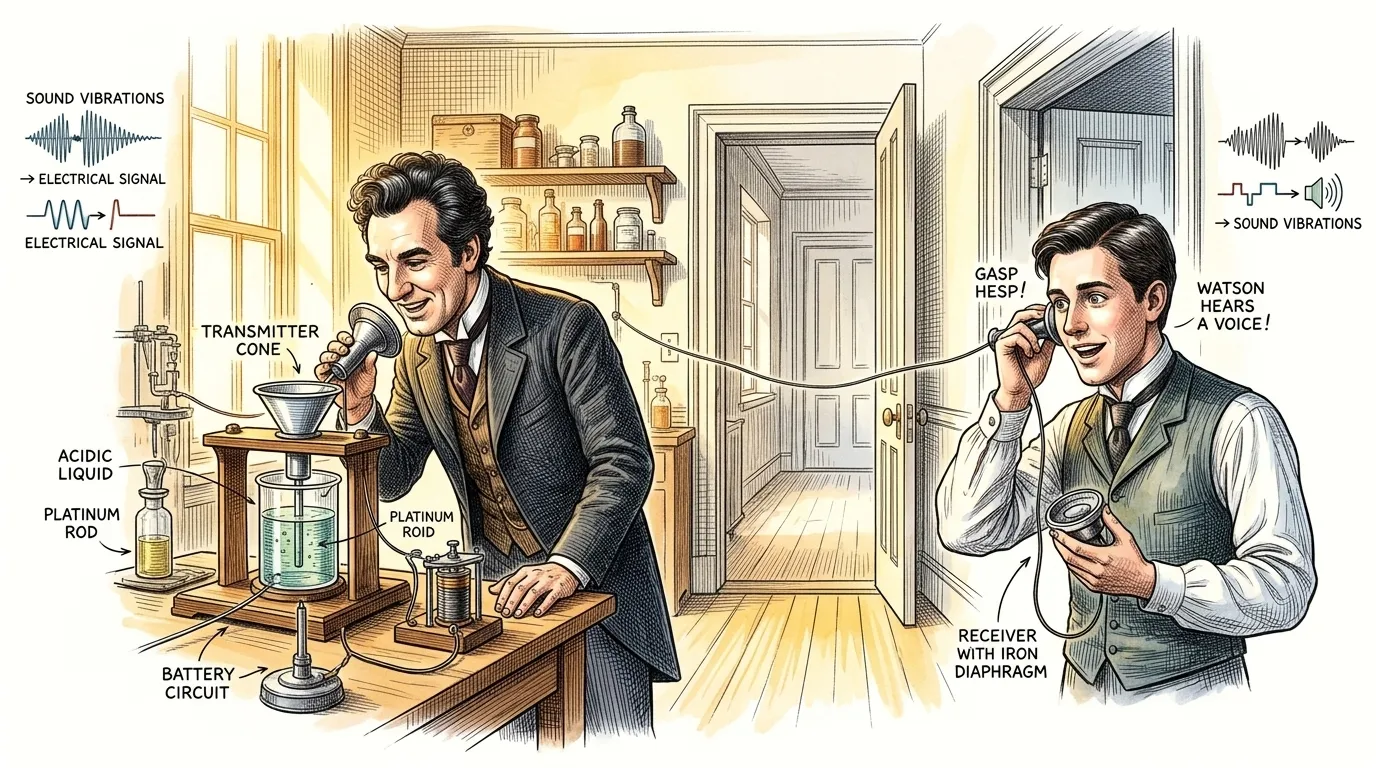
The tension was palpable in the small Boston laboratory. Alexander Graham Bell, his face intent, leaned over the liquid transmitter. Across the hall, his assistant, Thomas A. Watson, waited, holding a receiver to his ear. Bell spoke clearly into the diaphragm, the critical words resonating: 'Mr. Watson, come here, I want to see you.' Through the wire connecting the two rooms at 5 Exeter Place, Boston, Massachusetts, in 1876, Watson heard Bell's voice, a triumph of transmission that would reshape human connection. This single utterance confirmed the impossible: spoken words could now travel across distances, ushering in the age of instantaneous long-distance communication. It was a moment of profound, irreversible change.
"'Mr. Watson, come here, I want to see you,' Alexander Graham Bell articulated clearly, his voice steady despite the weight of the moment. Watson's gasp of recognition echoed from the adjacent room. 'I can hear you, Mr. Bell! I can hear your words!' Watson exclaimed, disbelief and elation mixing in his tone. Bell then said, 'As my father Melville always taught, 'Speech is power: speech is to persuade, to convert, to compel.' We have just given it a new form, a wire to carry its persuasion.'"
Page 2
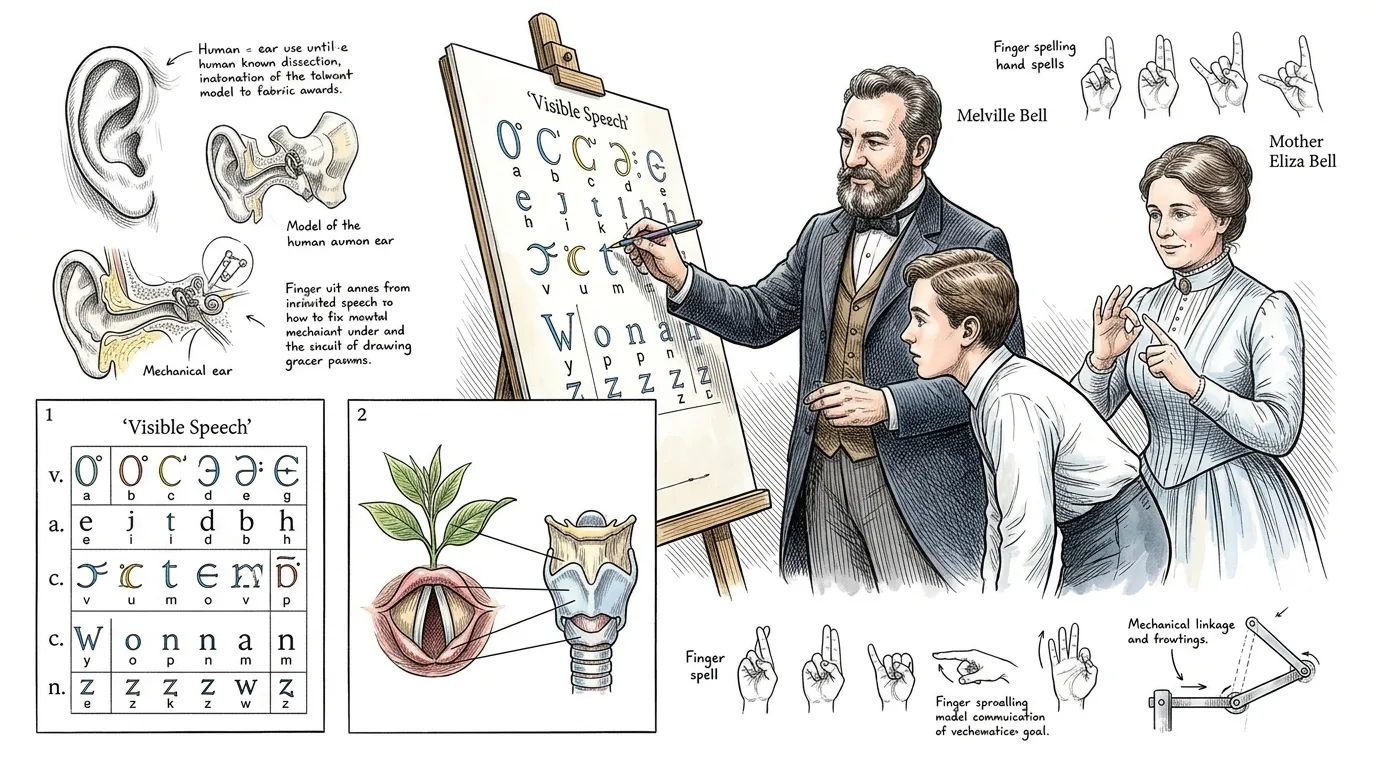
Born in Edinburgh, Scotland, Alexander Graham Bell carried the legacy of a family deeply engaged with the science of sound. His grandfather, Alexander Bell, was an elocution teacher, and his father, Melville Bell, developed 'Visible Speech'—a system for teaching the deaf how to speak by illustrating sound production. This profound familial connection to acoustics and communication shaped young Alexander's earliest investigations. The profound deafness of his mother, Eliza Bell, and later his wife, Mabel Hubbard, instilled in him a singular motivation: to bridge the chasm of silence. This personal connection drove his relentless pursuit of transmitting sound, transforming a theoretical challenge into a deeply personal quest.
"Young Alexander watched his father, Melville Bell, meticulously drawing symbols. 'Father,' Alexander asked, 'these 'Visible Speech' symbols, do they truly capture every nuance of sound?' Melville replied, 'Every sound, my son, can be dissected and understood. As the philosopher Aristotle once said, 'The roots of education are bitter, but the fruit is sweet.' Understanding speech, even its visual form, is a long journey, but its reward for the deaf will be immense.' Alexander nodded, observing his mother, Eliza, communicate through finger spelling. 'The challenge is not just to see sound,' Alexander pondered, 'but to send it where it cannot be seen or heard directly.'"
Page 3
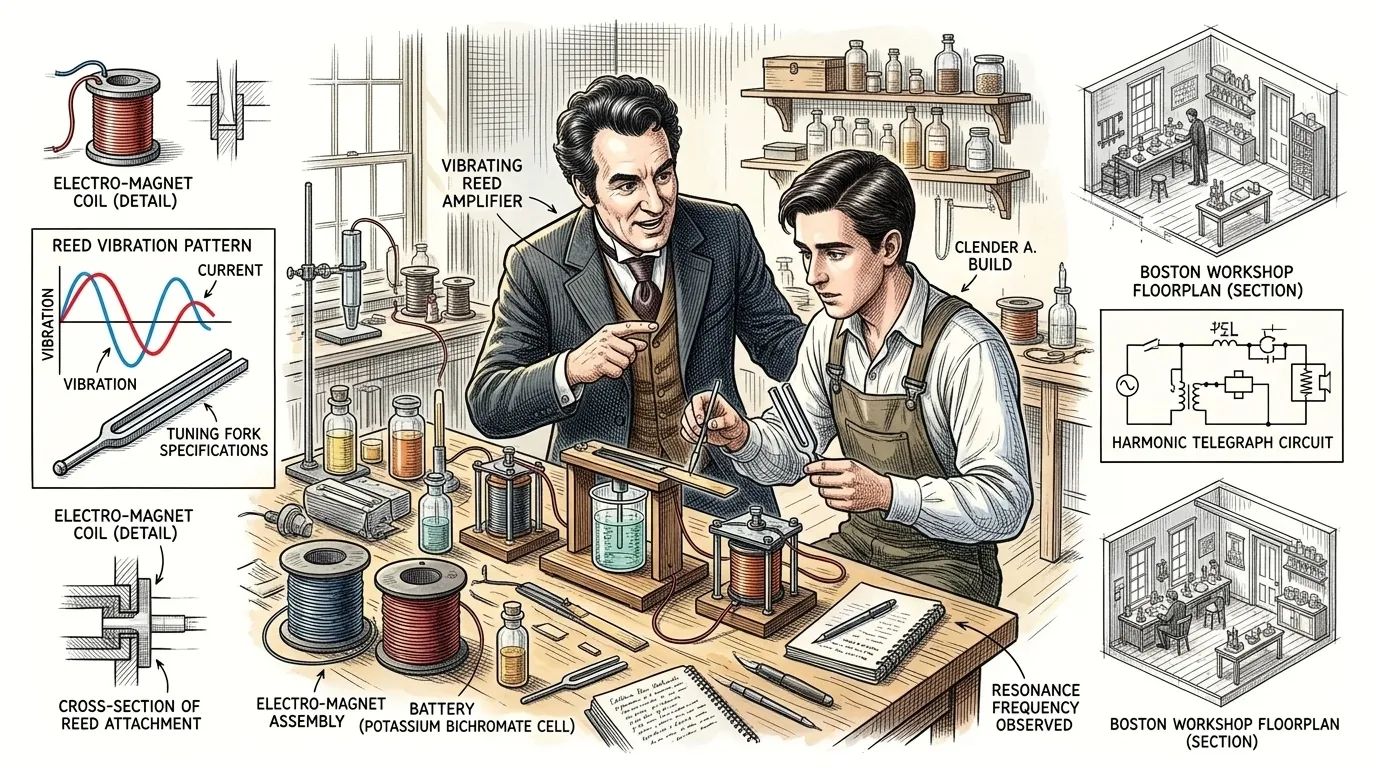
In Boston, Alexander Graham Bell began teaching at the Boston University School of Oratory, but his true focus remained on electrical telegraphy. He envisioned sending multiple telegraph messages over a single wire simultaneously, a concept known as the 'harmonic telegraph.' This project, though ultimately not his most famous, drew him deeply into electrical currents and acoustic vibrations. He sought to apply the principles of musical harmony—different notes vibrating at different frequencies—to electrical signals. Bell believed multiple tuned reeds, each vibrating at a distinct frequency, could transmit separate messages without interference. This intricate work formed the bedrock of his understanding of how sound could travel through electrical impulses.
"In his cluttered Boston workshop, Alexander Graham Bell pointed to a vibrating reed connected to a battery. 'Mr. Watson,' he explained to his assistant, Thomas A. Watson, 'if we can send multiple musical notes over one wire using different frequencies, we can send multiple telegraph messages. Each receiver will be tuned to a specific pitch, like a musical instrument picking out its own note from an orchestra.' Watson adjusted a tuning fork. 'It's like a symphony of signals, Mr. Bell. But ensuring each signal remains pure, uncorrupted by the others, that's the challenge.' Bell nodded, 'Precisely. As the physicist Lord Kelvin observed, 'If you are not a little confused, you are not paying attention.' We must embrace the complexity to find clarity.'"
Page 4
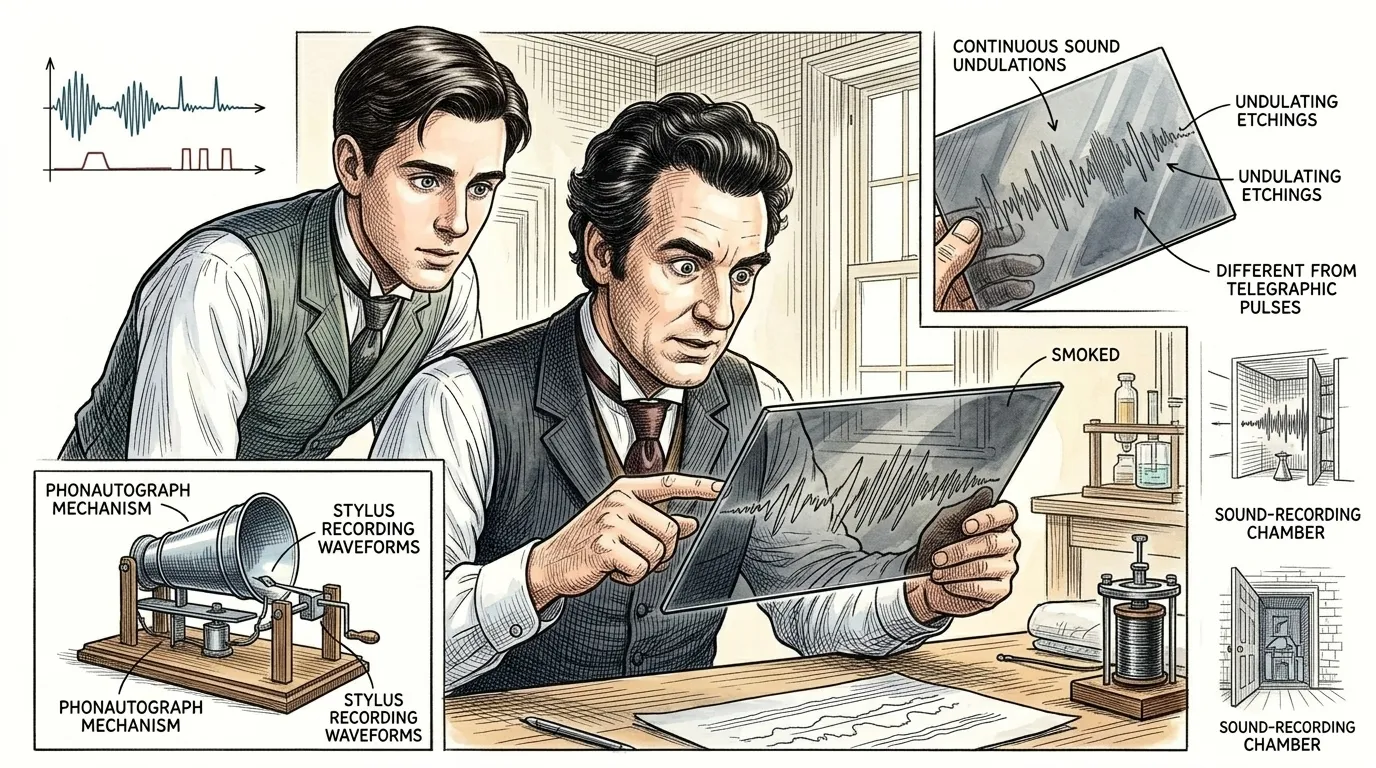
Bell tirelessly pursued the harmonic telegraph, yet a nagging problem persisted. His current approach relied on making and breaking a circuit, sending discrete signals. Then, in a pivotal moment of insight, while observing the phonautograph — a device that recorded sound vibrations as lines on smoked glass — he recognized the fundamental difference between the on-off pulses of telegraphy and the continuous, undulating waves of actual speech. His mind grasped the idea: a true telephone would require an electrical current that varied in intensity, precisely mirroring the continuous pressure changes of sound waves. This realization shifted his focus from merely transmitting musical notes to capturing the full, complex spectrum of the human voice.
"Alexander Graham Bell intently studied the etched lines on a piece of smoked glass, produced by a phonautograph. 'Watson,' he declared, pointing, 'Look at these waves. They are not broken. They are continuous, undulating curves, mirroring the very breath and tone of the spoken word.' Watson peered closer. 'But our harmonic telegraph sends distinct pulses, on-off signals.' Bell's eyes widened. 'That is the fundamental flaw! We need a current that flows and undulates, a direct electrical analogue to the sound wave itself. We must create an 'undulating current,' not a 'make-and-break' current.' He paused, 'As my mentor, Sir Charles Wheatstone, always said, 'The greatest discoveries are often born from the simplest observations.'"
Page 5
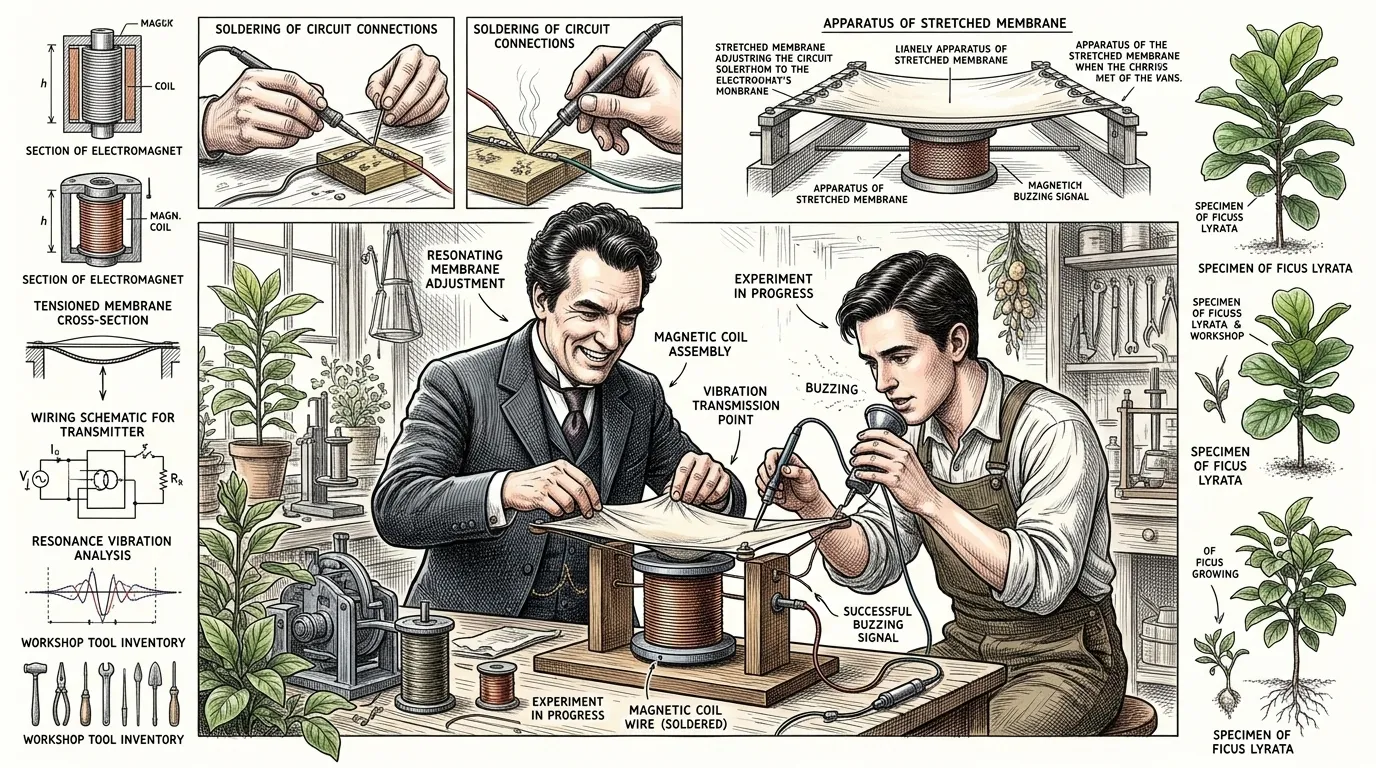
With the concept of an undulating current firmly in mind, Bell and his assistant, Thomas A. Watson, plunged into intense experimentation. Their workshop became a crucible of innovation. They toiled through trial and error, constructing various prototypes, each designed to translate sound vibrations into electrical undulations and back again. The challenge was immense: crafting a membrane sensitive enough to capture voice, a magnet strong enough to translate vibrations, and a circuit robust enough to carry the faint, continuous signal. Days blurred into nights, fueled by relentless determination, until a crude apparatus, featuring a stretched membrane and an electromagnet, finally whispered its first faint, recognizable sounds.
"Alexander Graham Bell meticulously adjusted a stretched membrane over a magnetic coil. 'Watson, this diaphragm must vibrate with the subtlety of a vocal chord,' he instructed, his brow furrowed with concentration. Watson, soldering a wire, responded, 'And the electrical current must mimic that vibration precisely. If it's too strong, it distorts; too weak, it vanishes.' Bell tested a connection. 'Try speaking into it, softly. Let's see if the receiving apparatus responds.' Watson leaned in, his voice low: 'Can you hear me now?' A faint, distinct buzzing emanated from the receiver. Bell's face broke into a grin. 'We are close, Watson. As the old adage goes, 'Fortune favors the bold.' Our bold experiment is yielding its first fruits.'"
Page 6
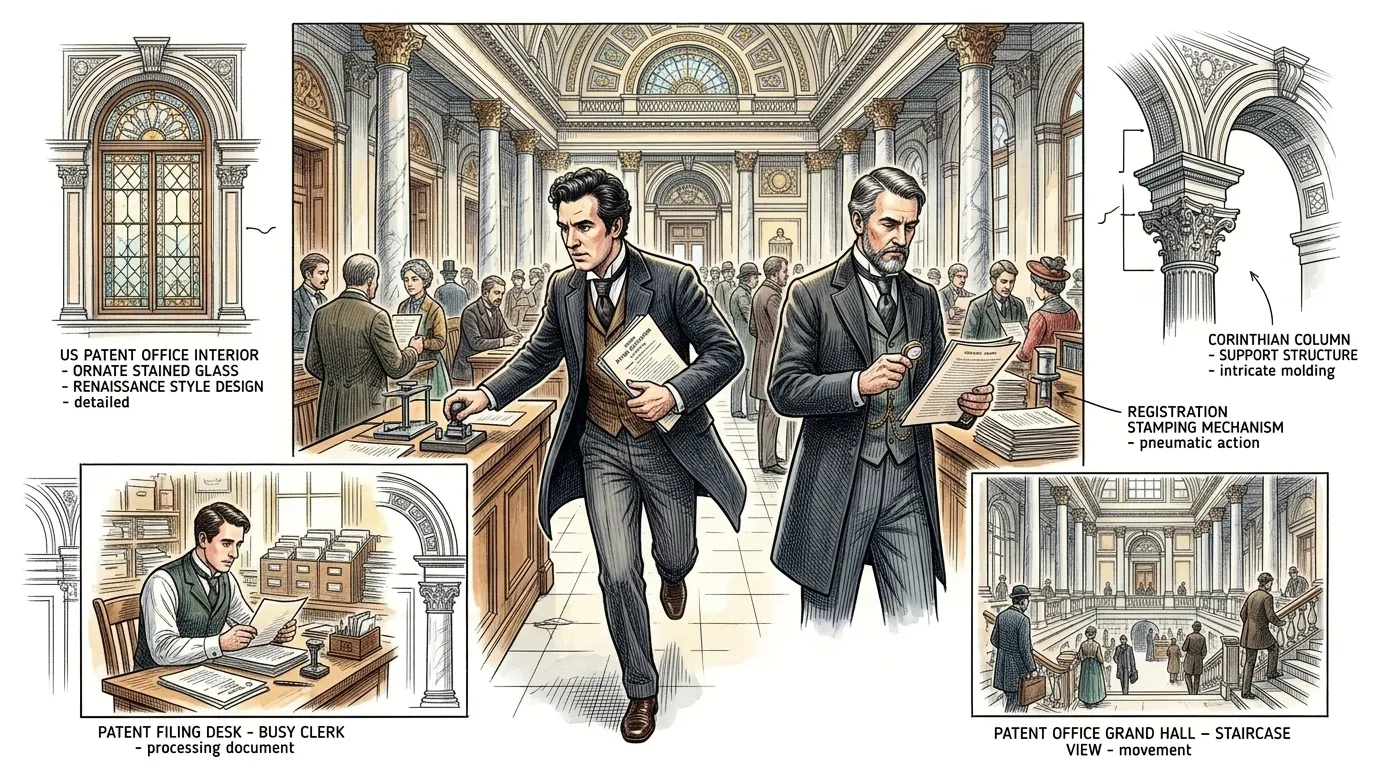
The race to invent a functional telephone was fierce, with several inventors closing in on similar ideas. Elisha Gray, a formidable competitor, was also working on a liquid transmitter. On the morning of February 14, 1876, the stakes were impossibly high. Alexander Graham Bell rushed to the U.S. Patent Office, his patent application for the telephone in hand, detailing his method for transmitting vocal sounds telegraphically. He filed it mere hours before Gray's lawyer arrived with a caveat for a similar invention. This close call solidified Bell's claim, not on the invention itself, but on the crucial principle of variable resistance that would make his device revolutionary. The patent, US Patent No. 174,465, secured his place in history.
"Alexander Graham Bell, clutching his patent application, hurried through the bustling halls of the U.S. Patent Office. 'We must file this immediately!' he urged his lawyer, Anthony Pollok, his voice tight with urgency. Pollok checked his watch. 'Another moment's delay could cost us everything, Mr. Bell. Elisha Gray's caveat is expected today.' Bell's jaw was set. 'My work on the undulating current, the variable resistance—that is the core. It must be protected.' Pollok nodded, reviewing the document. 'Indeed. As the American inventor Robert Fulton once declared, 'The mechanic should be a philosopher,' and your philosophy of sound transmission is unique. Let us secure it.' They submitted the papers, the outcome hanging by a thread."
Page 7
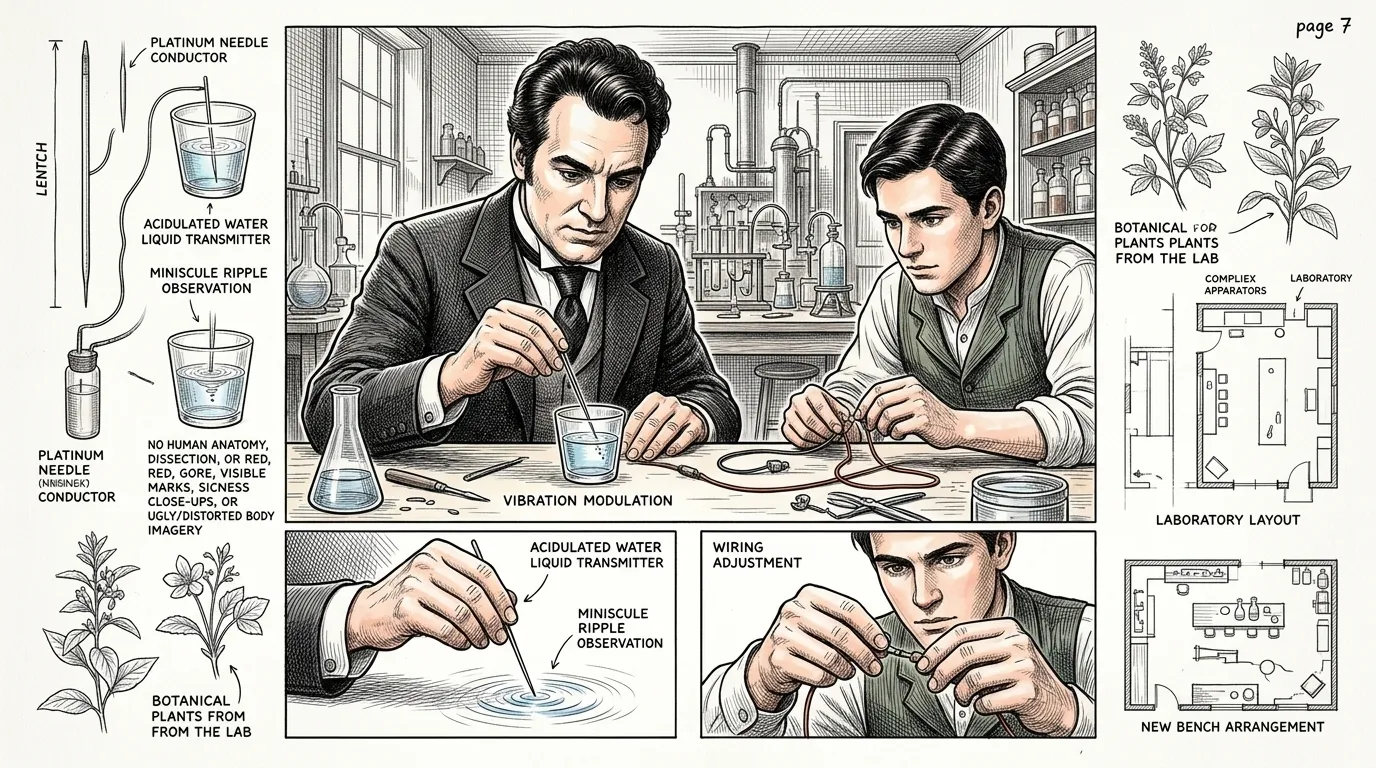
With the patent secured, Bell intensified his efforts to perfect the apparatus. The crude reed-and-electromagnet prototypes had shown promise, but a more sensitive mechanism was needed for clear voice transmission. His breakthrough came with the liquid transmitter. In this design, a diaphragm vibrated a needle in a cup of acidulated water, varying the electrical resistance in the circuit. This subtle change in resistance produced a continuous, undulating electrical current that precisely mimicked the sound waves of the human voice. It was this refined liquid transmitter that Bell used on March 10, 1876, to make the world's first successful telephone call to Thomas A. Watson, confirming his principle and silencing all doubts.
"Alexander Graham Bell carefully immersed a needle into a cup of acidulated water, observing the tiny ripples. 'Watson,' he explained, 'the problem was the rigidity of our earlier devices. This liquid, it allows for infinite, subtle variations in resistance. Each vibration of my voice will cause the needle to move, altering the current with perfect fidelity.' Watson adjusted a connected wire. 'So, the sound waves create an electrical shadow, a perfect copy?' Bell nodded, a glint in his eye. 'Exactly. As the poet Ralph Waldo Emerson wrote, 'Speech is power: speech is to persuade, to convert, to compel.' This liquid transmitter is the key to unleashing that power across a wire.' He motioned for Watson to take his position in the next room, poised for the test."
Page 8
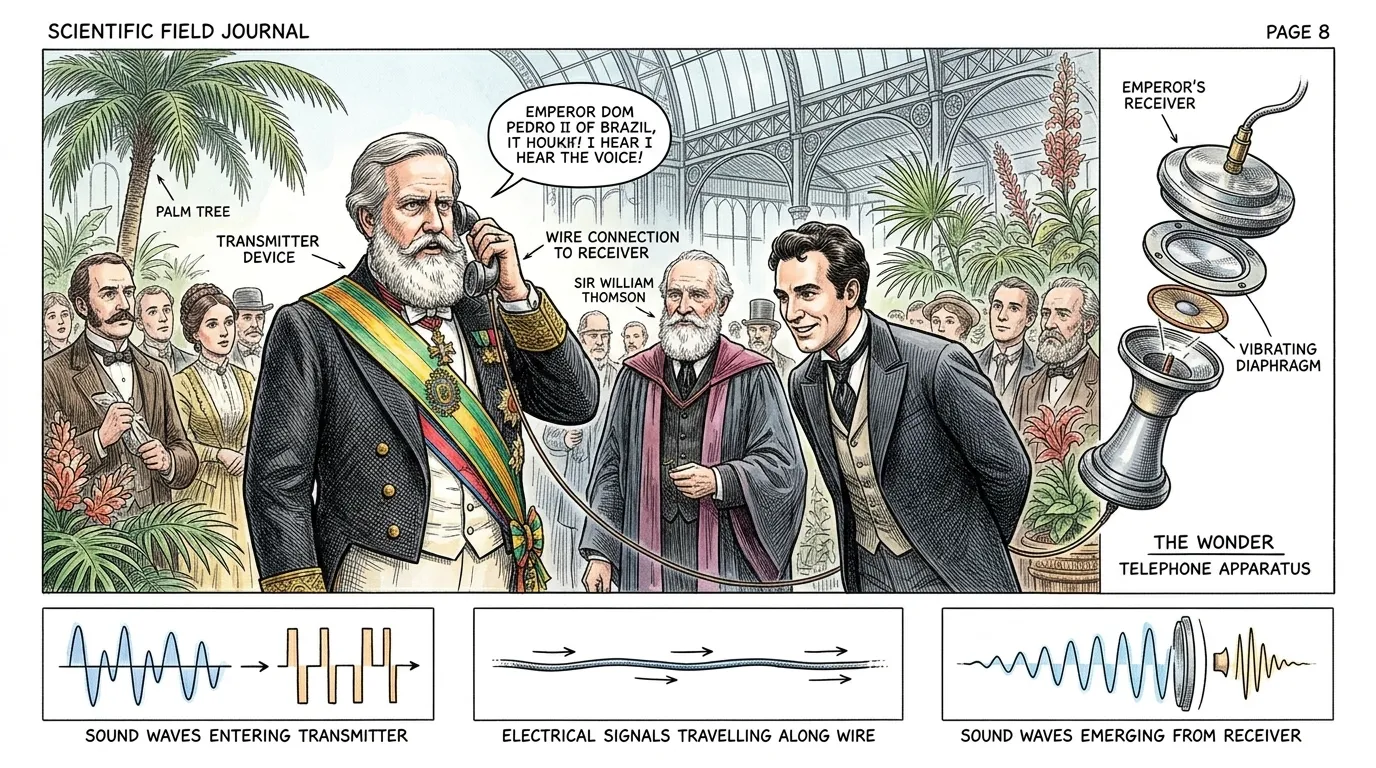
The public debut of Bell's telephone at the Centennial Exposition in Philadelphia in June 1876 was met with skepticism, then astonishment. Emperor Dom Pedro II of Brazil approached the unassuming device, listened, and exclaimed, 'My God, it talks!' Sir William Thomson, a renowned British scientist, called it 'the most wonderful thing I have seen in America.' These endorsements shattered doubt, propelling the telephone from a curious novelty to a world-changing invention. Bell conducted demonstrations across the nation, his presence commanding attention, his invention captivating audiences. The world had witnessed not just a new machine, but a new paradigm of communication, sparking immediate interest for its commercial potential.
"Emperor Dom Pedro II of Brazil held the telephone receiver to his ear, a look of profound disbelief on his face. 'My God, it talks!' he exclaimed, turning to Alexander Graham Bell with wide eyes. Sir William Thomson, observing nearby, nodded slowly. 'Mr. Bell, this device... it is the most wonderful thing I have seen in America.' Bell bowed slightly. 'Your Majesty, Sir William, it is merely the application of known principles in a novel way. As the philosopher Arthur Schopenhauer noted, 'All truth passes through three stages: First, it is ridiculed. Second, it is violently opposed. Third, it is accepted as being self-evident.' We are, perhaps, transitioning from ridicule to acceptance.' The crowd murmured, their skepticism transforming into awe at the demonstration."
Page 9
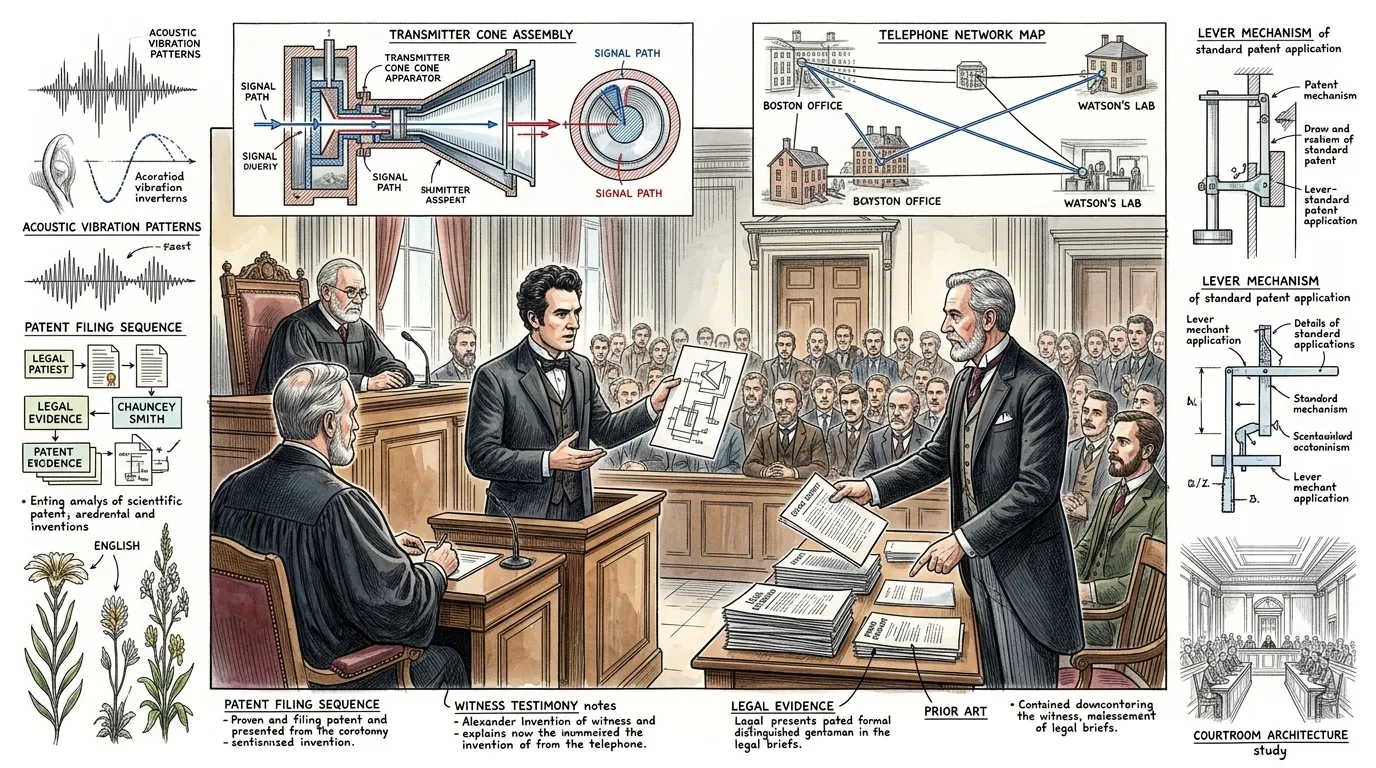
The telephone's immediate success sparked a torrent of legal challenges. Competitors, most notably Western Union and Elisha Gray, launched hundreds of lawsuits, claiming prior invention or patent infringement against Alexander Graham Bell and his nascent Bell Telephone Company. Bell found himself embroiled in protracted legal battles, defending his foundational patent against overwhelming opposition. These fights were not merely about intellectual property; they were existential struggles for the future of telecommunications. Bell's meticulous patent documentation and the decisive date of his filing ultimately prevailed, securing his company's dominance and allowing the rapid expansion of telephone networks across North America, transforming regional communication into a national infrastructure.
"Alexander Graham Bell stood firm against a volley of legal challenges in a crowded courtroom. His lawyer, Chauncey Smith, presented evidence of the patent filing. 'The integrity of our patent, Mr. Bell, is being tested at every turn by the likes of Western Union.' Bell replied, 'These challenges are immense, but our priority is not merely winning cases, but establishing the very right to innovate and bring this technology to the public.' Smith nodded, 'As the Roman philosopher Cicero wisely stated, 'The good of the people is the chief law.' The telephone serves the public good, and that truth will prevail.' The judge listened intently as Bell explained the technical nuances of his invention, defending the core principles of his undulating current against numerous competing claims."
Page 10
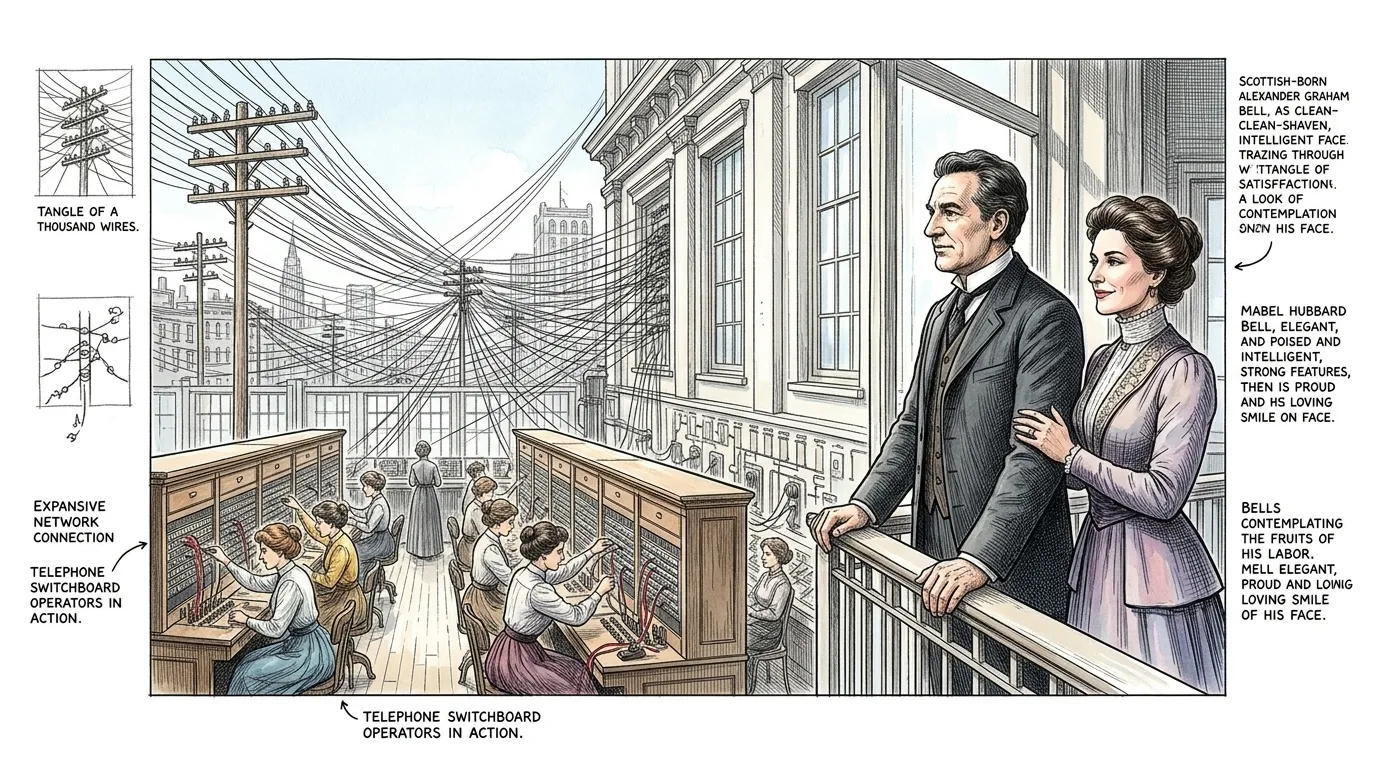
Alexander Graham Bell's invention of the telephone fundamentally reshaped global communication, but his impact extended far beyond a single device. He continued to innovate, developing the photophone—a device for transmitting speech on a beam of light—and dedicating significant resources to aviation research. Crucially, his lifelong commitment to the deaf community never wavered. He founded institutions, supported education, and championed methods for teaching speech to the hearing-impaired. The telephone became a ubiquitous tool connecting continents and cultures, accelerating commerce, and shrinking the world. Bell, in his later years, observed the vast network his initial spark had created, knowing his work had permanently altered the fabric of human interaction, leaving an indelible mark on education, technology, and society.
"An older Alexander Graham Bell, standing amidst a bustling telephone exchange, looked out at the tangle of wires stretching into the distance. 'Mabel,' he said to his wife, Mabel Hubbard Bell, 'we envisioned connection, but this vast network... it surpasses even my wildest dreams.' Mabel, her hand gently on his arm, smiled. 'Your dedication to overcoming silence, Alec, it built this. Not just wires, but bridges between people, across cities, across oceans.' Bell reflected, 'Indeed. As the great scientist Isaac Newton once humbly stated, 'If I have seen further than others, it is by standing upon the shoulders of giants.' My giants were my family, my students, and the profound need for human connection.' He watched the operators, recognizing that the essence of his work—the act of connecting—had become the world's most vital exchange."
About this story
- Location: Global
- Audience: general readers
Questions and answers
Read Wonder People on your phone
Wonder People is available on Android. Get Wonder People on Google Play.