Haruki Murakami
Haruki Murakami — an illustrated biography story, set in United Kingdom. 10 illustrated pages, free to read on Wonder People.

Page 1

In October 2006, within the ancient, gilded halls of Prague's Old Town Hall, Haruki Murakami stood, a figure of quiet intensity, to receive the prestigious Franz Kafka Prize. Surrounding him, an assembly of literary dignitaries and journalists from across continents recorded the moment. His novel, 'Kafka on the Shore,' published just four years prior, had already transcended language barriers, selling millions worldwide and cementing his status not merely as a Japanese writer, but as a singular, globally resonant voice.
Biographical Fact: Prague, Czech Republic — October 2006. The Franz Kafka Prize, a definitive mark of international literary recognition, bestowed upon Haruki Murakami, solidifying his global impact.
Page 2

Years earlier, long before literary awards, a different kind of stage defined Haruki Murakami's world. In the smoky, dimly lit confines of 'Peter Cat,' his jazz bar in Tokyo's Kokubunji district, he meticulously curated music, not words. Alongside his wife, Yoko, he managed the demanding rhythm of live performances and late-night patrons, a self-taught entrepreneur steeped in the improvisational spirit of American jazz and a burgeoning love for Western literature. This unique blend of practical grit and cultural immersion laid an unconventional foundation for the fantastical narratives yet to emerge.
Biographical Fact: Tokyo, Japan — Late 1970s. Haruki Murakami and his wife Yoko, running 'Peter Cat,' a jazz bar. This period cultivated his deep appreciation for Western culture and music, profoundly shaping his literary voice.
Page 3
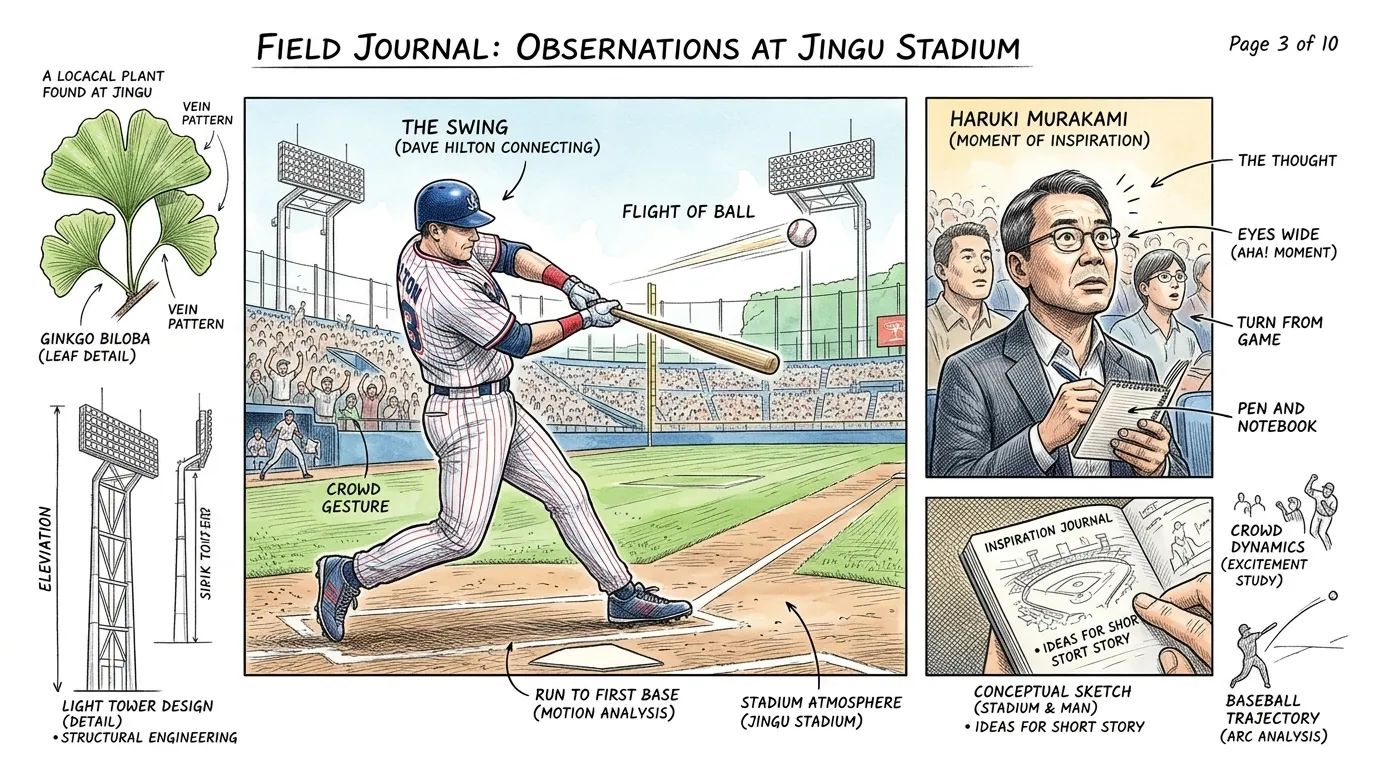
The year was 1978. At Tokyo's Jingu Stadium, during a Yakult Swallows baseball game, a sudden, inexplicable revelation struck Haruki Murakami. As Dave Hilton hit a double, a clear, decisive thought formed: he could write a novel. This wasn't a gradual ambition but an abrupt, powerful call. He closed 'Peter Cat' earlier each night, purchasing ink and paper, then sat at his kitchen table, driven by an almost mystical compulsion to translate this sudden inner shift into tangible prose, a transformation that would yield his first novel, 'Hear the Wind Sing.'
Biographical Fact: Tokyo, Japan — 1978. The pivotal moment at Jingu Stadium, leading to Haruki Murakami's decision to become a writer and the subsequent creation of his debut novel, 'Hear the Wind Sing'.
Page 4

Seeking distance from Japan's rigid literary establishment, Haruki and Yoko Murakami relocated to Greece and then Italy in the mid-1980s. This self-imposed exile became a crucible for his art. He wrote relentlessly, translating American authors like F. Scott Fitzgerald and Raymond Carver, simultaneously refining his own distinctive narrative voice—one that effortlessly blended the mundane with the surreal. Yoko, always his unwavering partner, observed his intense dedication. During one particularly challenging period of writing, she remarked, 'Only those who risk going too far can possibly find out how far one can go,' a quote from the American poet T.S. Eliot, reflecting on the courage required for true artistic discovery.
"Yoko Murakami, a supportive Japanese woman in her 30s with dark, bobbed hair, says to her husband, 'You know, like T.S. Eliot once said: 'Only those who risk going too far can possibly find out how far one can go.' You are finding your own way.'"
Biographical Fact: Greece & Italy — Mid-1980s. Haruki Murakami's period of self-imposed exile, where he extensively translated Western literature and developed his unique, genre-bending literary style, supported by his wife, Yoko.
Page 5

In 1987, Haruki Murakami's novel 'Norwegian Wood' shattered expectations. A poignant, more realistic departure from his previous surreal works, it became an unprecedented bestseller in Japan, selling millions of copies and captivating a generation. This book, a tender exploration of love and loss, propelled him from a niche literary figure to a cultural phenomenon. The novel's overwhelming success marked a critical turning point, establishing his name widely and demonstrating his ability to connect with a vast readership while still retaining his unique narrative sensibility.
Biographical Fact: Tokyo, Japan — 1987. The publication of 'Norwegian Wood' becomes a runaway success, fundamentally changing Haruki Murakami's literary standing and launching him into mainstream consciousness in Japan and beyond.
Page 6

The twin shocks of the 1995 Kobe earthquake and the Tokyo subway sarin attack prompted Haruki Murakami's return to Japan. He confronted the collective trauma of his nation, a significant departure from his usually internal narratives. For 'Underground,' he conducted over sixty interviews with victims and perpetrators of the sarin attack, refusing to fictionalize their pain. This act of journalistic empathy and rigorous documentation offered a profound, unfiltered look at a society grappling with inexplicable violence, cementing his role as an author willing to engage directly with real-world suffering and complex truth.
Biographical Fact: Tokyo, Japan — 1996. Following the Kobe earthquake and sarin attack, Haruki Murakami returns to Japan to write 'Underground,' a non-fictional account of the subway attack victims, marking a shift toward confronting collective trauma.
Page 7

By the late 2000s, Haruki Murakami undertook his most ambitious project: '1Q84.' This sprawling, multi-volume narrative pushed the boundaries of his signature style, weaving together parallel realities, cults, and compelling characters in a meticulously constructed, alternative 1984. The sheer scale and intricate plotting demonstrated a writer at the peak of his powers, crafting a literary architecture that demanded immersive engagement from its readers. Its release in 2009 was met with immediate, fervent anticipation, leading to unprecedented sales figures and critical acclaim worldwide, solidifying his status as a master of contemporary fiction.
Biographical Fact: Japan — 2009. Haruki Murakami dedicates himself to writing '1Q84,' a monumental work of fiction that would become a global sensation, showcasing his ambition and mastery of complex narratives.
Page 8

The impact of Haruki Murakami's work exploded across the globe. Translated into over 50 languages, his novels spawned dedicated fan communities from New York to Berlin to Seoul. Readers gathered for book clubs, dressed as his characters for Halloween, and debated the hidden meanings within his surreal landscapes. His distinct fusion of Western pop culture references with profound existential questions resonated universally, creating a transnational readership that recognized in his pages the anxieties and wonders of modern existence. He had not just written books; he had built a bridge between cultures.
Biographical Fact: Global — 2010s. Haruki Murakami's works achieve unprecedented international reach, translated into over 50 languages, fostering a vast and dedicated global readership that transcends cultural boundaries.
Page 9

Despite immense global fame, Haruki Murakami steadfastly retreated from the public spotlight. He consistently declined most interviews, avoided literary parties, and rarely accepted major awards in person, choosing instead the disciplined solitude of writing and long-distance running. This deliberate embrace of privacy became an integral part of his persona, a silent protest against the demands of authorial celebrity. He guarded his creative space fiercely, underscoring a belief that the work itself, untainted by the author's public image, must speak for itself, profoundly influencing how authors navigate the contemporary media landscape.
Biographical Fact: Worldwide — 2010s. Haruki Murakami's conscious decision to maintain an intensely private life, shunning celebrity despite immense global fame, became a significant aspect of his public persona and impact.
Page 10

Haruki Murakami's legacy reshaped contemporary literature, bridging the gap between high art and popular fiction with his distinctive blend of the mundane, the surreal, and profound human emotion. His stories, steeped in jazz, classical music, and Western literary traditions, while rooted in Japanese sensibility, created a truly global literary language. He redefined what a novel could be, inviting readers into labyrinthine narratives that explored loneliness, alienation, and the search for meaning in a fragmented world. His influence endures, inspiring new generations of writers to venture into the depths of imagination, leaving a timeless mark on the landscape of storytelling.
Biographical Fact: Ongoing. Haruki Murakami's enduring legacy as a literary innovator, a bridge between cultures, and a master of magical realism continues to influence global literature and inspire readers worldwide.
About this story
- Location: United Kingdom
- Audience: general readers