Joan of Arc
Joan of Arc — an illustrated biography story, set in Global. 10 illustrated pages, free to read on Wonder People.
Page 1

On July 17, 1429, within the hallowed grandeur of Reims Cathedral, Charles VII was consecrated King of France. This momentous act, a pivotal assertion of French sovereignty amidst the Hundred Years' War, unfolded directly due to the relentless military campaign spearheaded by Joan of Arc. Her presence, a young woman clad in armor among seasoned nobility and clergy, redefined the trajectory of a nation. The event signaled a profound shift in the conflict, marking the apex of her public influence.
Biographical Fact: The coronation of Charles VII at Reims was a critical propaganda victory, solidifying his claim to the throne and directly fulfilling Joan of Arc's stated divine mission. It demonstrated her extraordinary ability to mobilize and inspire.
Page 2

In the small, quiet village of Domrémy, Joan d'Arc emerged not from noble lineage or military training, but from the unadorned life of a peasant girl. From the age of thirteen, she began to experience divine visions and hear celestial voices. These were not fleeting fancies, but direct commands from Saint Michael, Saint Catherine, and Saint Margaret, instructing her to liberate France from English domination and ensure the Dauphin's coronation. This spiritual conviction became the singular force shaping her destiny, compelling her to abandon her rural existence for a path of unprecedented historical action.
Biographical Fact: Joan's mystical experiences were central to her identity and motivation, providing the unwavering resolve needed to pursue a mission that seemed impossible to the secular authorities of her time.
Page 3

At Vaucouleurs, Joan, barely seventeen, confronted Robert de Baudricourt, the garrison commander, with an audacious demand: an escort to the Dauphin at Chinon. Baudricourt, a seasoned captain, initially dismissed the peasant girl, believing her claims of divine mandate absurd. Yet, her unyielding conviction and the growing public support, fueled by rumors of her prophecies, slowly wore down his skepticism. This unwavering resolve, her insistence on a mission ordained by God, ultimately compelled him to furnish the necessary resources for her perilous journey through enemy territory.
Biographical Fact: Joan's persistence in convincing Baudricourt, a key military figure, demonstrated her early leadership and ability to overcome institutional skepticism, a crucial step in her improbable rise.
Page 4

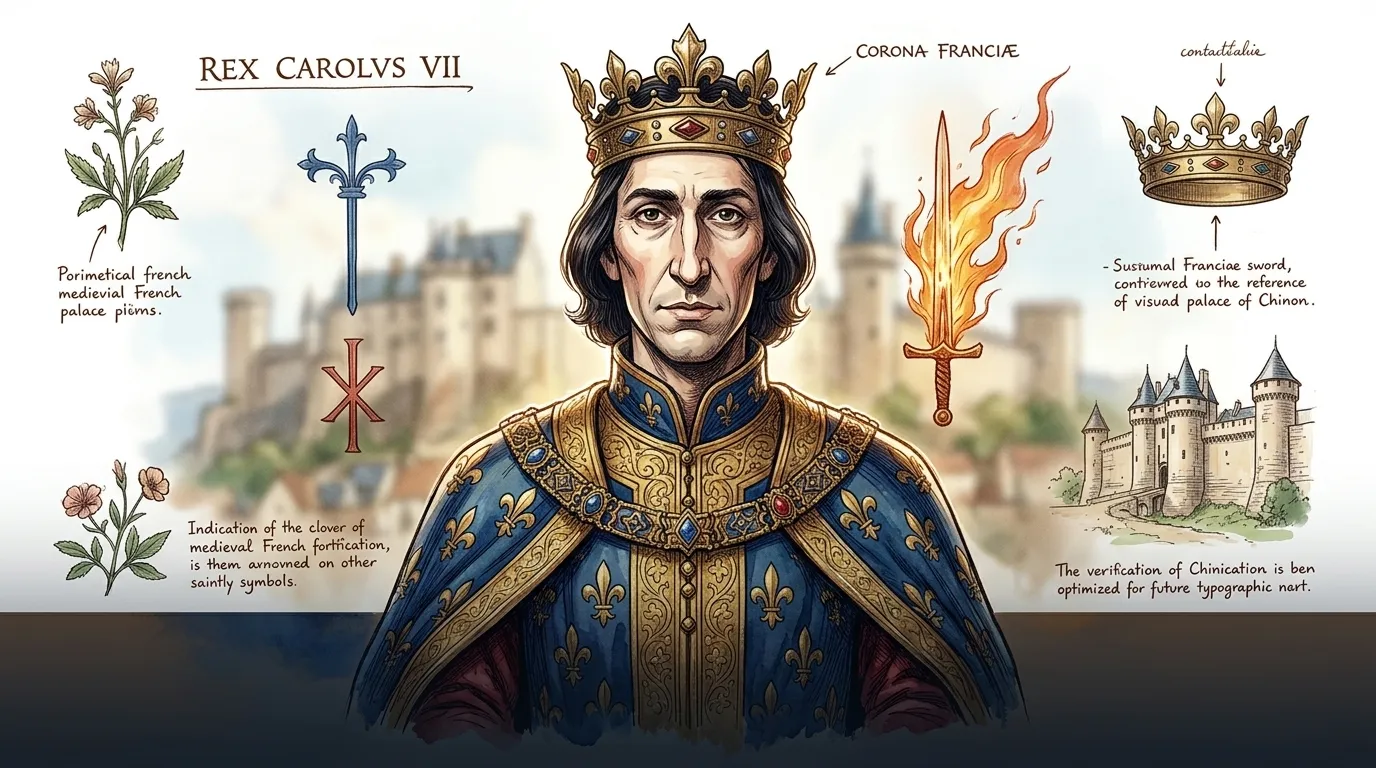
Upon reaching Chinon, Joan faced her most formidable challenge: convincing the Dauphin Charles of her divine mandate. Charles, wary and surrounded by advisors, tested her by disguising himself among his courtiers. Undeterred, Joan walked directly to him, revealing his identity and delivering a private message that reportedly dissolved his doubts. This extraordinary act, witnessed by the bewildered court, secured her an audience and ultimately, a command, solidifying her spiritual authority in a secular and cynical world. She presented a clear path forward, pledging to lift the Siege of Orléans and lead him to Reims.
Biographical Fact: Joan's ability to identify Charles amidst his court, a detail reportedly only known to him, lent immense credibility to her divine claims and swayed the skeptical Dauphin, enabling her to gain military authority.
Page 5

With the Dauphin's reluctant approval, Joan rode to the beleaguered city of Orléans, under siege by the English for months. She arrived not as a general, but as a rallying standard, carrying her sacred banner. Her presence ignited an unprecedented morale boost among the demoralized French troops and the populace. Leading a series of aggressive, seemingly impossible assaults, she shattered English defensive positions. Within nine days, the English retreated, breaking the siege that had threatened to extinguish all French hope. This victory, secured through her audacious leadership and unwavering faith, became known as the 'Miracle of Orléans,' fundamentally shifting the momentum of the Hundred Years' War.
Biographical Fact: The lifting of the Siege of Orléans was Joan's first major military triumph, demonstrating her tactical acumen and extraordinary ability to inspire, transforming a demoralized army into an unstoppable force.
Page 6

Following Orléans, Joan swiftly pressed the offensive, launching the Loire Campaign to clear the path to Reims. Her forces engaged the English in a rapid succession of battles, capturing Jargeau, Meung-sur-Loire, and Beaugency. Each victory further eroded English control and bolstered French morale. The decisive Battle of Patay saw her forces achieve a stunning rout of a larger English army, decimating their command structure and demonstrating her strategic understanding of aggressive, concentrated action. These relentless victories were not mere skirmishes; they systematically dismantled English resistance, creating an undeniable momentum towards the Dauphin's coronation.
Biographical Fact: The Loire Campaign proved Joan was not a one-hit wonder; her sustained military success systematically dismantled English strongholds and critically opened the route to Reims, fulfilling her prophetic promise.
Page 7
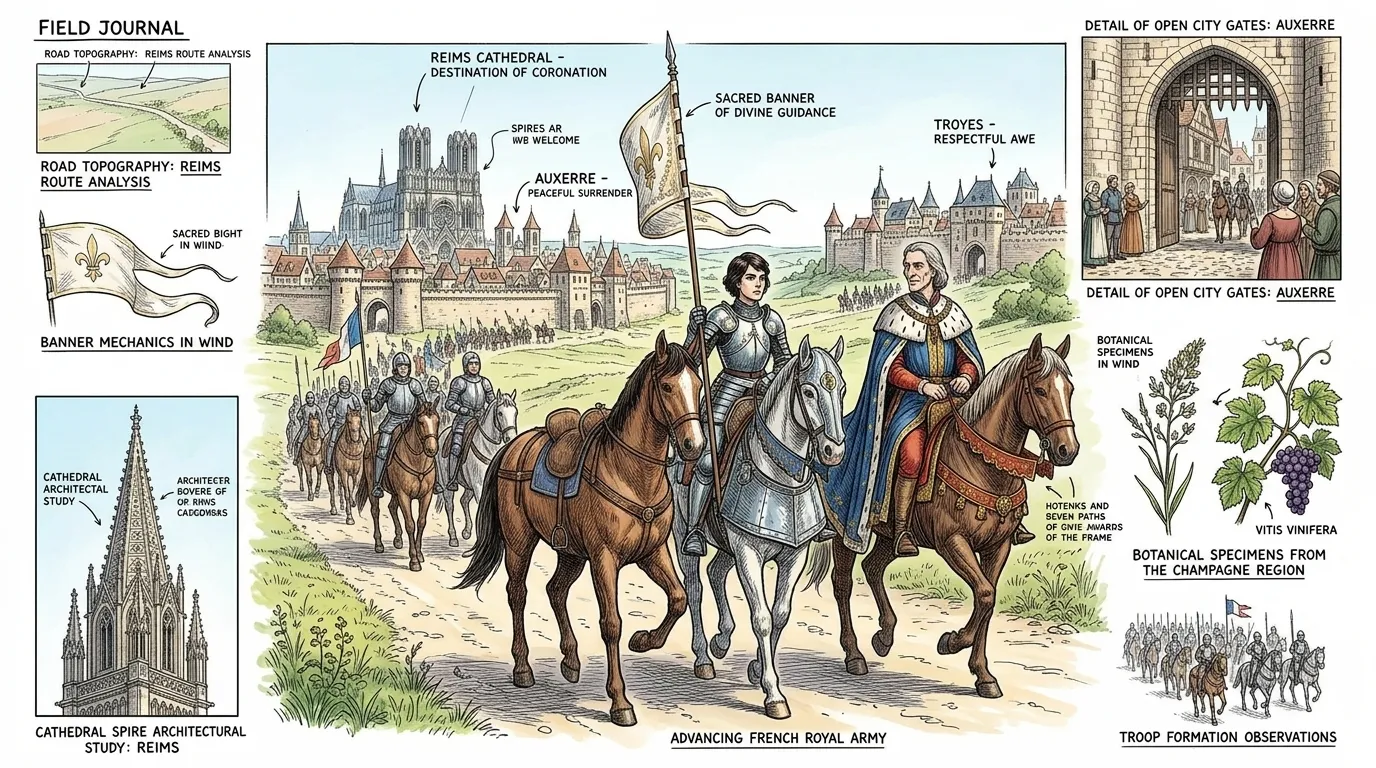
With the Loire cleared, Joan initiated the audacious 'March to Reims,' a daring move deep into enemy-held territory. She urged Charles VII to seize the opportunity, arguing that divine providence would ensure their passage. Town after town, including Auxerre and Troyes, opened their gates without a fight, intimidated by the Maid's reputation and the momentum of the French army. This bloodless advance, a testament to her psychological warfare and unshakeable conviction, culminated in the peaceful surrender of Reims itself. The path to the royal consecration, once deemed impossible, now lay open, secured not by prolonged siege, but by faith and fear.
Biographical Fact: The March to Reims, achieving its objective largely without battle, solidified Joan's image as a divinely guided figure capable of achieving the impossible, laying the groundwork for Charles VII's coronation.
Page 8
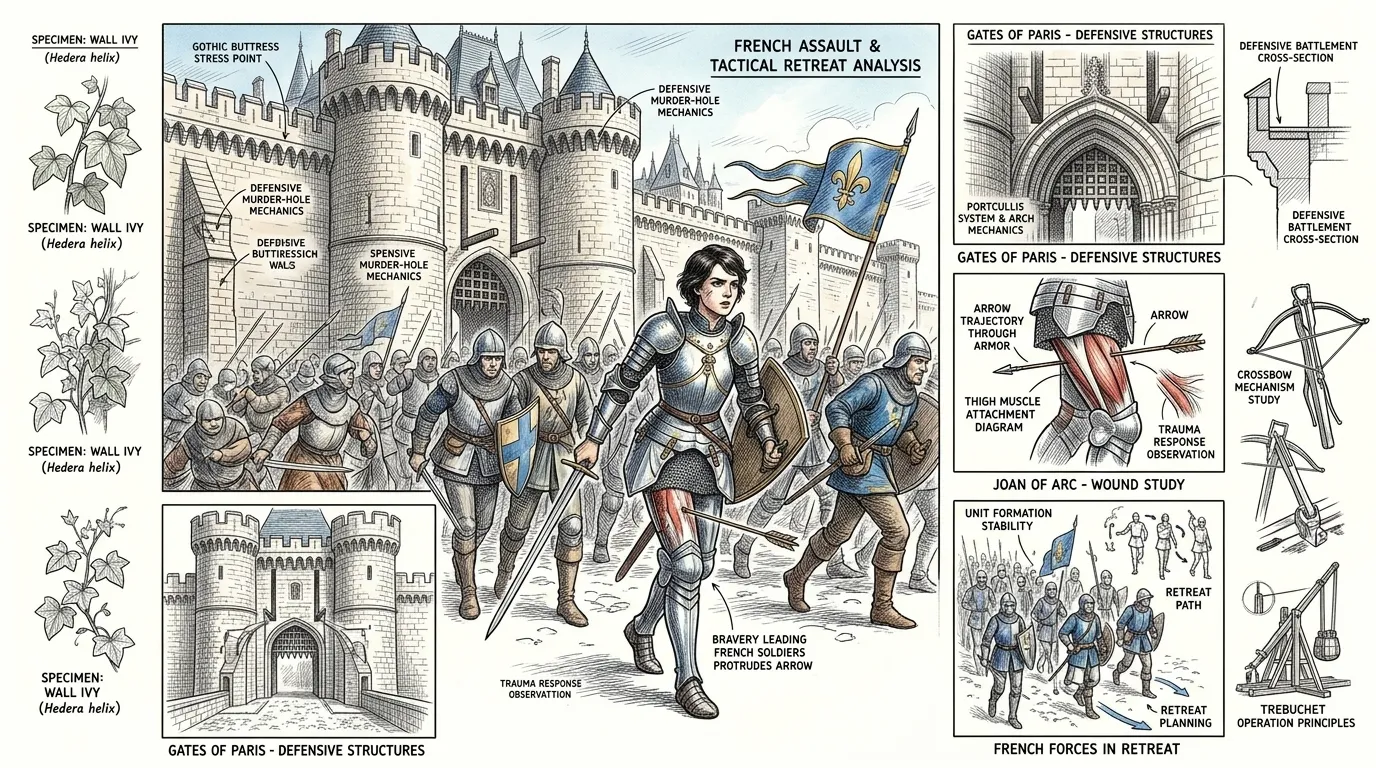
After the triumph at Reims, Joan sought to press her advantage by assaulting English-held Paris. This aggressive move, however, lacked the full support of Charles VII and his advisors, who favored diplomacy. On September 8, 1429, Joan led a fierce assault on the city's gates. Despite her relentless courage, the attack met formidable resistance. Joan herself suffered a severe arrow wound to the thigh, and the French forces, unsupported, were forced to retreat. This failure marked a turning point, as political factions at court began to undermine her influence, diminishing her direct military command and limiting her strategic initiatives.
Biographical Fact: The failed siege of Paris was a critical setback, revealing the political constraints on Joan's command and marking the beginning of the erosion of her influence at court, as strategic objectives diverged.
Page 9

On May 23, 1430, while attempting to relieve the besieged town of Compiègne, Joan of Arc found herself trapped. Leading a sortie against the Burgundian besiegers, she was cut off from her retreating forces by the raising of the town's drawbridge. Surrounded and outnumbered, she fought valiantly but was ultimately pulled from her horse and captured by a Burgundian archer. This moment ended her active military career. Soon after, the Burgundians sold her to the English for 10,000 livres tournois, setting the stage for a politically charged trial designed to discredit Charles VII by proving his champion a heretic.
Biographical Fact: Joan's capture at Compiègne was a devastating blow, not only for her personally but for French morale. It paved the way for her trial, orchestrated by the English to delegitimize her and, by extension, Charles VII.
Page 10
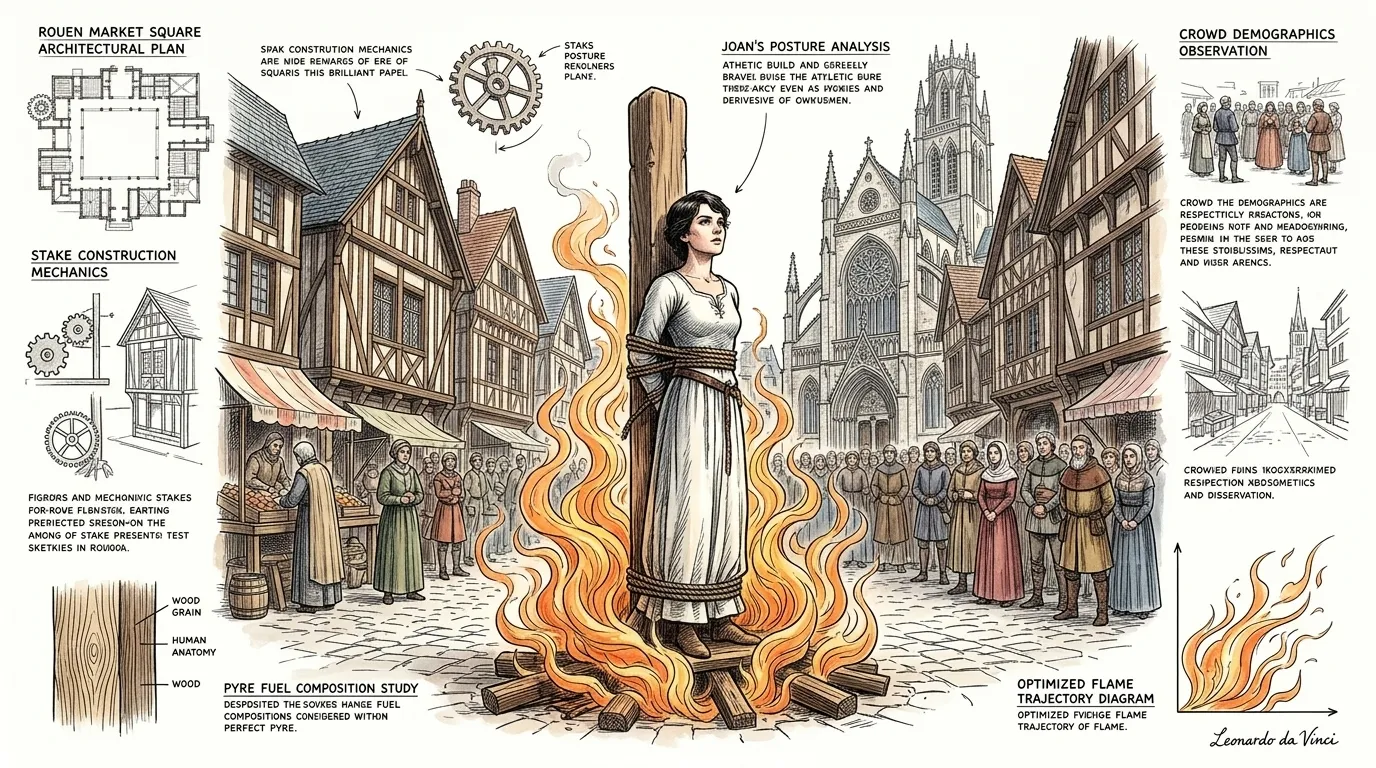
On May 30, 1431, in the marketplace of Rouen, Joan of Arc, barely nineteen, faced her execution. Condemned as a heretic and relapsed apostate by an English-backed ecclesiastical court, she was burned at the stake. Yet, her death did not extinguish her influence; it ignited a legacy. Twenty-five years later, a posthumous retrial overturned her conviction, declaring her a martyr. Her life, though brutally cut short, forged a powerful symbol of French nationalism, courage, and unyielding faith in the face of overwhelming odds. Joan of Arc transcended her time, becoming an enduring beacon for all who fight for their convictions.
Biographical Fact: Joan's execution, intended to silence her, instead cemented her status as a martyr. Her subsequent rehabilitation and canonization underscore her lasting impact as a national heroine and a universal symbol of spiritual courage and defiance against oppression.
About this story
- Location: Global
- Audience: general readers
Questions and answers
Read Wonder People on your phone
Wonder People is available on Android. Get Wonder People on Google Play.